New Semester
Started
Get
50% OFF
Study Help!
--h --m --s
Claim Now
Question Answers
Textbooks
Find textbooks, questions and answers
Oops, something went wrong!
Change your search query and then try again
S
Books
FREE
Study Help
Expert Questions
Accounting
General Management
Mathematics
Finance
Organizational Behaviour
Law
Physics
Operating System
Management Leadership
Sociology
Programming
Marketing
Database
Computer Network
Economics
Textbooks Solutions
Accounting
Managerial Accounting
Management Leadership
Cost Accounting
Statistics
Business Law
Corporate Finance
Finance
Economics
Auditing
Tutors
Online Tutors
Find a Tutor
Hire a Tutor
Become a Tutor
AI Tutor
AI Study Planner
NEW
Sell Books
Search
Search
Sign In
Register
study help
sciences
modern physics
Symmetry Broken Symmetry And Topology In Modern Physics A First Course 1st Edition Mike Guidry, Yang Sun - Solutions
Use the methods to construct a proton flavor-spin wavefunction that is symmetric with respect to flavor-spin exchange.
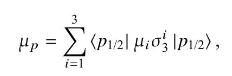
If we assume a non-relativistic model, the magnetic moment of a point quark is given by \(\mu_{i}=q_{i} / 2 m_{i}\), where \(q_{i}\) is the charge and \(m_{i}\) the effective mass of quark \(i\). Assume the magnetic moment of the proton to be given by the sum over valence quark contributionswhere
Construct a quark wavefunction for the neutron and proton, and use the results of Problem 9.8 to show that for the ratio of magnetic moments for protons and neutrons, \(\mu_{p} / \mu_{n}=-\frac{3}{2}\), if we approximate \(m_{u}=m_{d}\).Data from Problem 9.8If we assume a non-relativistic model,
Use Young diagrams to obtain the SU(6) Clebsch-Gordan series \(\mathbf{6} \otimes \mathbf{6} \otimes \mathbf{6}=\mathbf{5 6} \oplus\) \(\mathbf{7 0} \oplus \mathbf{7 0} \oplus \mathbf{2 0}\) of Eq. (9.5) that is relevant for baryons, and the Clebsch-Gordan series \(\mathbf{6} \otimes \mathbf{6}
Show that the if space, spin, and flavor are assumed to be the operative degrees of freedom for particles in the baryonic \(\mathbf{1 0}\) of Fig. 9.1 (d), the ground states for the spin- \(\frac{3}{2}\) baryons are in conflict with the Pauli principle (which requires a fermionic wavefunction to be
Show that the set of permutations on \(n\) objects forms a group with a multiplication operation defined as the application of two successive permutation operations.
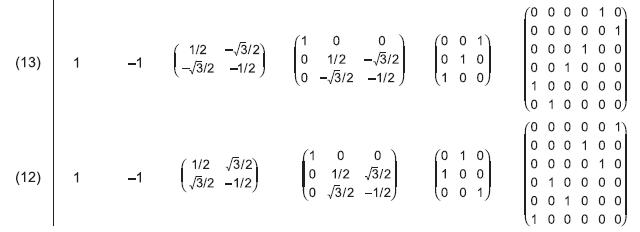
Verify that the mapping \(\{e,(123),(321)\} \rightarrow 1\) and \(\{(12),(23),(31)\} \rightarrow-1\) preserves the group multiplication operation for the permutation group \(\mathrm{S}_{3}\).
Sketch the Young tableaux for the permutation group \(\mathrm{S}_{5}\) and find their dimensionalities using the hook rule.
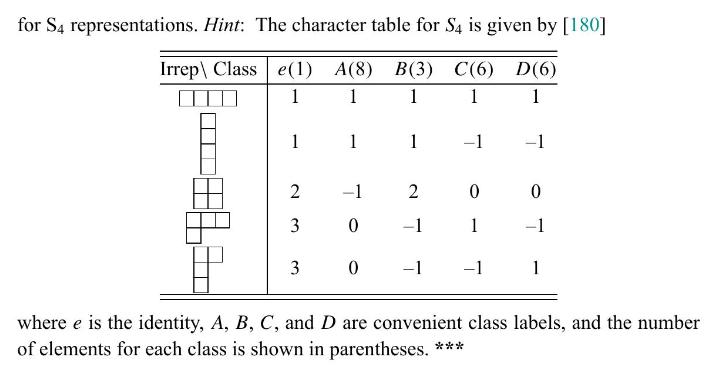
Use counting of Young tableaux to find the dimensionalities of the irreps for the group S4.
For the irreps \(\Gamma^{(1)}, \Gamma^{(2)}\), and \(\Gamma^{(3)}\) of the group \(\mathrm{S}_{3}\), determine the irrep content of the nine direct products \(\Gamma^{(n)} \otimes \Gamma^{(m)}\).
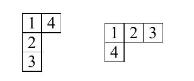
Write the Young operators for the \(\mathrm{S}_{4}\) tableauxand construct explicit wavefunctions having these permutational symmetries. 14 2 N 123 4 3
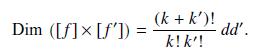
Construct the outer product [4] \(\times\) [3] for the partitions [4] of \(S_{4}\) and [3] of \(S_{3}\). Check the dimensionalities using Eq. (4.9).Data from Eq. (4.9) Dim ([f]x[f']) = (k + k')! == dd'. k! k'!
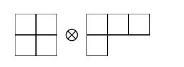
Determine the irrep content of
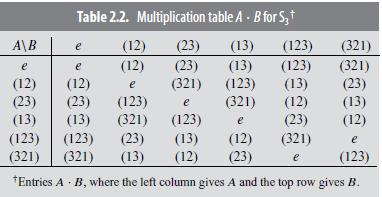
Prove that for a group the inverse of each group element and the identity are unique. Prove that the inverse of the product of two group elements is given by \((a \cdot b)^{-1}=\) \(b^{-1} a^{-1}\). Check this against the product \(a \cdot b=(12) \cdot(23)\) from Table 2.2 .Data from Table 2.2
Write out the multiplication table for all possible products of elements in the group \(S_{3}\) (permutations on three objects). Use this to demonstrate explicitly that \(S_{3}\) is a group, that it is non-abelian, and that it has two proper subgroups: the group \(\mathrm{S}_{2}\) of permutations
If the operator \(c_{4}\) rotates a system by \(\frac{\pi}{2}\) about a specified axis, demonstrate that the operator set \(\mathrm{C}_{4}=\left\{e, c_{4}, c_{4}^{2}, c_{4}^{3}\right\}\) constitutes an abelian group with the group multiplication defined by application of two successive rotations.
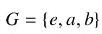
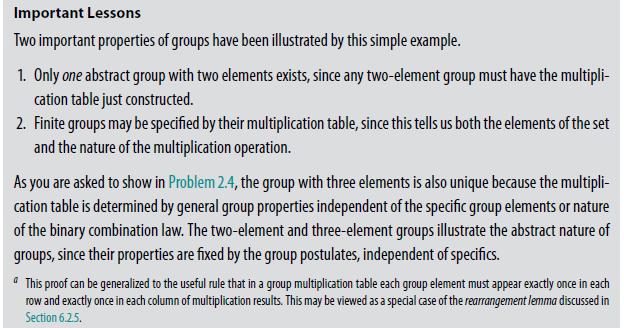
Show that the groupwith \(e\) the identity has one possible multiplication table; thus there is only one finite group of order three. G = {e, a, b}
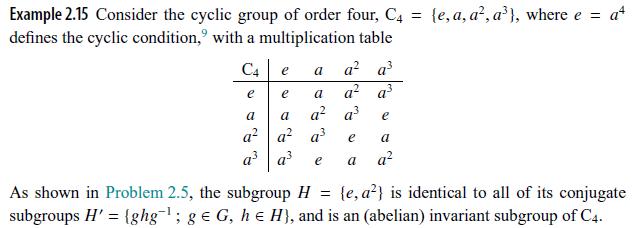
Demonstrate that for the cyclic group \(\mathrm{C}_{4}\) with multiplication table given in Example 2.15 , the subgroup \(H=\left\{e, a^{2}\right\}\) is an abelian invariant subgroup.Data from Example 2.15 Example 2.15 Consider the cyclic group of order four, C4 = {e, a, a, a), where e = a+
Prove that \(\{e,(123),(321)\}\) is an invariant subgroup of \(\mathrm{S}_{3}\) but \(\{e,(12)\}\) is not.
Show that the cyclic group \(\mathrm{C}_{4}\) is neither simple nor semisimple.
Prove that if a,b and \(c\) are elements of a group and class conjugation is indicated by \(\sim\), then (1) \(a \sim a\), (2) if \(a \sim b\), then \(b \sim a\), and (3) if \(a \sim b\) and \(b \sim c\), then \(a \sim c\). Thus conjugacy is an equivalence relation.
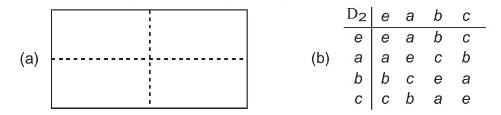
Show that the group {e, a, b, c} with multiplication table (b) below, is in one to one correspondence with the geometrical symmetry operations on figure (a) belowThis is called the 4-group or dihedral group \(\mathrm{D}_{2}\). Show that \(\mathrm{D}_{2}\) has three subgroups, \(\{e, a\},\{e,
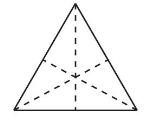
Demonstrate that the identity, reflections about the three symmetry axes (dashed lines), and rotations by \(\frac{2 \pi}{3}\) and \(\frac{4 \pi}{3}\) about the center of the equilateral triangleform a group of order six (the dihedral group, \(\mathrm{D}_{3}\) ) that is isomorphic to the permutation
Show that the quotient group of the 4-group \(\mathrm{D}_{2}\) defined in Problem 2.9 is \(\mathrm{C}_{2}\).
Prove that the angular momentum operator \(L_{z}\) generates rotations around the \(z\)-axis.
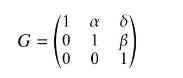
Show that for real numbers \(\alpha, \beta\), and \(\delta\) the matricesform a group under matrix multiplication. Show that the matrices \(G\) with \(\alpha=\beta=0\) form an invariant subgroup of \(G\). G = 01 0 0 B
Prove that the direct product of two representations is a representation, and that the character of the direct product is the product of characters for the representations.
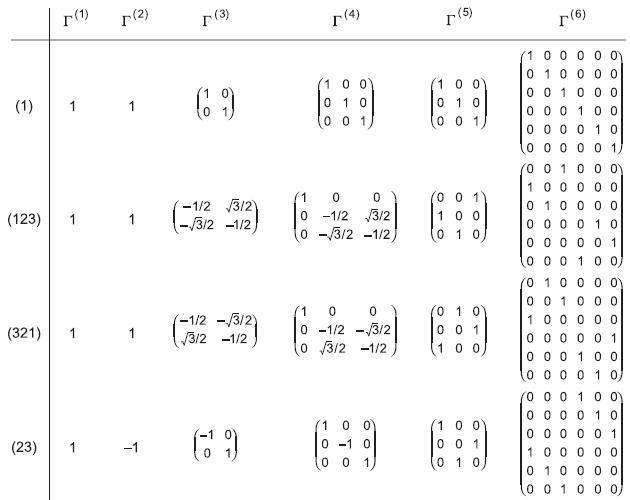
Determine the irrep content for the equivalent reducible \(S_{3}\) representations \(\Gamma^{(4)}\) and \(\Gamma^{(5)}\) of Fig. 2.4 .Data from Fig. 2.4 F(1) (2) 1 (3) (4) r(5) (6) 1 0 0 0 0 0 0 1 0 0 0 0 1 0 0 100 (1) 1 1 ( 9 0 0 1 0 0 0 0 1 0 0 1 0 0 0 0 1 0 0 001 0 0 1 0 0 0 0 1 0 0 0 0 0 0 1
Demonstrate explicitly that for invariant subgroups the cosets form a group under the coset multiplication law (2.27).
Prove that for a finite group \(G\) with an invariant subgroup \(G \supset H\) and \(g_{i} \in G\), two cosets \(g_{i} H\) and \(g_{j} H\) have no elements in common if \(i eq j\).
Use cosets to show that a finite group with an order that is a prime number can have no proper subgroups. Show that a finite group with order equal to a prime number is isomorphic to a cyclic group. Hint: Show that the group has a cyclic subgroup.
Show that the set of matrices \(\{a, b, c, d\}\) given bycloses under multiplication and is a representation of the group \(\mathrm{D}_{2}\) in Problem 2.9 .Data from Problem 2.9Show that the group {e, a, b, c\} with multiplication table (b) below, is in one to one correspondence with the
Show that the set of functions \(\left\{f_{1}(x)=x, f_{2}(x)=-x, f_{3}(x)=x^{-1}, f_{4}(x)=-x^{-1}\right\}\) forms a group under the binary operation of substitution of one function into another. Show that the group is isomorphic to the matrix group of Problem 2.19 .Data from Problem 2.19Show
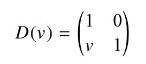
The real numbers form a group under the binary operation of arithmetic addition. Show that for real numbers \(v\) the matricesform a 2D representation of this additive group of real numbers. Show that transformation by this matrix corresponds to the Galilean transformations of classical physics,
Show that for a matrix representation \(D(x)\) satisfying Eq. (2.8), a new set of matrices formed by performing the same similarity transform \(S^{-1} D(x) S\) for a fixed matrix \(S\) on all matrices \(D(x)\) is also a representation.Data from Eq. (2.8) T(G)(r)=(G'r).
Consider a cartesian \((x y z)\) coordinate system and define the following operations: \(R=\) rotation by \(\pi\) in the \(x-y\) plane, \(E=\) do nothing, \(I=\) inversion of all three axes, and \(\sigma=\) reflection in the \(x-y\) plane. Show that these operations form a group under the product
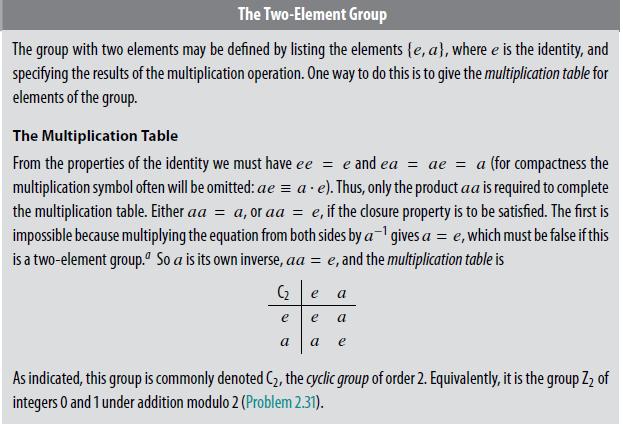
Verify that the mapping \(e \rightarrow 1\) and \(a \rightarrow-1\) gives a representation of the cyclic group \(\mathrm{C}_{2}\) described in Box 2.2 that preserves the group multiplication, as does the trivial mapping \(e \rightarrow 1\) and \(a \rightarrow 1\). Show that these two
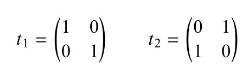
Show that the matricesconstitute a representation of the group \(\mathrm{C}_{2}\) described in Box 2.2 . Diagonalize this set of matrices and show that the 2D representation \(\left(t_{1}, t_{2}\right)\) is reducible to a direct sum of \(\mathrm{C}_{2}\) irreps.Data from Box 2.2 1 11 = (69) 12
Prove the trigonometric identitiesby the following group-theoretical means.1. Show that the complex numbers of unit modulus \(c=x+i y\) with \(|x|^{2}+|y|^{2}=1\) form a group under multiplication, and that \(e^{i \phi}\) with \(-\pi \leq \phi \leq \pi\) is a faithful representation: \(\cos \phi+i
(a) Divide the integers up into four equivalence classes,Show that {e, a, b, c} form a group \(\left(\mathrm{Z}_{4}\right)\), under addition modulo 4 by constructing the multiplication table. Hint: Recall that in addition modulo \(N\) two integers are added normally and then an integer multiple of
Show that the multiplication table for the 4-group {I, a, b, c\} given in Problem 2.9 follows from the algebraic requirements \(a^{2}=b^{2}=I\) and \(a b=b a=c\).Data from Problem 2.9Show that the group {e, a, b, c\} with multiplication table (b) below, is in one to one correspondence with the
For finite groups each group element \(a\) must give the identity \(e\) when raised to some finite power: \(a^{p}=e\). The integer \(p\) is called the order of the element \(a\). Show that two elements in the same conjugacy class have the same order \(p\).
Prove that the group identity \(e\) is always in a conjugacy class of its own, and that no group element can be in two different conjugacy classes.
Show that the group \(Z_{2}\) of integers under addition modulo 2 is isomorphic to the cyclic group \(\mathrm{C}_{2}\) described in Box 2.2 . Show that the set \(\{1,-1\}\) is isomorphic to \(\mathrm{C}_{2}\) under arithmetic multiplication.Data from Box 2.2 The Two-Element Group The group with
Show that for a direct product group \(G=A \times B\), the groups \(A\) and \(B\) are invariant subgroups of G .
Verify that the representation \(T\) given by Eq. (2.9) obeys \(T\left(G_{i}\right) T\left(G_{j}\right)=T\left(G_{i} G_{j}\right)\), so it preserves the group multiplication law for \(G\) and is a valid representation.Data from Eq. (2.9) T(G)(r) (Gr). =
Use the highest-weight algorithm to show that \(\mathbf{2} \otimes \mathbf{2} \otimes \mathbf{2}=\mathbf{4} \oplus \mathbf{2} \oplus \mathbf{2}\), for the product of three fundamental \(\mathrm{SU}(2)\) representations.
Suppose that \(D^{(\alpha)}\) and \(D^{(\beta)}\) are irreps of a compact simple group with dimensions \(n_{\alpha}\) and \(n_{\beta}\), respectively, and basis vectors \(x_{i}\) and \(y_{i}\), respectively. If the basis vectors \(\boldsymbol{x}=\left(x_{1}, x_{2}, \ldots\right)\) and
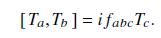
By expanding the group elements written in the canonical exponential form about the origin, derive the Lie algebra \(\left[X_{a}, X_{b}\right]=i f_{a b c} X_{c}\). A commutator can be defined by taking the difference between the product of two group elements and the product in reverse order.
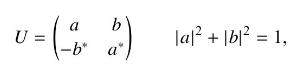
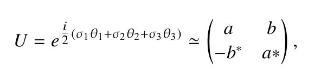
Show that the most general form for \(2 \times 2\) unitary matrices of unit determinant iswhere \(a\) and \(b\) are complex numbers. U = a |a|2 + |b| = 1, -b a
Prove that if matrices \(T_{a}\) with matrix elements \(\left(T_{a}\right)_{b c}\) proportional to the structure constants \(f_{a b c}\) are defined as in Eq. (3.8), these matrices satisfy the Lie algebra (3.9). Thus, show that the structure constants generate a representation of the algebra with
Use that the adjoint representation for \(\mathrm{SU}(2)\) is three-dimensional and that generators of the adjoint representation are the structure constants of the group to construct a 3D matrix representation of SU(2). Verify explicitly that the resulting matrices satisfy the \(\mathrm{SU}(2)\)
Prove Schur's lemma: a matrix that commutes with all generators of an irrep is a multiple of the unit matrix. Hint: Assume that \(\left[T_{a}, M\right]=0\) for all \(a\), where \(T_{a}\) is a group generator and \(M\) is some matrix. Show that there is a contradiction unless every member of the
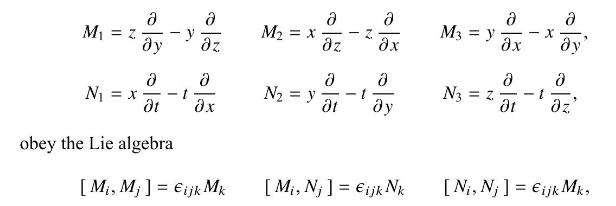
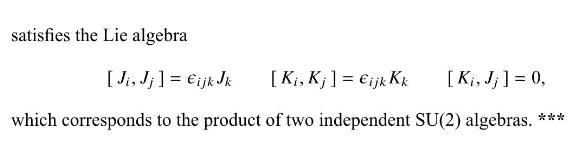
Show that for a four-dimensional cartesian space \((x, y, z, t)\) the operatorswhich is the algebra associated with the group \(\mathrm{SO}(4)\). Show that this \(\mathrm{SO}(4)\) is locally isomorphic to \(\mathrm{SU}(2) \times \mathrm{SU}(2)\) by showing that the new operator set, M = z a a a y
Show that the structure constants \(f_{a b c}\) appearing in Eq. (3.3) are real if the generators of the Lie algebra are hermitian.Data from Eq. (3.3) [Xa, Xb]=ifabe Xc = [A, B] AB BA,
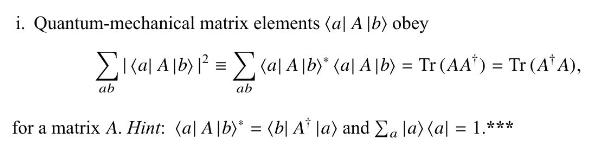
Matrices are central to representation theory. If \(A, B, C\), and \(D\) are square, invertible, \(n \times n\) matrices with complex entries, prove the following useful properties.a. The trace of a matrix is invariant under similarity transforms, \(\operatorname{Tr}\left(B A
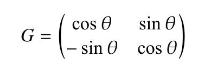
Show that for a continuous parameter \(\theta\) the set of matricesforms a one-parameter abelian Lie group under matrix multiplication, and that if the matrices \(G\) operate on a 2D cartesian space \(\left(x_{1}, x_{2}\right)\) they leave \(x_{1}^{2}+x_{2}^{2}\) invariant. cos e G = sin 0 sin 0
Show that the Pauli matrices generate a matrix representation of Lie group elements having the formas required by Problem 3.4 .Data from Problem 3.4Show that the most general form for \(2 \times 2\) unitary matrices of unit determinant iswhere \(a\) and \(b\) are complex numbers. U =
Prove that if the Lie group \(G_{1}\), with generators \(J_{i}(1)\), is isomorphic to a group \(G_{2}\), with generators \(J_{i}(2)\), and \(J_{i}(1)\) and \(J_{i}(2)\) operate on independent degrees of freedom, then the sum operators \(J_{i} \equiv J_{i}(1)+J_{i}(2)\) obey the same Lie algebra as
Show that the group-element commutator \(R_{y}(\delta \theta) R_{x}(\delta \theta) R_{y}^{-1}(\delta \theta) R_{x}^{-1}(\delta \theta)\), is related to the generator commutator \(\left[J_{x}, J_{y}\right]\) bywhere the group elements and generators are related by \(R_{x}(\theta)=\exp \left(i J_{x}
(a) Confirm the validity of the Jacobi identity given in Eq. (3.6). (b) Use Eq. (3.6) to confirm the validity of Eq. (3.7b).Data from Eq. (3.6)Data from Eq. (3.7b) [[A, B], C]+[[B, C], A] + [[C, A], B] = 0,
If a local density operator is expressed by \(ho(r)=\sum_{i} \delta\left(r-r_{i}\right)\), where the sum is over particles and \(\delta\left(r-r_{i}\right)\) is the Dirac delta function, what is its second-quantized form?
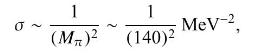
In \(\hbar=c=1\) natural units a particular hadronic cross section \(\sigma\) is estimated to bewhere the mass of the pion is \(M_{\pi} \sim 140 \mathrm{MeV}\). What is this cross section in more standard units of barns (b), where \(1 \mathrm{~b} \equiv 10^{-24} \mathrm{~cm}^{2}\) ? 1 1 MeV-2 (MR)
In special relativity it is common to use units where the speed of light \(c\) is set to one. The world record in the 100 meter dash is about 9.6 seconds. What is this time expressed in \(c=1\) units? What is the physical meaning of your result?
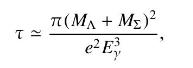
In natural \((\hbar=c=1)\) units the mean life for the decay \(\Sigma^{0} \rightarrow \Lambda+\gamma\), where \(\Sigma^{0}\) and \(\Lambda\) are elementary particles and \(\gamma\) is a photon, iswhere \(M_{\Sigma}\) and \(M_{\Lambda}\) are the masses of the elementary particles, \(E_{\gamma}\) is
What is one Joule in \(c=1\) units? What is one atmosphere \(\left(10^{5} \mathrm{~N} \mathrm{~m}^{-2}\right)\) of pressure expressed in \(c=1\) units?
Using the commutators for \(J_{i}\) and \(K_{i}\) given in Problem 3.8 , argue that the \(\mathrm{SO}(4)\) Lie algebra is semisimple, but not simple. Argue that \(\mathrm{SO}(4)\) can be written as a direct product of two simple groups, which can be analyzed independently.Data from Problem
Showing 200 - 300
of 267
1
2
3
Step by Step Answers

 Get 50% OFF
Claim Now
Get 50% OFF
Claim Now