New Semester
Started
Get
50% OFF
Study Help!
--h --m --s
Claim Now
Question Answers
Textbooks
Find textbooks, questions and answers
Oops, something went wrong!
Change your search query and then try again
S
Books
FREE
Study Help
Expert Questions
Accounting
General Management
Mathematics
Finance
Organizational Behaviour
Law
Physics
Operating System
Management Leadership
Sociology
Programming
Marketing
Database
Computer Network
Economics
Textbooks Solutions
Accounting
Managerial Accounting
Management Leadership
Cost Accounting
Statistics
Business Law
Corporate Finance
Finance
Economics
Auditing
Tutors
Online Tutors
Find a Tutor
Hire a Tutor
Become a Tutor
AI Tutor
AI Study Planner
NEW
Sell Books
Search
Search
Sign In
Register
study help
sciences
nature of mathematics
Nature Of Mathematics 13th Edition Karl J. Smith - Solutions
A freely falling body experiencing no air resistance falls \(s(t)=16 t^{2}\) feet in \(t\) seconds. Express the body's velocity at time \(t=2\) as a limit. Evaluate this limit.
Find the limit (if it exists) as \(n ightarrow \infty\) for each of the sequences in Problems 43-56.\(5,5 \frac{1}{2}, 5 \frac{2}{3}, 5 \frac{3}{4}, 5 \frac{4}{5}, \cdots\)
Consider the graph of \(y=x^{2}\) bounded by the \(x\)-axis and the line \(x=2\). Approximate the area under the curve by using rectangles and right endpoints as described in Problems 47-52.Use four rectangles of width 0.5 unit each.
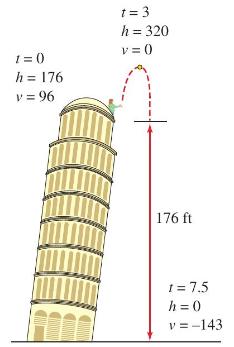
If you toss a ball from the top of the Tower of Pisa directly upward with an initial speed of \(96 \mathrm{ft} / \mathrm{s}\), the height \(h\) at time \(t\) is given by\[h(t)=-16 t^{2}+96 t+176\]Figure 18.22 shows \(h\) and the velocity, \(v\), at various times, \(t\).a. What is the height of the
Prepare a personal budget.
Find the limit (if it exists) as \(n ightarrow \infty\) for each of the sequences in Problems 43-56.\(\lim _{n ightarrow \infty} \frac{3 n^{2}-7 n+2}{5 n^{4}+9 n^{2}}\)
Consider the graph of \(y=x^{2}\) bounded by the \(x\)-axis and the line \(x=2\). Approximate the area under the curve by using rectangles and right endpoints as described in Problems 47-52.Use eight rectangles of width 0.25 unit each.
Suppose the profit, \(P\), measured in thousands of dollars, for a manufacturer is a function of the number of units produced, \(x\), and behaves according to the model\[P(x)=50 x-x^{2}\]Also suppose that the present production is 20 units. What is the per-unit increase in profit if production is
Prepare a budget for a family of two with an annual income of \(\$ 45,000\).
Find the limit (if it exists) as \(n ightarrow \infty\) for each of the sequences in Problems 43-56.\(\lim _{n ightarrow \infty} \frac{4 n^{4}+10 n-1}{9 n^{3}-2 n^{2}-7 n+3}\)
Consider the graph of \(y=x^{2}\) bounded by the \(x\)-axis and the line \(x=2\). Approximate the area under the curve by using rectangles and right endpoints as described in Problems 47-52.Use the results of Problems \(47-49\) to see if you can make a guess about the area under the curve.
Repeat Problem 49 for 20 to 25 units. Profit increases by \(\$ 5,000\).Data from problem 49Suppose the profit, \(P\), measured in thousands of dollars, for a manufacturer is a function of the number of units produced, \(x\), and behaves according to the model\[P(x)=50 x-x^{2}\]Also suppose that the
Prepare a budget for a family of four with an annual income of \(\$ 100,000\).
Find the limit (if it exists) as \(n ightarrow \infty\) for each of the sequences in Problems 43-56.\(\lim _{n ightarrow \infty} \frac{2 n^{4}+5 n^{2}-6}{3 n+8}\)
Consider the graph of \(y=x^{2}\) bounded by the \(x\)-axis and the line \(x=2\). Approximate the area under the curve by using rectangles and right endpoints as described in Problems 47-52.Calculate the sum of the areas of the rectangles for \(x=1\) using eight rectangles.
Repeat Problem 49 for 20 to 21 units. Profit increases by \(\$ 9,000\).Data from problem 49Suppose the profit, \(P\), measured in thousands of dollars, for a manufacturer is a function of the number of units produced, \(x\), and behaves according to the model\[P(x)=50 x-x^{2}\]Also suppose that the
Prepare a budget for a family of four with an annual income of \(\$ 250,000\).
Find the limit (if it exists) as \(n ightarrow \infty\) for each of the sequences in Problems 43-56.\(\lim _{n ightarrow \infty} \frac{10 n^{3}+13}{7 n^{2}-n+2}\)
Consider the graph of \(y=x^{2}\) bounded by the \(x\)-axis and the line \(x=2\). Approximate the area under the curve by using rectangles and right endpoints as described in Problems 47-52.Calculate the sum of the areas of the rectangles for \(x=1\) using sixteen rectangles.
What is the rate of change of profit in Problem 49 at x=20?Data from problem 49Suppose the profit, \(P\), measured in thousands of dollars, for a manufacturer is a function of the number of units produced, \(x\), and behaves according to the model\[P(x)=50 x-x^{2}\]Also suppose that the present
Find the limit (if it exists) as \(n ightarrow \infty\) for each of the sequences in Problems 43-56.\(\lim _{n ightarrow \infty} \frac{15+9 n-6 n^{2}}{2 n^{2}-4 n+1}\)
Repeat Problem 53 for 100 to 110 items.Data from problem 53The cost, \(C\), in dollars, for producing \(x\) items is given by \[C(x)=30 x^{2}-100 x\]Find the average rate of change of cost as \(x\) increases from 100 to 200 items.
Find the limit (if it exists) as \(n ightarrow \infty\) for each of the sequences in Problems 43-56.\(\lim _{n ightarrow \infty} \frac{-21 n^{3}+52}{-7 n^{3}+n^{2}+20 n-9}\)
Find the limit (if it exists) as \(n ightarrow \infty\) for each of the sequences in Problems 43-56.\(\lim _{n ightarrow \infty} \frac{12 n^{5}+7 n^{4}-3 n^{2}+2 n}{n^{5}+8 n^{3}+14}\)
First, sketch the region under the graph on the interval [a, b] in Problems 53–55. Then approximate the area of each region for the given value of n. Use the right endpoint of each rectangle to determine the height of that particular rectangle.\(y=\frac{1}{x^{2}}\) on \([1,2]\) for \(n=4 \)
Repeat Problem 53 for 100 to \((100+h)\) items.Data from problem 53The cost, \(C\), in dollars, for producing \(x\) items is given by \[C(x)=30 x^{2}-100 x\]Find the average rate of change of cost as \(x\) increases from 100 to 200 items.
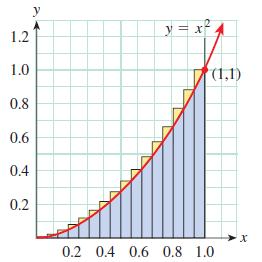
Approximate the sum of the areas of the rectangles shown in Figure (18.8 b). That is, using\[A_{1}+A_{2}+\cdots+A_{15}+A_{16}\]Figure (18.8 b) 1.2 1.0 0.8 0.6 0.4 0.2 y y=x (1,1) 0.2 0.4 0.6 0.8 1.0 X
Twenty-four milligrams of a drug is administered into the body. At the end of each hour, the amount of drug present is half what it was at the end of the previous hour. What amount of the drug is present at the end of 5 hours? At the end of \(n\) hours?
A culture is growing at an hourly rate of\[R^{\prime}(t)=200 e^{0.5 t}\]for \(0 \leq t \leq 10\). Find the area between the graph of this equation and the \(t\)-axis. What do you think this area represents?
Suppose the number (in millions) of bacteria present in a culture at time \(t\) is given by the formula\[N(t)=2 t^{2}-200 t+1,000\]Use this formula in Problems 57-60.How many bacteria (in millions) are in the given culture at time \(t=3\) ? How many are there initially?
In Problems 58-60, further assume that young rabbits become adults after two months and produce another pair of offspring at that time. A rabbit breeder begins with one adult pair. Let \(a_{n}\) denote the number of adult pairs of rabbits in this "colony" at the end of \(n\) months.Explain why
The population of New Haven, Connecticut, is growing at the rate of \(450+600 \sqrt{t}\), where \(t\) is measured in years, and the present population is 123,700 . Predict the population (rounded to the nearest hundred) in 5 years.
Suppose the number (in millions) of bacteria present in a culture at time \(t\) is given by the formula\[N(t)=2 t^{2}-200 t+1,000\]Use this formula in Problems 57-60.Derive a formula for the instantaneous rate of change of the number of bacteria with respect to time.
In Problems 58-60, further assume that young rabbits become adults after two months and produce another pair of offspring at that time. A rabbit breeder begins with one adult pair. Let \(a_{n}\) denote the number of adult pairs of rabbits in this "colony" at the end of \(n\) months.The growth rate
Suppose the accumulated cost of a piece of equipment is \(C(t)\) and the accumulated revenue is \(R(t)\), where both of these are measured in thousands of dollars and \(t\) is the number of years since the piece of equipment was installed. If it is known that\[C^{\prime}(t)=18 \quad \text { and }
Suppose the number (in millions) of bacteria present in a culture at time \(t\) is given by the formula\[N(t)=2 t^{2}-200 t+1,000\]Use this formula in Problems 57-60.Find the instantaneous rate of change of the number of bacteria with respect to time at time t=3 .
In Problems 58-60, further assume that young rabbits become adults after two months and produce another pair of offspring at that time. A rabbit breeder begins with one adult pair. Let \(a_{n}\) denote the number of adult pairs of rabbits in this "colony" at the end of \(n\) months.Assume that the
Suppose the number (in millions) of bacteria present in a culture at time \(t\) is given by the formula\[N(t)=2 t^{2}-200 t+1,000\]Use this formula in Problems 57-60.Find the instantaneous rate of change of the number of bacteria with respect to time at the beginning of this experiment.
The total accumulated cost and revenue (in millions of dollars) for a piece of business machinery is\[C^{\prime}(t)=\frac{t}{20} \quad \text { and } \quad R^{\prime}(t)=-e^{(-t)}\]where \(t\) is the time in years. Find the cost and revenue functions if the initial cost is \(\$ 0.25\) and the
How many ounces of a base metal (no silver) must be alloyed with 100 ounces of \(21 \%\) silver alloy to obtain an alloy that is \(15 \%\) silver?
Graph the solution of each system given in Problems 21-34.\(\left\{\begin{array}{l}8 x+3 y \leq-15 \\ y-4 \geq-\frac{8}{3}(x+2) \\ -10 \leq y \leq 6\end{array}ight.\)
Use Adams' plan in Problems 8-10. Show that it violates the quota rule. State: A 160 Population: Number of seats: 100 B 347 C 685 D 95
Modified quotas are given in Problems 7-14. Round your answers to two decimal places.a. Find the lower and upper quotas.b. Find the arithmetic mean of the lower and upper quotas.c. Find the geometric mean of the lower and upper quotas.d. Round the given modified quota by comparing it first with the
What is insincere voting?
Consider a vote for four candidates with the following results:Use this information for Problems 9-11. If there is a tie, break the tie by having a runoff of the tied candidates.Who wins by the Hare method? (ADBC) 7 (CABD) 5 (BCDA) 4 (DBAC) 1
Give one example in which you have participated in voting where the count was tabulated by the Hare voting method. Your example can be made up or factual, but you should be specific.
Use Adams' plan in Problems 8-10. Show that it violates the quota rule. State: A 871 Population: Number of seats: 225 B 2,129 C 610 D 190
Modified quotas are given in Problems 7-14. Round your answers to two decimal places.a. Find the lower and upper quotas.b. Find the arithmetic mean of the lower and upper quotas.c. Find the geometric mean of the lower and upper quotas.d. Round the given modified quota by comparing it first with the
Why is Arrow's impossibility theorem important?
Consider a vote for four candidates with the following results:Use this information for Problems 9-11. If there is a tie, break the tie by having a runoff of the tied candidates.Who wins by the pairwise comparison method? (ADBC) 7 (CABD) 5 (BCDA) 4 (DBAC) 1
Give one example in which you have participated in voting where the count was tabulated by using the tournament method. Your example can be made up or factual, but you should be specific.
Use Adams' plan in Problems 8-10. Show that it violates the quota rule. State: A 1.646 Population: Number of seats: 250 B C 2,091 154 D 6,937 E 685 F 988
Modified quotas are given in Problems 7-14. Round your answers to two decimal places.a. Find the lower and upper quotas.b. Find the arithmetic mean of the lower and upper quotas.c. Find the geometric mean of the lower and upper quotas.d. Round the given modified quota by comparing it first with the
Consider a vote for four candidates with the following results:Use this information for Problems 9-11. If there is a tie, break the tie by having a runoff of the tied candidates.If B pulls out before the election, who wins? Does this violate the irrelevant alternatives criterion? (ADBC) 7 (CABD) 5
Give one example in which you have participated in voting where the count was tabulated by the approval voting method. Your example can be made up or factual, but you should be specific.
Modified quotas are given in Problems 7-14. Round your answers to two decimal places.a. Find the lower and upper quotas.b. Find the arithmetic mean of the lower and upper quotas.c. Find the geometric mean of the lower and upper quotas.d. Round the given modified quota by comparing it first with the
Use Jefferson's plan in Problems 11-14. Show that it violates the quota rule. State: A Population: 68,500 Number of seats: 100 B 34,700 C 14,800 D 9,500
The South Davis Faculty Association is using the Hare method to vote for its collective bargaining representative. Members' choices are the All Faculty Association (A), American Federation of Teachers (B), and California Teachers Association (C). Here are the results of the voting:a. Which
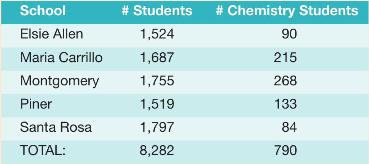
Chemistry is taught at five high schools in the Santa Rosa Unified School District. The district has just received a grant of 100 microscopes which are to be apportioned to the five high schools based on each school's chemistry population. Use the data in Table 17.11 for Problems 12-19.Find the
Use this information to answer the questions in Problems 12-17.What is the total number of votes? In voting among three candidates, the outcomes are reported as: (BAC) (CAB) (CBA) 3 2 5 (ABC) 8 (ACB) 4 (BCA) 0
Use Jefferson's plan in Problems 11-14. Show that it violates the quota rule. State: A Population: 17,179 Number of seats: 132 B 7,500 49,400 D 5,824
Modified quotas are given in Problems 7-14. Round your answers to two decimal places.a. Find the lower and upper quotas.b. Find the arithmetic mean of the lower and upper quotas.c. Find the geometric mean of the lower and upper quotas.d. Round the given modified quota by comparing it first with the
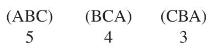
An election with three candidates has the following rankings:a. Is there a majority? If not, who wins the plurality vote?b. Who wins using the Borda count method?c. Does the Borda method violate the majority criterion? (ABC) 5 (BCA) 4 (CBA) 3
Chemistry is taught at five high schools in the Santa Rosa Unified School District. The district has just received a grant of 100 microscopes which are to be apportioned to the five high schools based on each school's chemistry population. Use the data in Table 17.11 for Problems 12-19.What are the
Use this information to answer the questions in Problems 12-17.How many votes would be necessary for a majority? In voting among three candidates, the outcomes are reported as: (BAC) (CAB) (CBA) 3 2 5 (ABC) 8 (ACB) 4 (BCA) 0
Modified quotas are given in Problems 7-14. Round your answers to two decimal places.a. Find the lower and upper quotas.b. Find the arithmetic mean of the lower and upper quotas.c. Find the geometric mean of the lower and upper quotas.d. Round the given modified quota by comparing it first with the
Use Jefferson's plan in Problems 11-14. Show that it violates the quota rule. State: A Population: 1,100 Number of seats: 200 B 1,100 C 1,515 D 4,590 E 2,010
Chemistry is taught at five high schools in the Santa Rosa Unified School District. The district has just received a grant of 100 microscopes which are to be apportioned to the five high schools based on each school's chemistry population. Use the data in Table 17.11 for Problems 12-19.Apportion
Use this information to answer the questions in Problems 12-17.a. What does the notation (CAB) mean?b. What does the " 5 " under (CBA) mean? In voting among three candidates, the outcomes are reported as: (BAC) (CAB) (CBA) 3 2 5 (ABC) 8 (ACB) 4 (BCA) 0
Use Jefferson's plan in Problems 11-14. Show that it violates the quota rule. State: Population: A 1,700 Number of seats: 150 B 3,300 7,000 D 24,190 E 8,810
Modified quotas are given in Problems 7-14. Round your answers to two decimal places.a. Find the lower and upper quotas.b. Find the arithmetic mean of the lower and upper quotas.c. Find the geometric mean of the lower and upper quotas.d. Round the given modified quota by comparing it first with the
In Problems 15-18, use Hamilton's plan to apportion the new seats to the existing states. Then increase the number of seats by one and decide whether the Ala bama paradox occurs. Assume that the populations are in thousands. State: Population: Number of seats: 246 A 181 B 246 C 812 D 1,485
The South Davis Faculty Association is using the Borda count method to vote for its collective bargaining unit. Members' choices are the All Faculty Association (A), American Federation of Teachers (B), and California Teachers Association (C). Here are the results of the voting:a. Is there a
Chemistry is taught at five high schools in the Santa Rosa Unified School District. The district has just received a grant of 100 microscopes which are to be apportioned to the five high schools based on each school's chemistry population. Use the data in Table 17.11 for Problems 12-19.Apportion
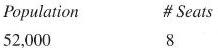
Find the standard divisor (to two decimal places) for the given populations and number of representative seats in Problems 15-22. Population 52,000 # Seats 8 00
Use this information to answer the questions in Problems 12-17.a. What does the notation \((\mathrm{ACB})\) mean?b. What does the " 4 " under (ACB) mean? In voting among three candidates, the outcomes are reported as: (BAC) (CAB) (CBA) 3 2 5 (ABC) 8 (ACB) 4 (BCA) 0
Consider the following voting situation:Notice that there is no winner using the majority or plurality rules.a. Who would win in a runoff election by dropping the choice with the fewest first-place votes?b. Who would win if B withdraws before the election?c. Does this violate any of the fairness
Chemistry is taught at five high schools in the Santa Rosa Unified School District. The district has just received a grant of 100 microscopes which are to be apportioned to the five high schools based on each school's chemistry population. Use the data in Table 17.11 for Problems 12-19.Apportion
Use this information to answer the questions in Problems 12-17.a. If a person ranks \(A\) as her first choice, \(B\) as her second choice, and \(C\) last, how would this be written?b. How many voters have this preference? In voting among three candidates, the outcomes are reported as: (BAC) (CAB)
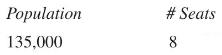
Find the standard divisor (to two decimal places) for the given populations and number of representative seats in Problems 15-22. Population 135,000 # Seats 8
In Problems 15-18, use Hamilton's plan to apportion the new seats to the existing states. Then increase the number of seats by one and decide whether the Ala bama paradox occurs. Assume that the populations are in thousands. State: A 235 Population: Number of seats: 45 B 318 564 D 938
Consider the following voting situation:Notice that there is no winner using the majority or plurality rules.a. Who would win in a runoff election by dropping the choice of the fewest first-place votes?b. Who would win if \(\mathrm{C}\) withdraws before the election?c. Does this violate any of the
Chemistry is taught at five high schools in the Santa Rosa Unified School District. The district has just received a grant of 100 microscopes which are to be apportioned to the five high schools based on each school's chemistry population. Use the data in Table 17.11 for Problems 12-19.Apportion
Use this information to answer the questions in Problems 12-17.a. What does the notation (BCA) mean?b. What does the " 0 " under (BCA) mean? In voting among three candidates, the outcomes are reported as: (BAC) (CAB) (CBA) 3 2 5 (ABC) 8 (ACB) 4 (BCA) 0
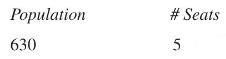
Find the standard divisor (to two decimal places) for the given populations and number of representative seats in Problems 15-22. Population 630 # Seats 5
In Problems 15-18, use Hamilton's plan to apportion the new seats to the existing states. Then increase the number of seats by one and decide whether the Ala bama paradox occurs. Assume that the populations are in thousands. State: A 300 Population: Number of seats: 50 B 301 C 340 D 630 E 505
The philosophy department is selecting a chairperson, and the candidates are Andersen (A), Bailey (B), and Clark (C). Here are the preferences of the 27 department members:a. Who is the Condorcet candidate, if there is one?b. Is there a majority winner? If not, who wins the plurality vote? Does
Chemistry is taught at five high schools in the Santa Rosa Unified School District. The district has just received a grant of 100 microscopes which are to be apportioned to the five high schools based on each school's chemistry population. Use the data in Table 17.11 for Problems 12-19.Apportion
Use this information to answer the questions in Problems 18-23.What is the total number of votes? In voting among four candidates, the outcomes are reported as: (DACB) 5 (ADBC) 8 (BADC) 3 (BDCA) 1 (DCAB) 2
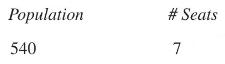
Find the standard divisor (to two decimal places) for the given populations and number of representative seats in Problems 15-22. Population 540 # Seats 7
In Problems 15-18, use Hamilton's plan to apportion the new seats to the existing states. Then increase the number of seats by one and decide whether the Ala bama paradox occurs. Assume that the populations are in thousands. A State: Population: Number of seats: 82 300 B 700 C 800 D 800 E 701
The philosophy department is selecting a chairperson, and the candidates are Andersen (A), Bailey (B), and Clark (C). Here are the preferences of the 27 department members:a. Who is the Condorcet candidate, if there is one?b. Who wins according to the Borda count method? Does this violate the
Chemistry is taught at five high schools in the Santa Rosa Unified School District. The district has just received a grant of 100 microscopes which are to be apportioned to the five high schools based on each school's chemistry population. Use the data in Table 17.11 for Problems 12-19.Can you
Use this information to answer the questions in Problems 18-23.How many votes would be necessary for a majority? In voting among four candidates, the outcomes are reported as: (DACB) 5 (ADBC) 8 (BADC) 3 (BDCA) 1 (DCAB) 2
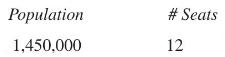
Find the standard divisor (to two decimal places) for the given populations and number of representative seats in Problems 15-22. Population 1,450,000 # Seats 12
In Problems 19-22, apportion the indicated number of representatives to three states, A, B, and C, using Hamilton's plan. Next, use the revised populations to reapportion the representatives. Decide whether the population paradox occurs. A State: Population: 55,200 Revised pop. 61,100 Number of
The Adobe School District is hiring a vice principal and has interviewed four candidates: Andrew (A), Bono (B), Carol (C), and Davy (D). The hiring committee members have indicated their preferences:a. Who is the winner using the plurality method?b. Suppose that Carol drops out of the running
Use this information to answer the questions in Problems 18-23.a. What does the notation (DACB) mean?b. What does the " 5 " under (DACB) mean? In voting among four candidates, the outcomes are reported as: (DACB) 5 (ADBC) 8 (BADC) 3 (BDCA) 1 (DCAB) 2
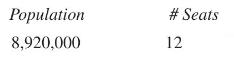
Find the standard divisor (to two decimal places) for the given populations and number of representative seats in Problems 15-22. Population 8,920,000 # Seats 12
In Problems 19-22, apportion the indicated number of representatives to three states, A, B, and C, using Hamilton's plan. Next, use the revised populations to reapportion the representatives. Decide whether the population paradox occurs. A State: Population: 90,000 Revised pop.: 98,000 Number of
Showing 200 - 300
of 6209
1
2
3
4
5
6
7
8
9
10
11
12
13
14
15
Last
Step by Step Answers

 Get 50% OFF
Claim Now
Get 50% OFF
Claim Now