New Semester
Started
Get
50% OFF
Study Help!
--h --m --s
Claim Now
Question Answers
Textbooks
Find textbooks, questions and answers
Oops, something went wrong!
Change your search query and then try again
S
Books
FREE
Study Help
Expert Questions
Accounting
General Management
Mathematics
Finance
Organizational Behaviour
Law
Physics
Operating System
Management Leadership
Sociology
Programming
Marketing
Database
Computer Network
Economics
Textbooks Solutions
Accounting
Managerial Accounting
Management Leadership
Cost Accounting
Statistics
Business Law
Corporate Finance
Finance
Economics
Auditing
Tutors
Online Tutors
Find a Tutor
Hire a Tutor
Become a Tutor
AI Tutor
AI Study Planner
NEW
Sell Books
Search
Search
Sign In
Register
study help
sciences
nature of mathematics
Nature Of Mathematics 13th Edition Karl J. Smith - Solutions
Consider the following apportionment problem:Use the apportionment plan requested in Problems 46-50 assuming that there must be 26 representatives.Adams' plan North: 18,200 South: 12,900 East: 17,600 West: 13,300
The township of Bella Rosa is divided into two districts, uptown (pop. 16,980) and downtown (pop. 3,350) and is governed by 100 council members. Use this information in Problems 48-53.What are the standard quotas?
Use this information to answer the questions in Problems 46-49.The fraternity \(\Sigma \Delta \Gamma\) is electing a national president, and there are four candidates: Alberto (A), Bate (B), Carl (C), and Dave (D). The voter preferences are:Who wins using the Borda count method? Does this violate
Determine the winner, if any, using the voting methods in Problems \(45-50\).Seventeen people serve on a board and are considering three alternatives: A, B, and C. Here are the choices followed by vote:Borda count method (ABC) (ACB) 1 3 (BAC) 4 (BCA) 3 (CAB) 5 (CBA) 1
Consider the following apportionment problem:Use the apportionment plan requested in Problems 46-50 assuming that there must be 26 representatives.Jefferson's plan North: 18,200 South: 12,900 East: 17,600 West: 13,300
Use this information to answer the questions in Problems 46-49.The fraternity \(\Sigma \Delta \Gamma\) is electing a national president, and there are four candidates: Alberto (A), Bate (B), Carl (C), and Dave (D). The voter preferences are:Who wins the election using the Hare method? Does this
Determine the winner, if any, using the voting methods in Problems \(45-50\).Seventeen people serve on a board and are considering three alternatives: A, B, and C. Here are the choices followed by vote:Hare method (ABC) (ACB) 1 3 (BAC) 4 (BCA) 3 (CAB) 5 (CBA) 1
Consider the following apportionment problem:Use the apportionment plan requested in Problems 46-50 assuming that there must be 26 representatives.Hamilton's plan North: 18,200 South: 12,900 East: 17,600 West: 13,300
Use this information to answer the questions in Problems 46-49.The fraternity \(\Sigma \Delta \Gamma\) is electing a national president, and there are four candidates: Alberto (A), Bate (B), Carl (C), and Dave (D). The voter preferences are:Who is the winner by using the pairwise comparison method?
The township of Bella Rosa is divided into two districts, uptown (pop. 16,980) and downtown (pop. 3,350) and is governed by 100 council members. Use this information in Problems 48-53.How should the seats be apportioned using Hamilton's plan?
Determine the winner, if any, using the voting methods in Problems \(45-50\).Seventeen people serve on a board and are considering three alternatives: A, B, and C. Here are the choices followed by vote:Pairwise comparison method (ABC) (ACB) 1 3 (BAC) 4 (BCA) 3 (CAB) 5 (CBA) 1
Consider the following apportionment problem:Use the apportionment plan requested in Problems 46-50 assuming that there must be 26 representatives.Webster's plan North: 18,200 South: 12,900 East: 17,600 West: 13,300
The township of Bella Rosa is divided into two districts, uptown (pop. 16,980) and downtown (pop. 3,350) and is governed by 100 council members. Use this information in Problems 48-53.Suppose the township annexes a third district (pop. 2,500), it was agreed that the new district should add 12 new
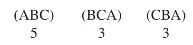
Consider an election with three candidates with the following results:a. Is there a majority winner? If not, who is the plurality winner?b. Who wins using the pairwise comparison method?c. Is the ordering for the choices for candidates in part \(\mathbf{b}\) transitive? (ABC) 5 (BCA) 3 (CBA) 3
Determine the winner, if any, using the voting methods in Problems \(45-50\).Seventeen people serve on a board and are considering three alternatives: A, B, and C. Here are the choices followed by vote:Tournament method (ABC) (ACB) 1 3 (BAC) 4 (BCA) 3 (CAB) 5 (CBA) 1
Consider the following apportionment problem:Use the apportionment plan requested in Problems 46-50 assuming that there must be 26 representatives.HH's plan North: 18,200 South: 12,900 East: 17,600 West: 13,300
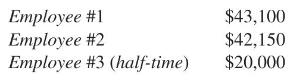
In Problems 54-56, suppose the annual salaries of three people areWhat are their salaries if they are given a 5\% raise, and then the result is rounded to an even \(\$ 1,000\) using Hamilton's plan with a cap on the total salaries of \(\$ 111,000\) ? Employee #1 Employee #2 Employee #3 (half-time)
Consider an election with four candidates with the following results:a. Is there a winner using the pairwise comparison method?b. Is there a winner using the tournament method?c. Do either of these methods violate any conditions of Arrow's impossibility theorem? (ABCD) (ABDC) 10 9 (CDAB) 8 (CDBA) 7
Suppose your college transcripts show the following distribution of grades:A: 2 B: 6 C: 5 D: 1 F: 0 If all of these grades are in three-unit classes, use this information to answer the questions in Problems 51-52.a. Which grade is the most common?b. Which voting method describes how you answered
Consider the following apportionment problem:Use the apportionment plan requested in Problems 51-55 assuming that there must be 16 representatives.Adams' plan North: 18,200 South: 12,900 East: 17,600 West: 13,300
In Problems 54-56, suppose the annual salaries of three people areSuppose the salary increase is to be \(6 \%\) with a cap of \(\$ 111,000\). What are the salaries if they are rounded to an even \(\$ 1,000\) using Hamilton's plan? Employee #1 Employee #2 Employee #3 (half-time) $43,100 $42,150
Repeat Problem 50, with 10 votes for each listed possibility. Answers are the same as for Problem 50.Data from problem 50Consider an election with three candidates with the following results: (ABC) 5 (BCA) 3 (CBA) 3
Suppose your college transcripts show the following distribution of grades:A: 2 B: 6 C: 5 D: 1 F: 0 If all of these grades are in three-unit classes, use this information to answer the questions in Problems 51-52.a. What is your GPA?b. Which voting method describes how you answered part a?
Consider the following apportionment problem:Use the apportionment plan requested in Problems 51-55 assuming that there must be 16 representatives.Jefferson's plan North: 18,200 South: 12,900 East: 17,600 West: 13,300
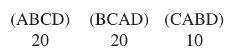
Consider an election with four candidates with the following results:a. Who wins the election using a Borda count method?b. Does the Borda count method violate the irrelevant alternative criterion? (ABCD) 20 (BCAD) 20 (CABD) 10
A fair apportionment of dividing a leftover piece of cake between two children is to let child \#1 cut the cake into two pieces and then to let child \#2 pick which piece he or she wants. Consider the following apportionment of dividing the leftover piece of cake among three children. Let the first
If all of these grades are in three-unit classes, use this information to answer the questions in Problems 53-54.Suppose your college transcripts show the following distribution of grades:A: 14 B: 21 C: 35 D: 5 F: 2a. Which grade is the most common?b. Which voting method describes how you answered
Consider the following apportionment problem:Use the apportionment plan requested in Problems 51-55 assuming that there must be 16 representatives.Hamilton's plan North: 18,200 South: 12,900 East: 17,600 West: 13,300
An elderly rancher died and left her estate to her three children. She bequeathed her 17 prize horses in the following manner: \(1 / 2\) to the eldest, \(1 / 3\) to the second child, and \(1 / 9\) to the youngest. How would you divide this estate?
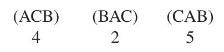
Consider an election with three candidates with the following results:a. Is there a majority winner? If not, who is the plurality winner?b. If a majority is required for election, there must be a runoff between the second and third choices. Who will win that runoff?c. How can the voters who support
If all of these grades are in three-unit classes, use this information to answer the questions in Problems 53-54.Suppose your college transcripts show the following distribution of grades:A: 14 B: 21 C: 35 D: 5 F: 2a. What is your GPA?b. Which voting method describes how you answered part a?
Consider the following apportionment problem:Use the apportionment plan requested in Problems 51-55 assuming that there must be 16 representatives.Webster's plan North: 18,200 South: 12,900 East: 17,600 West: 13,300
Consider an election with three candidates with the following results:a. Is there a majority winner? If not, who is the plurality winner?b. Who wins the election using the Borda count method?c. Who wins if he or she first eliminates the one with the most last-place votes and then has a runoff
The children decided to call in a very wise judge to help in the distribution of the rancher's estate. The judge arrived with a horse of his own. He put his horse in with the 17 belonging to the estate, and then told each child to pick from among the 18 in the proportions stipulated by the will
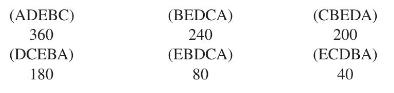
In Problems 55-59, consider the following situation. A political party holds a national convention with 1,100 delegates. At the convention, five persons (which we will call \(\mathrm{A}, \mathrm{B}, \mathrm{C}, \mathrm{D}\), and \(\mathrm{E}\) ) have been nominated as the party's presidential
Consider the following apportionment problem:Use the apportionment plan requested in Problems 51-55 assuming that there must be 16 representatives.HH's plan North: 18,200 South: 12,900 East: 17,600 West: 13,300
The children decided to call in a very wise judge to help in the distribution of the rancher's estate. They informed the judge that the 17 horses were not of equal value. The children agreed on a ranking of the 17 horses (\#1 being the best and \#17 being a real dog of a horse). They asked the
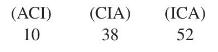
Suppose that 100 senators must vote on an appropriation: a new bridge in Alabama (A), a new freeway interchange in California (C), or a grain subsidy for Iowa (I). The Senate Whip estimates that the preferences of the senators is (ACI) 10 (CIA) 38 (ICA) 52
In Problems 55-59, consider the following situation. A political party holds a national convention with 1,100 delegates. At the convention, five persons (which we will call \(\mathrm{A}, \mathrm{B}, \mathrm{C}, \mathrm{D}\), and \(\mathrm{E}\) ) have been nominated as the party's presidential
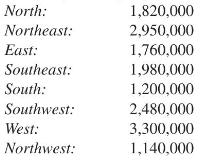
Consider the following apportionment problem:If there are to be 475 representatives, use the apportionment plan requested in Problems 56-60.Adams' plan North: Northeast: East: Southeast: South: Southwest: West: Northwest: 1,820,000 2,950,000 1,760,000 1,980,000 1,200,000 2,480,000 3,300,000
Suppose that Stephanie, Linda, Ann, and Melissa are members of a committee of the Tuesday Afternoon Club and Stephanie, Linda, and Ann all prefer a new rule that says the meeting time will change to the evenings. Stephanie proposed this new rule because she absolutely cannot come if the new rule is
A fair apportionment of dividing a leftover piece of cake between two children is to let child \#1 cut the cake into two pieces and then to let child \#2 pick which piece he or she wants. Consider the following apportionment of dividing the leftover piece of cake among three children. Let the first
In Problems 55-59, consider the following situation. A political party holds a national convention with 1,100 delegates. At the convention, five persons (which we will call \(\mathrm{A}, \mathrm{B}, \mathrm{C}, \mathrm{D}\), and \(\mathrm{E}\) ) have been nominated as the party's presidential
Consider the following apportionment problem:If there are to be 475 representatives, use the apportionment plan requested in Problems 56-60.Jefferson's plan North: Northeast: East: Southeast: South: Southwest: West: Northwest: 1,820,000 2,950,000 1,760,000 1,980,000 1,200,000 2,480,000 3,300,000
Make up an example of a vote that is not transitive.
In Problems 55-59, consider the following situation. A political party holds a national convention with 1,100 delegates. At the convention, five persons (which we will call \(\mathrm{A}, \mathrm{B}, \mathrm{C}, \mathrm{D}\), and \(\mathrm{E}\) ) have been nominated as the party's presidential
An elderly rancher died and left her estate to her three children. She bequeathed her 17 prize horses in the following manner: \(1 / 2\) to the eldest, \(1 / 3\) to the second child, and \(1 / 9\) to the youngest. How would you divide this estate?
Consider the following apportionment problem:If there are to be 475 representatives, use the apportionment plan requested in Problems 56-60.Hamilton's plan North: Northeast: East: Southeast: South: Southwest: West: Northwest: 1,820,000 2,950,000 1,760,000 1,980,000 1,200,000 2,480,000 3,300,000
Suppose there are ten serious, but almost indistinguishable, candidates for a U.S. presidential primary. Also suppose that at the last possible minute a very radical candidate enters the race. He is so radical, in fact, that \(90 \%\) of the voters rank this candidate at the bottom. Show how it
The children decided to call in a very wise judge to help in the distribution of the rancher's estate. The judge arrived with a horse of his own. He put his horse in with the 17 belonging to the estate, and then told each child to pick from among the 18 in the proportions stipulated by the will
In Problems 55-59, consider the following situation. A political party holds a national convention with 1,100 delegates. At the convention, five persons (which we will call \(\mathrm{A}, \mathrm{B}, \mathrm{C}, \mathrm{D}\), and \(\mathrm{E}\) ) have been nominated as the party's presidential
Consider the following apportionment problem:If there are to be 475 representatives, use the apportionment plan requested in Problems 56-60.Webster's plan North: Northeast: East: Southeast: South: Southwest: West: Northwest: 1,820,000 2,950,000 1,760,000 1,980,000 1,200,000 2,480,000 3,300,000
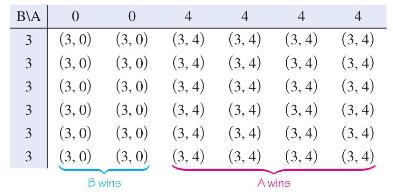
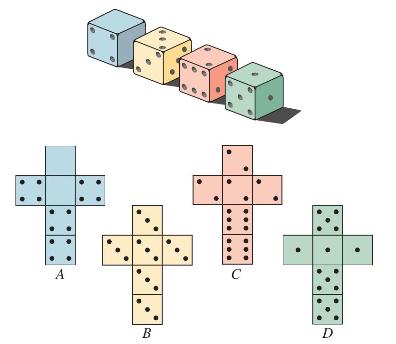
The Game of WIN Construct a set of nonstandard dice as shown in Figure 17.1.Suppose that one player picks die \(A\) and that the other picks die \(B\), the dice are rolled, and the higher number wins. We can enumerate the sample space as shown here. We see that \(A\) 's probability of winning is
The children (see Problem 58) decided to call in a very wise judge to help in the distribution of the rancher's estate. They informed the judge that the 17 horses were not of equal value. The children agreed on a ranking of the 17 horses (\#1 being the best and \#17 being a real dog of a horse).
By looking at your answers to Problems 55-59, who would you say should be declared the winner? Look at the title of the next section. Relate your answer to this question to the need to study the next section.
Consider the following apportionment problem:If there are to be 475 representatives, use the apportionment plan requested in Problems 56-60.HH's plan North: Northeast: East: Southeast: South: Southwest: West: Northwest: 1,820,000 2,950,000 1,760,000 1,980,000 1,200,000 2,480,000 3,300,000 1,140,000
What are the three main topics of calculus?
What do we mean by the limit of a sequence?
Evaluate the area function for the functions given in Problems 1-8.Let \(y=5\); find \(A(8)\).
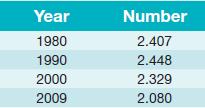
Table 18.3 gives some distances and commute times for a typical daily commute. Find the average speed (to the nearest mph) for the time intervals requested in Problems 1-4.Table 18.3\(6: 09\) to \(6: 36\) Year 1980 1990 2000 2009 Number 2.407 2.448 2.329 2.080
What are the main ideas of calculus? Briefly describe each of these main ideas. limits, derivatives, and integrals
What is a mathematical model? Why are mathematical models necessary or useful?
Outline a procedure for finding the limit of a sequence.
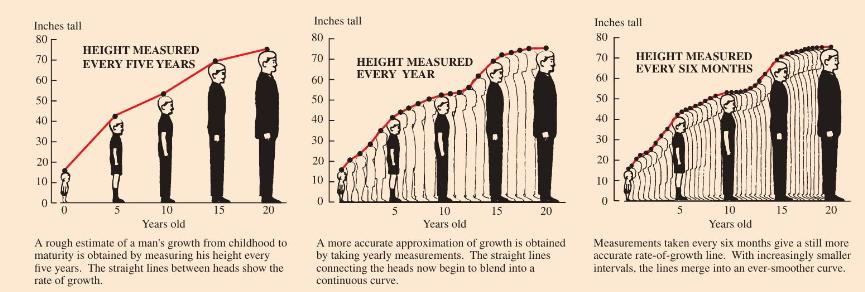
There are three pictures in Figure 18.29 (below) which can be used to find the growth rate of the boy. Explain what is being illustrated with this sequence of drawings. Why do you think we might title this sequence of illustrations "instantaneous growth rate"?Figure 18.29 Inches tall 80 70 60- 50
Evaluate the area function for the functions given in Problems 1-8.Let \(y=8.3\); find \(A(x)\) .
Table 18.3 gives some distances and commute times for a typical daily commute. Find the average speed (to the nearest mph) for the time intervals requested in Problems 1-4.Table 18.3\(6: 36\) to \(7: 03\) Year 1980 1990 2000 2009 Number 2.407 2.448 2.329 2.080
An analogy to Zeno's tortoise paradox can be made as follows.A woman standing in a room cannot walk to a wall. To do so, she would first have to go half the distance, then half the remaining distance, and then again half of what still remains. This process can always be continued and can never be
Write out the first five terms (beginning with \(n=1\) ) of the sequences given in Problems 3-10.\(\left\{1+(-1)^{n}ight\}\)
Table 18.3 gives some distances and commute times for a typical daily commute. Find the average speed (to the nearest mph) for the time intervals requested in Problems 1-4.Table 18.3\(7: 03\) to \(7: 28 \) Year 1980 1990 2000 2009 Number 2.407 2.448 2.329 2.080
Evaluate the area function for the functions given in Problems 1-8.Let \(y=x\); find \(A(3)\).
Evaluate the limits in Problems 3-7.\(\lim _{n ightarrow \infty} \frac{1}{n}\)
Zeno's paradoxes remind us of an argument that might lead to an absurd conclusion:Suppose I am playing baseball and decide to steal second base. To run from first to second base, I must first go half the distance, then half the remaining distance, and then again half of what remains. This process
Write out the first five terms (beginning with \(n=1\) ) of the sequences given in Problems 3-10.\(\left\{2+(-2)^{n}ight\}\)
Table 18.3 gives some distances and commute times for a typical daily commute. Find the average speed (to the nearest mph) for the time intervals requested in Problems 1-4.Table 18.3\(6: 09\) to \(7: 28\) Year 1980 1990 2000 2009 Number 2.407 2.448 2.329 2.080
Evaluate the area function for the functions given in Problems 1-8.Let \(y=3 x\); find \(A(4)\).
Evaluate the limits in Problems 3-7.\(\lim _{n ightarrow \infty}(-1)^{n}\)
Consider the sequence \(0.3,0.33,0.333,0.3333, \cdots\). What do you think is the appropriate limit of this sequence?
Write out the first five terms (beginning with \(n=1\) ) of the sequences given in Problems 3-10.\(\left\{\left(\frac{-1}{2}ight)^{n+2}ight\}\)
Evaluate the area function for the functions given in Problems 1-8.Let \(y=2 x\); find \(A(x)\).
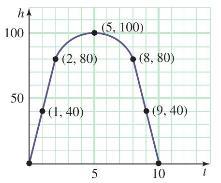
The graph in Figure 18.19 shows the height h of a projectile after \(t\) seconds. In Problems 5-8, find the average rate of change of height (in feet) with respect to the requested changes in time \(t\) (in seconds).Figure 18.191 to \(8 \) h4 100 50 (2,80) (1,40) 5 (5, 100) (8,80) (9.40) 10
Evaluate the limits in Problems 3-7.\(\lim _{n ightarrow \infty} \frac{3 n^{4}+20}{7 n^{4}}\)
Solve the systems in Problems 15-26 by the substitution method.\(\left\{\begin{array}{l}3 x-y=-1 \\ x=2 y+3\end{array}ight.\)
Graph the solution of each system given in Problems 5-18.\(\left\{\begin{array}{l}x+5 \geq 0 \\ x \leq 0\end{array}ight.\)
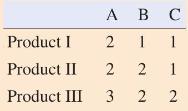
A manufacturer of auto accessories uses three basic parts, A, \(\mathrm{B}\), and \(\mathrm{C}\), in its three products, in the following proportions:The inventory shows 1,250 of part A, 900 of part B, and 750 of part \(\mathrm{C}\) on hand. How many of each product may be manufactured using all
Given the matrices in Problems 16-19, perform elementary row operations to obtain a 1 in the row 1, column 1 position.\([D]=\left[\begin{array}{rrr:r}5 & 20 & 15 & 6 \\ 7 & -5 & 3 & 2 \\ 12 & 0 & 1 & 4\end{array}ight]\)
Show that the given matrices are inverses in Problems 19-20.\([A]=\left[\begin{array}{ll}2 & 7 \\ 1 & 4\end{array}ight] ;[B]=\left[\begin{array}{rr}4 & -7 \\ -1 & 2\end{array}ight]\)
Solve the systems in Problems 15-26 by the substitution method.\(\left\{\begin{array}{l}2 x-3 y=15 \\ y=\frac{2}{3} x-8\end{array}ight.\)
Decide whether the given point is a feasible solution for the constraints\[\left\{\begin{array}{l}x \geq 0 \\y \geq 0 \\3 x+2 y \leq 10 \\2 x+4 y \leq 8\end{array}ight.\]a. \((1,3)\)b. \((2,1)\)c. \((1,2)\)d. \((-1,4)\)e. \((2,2)\)f. \((0,4)\)
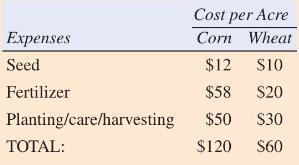
A farmer has 500 acres on which to plant two crops: corn and wheat. To produce these crops, there are certain expenses:After the harvest, the farmer must store the crops while awaiting proper market conditions. Each acre yields an average of 100 bushels of corn or 40 bushels of wheat. The farmer
Given the matrices in Problems 20-23, perform elementary row operations to obtain zeros under the 1 in the first column.\([A]=\left[\begin{array}{rrr:r}1 & 2 & -3 & 0 \\ 0 & 3 & 1 & 4 \\ 2 & 5 & 1 & 6\end{array}ight]\)
Show that the given matrices are inverses in Problems 19-20.\([A]=\left[\begin{array}{rrr}-16 & -2 & 7 \\ 7 & 1 & -3 \\ -3 & 0 & 1\end{array}ight]\); [B \(]=\left[\begin{array}{rrr}1 & 2 & -1 \\ 2 & 5 & 1 \\ 3 & 6 & -2\end{array}ight]\)
An after-shave lotion is \(50 \%\) alcohol. If you have 6 fluid ounces of the lotion, how much water must be added to reduce the mixture to \(20 \%\) alcohol?
Solve the systems in Problems 15-26 by the substitution method.\(\left\{\begin{array}{l}x+y=12 \\ 0.6 y=0.5(12)\end{array}ight.\)
Decide whether the given point is a corner point for the constraints\[\left\{\begin{array}{l}x \geq 0 \\y \geq 0 \\2 x+3 y \geq 120 \\2 x+y \geq 80 \end{array}ight.\]a. \((0,0)\)b. \((0,80)\)c. \((80,0)\)d. \((60,0)\)e. \((30,20)\)f. \((20,30)\)
Given the matrices in Problems 20-23, perform elementary row operations to obtain zeros under the 1 in the first column. Answers may vary.\([B]=\left[\begin{array}{rrr:r}1 & 3 & -5 & 6 \\ -3 & 4 & 1 & 2 \\ 0 & 5 & 1 & 3\end{array}ight]\)
Find the inverse of each matrix in Problems 21-26, if it exists.\(\left[\begin{array}{rr}4 & -7 \\ -1 & 2\end{array}ight]\)
Milk containing \(20 \%\) butterfat is mixed with cream containing \(60 \%\) butterfat to produce half-and-half, which is \(50 \%\) butterfat. How many gallons of each must be mixed to make 180 gallons of half-and-half?
Solve the systems in Problems 15-26 by the substitution method.\(\left\{\begin{array}{l}4 y+5 x=2 \\ y=\frac{5}{4} x+2\end{array}\ ight.\)
Graph the solution of each system given in Problems 21-34.\(\left\{\begin{array}{l}-10 \leq x \\ x \leq 6 \\ -3
Given the matrices in Problems 20-23, perform elementary row operations to obtain zeros under the 1 in the first column. Answers may vary.\([C]=\left[\begin{array}{rrr:r}1 & 2 & 4 & 1 \\ -2 & 5 & 0 & 2 \\ -4 & 5 & 1 & 3\end{array}ight]\)
Showing 400 - 500
of 6209
1
2
3
4
5
6
7
8
9
10
11
12
13
14
15
Last
Step by Step Answers

 Get 50% OFF
Claim Now
Get 50% OFF
Claim Now