New Semester
Started
Get
50% OFF
Study Help!
--h --m --s
Claim Now
Question Answers
Textbooks
Find textbooks, questions and answers
Oops, something went wrong!
Change your search query and then try again
S
Books
FREE
Study Help
Expert Questions
Accounting
General Management
Mathematics
Finance
Organizational Behaviour
Law
Physics
Operating System
Management Leadership
Sociology
Programming
Marketing
Database
Computer Network
Economics
Textbooks Solutions
Accounting
Managerial Accounting
Management Leadership
Cost Accounting
Statistics
Business Law
Corporate Finance
Finance
Economics
Auditing
Tutors
Online Tutors
Find a Tutor
Hire a Tutor
Become a Tutor
AI Tutor
AI Study Planner
NEW
Sell Books
Search
Search
Sign In
Register
study help
sciences
nature of mathematics
Nature Of Mathematics 13th Edition Karl J. Smith - Solutions
The seniors at Weseltown High School are voting for where to go for their senior trip. They are deciding on Angel Falls (A), Bend Canyon (B), Cedar Lake (C), or Danger Gap (D). The results of the preferences are:Who is the Condorcet candidate, if there is one? (DABC) (ACBD) (BCAD) (CBDA) (CBAD) 30
Use this information to answer the questions in Problems 18-23.a. What does the notation (ADBC) mean?b. What does the " 8 " under (ADBC) mean? In voting among four candidates, the outcomes are reported as: (DACB) 5 (ADBC) 8 (BADC) 3 (BDCA) 1 (DCAB) 2
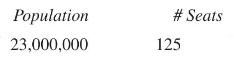
Find the standard divisor (to two decimal places) for the given populations and number of representative seats in Problems 15-22. Population 23,000,000 # Seats 125
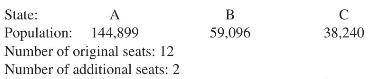
In Problems 19-22, apportion the indicated number of representatives to three states, A, B, and C, using Hamilton's plan. Next, use the revised populations to reapportion the representatives. Decide whether the population paradox occurs. State: A Population: 89,950 Revised pop.: 97,950 Number of
The seniors at Weseltown High School are voting for where to go for their senior trip. They are deciding on Angel Falls (A), Bend Canyon (B), Cedar Lake (C), or Danger Gap (D). The results of the preferences are:Is there a majority winner? If not, is there a plurality winner? Does this violate the
Use this information to answer the questions in Problems 18-23.a. If a person ranks \(B\) as his first choice, \(C\) as his second choice, \(\mathrm{D}\) as his third choice, and A last, how would this be written?b. How many voters have this preference? In voting among four candidates, the outcomes
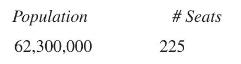
Find the standard divisor (to two decimal places) for the given populations and number of representative seats in Problems 15-22. Population 62,300,000 # Seats 225
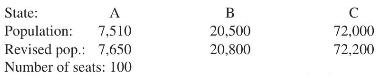
In Problems 19-22, apportion the indicated number of representatives to three states, A, B, and C, using Hamilton's plan. Next, use the revised populations to reapportion the representatives. Decide whether the population paradox occurs. A State: Population: 7,510 Revised pop.: 7,650 Number of
The seniors at Weseltown High School are voting for where to go for their senior trip. They are deciding on Angel Falls (A), Bend Canyon (B), Cedar Lake (C), or Danger Gap (D). The results of the preferences are:Who wins the Borda count? Does this violate the Condorcet criterion? (DABC) (ACBD)
Use this information to answer the questions in Problems 18-23.a. How many possibilities are there for voter preferences with four candidates?b. Name those possibilities that have 0 voter preferences. In voting among four candidates, the outcomes are reported as: (DACB) 5 (ADBC) 8 (BADC) 3 (BDCA) 1
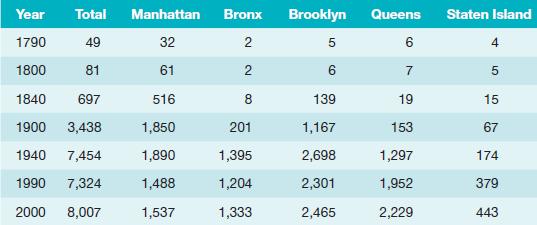
For the given year, find the standard quotas for the New York City boroughs given in Table 17.5 in Problems 23-28. Assume there are eight council seats.Table 17.51800 Year Total 1790 49 1800 81 1840 697 1900 3,438 1940 7,454 1990 7,324 2000 8,007 Manhattan 32 61 516 1,850 1,890 1,488 1,537 Bronx 2
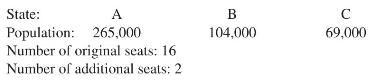
In Problems 23-26, apportion the indicated number of representatives to two states, A, and B, using Hamilton's plan. Next, recalculate the apportionment using Hamilton's plan for the three states, \(\mathrm{C}\) and the original states. Decide whether the new states paradox occurs. State: A
The seniors at Weseltown High School are voting for where to go for their senior trip. They are deciding on Angel Falls (A), Bend Canyon (B), Cedar Lake (C), or Danger Gap (D). The results of the preferences are:Who wins using the Hare method? Does this violate the Condorcet criterion? (DABC)
Which of the following are examples of a dictatorship?a. Dad comes home with a surprise for the family—he just bought tickets for the family to vacation in Hawaii.b. The choice of selecting the champagne for the toast is left to the cellar master at the restaurant.c. The chairperson makes a
For the given year, find the standard quotas for the New York City boroughs given in Table 17.5 in Problems 23-28. Assume there are eight council seats.Table 17.51840 Year Total 1790 49 1800 81 1840 697 1900 3,438 1940 7,454 1990 7,324 2000 8,007 Manhattan 32 61 516 1,850 1,890 1,488 1,537 Bronx 2
In Problems 23-26, apportion the indicated number of representatives to two states, A, and B, using Hamilton's plan. Next, recalculate the apportionment using Hamilton's plan for the three states, \(\mathrm{C}\) and the original states. Decide whether the new states paradox occurs. State: A
The seniors at Weseltown High School are voting for where to go for their senior trip. They are deciding on Angel Falls (A), Bend Canyon (B), Cedar Lake (C), or Danger Gap (D). The results of the preferences are:Who wins using the pairwise comparison method? Does this violate the Condorcet
For the given year, find the standard quotas for the New York City boroughs given in Table 17.5 in Problems 23-28. Assume there are eight council seats.Table 17.51900 Year Total 1790 49 1800 81 1840 697 1900 3,438 1940 7,454 1990 7,324 2000 8,007 Manhattan 32 61 516 1,850 1,890 1,488 1,537 Bronx 2
a. How many different ways can a voter rank 3 candidates (no ties are allowed)?b. How many different ways can a voter rank 4 candidates (no ties are allowed)?c. How many different ways can a voter rank 5 candidates (no ties are allowed)?
In Problems 23-26, apportion the indicated number of representatives to two states, A, and B, using Hamilton's plan. Next, recalculate the apportionment using Hamilton's plan for the three states, \(\mathrm{C}\) and the original states. Decide whether the new states paradox occurs. A State:
The seniors at Weseltown High School are voting for where to go for their senior trip. They are deciding on Angel Falls (A), Bend Canyon (B), Cedar Lake (C), or Danger Gap (D). The results of the preferences are:Who is the Condorcet candidate? (DABC) (ACBD) (BCAD) (CBDA) 80 45 30 10 (CBAD) 50
For the given year, find the standard quotas for the New York City boroughs given in Table17.5 in Problems 23-28. Assume there are eight council seats.Table 17.51940 Year Total 1790 49 1800 81 1840 697 1900 3,438 1940 7,454 1990 7,324 2000 8,007 Manhattan 32 61 516 1,850 1,890 1,488 1,537 Bronx 2
a. If there are 10 voters and 5 candidates, how many total points would there be in a Borda count?b. If there are 20 voters and 4 candidates, how many total points would there be in a Borda count?c. If there are 200 voters and 3 candidates, how many total points would there be in a Borda count?
In Problems 23-26, apportion the indicated number of representatives to two states, A, and B, using Hamilton's plan. Next, recalculate the apportionment using Hamilton's plan for the three states, \(\mathrm{C}\) and the original states. Decide whether the new states paradox occurs. State: A
The seniors at Weseltown High School are voting for where to go for their senior trip. They are deciding on Angel Falls (A), Bend Canyon (B), Cedar Lake (C), or Danger Gap (D). The results of the preferences are:Is there a majority winner? If not, is there a plurality winner? Does this violate the
How many different ways can a voter rank \(n\) candidates (no ties are allowed)?
For the given year, find the standard quotas for the New York City boroughs given in Table 17.5 in Problems 23-28. Assume there are eight council seats.Table 17.51990 Year Total 1790 49 1800 81 1840 697 1900 3,438 1940 7,454 1990 7,324 2000 8,007 Manhattan 32 61 516 1,850 1,890 1,488 1,537 Bronx 2
The city district attorney has 30 litigators to be divided among three courts. The following table shows the schedule of the number of pending cases for each court.Apportion the 30 litigators using Hamilton's method, and then decide if the Alabama paradox occurs if the number of litigators is
The seniors at Weseltown High School are voting for where to go for their senior trip. They are deciding on Angel Falls (A), Bend Canyon (B), Cedar Lake (C), or Danger Gap (D). The results of the preferences are:Who wins the Borda count? Does this violate the Condorcet criterion? (DABC) (ACBD)
It can be shown that\[1+2+3+\cdots+m=\frac{m(m+1)}{2}\]Use this formula to determine how many total points there would be in a Borda count with \(n\) voters and \(m\) candidates.
For the given year, find the standard quotas for the New York City boroughs given in Table 17.5 in Problems 23-28. Assume there are eight council seats.Table 17.52000 Year Total 1790 49 1800 81 1840 697 1900 3,438 1940 7,454 1990 7,324 2000 8,007 Manhattan 32 61 516 1,850 1,890 1,488 1,537 Bronx 2
A city has 57 delegates to a Green World conference, and these delegates are to be apportioned according to the borough that they represent.Apportion the delegates to each borough using Hamilton's method, and then decide if the Alabama paradox occurs if the number of delegates is increased from 57
The seniors at Weseltown High School are voting for where to go for their senior trip. They are deciding on Angel Falls (A), Bend Canyon (B), Cedar Lake (C), or Danger Gap (D). The results of the preferences are:Who wins using the Hare method? Does this violate the Condorcet criterion? (DABC)
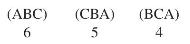
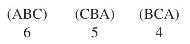
Determine the winner, if any, using the voting methods in Problems 29-34.Majority rule In voting among three candidates, the outcomes are reported as: (CBA) (ACB) (BAC) (BCA) (CAB) 3 0 4 2 5 (ABC) 8
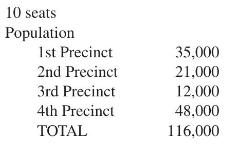
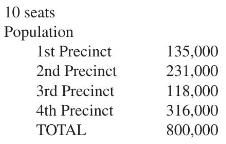
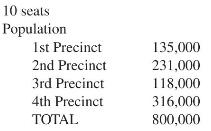
Consider the populations given in Problems 29-32.a. Find the standard divisor.b. Find the standard quota for each precinct.c. Total, rounding the standard quotas down.d. Find a modified divisor that will give modified quotas to produce the desired number of seats. 10 seats Population 1st Precinct
The city district attorney has 60 litigators to be divided among three courts. The following table shows the schedule of the number of pending cases for each court.Apportion the 60 litigators using Hamilton's method. Court: Pending cases: A 209 B 769 2,022 Total 3,000
The seniors at Weseltown High School are voting for where to go for their senior trip. They are deciding on Angel Falls (A), Bend Canyon (B), Cedar Lake (C), or Danger Gap (D). The results of the preferences are:Who wins using the pairwise comparison method? Does this violate the Condorcet
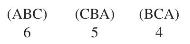
Determine the winner, if any, using the voting methods in Problems 29-34.Plurality method In voting among three candidates, the outcomes are reported as: (CBA) (ACB) (BAC) (BCA) (CAB) 3 0 4 2 5 (ABC) 8
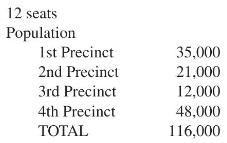
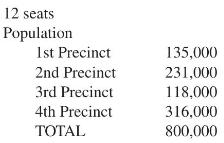
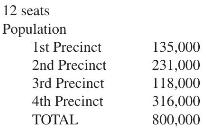
Consider the populations given in Problems 29-32.a. Find the standard divisor.b. Find the standard quota for each precinct.c. Total, rounding the standard quotas down.d. Find a modified divisor that will give modified quotas to produce the desired number of seats. 12 seats Population 1st Precinct
The city district attorney has 60 litigators to be divided among three courts. The following table shows the schedule of the number of pending cases for each court.Decide if the Alabama paradox occurs if the number of litigators is increased from 60 to 61 . Court: Pending cases: A 209 B 769 2,022
A focus group of 33 people for \(A B C T V\) were asked to rank the government spending priorities of education \((\mathrm{E})\), military spending \((\mathrm{M})\), health care \((\mathrm{H})\), immigration \((\mathrm{I})\), and lowering taxes \((\mathrm{T})\). Here are the preferences:Who is the
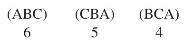
Determine the winner, if any, using the voting methods in Problems 29-34.Borda count method In voting among three candidates, the outcomes are reported as: (CBA) (ACB) (BAC) (BCA) (CAB) 3 0 4 2 5 (ABC) 8
Consider the populations given in Problems 29-32.a. Find the standard divisor.b. Find the standard quota for each precinct.c. Total, rounding the standard quotas down.d. Find a modified divisor that will give modified quotas to produce the desired number of seats. 10 seats Population 1st Precinct
The city district attorney has 60 litigators to be divided among three courts. The following table shows the schedule of the number of pending cases for each court.Suppose that a fourth court is added to handle an additional 260 cases as shown.To handle the extra work load, the district attorney
A focus group of 33 people for \(A B C T V\) were asked to rank the government spending priorities of education \((\mathrm{E})\), military spending \((\mathrm{M})\), health care \((\mathrm{H})\), immigration \((\mathrm{I})\), and lowering taxes \((\mathrm{T})\). Here are the preferences:Who is the
Determine the winner, if any, using the voting methods in Problems 29-34.Hare method In voting among three candidates, the outcomes are reported as: (CBA) (ACB) (BAC) (BCA) (CAB) 3 0 4 2 5 (ABC) 8
Consider the populations given in Problems 29-32.a. Find the standard divisor.b. Find the standard quota for each precinct.c. Total, rounding the standard quotas down.d. Find a modified divisor that will give modified quotas to produce the desired number of seats. 12 seats Population 1st Precinct
The city district attorney has 60 litigators to be divided among three courts. The following table shows the schedule of the number of pending cases for each court. Court: Pending cases: A 209 B 769 2,022 Total 3,000
A focus group of 33 people for \(A B C T V\) were asked to rank the government spending priorities of education \((\mathrm{E})\), military spending \((\mathrm{M})\), health care \((\mathrm{H})\), immigration \((\mathrm{I})\), and lowering taxes \((\mathrm{T})\). Here are the preferences:Suppose
Determine the winner, if any, using the voting methods in Problems 29-34.Pairwise comparison method In voting among three candidates, the outcomes are reported as: (CBA) (ACB) (BAC) (BCA) (CAB) 3 0 4 2 5 (ABC) 8
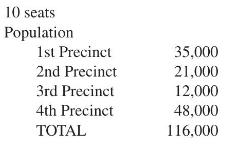
Consider the populations given in Problems 33-36.a. Find the standard divisor.b. Find the standard quota for each precinct.c. Total, rounding the standard quotas up.d. Find a modified divisor that will give modified quotas to produce the desired number of seats. 10 seats Population 1st Precinct 2nd
A focus group of 33 people for \(A B C T V\) were asked to rank the government spending priorities of education \((\mathrm{E})\), military spending \((\mathrm{M})\), health care \((\mathrm{H})\), immigration \((\mathrm{I})\), and lowering taxes \((\mathrm{T})\). Here are the preferences:Suppose
Determine the winner, if any, using the voting methods in Problems 29-34.Tournament method In voting among three candidates, the outcomes are reported as: (CBA) (ACB) (BAC) (BCA) (CAB) 3 0 4 2 5 (ABC) 8
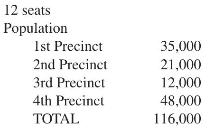
Consider the populations given in Problems 33-36.a. Find the standard divisor.b. Find the standard quota for each precinct.c. Total, rounding the standard quotas up.d. Find a modified divisor that will give modified quotas to produce the desired number of seats. 12 seats Population 1st Precinct 2nd
A focus group of 33 people for \(A B C T V\) were asked to rank the government spending priorities of education \((\mathrm{E})\), military spending \((\mathrm{M})\), health care \((\mathrm{H})\), immigration \((\mathrm{I})\), and lowering taxes \((\mathrm{T})\). Here are the preferences:Suppose
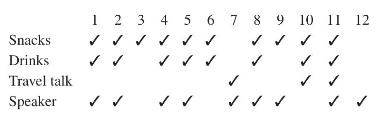
Twelve board members are voting on after-meeting activities, and they are asked to check any that they might like. The outcome of their choices is shown here:What is the outcome using approval voting? Snacks Drinks Travel talk Speaker 1 2 3 4 5 6 7 8 9 10 11 12
Consider the populations given in Problems 33-36.a. Find the standard divisor.b. Find the standard quota for each precinct.c. Total, rounding the standard quotas up.d. Find a modified divisor that will give modified quotas to produce the desired number of seats. 10 seats Population 1st Precinct 2nd
A focus group of 33 people for \(A B C T V\) were asked to rank the government spending priorities of education \((\mathrm{E})\), military spending \((\mathrm{M})\), health care \((\mathrm{H})\), immigration \((\mathrm{I})\), and lowering taxes \((\mathrm{T})\). Here are the preferences:Suppose
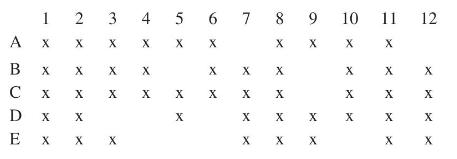
Twelve board members are voting on admitting two new board members. They interview 5 candidates and vote " \(x\) " for an acceptable candidate and no vote for an unacceptable candidate. The outcome of their choices is shown here:What is the outcome using approval voting? 1 X A B X C X D x EX 2 X X
Consider the populations given in Problems 33-36.a. Find the standard divisor.b. Find the standard quota for each precinct.c. Total, rounding the standard quotas up.d. Find a modified divisor that will give modified quotas to produce the desired number of seats. 12 seats Population 1st Precinct 2nd
In 1988 the 94th International Olympic Committee (IOC) met in Seoul to select the 1994 Winter Olympics site. The cities in the running were Anchorage (A), Lillehammer (L), Ostersund (T), and Sofia (S). Consider the following fictional account of how the voting might have been conducted. The voting
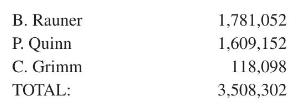
In the 2014 race for the governor of Illinois, the state vote was as follows:Was there a majority winner in this election, and if so, who was it? B. Rauner P. Quinn C. Grimm TOTAL: 1,781,052 1,609,152 118,098 3,508,302
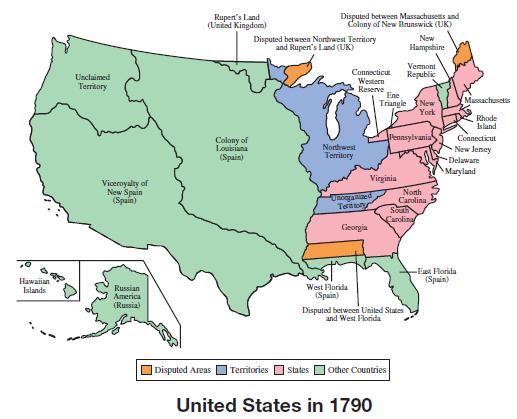
In the apportionment of the House of Representatives based on the 1790 census , there are 15 states. At that time, Maine was still considered part of Massachusetts. If Maine had been a separate state, it would have shared in the distribution of the seats in the House. In the 1790 census, Maine's
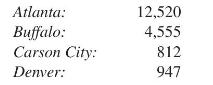
Packard-Hue manufactures testing equipment at four locations, and has just hired 300 new employees. Those employees are to be apportioned using production levels at the four locations according to Jefferson's plan. The locations and production are as follows:Use this information in Problems
In 1988 the 94th International Olympic Committee (IOC) met in Seoul to select the 1994 Winter Olympics site. The cities in the running were Anchorage (A), Lillehammer (L), Ostersund (T), and Sofia (S). Consider the following fictional account of how the voting might have been conducted. The voting
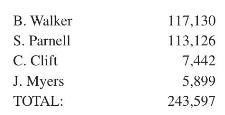
In the 2014 race for governor of Alaska, the vote was as follows:Was there a majority winner in this election, and if so, who was it? B. Walker S. Parnell C. Clift J. Myers TOTAL: 117,130 113,126 7,442 5,899 243,597
In the apportionment of the House of Representatives based on the 1790 census , there are 15 states. At that time, Maine was still considered part of Massachusetts. If Maine had been a separate state, it would have shared in the distribution of the seats in the House. In the 1790 census, Maine's
Packard-Hue manufactures testing equipment at four locations, and has just hired 300 new employees. Those employees are to be apportioned using production levels at the four locations according to Jefferson's plan. The locations and production are as follows:Use this information in Problems
In 1993 the 101st International Olympic Committee met in Monaco to select the 2000 Winter Olympics site. The cities in the running were Beijing (B), Berlin (L), Istanbul (I), Manchester (M), and Sydney (S). Suppose we look at their voting preferences:a. Is there a majority winner? If not, which
Twelve people serve on a board and are considering three alternatives: A, B, and C. Here are the choices followed by vote:Determine the winner, if any, using the voting methods in Problems 39-44.Majority rule none (ABC) (ACB) 2 4 (BAC) 2 (BCA) 1 (CAB) 2 (CBA) I
In the apportionment of the House of Representatives based on the 1790 census , there are 15 states. At that time, Maine was still considered part of Massachusetts. If Maine had been a separate state, it would have shared in the distribution of the seats in the House. In the 1790 census, Maine's
Packard-Hue manufactures testing equipment at four locations, and has just hired 300 new employees. Those employees are to be apportioned using production levels at the four locations according to Jefferson's plan. The locations and production are as follows:Use this information in Problems
In 1993 the 101st International Olympic Committee met in Monaco to select the 2000 Winter Olympics site. The cities in the running were Beijing (B), Berlin (L), Istanbul (I), Manchester (M), and Sydney (S). Suppose we look at their voting preferences:a. Find the result of the election using a Borda
Twelve people serve on a board and are considering three alternatives: A, B, and C. Here are the choices followed by vote:Determine the winner, if any, using the voting methods in Problems 39-44.Plurality method (ABC) (ACB) 2 4 (BAC) 2 (BCA) 1 (CAB) 2 (CBA) I
In the apportionment of the House of Representatives based on the 1790 census , there are 15 states. At that time, Maine was still considered part of Massachusetts. If Maine had been a separate state, it would have shared in the distribution of the seats in the House. In the 1790 census, Maine's
Packard-Hue manufactures testing equipment at four locations, and has just hired 300 new employees. Those employees are to be apportioned using production levels at the four locations according to Jefferson's plan. The locations and production are as follows:Use this information in Problems
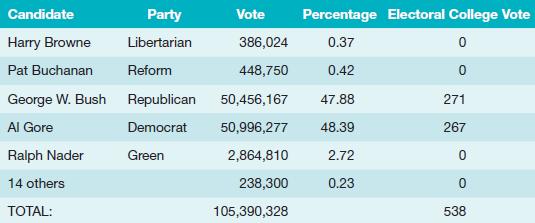
The U.S. president is elected with a vote of the Electoral College. However, if the vote were conducted using the Hare method, what would be the outcome? Use the data in Table 17.3, and assume that the second choice of the Browne voters is Gore, and the second choice of the Buchanan voters is Bush.
Twelve people serve on a board and are considering three alternatives: A, B, and C. Here are the choices followed by vote:Determine the winner, if any, using the voting methods in Problems 39-44.Borda count method (ABC) (ACB) 2 4 (BAC) 2 (BCA) 1 (CAB) 2 (CBA) I
Consider the following apportionment problem for College Town:Suppose each council member is to represent approximately 2,500 citizens. Use the apportionment plan requested in Problems 41-45 assuming that there must be 10 representatives.Adams' plan North: 8,700 South: 5,600 East: 7,200 West: 3,500
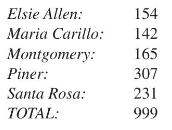
The English enrollments at five high schools in the Santa Rosa Unified School District are as follows:In Problems 42-47, suppose that 45 copies of an important instructional video are to be allocated to the schools by using Hamilton's plan and the school population.What is the standard divisor?
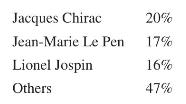
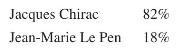
Article 7 of the French constitution states, "The President of the Republic is elected by an absolute majority of votes cast. If this is not obtained on the first ballot, a second round of voting must be held, to take place two Sundays later. Only two candidates may stand for election on the second
Twelve people serve on a board and are considering three alternatives: A, B, and C. Here are the choices followed by vote:Determine the winner, if any, using the voting methods in Problems 39-44.Hare method (ABC) (ACB) 2 4 (BAC) 2 (BCA) 1 (CAB) 2 (CBA) I
Consider the following apportionment problem for College Town:Suppose each council member is to represent approximately 2,500 citizens. Use the apportionment plan requested in Problems 41-45 assuming that there must be 10 representatives.Jefferson's plan North: 8,700 South: 5,600 East: 7,200 West:
The English enrollments at five high schools in the Santa Rosa Unified School District are as follows:In Problems 42-47, suppose that 45 copies of an important instructional video are to be allocated to the schools by using Hamilton's plan and the school population.What are the standard quotas?
A group of fun-loving people have decided to play a practical joke on one of their friends, but they can't decide which friend, Alice (A), Betty (B), or Connie (C). Their preferences are:Use this information to answer the questions in Problems 42-45.a. Is there a Condorcet candidate?b. Is there a
Twelve people serve on a board and are considering three alternatives: A, B, and C. Here are the choices followed by vote:Determine the winner, if any, using the voting methods in Problems 39-44.Pairwise comparison method (ABC) (ACB) 2 4 (BAC) 2 (BCA) 1 (CAB) 2 (CBA) I
Consider the following apportionment problem for College Town:Suppose each council member is to represent approximately 2,500 citizens. Use the apportionment plan requested in Problems 41-45 assuming that there must be 10 representatives.Hamilton's plan North: 8,700 South: 5,600 East: 7,200 West:
The English enrollments at five high schools in the Santa Rosa Unified School District are as follows:In Problems 42-47, suppose that 45 copies of an important instructional video are to be allocated to the schools by using Hamilton's plan and the school population.What are the lower and upper
A group of fun-loving people have decided to play a practical joke on one of their friends, but they can't decide which friend, Alice (A), Betty (B), or Connie (C). Their preferences are:Use this information to answer the questions in Problems 42-45.Who wins using the Borda count method? Does this
Twelve people serve on a board and are considering three alternatives: A, B, and C. Here are the choices followed by vote:Determine the winner, if any, using the voting methods in Problems 39-44.Tournament method (ABC) (ACB) 2 4 (BAC) 2 (BCA) 1 (CAB) 2 (CBA) I
Consider the following apportionment problem for College Town:Suppose each council member is to represent approximately 2,500 citizens. Use the apportionment plan requested in Problems 41-45 assuming that there must be 10 representatives.Webster's plan North: 8,700 South: 5,600 East: 7,200 West:
The English enrollments at five high schools in the Santa Rosa Unified School District are as follows:In Problems 42-47, suppose that 45 copies of an important instructional video are to be allocated to the schools by using Hamilton's plan and the school population.What are the allocations for the
A group of fun-loving people have decided to play a practical joke on one of their friends, but they can't decide which friend, Alice (A), Betty (B), or Connie (C). Their preferences are:Use this information to answer the questions in Problems 42-45.Who wins the election using the Hare method? Does
A group of fun-loving people have decided to play a practical joke on one of their friends, but they can't decide which friend, Alice (A), Betty (B), or Connie (C). Their preferences are:Use this information to answer the questions in Problems 42-45.Who wins the election using the pairwise
Determine the winner, if any, using the voting methods in Problems \(45-50\).Seventeen people serve on a board and are considering three alternatives: A, B, and C. Here are the choices followed by vote:Majority rule (ABC) (ACB) 1 3 (BAC) 4 (BCA) 3 (CAB) 5 (CBA) 1
Consider the following apportionment problem for College Town:Suppose each council member is to represent approximately 2,500 citizens. Use the apportionment plan requested in Problems 41-45 assuming that there must be 10 representatives.HH's plan North: 8,700 South: 5,600 East: 7,200 West: 3,500
The English enrollments at five high schools in the Santa Rosa Unified School District are as follows:In Problems 42-47, suppose that 45 copies of an important instructional video are to be allocated to the schools by using Hamilton's plan and the school population.Suppose you add a new video so
The township of Bella Rosa is divided into two districts, uptown (pop. 16,980) and downtown (pop. 3,350) and is governed by 100 council members. Use this information in Problems 48-53.What is the standard divisor?
The fraternity \(\Sigma \Delta \Gamma\) is electing a national president, and there are four candidates: Alberto (A), Bate (B), Carl (C), and Dave (D). The voter preferences are:a. How many votes were cast?b. Is there a majority? If not, who wins the plurality vote?c. Is there a Condorcet
Determine the winner, if any, using the voting methods in Problems \(45-50\).Seventeen people serve on a board and are considering three alternatives: A, B, and C. Here are the choices followed by vote:Plurality method (ABC) (ACB) 1 3 (BAC) 4 (BCA) 3 (CAB) 5 (CBA) 1
Showing 300 - 400
of 6209
1
2
3
4
5
6
7
8
9
10
11
12
13
14
15
Last
Step by Step Answers

 Get 50% OFF
Claim Now
Get 50% OFF
Claim Now