New Semester
Started
Get
50% OFF
Study Help!
--h --m --s
Claim Now
Question Answers
Textbooks
Find textbooks, questions and answers
Oops, something went wrong!
Change your search query and then try again
S
Books
FREE
Study Help
Expert Questions
Accounting
General Management
Mathematics
Finance
Organizational Behaviour
Law
Physics
Operating System
Management Leadership
Sociology
Programming
Marketing
Database
Computer Network
Economics
Textbooks Solutions
Accounting
Managerial Accounting
Management Leadership
Cost Accounting
Statistics
Business Law
Corporate Finance
Finance
Economics
Auditing
Tutors
Online Tutors
Find a Tutor
Hire a Tutor
Become a Tutor
AI Tutor
AI Study Planner
NEW
Sell Books
Search
Search
Sign In
Register
study help
sciences
nature of mathematics
Nature Of Mathematics 13th Edition Karl J. Smith - Solutions
An object moving in a straight line travels \(d\) miles in \(t\) hours according to the formula\[d(t)=\frac{1}{5} t^{2}+5 t\]What is the object's velocity when \(t=5\) ?
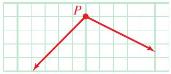
Copy the figures in Problems 13-20 on your paper. Draw what you think is an appropriate tangent line for each curve at the point \(P\) by using the secant method. P
The rate of consumption (in billions of barrels per year) for oil conforms to the formula\[R(t)=30 e^{6 t / 125}\]for \(t\) years after 2012. If the total oil still left in the earth is estimated to be 800 billion barrels, estimate the length of time before all available oil is consumed if the rate
In Problems 21-38, guess the requested limits.\(\lim _{n ightarrow \infty} \frac{2 n}{n+4}\)
Compute the limit of the convergent sequences in Problems 19-26.\(\left\{\frac{3 n}{n+5}ight\}\)
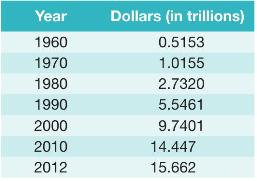
Table 18.5 shows the gross national product (GNP) in trillions of dollars for the years 1960-2012. Find the average yearly rate of change of the GNP for the requested years in Problems 19-26.Table 18.51990 to 2000 Year 1960 1970 1980 1990 2000 2010 2012 Dollars (in trillions) 0.5153 1.0155 2.7320
Find the antiderivative by using areas in Problems 9-22.\(\int(5 x+1) d x\)
In Problems 21-38, guess the requested limits.\(\lim _{n ightarrow \infty} \frac{2 n}{3 n+1}\)
Compute the limit of the convergent sequences in Problems 19-26.\(\left\{\frac{n}{3 n+5}ight\}\)
Find the antiderivative by using areas in Problems 9-22.\(\int(6 x+3) d x\)
Table 18.5 shows the gross national product (GNP) in trillions of dollars for the years 1960-2012. Find the average yearly rate of change of the GNP for the requested years in Problems 19-26.Table 18.5How fast do you think the GNP is changing in 2000 ? Year 1960 1970 1980 1990 2000 2010 2012
Graph each sequence in Problems 27-34 in one dimension.\(a_{n}=\frac{2}{n}\)
Show that \(2 x^{2}\) is an antiderivative of \(4 x\).
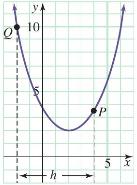
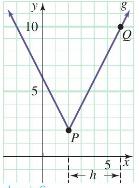
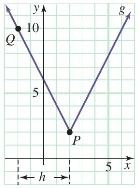
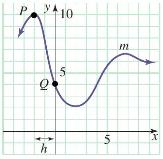
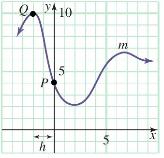
Trace the curves in Problems 27-32 onto your own paper and draw the secant line passing through \(P\) and \(Q\). Next, imagine \(h ightarrow 0\) and draw the tangent line at \(P\) assuming that \(Q\) moves along the curve to the point \(P\). Finally, estimate the slope of the curve at \(P\) using
Graph each sequence in Problems 27-34 in one dimension.\(a_{n}=\frac{2 n}{n+2}\)
In Problems 21-38, guess the requested limits.\(\lim _{n ightarrow \infty} \frac{n+1,500}{n+21,300}\)
Show that \(\frac{1}{2} x^{2}+8\) is an antiderivative of \(x\).
Trace the curves in Problems 27-32 onto your own paper and draw the secant line passing through \(P\) and \(Q\). Next, imagine \(h ightarrow 0\) and draw the tangent line at \(P\) assuming that \(Q\) moves along the curve to the point \(P\). Finally, estimate the slope of the curve at \(P\) using
In Problems 21-38, guess the requested limits.\(\lim _{n ightarrow \infty} \frac{54,500}{5 n}\)
Trace the curves in Problems 27-32 onto your own paper and draw the secant line passing through \(P\) and \(Q\). Next, imagine \(h ightarrow 0\) and draw the tangent line at \(P\) assuming that \(Q\) moves along the curve to the point \(P\). Finally, estimate the slope of the curve at \(P\) using
Graph each sequence in Problems 27-34 in one dimension.\(a_{n}=\frac{n}{1-n}\)
Show that \(\frac{1}{2} x^{2}-5\) is an antiderivative of \(x\).
In Problems 21-38, guess the requested limits.\(\lim _{n ightarrow \infty} \frac{n+1}{2 n}\)
Graph each sequence in Problems 27-34 in one dimension.\(a_{n}=\frac{n^{2}}{2 n+1}\)
Trace the curves in Problems 27-32 onto your own paper and draw the secant line passing through \(P\) and \(Q\). Next, imagine \(h ightarrow 0\) and draw the tangent line at \(P\) assuming that \(Q\) moves along the curve to the point \(P\). Finally, estimate the slope of the curve at \(P\) using
Show that \(2 x^{3}\) is an antiderivative of \(6 x^{2}\).
In Problems 21-38, guess the requested limits.\(\lim _{n ightarrow \infty} \frac{n-5}{3 n}\)
Graph each sequence in Problems 27-34 in one dimension.\(a_{n}=\frac{n+1}{n^{2}}\)
Trace the curves in Problems 27-32 onto your own paper and draw the secant line passing through \(P\) and \(Q\). Next, imagine \(h ightarrow 0\) and draw the tangent line at \(P\) assuming that \(Q\) moves along the curve to the point \(P\). Finally, estimate the slope of the curve at \(P\) using
Show that \(2 x^{3}-3\) is an antiderivative of \(6 x^{2}\).
In Problems 21-38, guess the requested limits.\(\lim _{n ightarrow \infty} \frac{1-3 n}{2 n}\)
Graph each sequence in Problems 27-34 in one dimension.\(a_{n}=\frac{n-3}{1-2 n}\)
Find the area under the curves in Problems 33-40 on the given intervals.\(y=x^{2}\) on \([0,4]\)
Find the average and instantaneous rates of change of the functions in Problems 33-36.\(f(x)=4-3 x\)a. average for \(x=-3\) to \(x=2\)b. instantaneous at \(x=-3 \)
In Problems 21-38, guess the requested limits.\(\lim _{n ightarrow \infty} \frac{3-n}{2 n}\)
Graph each sequence in Problems 27-34 in one dimension.\(a_{n}=\frac{2 n+1}{n+2}\)
Find the area under the curves in Problems 33-40 on the given intervals.\(y=x^{2}\) on \([2,5]\)
Find the average and instantaneous rates of change of the functions in Problems 33-36.\(f(x)=5\)a. average for \(x=-3\) to \(x=3\)b. instantaneous at \(x=-3\)
In Problems 21-38, guess the requested limits.\(\lim _{n ightarrow \infty} \frac{5-2 n}{5 n}\)
Graph each sequence in Problems 35-42 in two dimensions.\(a_{n}=\frac{1}{n}\)
Find the area under the curves in Problems 33-40 on the given intervals.\(y=x^{2}\) on \([1,9]\)
Find the average and instantaneous rates of change of the functions in Problems 33-36.\(f(x)=3 x^{2}\)a. average for \(x=1\) to \(x=3 \)b. instantaneous at \(x=1\)
In Problems 21-38, guess the requested limits.\(\lim _{n ightarrow \infty} \frac{2-3 n}{2 n}\)
Graph each sequence in Problems 35-42 in two dimensions.\(a_{n}=\frac{2}{n}\)
Find the area under the curves in Problems 33-40 on the given intervals.\(y=x^{2}\) on \([3,10]\)
Find the average and instantaneous rates of change of the functions in Problems 33-36.\(f(x)=-2 x^{2}+x+4\)a. average for \(x=4\) to \(x=9 \)b. instantaneous at \(x=4 \)
In Problems 21-38, guess the requested limits.\(\lim _{n ightarrow \infty} \frac{3 n}{n^{2}+2}\)
Graph each sequence in Problems 35-42 in two dimensions.\(a_{n}=\frac{2 n}{n+2}\)
Find the area under the curves in Problems 33-40 on the given intervals.\(y=4 x\) on \([2,4] \)
Find the derivative, \(f^{\prime}(x)\), of each of the functions in Problems 37-42 by using the derivative definition or the derivative of the exponential function.\(f(x)=\frac{1}{2} x^{2}\)
In Problems 21-38, guess the requested limits.\(\lim _{n ightarrow \infty} \frac{3 n^{2}+1}{2 n^{2}-1}\)
Graph each sequence in Problems 35-42 in two dimensions.\(a_{n}=\frac{n}{1-n}\)
Find the area under the curves in Problems 33-40 on the given intervals.\(y=3 x\) on \([3,8] \)
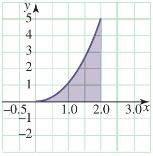
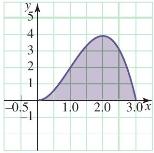
Estimate the area in each figure shown in Problems 39-46. y A 5 5432 4 1 -0.51 L -2 1.0 2.0 3.0x
Find the derivative, \(f^{\prime}(x)\), of each of the functions in Problems 37-42 by using the derivative definition or the derivative of the exponential function.\(f(x)=\frac{1}{3} x^{3}\)
Graph each sequence in Problems 35-42 in two dimensions.\(a_{n}=\frac{n^{2}}{2 n+1}\)
Find the area under the curves in Problems 33-40 on the given intervals.\(y=x+3\) on \([1,3]\)
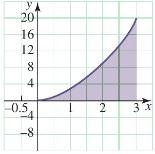
Estimate the area in each figure shown in Problems 39-46. y 20 16 12 0 + 8 4 0.5 -4 -8 2 3 x
Find the derivative, \(f^{\prime}(x)\), of each of the functions in Problems 37-42 by using the derivative definition or the derivative of the exponential function.\(f(x)=e^{1.2 x}\)
Find the area under the curves in Problems 33-40 on the given intervals.\(y=2 x+1\) on \([1,4] \)
Graph each sequence in Problems 35-42 in two dimensions.\(a_{n}=\frac{n+1}{n^{2}}\)
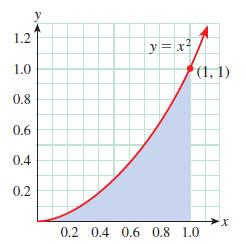
Approximate the area under the curve in Figure 18.7 using \(A_{1}\).Figure 18.7 1.2 1.0 0.8 0.6 0.4 0.2 y y=x (1, 1) 0.2 0.4 0.6 0.8 1.0 x
First, sketch the region under the graph on the interval \([a, b]\) in Problems 53-55. Then approximate the area of each region for the given value of \(n\). Use the right endpoint of each rectangle to determine the height of that particular rectangle.\(y=4 x+1\) on \([0,1]\) fora. \(n=4\)b. \(n=8\)
The cost, \(C\), in dollars, for producing \(x\) items is given by\[C(x)=30 x^{2}-100 x\]Find the average rate of change of cost as \(x\) increases from 100 to 200 items.
Approximate the area under the curve in Figure 18.7 using\[A_{1}+A_{2}\]Figure 18.7 1.2 1.0 0.8 0.6 0.4 0.2 y y=x (1, 1) 0.2 0.4 0.6 0.8 1.0 x
Find the limit (if it exists) as \(n ightarrow \infty\) for each of the sequences in Problems 43-56.\(\lim _{n ightarrow \infty} \frac{n^{4}+5 n^{3}+8 n^{2}-4 n+12}{2 n^{4}-7 n^{2}+3 n}\)
First, sketch the region under the graph on the interval \([a, b]\) in Problems 53-55. Then approximate the area of each region for the given value of \(n\). Use the right endpoint of each rectangle to determine the height of that particular rectangle.\(y=4 x^{2}+1\) on \([0,1]\) for \(n=4 \)
Approximate the area under the curve in Figure 18.7 using\[A_{1}+A_{2}+A_{3}+A_{4}\]Figure 18.7 1.2 1.0 0.8 0.6 0.4 0.2 y y=x (1, 1) 0.2 0.4 0.6 0.8 1.0 x
First, sketch the region under the graph on the interval \([a, b]\) in Problems 53-55. Then approximate the area of each region for the given value of \(n\). Use the right endpoint of each rectangle to determine the height of that particular rectangle.\(y=\frac{2}{x}\) on \([1,2]\) for \(n=4 \)
Repeat Problem 53 for 100 to 101 items.Data from problem 53The cost, \(C\), in dollars, for producing \(x\) items is given by \[C(x)=30 x^{2}-100 x\]Find the average rate of change of cost as \(x\) increases from 100 to 200 items.
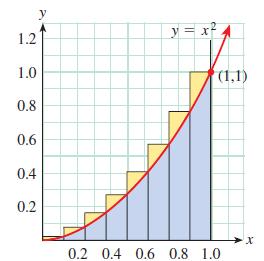
Approximate the sum of the areas of the rectangles shown in Figure 18.8a. That is, using\[A_{1}+A_{2}+\cdots+A_{7}+A_{8}\]Figure 18.8 1.2 1.0 0.8 0.6 y 0.4 0.2 y = x, (1,1) 0.2 0.4 0.6 0.8 1.0 X
Find the derivative, \(f^{\prime}(x)\), of each of the functions in Problems 37-42 by using the derivative definition or the derivative of the exponential function.\(y=e^{-6 x} \)
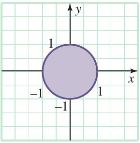
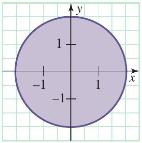
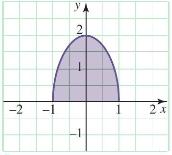
Estimate the area in each figure shown in Problems 39-46. -1 1 V 1 X
Graph each sequence in Problems 35-42 in two dimensions.\(a_{n}=\frac{n-3}{1-2 n}\)
Evaluate the integrals given in Problems 41-46.\(\int_{0}^{2} e^{0.5 x} d x\)
Find the derivative, \(f^{\prime}(x)\), of each of the functions in Problems 37-42 by using the derivative definition or the derivative of the exponential function.\(y=25-250 x\)
Estimate the area in each figure shown in Problems 39-46. -1 1 X
Graph each sequence in Problems 35-42 in two dimensions.\(a_{n}=\frac{2 n+1}{n+2}\)
Evaluate the integrals given in Problems 41-46.\(\int_{0}^{3} e^{x} d x\)
Find the derivative, \(f^{\prime}(x)\), of each of the functions in Problems 37-42 by using the derivative definition or the derivative of the exponential function.\(f(x)=3+2 x-3 x^{2}\)
Estimate the area in each figure shown in Problems 39-46. y 5' 4 3 2 -0.5, 1.0 2.0 3.0x
Find the limit (if it exists) as \(n ightarrow \infty\) for each of the sequences in Problems 43-56.\(\left\{\frac{1}{3 n}ight\}\)
Evaluate the integrals given in Problems 41-46.\(\int_{-1}^{3}\left(9-x^{2}ight) d x\)
Find an equation of the line tangent to the curves in Problems 43-46 at the given point.\(y=5 x^{2}\) at \(x=-3 \)
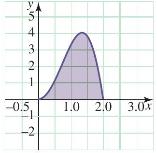
Estimate the area in each figure shown in Problems 39-46. 5 4 DWA 3 2 1 -0.5, -2 1.0 2.0 3.0x
Find the limit (if it exists) as \(n ightarrow \infty\) for each of the sequences in Problems 43-56.\(\left\{\frac{100}{5 n}ight\}\)
Evaluate the integrals given in Problems 41-46.\(\int_{1}^{5}(1+6 x) d x\)
Find an equation of the line tangent to the curves in Problems 43-46 at the given point.\(y=2 x^{2}\) at \(x=4 \)
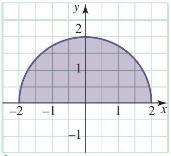
Estimate the area in each figure shown in Problems 39-46. -2 -1 YA 2 1 -1 1 2 x
Find the limit (if it exists) as \(n ightarrow \infty\) for each of the sequences in Problems 43-56.\(\left\{\frac{1}{3^{n}}ight\}\)
Evaluate the integrals given in Problems 41-46.\(\int_{0}^{1}\left(x-e^{x}ight) dx\)
Estimate the area in each figure shown in Problems 39-46. -2 -1 YA 2 1 1 2x
Find an equation of the line tangent to the curves in Problems 43-46 at the given point.\(y=4-5 x\) at \(x=-2 \)
Find the limit (if it exists) as \(n ightarrow \infty\) for each of the sequences in Problems 43-56.\(\left\{\frac{1}{2^{n}}ight\}\)
Evaluate the integrals given in Problems 41-46.\(\int_{0}^{2}\left(e^{x}+e^{2}ight) d x \)
Find an equation of the line tangent to the curves in Problems 43-46 at the given point.\(y=3 x^{2}+4 x\) at \(x=0 \)
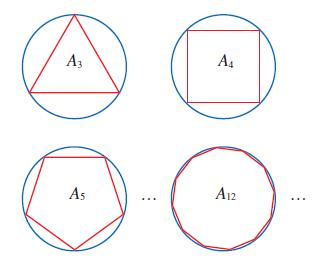
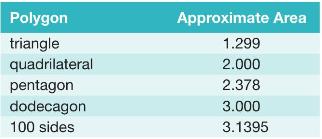
Suppose the circle in Figure 18.6 has radius 1.Table 18.1 shows the approximate areas of inscribed polygons.Figure 18.6Table 18.1What is the limit of the approximate area? A3 As A A12
Find the limit (if it exists) as \(n ightarrow \infty\) for each of the sequences in Problems 43-56.\(0.69,0.699,0.6999,0.69999\),
Consider the graph of \(y=x^{2}\) bounded by the \(x\)-axis and the line \(x=2\). Approximate the area under the curve by using rectangles and right endpoints as described in Problems 47-52.Use two rectangles of width 1 unit each.
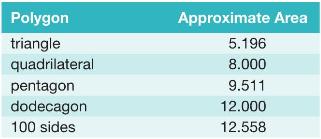
Suppose the circle in Figure 18.6 has radius 2.Table 18.2 shows the approximate areas of inscribed polygons.Figure 18.6 Table 18.2What is the limit of the approximate area? A3 As A A12
Showing 100 - 200
of 6209
1
2
3
4
5
6
7
8
9
10
11
12
13
14
15
Last
Step by Step Answers

 Get 50% OFF
Claim Now
Get 50% OFF
Claim Now