New Semester
Started
Get
50% OFF
Study Help!
--h --m --s
Claim Now
Question Answers
Textbooks
Find textbooks, questions and answers
Oops, something went wrong!
Change your search query and then try again
S
Books
FREE
Study Help
Expert Questions
Accounting
General Management
Mathematics
Finance
Organizational Behaviour
Law
Physics
Operating System
Management Leadership
Sociology
Programming
Marketing
Database
Computer Network
Economics
Textbooks Solutions
Accounting
Managerial Accounting
Management Leadership
Cost Accounting
Statistics
Business Law
Corporate Finance
Finance
Economics
Auditing
Tutors
Online Tutors
Find a Tutor
Hire a Tutor
Become a Tutor
AI Tutor
AI Study Planner
NEW
Sell Books
Search
Search
Sign In
Register
study help
business
marketing
Consumer Behavior Building Marketing Strategy 12th edition Delbert Hawkins, David Mothersbaugh - Solutions
What is task definition (as a situational variable)? Give an example of how it can influence the consumption process?
Describe the impact of purchase involvement on the decision process?
Explain problem recognition and how it fits into the consumer decision process?
Summarize the uncontrollable determinants of problem recognition?
Discuss the role of consumer problems and problem recognition in marketing strategy?
Monitor several chat sites or interest groups for a week. Prepare a report on how a marketer could learn about the consumption problems of consumers by doing this?
What is meant by purchase involvement? How does it differ from product involvement?
What are the main uncontrollable factors that influence the existing state?
How can you measure problem recognition?
In what ways can marketers react to problem recognition? Give several examples?
How does generic problem recognition differ from selective problem recognition? Under what conditions would a firm attempt to influence generic problem recognition? Why?
How can a firm cause problem recognition? Give examples?
How can a firm suppress problem recognition?
What products do you think generally are associated with nominal, limited, and extended decision making? Under what conditions, if any, would these products be associated with a different form of decision making?
What products do you think generally are purchased or used for emotional reasons? How would the decision process differ for an emotion-driven purchase compared to a more functional purchase?
What products do you think generally are associated with brand-loyal decision making and which with repeat purchase decision making? Justify your response?
Describe a purchase you have made using nominal decision making, one using limited decision making, and one using extended decision making. What caused you to use each type of decision process?
How does consumer decision making change as purchase involvement increases?
How would you measure consumer problems among the following? a) College students b) Children aged 2 to 4 c) Internet shoppers d) New residents in a town e) Vegans f) Newly married couples
How would you determine the existence of consumer problems of relevance to a marketer of the following? a) Women’s spa b) Internet retail outlets c) Online health food store d) Public library e) Hawaiian vacation resort f) Mountain bikes
Discuss the types of products that resolve specific problems that occur for most consumers at different stages of their household life cycle?
How would you activate problem recognition among college students for the following: a) Volunteering time at the Salvation Army b) Student recreation center c) A vegan diet d) Rooms To Go e) Using a designated driver if drinking f) Laundry service
How would you influence the time of problem recognition for the following? a) Fire alarm battery replacement b) Gift basket c) Car tune-up d) Air conditioner filters e) Health insurance f) Vitamins
Respond to the questions in Consumer Insight 14-1?
What is the role of emotion in the consumer decision process?
How do nominal, limited, and extended decision making differ? How do the two types of nominal decision making differ?
What influences the motivation to resolve a recognized problem?
What is the difference between an active and an inactive problem? Why is this distinction important?
What are the main uncontrollable factors that influence the desired state?
Discuss internal and external information search and their role in different decision types?
Using the DDB data (Tables 1B through 7B) describe the major determinants of the following search-related behaviors and beliefs. What are the marketing implications?General Regarding marketing implications of high versus low searchers. Two sides of this issue are important. First, since
Some consumers feel more technology savvy than others. Examine the DDB data in Tables 1B through 7B to determine what characterizes one who is likely to feel tech savvy.
Using Table 3B, specifically examine the relationship between consumer perceptions of being tech savvy and the two search-related variables in Question 1. What are the relationships and implications?
Summarize the types of information consumers search for?
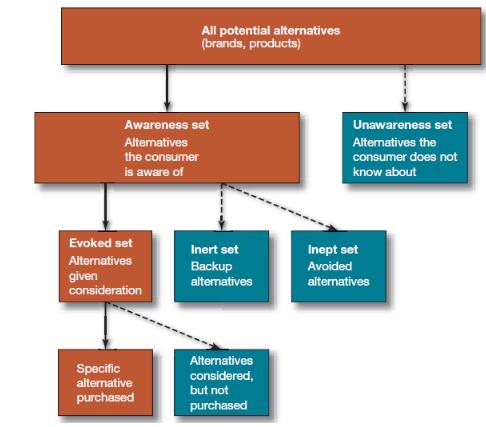
Describe the categories of decision alternatives relating to the evoked set?
Discuss available information sources and the role of Internet and mobile search?
Discuss the major cost-benefit factors driving the amount of external search?
Summarize the marketing strategies based on information search patterns?
Find and describe a magazine ad that is particularly effective at causing readers to consult a website. Why is it effective?
Use an Internet shopping service such as www.mysimon.com to determine the “best buy” for a product that interests you. Evaluate this process. How could it be improved? If you were actually going to make the purchase, would you buy this one or would you purchase elsewhere? Why?
Visit www.Amazon.com, www.epinions.com, or a similar site. Examine the product reviews provided by other customers. How useful do you think these are? What could make them more useful?
When does information search occur? What is the difference between internal and external information search?
How do nonsearchers, limited information searchers, and extended information searchers differ in their search for information?
What factors might influence the search effort of consumers who are essentially one-stop shoppers? How do these factors differ in terms of how they influence limited information searchers and extended information searchers?
What factors have to be considered in the total cost of the information search? How might these factors be different for different consumers?
Explain how different market characteristics affect information search.
How do different consumer characteristics influence a consumer’s information search effort?
How do product characteristics influence a consumer’s information search effort?
How do situational characteristics influence a consumer’s information search effort?
Describe the information search characteristics that should lead to each of the following strategies: a) Maintenance: b) Disrupt: c) Capture: d) Intercept: e) Preference: f) Acceptance:
Describe each of the strategies listed in Question 17. In question 17 a) Maintenance: b) Disrupt: c) Capture: d) Intercept: e) Preference: f) Acceptance:
Pick a product/brand that you believe would require each strategy in Table 15-3 (six products in total). Justify your selection. Develop a specific marketing strategy for each (six strategies in total).
What kind of information is sought in an external search for information?
Which product classes are most likely to have evoked sets of one? Relate this to the type of decision process.
Use a shopping service such as NexTag to help you choose a brand of digital camera. In what way does it help you form your evoked or consideration set? Is information overload a problem? Explain.
Do you have a local mobile search app? If so, what is your evaluation of it? If no, why not?
What factors contribute to the size of the awareness set, evoked set, inert set, and inept set?
Is it ever in the best interest of a marketer to encourage potential customers to carry out an extended prepurchase search? Why or why not?
What implications for marketing strategy does Figure 15-2 suggest?
What implications for online marketing strategy does Figure 15-5 suggest?
What role, if any, should the government play in ensuring that consumers have easy access to relevant product information? How should it accomplish this?
What are evaluative criteria and how do they relate to information search?
Respond to the questions in Consumer Insight 15-1. In insight When does information search occur? What is the difference between internal and external information search?
Describe a recent purchase in which you engaged in extensive search and one in which you did little prepurchase search. What factors caused the difference?
What roles do the evoked set, inert set, and inept set play in a consumer’s information search?
What are the primary sources of information available to consumers?
What is search engine optimization?
Discuss how actual consumer choice often differs from rational choice theory?
Summarize the types of choice processes consumers engage in?
Explain evaluative criteria and their measurement?
Describe the role of evaluative criteria in consumer judgment and marketing strategy?
Summarize the five decision rules for attribute-based choice and their strategic relevance?
Use Dell’s recommendation feature to select a laptop computer (hint: go to www.dell.com, select "small and medium business," and then click on "laptop"). What decision rule or combination of rules does this decision aid reflect? What type of consumer would be most likely to utilize this adviser
Visit www.Orbitz.com. What decision rule and evaluative criteria seem to dominate? Why do you think this is?
Based on the DDB Tables 1B through 7B, what characterizes an individual who would say, “In making big decisions, I go with my heart rather than my head”? How does this relate to affective decision making? What are the marketing implications of this?
What is rational choice theory?
What is sensory discrimination, and what role does it play in the evaluation of products? What is meant by a just noticeable difference?
What are surrogate indicators? How are they used in the consumer evaluation process?
What is the elimination-by-aspects decision rule?
What is the lexicographic decision rule?
How can knowledge of consumers’ evaluative criteria and criteria importance be used in developing marketing strategy?
How can knowledge of the decision rules consumers might use in a certain purchase assist a firm in developing marketing strategy? a. Disjunctive b. Conjunctive c. Lexicographic d. Elimination by aspects e. Compensatory:
Respond to the questions in Consumer Insight 16-1. In insight 16-1 What is rational choice theory?
Identify five products for which surrogate indicators may be used as evaluative criteria in a brand choice decision. Why are the indictors used, and how might a firm enhance their use (i.e., strengthen their importance)?
The table below represents a particular consumer’s evaluative criteria, criteria importance, acceptable level of performance, and judgments of performance with respect to several brands of mopeds. Discuss the brand choice this consumer would make when using the lexicographic, compensatory, and
Describe the decision rule(s) you used or would use in buying, renting, or giving to the options listed for question 23. Would you use different rules in different situations? Which ones? Why? Would any of these involve an affective choice?
Describe your last two major and your last two minor purchases. What role did emotions or feelings play? How did they differ? What evaluative criteria and decision rules did you use for each? Why?
Discuss surrogate indicators that could be used to evaluate the perceived quality of the products or activities listed in question 23. In question a) Adopting a pet from a shelter b) A movie c) A digital reader d) A BBQ grill e) A personal trainer f) Athletic shoes g) A new shampoo h) An
What are three common metagoals for consumer decisions?
What is affective choice and when is it most likely to occur?
How does attribute-based choice differ from attitude-based choice? When is each most likely?
What are evaluative criteria and on what characteristics can they vary?
How can you determine which evaluative criteria consumers use?
Describe how retailing is evolving?
What most characterizes someone who frequently uses mail order catalogs to make purchases (DDB Tables 1A through 7A)? Does there seem to be any relationship between characteristics of Internet buyers (Question 2) and catalog buyers? Explain.
What are the characteristics of heavy store brand buyers (Tables 1A through 7A)? What are the retail implications?
Discuss the Internet and mobile as part of multi- and omni-channel shopping?
Explain the retail and consumer attributes that affect outlet selection?
Summarize the in-store and online influences on brand choice?
Understand how purchase plays a role in the shopping process?
Showing 7400 - 7500
of 13098
First
68
69
70
71
72
73
74
75
76
77
78
79
80
81
82
Last
Step by Step Answers

 Get 50% OFF
Claim Now
Get 50% OFF
Claim Now