New Semester
Started
Get
50% OFF
Study Help!
--h --m --s
Claim Now
Question Answers
Textbooks
Find textbooks, questions and answers
Oops, something went wrong!
Change your search query and then try again
S
Books
FREE
Study Help
Expert Questions
Accounting
General Management
Mathematics
Finance
Organizational Behaviour
Law
Physics
Operating System
Management Leadership
Sociology
Programming
Marketing
Database
Computer Network
Economics
Textbooks Solutions
Accounting
Managerial Accounting
Management Leadership
Cost Accounting
Statistics
Business Law
Corporate Finance
Finance
Economics
Auditing
Tutors
Online Tutors
Find a Tutor
Hire a Tutor
Become a Tutor
AI Tutor
AI Study Planner
NEW
Sell Books
Search
Search
Sign In
Register
study help
engineering
mechanical engineering
Vector Mechanics For Engineers Statics And Dynamics 8th Edition Ferdinand Beer, E. Russell Johnston, Jr., Elliot Eisenberg, William Clausen, David Mazurek, Phillip Cornwell - Solutions
The reflector of a small flashlight has the parabolic shape shown. Determine the surface area of the inside of the reflector.
For the beam and loading shown, determine(a) The magnitude and location of the resultant of the distributed load,(b) The reactions at the beam supports.
For the beam and loading shown, determine(a) The magnitude and location of the resultant of the distributed load,(b) The reactions at the beam supports.
Determine the reactions at the beam supports for the given loading.
Determine the reactions at the beam supports for the given loading.
Determine the reactions at the beam supports for the given loading.
Determine the reactions at the beam supports for the given loading.
Determine the reactions at the beam supports for the given loading.
Determine the reactions at the beam supports for the given loading.
Determine(a) The distance a so that the vertical reactions at supports A and B are equal,(b) The corresponding reactions at the supports.
Determine(a) The distance a so that the vertical reaction at support B is minimum,(b) The corresponding reactions at the supports.
Determine the reactions at the beam supports for the given loading when 0 1.5 w = 5 kN/m.
Determine(a) The distributed load 0 w at the end D of the beam ABCD for which the reaction at B is zero,(b) The corresponding reactions at C.
A grade beam AB supports three concentrated loads and rests on soil and the top of a large rock. The soil exerts an upward distributed load, and the rock exerts a concentrated load RR as shown. Knowing that P = 4 kN and wB = ½wA, determine the values of wA and RR corresponding to equilibrium.
A grade beam AB supports three concentrated loads and rests on soil and the top of a large rock. The soil exerts an upward distributed load, and the rock exerts a concentrated load RR as shown. Knowing that wB = 0.4wA, determine (a) The largest value of P for which the beam is in
The cross section of a concrete dam is as shown. For a dam section of unit width, determine(a) The reaction forces exerted by the ground on the base AB of the dam,(b) The point of application of the resultant of the reaction forces of part a,(c) The resultant of the pressure forces exerted by the
The cross section of a concrete dam is as shown. For a dam section of unit width, determine(a) The reaction forces exerted by the ground on the base AB of the dam,(b) The point of application of the resultant of the reaction forces of part a,(c) The resultant of the pressure forces exerted by the
The 9×12-ft side AB of a tank is hinged at its bottom A and is held in place by a thin rod BC. The maximum tensile force the rod can withstand without breaking is 40 kips, and the design specifications require the force in the rod not exceed 20 percent of this value. If the tank is slowly filled
The 9 × 12-ft side of an open tank is hinged at its bottom A and is held in place by a thin rod. The tank is filled with glycerin, whose specific weight is 80lb/ft3. Determine the force T in the rod and the reactions at the hinge after the tank is filled to a depth of 8 ft.
The friction force between a 2 × 2-m square sluice gate AB and its guides is equal to 10 percent of the resultant of the pressure forces exerted by the water on the face of the gate. Determine the initial force needed to lift the gate that its mass is 500 kg.
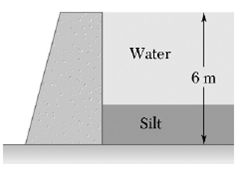
The dam for a lake is designed to withstand the additional force caused by silt which has settled on the lake bottom. Assuming that silt is equivalent to a liquid of density ρs = 1.76 × 10³ kg/m3 and considering a 1-m-wide section of dam, determine the percentage increase in the force
The base of a dam for a lake is designed to resist up to 150 percent of the horizontal force of the water. After construction, it is found that silt (which is equivalent to a liquid of density ρ = 1.76 × 10³ kg/ms3 is settling on the lake bottom at a rate of 20 mm/y. Considering a 1-m-wide
The square gate AB is held in the position shown by hinges along its top edge A and by a shear pin at B. For a depth of water d = 3.5 m, determine the force exerted on the gate by the shear pin.
Problem 5.83: A temporary dam is constructed in a 5-ft-wide fresh water channel by nailing two boards to pilings located at the sides of the channel and propping a third board AB against the pilings and the floor of the channel. Neglecting friction, determine the reactions at A and B when rope BC
Problem 5.85: A 2 × 3-m gate is hinged at A and is held in position by rod CD. End D rests against a spring whose constant is 12kN/m. The spring is undeformed when the gate is vertical. Assuming that the force exerted by rod CD on the gate remains horizontal, determine the minimum depth of water d
Problem 5.87: The gate at the end of a 3-ft-wide fresh water channel is fabricated from three 240-lb, rectangular steel plates. The gate is hinged at A and rests against a frictionless support at D. Knowing that d = 2.5 ft, determine the reactions at A and D.Problem 5.88: The gate at the end of a
A rain gutter is supported from the roof of a house by hangers that are spaced 0.6 m apart. After leaves clog the gutter’s drain, the gutter slowly fills with rainwater. When the gutter is completely filled with water, determine (a) The resultant of the pressure force exerted by the water on
The composite body shown is formed by removing a hemisphere of radius r from a cylinder of radius R and height 2R. Determine(a) The y coordinate of the centroid when r = 3R/4,(b) The ratio r/R for which y= − 1.2R.
Determine the y coordinate of the centroid of the body shown.
Determine the z coordinate of the centroid of the body shown.
Consider the composite body shown. Determine(a) The value of x when h = L/2,(b) The ratio h/L for which x = L.
Problem 5.94: For the machine element shown, determine the x coordinate of the center of gravity.Problem 5.95: For the machine element shown, determine the y coordinate of the center of gravity.
Problem 5.96: For the machine element shown, locate the x coordinate of the center of gravity.Problem 5.97: For the machine element shown, locate the y coordinate of the center of gravity.
Problem 5.98: For the stop bracket shown, locate the x coordinate of the center of gravity.Problem 5.99: For the stop bracket shown, locate the z coordinate of the center of gravity.
Locate the center of gravity of the sheet-metal form shown.
A mounting bracket for electronic components is formed from sheet metal of uniform thickness. Locate the center of gravity of the bracket.
Locate the center of gravity of the sheet-metal form shown.
An enclosure for an electronic device is formed from sheet metal of uniform thickness. Locate the center of gravity of the enclosure.
A 200-mm-diameter cylindrical duct and a 100 × 200-mm rectangular duct are to be joined as indicated. Knowing that the ducts are fabricated from the same sheet metal, which is of uniform thickness, locate the center of gravity of the assembly.
An elbow for the duct of a ventilating system is made of sheet metal of uniform thickness. Locate the center of gravity of the elbow.
A window awning is fabricated from sheet metal of uniform thickness. Locate the center of gravity of the awning.
The thin, plastic front cover of a wall clock is of uniform thickness. Locate the center of gravity of the cover.
A thin steel wire of uniform cross section is bent into the shape shown, where arc BC is a quarter circle of radius R. Locate its center of gravity.
A thin steel wire of uniform cross section is bent into the shape shown, where arc BC is a quarter circle of radius R. Locate its center of gravity.
The frame of a greenhouse is constructed from uniform aluminum channels. Locate the center of gravity of the portion of the frame shown.
The decorative metalwork at the entrance of a store is fabricated from uniform steel structural tubing. Knowing that R = 1.2 m, locate the center of gravity of the metalwork.
A scratch awl has a plastic handle and a steel blade and shank. Knowing that the specific weight of plastic is 0.0374 lb/in3 and of steel is 0.284 lb/in3, locate the center of gravity of the awl.
A bronze bushing is mounted inside a steel sleeve. Knowing that the density of bronze is 8800 kg/m3 and of steel is 7860 kg/m3, determine the center of gravity of the assembly.
A marker for a garden path consists of a truncated regular pyramid carved from stone of specific weight 160 lb/ft3. The pyramid is mounted on a steel base of thickness h, knowing that the specific weight of steel is 490 lb/ft3 and that steel plate is available in 1/4 in increments specify the
The ends of the park bench shown are made of concrete, while the seat and back are wooden boards. Each piece of wood is 36 ×120 × 1180mm, knowing that the density of concrete is 2320 kg/m3 and of wood is 470 kg/m3 determine the x and y coordinates of the center of gravity of the bench.
Determine by direct integration the values of x for the two volumes obtained by passing a vertical cutting plane through the given shape of Fig. 5.21. The cutting plane is parallel to the base of the given shape and divides the shape into two volumes of equal height.A hemisphere
Determine by direct integration the values of x for the two volumes obtained by passing a vertical cutting plane through the given shape of Fig. 5.21. The cutting plane is parallel to the base of the given shape and divides the shape into two volumes of equal height.A semi ellipsoid of revolution
Determine by direct integration the values of x for the two volumes obtained by passing a vertical cutting plane through the given shape of Fig. 5.21. The cutting plane is parallel to the base of the given shape and divides the shape into two volumes of equal height.A paraboloid of revolution
Locate the centroid of the volume obtained by rotating the shaded area about the x axis.
Locate the centroid of the volume obtained by rotating the shaded area about the x axis.
Locate the centroid of the volume obtained by rotating the shaded area about the line x = h.
Locate the centroid of the volume generated by revolving the portion of the sine curve shown about the x axis.
Locate the centroid of the volume generated by revolving the portion of the sine curve shown about the y axis.
Show that for a regular pyramid of height h and n sides (n = 3, 4,…) the centroid of the volume of the pyramid is located at a distance h / 4 above the base.
Determine by direct integration the location of the centroid of one-half of a thin, uniform hemispherical shell of radius R.
The sides and the base of a punch bowl are of uniform thickness t. If t
After grading a lot, a builder places four stakes to designate the corners of the slab for a house. To provide a firm, level base for the slab, the builder places a minimum of 60 mm of gravel beneath the slab. Determine the volume of gravel needed and the x coordinate of the centroid of the volume
Determine by direct integration the location of the centroid of the volume between the xz plane and the portion shown of the surface
Locate the centroid of the section shown, which was cut from a circular cylinder by an inclined plane.
Locate the centroid of the plane area shown.
For the area shown, determine the ratio a/b for which x = y.
Locate the centroid of the plane area shown.
Determine by direct integration the centroid of the area shown. Express your answer in terms of a and h.
Member ABCDE is a component of a mobile and is formed from a single piece of aluminum tubing. Knowing that the member is supported at C and that l = 2 m, determine the distance d so that portion BCD of the member is horizontal.
A cylindrical hole is drilled through the center of a steel ball bearing shown here in cross section. Denoting the length of the hole by L, show that the volume of the steel remaining is equal to the volume of a sphere of diameter L.
For the beam and loading shown, determine(a) The magnitude and location of the resultant of the distributed load,(b) The reactions at the beam supports.
Determine the reactions at the beam supports for the given loading.
Locate the center of gravity of the sheet-metal form shown.
The composite body shown is formed by removing a semi ellipsoid of revolution of semi major axis h and semi minor axis 2 a from a hemisphere of radius a. Determine(a) The y coordinate of the centroid when h = a/2,(b) The ratio h/a for which y = − 0.4a.
A thin steel wire of uniform cross section is bent into the shape shown. Locate its center of gravity.
Locate the centroid of the volume obtained by rotating the shaded area about the x axis.
Determine the vertical force P which must be applied at G so that the linkage is in equilibrium for the position shown.
Determine the vertical force P which must be applied at G so that the linkage is in equilibrium for the position shown.
Determine the couple M which must be applied to member DEFG so that the linkage is in equilibrium for the position shown.
Determine the couple M which must be applied to member DEFG so that the linkage is in equilibrium for the position shown.
Determine the horizontal force P which must be applied at A so that the linkage is in equilibrium for the position shown.
An un-stretched spring of constant 720 N/m is attached to pins at points C and I as shown. The pin at B is attached to member BDE and can slide freely along the slot in the fixed plate. Determine the force in the spring and the horizontal displacement of point H when a 90-N horizontal force
An un-stretched spring of constant 720 N/m is attached to pins at points C and I as shown. The pin at B is attached to member BDE and can slide freely along the slot in the fixed plate. Determine the force in the spring and the horizontal displacement of point H when a 90-N horizontal force
The two-bar linkage shown is supported by a pin and bracket at B and a collar at D that slides freely on a vertical rod. Determine the force P required to maintain the equilibrium of the linkage.
Knowing that the line of action of the force Q passes through point C, derive an expression for the magnitude of Q required to maintain equilibrium.
The mechanism shown is acted upon by the force P. Derive an expression for the magnitude of the force Q required for equilibrium.
The mechanism shown is acted upon by the force P. Derive an expression for the magnitude of the force Q required to maintain equilibrium.
An overhead garage door of weight W consists of a uniform rectangular panel AC that is supported by two sets of frictionless rollers A and B which slide in horizontal and vertical channels, respectively. The door is held in the position shown by a cable attached to the door at the middle of its
A double-scissor lift table is used to raise a 450-kg machine component. The table consists of a platform and two identical linkages on which hydraulic cylinders exert equal forces. (Only one linkage and one cylinder are shown.) Each member of the linkage is of length 600 mm, and pins C and G are
A double-scissor lift table is used to raise a 450-kg machine component. The table consists of a platform and two identical linkages on which hydraulic cylinders exert equal forces. (Only one linkage and one cylinder are shown.) Each member of the linkage is of length 600 mm, and pins C and G are
Derive an expression for the magnitude of the couple M required to maintain the equilibrium of the linkage shown.
Derive an expression for the magnitude of the couple M required to maintain the equilibrium of the linkage shown.
Derive an expression for the magnitude of the couple M required to maintain the equilibrium of the linkage shown.
The pin at C is attached to member BCD and can slide along a slot cut in the fixed plate shown. Neglecting the effect of friction, derive an expression for the magnitude of the couple M required to maintain equilibrium when the force P which acts at D is directed(a) As shown,(b) Vertically
A 1-kip force P is applied as shown to the piston of the engine system. Knowing that 2.5 AB = in. and BC = 10 in. , determine the couple M required to maintain the equilibrium of the system when(a) θ =30°,(b) θ =150°.
A couple M of magnitude 75lb‹…ft is applied as shown to the crank of the engine system. Knowing that AB = 2.5 in. and BC = 10 in., determine the force P required to maintain the equilibrium of the system when(a) θ =60°,(b) θ =120°.
For the linkage shown, determine the force P required for equilibrium when 450 a = mm, M = 27 N ⋅ m, and θ =30°.
For the linkage shown, determine the couple M required for equilibrium when a = 600 mm, P = 135 N, and θ = 40°.
Determine the value of θ corresponding to the equilibrium position of the mechanism of Prob. 10.9 when 60 P = lb and Q = 75 lb.
Determine the value of θ, where 0 ‰¤ θ ‰¤ 90°, corresponding to the equilibrium position of the mechanism of Prob. 10.16 when l = 250 mm, P = 60N, and M = 13.5 N ‹… m. Problem 10.16: Derive an expression for the magnitude of the couple
Showing 9500 - 9600
of 18200
First
89
90
91
92
93
94
95
96
97
98
99
100
101
102
103
Last
Step by Step Answers

 Get 50% OFF
Claim Now
Get 50% OFF
Claim Now


.PNG)
.PNG)
.PNG)
.PNG)
.PNG)
.PNG)
.PNG)
.PNG)
.PNG)
.PNG)
.PNG)
.PNG)
.PNG)
.PNG)
.PNG)
.PNG)
.PNG)
.PNG)
.PNG)
.PNG)
.PNG)
.PNG)
.PNG)
.PNG)
.PNG)
.PNG)
.PNG)
.PNG)
.PNG)
.PNG)
.PNG)
.PNG)
.PNG)
.PNG)
.PNG)
.PNG)
.PNG)
.PNG)
.PNG)
.PNG)
.PNG)
.PNG)
.PNG)
.PNG)
.PNG)
.PNG)
.PNG)
.PNG)
.PNG)
.PNG)
.PNG)
.PNG)
.PNG)
.PNG)
.PNG)
.PNG)
.PNG)
.PNG)
.PNG)
.PNG)
.PNG)
.PNG)
.PNG)
.PNG)
.PNG)
.PNG)
.PNG)
.PNG)
.PNG)
.PNG)
.PNG)
.PNG)
.PNG)
.PNG)
.PNG)
.PNG)
.PNG)
.PNG)
.PNG)
.PNG)
.PNG)
.PNG)
.PNG)
.PNG)
.PNG)
.PNG)
.PNG)
.PNG)
.PNG)
.PNG)
.PNG)
.PNG)
.PNG)
.PNG)
.PNG)


