New Semester
Started
Get
50% OFF
Study Help!
--h --m --s
Claim Now
Question Answers
Textbooks
Find textbooks, questions and answers
Oops, something went wrong!
Change your search query and then try again
S
Books
FREE
Study Help
Expert Questions
Accounting
General Management
Mathematics
Finance
Organizational Behaviour
Law
Physics
Operating System
Management Leadership
Sociology
Programming
Marketing
Database
Computer Network
Economics
Textbooks Solutions
Accounting
Managerial Accounting
Management Leadership
Cost Accounting
Statistics
Business Law
Corporate Finance
Finance
Economics
Auditing
Tutors
Online Tutors
Find a Tutor
Hire a Tutor
Become a Tutor
AI Tutor
AI Study Planner
NEW
Sell Books
Search
Search
Sign In
Register
study help
engineering
mechanical engineering
Vector Mechanics For Engineers Statics 7th Edition R.C.Hibbeler - Solutions
The slender rod AB of length l = 30 in. is attached to a collar at B and rests on a small wheel located at a horizontal distance a = 4 in. from the vertical rod on which the collar slides. Knowing that the coefficient of static friction between the collar and the vertical rod is 0.25 and neglecting
The 4.5-kg block A and the 3-kg block B are connected by a slender rod of negligible mass. The coefficient of static friction is 0.40 between all surfaces of contact. Knowing that for the position shown the rod is horizontal, determine the range of values of P for which equilibrium is maintained.
Bar AB is attached to collars which can slide on the inclined rods shown. A force P is applied at point D located at a distance a from end A. Knowing that the coefficient of static friction μs between each collar and the rod upon which it slides is 0.30 and neglecting the weights of the bar and of
The 6-kg slender rod AB is pinned at A and rests on the 18-kg cylinder C. Knowing that the diameter of the cylinder is 250 mm and that the coefficient of static friction is 0.35 between all surfaces of contact, determine the largest magnitude of the force P for which equilibrium is maintained.
Two rods are connected by a collar at B. . A couple MA of magnitude 12 lb ft ⋅ is applied to rod AB. Knowing that μs = 0.30 between the collar and rod AB, determine the largest couple MC for which equilibrium will be maintained.
In Problem 8.40, determine the smallest couple le MC for which equilibrium will be maintained.
Blocks A, B, and C having the masses shown are at rest on an incline. Denoting by μs the coefficient of static friction between all surfaces of contact, determine the smallest value of μs for which equilibrium is maintained.
A slender steel rod of length 9 in. is placed inside a pipe as shown. Knowing that the coefficient of static friction between the rod and the pipe is 0.20, determine the largest value of θ for which the rod will not fall into the pipe.
In Problem 8.43, determine the smallest value of θ for which the rod will not fall out of the pipe.
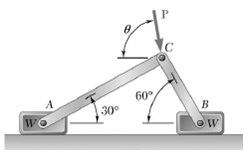
Two slender rods of negligible weight are pin-connected at C and attached to blocks A and B, each of weight W. Knowing that θ = 70o and that the coefficient of static friction between the blocks and the horizontal surface is 0.30, determine the largest value of P for which equilibrium is
A 40-lb weight is hung from a lever which rests against a 10° wedge at A and is supported by a frictionless hinge at C. Knowing that the coefficient of static friction is 0.25 at both surfaces of the wedge and that for the position shown the spring is stretched 4 in., determine (a) The
Solve Problem 8.46 assuming that force P is directed to the left.
Two 8° wedges of negligible mass are used to move and position a 240-kg block. Knowing that the coefficient of static friction is 0.40 at all surfaces of contact, determine the magnitude of the force P for which motion of the block is impending.
Two 8° wedges of negligible mass are used to move and position a 240-kg block. Knowing that the coefficient of static friction is 0.40 at all surfaces of contact, determine the magnitude of the force P for which motion of the block is impending.
The elevation of the end of the steel beam supported by a concrete floor is adjusted by means of the steel wedges E and F. The base plate CD has been welded to the lower flange of the beam, and the end reaction of the beam is known to be 150kN. The coefficient of static friction is 0.30 between the
The elevation of the end of the steel beam supported by a concrete floor is adjusted by means of the steel wedges E and F. The base plate CD has been welded to the lower flange of the beam, and the end reaction of the beam is known to be 150kN. The coefficient of static friction is 0.30 between the
Block A supports a pipe column and rests as shown on wedge B. Knowing that the coefficient of static friction at all surfaces of contact is 0.25 and that at θ = 45°, determine the smallest force P required to raise block A.
Block A supports a pipe column and rests as shown on wedge B. Knowing that the coefficient of static friction at all surfaces of contact is 0.25 and that θ = 45°, determine the smallest force P for which equilibrium is maintained.
A 16° wedge A of negligible mass is placed between two 80-kg blocks B and C which are at rest on inclined surfaces as shown. The coefficient of static friction is 0.40 between both the wedge and the blocks and block C and the incline. Determine the magnitude of the force P for which motion of
A 16° wedge A of negligible mass is placed between two 80-kg blocks B and C which are at rest on inclined surfaces as shown. The coefficient of static friction is 0.40 between both the wedge and the blocks and block C and the incline. Determine the magnitude of the force P for which motion of the
A 10° wedge is to be forced under end B of the 12-lb rod AB. Knowing that the coefficient of static friction is 0.45 between the wedge and the rod and 0.25 between the wedge and the floor, determine the smallest force P required to raise end B of the rod.
A small screwdriver is used to pry apart the two coils of a circular key ring. The wedge angle of the screwdriver blade is 16° and the coefficient of static friction is 0.12 between the coils and the blade. Knowing that a force P of magnitude 0.8 lb was required to insert the screwdriver to
A conical wedge is placed between two horizontal plates that are then slowly moved toward each other. Indicate what will happen to the wedge(a) If μs = 0.20,(b) If μs = 0.30.
A 6° steel wedge is driven into the end of an ax handle to lock the handle to the ax head. The coefficient of static friction between the wedge and the handle is 0.35. Knowing that a force P of magnitude 250 N was required to insert the wedge to the equilibrium position shown, determine the
A 15° wedge is forced under a 100-lb pipe as shown. The coefficient of static friction at all surfaces is 0.20. Determine(a) At which surface slipping of the pipe will first occur,(b) The force P for which motion of the wedge is impending.
A 15° wedge is forced under a 100-lb pipe as shown. Knowing that the coefficient of static friction at both surfaces of the wedge is 0.20, determine the largest coefficient of static friction between the pipe and the vertical wall for which slipping is impending at A.
Bags of grass seed are stored on a wooden plank as shown. To move the plank, a 9° wedge is driven under end A. Knowing that the weight of the grass seed can be represented by the distributed load shown and that the coefficient of static friction is 0.45 between all surfaces of contact,(a)
Solve Problem 8.62 assuming that the wedge is driven under the plank at B instead of at A.
The 20-lb block A is at rest against the 100-lb block B as shown. The coefficient of static friction μs is the same between blocks A and B and between block B and the floor, while friction between block A and the wall can be neglected. Knowing that 30 P = lb, determine the value of μs for which
Solve Problem 8.64 assuming that μs is the coefficient of static friction between all surfaces of contact.
Derive the following formulas relating the load W and the force P exerted on the handle of the jack discussed in Section 8.6.(a) P = (Wr/a) tan (θ + φ s), to raise the load;(b) P = (Wr/a) tan (φs − θ), to lower the load if the screw is self-locking;(c) P = (Wr/a) tan (θ − φs), to hold the
Determine by direct integration the moment of inertia of the shaded area with respect to the y axis.
The square-threaded worm gear shown has a mean radius of 30 mm and a lead of 7.5 mm. The larger gear is subjected to a constant clockwise couple of 720 N ⋅ m. Knowing that the coefficient of static friction between the two gears is 0.12 determine the couple that must be applied to shaft AB in
Determine by direct integration the moment of inertia of the shaded area with respect to the y axis.
In Problem 8.67, determine the couple that must be applied to shaft AB in order to rotate the gear clockwise.
Determine by direct integration the moment of inertia of the shaded area with respect to the y axis.
Determine by direct integration the moment of inertia of the shaded area with respect to the y axis.
High-strength bolts are used in the construction of many steel structures. For a 24-mm-nominal-diameter bolt the required minimum bolt tension is 210kN. Assuming the coefficient of friction to be 0.40, determine the required couple that should be applied to the bolt and nut. The mean diameter of
The ends of two fixed rods A and B are each made in the form of a single threaded screw of mean radius 0.3 in. and pitch 0.1 in. Rod A has a right handed thread and rod B a left-handed thread. The coefficient of static friction between the rods and the threaded sleeve is 0.12. Determine the
Assuming that in Problem 8.70 a right-handed thread is used on both rods A and B, determine the magnitude of the couple that must be applied to the sleeve in order to rotate it.
The position of the automobile jack shown is controlled by a screw ABC that is single-threaded at each end (right-handed thread at A, left-handed thread at C). Each thread has a pitch of 2 mm and a mean diameter of 7.5 mm. If the coefficient of static friction is 0.15, determine the magnitude of
For the jack of Problem 8.72, determine the magnitude of the couple M that must be applied to lower the automobile.
In the gear-pulling assembly shown, the square-threaded screw AB has a mean radius of 22.5 mm and a lead of 6 mm. Knowing that the coefficient of static friction is 0.10, determine the couple which must be applied to the screw in order to produce a force of 4.5 kN on the gear. Neglect friction at
A 120-mm-radius pulley of mass 5 kg is attached to a 30-mm-radius shaft which fits loosely in a fixed bearing. It is observed that the pulley will just start rotating if a 0.5-kg mass is added to block A. Determine the coefficient of static friction between the shaft and the bearing.
The double pulley shown is attached to a 0.5-in.-radius shaft which fits loosely in a fixed bearing. Knowing that the coefficient of static friction between the shaft and the poorly lubricated bearing is 0.40, determine the magnitude of the force P required to start raising the load.
The double pulley shown is attached to a 0.5-in.-radius shaft which fits loosely in a fixed bearing. Knowing that the coefficient of static friction between the shaft and the poorly lubricated bearing is 0.40, determine the magnitude of the force P required to start raising the load.
Determine by direct integration the moment of inertia of the shaded area with respect to the x axis.
The double pulley shown is attached to a 0.5-in.-radius shaft which fits loosely in a fixed bearing. Knowing that the coefficient of static friction between the shaft and the poorly lubricated bearing is 0.40, determine the magnitude of the force P required to maintain equilibrium.
Determine by direct integration the moment of inertia of the shaded area with respect to the X axis.
Determine by direct integration the moment of inertia of the shaded area with respect to the x axis.
The double pulley shown is attached to a 0.5-in.-radius shaft which fits loosely in a fixed bearing. Knowing that the coefficient of static friction between the shaft and the poorly lubricated bearing is 0.40, determine the magnitude of the force P required to maintain equilibrium.
Determine by direct integration the moment of inertia of the shaded area with respect to the x axis.
Control lever ABC fits loosely on a 18-mm-diameter shaft at support B. Knowing that 130 P = N for impending clockwise rotation of the lever, determine(a) The coefficient of static friction between the pin and the lever,(b) The magnitude of the force P for which counterclockwise rotation of the
The block and tackle shown is used to raise a 600-N load. Each of the 60-mm-diameter pulleys rotates on a 10-mm-diameter axle. Knowing that the coefficient of kinetic friction is 0.20, determine the tension in each portion of the rope as the load is slowly raised.
Determine by direct integration the moment of inertia of the shaded area with respect to the x axis.
The block and tackle shown is used to lower a 600-N load. Each of the 60-mm-diameter pulleys rotates on a 10-mm-diameter axle. Knowing that the coefficient of kinetic friction is 0.20, determine the tension in each portion of the rope as the load is slowly lowered.
Determine by direct integration the moment of inertia of the shaded area with respect to the x axis.
Determine by direct integration the moment of inertia of the shaded area with respect to the x axis.
The link arrangement shown is frequently used in highway bridge construction to allow for expansion due to changes in temperature. At each of the 3-in.-diameter pins A and B the coefficient of static friction is 0.20. Knowing that the vertical component of the force exerted by BC on the link is 50
Determine by direct integration the moment of inertia of the shaded area with respect to the x axis.
A gate assembly consisting of a 24-kg gate ABC and a 66-kg counterweight D is attached to a 24-mm-diameter shaft B which fits loosely in a fixed bearing. Knowing that the coefficient of static friction is 0.20 between the shaft and the bearing, determine the magnitude of the force P for which
A gate assembly consisting of a 24-kg gate ABC and a 66-kg counterweight D is attached to a 24-mm-diameter shaft B which fits loosely in a fixed bearing. Knowing that the coefficient of static friction is 0.20 between the shaft and the bearing, determine the magnitude of the force P for which
Determine by direct integration the moment of inertia of the shaded area with respect to the y axis.
A gate assembly consisting of a 24-kg gate ABC and a 66-kg counterweight D is attached to a 24-mm-diameter shaft B which fits loosely in a fixed bearing. Knowing that the coefficient of static friction is 0.20 between the shaft and the bearing, determine the magnitude of the force P for which
Determine by direct integration the moment of inertia of the shaded area with respect to the y axis.
A gate assembly consisting of a 24-kg gate ABC and a 66-kg counterweight D is attached to a 24-mm-diameter shaft B which fits loosely in a fixed bearing. Knowing that the coefficient of static friction is 0.20 between the shaft and the bearing, determine the magnitude of the force P for which
Determine the moment of inertia and the radius of gyration of the shaded area shown with respect to the x axis.
Determine the moment of inertia and the radius of gyration of the shaded area shown with respect to the x axis.
A loaded railroad car has a weight of 35 tons and is supported by eight 32-in.-diameter wheels with 5-in.-diameter axles. Knowing that the coefficients of friction are μs = 0.020 and μk = 0.015, determine the horizontal force required(a) For impending motion of the car,(b) To keep the car moving
A scooter is designed to roll down a 2 percent slope at a constant speed. Assuming that the coefficient of kinetic friction between the 1-in-diameter axles and the bearing is 0.10, determine the required diameter of the wheels. Neglect the rolling resistance between the wheels and the ground.
Determine the moment of inertia and the radius of gyration of the shaded area shown with respect to the y axis.
A 25-kg electric floor polisher is operated on a surface for which the coefficient of kinetic friction is 0.25. Assuming that the normal force per unit area between the disk and the floor is uniformly distributed, determine the magnitude Q of the horizontal forces required to prevent motion of the
Determine the moment of inertia and the radius of gyration of the shaded area shown with respect to the y axis.
The pivot for the seat of a desk chair consists of the steel plate A, which supports the seat, the solid steel shaft B which is welded to A and which turns freely in the tubular member C, and the nylon bearing D. If a person of weight W = 180 lb is seated directly above the pivot, determine the
As the surfaces of a shaft and a bearing wear out, the frictional resistance of a thrust bearing decreases it is generally assumed that the wear is directly proportional to the distance traveled by any given point of the shaft and thus to the distance r from the point to the axis of the shaft.
Assuming that bearings wear out as indicated in Problem 8.92, show that the magnitude M of the couple required to overcome the frictional resistance of a worn-out collar bearing is M = ½ μk P(R1 + R2) where P = magnitude of the total axial force R1, R2 = inner and outer radii of collar.
Assuming that the pressure between the surfaces of contact is uniform, show that the magnitude M of the couple required to overcome frictional resistance for the conical bearing shown is M = 2/3 μk P/sin θ R3/2-R3/1 / R2/2 – R2/1.
P 9.19 Determine the moment of inertia and the radius of gyration of the shaded area shown with respect to the x axis. P 9.20 Determine the moment of inertia and the radius of gyration of the shaded area shown with respect to the y axis.
Solve Problem 8.90 assuming that the normal force per unit area between the disk and the floor varies linearly from a maximum at the center to zero at the circumference of the disk.
A 1-ton machine base is rolled along a concrete floor using a series of steel pipes with outside diameters of 5 in. Knowing that the coefficient of rolling resistance is 0.025 in. between the pipes and the base and 0.0625 in. between the pipes and the concrete floor, determine the magnitude of the
Knowing that a 120-mm-diameter disk rolls at a constant velocity down a 2 percent incline, determine the coefficient of rolling resistance between the disk and the incline?
Determine the horizontal force required to move a 1-Mg automobile with 460-mm-diameter tires along a horizontal road at a constant speed. Neglect all forms of friction except rolling resistance, and assume the coefficient of rolling resistance to be 1 mm.
Solve Problem 8.88 including the effect of a coefficient of rolling resistance of 0.02 in.
Solve Problem 8.89 including the effect of a coefficient of rolling resistance of 0.07 in.
Determine the moment of inertia and the radius of gyration of the shaded area with respect to the x axis.
Determine the moment of inertia and the radius of gyration of the shaded area with respect to the x axis.
A hawser is wrapped two full turns around a bollard. By exerting a 320-N force on the free end of the hawser, a dockworker can resist a force of 20kN on the other end of the hawser. Determine(a) The coefficient of static friction between the hawser and the bollard,(b) The number of times the hawser
Determine the moment of inertia and the radius of gyration of the shaded area with respect to the y axis.
Blocks A and B are connected by a cable that passes over support C. Friction between the blocks and the inclined surfaces can be neglected. Knowing that motion of block B up the incline is impending when 16 WB = lb, determine(a) The coefficient of static friction between the rope and the
Determine the moment of inertia and the radius of gyration of the shaded area with respect to the y axis.
Determine the moments of inertia of the shaded area shown with respect to the x and y axes.
Determine the moments of inertia of the shaded area shown with respect to the x and y axes.
Blocks A and B are connected by a cable that passes over support C. Friction between the blocks and the inclined surfaces can be neglected. Knowing that the coefficient of static friction between the rope and the support is 0.50, determine the range of values of WB for which equilibrium is
A 120-kg block is supported by a rope which is wrapped 1 ½ times around a horizontal rod. Knowing that the coefficient of static friction between the rope and the rod is 0.15, determine the range of values of P for which equilibrium is maintained.
For the 6-in2 shaded area shown, determine the distance d2 and the moment of inertia with respect to the centroidal axis parallel to AA′ knowing that the moments of inertia with respect to AA′ and BB′ are 30 in4 and 58 in4, respectively, and that d1 = 1.25 in.
The coefficient of static friction between block B and the horizontal surface and between the rope and support C is 0.40. Knowing that WA = 30 lb, determine the smallest weight of block B for which equilibrium is maintained.
The coefficient of static friction μs is the same between block B and the horizontal surface and between the rope and support C. Knowing that WA = WB, determine the smallest value of μs for which equilibrium is maintained.
Determine for the shaded region the area and the moment of inertia with respect to the centroidal axis parallel to BB′ knowing that d1 = 1.25 in. and d2 = 0.75 in. and that the moments of inertia with respect to AA′ and BB′ are 20 in4 and 15 in4, respectively.
In the pivoted motor mount shown, the weight W of the 85-kg motor is used to maintain tension in the drive belt. Knowing that the coefficient of static friction between the flat belt and drums A and B is 0.40, and neglecting the weight of platform CD, determine the largest torque which can be
Solve Problem 8.107 assuming that the drive drum A is rotating counterclockwise.
Showing 10200 - 10300
of 18200
First
96
97
98
99
100
101
102
103
104
105
106
107
108
109
110
Last
Step by Step Answers

 Get 50% OFF
Claim Now
Get 50% OFF
Claim Now


.PNG)
.PNG)
.PNG)
.PNG)
.PNG)
.PNG)
.PNG)
.PNG)
.PNG)
.PNG)
.PNG)
.PNG)
.PNG)
.PNG)
.PNG)
.PNG)
.PNG)
.PNG)
.PNG)
.PNG)
.PNG)
.PNG)
.PNG)
.PNG)
.PNG)
.PNG)
.PNG)
.PNG)
.PNG)
.PNG)
.PNG)
.PNG)
.PNG)
.PNG)
.PNG)
.PNG)
.PNG)
.PNG)
.PNG)
.PNG)
.PNG)
.PNG)
.PNG)
.PNG)
.PNG)
.PNG)
.PNG)
.PNG)
.PNG)
.PNG)
.PNG)
.PNG)
.PNG)
.PNG)
.PNG)
.PNG)
.PNG)
.PNG)
.PNG)
.PNG)
.PNG)
.PNG)
.PNG)
.PNG)
.PNG)
.PNG)
.PNG)
.PNG)
.PNG)
.PNG)
.PNG)
.PNG)
.PNG)
.PNG)
.PNG)
.PNG)
.PNG)
.PNG)
.PNG)
.PNG)
.PNG)
.PNG)
.PNG)


