New Semester
Started
Get
50% OFF
Study Help!
--h --m --s
Claim Now
Question Answers
Textbooks
Find textbooks, questions and answers
Oops, something went wrong!
Change your search query and then try again
S
Books
FREE
Study Help
Expert Questions
Accounting
General Management
Mathematics
Finance
Organizational Behaviour
Law
Physics
Operating System
Management Leadership
Sociology
Programming
Marketing
Database
Computer Network
Economics
Textbooks Solutions
Accounting
Managerial Accounting
Management Leadership
Cost Accounting
Statistics
Business Law
Corporate Finance
Finance
Economics
Auditing
Tutors
Online Tutors
Find a Tutor
Hire a Tutor
Become a Tutor
AI Tutor
AI Study Planner
NEW
Sell Books
Search
Search
Sign In
Register
study help
physics
electrodynamics
Elements of Electromagnetics 3rd Edition Matthew - Solutions
Find the work done in carrying a 5-C charge from P(1, 2, - 4) to R(3, – 5, 6) in an electric fieldE = ax + z2ay + 2yzaz V/m
Given that the electric field in a certain region is E = (z + 1) sin Φ aρ, + (z + 1) cos aΦ + ρ sin Φ az V/m determine the work done in moving a 4-nC charge from (a) A(1, 0, 0) to B(4, 0,0) (b) B(4, 0, 0) to C(4, 30°, 0) (c) C(4, 30°, 0) to D(4, 30°, – 2) (d) A
In an electric field E = 20r sin θ ar + 10r cos θ aθ V/m, calculate the energy expended in transferring a 10-nC charge (a) From A(5, 30°, 0°) to B(5, 90°, 0°) (b) From A to C(10, 30°, 0°) (c) From A to D(5,30°, 60°) (d) From A to E(10, 90°, 60°)
Let V = xy2z, calculate the energy expended in transferring a 2-µC point charge from (1, –1, 2) to (2, 1, –3).
Determine the electric field due to the following potentials: (a) V= x2 + 2y2 + 4z2 (b) V = sin(x2 + y2 + z2)1/2 (c) V = ρ2(z + l)sin Φ (d) V = e–r sin θ cos 2Φ
Three point charges Q1 = 1mC, Q2 = –2mC, and Q3 = 3mC are, respectively, located at (0, 0, 4), (–2, 5, 1), and (3, – 4, 6).(a) Find the potential VP at P(–1, 1, 2).(b) Calculate the potential difference VPQ if Q is (1, 2, 3).
In free space, V = x2y (z + 3) V. Find(a) Eat (3, 4, – 6)(b) The charge within the cube 0 < x, y, z < 1.
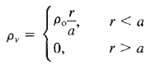
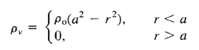
A spherical charge distribution is given byFind V every where.
To verify that E = yzax + xzay + xyaz V/m is truely an electric field, show that (a) ∆ x E = 0 (b) ∫L E ∙ dI = 0, where L is the edge of the square defined 0
(a) A total charge Q = 60µC is split into two equal charges located at 180° intervals around a circular loop of radius 4 m. Find the potential at the center of the loop. (b) If Q is split into three equal charges spaced at 120° intervals around the loop, find the potential at the center. (c)
For a spherical charge distribution (a) Find E and V for r > a (b) Find E and V for r (c) Find the total charge (d) Show that E is maximum when r =0.145a.
(a) Prove that when a particle of constant mass and charge is accelerated from rest in an electric field, its final velocity is proportional to the square root of the potential difference through which it is accelerated.(b) Find the magnitude of the proportionality constant if the particle is an
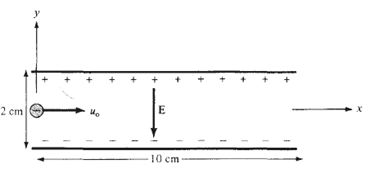
An electron is projected with an initial velocity uo = 107 m/s into the uniform field between the parallel plates of figure. It enters the field at the midway between the plates. If the electron just misses the upper plate as it emerges from the field.(a) Find the electric field intensity.(b)
An electric dipole with p = paz C ∙ m is placed at (x, z) = (0, 0). If the potential at (0, 1) nm is 9 V, find the potential at (1, 1) nm.
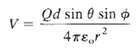
Point charges Q and ? Q are located at (0, d/2, 0) and (0, ? d/2, 0). Show that at point (r, ?, ?), where r >> d Find the corresponding E field.
Determine the work necessary to transfer charges Q1 = 1mC and Q2 = –2mC from infinity to points (– 2, 6, 1) and (3, –4, 0), respectively.
A point charge Q is placed at the origin. Calculate the energy stored in region r > a.
Find the energy stored in the hemispherical region r < 2 m, 0 < θ < π, where E = 2r sin θ cos Φ ar + r cos θ cos Φ aθ – r sin Φ aΦ V/m exists.
If V = ρ2z sin Φ, calculate the energy within the region defined by 1 < ρ < 4, - 2 < z < 2, 0 < Φ < π/3.
In a certain region, J = 3r2 cos θ ar – r2 sin θ aθ A/m, find the current crossing the surface defined by θ = 30°, 0 < Φ < 2π, 0 < r < 2 m.
Determine the total current in a wire of radius 1.6 mm if J 500az /ρ = A/m2.
The current density in a cylindrical conductor of radius a isJ = 10e-(1–ρ/a}az A/m2Find the current through the cross section of the conductor.
The charge 10–4e–3t C is removed from a sphere through a wire. Find the current in the wire at t = 0 and t = 2.5 s.
(a) Let V = x2y2z in a region (ε = 2ε0) defined by – 1 < x, y, z < 1. Find the charge density ρv in the region.(b) If the charge travels at 104yay m/s, determine the current crossing surface 0 < x, z < 0.5, y = 1.
If the ends of a cylindrical bar of carbon (σ = 3 X 10⁴) of radius 5 mm and length 8 cm are maintained at a potential difference of 9 V, find: (a) The resistance of the bar, (b) The current through the bar, (c) The power dissipated in the bar.
The resistance of round long wire of diameter 3 mm is 4.04Ω/km. If a current of 40 A flows through the wire, find (a) The conductivity of the wire and identify the material of the wire (b) The electric current density in the wire
A coil is made of 150 turns of copper wire wound on a cylindrical core. If the mean radius of the turns is 6.5 mm and the diameter of the wire is 0.4 mm, calculate the resistance of the coil.
A composite conductor 10 m long consists of an inner core of steel of radius 1.5 cm and an outer sheath of copper whose thickness is 0.5 cm. (a) Determine the resistance of the conductor. (b) If the total current in the conductor is 60 A, what current flows in each metal? (c) Find the resistance
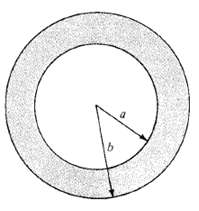
A hollow cylinder of length 2 m has its cross section as shown in figure. If the cylinder is made of carbon (? = 105 mhos/m), determine the resistance between the ends of the cylinder. Take a = 3 cm, b = 5 cm.
At a particular temperature and pressure, a helium gas contains 5 × 1025 atoms/m3. If a 10-kV/m field applied to the gas causes an average electron cloud shift of 10–8 m, find the dielectric constant of helium.
A dielectric material contains 2 × 10¹⁹ polar molecules/m3, each of dipole moment 1.8 × 10⁻²⁷ C/m. Assuming that all the dipoles are aligned in the direction of the electric field E = 105 ax V/m, find P and εr.
In a slab of dielectric material for which ε = 2.4ε0 and V = 300z2 V, find: (a) D and ρv, (b) P and ρpv.
A cylindrical capacitor with inner radius a and outer radius b is filled with an inhomogeneous dielectric having ε = εok/p, where A; is a constant. Calculate the capacitance per unit length of the capacitor.
Consider figure as a spherical dielectric shell so that ε = ε0εr for a < r < b and ε = eo for 0 < r < a. If a charge Q is placed at the center of the shell, find (a) P for a < r < b (b) ρpv for a < r < b (c) ρps at r = a and r = b
Two point charges when located in free space exert a force of 4.5μN on each other. When the space between them is filled with a dielectric material, the force changes to 2μN find the dielectric constant of the material and identify the material.
A conducting sphere of radius 10 cm is centered at the origin and embedded in a dielectric material with e = 2.5eo. If the sphere carries a surface charge of 4nC/m2, find E at (—3 cm, 4 cm, 12 cm).
At the center of a hollow dielectric sphere (ε = εoεr) is placed a point charge Q. If the sphere has inner radius a and outer radius b, calculate D, E, and P.
A sphere of radius a and dielectric constant er has a uniform charge density of ?o. (a) At the center of the sphere, show that (b) Find the potential at the surface of the sphere.
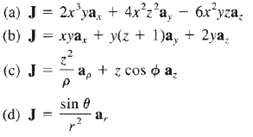
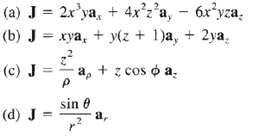
For static (time-independent) fields, which of the following current densities arepossible?
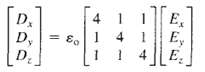
For an anisotropic medium Obtain D for: (a) E = 10ax + 10ay, V/m,? (b) E = 10ax + 20ay - 30az V/m.
If J = 100/ρ2 aρ A/m2, find: (a) The rate of increase in the volume charge density, (b) The current passing through surface defined by ρ = 2,0 < z < 1, 0 < Φ <2 π.
Given that J = 5e – 104t/r ar A/m2, at t = 0.1 ms, find: (a) The amount of current passing surface r = 2 m, (b) The charge density ρv on that surface.
Determine the relaxation time for each of the following medium: (a) Hard rubber (σ = 10–15 S/m, ε = 3.1εo) (b) Mica (σ = 10–15 S/m, ε = 6εo) (c) Distilled water (σ = 10–4 S/m, ε = 80 εo)
The excess charge in a certain medium decreases to one-third of its initial value in 20μs. (a) If the conductivity of the medium is 10 4 S/m, what is the dielectric constant of the medium? (b) What is the relaxation time? (c) After 30μs, what fraction of the charge will remain?
Lightning strikes a dielectric sphere of radius 20 mm for which εr = 2.5, σ = 5 X 10⁻⁶ mhos/m and deposits uniformly a charge of 10μC. Determine the initial charge density and the charge density 2μs later.
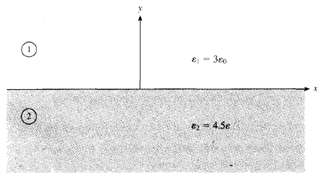
Region 1 (z < 0) contains a dielectric for which ε = 2.5, while region 2 (z > 0) is characterized by ε = 4. Let E1 = -30ax + 50ay + 70az V/m and find: (a) D2, (b) P2, (c) The angle between E1 and the normal to the surface.
Given that E1 = 10ax - 6ay + 12az, V/m in figure find:(a) P1(b) E2 and the angle E2 makes with the y-axis,(c) The energy density in eachregion.
Two homogeneous dielectric regions 1 (p < 4 cm) and 2 (p > 4 cm) have dielectric constants 3.5 and 1.5, respectively. If D2 = 12ap - 6a0 + 9az nC/m2, calculate: (a) E1 and D1, (b) P2 and ppv2, (c) The energy density for each region.
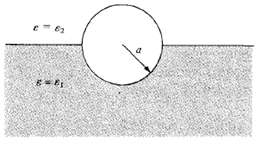
A conducting sphere of radius a is half-embedded in a liquid dielectric medium of permittivity s, as in figure. The region above the liquid is a gas of permittivity ?2. If the total free charge on the sphere is Q, determine the electric field intensity everywhere.
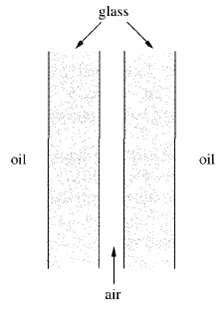
Two parallel sheets of glass (?r = 8.5) mounted vertically are separated by a uniform air gap between their inner surface. The sheets, properly sealed, are immersed in oil (?r = 3.0) as shown in figure. A uniform electric field of strength 2000 V/m in the horizontal direction exists in the oil.
(a) Given that E = 15ax – 8az V/m at a point on a conductor surface, what is the surface charge density at that point? Assume ε = ε0. (b) Region y > 2 is occupied by a conductor. If the surface charge on the conductor is – 20nC/m2, find D just outside the conductor.
A silver-coated sphere of radius 5 cm carries a total charge of 12nC uniformly distributed on its surface in free space. Calculate (a) |D| on the surface of the sphere, (b) D external to the sphere, and (c) The total energy stored in the field.
A point charge of 10nC is located at point P(0, 0, 3) while the conducting plane z = 0 is grounded. Calculate(a) V and E at R(6,3,5)(b) The force on the charge due to induced charge on the plane.
Two point charges of 3nC and – 4nC are placed, respectively, at (0, 0, 1 m) and (0, 0, 2 m) while an infinite conducting plane is at z = 0. Determine(a) The total charge induced on the plane(b) The magnitude of the force of attraction between the charges and the plane
Two point charges of 50nC and – 20nC are located at (– 3, 2, 4) and (1, 0, 5) above the conducting ground plane z = 2. Calculate (a) The surface charge density at (7, –2, 2),(b) D at (3, 4, 8), and (c) D at (1, 1, 1).
A point charge of 10μC is located at (1, 1, 1), and the positive portions of the coordinate planes are occupied by three mutually perpendicular plane conductors maintained at zero potential. Find the force on the charge due to the conductors.
A point charge Q is placed between two earthed intersecting conducting planes that are inclined at 45° to each other. Determine the number of image charges and their locations.
Infinite line x = 3, z = 4 carries 16nC/m and is located in free space above the conducting plane z = 0. (a) Find E at (2, – 2, 3). (b) Calculate the induced surface charge density on the conducting plane at (5, – 6, 0).
In free space, infinite planes y = A and y = 8 carry charges 20nC/m2 and 30 nC/m2, respectively. If plane y = 2 is grounded, calculate E at P(0, 0, 0) and Q(– 4, 6, 2).
In free space, V = 6xy2z + 8. At point P(1, 2, – 5) , find E and ρv.
Two infinitely large conducting plates are located at x = 1 and x = 4. The space between them is free space with charge distribution x/6π nC/m3. Find V at x = 2 if V(l) = – 50V and V(4) = 50V.
The region between x = 0 and x = d is free space and has ρv = po(x – d)/d. If V(x = 0) = 0 and V(x = d) = Vo, find:(a) V and E,(b) The surface charge densities at x = 0 and x = d.
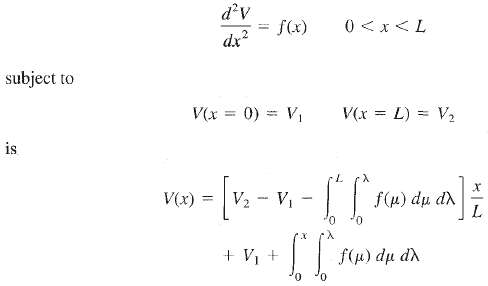
Show that the exact solution of the equation
A certain material occupies the space between two conducting slabs located at y = ± 2 cm. When heated, the material emits electrons such that ρv = 50(1 – y2) μC/m3. If the slabs are both held at 30 kV, find the potential distribution within the slabs. Take ε = 3ε0.
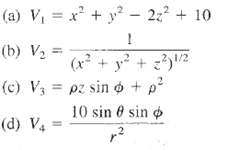
Determine which of the following potential field distributions satisfy Laplace'sequation.
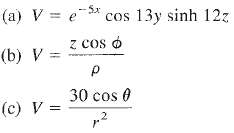
Show that the following potentials satisfy Laplace'sequation.
Show that E = (Ex, Ey, Ez) satisfies Laplace's equation.
Let V = (A cos nx + B sin nx) (Ceny + De–ny), where A, B, C, and D are constants. Show that V satisfies Laplace's equation.
The potential field V = 2x2yz – y3z exists in a dielectric medium having ε = 2ε0. (a) Does V satisfy Laplace's equation? (b) Calculate the total charge within the unit cube 0 < x, y, z < 1 m.
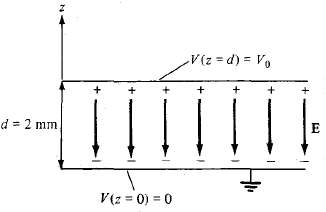
Consider the conducting plates shown in figure. If V(z = 0) = 0 and V(z = 2 mm) = 50 V, determine V, E, and D in the dielectric region (?r = 1.5) between the plates and ?s on the plates.
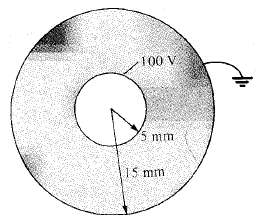
The cylindrical-capacitor whose cross section is in Figure has inner and outer radii of 5 mm and 15 mm, respectively. If V(? =?5 mm) = 100 V and V(? = 1 5 mm) = 0 V, calculate V,?E, and D at ? =?10 mm and ?s?on each plate. Take ?r = 2.0.
Concentric cylinders ρ = 2 cm and ρ = 6 cm are maintained at V = 60 V and V = – 20 V, respectively. Calculate V, E, and D at ρ = 4 cm.
The region between concentric spherical conducting shells r = 0.5 m and r = 1 m is charge free. If V(r = 0.5) = – 5 0 V and V(r = 1) = 50 V, determine the potential distribution and the electric field strength in the region between the shells.
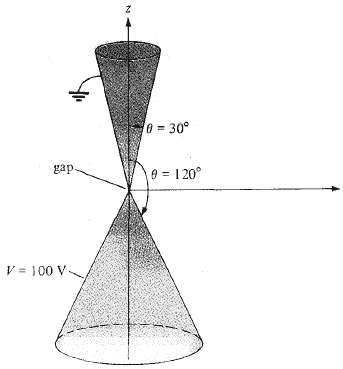
Find V and E at (3, 0, 4) due to the two conducting cones of infinite extent shown in Figure.
The inner and outer electrodes of a diode are coaxial cylinders of radii a = 0.6 m and b = 30 mm, respectively. The inner electrode is maintained at 70 V while the outer electrode is grounded, (a) Assuming that the length of the electrodes ℓ >> a, b and ignoring the effects of space charge,
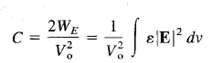
Another method of finding the capacitance of a capacitor is using energy considerations, that is Using this approach, derive eqs. (6.22), (6.28), and(6.32).
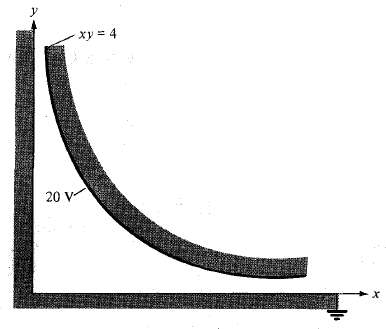
An electrode with a hyperbolic shape (xy = 4) is placed above an earthed right-angle corner as in figure. Calculate V and E at point (1, 2, 0) when the electrode is connected to a 20-Vsource.
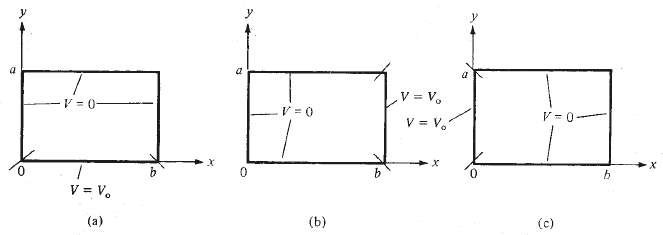
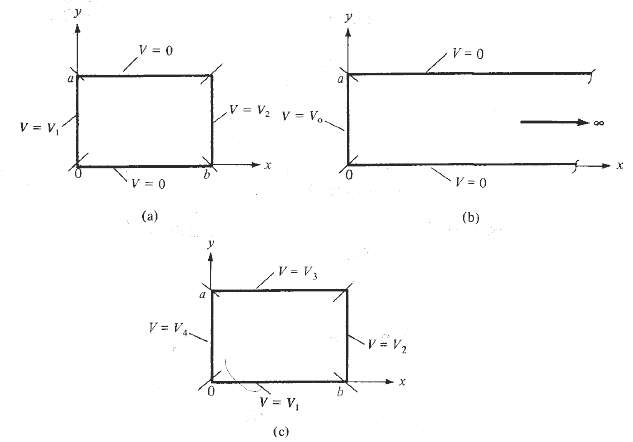
Solve Laplace's equation for the two-dimensional electrostatic systems of figure and find the potential V(x,y).
Find the potential V(x, y) due to the two-dimensional systems offigure.
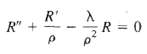
By letting V(p, ?) = R(p) ? (?)?be the solution of Laplace's equation in a region where p # 0, show that the separated differential equations for R?and ??are? And ?" + ?? = 0 where X is the separation constant.
A potential in spherical coordinates is a function of r and θ but not Φ. Assuming that V(r, θ) = R(r) F(θ), obtain the separated differential equations for R and F in a region for which ρv = 0.
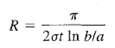
Show that the resistance of the bar of figure between the vertical ends located at ? = 0 and ? = ?/2 is
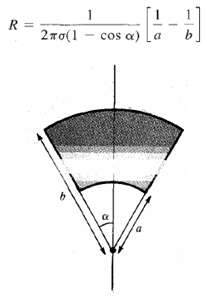
Show that the resistance of the sector of a spherical shell of conductivity a, with cross section shown in figure (where 0
A hollow conducting hemisphere of radius a is buried with its flat face lying flush with the earth surface thereby serving as an earthing electrode. If the conductivity of earth is a, show that the leakage conductance between the electrode and earth is 2πασ
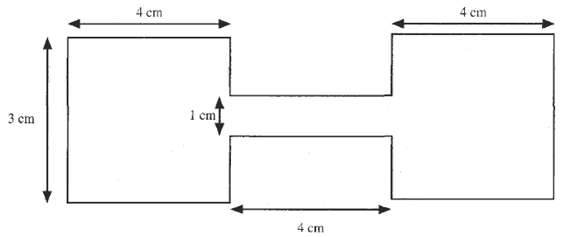
The cross section of an electric fuse is shown in figure. If the fuse is made of copper and of thickness 1.5 mm, calculate itsresistance.
In an integrated circuit, a capacitor is formed by growing a silicon dioxide layer (εr = 4) of thickness 1μm over the conducting silicon substrate and covering it with a metal electrode of area 5. Determine S if a capacitance of 2nF is desired.
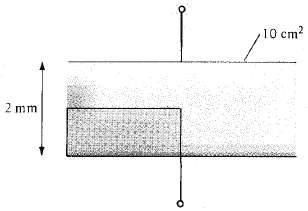
The parallel-plate capacitor of figure is quarter-filled with mica (?r = 6). Find the capacitance of the capacitor.
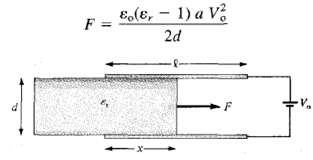
An air-filled parallel plate capacitor of length L, width a, and plate separation d has its plates maintained at constant potential difference Vo. If a dielectric slab of dielectric constant ?r is slid between the plates and is withdrawn until only a length x remains between the plates as in
A parallel-plate capacitor has plate area 200 cm2 and plate separation 3 mm. The charge density is 1μC/m2 with air as dielectric. Find (a) The capacitance of the capacitor (b) The voltage between the plates (c) The force with which the plates attract each other
Two conducting plates are placed at z = – 2 cm and z = 2 cm and are, respectively, maintained at potentials 0 and 200 V. Assuming that the plates are separated by a polypropylene (ε = 2.25εo). Calculate: (a) The potential at the middle of the plates, (b) The surface charge densities
Two conducting parallel plates are separated by a dielectric material with ε = 5.6ε0 and thickness 0.64 mm. Assume that each plate has an area of 80 cm2. If the potential field distribution between the plates is V = 3x + Ay – 12z + 6 kV, determine: (a) The capacitance of the
The space between spherical conducting shells r = 5 cm and r = 10 cm is filled with a dielectric material for which ε = 2.25εo. The two shells are maintained at a potential difference of 80 V. (a) Find the capacitance of the system, (b) Calculate the charge density on shell r = 5 cm.
Concentric shells r = 20 cm and r = 30 cm are held at V = 0 and V = 50, respectively. If the space between them is filled with dielectric material (ε = 3.1ε0, a = 10–12 S/m), find:(a) V, E, and D,(b) The charge densities on the shells,(c) The leakage resistance.
A spherical capacitor has inner radius a and outer radius d. Concentric with the spherical conductors and lying between them is a spherical shell of outer radius c and inner radius b. If the regions d < r < c, c < r < b, and b < r < a are filled with materials with per-mittivites ε1, ε2,
Determine the capacitance of a conducting sphere of radius 5 cm deeply immersed in sea water (εr = 80).
A conducting sphere of radius 2 cm is surrounded by a concentric conducting sphere of radius 5 cm. If the space between the spheres is filled with sodium chloride (εr = 5.9), calculate the capacitance of the system.
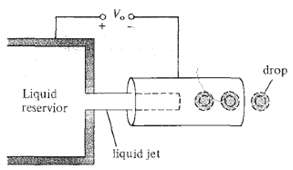
In an ink-jet printer the drops are charged by surrounding the jet of radius 20?m with a concentric cylinder of radius 600?m as in figure. Calculate the minimum voltage required to generate a charge 50fC on the drop if the length of the jet inside the cylinder is 100?m. Take ? = ?o.
A given length of a cable, the capacitance of which is 10μF/km with a resistance of insulation of 100MΩ/km, is charged to a voltage of 100 V. How long does it take the voltage to drop to 50 V?
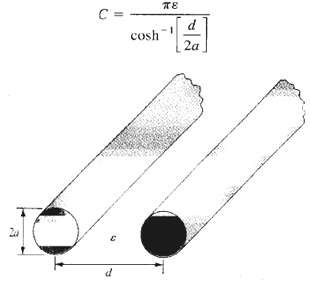
The capacitance per unit length of a two-wire transmission line shown in figure is given byDetermine the conductance per unitlength.
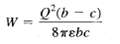
A spherical capacitor has an inner conductor of radius a carrying charge Q and maintained at zero potential. If the outer conductor contracts from a radius b to c under internal forces, prove that the work performed by the electric field as a result of the contractionis
Showing 800 - 900
of 1324
1
2
3
4
5
6
7
8
9
10
11
12
13
14
Step by Step Answers

 Get 50% OFF
Claim Now
Get 50% OFF
Claim Now