New Semester
Started
Get
50% OFF
Study Help!
--h --m --s
Claim Now
Question Answers
Textbooks
Find textbooks, questions and answers
Oops, something went wrong!
Change your search query and then try again
S
Books
FREE
Study Help
Expert Questions
Accounting
General Management
Mathematics
Finance
Organizational Behaviour
Law
Physics
Operating System
Management Leadership
Sociology
Programming
Marketing
Database
Computer Network
Economics
Textbooks Solutions
Accounting
Managerial Accounting
Management Leadership
Cost Accounting
Statistics
Business Law
Corporate Finance
Finance
Economics
Auditing
Tutors
Online Tutors
Find a Tutor
Hire a Tutor
Become a Tutor
AI Tutor
AI Study Planner
NEW
Sell Books
Search
Search
Sign In
Register
study help
physics
electrodynamics
Classical Electrodynamics 3rd Edition John David Jackson - Solutions
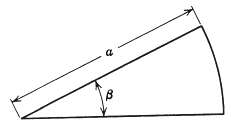
The geometry of a two-dimensional potential problem is defined in polar coordinates by the surfaces ? = 0, ? = ?, and ?? = a, as indicated in the sketch. Using separation of variables in polar coordinates, show that the Green function can be written as Problem 2.25 may be of use.
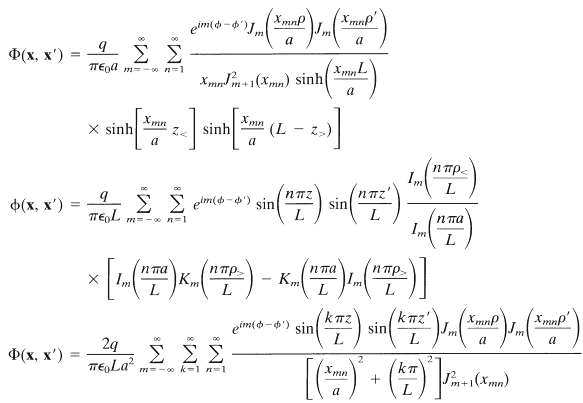
A point charge q is located at the point (??, ?', z') inside a grounded cylindrical box defined by the surfaces z = 0, z = L, ? = a. Show that the potential inside the box can be expressed in the following alternative forms: Discuss the relation of the last expansion (with its extra summation) to
The walls of the conducting cylindrical box of Problem 3.23 are all at zero potential, except for a disc in the upper end, defined by ρ = b < a, at potential V.(a) Using the various forms of the Green function obtained in Problem 3.23, find three expansions for the potential inside the
Consider the Green function appropriate for Neumann boundary conditions for the volume V between the concentric spherical surfaces defined by r = a and r = b, a Where gt(r, r') = rl/ rl+1>?+ fl(r, r') (a) Show that for l > 0, the radial Green function has the symmetric form (b) Show that
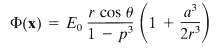
Apply the Neumann Green function of problem 3.26 to the situation in which the normal electric field is Er = ?E0 cos ? at the outer surface (r = b) and is Er = 0 on the inner surface (r = a). (a) Show that the electrostatic potential inside the volume V is Where p = a/b. find the components of
A point dipole with dipole moment p is located at the point x0. From the properties of the derivative of a Dirac delta function, show that for calculation of the potential Ф or the energy of a dipole in an external field, the dipole can be described by an effective charge densityΡeff(x) = -p
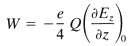
A nucleus with quadrupole moment Q finds itself in a cylindrically symmetric electric field with a gradient (?Ez/?z)0 along the z axis at the position of the nucleus. (a) Show that the energy of quadrupole interaction is (b) If it is known that Q = 2 X 10?8 m2 and that W/h is 10 MHz, where h is
A very long, right circular, cylindrical shell of dielectric constant ε/ε0 and inner and outer radii a and b, respectively, is placed in a previously uniform electric field E0 with its axis perpendicular to the field. The medium inside and outside the cylinder has a dielectric constant of unity.
A point charge q is located in free space a distance d from the center of a dielectric sphere of radius a (a < d) and dielectric constant ε /ε0.(a) Find the potential at all points in space as an expansion in spherical harmonics.(b) Calculate the rectangular components of the electric field
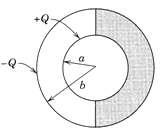
Two concentric conducting spheres of inner and outer radii a and b, respectively, carry charges ?Q. The empty space between the spheres is half-filled by a hemispherical shell of dielectric (of dielectric constant ?/?0), as shown in the figure. (a) Find the electric field everywhere between the
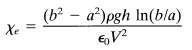
Two long, coaxial, cylindrical conducting surfaces of radii a and b are lowered vertically into a liquid dielectric. If the liquid raises an average height h between the electrodes when a potential difference V is established between them, show that the susceptibility of the liquid is Where ρ is
For each set of Stokes parameters given below deduce the amplitude of the electric field, up to an overall phase, in both linear polarization and circular polarization bases and makes an accurate drawing similar to Figure showing the lengths of the axes of one of the ellipses and its
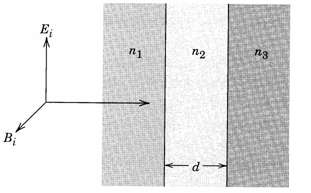
A plane wave is incident on a layered interface as shown in the figure. The indices of refraction of the three nonpermeable media are n1, n2, n3. The thickness of the intermediate layer is d. Each of the other media is semi-infinite. (a) Calculate the transmission and reflection coefficients
Two plane semi-infinite slabs of the same uniform, isotropic, nonpermeable, lossless dielectric with index of refraction n are parallel and separated by an air gap (n = 1) of width d. A plane electromagnetic wave of frequency w is incident on the gap from one of the slabs with angle of incidence i.
A plane-polarized electromagnetic wave of frequency w in free space is incident normally on the flat surface of a nonpermeable medium of conductivity a and dielectric constant ε.(a) Calculate the amplitude and phase of the reflected wave relative to the incident wave for arbitrary σ and ε.(b)
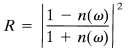
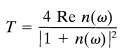
A plane wave of frequency w is incident normally from vacuum on a semi-infinite slab of material with a complex index of refraction n(w) [n2(w) = ?(w)/?0]. (a) Show that the ratio of reflected power to incident power is while the ratio of power transmitted into the medium to the incident power
The time dependence of electrical disturbances in good conductors is governed by the frequency-dependent conductivity G.58). Consider longitudinal electric fields in a conductor, using Ohm's law, the continuity equation, and the differential form of Coulomb's law.(a) Show that the
A stylized model of the ionosphere is a medium described by the dielectric constant (7.59). Consider the earth with such a medium beginning suddenly at a height h and extending to infinity. For waves with polarization both perpendicular to the plane of incidence (from a horizontal antenna) and in
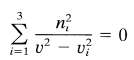
Plane waves propagate in a homogeneous, non-permeable, but anisotropic dielectric. The dielectric is characterized by a tensor ?ij, but if coordinate axes are chosen as the principle axes, the components of displacement along these axes are related to the electric-field components by Di = ?iEi(i =
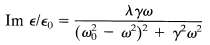
Use the Kramers-Kronig relation (7.120) to calculate the real part of ?(w), given the imaginary part of ?(w) for positive w as (a) Im ?/?0 = ?[?(w ? w1) - ?(w ? w2)], ? ? ? ? ? ?w2 > w1 > 0 (b) In each case sketch the behavior of Im ?(w) and the result for Re ?(w) as functions of w. Comment
Discuss the extension of the Kramers-Kronig relations (7.120) for a medium with a static electrical conductivity a. Show that the first equation in (7.120) is unchanged, but that the second is changedinto
A circularly polarized plane wave moving in the z direction has a finite extent in the x and ?? directions. Assuming that the amplitude modulation is slowly varying (the wave is many wavelengths broad), show that the electric and magnetic fields are given approximately by where e1, e2, e3 are
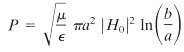
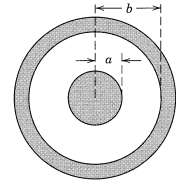
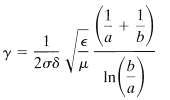
A transmission line consisting of two concentric circular cylinders of metal with conductivity a and skin depth ?, as shown, is filled with a uniform lossless dielectric (?, ?). ? ??? mode is propagated along this line. Section 8.1 applies. (a) Show that the time-averaged power flow along the line
Transverse electric and magnetic waves are propagated along a hollow, right circular cylinder with inner radius R and conductivity a. (a) Find the cutoff frequencies of the various ТЕ and TM modes. Determine numerically the lowest cutoff frequency (the dominant mode) in terms of the tube radius
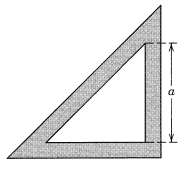
A waveguide is constructed so that the cross section of the guide forms a right triangle with sides of length a, a, ?2a, as shown. The medium inside has ?? = ?r = 1. (a) Assuming infinite conductivity for the walls, determine the possible modes of propagation and their cutoff frequencies. (b) For
A resonant cavity of copper consists of a hollow, right circular cylinder of inner radius R and length L, with flat end faces.(a) Determine the resonant frequencies of the cavity for all types of waves. With (1/√με R) as a unit of frequency, plot the lowest four resonant frequencies of each
For the Schumann resonances of Section 8.9 calculate the Q values on the assumption that the earth has a conductivity σe and the ionosphere has a conductivity σi, with corresponding skin depths 8e and δi.(a) Show that to lowest order in h/a the Q value is given by Q = Nh/(δe + δi) and
Apply the variational method of Problem 8.9 to estimate the resonant frequency of the lowest TM mode in a "breadbox" cavity with perfectly conducting walls, of length d in the z direction, radius R for the curved quarter-circle "front" of the breadbox, and the "bottom" and "back" of the box defined
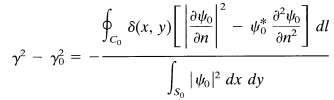
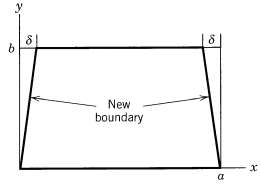
A waveguide with lossless dielectric inside and perfectly conducting walls has a cross-sectional contour ? that departs slightly from a comparison contour Co whose fields are known. The difference in boundaries is described by ?(x, y), the length measured from C0 to ? along the normal to C0 at the
To treat perturbations if there is a degeneracy of modes in guides or cavities under ideal conditions one must use degenerate-state perturbation theory. Consider the two-dimensional (waveguide) situation in which there is an N-fold degeneracy in the ideal circumstances (of perfect conductivity or
(a) From the use of Green's theorem in two dimensions show that the TM and ТЕ modes in a waveguide defined by the boundary-value problems (8.34) and (8.36) are orthogonal in the sense that ∫A EzλEzμda = 0 for λ ≠ μ for TM modes, and a corresponding relation for Hz for ТЕ modes.(b) Prove
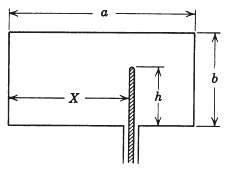
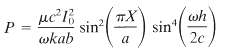
The figure shows a cross-sectional view of an infinitely long rectangular waveguide with the center conductor of a coaxial line extending vertically a distance h into its interior at z = 0. The current along the probe oscillates sinusoidally in time with frequency w, and its variation in space can
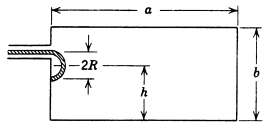
An infinitely long rectangular waveguide has a coaxial line terminating in the short side of the guide with the thin central conductor forming a semicircular loop of radius R whose center is a height h above the floor of the guide, as shown in the accompanying cross-sectional view. The half-loop is
A hollow metallic waveguide with a distortion in the form of a localized bend or increase in cross section can support nonpropagating ("bound state") configurations of fields in the vicinity of the distortion. Consider a rectangular guide that has its distortion confined to a plane, as shown in the
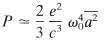
Using the Lienard-Wiechert fields, discuss the time-averaged power radiated per unit solid angle in nonrelativistic motion of a particle with charge e, moving(a) Along the z axis with instantaneous position z(t) = a cos w0t,(b) In a circle of radius R in the x-y plane with constant angular
A nonrelativistic particle of charge ze, mass m, and kinetic energy E makes a head-on collision with a fixed central force field of finite range. The interaction is repulsive and described by a potential V(r), which becomes greater than E at close distances. (a) Show that the total energy radiated
(a) Generalize the circumstances of the collision of Problem 14.5 to nonzero angular momentum (impact parameter) and show that the total energy radiated is given by where rmin is the closest distance of approach (root of E ? V ? L2/2mr2), L = mbv0, where b is the impact parameter, and v0 is the
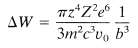
A nonrelativistic particle of charge ze, mass m, and initial speed v0 is incident on a fixed charge Ze at an impact parameter b that is large enough to ensure that the particle's deflection in the course of the collision is very small. (a) Using the Larmor power formula and Newton's second law,
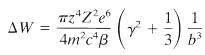
A swiftly moving particle of charge ze and mass m passes a fixed point charge Ze in an approximately straight-line path at impact parameter b and nearly constant speed v. Show that the total energy radiated in the encounter is This is the relativistic generalization of the result of Problem14.7.
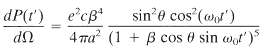
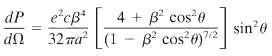
As in Problem 14.4a a charge e moves in simple harmonic motion along the z axis, z(t') = ? cos(w0t?). (a) Show that the instantaneous power radiated per unit solid angle is? where ? = ? w0/?. (b) By performing a time averaging, show that the average power per unit solid angle is (c) Make rough
Show explicitly by use of the Poisson sum formula or other means that, if the motion of a radiating particle repeats itself with periodicity T, the continuous frequency spectrum becomes a discrete spectrum containing frequencies that are integral multiples of the fundamental. Show that a general
(a) Show that for the simple harmonic motion of a charge discussed in Problem 14.12 the average power radiated per unit solid angle in the mth harmonic is (b) Show that in the nonrelativistic limit the total power radiated is all in the fundamental and has the value where α2 is the mean square
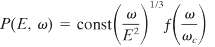
A particle of charge e and mass m moves relativistically in a helical path in a uniform magnetic field B. The pitch angle of the helix is ? (? = 0 corresponds to circular motion). (a) By arguments similar to those of Section 14.4, show that an observer far from the helix would detect radiation with
Consider the synchrotron radiation from the Crab nebula. Electrons with energies up to 1013eV move in a magnetic field of the order of 10?4 gauss. (a) For E = 1013eV, ? = 3 X 10?4 gauss, calculate the orbit radius ?, the fundamental frequency w0 = c/p, and the critical frequency wc. What is the
A radiating quadrupole consists of a square of side a with charges ± q at alternate corners. The square rotates with angular velocity ω about an axis normal to the plane of the square and through its center. Calculate the quadrupole moments, the radiation fields, the angular distribution of
Two halves of a spherical metallic shell of radius R and infinite conductivity are separated by a very small insulating gap. An alternating potential is applied between the two halves of the sphere so that the potentials are ± V cos ωt. In the long-wavelength limit, find the radiation fields, the
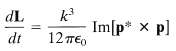
(a) Show that a classical oscillating electric dipole p with fields given by (9.18) radiates electromagnetic angular momentum to infinity at the rate (b) What is the ratio of angular momentum radiated to energy radiated? Interpret. (c) For a charge e rotating in the x-y plane at radius ? and
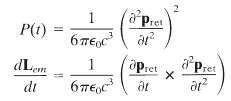
(a) From the electric dipole fields with general time dependence of Problem 9.6, show that the total power and the total rate of radiation of angular momentum through a sphere at large radius r and time t are where the dipole moment p is evaluated at the retarded time t = t ? r/c. (b) The dipole
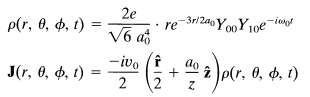
The transitional charge and current densities for the radiative transition from the m = 0, 2p state in hydrogen to the Is ground state are, in the notation of (9.1) and with the neglect of spin, Where a0 = 4??0h2/m?2 = 0.529 ? 10-10 m is the Bohr radius, ?0 = 3e2/32??0ha0 is the frequency
An almost spherical surface defined byR(θ) = R0[1 + βP2(cos θ)]has inside of it a uniform volume distribution of charge totaling Q. The small parameter β varies harmonically in time at frequency ω. This corresponds to surface waves on a sphere. Keeping only lowest order terms in β and making
The uniform charge density of Problem 9.12 is replaced by a uniform density of intrinsic magnetization parallel to the z axis and having total magnetic moment M. With the same approximations as above calculate the nonvanishing radiation multipole moments, the angular distribution of radiation, and
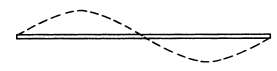
A thin linear antenna of length d is excited in such a way that the sinusoidal current makes a full wavelength of oscillation as shown in the figure. (a) Calculate exactly the power radiated per unit solid angle and plot the angular distribution of radiation. (b) Determine the total power radiated
Treat the linear antenna of Problem 9.16 by the multipole expansion method. (a) Calculate the multipole moments (electric dipole, magnetic dipole, and electric quadrupole) exactly and in the long-wavelength approximation. (b) Compare the shape of the angular distribution of radiated power for the
A spherical hole of radius a in a conducting medium can serve as an electromagnetic resonant cavity. (a) Assuming infinite conductivity, determine the transcendental equations for the characteristic frequencies ωlm of the cavity for ТЕ and TM modes. (b) Calculate numerical values for the
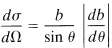
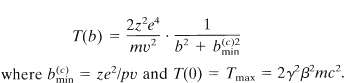
If the light particle (electron) in the Coulomb scattering of Section 13.1 is treated classically, scattering through an angle ? is correlated uniquely to an incident trajectory of impact parameter b according to b = ze2/p? cot ?/2 where p = ?m? and the differential scattering cross section
Time-varying electromagnetic fields E(x, t) and B(x, t) of finite duration act on a charged particle of charge e and mass m bound harmonically to the origin with natural frequency ?0 and small damping constant ?. The fields may be caused by a passing charged particle or some other external source.
The external fields of Problem 13.2 are caused by a charge ze passing the origin in a straight-line path at speed v and impact parameter b. The fields are given by (11.152). (a) Evaluate the Fourier transforms for the perpendicular and parallel components of the electric field at the origin and
(a) Taking h(ω) = 12Z eV in the quantum-mechanical energy-loss formula, calculate the rate of energy loss (in MeV/cm) in air at NTP, aluminum, copper, and lead for a proton and a mu meson, each with kinetic energies of 10,100,1000 MeV.(b) Convert your results to energy loss in units of MeV •
Assuming that Plexiglas or Lucite has an index of retraction of 1.50 in the visible region, compute the angle of emission of visible Cherenkov radiation for electrons and protons as a function of their kinetic energies in MeV. Determine how many quanta with wavelengths between 4000 and 6000 A are
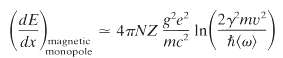
A magnetic monopole with magnetic charge g passes through matter and loses energy by collisions with electrons, just as does a particle with electric charge ze. (a) In the same approximation as presented in Section 13.1, show that the energy loss per unit distance is given approximately by (13.14),
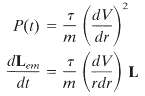
A nonrelativistic particle of charge e and mass m is bound by a linear, isotropic, restoring force with force constant mw20. Using (6.13) and (16.16) of Section 16.2, show that the energy and angular momentum of the particle both decrease exponentially from their initial values as e–Γt, where Г
A nonrelativistic electron of charge —e and mass m bound in an attractive Coulomb potential (–Ze2/r) moves in a circular orbit in the absence of radiation reaction.(a) Show that both the energy and angular-momentum equations (16.13) and (16.16) lead to the solution for the slowly changing orbit
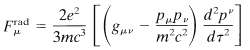
(a) Show that the radiation reaction force in the Lorentz-Dirac equation of Problem 16.7 can be expressed alternatively as (b) The relativistic generalization of A6.10) can be obtained by replacing d2pv/d??2 by gvλ dFextλ/d?? in the expression for Fradμ. Show that the spatial part of the
(a) Show that for arbitrary initial polarization, the scattering cross section of a perfectly conducting sphere of radius a, summed over outgoing polarizations, is given in the long-wavelength limit by Where n0 and n are the directions of the incident and scattered radiations, respectively,
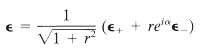
Electromagnetic radiation with elliptic polarization, described (in the notation of Section 7.2) by the polarization vector, is scattered by a perfectly conducting sphere of radius a. Generalize the amplitude in the scattering cross section (10.71), which applies for r = 0 or r = ? , and
A solid uniform sphere of radius R and conductivity σ acts as a scatterer of a plane-wave beam of unpolarized radiation of frequency ω, with ωR/c
Discuss the scattering of a plane wave of electromagnetic radiation by a nonper-meable, dielectric sphere of radius α and dielectric constant єr. (a) By finding the fields inside the sphere and matching to the incident plus scattered wave outside the sphere, determine without any restriction on
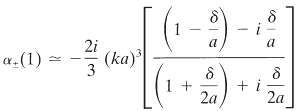
Consider the scattering of a plane wave by a nonpermeable sphere of radius ? and very good, but not perfect, conductivity following the spherical multipole field approach of Section 10.4. Assume that ka (a) Show from the analysis of Section 8.1 that Zs/Z0 = k?/2 (1 ? i) (b) In the long-wavelength
The aperture or apertures in a perfectly conducting plane screen can be viewed as the location of effective sources that produce radiation (the diffracted fields). An aperture whose dimensions are small compared with a wavelength acts as a source of dipole radiation with the contributions of other
A perfectly conducting flat screen occupies half of the x-y plane (i.e., x 0 and wave number ? is incident along the z axis from the region z 0. Let the coordinates of the observation point be (X, 0, Z). (a) Show that, for the usual scalar Kirchhoff approximation and in the limit Z >> X and
A linearly polarized plane wave of amplitude E0 and wave number k is incident on a circular opening of radius α in an otherwise perfectly conducting flat screen. The incident wave vector makes an angle α with the normal to the screen. The polarization vector is perpendicular to the plane of
A rectangular opening with sides of length α and b > α defined by x = ±(α/2), у = ±(b/2) exists in a flat, perfectly conducting plane sheet filling the x-y plane. A plane wave is normally incident with its polarization vector making an angle β with the long edges of the opening.(a)
(a) Show from (10.125) that the integral of the shadow scattering differential cross section, summed over outgoing polarizations, can be written in the short-wavelength limit as and therefore is equal to the projected area of the scatterer, independent of its detailed shape. (b) Apply the
Discuss the diffraction due to a small, circular hole of radius a in a flat, perfectly conducting sheet, assuming that k? (a) If the fields near the screen on the incident side are normal E0e?i?t and tangential B0e?i?t, show that the diffracted electric field in the Fraunhofer zone is? where k
Show explicitly that two successive Lorentz transformations in the same direction are equivalent to a single Lorentz transformation with a velocity v = v1 + v2/1 + (v1v2/c2)This is an alternative way to derive the parallel-velocity addition law.
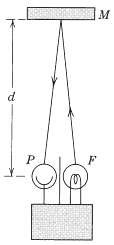
A possible clock is shown in the figure. It consists of a flashtube F and a photocell P shielded so that each views only the mirror M, located a distance d away, and mounted rigidly with respect to the flashtube-photocell assembly. The electronic innards of the box are such that when the photocell
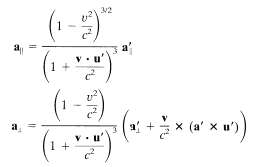
A coordinate system K' moves with a velocity v relative to another system K. In K' a particle has a velocity u' and an acceleration a'. Find the Lorentz transformation law for accelerations, and show that in the system К the components of acceleration parallel and perpendicular to vare
Assume that a rocket ship leaves the earth in the year 2100. One of a set of twins born in 2080 remains on earth; the other rides in the rocket. The rocket ship is so constructed that it has an acceleration g in its own rest frame (this makes the occupants feel at home). It accelerates in a
In the reference frame К two very evenly matched sprinters are lined up a distance d apart on the у axis for a race parallel to the x axis. Two starters, one beside each man, will fire their starting pistols at slightly different times, giving a handicap to the better of the two runners. The time
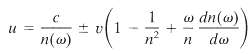
(a) Use the relativistic velocity addition law and the invariance of phase to discuss the Fizeau experiments on the velocity of propagation of light in moving liquids. Show that for liquid flow at a speed v parallel or antiparallel to the path of the light the speed of the light, as observed in the
An infinitesimal Lorentz transformation and its inverse can be written as where ??? and ??? are infinitesimal. (a) Show from the definition of the inverse that ??? = ? ??? . (b) Show from the preservation of the norm that ??? = ? ??? . (c) By writing the transformation in terms of contravariant
An infinitely long straight wire of negligible cross-sectional area is at rest and has a uniform linear charge density q0 in the inertial frame K'. The frame K' (and the wire) move with a velocity v parallel to the direction of the wire with respect to the laboratory frame K. (a) Write down the
In a certain reference frame a static, uniform, electric field E0 is parallel to the x axis, and a static, uniform, magnetic induction B0 = 2E0 lies in the x-y plane, making an angle θ with the axis. Determine the relative velocity of a reference frame in which the electric and magnetic fields are
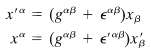
In the rest frame of a conducting medium the current density satisfies Ohm's law J' = σE', where σ is the conductivity and primes denote quantities in the rest frame.(a) Taking into account the possibility of convection current as well as conduction current, show that the covariant generalization
The electric and magnetic fields of a particle of charge q moving in a straight line with speed v = ?c, given by (11.152), become more and more concentrated as ? ? 1, as is indicated in Fig. Choose axes so that the charge moves along the z axis in the positive direction, passing the origin at t =
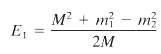
A particle of mass M and 4-momentum P decays into two particles of masses m1 and m2. (a) Use the conservation of energy and momentum in the form, p2 = P ? ?1, and the invariance of scalar products of 4-vectors to show that the total energy of the first particle in the rest frame of the decaying
The presence in the universe of an apparently uniform "sea" of blackbody radiation at a temperature of roughly 3K gives one mechanism for an upper limit on the energies of photons that have traveled an appreciable distance since their creation. Photon-photon collisions can result in the
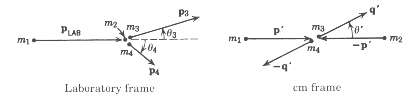
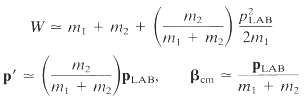
In a collision process a particle of mass m2, at rest in the laboratory, is struck by a particle of mass m1 momentum PLAB and total energy ELAB. In the collision the two initial particles are transformed into two others of mass m3 and m4. The con-figurations of the momentum vectors in the center of
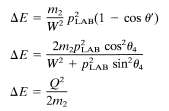
In an elastic scattering process the incident particle imparts energy to the stationary target. The energy ?E lost by the incident particle appears as recoil kinetic energy of the target. In the notation of Problem 11.23, m3 = m1 and m4 = m2, while ?E = T4 = E4?- m4. (a) Show that AE can be
(a) A charge density ρ' of zero total charge, but with a dipole moment p, exists in reference frame K'. There is no current density in K'. The frame K' moves with a velocity v = βc in the frame K. Find the charge and current densities ρ and J in the frame k and show that there is a magnetic
Show that the Lorentz invariant Lagrangian (in the sense of Section 12.1B)L = – mUαUα/2 – q/c UαAαgives the correct relativistic equations of motion for a particle of mass m and charge q interacting with an external field described by the 4-vector potential Aα(x).
(a) Show from Hamilton's principle that Lagrangians that differ only by a total time derivative of some function of the coordinates and time are equivalent in the sense that they yield the same Euler-Lagrange equations of motion.(b) Show explicitly that the gauge transformation Aα → Aα + ∂αA
A particle with mass m and charge e moves in a uniform, static, electric field E0. (a) Solve for the velocity and position of the particle as explicit functions of time, assuming that the initial velocity v0 was perpendicular to the electric field. (b) Eliminate the time to obtain the trajectory of
It is desired to make an E × В velocity selector with uniform, static, crossed, electric and magnetic fields over a length L. If the entrance and exit slit widths are ∆x, discuss the interval ∆u of velocities, around the mean value u = cE/B, that is transmitted by the device as a
A particle of mass m and charge e moves in the laboratory in crossed, static, uniform, electric and magnetic fields. E is parallel to the x axis; В is parallel to the у axis. (a) For | E | < | В | make the necessary Lorentz transformation described in Section 12.3 to obtain explicitly parametric
The magnetic field of the earth can be represented approximately by a magnetic dipole of magnetic moment M = 8.1 ? 1025 gauss-cm3. Consider the motion of energetic electrons in the neighborhood of the earth under the action of this dipole field (Van Allen electron belts). [Note that M points
Consider the precession of the spin of a muon, initially longitudinally polarized, as the muon moves in a circular orbit in a plane perpendicular to a uniform magnetic field B.(a) Show that the difference Ω of the spin precession frequency and the orbital gyration frequency isΩ =
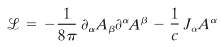
An alternative Lagrangian density for the electromagnetic field is (a) Derive the Euler-Lagrange equations of motion. Are they the Maxwell equations? Under what assumptions?(b) Show explicitly, and with what assumptions, that this Lagrangian density differs from (12.85) by a 4-divergence. Does
Consider the Proca equations for a localized steady-state distribution of current that has only a static magnetic moment. This model can be used to study the observable effects of a finite photon mass on the earth's magnetic field. Note that if the magnetization is M(x) the current density can be
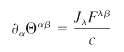
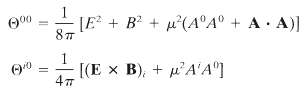
(a) Starting with the Proca Lagrangian density (12.91) and following the same procedure as for the electromagnetic fields, show that the symmetric stress-energy-momentum tensor for the Proca fields is (b) For these fields in interaction with the external source J?, as in (12.91), show that the
Showing 1200 - 1300
of 1324
1
2
3
4
5
6
7
8
9
10
11
12
13
14
Step by Step Answers

 Get 50% OFF
Claim Now
Get 50% OFF
Claim Now