New Semester
Started
Get
50% OFF
Study Help!
--h --m --s
Claim Now
Question Answers
Textbooks
Find textbooks, questions and answers
Oops, something went wrong!
Change your search query and then try again
S
Books
FREE
Study Help
Expert Questions
Accounting
General Management
Mathematics
Finance
Organizational Behaviour
Law
Physics
Operating System
Management Leadership
Sociology
Programming
Marketing
Database
Computer Network
Economics
Textbooks Solutions
Accounting
Managerial Accounting
Management Leadership
Cost Accounting
Statistics
Business Law
Corporate Finance
Finance
Economics
Auditing
Tutors
Online Tutors
Find a Tutor
Hire a Tutor
Become a Tutor
AI Tutor
AI Study Planner
NEW
Sell Books
Search
Search
Sign In
Register
study help
physics
electrodynamics
Introduction to Electrodynamics 3rd Edition David J. Griffiths - Solutions
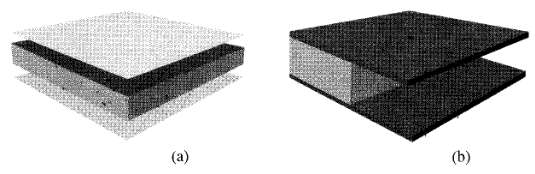
Find the electric field at a height z above the center of a square sheet (side a) carrying a uniform surface charge σ. Check your result for the limiting cases a → ∞ and z >> a.
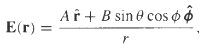
If the electric field in some region is given (in spherical coordinates) by the expression where A and B are constants, what is the charge density?
Find the net force that the southern hemisphere of a uniformly charged sphere exerts on the northern hemisphere. Express your answer in terms of the radius R and the total charge Q.
An inverted hemispherical bowl of radius R carries a uniform surface charge density σ. Find the potential difference between the "noah pole" and the center.
A sphere of radius R carries a charge density p (r) = kr (where k is a constant). Find the energy of the configuration. Check your answer by calculating it in at least two different ways.
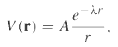
The electric potential of some configuration is given by the expression where A and λ are constants. Find the electric field E(r), the charge density p(r), and the total charge Q.
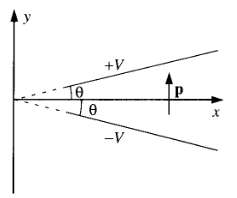
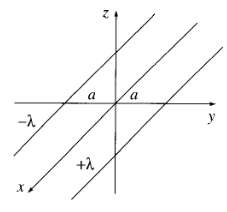
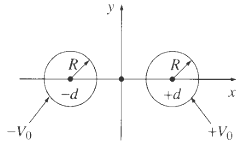
Two infinitely long wires running parallel to the x axis carry uniform charge densities + ? and ? ? (Fig. 2.54).? (a) Find the potential at any point (x, y, z), using the origin as your reference.? (b) Show that the equipotential surfaces are circular cylinders, and locate the axis and radius of
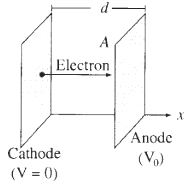
In a vacuum diode, electrons are "boiled" off a hot cathode, at potential zero, and accelerated across a gap to the anode, which is held at positive potential V0. The cloud of moving electrons within the gap (called space charge) quickly builds up to the point where it reduces the field at the
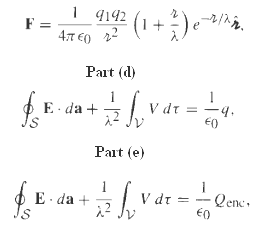
Problem 2.49 Imagine that new and extraordinarily precise measurements have revealed an error in Coulomb's law. The actual force of interaction between two point charges is found to be where λ is a new constant of nature (it has dimensions of length, obviously, and is a huge number--say half the
Suppose an electric field E(x, y, z) has the form Ex = ax, Ey = 0, Ez = 0 where a is a constant. What is the charge density? How do you account for the fact that the field points in a particular direction, when the charge density is uniform? [This is a more subtle problem than it looks, and worthy
All of electrostatics follows from the 1/r2 character of Coulomb's law, together with the principle of superposition. An analogous theory can therefore be constructed for Newton's law of universal gravitation. What is the gravitational energy of a sphere, of mass M and radius R, assuming the
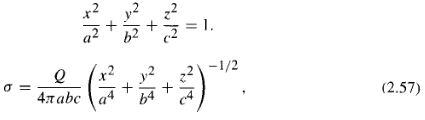
We know that the charge on a conductor goes to the surface, but just how it distributes itself there is not easy to determine. One famous example in which the surface charge density can be calculated explicitly is the ellipsoid: In this case11 where Q is the total charge. By choosing appropriate
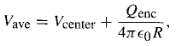
Find the average potential over a spherical surface of radius R due to a point charge q located inside (same as above, in other words, only with z
In one sentence, justify Earn Shaw’s Theorem: A charged particle cannot be held in a stable equilibrium by electrostatic forces alone. As an example, consider the cubical arrangement of fixed charges in Fig. 3.4. It looks, off hand, as though a positive charge at the center would be suspended in
Find the general solution to Laplace's equation in spherical coordinates, for the case where V depends only on r. Do the same for cylindrical coordinates, assuming V depends only on s.
Prove that the field is uniquely determined when the charge density p is given and either V or the normal derivative ∂V/∂n is specified on each boundary surface. Do not assume the boundaries are conductors, or that V is constant over any given surface.
A more elegant proof of the second uniqueness theorem uses Green's identity (Prob. 1.60c), with T = U = V3. Supply the details.
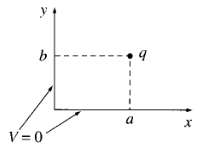
Find the force on the charge +q in Fig. 3.14. (The xy plane is a grounded conductor)
(a) Using the law of cosines, show that Eq. 3.17 can be written as follows where r and θ are the usual spherical polar coordinates, with the z axis along the line through q. In this form it is obvious that V = 0 on the sphere, r = R.(b) Find the induced surface charge on the sphere, as a function
In Ex. 3.2 we assumed that the conducting sphere was grounded (V = 0). But with the addition of a second image charge, the same basic model will handle the case of a sphere at any potential V 0 (relative, of course, to infinity). What charge should you use, and where should you put it? Find the
A uniform line charge λ is placed on an infinite straight wire, a distance d above a grounded conducting plane. (Let's say the wire runs parallel to the x-axis and directly above it, and the conducting plane is the xy plane.)(a) Find the potential in the region above the plane.(b) Find the charge
Two semi-infinite grounded conducting planes meet at right angles. In the region between them, there is a point charge q, situated as shown in Fig. 3.15. Set up the image configuration, and calculate the potential in this region. What charges do you need, and where should they be located? What is
Two long, straight coppek pipes, each of radius R, are held a distance 2d apart. One is at potential V0, the other at – V0 (Fig. 3.16). Find the potential everywhere.
Find the potential in the infinite slot of Ex. 3.3 if the boundary at x = 0 consists of two metal strips: one, from y = 0 to y = a/2, is held at a constant potential V0, and the other, from y = a/2 to y = a, is at potential–V0.
For the infinite slot (Ex. 3.3) determine the charge density σ(y) on the strip at x = 0, assuming it is a conductor at constant potential V0.
A rectangular pipe, running parallel to the z-axis (from – ∞ to + ∞), has three grounded metal sides, at y = 0, y = a, and x = 0. The fourth side, at x = b, is maintained at a specified potential V0(y).(a) Develop a general formula for the potential within the pipe.(b) Find the potential
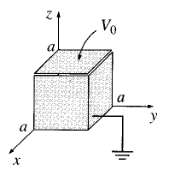
A cubical box (sides of length a) consists of five metal plates, which are welded together and grounded (Fig. 3.23). The top is made of a separate sheet of metal, insulated from the others, and held at a constant potential V0. Find the potential inside the box.
Derive P3 (x) from the Rodrigues formula, and check that P3 (cos θ) satisfies the angular equation (3.60) for l = 3. Check that P3 and P1 are orthogonal by explicit integration.
(a) Suppose the potential is a constant V0 over the surface of the sphere. Use the results of Ex. 3.6 and Ex. 3.7 to find the potential inside and outside the sphere. (Of course, you know the answers in advance--this is just a consistency check on the method.) (b) Find the potential inside and
The potential at the surface of a sphere (radius R) is given by V0 = k cos 3θ, where k is a constant. Find the potential inside and outside the sphere, as well as the surface charge density σ (θ) on the sphere. (Assume there's no charge inside or outside the sphere.)
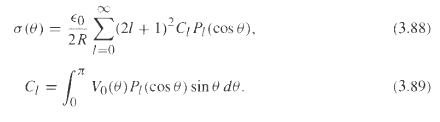
Suppose the potential V0 (θ) at the surface of a sphere is specified, and there is no charge inside or outside the sphere. Show that the charge density on the sphere is given by where
Find the potential outside a charged metal sphere (charge Q, radius R) placed in an otherwise uniform electric field E 0. Explain clearly where you are setting the zero of potential.
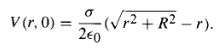
In Prob. 2.25 you found the potential on the axis of a uniformly charged disk: (a) Use this, together with the fact that Pl(1) = 1, to evaluate the first three terms in the expansion (3.72) for the potential of the disk at points off the axis, assuming r > R. (b) Find the potential for r
A spherical shell of radius R carries a uniform surface charge σ0 on the "northern" hemisphere and a uniform surface charge – σ0 on the "southern" hemisphere. Find the potential inside and outside the sphere, calculating the coefficients explicitly up to A6 and B6.
Solve Laplace's equation by separation of variables in cylindrical coordinates, assuming there is no dependence on z (cylindrical symmetry). [Make sure you find all solutions to the radial equation; in particular, your result must accommodate the case of an infinite line charge, for which (of
Find the potential outside an infinitely long metal pipe, of radius R, placed at right angles to an otherwise uniform electric field E0. Find the surface charge induced on the pipe.
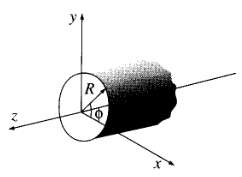
Charge density ?? (Ф) = a sin 5Ф (where a is a constant) is glued over the surface of an infinite cylinder of radius R (Fig. 3.25). Find the potential inside and outside the cylinder.
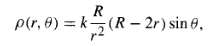
A sphere of radius R, centered at the origin, carries charge density where k is a constant, and r, ? are the usual spherical coordinates. Find the approximate potential for points on the z axis, far from the sphere.
Four particles (one of charge q, one of charge 3q, and two of charge – 2q) are placed as shown in Fig. 3.31, each a distance a from the origin. Find a simple approximate formula for the potential, valid at points far from the origin.
In Ex. 3.9 we derived the exact potential for a spherical shell of radius R, which carries a surface charge σ = k cos θ.(a) Calculate the dipole moment of this charge distribution.(b) Find the approximate potential, at points far from the sphere, and compare the exact answer (3.87). What can you
For the dipole in Ex. 3.10, expand 1/π ± to order (d/r)3, and use this to determine the quadruple and octopole terms in the potential
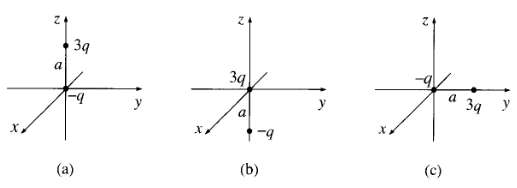
Two point charges, 3q and -q, are separated by a distance a. For each of the arrangements in Fig. 3.35, find (i) the monopole moment, (ii) the dipole moment, and (iii) the approximate potential (in spherical coordinates) at large r (include both the monopole and dipole contributions).
A "pure" dipole p is situated at the origin, pointing in the z direction.(a) What is the force on a point charge q at (a, 0, 0) (Cartesian coordinates)?(b) What is the force on q at (0, 0, a)?(c) How much work does it take to move q from (a, 0, 0) to (0, 0, a)?
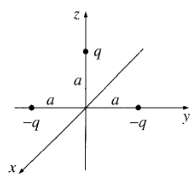
Three point charges are located as shown in Fig. 3.38, each a distance a from the origin. Find the approximate electric field at points far from the origin. Express your answer in spherical coordinates, and include the two lowest orders in the multipole expansion.
Show that the electric field of a ("pure") dipole (Eq. 3.103) can be written in the coordinate-free form
A point charge q of mass m is released from rest at a distance d from an infinite grounded conducting plane. How long will it take for the charge to hit the plane?
Two infinite parallel grounded conducting planes are held a distance a apart. A point charge q is placed in the region between them, a distance x from one plate. Find the force on q. Check that your answer is correct for the special cases a → ∞ and x = a/2.
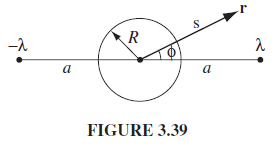
Two long straight wires, carrying opposite uniform line charges ± λ, are situated on either side of a long conducting cylinder (Fig. 3.39). The cylinder (which carries no net charge) has radius R, and the wires are a distance a from the axis. Find the potential at point r.
A conducting sphere of radius a, at potential V0, is surrounded by a thin concentric spherical shell of radius b, over which someone has glued a surface charge σ(θ) = k cosθ, where k is a constant, and θ is the usual spherical coordinate.(a) Find the potential in each region: (i) r > b, and
A charge + Q is distributed uniformly along the z axis from z = ? a to z = + a. Show that the electric potential at a point r is given by for r > a.
A long cylindrical shell of radius R carries a uniform surface charge σ0 on the upper half and an opposite charge σ0 on the lower half (Fig. 3.40). Find the electric potential inside and outside the cylinder.
A thin insulating rod, running from z = – a to z = + a, carries the indicated line charges. In each case, find the leading term in the multipole expansion of the potential:(a) λ = k cos(πz/2a),(b) λ = k sin(πz/a),(c) λ = k cos(πz/a), where k is a constant.
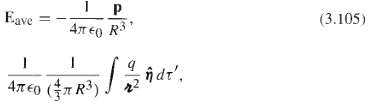
Show that the average field inside a sphere of radius R, due to all the charge within the sphere, is where p is the total dipole moment. There are several ways to prove this delightfully simple result. Here's one method: (a) Show that the average field due to a single charge q at point r inside the
(a) Using Eq. 3.103, calculate the average electric field of a dipole, over a spherical volume of radius R, centered at the origin. Do the angular intervals first. [Note: You must express r and ? in terms of x, y, and z (see back cover) before integrating. If you don't understand why, reread the
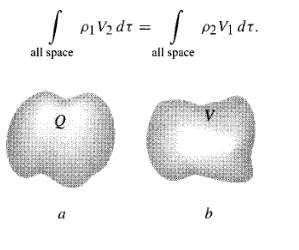
(a) Suppose a charge distribution P1 (r) produces a potential V1 (r), and some other charge distribution p2(r) produces a potential V2(r). [The two situations may have nothing in common, for all I care--perhaps number 1 is a uniformly charged sphere and number 2 is a parallel-plate capacitor.
Use Green's reciprocity theorem (Prob. 3.43) to solve the following two problems.(a) Both plates of a parallel-plate capacitor are grounded, and a point charge q is placed between them at a distance x from plate 1. The plate separation is d. Find the induced charge on each plate.(b) Two concentric
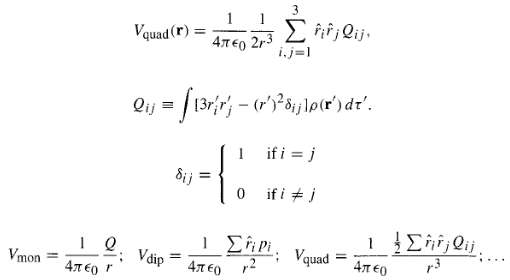
(a) Show that the quadrupole term in the multi pole expansion can be written where here is the Kronecker delta, and Qij is the quadrupole moment of the charge distribution. Notice the hierarchy: The monopole moment (Q) is a scalar, the dipole moment (p) is a vector, the quadrupole moment (Qij) is a
In Ex. 3.8 we determined the electric field outside a spherical conductor (radius R) placed in a uniform external field E 0. Solve the problem now using the method of images, and check that your answer agrees with Eq. 3.76.
For the infinite rectangular pipe in Ex. 3.4, suppose the potential on the bottom (y = 0) and the two sides (x = ± b) is zero, but the potential on the top (y = a) is a nonzero constant V 0. Find the potential inside the pipe. [Note: This is a rotated version of Prob. 3.14(b), but set it up as in
(a) A long metal pipe of square cross-section (side a) is grounded on three sides, while the fourth (which is insulated from the rest) is maintained at constant potential V0. Find the net charge per unit length on the side opposite to V0.(b) A long metal pipe of circular cross-section (radius R) is
An ideal electric dipole is situated at the origin, and points in the z direction, as in Fig. 3.36. An electric charge is released from rest at a point in the xy plane. Show that it swings back and forth in a semi-circular arc, as though it were a pendulum supported at the origin.
A hydrogen atom (with the Bohr radius of half an angstrom) is situated between two metal plates 1 mm apart, which are connected to opposite terminals of a 500 V battery. What fraction of the atomic radius does the separation distance d amount to, roughly? Estimate the voltage you would need with
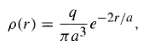
According to quantum mechanics, the electron cloud for a hydrogen atom in the ground state has a charge density. where q is the charge of the electron and a is the Bohr radius. Find the atomic polarizability of such an atom.
According to Eq. 4.1, the induced dipole moment of an atom is proportional to the external field. This is a "rule of thumb," not a fundamental law, and it is easy to concoct exceptions––in theory. Suppose, for example, the charge density of the electron cloud were proportional to the distance
A point charge q is situated a large distance r from a neutral atom of polarizability a Find the force of attraction between them.
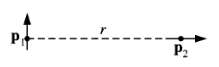
In Figure 4.6, P1 and P2 are (perfect) dipoles a distance r apart. What is the torque on P1 due to p2? What is the torque on P2 due to P1? [In each case I want the torque on the dipole about its own center. If it bothers you that the answers are not equal and opposite, see Prob.4.29.]
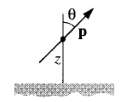
(Perfect) dipole p is situated a distance z above an infinite grounded conducting plane (Fig. 4.7). The dipole makes an angle 0 with the perpendicular to the plane. Find the torque on p. If the dipole is free to rotate, in what orientation will it come to rest?
Show that the energy of an ideal dipole p in an electric field E is given by U = – p ∙ E. (4.6)
Show that the interaction energy of two dipoles separated by a displacement r is
A dipole p is a distance r from a point charge q, and oriented so that p makes an angle θ with the vector r from q to p.(a) What is the force on p?(b) What is the force on q?
A sphere of radius R carries a polarization P(r) = kr, where k is a constant and r is the vector from the center.(a) Calculate the bound charges σb and pb.(b) Find the field inside and outside the sphere.
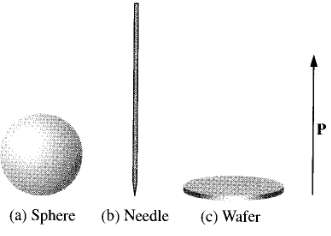
A short cylinder, of radius a and length L, carries a "frozen-in" uniform polarization P, parallel to its axis. Find the bound charge, and sketch the electric field (i) for L >> a. (ii) for L << a, and (iii) for L m a. [This device is known as a bar electret; it is the electrical analog
Calculate the potential of a uniformly polarized sphere (Ex. 4.2) directly from Eq. 4.9.
A very long cylinder, of radius a, carries a uniform polarization P perpendicular to its axis. Find the electric field inside the cylinder. Show that the field outside the cylinder can be expressed in the form [Careful: I said ?uniform,? not ?radial?!]
When you polarize a neutral dielectric, charge moves a bit, but the total remains zero. This fact should be reflected in the bound charges crb and Pb. Prove from Eqs. 4.11 and 4.12 that the total bound charge vanishes.
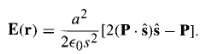
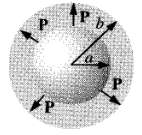
A thick spherical shell (inner radius a, outer radius b) is made of dielectric material with a "frozen-in" polarization P(r) = k/r r. where k is a constant and r is the distance from the center (Fig. 4.18). (There is no free charge in the problem.) Find the electric field in all three regions by
Suppose the field inside a large piece of dielectric is E0, so that the electric displacement is D0 = ?0E0 + P.? (a) Now a small spherical cavity (Fig. 4.19a) is hollowed out of the material. Find the field at the center of the cavity in terms of E 0 and P. Also find the displacement at the center
For the bar electret of Prob. 4.11, make three careful sketches: one of P, one of E, and one of D. Assume L is about 2a.
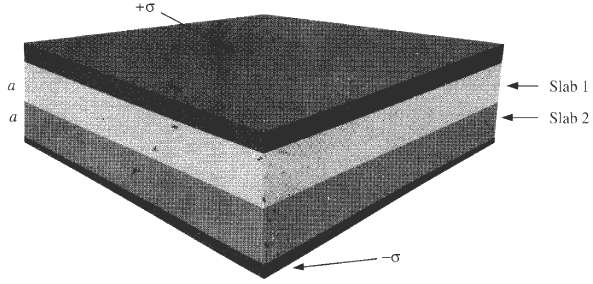
The space between the plates of a parallel-plate capacitor (Fig. 4.24) is filled with two slabs of linear dielectric material. Each slab has thickness a, so the total distance between the plates is 2a. Slab 1 has a dielectric constant of 2, and slab 2 has a dielectric constant of 1.5. The free
Suppose you have enough linear dielectric material, of dielectric constant εr, to half-fill a parallel-plate capacitor (Fig. 4.25). By what fraction is the capacitance increased when you distribute the material as in Fig. 4.25(a)? How about Fig. 4.25(b)? For a given potential difference V between
A sphere of linear dielectric material has embedded in it a uniform free charge density p. Find the potential at the center of the sphere (relative to infinity), if its radius is R and its dielectric constant is εr.
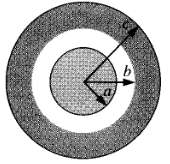
A certain coaxial cable consists of a copper wire, radius a, surrounded by a concentric copper tube of inner radius c (Fig. 4.26). The space between is partially filled (from b out to c) with material of dielectric constant 6r, as shown. Find the capacitance per unit length of this cable.
A very long cylinder of linear dielectric material is placed in an otherwise uniform electric field E 0. Find the resulting field within the cylinder. (The radius is a, the susceptibility Xe, and the axis is perpendicular to E0).
Find the field inside a sphere of linear dielectric material in an otherwise uniform electric field E0 (Ex. 4.7) by the following method of successive approximations: First pretend the field inside is just E 0, and use Eq. 4.30 to write down the resulting polarization P0. This polarization
An uncharged conducting sphere of radius a is coated with a thick insulating shell (dielectric constant εr) out to radius b. This object is now placed in an otherwise uniform electric field E0. Find the electric field in the insulator.
Suppose the region above the xy plane in Ex. 4.8 is also filled with linear dielectric but of a different susceptibility Xe'. Find the potential everywhere.
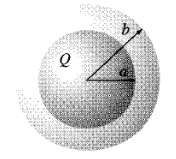
A spherical conductor, of radius a, carries a charge Q (Fig. 4.29). It is surrounded by linear dielectric material of susceptibility Xe, out to radius b. Find the energy of this configuration (Eq.4.58).
Calculate W, using both Eq. 4.55 and Eq. 4.58, for a sphere of radius R with frozen-in uniform polarization P (Ex. 4.2). Comment on the discrepancy. Which (if either) is the "true" energy of the system?
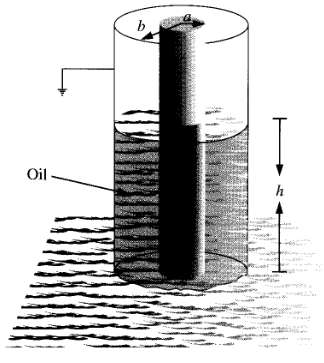
Two long coaxial cylindrical metal tubes (inner radius a, outer radius b) stand vertically in a tank of dielectric oil (susceptibility Xe, mass density p). The inner one is maintained at potential V, and the outer one is grounded (Fig. 4.32). To what height (h) does the oil rise in the space
(a) For the configuration in Problem 4.5, calculate the force on P2 due to P1, and the force on P1 due to P2. Are the answers consistent with Newton's third law?(b) Find the total torque on P2 with respect to the center ofpl, and compare it with the torque on Pl about that same point. [Hint:
An electric dipole p, pointing in the y direction, is placed midway between two large conducting plates, as shown in Fig. 4.33. Each plate makes a small angle ? with respect to the x axis, and they are maintained at potentials 4-V. What is the direction of the net force on p? (There's nothing to
A dielectric cube of side a, centered at the origin, carries a "frozen-in" polarization P = kr, where k is a constant. Find all the bound charges, and check that they add up to zero.
A point charge q is imbedded at the center of a sphere of linear dielectric material (with susceptibility Xe and radius R). Find the electric field, the polarization, and the bound charge densities, Pb and a b. What is the total bound charge on the surface? Where is the compensating negative bound
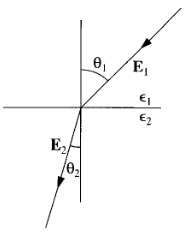
At the interface between one linear dielectric and another the electric field lines bend (see Fig. 4.34). Show that tan ?2/tan ?1 = ?2/ ?1, (4.68) assuming there is no free charge at the boundary. [Comment: Eq. 4.68 is reminiscent of Snell's law in optics. Would a convex "lens" of dielectric
A point dipole p is imbedded at the center of a sphere of linear dielectric material (with radius R and dielectric constant εr). Find the electric potential inside and outside the sphere.
Prove the following uniqueness theorem: A volume 1; contains a specified free charge distribution, and various pieces of linear dielectric material, with the susceptibility of each one given. If the potential is specified on the boundaries ,S of V(V = 0 at infinity would be suitable) then the
A conducting sphere at potential V0 is half embedded in linear dielectric material of susceptibility Xe, which occupies the region z (a) Write down the formula for the proposed potential V(r), in terms of V0, R, and r. Use it to determine the field, the polarization, the bound charge, and the free
According to Eq. 4.5, the force on a single dipole is (p ?? ??)E, so the net force on a dielectric object is [Here Eext is the field of everything except the dielectric. You might assume that it wouldn't matter if you used the total field; after all, the dielectric can't exert a force on itself.
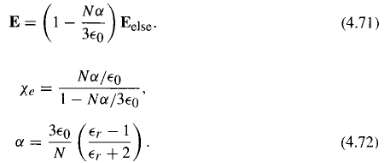
In a linear dielectric, the polarization is proportional to the field: P = ε0XeE. If the material consists of atoms (or nonpolar molecules), the induced dipole moment of each one is likewise proportional to the field p = aE. Question. What is the relation between the atomic polarizability a and
Check the Clausius-Mossotti relation (Eq. 4.72) for the gases listed in Table 4.1. Dielectric constants are given in Table 4.2.) (The densities here are so small that Eqs. 4.70 and 4.72 are indistinguishable.
Showing 100 - 200
of 1324
1
2
3
4
5
6
7
8
9
10
11
12
13
14
Step by Step Answers

 Get 50% OFF
Claim Now
Get 50% OFF
Claim Now





![[pI P2 - 3(P1 f)(p2 · f)]. (4.7) 4T €0 r3](https://dsd5zvtm8ll6.cloudfront.net/si.question.images/images/question_images/1552/9/9/2/6305c90c976ae32a1552992631856.jpg)