New Semester
Started
Get
50% OFF
Study Help!
--h --m --s
Claim Now
Question Answers
Textbooks
Find textbooks, questions and answers
Oops, something went wrong!
Change your search query and then try again
S
Books
FREE
Study Help
Expert Questions
Accounting
General Management
Mathematics
Finance
Organizational Behaviour
Law
Physics
Operating System
Management Leadership
Sociology
Programming
Marketing
Database
Computer Network
Economics
Textbooks Solutions
Accounting
Managerial Accounting
Management Leadership
Cost Accounting
Statistics
Business Law
Corporate Finance
Finance
Economics
Auditing
Tutors
Online Tutors
Find a Tutor
Hire a Tutor
Become a Tutor
AI Tutor
AI Study Planner
NEW
Sell Books
Search
Search
Sign In
Register
study help
physics
electrodynamics
Introduction to Electrodynamics 3rd Edition David J. Griffiths - Solutions
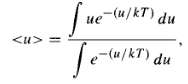
The Clausius-Mossotti equation (prob. 4.38) tells you how to calculate the susceptibility of a nonpolar substance, in terms of the atomic polarizability a. The Langevin equation tells you how to calculate the susceptibility of a polar substance, in terms of the permanent molecular dipole moment p.
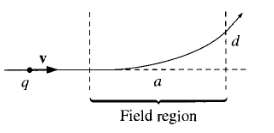
A particle of charge q enters a region of uniform magnetic field B (pointing into the page). The field deflects the particle a distance d above the original line of right, as shown in Fig. 5.8. Is the charge positive or negative? In terms of a, d, B and q, find the momentum of the particle.
Find and sketch the trajectory of the particle in Ex. 5.2, if it starts at the origin with velocity(a) v(0) = (E/B)y,(b) v(0) = (E/2B)y,(c) v(0) = (E/B)(y + z).
In 1897 J. J. Thomson "discovered" the electron by measuring the charge-to-mass ratio of "cathode rays" (actually, streams of electrons, with charge q and mass m) as follows:(a) First he passed the beam through uniform crossed electric and magnetic fields E and B (mutually perpendicular, and both
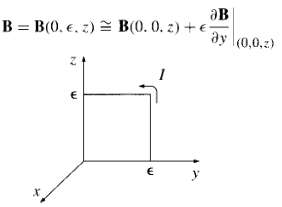
Suppose that the magnetic field in some region has the form B = kzx (where k is a constant). Find the force on a square loop (side a), lying in the yz plane and centered at the origin, if it carries a current 1, flowing counterclockwise, when you look down the x axis.
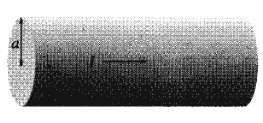
A current I flows down a wire of radius a.(a) If it is uniformly distributed over the surface, what is the surface current density K?(b) If it is distributed in such a way that the volume current density is inversely proportional to the distance from the axis, what is J?
(a) A phonograph record carries a uniform density of "static electricity" σ. If it rotates at angular velocity w, what is the surface current density K at a distance r from the center?(b) A uniformly charged solid sphere, of radius R and total charge Q, is centered at the origin and spinning at a
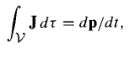
For a configuration of charges and currents confined within a volume V, show that where p is the total dipole moment.
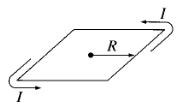
(a) Find the magnetic field at the center of a square loop, which carries a steady current 1. Let R be the distance from center to side (Fig. 5.22). (b) Find the field at the center of a regular n-sided polygon, carrying a steady current 1. Again, let R be the distance from the center to any
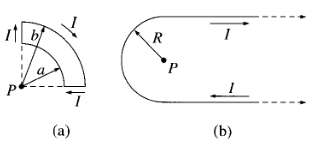
Find the magnetic field at point P for each of the steady current configurations shown in Fig.5.23.
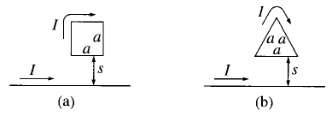
(a) Find the force on a square loop placed as shown in Fig. 5.24 (a), near an infinite straight wire. Both the loop and the wire carry a steady current 1. (b) Find the force on the triangular loop in Fig. 5.24(b).
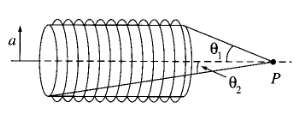
Find the magnetic field at point P on the axis of a tightly wound solenoid (helical coil) consisting of n tums per unit length wrapped around a cylindrical tube of radius a and carrying current I (Fig. 5.25). Express your answer in terms of θ1 and θ2 (it's easiest that way). Consider the tums to
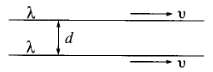
Suppose you have two infinite straight line charges λ, a distance d apart, moving along at a constant speed v (Fig. 5.26). How great would v have to be in order for the magnetic attraction to balance the electrical repulsion? Work out the actual number... Is this a reasonable sort of speed?
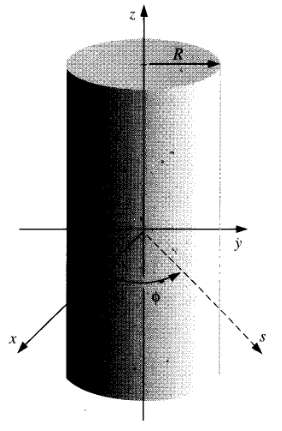
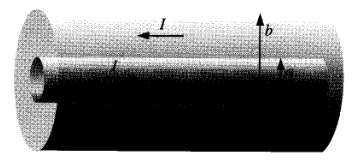
A steady current I flows down a long cylindhcal wire of radius a (Fig. 5.40). Find the magnetic field, both inside and outside the wire, if (a) The current is uniformly distributed over the outside surface of the wire. (b) The current is distributed in such a way that J is proportional to s, the
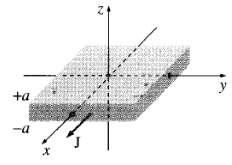
A thick slab extending from z = ?? a to z = + a carries a uniform volume current J = J x (Fig. 5.41). Find the magnetic field, as a function of z, both inside and outside the slab.
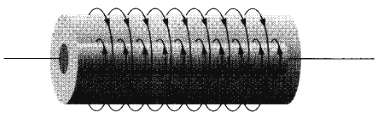
Two long coaxial solenoids each carry current I, but in opposite directions, as shown in Fig. 5.42. The inner solenoid (radius a) has nl tums per unit length, and the outer one (radius b) has n2. Find B in each of the three regions: (i) inside the inner solenoid, (ii) between them, and (iii)
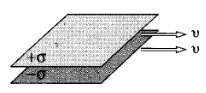
A large parallel-plate capacitor with uniform surface charge a on the upper plate and ?? σ on the lower is moving with a constant speed v, as shown in Fig. 5.43. (a) Find the magnetic field between the plates and also above and below them. (b) Find the magnetic force per unit area on the upper
Show that the magnetic field of an infinite solenoid runs parallel to the axis, regardless of the cross-sectional shape of the coil, as long as that shape is constant along the length of the solenoid. What is the magnitude of the fie!d, inside and outside of such a coil? Show that the toroid field
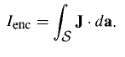
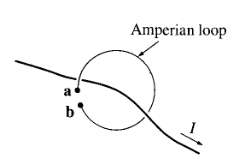
Problem 5.18 In calculating the current enclosed by an amperian loop, one must, in general. evaluate an integral of the form. The trouble is, there are infinitely many surfaces that share the same boundary line. Which one are we supposed touse?
(a) Find the density p of mobile charges in a piece of copper, assuming each atom contributes one free electron. [Look up the necessary physical constants.](b) Calculate the average electron velocity in a copper wire 1 mm in diameter, carrying a current of 1 A. [Note: this is literally a snail's
Is Ampere's law consistent with the general rule (Eq. 1.46) that divergence-of-curl is always zero? Show that Ampere's law cannot be valid, in general, outside magneto-statics. Is there any such "defect" in the other three Maxwell equations?
Suppose there did exist magnetic monopoles. How would you modify Maxwell's equations and the force law, to accommodate them? If you think there are several plausible options, list them, and suggest how you might decide experimentally which one is right.
Find the magnetic vector potential of a finite segment of straight wire, carrying a current I. [Put the wire on the z axis, from z1 to z2, and use Eq. 5.64.] Check that your answer is consistent with Eq. 5.35.
If B is uniform, show that A(r) = – ½ (r x B) works. That is, check that ∆ ∙ A = 0 and ∆ x A = B. Is this result unique, or are there other functions with the same divergence and curl?
(a) By whatever means you can think of (short of looking it up), find the vector potential a distance s from an infinite straight wire carrying a current I. Check that ∆ ∙ A = 0 and ∆ x A = B.(b) Find the magnetic potential inside the wire, if it has radius R and the current is uniformly
Find the vector potential above and below the plane surface current in Ex. 5.8.
(a) Check that Eq. 5.63 is consistent with Eq. 5.61, by applying the divergence.(b) Check that Eq. 5.63 is consistent with Eq. 5.45, by applying the curl.(c) Check that Eq.5.63 is consistent with Eq. 5.62, by applying the Laplacian.
Suppose you want to define a magnetic scalar potential U (Eq. 5.65), in the vicinity of a current-carrying wire. First of all, you must stay away from the wire itself (there ?? x B ?? 0); but that's not enough. Show, by applying Ampere's law to a path that starts at a and circles the wire,
Use the results of Ex. 5.11 to find the field inside a uniformly charged sphere. of total charge Q and radius R, which is rotating at a constant angular velocity w.
(a) Complete the proof of Theorem 2, Sect. 1.6.2. That is, show that any divergenceless vector field F can be written as the curl of a vector potential A. What you have to do is find Ax, Ay. and Az such that: (i) ∂Az/∂y - ∂Ay/∂z = Fx; (ii) ∂Ax/∂z – ∂Az/∂x = Fy; and (iii)
(a) Check Eq. 5.74 for the configuration in Ex. 5.9.(b) Check Eqs. 5.75 and 5.76 for the configuration in Ex. 5.11.
Prove Eq. 5.76, using Eqs. 5.61, 5.74, and 5.75. [Suggestion: I'd set up Cartesian coordinates at the surface, with z perpendicular to the surface and x parallel to the current. ]
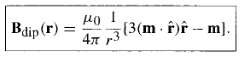
Show that the magnetic field of a dipole can be written in coordinate free form
A circular loop of wire, with radius R, lies in the xy plane, centered at the origin. and carries a current 1 running counterclockwise as viewed from the positive z axis.(a) What is its magnetic dipole moment?(b) What is the (approximate) magnetic field at points far from the origin?(c) Show that,
Find the magnetic dipole moment of the spinning spherical shell in Ex. 5.11. Show that for points r > R the potential is that of a perfect dipole.
Find the exact magnetic field a distance z above the center of a square loop of side w, carrying a current 1. Verify that it reduces to the field of a dipole, with the appropriate dipole moment, when z >> w.
It may have occurred to you that since parallel currents attract, the current within a single wire should contract into a tiny concentrated stream along the axis. Yet in practice the current typically distributes itself quite uniformly over the wire. How do you account for this? If the positive
A current I flows to the right through a rectangular bar of conducting material, in the presence of a uniform magnetic field B pointing out of the page (Fig. 5.56). (a) If the moving charges are positive, in which direction are they deflected by the magnetic field? This deflection results in an
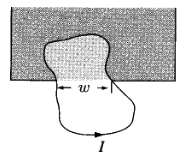
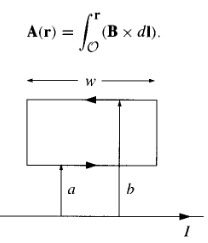
A plane wire loop of irregular shape is situated so that part of it is in a uniform magnetic field B (in Fig. 5.57 the field occupies the shaded region, and points perpondicular to the plane of the loop). The loop carries a current I. Show that the net magnetic force on the loop is F = IBw, where w
A circularly symmetrical magnetic field (B depends only on the distance from the axis), pointing perpendicular to the page, occupies the shaded region in Fig. 5.58. If the total flux (f B ∙ da) is zero, show that a charged particle that starts out at the center will emerge from the field region
Calculate the magnetic force of attraction between the northern and southern hemispheres of a spinning charged spherical shell (Ex. 5.11).
Consider the motion of a particle with mass m and electric charge qe in the field of a (hypothetical) stationary magnetic monopole qm at the origin:(a) Find the acceleration of qe, expressing your answer in terms of q, qm, m, r (the position of the particle), and v (its velocity). (b) Show
Use the Biot-Savart law (most conveniently in the form 5.39 appropriate to surface currents) to find the field inside and outside an infinitely long solenoid of radius R, with n tums per unit length, carrying a steady current I.
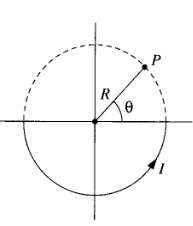
A semicircular wire cames a steady current 1 (it must be hooked up to some other wires to complete the circuit, but we're not concerned with them here). Find the magnetic field atapoint P on the other semicircle (Fig.5.59).
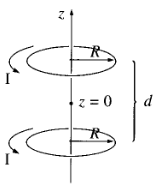
Problem 5.46 The magnetic field on the axis of a circular current loop (Eq. 5.38) is far from uniform (it falls off sharply with increasing z). You can produce a more nearly uniform field by using two such loops a distance d apart (Fig. 5.60). (a) Find the field (B) as a function of z, and
Problem 5.47 Find the magnetic field at a point z > R on the axis of(a) The rotating disk and(b) The rotating sphere, in Prob. 5.6.
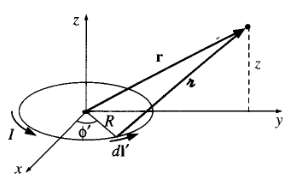
Suppose you wanted to find the field of a circular loop (Ex. 5.6) at a point r that is not directly above the center (Fig. 5.61). You might as well choose your axes so that r lies in the yz plane at (0, y, z). The source point is (R cos Ф', R sin Ф', 0), and Ф' runs from 0 to 2π. Set up the
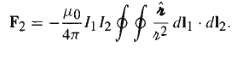
Magnetostatibs treats the "source current" (the one that sets up the field) and the "recipient current" (the one that experiences the force) so asymmetrically that it is by no means obvious that the magnetic force between two current loops is consistent with Newton's third law. Show, starting with
(a) One way to fill in the "missing link" in Fig. 5.48 is to exploit the analogy between the defining equations for A (?? ?? A = 0, V x A = B) and Maxwell's equations for B (?? ?? B = 0. V x B = ?0J). Evidently A depends on B in exactly the same way that B depends on ?0J (to wit: the Biot-Savan
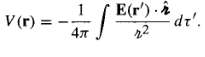
Another way to fill in the "missing link" in Fig. 5.48 is to look for a magnetostatic analog to Eq. 2.21. The obvious candidate would be(a) Test this formula for the simplest possible case--uniform B (use the origin as your reference point). Is the result consistent with Prob. 5.247 You could cure
(a) Construct the scalar potential U (r) for a "pure" magnetic dipole m.(b) Construct a scalar potential for the spinning spherical shell (Ex. 5.11).(c) Try doing the same for the interior of a solid spinning sphere.
Just as ∆ ∙ B = 0 allows us to express B as the curl of a vector potential (B = ∆ x A), so ∆ ∙ A = 0 permits us to write A itself as the curl of a "higher" potential: A = ∆ x W. (And this hierarchy can be extended ad infinitum.)(a) Find the general formula for W (as an integral over B),
Prove the following uniqueness theorem: If the current density J is specified throughout a volume V, and either the potential A or the magnetic field B is specified on the surface $ bounding V, then the magnetic field itself is uniquely determined throughout V.
A magnetic dipole m = – m0z is situated at the origin, in an otherwise uniform magnetic field B = B0z. Show that there exists a spherical surface, centered at the origin. through which no magnetic field lines pass. Find the radius of this sphere, and sketch the field lines, inside and out.
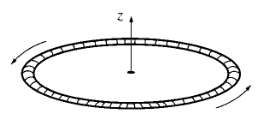
A thin uniform donut, carrying charge Q and mass M, rotates about its axis as shown in Fig. 5.64. (a) Find the ratio of its magnetic dipole moment to its angular momentum. This is called the gyromagnetic ratio (or magnetomechanical ratio). (b) What is the gyromagnetic ratio for a uniform spinning
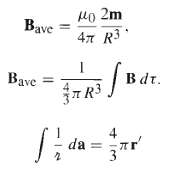
(a) Prove that the average magnetic field, over a sphere of radius R, due to steady currents within the sphere, is where m is the total dipole moment of the sphere. Contrast the electrostatic result, Eq. 3.105. [This is tough, so I'll give you a start: Write B as (V x A), and apply Prob. 1.60b. Now
A uniformly charged solid sphere of radius R carries a total charge Q, and is set spinning with angular velocity co about the z axis. (a) What is the magnetic dipole moment of the sphere? (b) Find the average magnetic field within the sphere (see Prob. 5.57). (c) Find the approximate
Using Eq. 5.86, calculate the average magnetic field of a dipole over a sphere of radius R centered at the origin. Do the angular integrals first. Compare your answer with the general theorem in Prob. 5.57. Explain the discrepancy, and indicate how Eq. 5.87 can be corrected to resolve the ambiguity
I worked out the multipole expansion for the vector potential of a line current because that's the most common type, and in some respects the easiest to handle. For a volume current J: (a) Write down the multipole expansion, analogous to Eq. 5.78. (b) Write down the monopole potential, and prove
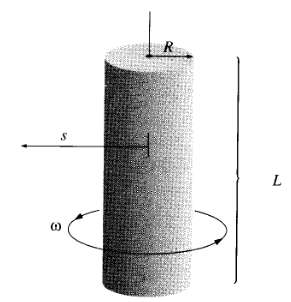
A thin glass rod of radius R and length L carries a uniform surface charge σ. It is set spinning about its axis, at an angular velocity to. Find the magnetic field at a distance s >> R from the center of the rod (Fig. 5.66).
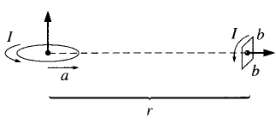
Calculate the torque exerted on the square loop shown in Fig. 6.6, due to the circular loop (assume r is much larger than a or b). If the square loop is free to rotate, what will its equilibrium orientation be?
Starting from the Lorentz force law, in the form of Eq. 5.16, show that the torque on any steady current distribution (not just a square loop) in a uniform field B is m x B.
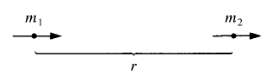
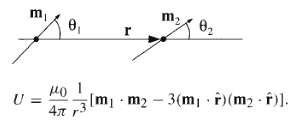
Find the force of attraction between two magnetic dipoles, m1 and m2, oriented as shown in Fig. 6.7, a distance r apart, (a) Using Eq. 6.2, and (b) Using Eq.6.3.
Derive Eq. 6.3. [Here's one way to do it: Assume the dipole is an infinitesimal square, of side 6 (if it's not, chop it up into squares, and apply the argument to each one). Choose axes as shown in Fig. 6.8, and calculate F = I f(dl x B) along each of the four sides. Expand B in a Taylor series??on
A uniform current density J = J0 z fills a slab straddling the yz plane, from x = – a to x = + a. A magnetic dipole m = m0 x is situated at the origin. (a) Find the force on the dipole, using Eq. 6.3. (b) Do the same for a dipole pointing in the y direction: m = m0y. (c) In the
Of the following materials, which would you expect to be paramagnefic and which diamagnetic? Aluminum, copper, copper chloride (CuC12), carbon, lead, nitrogen (N2), salt (NaC1), sodium, sulfur, water. (Actually, copper is slightly diamagnetic; otherwise they're all what you'd expect.)
An infinitely long circular cylinder carries a uniform magnetization M parallel to its axis. Find the magnetic field (due to M) inside and outside the cylinder.
A long circular cylinder of radius R carries a magnetization M = ks2 Ф, where k is a constant, s is the distance from the axis, and Ф is the usual azimuthal unit vector (Fig. 6.13). Find the magnetic field due to M, for points inside and outside the cylinder.
A short circular cylinder of radius a and length L carries a "frozen-in" uniform magnetization M parallel to its axis. Find the bound current, and sketch the magnetic field of the cylinder. (Make three sketches: one for L >> a, one for L << a, and one for L ≈ a.) Compare this bar
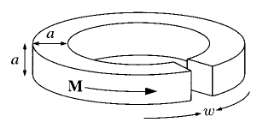
An iron rod of length L and square cross section (side a), is given a uniform longitudinal magnetization M, and then bent around into a circle with a narrow gap (width w). as shown in Fig. 6.14. Find the magnetic field at the center of the gap, assuming w
In Sect, 6.2.1, we began with the potential of a perfect dipole (Eq. 6.10). whereas in fact we are dealing with physical dipoles. Show, by the method of Sect. 4.2.3, that we nonetheless get the correct macroscopic field.
An infinitely long cylinder, of radius R, carries a "frozen-in" magnetization. Parallel to the axis, M = ksz, where k is a constant and s is the distance from the axis; there is no free current anywhere. Find the magnetic field inside and outside the cylinder by two different methods:(a) As in
Suppose the field inside a large piece of magnetic material is B0, so that H0 = (1/?0)B0 ?? M. (a) Now a small spherical cavity is hollowed out of the material (Fig. 6.21). Find the field at the center of the cavity, in terms of B 0 and M. Also find H at the center of the cavity, in terms of H0 and
For the bar magnet of Prob. 6.9, make careful sketches of M, B, and H, assuming L is about 2a. Compare Prob. 4.17.
If J f = 0 everywhere, the curl of H vanishes (Eq. 6.19), and we can express H as the gradient of a scalar potential W: H = – ∆W. According to Eq. 6.23, then, ∆2W = (∆ ∙ M), so W obeys Poisson's equation, with ∆ ∙ M as the "source."
A coaxial cable consists of two very long cylindrical tubes, separated by linear insulating material of magnetic susceptibility Xm. A current I flows down the inner conductor and returns along the outer one; in each case the current distributes itself uniformly over the surface (Fig. 6.24). Find
A current I flows down a long straight wire of radius a. If the wire is made of linear material (copper, say, or aluminum) with susceptibility Xm, and the current is distributed uniformly, what is the magnetic field a distance s from the axis? Find all the bound currents. What is the net bound
A sphere of linear magnetic material is placed in an otherwise uniform magnetic field B0. Find the new field inside the sphere.
On the basis of the naYve model presented in Sect. 6.1.3, estimate the magnetic susceptibility of a diamagnetic metal such as copper. Compare your answer with the empirical value in Table 6.1, and comment on any discrepancy.
How would you go about demagnetizing a permanent magnet (such as the wrench we have been discussing, at point c in the hysteresis loop)? That is, how could you restore it to its original state, with M = 0 at I = 07?
(a) Show that the energy of a magnetic dipole in a magnetic field B is given by U = ?? m ?? B. (6. 34) [Assume that the magnitude of the dipole moment is fixed, and all you have to do is move it into place and rotate it into its final orientation.] Compare Eq. 4.7. (c) Express your answer to (b) in
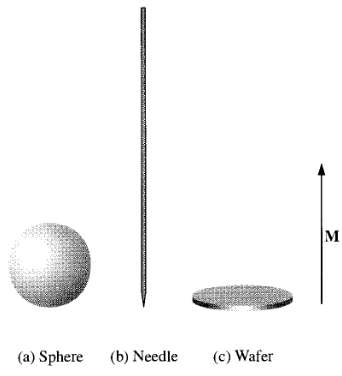
Notice the following parallel: Thus, the transcription D ?? B, E ?? H, P ?? ?0 M, ε0 ?? /?0 tums an electrostatic problem into an analogous magnetostatic one. Use this observation, together with your knowledge of the electrostatic results, to rederive (a) the magnetic field inside a uniformly
Compare Eqs. 2.15, 4.9, and 6.11. Notice that if p, P, and M are uniform, the same integral is involved in all three: Therefore, if you happen to know the electric field of a uniformly charged object, you can immediately write down the scalar potential of a uniformly polarized object, and the
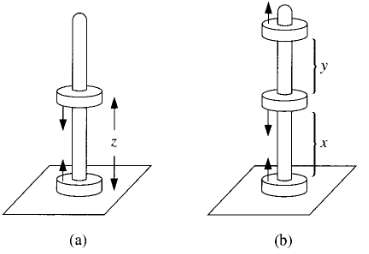
A familiar toy consists of donut-shaped permanent magnets (magnetization parallel to the axis), which slide frictionlessly on a vertical rod (Fig. 6.31). Treat the magnets as dipoles, with mass md and dipole moment m. (a) If you put two back-to-back magnets on the rod, the upper one will
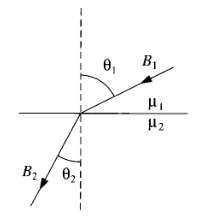
At the interface between one linear magnetic material and another the magnetic field lines bend (see Fig. 6.32). Show that tan θ2/tan θ1 = ?2/?1, assuming there is no free current at the boundary. Compare Eq. 4.68.
Problem 6.27 A magnetic dipole m is imbedded at the center of a sphere (radius R) of linear magnetic material (permeability ?). Show that the magnetic field inside the sphere (0
You are asked to referee a grant application, which proposes to determine whether the magnetization of iron is due to "Ampere" dipoles (current loops) or "Gilbert" dipoles (separated magnetic monopoles). The experiment will involve a cylinder of iron (radius R and length L: 10R), uniformly
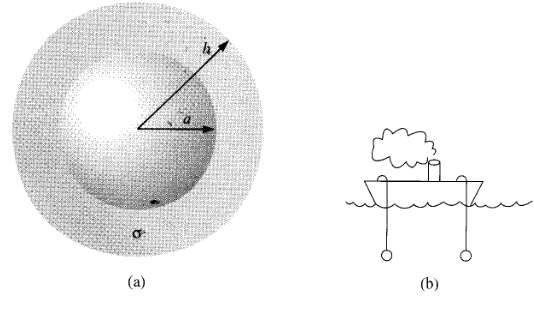
Two concentric metal spherical shells, of radius a and b, respectively, are separated by weakly conducting material of conductivity σ (Fig. 7.4a).? (a) If they are maintained at a potential difference V, what current flows from one to the other?? (b) What is the resistance between the shells?? (c)
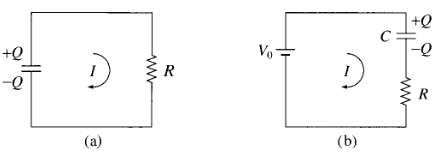
A capacitor C has been charged up to potential V0; at time t = 0 it is connected to a resistor R, and begins to discharge (Fig. 7.5a). (a) Determine the charge 0n the capacitor as a function of time, Q(t). What is the current through the resistor, I(t)? (b) What was the original energy stored in
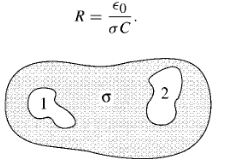
(a) Two metal objects are embedded in weakly conducting material of conductivity a (Fig. 7.6). Show that the resistance between them is related to the capacitance of the arrangement by (b) Suppose you connected a battery between I and 2 and charged them up to a potential difference V0. If you
Suppose the conductivity of the material separating the cylinders in Ex. 7.2 is not uniform; specifically, σ (s) = k/s, for some constant k. Find the resistance between the cylinders.
A battery of emf ξ and internal resistance r is hooked up to a variable "load" resistance, R. If you want to deliver the maximum possible power to the load, what resistance R should you choose? (You can't change ξ and r, of course.)
A rectangular loop of wire is situated so that one end (height h) is between the plates of a parallel-plate capacitor (Fig. 7.9), oriented parallel to the field E. The other end s way outside, where the field is essentially zero. What is the emf in this loop? If the total resistance is R, what
A metal bar of mass rn slides frictionlessly on two parallel conducting rails a distance l apart (Fig. 7.16). A resistor R is connected across the rails and a uniform magnetic field B, pointing into the page, fills the entire region. (a) If the bar moves to the right at speed v, what is the
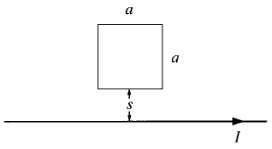
A square loop of wire (side a) lies on a table, a distance s from a very long straight wire, which carries a current I, as shown in Fig. 7.17. (a) Find the flux of B through the loop. (b) If someone now pulls the loop directly away from the wire, at speed v, what emf is generated? In what direction
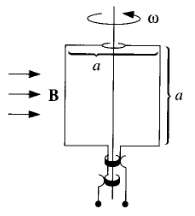
A square loop (side a) is mounted on a vertical shaft and rotated at angular velocity w (Fig. 7.18). A uniform magnetic field B points to the right. Find the ξ (t) for thi, alternating current generator.
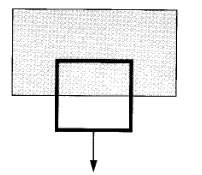
A square loop is cut out of a thick sheet of aluminum. It is then placed so that the top portion is in a uniform magnetic field B, and allowed to fall under gravity (Fig. 7.19). (In the diagram, shading indicates the field region; B points into the page.) If the magnetic field is 1 T (a pretty
A long solenoid, of radius a, is driven by an alternating current, so that the field inside is sinusoidal: B(t) = B0 cos(wt) z. A circular loop of wire, of radius a/2 and resistance R, is placed inside the solenoid, and coaxial with it. Find the current induced in the loop, as a function of time.
A square loop of wire, with sides of length a, lies in the first quadrant of the xy plane, with one corner at the origin. In this region there is a nonuniform time-dependent magnetic field B(y, t) = ky3t2 z (where k is a constant). Find the emf induced in the loop.
As a lecture demonstration a short cylindrical bar magnet is dropped down a vertical aluminum pipe of slightly larger diameter, about 2 meters long. It takes several seconds to emerge at the bottom, whereas an otherwise identical piece of unmagnetized iron makes the trip in a fraction of a second.
Showing 200 - 300
of 1324
1
2
3
4
5
6
7
8
9
10
11
12
13
14
Step by Step Answers

 Get 50% OFF
Claim Now
Get 50% OFF
Claim Now