New Semester
Started
Get
50% OFF
Study Help!
--h --m --s
Claim Now
Question Answers
Textbooks
Find textbooks, questions and answers
Oops, something went wrong!
Change your search query and then try again
S
Books
FREE
Study Help
Expert Questions
Accounting
General Management
Mathematics
Finance
Organizational Behaviour
Law
Physics
Operating System
Management Leadership
Sociology
Programming
Marketing
Database
Computer Network
Economics
Textbooks Solutions
Accounting
Managerial Accounting
Management Leadership
Cost Accounting
Statistics
Business Law
Corporate Finance
Finance
Economics
Auditing
Tutors
Online Tutors
Find a Tutor
Hire a Tutor
Become a Tutor
AI Tutor
AI Study Planner
NEW
Sell Books
Search
Search
Sign In
Register
study help
physics
oscillations mechanical waves
Fundamentals of Physics 8th Extended edition Jearl Walker, Halliday Resnick - Solutions
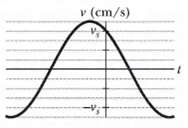
What is the phase constant for the harmonic oscillator with the velocity function v(t) given in Figure if the position function x(t) has the form x = x- cos (wt + Φ)? The vertical axis scale is set by vs = 4.0 cm/s.
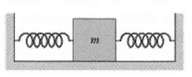
In Figure two identical springs of spring constant 7580 N/m are attached to a block of mass 0.245 kg. What is the frequency of oscillation on the friction-less floor?
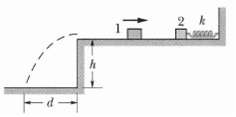
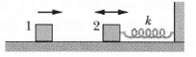
Figure shows block 1 of mass 0.200 kg sliding to the right over a frictionless elevated surface at a speed of 8.00 m/s. The block undergoes an elastic collision with stationary block 2, which is attached to a spring of spring const ant 1208.5 N/m. (Assume that the spring does not affect the
An oscillator consists of a block attached to a spring (k = 400 N/m). At some time t, the position (measured from the system's equilibrium location), velocity, and acceleration of the block are x = 0.100 m, v = – 13.6 m/s, and a = – 123 m/s2. Calculate (a) The frequency of oscillation, (b) The
At a certain harbor, the tides cause the ocean surface to rise and fall a distanc e d (from highest level to lowest level) in simple harmonic motion, with a period of I2.5 h. How long does it take for the water to fall a distance 0.250d from its highest level?
A block is on a horizontal surface (a shake table) that is moving back and forth horizontally with simple harmonic motion of frequency 2.0 Hz. The coefficient of static friction between block and surface is 0.50. How great can the amplitude of the SHM be if the block is not to slip along the
Two particles execute simple harmonic motion of the same amplitude and frequency along close parallel lines. They pass each other moving in opposite directions each time their displacement is half their amplitude. What is their phase difference?
Two particles oscillate in simple harmonic motion along a conrmon straight-line segment of length A. Each particle has a period of 1.5 s, but they differ in phase by π/6 rad.(a) How far apart are they (in terms of A) 0.50 s after the lagging particle leaves one end of the path?(b) Are they then
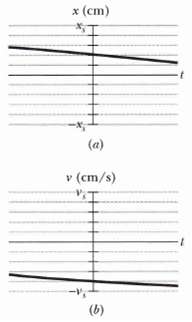
Figure a is a partial graph of the position function x(t) for a simple harmonic oscillator with an angular frequency of 1.20 rad/s; Figure b is a partial graph of the corresponding velocity function v(t). The vertical axis scales are set by xs = 5.0 cm and vs = 5.0 cm/s. What is the phase constant
A block rides on a piston that is moving vertically with simple harmonic motion.(a) If the SHM has period 1.0 s, at what amplitude of motion will the block and piston separate?(b) If the piston has an amplitude of 5.0 cm, what is the maximum frequency for which the block and piston will be in
A simple harmonic oscillator consists of a block of mass 2.00 kg attached to a spring of spring constant 100 N/m. When t = 1.00 s, the position and velocity of the block are x = 0.129 m and v = 3.415 m/s.(a) What is the amplitude of the oscillations? What were the?(b) Position and(c) Velocity of
In Figure two springs are attached to a block that can oscillate over a frictionless floor. If the left spring is removed, the block oscillates at a frequency of 30 Hz. If, instead, the spring on the right is removed, the block oscillates at a frequency of. 45 Hz. At what frequency does the block
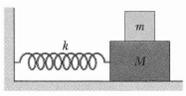
In Figure two blocks (m = 1.8kg and M = 10 kg) and a spring (k = 200 N/m) are arranged on a horizontal, frictionless surface. The coefficient of static friction between the two blocks is 0.40. What amplitude of simple harmonic motion of the spring-blocks system puts the smaller block on the verge
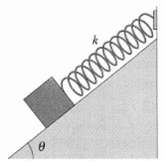
In Figure a block weighing 14.0 N, which can slide without friction on an incline at angle θ = 40.0o, is connected to the top of the incline by a massless spring of unstretched length 0.450 m and spring constant 120 N/m. (a) How far from the top of the incline is the block's equilibrium point? (b)
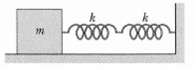
In Figure two springs are joined and connected to a block of mass 0.245 kg that is set oscillating over a frictionless floor. The springs each have spring constant k = 6430 N/m. What is the frequency of the oscillations?
Find the mechanical energy of a block-spring system having a spring constant of 1.3 N/cm and an oscillation amplitude of 2.4 cm.
An oscillating block-spring system has a mechanical energy of 1.00J, an amplitude of 10.0 cffi, and a maximum speed of 1 .20 mls. Find(a) The spring constant,(b) The mass of the block, and(c) The frequency of oscillation.
When the displacement in SHM is one-half the amplitude xm, what fraction of the total energy is(a) Kinetic energy and(b) Potential energy?(c) At what displacement, in terms of the amplitude, is the energy of the system half kinetic energy and half potential energy?
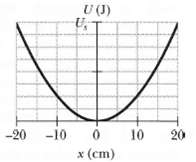
Figure gives the one-dimensional potential energy well for a 2.0 kg particle (the function U(x) has the form bx2 and the vertical axis scale is set by us = 2.0 J). (a) If the particle passes through the equilibrium position with a velocity of 85 cm/s, will it be turned back before it reaches x = 15
A 5.00 kg object on a horizontal frictionless surface is attached to a spring with k = 1000N/m. The object is displaced from equilibrium 50.0 cm horizontally and given an initial velocity of 10.0 m/s back toward the equilibrium position. What are?(a) The motion's frequency,(b) The initial potential
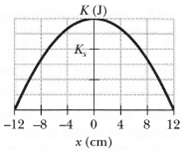
Figure shows the kinetic energy K of a simple harmonic oscillator versus its position x. The vertical axis scale is set by Ks = 4.0 J. What is the spring constant?
A 10 g particle undergoes SHM with an amplitude of 2.0mm, a maximum acceleration of magnitude 8.0 x 10³ m/s2, and an unknown phase constant Φ. What are?(a) The period of the motion,(b) The maximum speed of the particle, and(c) The total mechanical energy of the oscillator? What is the magnitude of
If the phase angle for a block-spring system in SHM is π/6 rad and the block's position is given by x = xm cos (wt + Φ), what is the ratio of the kinetic energy to the potential energy at time t = 0?
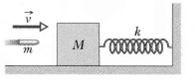
A block of mass M = 5.4 kg, at rest on a horizontal frictionless table, is attached to a rigid support by a spring of constant k = 6000 N/m. A bullet of mass m = 9.5g and velocity i of magnitude 630 m/s strikes and is embedded in the block (Figure). Assuming the compression of the spring is
In Figure block 2 of mass 2.0 kg oscillates on the end of a spring in SHM with a period of 20ms. The position of the block is given by x = (1.0 cm) cos (wt + ?/2). Block 1 of mass 4.0 kg slides toward block 2 with a velocity of magnitude 6.0 m/s, directed along the spring's length. The two blocks
A mass less spring hangs from the ceiling with a small object attached to its lower end. The object is initially held at rest in a position yi such that the spring is at its rest length. The object is then released from yi and oscillates up and down, with its lowest position being 10cm below yi.(a)
A 95 kg solid sphere with a 15 cm radius is suspended by a vertical wire. A torque of 0.20N ∙ m is required to rotate the sphere through an angle of 0.85 rad and then maintain that orientation. What is the period of the oscillations that result when the sphere is then released?
The balance wheel of an old-fashioned watch oscillates with angular amplitude π rad and period 0.500s. Find (a) The maximum angular speed of the wheel, (b) The angular speed at displacement π/2 rad, and (c) The magnitude of the angular acceleration at displacement π/4 rad.
Suppose that a simple pendulum consists of a small 60.0 g bob at the end of a cord of negligible mass. If the angle θ between the cord and the vertical is given by θ = (0.0800 rad) cos [(4.43 rad/s) t + Φ], what are(a) The pendulum's length and(b) Its maximum kinetic energy?
(a) If the physical pendulum of Sample Problem is inverted and suspended at point P, what is its period of oscillation?(b) Is the period now greater than, less than, or equal to its previous value?
In Sample Problem we saw that a physical pendulum has a center of oscillation at distance 2L/3 from its point of suspension. Show that the distance between the point of suspension and the center of oscillation for a physical pendulum of any form I/mh, where I and h have the meanings assigned to
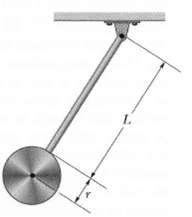
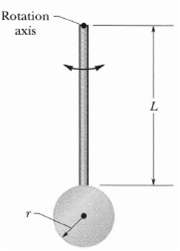
In Figure the pendulum with radius r = 10.0 cm and mass 500 g attached to a uniform rod with length L = 500 mm and mass 270 g.(a) Calculate the rotational inertia of the pendulum about the pivot point.(b) What is the distance between the pivot point and the center of mass of the pendulum?(c)
A physical pendulum consists of a meter stick that is pivoted at a small hole drilled through the stick a distance d from the 50 cm mark. The period of oscillation is 2.5s. Find d.
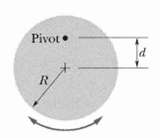
In Figure a physical pendulum consists of a uniform solid disk (of radius R = 2.35 cm) supported in a vertical plane by a pivot located a distance d = 1.75 cm from the center of the disk. The disk is displaced by a small angle and released. What is the period of the resulting simple harmonicmotion?
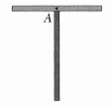
A physical pendulum consists of two meter-long sticks joined together as shown in Figure. What is the pendulum's period of oscillation about a pin inserted through point A at the center of the horizontalstick?
A performer seated on a trapeze is swinging back and forth with a period of 8.85 s. If she stands up, thus raising the center of mass of the trapeze + performer system by 35.0cm, what will be the new period of the system? Treat trapeze + performer as a simple pendulum.
A thin uniform rod (mass = 0.50 kg) swings about an axis that passes through one end of the rod and is perpendicular to the plane of the swing. The rod swings with a period of 1.5 s and an angular amplitude of 10o. (a) What is the length of the rod? (b) What is the maximum kinetic energy
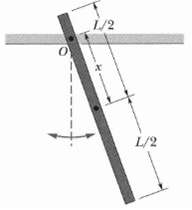
In Figure a stick of length L = 1.85m oscillates as a physical pendulum.(a) What value of distance x between the stick's center of mass and its pivot point O gives the least period?(b) What is that leastperiod?
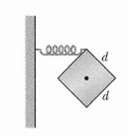
The 3.00 kg cube in Figure has edge lengths d = 6.00 cm and is mounted on an axle through its center. A spring (k = 1200N/m) connects the cube's upper corner to a rigid wall. Initially the spring is at its rest length. If the cube is rotated 3o?and released, what is the period of the resulting SHM?
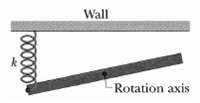
In the overhead view of Figure a long uniform rod of mass 0.600 kg is free to rotate in a horizontal plane about a vertical axis through its center. A spring with force constant k = 1850 N/m is connected horizontally between one end of the rod and a fixed wall. When the rod is in equilibrium, it is
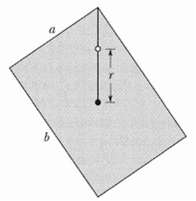
A rectangular block, with face lengths a = 35 cm and b = 45cm, is to be suspended on a thin horizontal rod running through a narrow hole in the block. The block is then to be set swinging about the rod like a pendulum, through small angles so that it is in SHM. Figure shows one possible position of
The angle of the pendulum of Figure b is given by θ = θm cos [(4.44 rad/s)t + Φ]. If at t = 0, 9 = 0.040rad and dθ/dt = 0.200 rad/s, what are (a) The phase constant Φ and (b) The maximum angle θm?
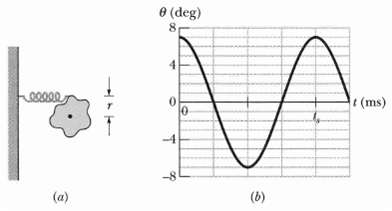
In Figure a, a metal plate is mounted on an axle through its center of mass. A spring with k = 2000 N/m connects a wall with a point on the rim a distance r = 2.5 cm from the center of mass. Initially the spring is at its rest length. If the plate is rotated by 7oand released, it rotates about the
A pendulum is formed by pivoting a long thin rod about a point on the rod. In a series of experiments, the period is measured as a function of the distance x between the pivot point and the rod's center. (a) If the rod's length is L = 2.20 m and its mass rs m = 22.1 g, what is the minimum period?
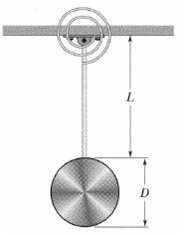
In Figure a 2.50 kg disk of diameter D = 42.0 cm is supported by a rod of length L = 76.0 cm and negligible mass that is pivoted at its end.(a) With the massless torsion spring unconnected, what is the period of oscillation?(b) With the torsion spring connected, the rod is vertical at equilibrium.
In Figure the block has a mass of 1.50 kg and the spring constant is 8.00 N/m. The damping force is given by – b(dx/dt), where b = 230 g/s. The block is pulled down 12.0 cm and released. (a) Calculate the time required for the amplitude of the resulting oscillations to fall to one-third of its
In Sample Problem what is the ratio of the amplitude of the damped oscillations to the initial amplitude at the end of 20 cycles?
The amplitude of a lightly damped oscillator decreases by 3.0% during each cycle. What percentage of the mechanical energy of the oscillator is lost in each cycle?
The suspension system of a 2000 kg automobile "sags" L0 cm when the chassis is placed on it. Also, the oscillation amplitude decreases by 50% each cycle. Estimate the values of (a) The spring constant k and (b) The damping constant b for the spring and shock absorber system of one wheel, assuming
For Equation suppose the amplitude Fm is given by where F^ is the (constant) amplitude of the external oscillating force exerted on the spring by the rigid support in Figure. At resonance, what are the (a) Amplitude and(b) Velocity amplitude of the oscillating object?
A 1000 kg car carrying four 32kg people travels over a "washboard" dirt road with corrugations 4.0 m apart. The car bounces with maximum amplitude when its speed is 16 km/h. When the car stops, and the people get out, by how much does the car body rise on its suspension?
A block is in SHM on the end of a spring, with position given by x = xm cos (wt + Φ). If Φ = π/5 rad, then at t = 0 what percentage of the total mechanical energy is potential energy?
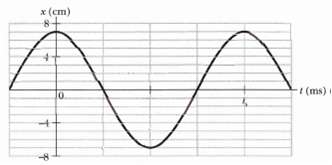
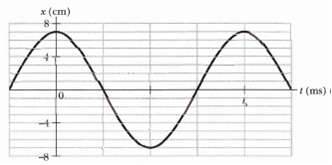
Figure gives the position of a 20 g block oscillating in SHM on the end of a spring. The horizontal axis scale is set by ts = 40.0ms. What are?(a) The maximum kinetic energy of the block and(b) The number of times per second that maximum is reached?
Figure gives the position x(t) of a block oscillating in SHM on the end of a spring (ts = 40.0 ms).What are(a) The speed and(b) The magnitude of the radial acceleration of a particle in the corresponding uniform circularmotion?
Figure shows the kinetic energy K of a simple pendulum versus its angle θ from the vertical. The vertical axis scale is set by Ks = 10.0mJ. The pendulum bob has mass 0.200 kg. What is the length of the pendulum?
Although California is known for earthquakes, it has large regions dotted with precariously balanced rocks that would be easily toppled by even a mild earthquake. The rocks have stood this way for thousands of years, suggesting that major earthquakes have not occurred in those regions during that
A 4.00 kg block is suspended from a spring with k = 500 N/m. A 50.0 g bullet is fired into the block from directly below with a speed of 150 m/s and becomes embedded in the block. (a) Find the amplitude of the resulting SHM. (b) What percentage of the original kinetic energy of the bullet is
A 55.0 g block oscillates in SHM on the end of a spring with k = 1500 N/m according to x = xm cos (wt + Φ). How long does the block take to move from position + 0.800xm to (a) Position + 0.600xm and (b) Position – 0.800xm?
A loudspeaker diaphragm is oscillating in simple harmonic motion with a frequency of 440 Hz and a maximum displacement of 0.75 mm. What are the (a) Angular frequency, (b) Maximum speed, and (c) Magnitude of the maximum acceleration?
The tip of one prong of a tuning fork undergoes SHM of frequency 1000 Hz and amplitude 0.40 mm. For this tip, what is the magnitude of the (a) Maximum acceleration, (b) Maximum velocity,(c) Acceleration at tip displacement 0.20mm, and (d) Velocity at tip displacement 0.20 mm?
A flat uniform circular disk has a mass of 3.00 kg and a radius of 70.0 cm. It is suspended in a horizontal plane by a vertical wire attached to its center. If the disk is rotated 2.50 rad about the wire, a torque of 0.0600 N ∙ m is required to maintain that orientation. Calculate (a) The
A uniform circular disk whose radius R is 12.6 cm is suspended as a physical pendulum from a point on its rim.(a) What is its period? (b) At what radial distance r < R is there a pivot point that gives the same period?
What is the frequency of a simple pendulum 2.0 m long(a) In a room, (b) In an elevator accelerating upward at a rate of 2.0 m/s2, and (c) In free fall?
A particle executes linear SHM with frequency 0.25 Hz about the point x = 0. At t = 0, it has displacement x = 0.37 cm and zero velocity. For the motion, determine the(a) Period, (b) Angular frequency, (c) Amplitude, (d) Displacement x(t), (e) Velocity v(t), (f) Maximum speed,(g) Magnitude of the
A 50.0 g stone is attached to the bottom of a vertical spring and set vibrating. If the maximum speed of the stone is 15.0 cm/s and the period is 0.500 s, find the (a) Spring constant of the spring, (b) Amplitude of the motion, and (c) Frequency of oscillation.
A 2.00 kg block hangs from a spring. A 300 g body hung below the block stretches the spring 2.00 cm farther. (a) What is the spring constant? (b) If the 300 g body is removed and the block is set into oscillation, find the period of the motion.
The end point of a spring oscillates with a period of 2.0 s when a block with mass m is attached to it. When this mass is increased by 2.0 kg, the period is found to be 3.0 s. Find m.
A 0.10 kg block oscillates back and forth along a straight line on a frictionless horizontal surface. Its displacement from the origin is given by x = (10 cm) cos [(10 rad/s)t + π/2 rad]. (a) What is the oscillation frequency? (b) What is the maximum speed acquired by the block? (c) At
A 3.0 kg particle is in simple harmonic motion in one dimension and moves according to the equation x = (5.0 m) cos [(π/3 rad/s)t – π/4 rad], with / in seconds. (a) At what value of x is the potential energy of the particle equal to half the total energy? (b) How long does the
A mass less spring with spring constant 19 N/m hangs vertically. A body of mass 0.20 kg is attached to its free end and then released. Assume that the spring was un-stretched before the body was released. Find (a) How far below the initial position the body descends, and the (b) Frequency and(c)
The piston in the cylinder head of a locomotive has a stroke (twice the amplitude) of 0.76 m. If the piston moves with simple harmonic motion with an angular frequency of 180rev/min, what is its maximum speed?
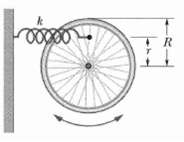
A wheel is free to rotate about its fixed axle. A spring is attached to one of its spokes a distance r from the axle, as shown in Figure.(a) Assuming that the wheel is a hoop of mass m and radius R, what is the angular frequency w of small oscillations of this system in terms of m, R, r, and the
The scale of a spring balance that reads from 0 to 15.0 kg is 12.0 cm long. A package suspended from the balance is found to oscillate vertically with a frequency of. 2.00 Hz(a) What is the spring constant? (b) How much does the package weigh?
A uniform spring with k = 8600 N/m is cut into pieces I and 2 of un-stretched lengths L1 = 7.0 cm and L2 = 10 cm. What are? (a) k1 and (b) k2? A block attached to the original spring as in Figure oscillates at 200 Hz. What is the oscillation frequency of the block attached to? (c) Piece 1 and(d)
In Figure three 10 000 kg ore cars are held at rest on a mine railway using a cable that is parallel to the rails, which are inclined at angle θ = 30o. The cable stretches 15 cm just before the coupling between the two lower cars breaks, detaching the lowest car. Assuming that the cable obeys
A simple pendulum of length 20 cm and mass 5.0 g is suspended in a race car traveling with constant speed 70 m/s around a circle of radius 50 m. If the pendulum undergoes small oscillations in a radial direction about its equilibrium position, what is the frequency of oscillation?
A vertical spring stretches 9.6 cm when a 1.3 kg block is hung from its end. (a) Calculate the spring constant. This block is then displaced an additional 5.0 cm downward and released from rest. Find the (b) Period, (c) Frequency, (d) Amplitude, and (e) Maximum speed of the resulting SHM.
A block weighing 20 N oscillates at one end of a vertical spring for which k = 100 N/m; the other end of the spring is attached to a ceiling. At a certain instant the spring is stretched 0.30 m beyond its relaxed length (the length when no object is attached) and the block has zero velocity. (a)
A 1.2kg block sliding on a horizontal frictionless surface is attached to a horizontal spring with k = 480 N ∙ m. Let x be the displacement of the block from the position at which the spring is un-stretched. At t = 0 the block passes through x = 0 with a speed of 5.2 m/s in the positive x
A simple harmonic oscillator consists of an 0.80 kg block attached to a spring (k = 200 N/m).The block slides on a horizontal frictionless surface about the equilibrium point x = 0 with a total mechanical energy of 4.0J. (a) What is the amplitude of the oscillation? (b) How many oscillations does
An engineer has an odd-shaped 10 kg object and needs to find its rotational inertia about an axis through its center of mass. The object is supported on a wire stretched along the desired axis. The wire has a torsion constant k = 0.50 N ∙ m. If this torsion pendulum oscillates through 20
A grandfather clock has a pendulum that consists of a thin brass disk of radius r = 15.00 cm and mass 1.000 kg that is attached to a long thin rod of negligible mass. The pendulum swings freely about an axis perpendicular to the rod and through the end of the rod opposite the disk, as shown in
A block sliding on a horizontal frictionless surface is attached to a horizontal spring with a spring constant of 600 N/m. The block executes SHM about its equilibrium position with a period of 0.40 s and an amplitude of 0.20 m. As the block slides through its equilibrium position, a 0.50 kg putty
When a 20 N can is hung from the bottom of a vertical spring, it causes the spring to stretch 20 cm. (a) What is the spring constant? (b) This spring is now placed horizontally on a frictionless table. One end of it is held fixed, and the other end is attached to a 5.0N can. The can is then moved
A 4.00 kg block hangs from a spring, extending it 16.0 cm from its un-stretched position. (a) What is the spring constant?(b) The block is removed, and a 0.500 kg body is hung from the same spring. If the spring is then stretched and released, what is its period of oscillation?
A damped harmonic oscillator consists of a block (m = 2.00 kg), a spring (k = 10.0 N/m), and a damping force (F = – bv). Initially, it oscillates with an amplitude of 25.0 cm; because of the damping, the amplitude falls to three-fourths of this initial value at the completion of four
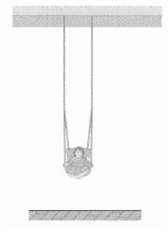
A common device for entertaining a toddler is a jump seat that hangs from the horizontal portion of a doorframe via elastic cords (Figure). Assume that only one cord is on each side in spite of the more realistic arrangement shown. When a child is placed in the seat, they both descend by a distance
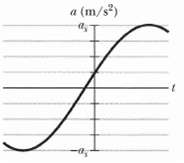
What is the phase constant for SMH with a(t) given in Figure if the position function x(t) has the form x = xm cos(wf + ?) and as = 4.0 m/s2?
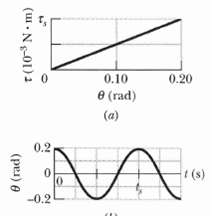
A torsion pendulum consists of a metal disk with a wire running through its center and soldered in place. The wire is mounted vertically on clamps and pulled taut. Figure a gives the magnitude ? of the torque needed to rotate the disk about its center (and thus twist the wire) versus the rotation
A spider can tell when its web has captured, say, a fly because the fly's thrashing causes the web threads to oscillate. A spider can even determine the size of the fly by the frequency of the oscillations. Assume that a fly oscillates on the capture thread on which it is caught like a block on a
For a simple pendulum, find the angular amplitude θm at which the restoring torque required for simple harmonic motion deviates from the actual restoring torque by 1.0%. (See "Trigonometric Expansions" in Appendix E.)
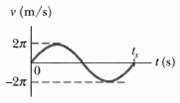
A simple harmonic oscillator consists of a block attached to a spring with k = 200 N/m. The block slides on a frictionless surface, with equilibrium point x = 0 and amplitude 0.20 m. A graph of the block's velocity y as a function of time r is shown in Figure. The horizontal scale is set by ts =
A simple harmonic oscillator consists of a 0.50 kg block attached to a spring. The block slides back and forth along a straight line on a frictionless surface with equilibrium point x = 0. At t = 0 the block is at x= 0 and moving in the positive x direction. A graph of the magnitude of the net
In Figure a solid cylinder attached to a horizontal spring (k = 3.00 N/m) rolls without slipping along a horizontal surface. If the system is released from rest when the spring is stretched by 0.250 m, find (a) The translational kinetic energy and (b) The rotational kinetic energy of the
A block weighing 10.0 N is attached to the lower end of a vertical spring (k = 200.0 N/m), the other end of which is attached to a ceiling. The block oscillates vertically and has a kinetic energy of 2.00 J as it passes through the point at which the spring is un-stretched. (a) What is the period
A2.0 kg block executes SHM while attached to a horizontal spring of spring constant 200N/m. The maximum speed of the block as it slides on a horizontal frictionless surface is 3.0m/s what are? (a) The amplitude of the block's motion,(b) The magnitude of its maximum acceleration, and (c) The
The vibration frequencies of atoms in solids at normal temperatures are of the order of 1013 Hz. Imagine the atoms to be connected to one another by springs. Suppose that a single silver atom in a solid vibrates with this frequency and that all the other atoms ate at rest. Compute the effective
In Figure a 2500 kg demolition ball swings from the end of a crane. The length of the swinging segment of cable is 17 m. (a) Find the period of the swinging, assuming that the system can be treated as a simple pendulum. (b) Does the period depend on the ball's mass?
The center of oscillation of a physical pendulum has this interesting property: If an impulse (assumed horizontal and in the plane of oscillation) acts at the center of oscillation, no oscillations are felt at the point of support. Baseball players (and players of many other sports) know that
A 2.0 kg block is attached to the end of a spring with a spring constant of 350 N/m and forced to oscillate by an applied force F = (15 N) sin (wdt), where wd = 35 rad/s. The damping constant is b = 15 kg/s. At t = 0, the block is at rest with the spring at its rest length. (a) Use numerical
Showing 1000 - 1100
of 2092
First
4
5
6
7
8
9
10
11
12
13
14
15
16
17
18
Last
Step by Step Answers

 Get 50% OFF
Claim Now
Get 50% OFF
Claim Now