New Semester
Started
Get
50% OFF
Study Help!
--h --m --s
Claim Now
Question Answers
Textbooks
Find textbooks, questions and answers
Oops, something went wrong!
Change your search query and then try again
S
Books
FREE
Study Help
Expert Questions
Accounting
General Management
Mathematics
Finance
Organizational Behaviour
Law
Physics
Operating System
Management Leadership
Sociology
Programming
Marketing
Database
Computer Network
Economics
Textbooks Solutions
Accounting
Managerial Accounting
Management Leadership
Cost Accounting
Statistics
Business Law
Corporate Finance
Finance
Economics
Auditing
Tutors
Online Tutors
Find a Tutor
Hire a Tutor
Become a Tutor
AI Tutor
AI Study Planner
NEW
Sell Books
Search
Search
Sign In
Register
study help
physics
oscillations mechanical waves
Fundamentals of Physics 8th Extended edition Jearl Walker, Halliday Resnick - Solutions
A wave the an angular frequency of 110 rad/s and a wavelength of 1.80m. Calculate(a) The angular wave number and (b) The speed of the wave.
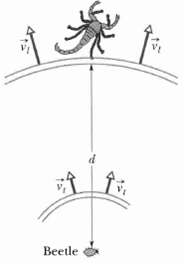
A Sand scorpion can detect the motion of a nearby beetle (its prey) by the waves the motion sends along the sand surface (Figure). The waves are of two types: transverse waves traveling at vt = 50m/s and longitudinal waves traveling at vl = 50 m/s. If a sudden motion sends out such waves, a
A sinusoidal wave travels along a string. The time for a particular point to move from maximum displacement to zero is 0.170 s. What are the (a) Period and (b) Frequency? (c) The wavelength is 1.40 m; what is the wave speed?
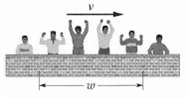
A human wave, during sporting events within large, densely packed stadiums, spectators will send a wave (or pulse) around the stadium (Figure). As the wave reaches a group of spectators, they stand with a cheer and then sit. At any instant, the width w of the wave is the distance from the leading
If y(x, t) = (6.0 mm) sin(kx + (600 rad/s)t + Φ) describes a wave traveling along a string, how much time does any given point on the string take to move between displacements y = +2.0 mm and y = –2.0 mm?
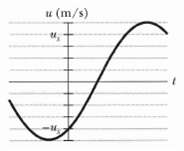
Figure shows the transverse velocity u versus time t of the point on a string at x = 0, as a wave passes through it. The scale on the vertical axis is set by us = 4.0m/s. The wave has form y(x, t) = ym sin (kx ?? wt + ?). What is ?? (Caution: A calculator does not always give the proper inverse
A sinusoidal wave of frequency 500 Hz has a speed of 350 m/s. (a) How far apart are two points that differ in phase by π/3 rad? (b) What is the phase difference between two displacements at a certain point at times 1.00 ms apart?
The equation of a transverse wave traveling along a very long string is y = 6.0 sin (0.020πx + 4.0πt), where x and y are expressed in centimeters and r is in seconds. Determine (a) The amplitude, (b) The wavelength, (c) The frequency, (d) The speed, (e) The direction of
A transverse sinusoidal wave is moving along a string in the positive direction of an x axis with a speed of 80 m/s. At t = 0, the string particle at x = 0 has a transverse displacement of 4.0 cm from its equilibrium position and is not moving. The maximum transverse speed of the string particle at
The function y(x, t) = (15.0 cm) cos (πx – 15πt), with x in meters and t in seconds, describes a wave on a taut string. What is the transverse speed for a point on the string at an instant when that point has the displacement y = +12.0 cm?
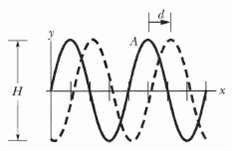
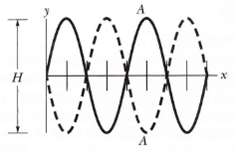
A sinusoidal wave moving along a string is shown twice in Figure, as crest A travels in the positive direction of an x axis by distance d = 6.0 cm in 4.0ms. The tick marks along the axis are separated by 10 cm; height H = 6.00 mm. If the wave equation is of the form y(x, t) = ym sin (kx + wt), what
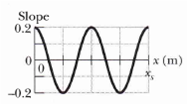
A sinusoidal wave travels along a string under tension. Figure gives the slopes along the string at time t = 0. The scale of the x axis is set by xs = 0.80 m. What is the amplitude of thewave?
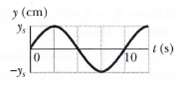
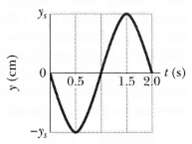
A sinusoidal transverse wave of wavelength 20 cm travels along a string in the positive direction of an x axis. The displacement y of the string particle at x = 0 is given in Figure as a function of time /. The scale of the vertical axis is set by ys = 4.0 cm. The wave equation is to be in the form
The tension in a wire clamped at both ends is doubled without appreciably changing the wire's length between the clamps. What is the ratio of the new to the old wave speed for transverse waves traveling along this wire?
What is the speed of a transverse wave in a rope of length 2.00 m and mass 60.0 g under a tension of 500 N?
The heaviest and lightest strings on a certain violin have linear densities of 3.0 and 0.29 g/m. What is the ratio of the diameter of the heaviest string to that of the lightest string, assuming that the strings are of the same material?
A stretched string has a mass per unit length of 5.00 g/cm and a tension of 10.0 N.A sinusoidal wave on this string has an amplitude of 0.12 mm and a frequency of 100 Hz and is traveling in the negative direction of an x axis. If the wave equation is of the form y(x, t) = ym sin (kx + wt), what are
The speed of a transverse wave on a string is 170 m/s when the string tension is 120 N. To what value must the tension be changed to raise the wave speed to 180 m/s?
The linear density of a string is l6 x 10-4 kg/m. A transverse wave on the string is described by the equation y = (0.021 m) sin [(2.0m-1)x + (30 s-1)t]. What are? (a) The wave speed and (b) The tension in the string?
The equation of a transverse wave on a string is y = (2.0 mm) sin [(20 m-1) x – (600 s-1)t]. The tension in the string is 15 N. (a) What is the wave speed?(b) Find the linear density of this string in grams per meter.
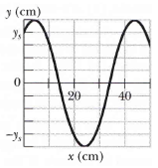
A sinusoidal transverse wave is traveling along a string in the negative direction of an x axis. Figure shows a plot of the displacement as a function of position at time t = 0; the scale of the y axis is set by ys= 4.0 cm. The string tension is 3.6 N, and its linear density is 25 g/m. Find
A sinusoidal wave is traveling on a string with speed 40 cm/s. The displacement of the particles of the string at x = 10 cm is found to vary with time according to the equation y = (5.0 cm) sin[1.0 – (4.0 s-1)t]. The linear density of the string is 4.0 g/cm. What are? (a) The frequency and (b)
A 100 g wire is held under a tension of 250 N with one end at x = 0 and the other at x = 10.0 m. At time t = 0, pulse 1 is sent along the wire from the end at x = 10.0 m. At time t = 30.0 ms, pulse 2 is sent along the wire from the end at x = 0 at what position x do the pulses begin to meet?
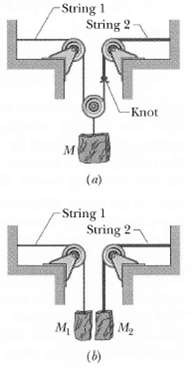
In Figure a, string 1 has a linear density of 3.00g/m, and string 2 has a linear density of 5.00g/m. They are under tension due to the hanging block of mass M = 500 g Calculate the wave speed on(a) String 1 and(b) String 2.Next the block is divided into two blocks (with M1 t Mz - M) and the
A uniform rope of mass m and length L hangs from a ceiling. (a) Show that the speed of a transverse wave on the rope is a function of y, the distance from the lower end, and is given by v = √gy. (b) Show that the time a transverse wave takes to travel the length of the rope is given by t =
A string along which waves can travel is 2.70 m long and has a mass of 260 g. The tension in the string is 36.0 N. What must be the frequency of traveling waves of amplitude 7.70 mm for the average power to be 85.0 W?
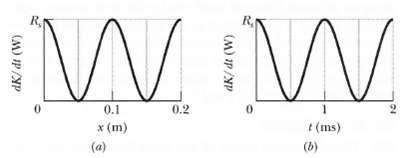
A sinusoidal wave is sent along a string with a linear density of 2.0g/m. As it travels, the kinetic energies of the mass elements along the string vary. Figure a gives the rate dK/dt at which kinetic energy passes through the string elements at a particular instant, plotted as a function of
Use the wave equation to find the speed of a wave given by y(x, t) = (3.00mm) sin [(4.00 m–1)x – (7.00 s–1)t].
Use the wave equation to find the speed of a wave given by y(x, t) = (2.00 mm) [(20 m–1)x – (4.0 s–1) t]0.5.
Use the wave equation to find the speed of a wave given in terms of the general function h(x, t): y(x, t) = (4.00 mm) h (30 m–1)x + (6.0 s–1)t].
Two identical traveling waves, moving in the same direction, are out of phase by π/2 rad. What is the amplitude of the resultant wave in terms of the common amplitude ym of the two combining waves?
What phase difference between two identical traveling waves, moving in the same direction along a stretched string, results in the combined wave having an amplitude 1.50 times that of the common amplitude of the two combining waves? Express your answer in (a) Degrees, (b) Radians, and (c)
Two sinusoidal waves with the same amplitude of 9.00 mm and the same wavelength travel together along a string that is stretched along an x axis. Their resultant wave is shown twice in Figure as valley A travels in the negative direction of the x axis by distance d = 56.0 cm in 8.0 ms. The tick
A sinusoidal wave of angular frequency 1200 rad/s and amplitude 3.00 mm is sent along a cord with linear density 2.00 glm and tension 1200 N. (a) What is the average rate at which energy is transported by the wave to the opposite end of the cord? (b) It simultaneously, an identical wave travels
Two sinusoidal waves of the same frequency travel in the same direction along a string. If ym1 = 3.0 cm, 4.0 cm, Φ1 = 0, and Φ1 = π/2 rad, what is the amplitude of the resultant wave?
Two sinusoidal waves of the same frequency are to be sent in the same direction along a taut string. One wave has an amplitude of 5.0 mm, the other 8.0 mm. (a) What phase difference Φ1 between the two waves results in the smallest amplitude of the resultant wave? (b) What is that smallest
Two sinusoidal waves of the same period, with amplitudes of 5.0 and 7.0 mm, travel in the same direction along a stretched string; they produce a resultant wave with an amplitude of 9.0 mm. The phase constant of the 5.0 mm wave is 0. What is the phase constant of the 7 .0 mm wave?
Four waves are to be sent along the same string, in the same direction: y1(x, t) = (4.00 mm) sin (2πx – 400πt) y2(x, t) = (4.00 mm) sin (2πx – 400πt + 0.7π) y3(x, t) = (4.00 mm) sin (2πx – 400πt + π) y4(x, t) = (4.00 mm) sin (2πx – 400πt
These two waves travel along the same string: y1(x, t) = (4.60 mm) sin (2πx – 400πt) y2(x, t) = (5.60 mm) sin (2πx – 400πt + 0.80π rad). What are? (a) The amplitude and (b) The phase angle (relative to wave 1) of the resultant wave? (c) If a third wave of
A 125 cm length of string has mass 2.00 g and tension 7.00 N. (a) What is the wave speed for this string? (b) What is the lowest resonant frequency of this string?
What are? (a) The lowest frequency, (b) The second lowest and(c) The third lowest frequency for standing waves on a wire that is 10.0m long, has a mass of 100g, and is stretched under a tension of 250 N?
String A is stretched between two clamps separated by distance L. String B, with the same linear density and under the same tension as string A, is stretched between two clamps separated by distance 4L. Consider the first eight harmonics of strin g B. For which of these eight harmonics of B (if
A string fixed at both ends is 8.40 m long and has a mass of 0.120 kg. It is subjected to a tension of 96.0 N and set oscillating. (a) What is the speed of the waves on the string?(b) What is the longest possible wavelength for a standing wave? (c) Give the frequency of that wave?
Two sinusoidal waves with identical wavelengths and amplitudes travel in opposite directions along a string with a speed of 10 cm/s. If the time interval between instants when the string is flat is 0.50 s, what is the wavelength of the waves?
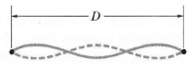
A nylon guitar string has a density of 7.20g/m and is a tension of 150 N. The fixed supports are distance D = 90.0 cm apart. The string is oscillating in the standing wave pattern shown in Figure. Calculate the(a) Speed,(b) Wavelength, and(c) Frequency of the traveling waves whose superposition
A string under tension τi oscillates in the third harmonic at frequency f3, and the waves on the string have wavelength λ3. If the tension is increased to τi = 4τi and the string is again made to oscillate in the third harmonic, what then are (a) The frequency of oscillation
A string that is stretched between fixed supports separated by 75.0 cm has resonant frequencies of 420 and 315 Hz, with no intermediate resonant frequencies. What are? (a) The lowest resonant frequency and (b) The wave speed?
If a transmission line in a cold climate collects ice, the increased diameter tends to cause vortex formation in a passing wind. The air pressure variations in the vortexes tend to cause the line to oscillate (gallop), especially if the frequency of the variations matches a resonant frequency of
One of the harmonic frequencies for a particular string under tension is 325Hz. The next higher harmonic frequency is 390 Hz. What harmonic frequency is next higher after the harmonic frequency 195 Hz?
A rope, under a tension of 200 N and fixed at both ends, oscillates in a second-harmonic standing wave pattern. The displacement of the rope is given by y = (0.10 m) (sin πx/2) sin 12πt, where x = 0 at one end of the rope, x is in meters, and t is in seconds. What are (a) The length of
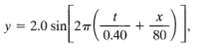
A string oscillates according to the equation what are the(a) Amplitude and(b) Speed of the two waves (identical except for direction of travel) whose superposition gives this oscillation?(c) What is the distance between nodes?(d) What is the transverse speed of a particle of the string at the
A standing wave pattern on a string is described by y(x, t) = 0.040 (sin 5πx) (cos 40πt), where x and y are in meters and r is in seconds. For x > 0, what is the location of the node with the (a) Smallest, (b) Second smallest, and (c) Third smallest value of x? (d) What is the
Two waves are generated on a string of length 3.0m to produce a three-loop standing wave with an amplitude of 1.0 cm. The wave speed is 100 m/s. Let the equation for one of the waves be of the form y(x, t) = ym sin (kx + wt).In the equation for the other wave, what are (a) ym, (b) k,(c) w, and (d)
For a certain transverse standing wave on a long string, an anti node is at x = 0 and an adjacent node is at x = 0.10 m. The displacement y(t) of the string particle at x = 0 is shown in Figure, where the scale of the y axis is set by ys = 4.0 cm. When t = 0.50 s, what is the displacement of the
A generator at one end of a very long string creates a wave given by y = (6.0 cm) cos π/2 [(2.00m-1) x + (8.00 s-1)t], and a generator at the other end creates the wave y = (6.0 cm) cos π/2 [(2.00 m-1)x - (8.00 s-1)t]. Calculate the (a) Frequency, (b) Wavelength, and (c) Speed of
Two sinusoidal waves with the same amplitude and wavelength travel through each other along a string that is stretched along an x axis. Their resultant wave is shown twice in Figure as the anti node A travels from an extreme upward displacement to an extreme downward displacement in 6.0ms. The tick
The following two waves are sent in opposite directions on a horizontal string so as to create a standing wave in a vertical plane: y1(x, t) = (6.00 mm) sin (4.00πx – 400πt) y2 (x, t) = (6.00 mm) sin (4.00πx + 400πt), with x in meters and t in seconds. An anti node is located
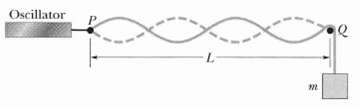
In Figure a string, tied to a sinusoidal oscillator at P and running over a support at Q, is stretched by a block of mass m. Separation L = 1.20 m, linear density ? = 1.6 g/m, and the oscillator frequency f = 120Hz.The amplitude of the motion at P is small enough for that point to be considered a
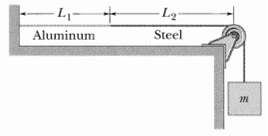
In Figure an aluminum wire, of length L1 = 60.0cm, cross-sectional area 1.00 x 10⁻² cm2, and density 2.60 g/cm3, is joined to a steel wire, of density 7.80 g/cm3 and the same cross-sectional area. The compound wire, loaded with a block of mass m = 10.0 kg, is arranged so that the distance L2 from
In Figure a string, tied to a sinusoidal oscillator at P and running over a support at Q, is stretched by a block of mass m. The separation L between P and Q is 1.20 m, and the frequency f of the oscillator is fixed at 120Hz.The amplitude of the motion at P is small enough for that point to be
Three sinusoidal waves of the same frequency travel along a string in the positive direction of an x axis. Their amplitudes are y1, y1/2, and y1/3, and their phase constants are 0, π/2, and π, respectively. What are the (a) Amplitude and (b) Phase constant of the resultant wave? (c)
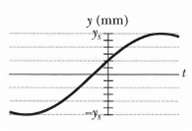
Figure shows the displacement y versus time t of the point on a string at x = 0, as a wave passes through that point. The scale of the y axis is set by ys = 6.0 mm. The wave has form y(x, t) = ym sin (kx ?? at + ?). What is ?? (Caution: A calculator does not always give the proper inverse trig
Two sinusoidal waves, identical except for phase, travel in the same direction along a string, producing a net wave y'(x, t) = (3.0 mm) sin (20x – 4.0t + 0.820 rad), with x in meters and t in seconds. What are? (a) The wavelength λ of the two waves, (b) The phase difference between them,
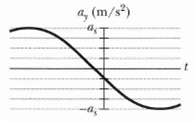
Figure shows transverse acceleration ay versus time t of the point on a string at x = 0, as a wave written in the form y(x, t) = ym sin (kx ?? wt + ?) passes through that point. The scale of the vertical axis is set by as = 400 m/s2. What is ?? (Caution: A calculator does not always give the proper
At time t = 0 and at position x- 0malong a string, a traveling sinusoidal wave with an angular frequency of 440 rad/s has displacement y = + 45 mm and transverse velocity u = – 0.75 m/s. If the wave has general form y(x, t) = ym sin (kx – wt + Φ), what is phase constant Φ?
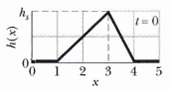
A single pulse, given by h(x ?? 5.0t), is shown in Figure for t = 0.The scale of the vertical axis is set by hs = 2.Herex is in centimeters and r is in seconds. What are the(a) Speed and(b) Direction of travel of the pulse?(c) Plot h(x ?? 5t) as a function of x for t = 2 s.(d) Plot h(x ?? 5t) as a
A transverse sinusoidal wave is generated at one end of a long, horizontal string by a bar that moves up and down through a distance of 1.00 cm. The motion is continuous and is repeated regularly 120 times per second. The string has linear density 120g/m and is kept under a tension of 90.0 N. Find
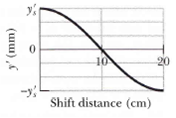
Two sinusoidal 120 Hz waves, of the same frequency and amplitude, are to be sent in the positive direction of an x axis that is directed along a cord under tension. The waves can be sent in phase, or they can be phase-shifted. Figure shows the amplitude y' of the resulting wave versus the distance
A sinusoidal transverse wave of amplitude ym and wavelength λ travels on a stretched cord.(a) Find the ratio of the maximum particle speed (the speed with which a single particle in the cord moves transverse to the wave) to the wave speed.(b) Does this ratio depend on the material of which the
A sinusoidal transverse wave traveling in the positive direction of an x axis has an amplitude of 2.0 cm, a wavelength of 10 cm, and a frequency of 400 Hz. If the wave equation is of the form y(x, t) = ym sin (kx + wt), what are(a) ym,(b) k,(c) w and(d) The correct choice of sign in front of w?
A sinusoidal transverse wave traveling in the negative direction of an x axis has an amplitude of 1.00 cm, a frequency of 550 Hz, and a speed of 330 m/s. If the wave equation is of the form y(x, t) = ym sin (kx + wt), what are(a) ym,(b) w,(c) k, and(d) The correct choice of sign in front of w?
Two sinusoidal waves of the same wavelength travel in the same direction along a stretched string. For wave 1, ym = 3.0 mm and Φ = 0; for wave 2, ym = 5.0 mm and Φ = 70o.What are the(a) Amplitude and(b) Phase constant of the resultant wave?
A wave has a speed of 240 m/s and a wavelength of 3.2m. What are the(a) Frequency and(b) Period of the wave?
When played in a certain manner, the lowest resonant frequency of a certain violin string is concert A (440Hz).What is the frequency of the(a) Second and(b) Third harmonic of the string?
A 120 cm length of string is stretched between fixed supports. What are the(a) Longest,(b) Second longest, and(c) Third longest wavelength for waves traveling on the string if standing waves are to be set up?(d) Sketch those standing waves.
The equation of a transverse wave traveling along a string is y = 0.15 sin (0.79 x – 13t) in which x and y are in meters and r is in seconds.(a) What is the displacement y at x = 2.3 m, t = 0.16 s? A second wave is to be added to the first wave to produce standing waves on the string. If the wave
A 1.50 m wire has a mass of 8.70 g and is under a tension of 120 N. The wire is held rigidly at both ends and set into oscillation.(a) What is the speed of waves on the wire? What is the wavelength of the waves that produce?(b) One-loop and(c) Two-loop standing waves? What is the frequency of the
Energy is transmitted at rate P1 by a wave of frequency f1 on a string under tension τ1. What is the new energy transmission rate P2 in terms of P1(a) If the tension is increased to τ2 = 4τ1 and(b) If instead, the frequency is decreased to f2 = f1/2?
The equation of a transverse wave traveling along a string is y = (2.0 mm) sin [(20 m-1)x – (600 s-1)t]. Find the(a) Amplitude,(b) Frequency,(c) Velocity (including sign), and(d) Wavelength of the wave.(e) Find the maximum transverse speed of a particle in the string.
Oscillation of a 600 Hz tuning fork sets up standing waves in a string clamped at both ends. The wave speed for the string is 400 m/s. The standing wave has four loops and an amplitude of 2.0 mm.(a) What is the length of the string?(b) Write an equation for the displacement of the string as a
In an experiment on standing waves, a string 90 cm long is attached to the prong of an electrically driven tuning fork that oscillates perpendicular to the length of the string at a frequency of 60 Hz. The mass of the string is 0.044 kg. What tension must the string be under (weights are attached
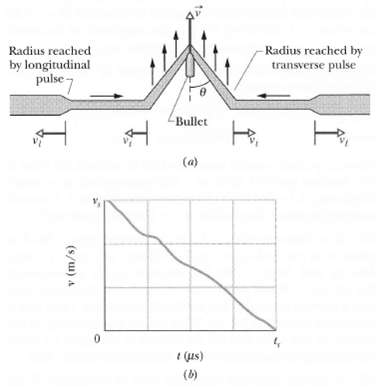
Body armor when a high-speed projectile such as a bullet or bomb fragment strikes modern body armor the fabric of the armor stops the projectile and prevents penetration by quickly spreading the projectile's energy over a large area. This spreading is done by longitudinal and transverse pulses that
(a) What is the fastest transverse wave that can be sent along a steel wire? For safety reasons, the maximum tensile stress to which steel wires should be subjected is 7.00 x 10⁸ N/m2. The density of steel is 7800 kg/m3.(b) Does your answer depend on the diameter of the wire?
(a) Write an equation describing a sinusoidal transverse wave traveling on a cord in the positive direction of a y axis with an angular wave number of 60 cm-1, a period of 0.20 s, and an amplitude of 3.0 mm. Take the transverse direction to be the z direction.(b) What is the maximum transverse
A wave on a string is described by y(x, t) = 15.0 sin (πx/8 – 4πt), where x and y are in centimeters and / is in seconds.(a) What is the transverse speed for a point on the string at x = 6.00cm when t = 0.250 s?(b) What is the maximum transverse speed of any point on the string?(c) What is the
A standing wave results from the sum of two transverse traveling waves given by y1 = 0.050 cos (πx – 4 πt) and y2 = 0.050 cos (πx + 4πt), where x, y1, and y2 are in meters and r is in seconds.(a) What is the smallest positive value of x that corresponds to a node? Beginning at t = 0, what is
In a demonstration, a l.2 kg horizontal rope is fixed in place at its two ends (x = 0 and x = 2.0 m) and made to oscillate up and down in the fundamental mode, at frequency 5.0 Hz. At t = 0, the point at x = 1.0m has zero displacement and is moving upward in the positive direction of a y axis with
A certain transverse sinusoidal wave of wavelength 20 cm is moving in the positive direction of an x axis. The transverse velocity of the particle at x = 0 as a function of time is shown in Figure, where the scale of the vertical axis is set by us = 5.0 cm/s. What are the(a) Wave speed,(b)
The type of rubber band used inside some baseballs and golf balls obeys Hooke's law over a wide range of elongation of the band. A segment of this material has an un-stretched length (and a mass m. When a force F is applied, the band stretches an additional length Δℓ.(a) What is the speed (in
Two waves, y¬ = (2.50 mm) sin [(25.1 rad/m)x - (440 rad/s)r] and y2 = (1.50 mm) sin [(25.1 rad/m)x + (440 rad/s)r], travel along a stretched string. br> (a) Plot the resultant wave as a function of t for x = 0, λ/8, λ/4, 3λ/8, and λ/2, where λ is the wavelength. The graphs should extend
Two waves are described by y1 = 0.30 sin [π (5x – 200)t] and y2 = 0.30 sin [π(5x – 200t) + π/3], where y1, y2, and x are in meters and t is in seconds. When these two waves are combined, a traveling wave is produced. What are the(a) Amplitude,(b) Wave speed, and(c) Wavelength of that
The speed of electromagnetic waves (which include visible light, radio, and x rays) in vacuum is 3.0 x 10⁸ m/s.(a) Wavelengths of visible light waves range from about 400 nm in the violet to about 700 nm in the red. What is the range of frequencies of these waves?(b) The range of frequencies for
A traveling wave on a string is described by where x and y are in centimeters and t is in seconds. (a) For t = 0, plot y as a function of x for 0 (b) Repeat (a) for t = 0.05 and t = 0.10s. From your graphs, determine (c) The wave speed and (d) The direction in which the wave is traveling.
When the door of the Chapel of the Mausoleum in Hamilton, Scotland, is slammed shut, the last echo heard by someone standing just inside the door reportedly comes l5s later. (a) If that echo were due to a single reflection off a wall opposite the door, how far from the door would that wall be?(b)
A column of soldiers, marching at 120 paces per minute, keep in step with the beat of a drummer at the head of the column. The soldiers in the rear end of the column are striding forward with the left foot when the drummer is advancing with the right foot. What is the approximate length of the
Two spectators at a soccer game in Montjuic Stadium see, and a moment later hear, the ball being kicked on the playing field. The time delay for spectator A is 0.23 s, and for spectator B it is 0.12 s. Sight lines from the two spectators to the player kicking the ball meet at an angle of 90". How
What is the bulk modulus of oxygen if 32.0 g of oxygen occupies 22.4 L and the speed of sound in the oxygen is 317 m/s?
A stone is dropped into a well. The splash is heard 3.00 s later. What is the depth of the well?
Hot chocolate effect tap a metal spoon inside a mug of water and note the frequency fi you hear. Then add a spoonful of powder (say, chocolate mix or instant coffee) and tap again as you stir the powder. The frequency you hear has a lower value f because the tiny air bubbles released by the powder
Earthquakes generate sound waves inside Earth. Unlike a gas, Earth can experience both transverse (S) and longitudinal (P) sound waves. Typically, the speed of S waves is about 4.5 km/s, and that of P waves 8.0 km/s. A seismograph records P and S waves from an earthquake. The first P waves arrive
Showing 1100 - 1200
of 2092
First
5
6
7
8
9
10
11
12
13
14
15
16
17
18
19
Last
Step by Step Answers

 Get 50% OFF
Claim Now
Get 50% OFF
Claim Now