New Semester
Started
Get
50% OFF
Study Help!
--h --m --s
Claim Now
Question Answers
Textbooks
Find textbooks, questions and answers
Oops, something went wrong!
Change your search query and then try again
S
Books
FREE
Study Help
Expert Questions
Accounting
General Management
Mathematics
Finance
Organizational Behaviour
Law
Physics
Operating System
Management Leadership
Sociology
Programming
Marketing
Database
Computer Network
Economics
Textbooks Solutions
Accounting
Managerial Accounting
Management Leadership
Cost Accounting
Statistics
Business Law
Corporate Finance
Finance
Economics
Auditing
Tutors
Online Tutors
Find a Tutor
Hire a Tutor
Become a Tutor
AI Tutor
AI Study Planner
NEW
Sell Books
Search
Search
Sign In
Register
study help
physics
oscillations mechanical waves
Fundamentals of Ethics for Scientists and Engineers 1st Edition Edmund G. Seebauer, Robert L. Barry - Solutions
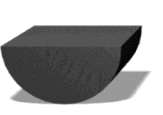
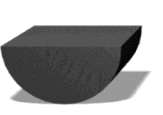
Figure shows a solid half-cylinder of mass M and radius R resting on a horizontal surface. If one side of this cylinder is pushed down slightly and then released, the object will oscillate about its equilibrium position. Determine the period of thisoscillation.
Repeat Problem 123 replacing the half-cylinder with a half-sphere.
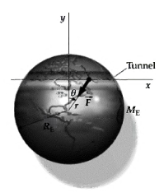
A straight tunnel is dug through the earth as shown in Figure. Assume that the walls of the tunnel are frictionless.(a) The gravitational force exerted by the earth on a particle of mass m at a distance r from the center of the earth when r < RE is Fr = – (GmME/R3E)r, where ME is
A damped oscillator has a frequency ώ’ that is 10% less than its undamped frequency.(a) By what factor is the amplitude of the oscillator decreased during each oscillation?(b) By what factor is its energy reduced during each oscillation?
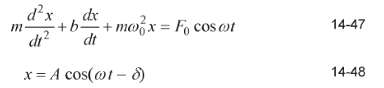
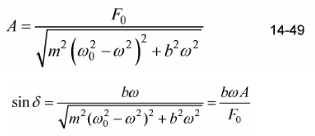
Show by direct substitution that Equation 14-48 is a solution of Equation 14-47. Equation 14-47 reads
A block of mass m on a horizontal table is attached to a spring of force constant k as shown in Figure. The coefficient of kinetic friction between the block and the table is mk. The spring is stretched a distance A and released.(a) Apply Newton’s second law to the block to obtain an equation for
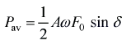
In this problem, you will derive the expression for the average power delivered by a driving force to a driven oscillator (Figure).(a) Show that the instantaneous power input of the driving force is given byP = Fv AώF0 cos wt sin (ώt – 1).(b) Use the trigonometric identity sin (θ1 –
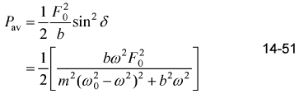
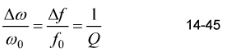
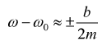
In this problem, you are to use the result of Problem 129 to derive Equation 14-45, which relates the width of the resonance curve to the Q value when the resonance is sharp. At resonance, the denominator of the fraction in brackets in Equation 14-51 is b2ώ02 and Pav has its maximum value.
(Multiple choice)(1) True/false(a) In simple harmonic motion, the period is proportional to the square of the amplitude. (b) In simple harmonic motion, the frequency does not depend on the amplitude. (c) If the acceleration of a particle is proportional to the displacement and oppositely
(Multiple choice)(1) True or false:The motion of a simple pendulum is periodic for any initial angular displacement.(2)Two clocks have simple pendulums of identical lengths L. The pendulum of clock A swings through an arc of 10°; that of clock B swings through an arc of 5°. When the two clocks
(Multiple choice)(1)A crystal wineglass shattered by an intense sound is an example of (a) Resonance. (b) Critical damping. (c) An exponential decrease in energy. (d) Over-damping.(2)Two mass–spring systems oscillate at frequencies fA and fB. If fA = 2fB and the spring
(a) The bulk modulus for water is 2.0 x 10⁹ N/m2. Use it to find the speed of sound in water.(b) The speed of sound in mercury is 1410 m/s. What is the bulk modulus for mercury (r = 13.6 x 10³ kg/m3)?
Calculate the speed of sound waves in hydrogen gas at T = 300 K. (Take M = 2 g/mol and g = 1.4.)
A steel wire 7 m long has a mass of 100 g. It is under a tension of 900 N. What is the speed of a transverse wave pulse on this wire?
Transverse waves travel at 150 m/s on a wire of length 80 cm that is under a tension of 550 N. What is the mass of the wire?
A steel piano wire is 0.7 m long and has a mass of 5 g. It is stretched with a tension of 500 N.(a) What is the speed of transverse waves on the wire?(b) To reduce the wave speed by a factor of 2 without changing the tension, what mass of copper wire would have to be wrapped around the steel wire?
The cable of a ski lift runs 400 m up a mountain and has a mass of 80 kg. When the cable is struck with a transverse blow at one end, the return pulse is detected 12 s later.(a) What is the speed of the wave?(b) What is the tension in the cable?
A common method for estimating the distance to a lightning flash is to begin counting when the flash is observed and continue until the thunder clap is heard. The number of seconds counted is then divided by 3 to get the distance in kilometers.(a) What is the velocity of sound in kilometers per
A method for measuring the speed of sound using an ordinary watch with a second hand is to stand some distance from a large flat wall and clap your hands rhythmically in such a way that the echo from the wall is heard halfway between every two claps.(a) Show that the speed of sound is given by v =
A man drops a stone from a high bridge and hears it strike the water below exactly 4 s later.(a) Estimate the distance to the water based on the assumption that the travel time for the sound to reach the man is negligible.(b) Improve your estimate by using your result from part (a) for the distance
(a) Compute the derivative of the speed of a wave on a string with respect to the tension dv/dF, and show that the differentials dv and dF obey dv/v = ½ dF/F.(b) A wave moves with a speed of 300 m/s on a wire that is under a tension of 500 N. Using dF to approximate a change in tension, determine
(a) Compute the derivative of the velocity of sound with respect to the absolute temperature, and show that the differentials dv and dT obey dv/v = ½ dT/T.(b) Use this result to compute the percentage change in the velocity of sound when the temperature changes from 0 to 27oC.(c) If the speed of
In this problem, you will derive a convenient formula for the speed of sound in air at temperature t in Celsius degrees. Begin by writing the temperature as T = T0 + ∆T, where T0 = 273 K corresponds to 0oC and ∆T = t, the Celsius temperature. The speed of sound is a function of T, v(T). To
While studying physics in her dorm room, a student is listening to a live radio broadcast of a baseball game. She is 1.6 km due south of the baseball field. Over her radio, the student hears a noise generated by the electromagnetic pulse of a lightning bolt. Two seconds later, she hears over the
A coiled spring, such as a Slinky, is stretched to a length L. It has a force constant k and a mass m.(a) Show that the velocity of longitudinal compression waves along the spring is given by v = L k/m(b) Show that this is also the velocity of transverse waves along the spring if the natural length
Show explicitly that the following functions satisfy the wave equation:(a) y(x, t) = k(x + vt )3;(b) y(x ,t) = Aeik(x - vt) , where A and k are constants and i = √– 1 ; and(c) y(x, t) = ln k(x – vt).
Show that the function y = A sin kx cos wt satisfies the wave equation.
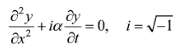
Consider the following equation: where a is a constant. Show that y(x, t) = A sin(kx - ?t) is not a solution of this equation but that the functions y(x, t) = Aei(kx - ?t) and y(x, t) = Aei(kx - ?t) do satisfy that equation.
One end of a string 6 m long is moved up and down with simple harmonic motion at a frequency of 60 Hz. The waves reach the other end of the string in 0.5 s. Find the wavelength of the waves on the string.
Equation 15-13 expresses the displacement of a harmonic wave as a function of x and t in terms of the wave parameters k and ?. Write the equivalent expressions that contain the following pairs of parameters instead of k and ?: (a) k and v (b) ? and f (c) ? and T (d) ? and v and (e) f and v
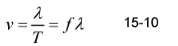
Equation 15-10 applies to all types of periodic waves, including electromagnetic waves such as light waves and microwaves, which travel at 3 x 10⁸ m/s in a vacuum. (a) The range of wavelengths of light to which the eye is sensitive is about 4 x 10?7 to 7 x 10?7 m. What are the frequencies that
A harmonic wave on a string with a mass per unit length of 0.05 kg/m and a tension of 80 N has an amplitude of 5 cm. Each section of the string moves with simple harmonic motion at a frequency of 10 Hz. Find the power propagated along the string.
A rope 2 m long has a mass of 0.1 kg. The tension is 60 N. A power source at one end sends a harmonic wave frequency of the power source if the power transmitted is 100 W?
The wave function for a harmonic wave on a string is y(x, t) = (0.001 m) sin (62.8 m-1 x + 314 s-1t).(a) In what direction does this wave travel, and what is its speed?(b) Find the wavelength, frequency, and period of this wave.(c) What is the maximum speed of any string segment?
A harmonic wave with a frequency of 80 Hz and an amplitude of 0.025 m travels along a string to the right with a speed of 12 m/s.(a) Write a suitable wave function for this wave.(b) Find the maximum speed of a point on the string.(c) Find the maximum acceleration of a point on the string.
Waves of frequency 200 Hz and amplitude 1.2 cm move along a 20-m string that has a mass of 0.06 kg and a tension of 50 N.(a) What is the average total energy of the waves on the string?(b) Find the power transmitted past a given point on the string.
In a real string, a wave loses some energy as it travels down the string. Such a situation can be described by a wave function whose amplitude A(x) depends on x:y = A(x) (kx- ώt) = (A0e-bx) (kx - ώt) sin (kx – ώt)(a) What is the original power carried by the wave at the
Power is to be transmitted along a stretched wire by means of transverse harmonic waves. The wave speed is 10 m/s, and the linear mass density of the wire is 0.01 kg/m. The power source oscillates with an amplitude of 0.50 mm.(a) What average power is transmitted along the wire if the frequency is
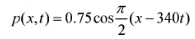
A sound wave in air produces a pressure variation given bywhere p is in pascals, x is in meters, and t is in seconds. Find(a) The pressure amplitude of the sound wave,(b) The wavelength,(c) The frequency, and(d) The speed?
(a) Middle C on the musical scale has a frequency of 262 Hz. What is the wavelength of this note in air?(b) The frequency of the C an octave above middle C is twice that of middle C. What is the wavelength of this note in air?
(a) What is the displacement amplitude for a sound wave having a frequency of 100 Hz and a pressure amplitude of 104 atm?(b) The displacement amplitude of a sound wave of frequency 300 Hz is 107 m. What is the pressure amplitude of this wave?
(a) Find the displacement amplitude of a sound wave of frequency 500 Hz at the pain-threshold pressure amplitude of 29 Pa.(b) Find the displacement amplitude of a sound wave with the same pressure amplitude but a frequency of 1 kHz.
A typical loud sound wave with a frequency of 1 kHz has a pressure amplitude of about 10-4 atm.(a) At t = 0, the pressure is a maximum at some point x1. What is the displacement at that point at t = 0?(b) What is the maximum value of the displacement at any time and place? (Take the density of air
(a) Find the displacement amplitude of a sound wave of frequency 500 Hz at the threshold-of-hearing pressure amplitude of 2.9 x 10⁵ Pa.(b) Find the displacement amplitude of a wave of the same pressure amplitude but a frequency of 1 kHz.
A piston at one end of a long tube filled with air at room temperature and normal pressure oscillates with a frequency of 500 Hz and an amplitude of 0.1 mm. The area of the piston is 100 cm2.(a) What is the pressure amplitude of the sound waves generated in the tube?(b) What is the intensity of the
A spherical source radiates sound uniformly in all directions. At a distance of 10 m, the sound intensity level is 104 W/m2.(a) At what distance from the source is the intensity 106 W/m2?(b) What power is radiated by this source?
A loudspeaker at a rock concert generates 102 W/m2 at 20 m at a frequency of 1 kHz. Assume that the speaker spreads its energy uniformly in three dimensions.(a) What is the total acoustic power output of the speaker?(b) At what distance will the intensity be at the pain threshold of 1 W/m2?(c) What
When a pin of mass 0.1 g is dropped from a height of 1 m, 0.05% of its energy is converted into a sound pulse with a duration of 0.1 s.(a) Estimate the range at which the dropped pin can be heard if the minimum audible intensity is 10-11 W/m2.(b) Your result in (a) is much too large in
Find the intensity of a sound wave if(a) b = 10 dB, and(b) b = 3 dB.(c) Find the pressure amplitudes of sound waves in air for each of these intensities.
Normal human speech has a sound intensity level of about 65 dB at 1 m. Estimate the power of human speech.
A spherical source radiates sound uniformly in all directions. At a distance of 10 m, the sound intensity level is 80 dB.(a) At what distance from the source is the intensity level 60 dB?(b) What power is radiated by this source?
A spherical source of intensity I0 radiates sound uniformly in all directions. Its intensity level is b1 at a distance r1, and b2 at a distance r2. Find b2 /b1.
A loudspeaker at a rock concert generates 102 W/m2 at 20 m at a frequency of 1 kHz. Assume that the speaker spreads its energy uniformly in all directions.(a) What is the intensity level at 20 m?(b) What is the total acoustic power output of the speaker?(c) At what distance will the intensity level
An article on noise pollution claims that sound intensity levels in large cities have been increasing by about 1 dB annually.(a) To what percentage increase in intensity does this correspond? Does this increase seem reasonable?(b) In about how many years will the intensity of sound double if it
Three noise sources produce intensity levels of 70, 73, and 80 dB when acting separately. When the sources act together, their intensities add.(a) Find the sound intensity level in decibels when the three sources act at the same time.(b) Discuss the effectiveness of eliminating the two least
The equation I = Pav/4πr2 is predicated on the assumption that the transmitting medium does not absorb any energy. It is known that absorption of sound by dry air results in a decrease of intensity of approximately 8 dB/km. The intensity of sound at a distance of 120 m from a jet engine is 130 dB.
When a violinist pulls the bow across a string, the force with which the bow is pulled is fairly small, about 0.6 N. Suppose the bow travels across the A string, which vibrates at 440 Hz, at 0.5 m/s. A listener 35 m from the performer hears a sound of 60 dB intensity. With what efficiency is the
The noise level in an empty examination hall is 40 dB. When 100 students are writing an exam, the sounds of heavy breathing and pens traveling rapidly over paper cause the noise level to rise to 60 dB (not counting the occasional groans). Assuming that each student contributes an equal amount of
Stars often occur in pairs revolving around their common center of mass. If one of the stars is a black hole, it is invisible. Explain how the existence of such a black hole might be inferred from the light observed from the other, visible star.
A conveyor belt moves to the right with a speed v = 300 m/min. A very fast piemaker puts pies on the belt at a rate of 20 per minute, and they are received at the other end by a pie eater.(a) If the piemaker is stationary, find the spacing l between the pies and the frequency f with which they are
For the situation described in Problem 63, derive general expressions for the spacing of the pies l and the frequency f with which they are received by the pie eater in terms of the speed of the belt v, the speed of the sender us, the speed of the receiver ur, and the frequency f0 with which the
The sound source described above moves with a speed of 80 m/s relative to still air toward a stationary listener.(a) Find the wavelength of the sound between the source and the listener.(b) Find the frequency heard by the listener.
Consider the situation in Problem 65 from the reference frame in which the source is at rest. In this frame, the listener moves toward the source with a speed of 80 m/s, and there is a wind blowing at 80 m/s from the listener to the source.(a) What is the speed of the sound from the source to the
The source moves away from the stationary listener at 80 m/s.(a) Find the wavelength of the sound waves between the source and the listener.(b) Find the frequency heard by the listener.
The listener moves at 80 m/s relative to still air toward the stationary source.(a) What is the wavelength of the sound between the source and the listener?(b) What is the frequency heard by the listener?
Consider the situation in Problem 68 in a reference frame in which the listener is at rest.(a) What is the wind velocity in this frame?(b) What is the speed of the sound from the source to the listener in this frame, that is, relative to the listener?(c) Find the wavelength of the sound between the
The listener moves at 80 m/s relative to the still air away from the stationary source. Find the frequency heard by the listener.
A jet is traveling at Mach 2.5 at an altitude of 5000 m.(a) What is the angle that the shock wave makes with the track of the jet? (Assume that the speed of sound at this altitude is still 340 m/s.)(b) Where is the jet when a person on the ground hears the shock wave?
If you are running at top speed toward a source of sound at 1000 Hz, estimate the frequency of the sound that you hear. Suppose that you can recognize a change in frequency of 3%. Can you use your sense of pitch to estimate your running speed?
A radar device emits microwaves with a frequency of 2.00 GHz. When the waves are reflected from a car moving directly away from the emitter, a frequency difference of 293 Hz is detected. Find the speed of the car.
A stationary destroyer is equipped with sonar that sends out pulses of sound at 40 MHz. Reflected pulses are received from a submarine directly below with a time delay of 80 ms at a frequency of 39.958 MHz. If the speed of sound in seawater is 1.54 km/s, find(a) The depth of the submarine, and(b)
Two airplanes, one flying due east and the other due west, are on a near collision course separated by 15 km when the pilot of one plane, traveling at 900 km/h, observes the other on his Doppler radar. The radar unit emits electromagnetic waves of frequency 3 x 10¹⁰ Hz. The radar readout indicates
Suppose the police car of Problem 76 is moving in the same direction as the other vehicle at a speed of 60 km/h. What then is the difference in frequency between the emitted and the reflected signals?
At time t = 0, a supersonic plane is directly over point P flying due west at an altitude of 12 km and a speed of Mach 1.6. Where is the plane when the sonic boom is heard?
A small radio of 0.10 kg mass is attached to one end of an air track by a spring. The radio emits a sound of 800 Hz. A listener at the other end of the air track hears a sound whose frequency varies between 797 and 803 Hz.(a) Determine the energy of the vibrating mass–spring system.(b) If the
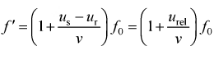
A sound source of frequency f0 moves with speed us relative to still air toward a receiver who is moving with speed ur relative to still air away from the source.(a) Write an expression for the received frequency f’.(b) Use the result that (1 - x)-1 ≈ 1 + x to show that if both us and ur are
Two students with vibrating 440-Hz tuning forks walk away from each other with equal speeds. How fast must they walk so that they each hear a frequency of 438 Hz from the other fork?
A physics student walks down a long hall carrying a vibrating 512-Hz tuning fork. The end of the hall is closed so that sound reflects from it. The student hears a sound of 516 Hz from the wall. How fast is the student walking?
A small speaker radiating sound at 1000 Hz is tied to one end of an 0.8-m-long rod that is free to rotate about its other end. The rod rotates in the horizontal plane at 4.0 rad/s. Derive an expression for the frequency heard by a stationary observer far from the rotating speaker.
You have won a free trip on the Queen Elizabeth II and are in mid-Atlantic steaming due east at 45 km/h as the Concorde passes directly overhead flying due west at Mach 1.6 at an altitude of 12,500 m. Where is the Concorde relative to the QEII when you hear the sonic boom?
A balloon driven by a 36-km/h wind emits a sound of 800 Hz as it approaches a tall building.(a) What is the frequency of the sound heard by an observer at the window of this building?(b) What is the frequency of the reflected sound heard by a person riding in the balloon?
A car is approaching a reflecting wall. A stationary observer behind the car hears a sound of frequency 745 Hz from the car horn and a sound of frequency 863 Hz from the wall.(a) How fast is the car traveling?(b) What is the frequency of the car horn?(c) What frequency does the car driver hear
The driver of a car traveling at 100 km/h toward a vertical cliff briefly sounds the horn. Exactly one second later she hears the echo and notes that its frequency is 840 Hz. How far from the cliff was the car when the driver sounded the horn and what is the frequency of the horn?
You are on a transatlantic flight traveling due west at 800 km/h. A Concorde flying at Mach 1.6 and 3 km to the north of your plane is also on an east-to-west course. What is the distance between the two planes when you hear the sonic boom from the Concorde?
Astronomers can deduce the existence of a binary star system even if the two stars cannot be visually resolved by noting an alternating Doppler shift of a spectral line. Suppose that an astronomical observation shows that the source of light is eclipsed once every 18 h. The wavelength of the
A physics student drops a vibrating 440-Hz tuning fork down the elevator shaft of a tall building. When the student hears a frequency of 400 Hz, how far has the tuning fork fallen?
When a guitar string is plucked, is the wavelength of the wave it produces in air the same as the wavelength of the wave on the string?
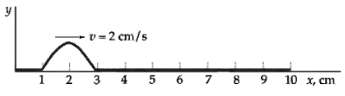
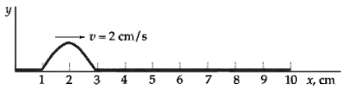
Figure shows a wave pulse at time t = 0 moving to the right. At this particular time, which segments of the string are moving up? Which are moving down? Is there any segment of the string at the pulse that is instantaneously at rest? Answer these questions by sketching the pulse at a slightly later
Make a sketch of the velocity of each string segment versus position for the pulse shown inFigure.
Consider a long line of cars equally spaced by one car length and moving slowly with the same speed. One car suddenly slows to avoid a dog and then speeds up until it is again one car length behind the car ahead. Discuss how the space between cars propagates back along the line. How is this like a
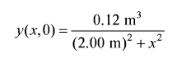
At time t = 0, the shape of a wave pulse on a string is given by the functionwhere x is in meters.(a) Sketch y(x, 0) versus x. Give the wave function y(x, t) at a general time t if(b) The pulse is moving in the positive x direction with a speed of 10 m/s, and(c) The pulse is
A wave with frequency of 1200 Hz propagates along a wire that is under a tension of 800 N. The wavelength of the wave is 24 cm. What will be the wavelength if the tension is decreased to 600 N and the frequency is kept constant?
A boat traveling at 10 m/s on a still lake makes a bow wave at an angle of 20o with its direction of motion. What is the speed of the bow wave?
A whistle of frequency 500 Hz moves in a circle of radius 1 m at 3rev/s. What are the maximum and minimum frequencies heard by a stationary listener in the plane of the circle and 5 m away from its center?
Ocean waves move toward the beach with a speed of 8.9 m/s and a crest-to-crest separation of 15.0 m. You are in a small boat anchored off shore.(a) What is the frequency of the ocean waves?(b) You now lift anchor and head out to sea at a speed of 15 m/s. What frequency of the waves do you observe?
Two connected wires with linear mass densities that are related by μ1 = 3μ2 are under the same tension. When the wires oscillate at a frequency of 120 Hz waves of wavelength 10 cm travel down the first wire with the linear density of μ1.(a) What is the wave speed in the first wire?(b) What is
A 12.0-m wire of mass 85 g is stretched under a tension of 180 N. A pulse is generated at the left end of the wire, and 25 ms later a second pulse is generated at the right end of the wire. Where do the pulses first meet?
A harmonic wave moves down a string with speed 12.4 m/s. A particle on the string has a maximum displacement of 4.5 cm and a maximum speed of 9.4 m/s. Find(a) The wavelength of the wave, and(b) The frequency.(c) Write an equation for the wave function.
Find the speed of a car for which the tone of its horn will drop by 10% as it passes you. Let a = us/v.
A loudspeaker diaphragm 20 cm in diameter is vibrating at 800 Hz with an amplitude of 0.025 mm. Assuming that the air molecules in the vicinity have this same amplitude of vibration, find(a) The pressure amplitude immediately in front of the diaphragm,(b) The sound intensity, and(c) The acoustic
Showing 1500 - 1600
of 2092
First
7
8
9
10
11
12
13
14
15
16
17
18
19
20
21
Step by Step Answers

 Get 50% OFF
Claim Now
Get 50% OFF
Claim Now