New Semester
Started
Get
50% OFF
Study Help!
--h --m --s
Claim Now
Question Answers
Textbooks
Find textbooks, questions and answers
Oops, something went wrong!
Change your search query and then try again
S
Books
FREE
Study Help
Expert Questions
Accounting
General Management
Mathematics
Finance
Organizational Behaviour
Law
Physics
Operating System
Management Leadership
Sociology
Programming
Marketing
Database
Computer Network
Economics
Textbooks Solutions
Accounting
Managerial Accounting
Management Leadership
Cost Accounting
Statistics
Business Law
Corporate Finance
Finance
Economics
Auditing
Tutors
Online Tutors
Find a Tutor
Hire a Tutor
Become a Tutor
AI Tutor
AI Study Planner
NEW
Sell Books
Search
Search
Sign In
Register
study help
physics
thermodynamics
Fundamentals of Thermodynamics 6th edition Richard E. Sonntag, Claus Borgnakke, Gordon J. Van Wylen - Solutions
A boiler receives a constant flow of 5000 kg/h liquid water at 5 MPa, 20°C and it heats the flow such that the exit state is 450°C with a pressure of 4.5 MPa. Determine the necessary minimum pipe flow area in both the inlet and exit pipe(s) if there should be no velocities larger than 20 m/s.
An empty bathtub has its drain closed and is being filled with water from the faucet at a rate of 10 kg/min. After 10 minutes the drain is opened and 4 kg/min flows out and at the same time the inlet flow is reduced to 2 kg/min. Plot the mass of the water in the bathtub versus time and determine
Nitrogen gas flowing in a 50-mm diameter pipe at 15°C, 200 kPa, at the rate of 0.05 kg/s, encounters a partially closed valve. If there is a pressure drop of 30 kPa across the valve and essentially no temperature change, what are the velocities upstream and downstream of the valve?
Saturated vapor R-134a leaves the evaporator in a heat pump system at 10°C, with a steady mass flow rate of 0.1 kg/s. What is the smallest diameter tubing that can be used at this location if the velocity of the refrigerant is not to exceed 7 m/s?
A hot air home heating system takes 0.25 m3/s air at 100 kPa, 17oC into a furnace and heats it to 52oC and delivers the flow to a square duct 0.2 m by 0.2 m at 110 kPa. What is the velocity in the duct?
Steam at 3 MPa, 400°C enters a turbine with a volume flow rate of 5 m3/s. An extraction of 15% of the inlet mass flow rate exits at 600 kPa, 200°C. The rest exits the turbine at 20 kPa with a quality of 90%, and a velocity of 20 m/s. Determine the volume flow rate of the extraction flow and the
A household fan of diameter 0.75 m takes air in at 98 kPa, 22oC and delivers it at 105 kPa, 23oC with a velocity of 1.5 m/s. What are the mass flow rate (kg/s), the inlet velocity and the outgoing volume flow rate in m3/s?
Nitrogen gas flows into a convergent nozzle at 200 kPa, 400 K and very low velocity. It flows out of the nozzle at 100 kPa, 330 K. If the nozzle is insulated find the exit velocity.
A nozzle receives 0.1 kg/s steam at 1 MPa, 400oC with negligible kinetic energy. The exit is at 500 kPa, 350oC and the flow is adiabatic. Find the nozzle exit velocity and the exit area.
Superheated vapor ammonia enters an insulated nozzle at 20°C, 800 kPa, shown in Fig. P6.32, with a low velocity and at the steady rate of 0.01 kg/s. The ammonia exits at 300 kPa with a velocity of 450 m/s. Determine the temperature (or quality, if saturated) and the exit area of the nozzle.
In a jet engine a flow of air at 1000 K, 200 kPa and 30 m/s enters a nozzle, as shown in Fig. P6.33, where the air exits at 850 K, 90 kPa. What is the exit velocity assuming no heat loss?
In a jet engine a flow of air at 1000 K, 200 kPa and 40 m/s enters a nozzle where the air exits at 500 m/s, 90 kPa. What is the exit temperature assuming no heat loss?
A sluice gate dams water up 5 m. There is a small hole at the bottom of the gate so liquid water at 20oC comes out of a 1 cm diameter hole. Neglect any changes in internal energy and find the exit velocity and mass flow rate.
A diffuser, shown in Fig. P6.36, has air entering at 100 kPa, 300 K, with a velocity of 200 m/s. The inlet cross-sectional area of the diffuser is 100 mm2. At the exit, the area is 860 mm2, and the exit velocity is 20 m/s. Determine the exit pressure and temperature of the air.
A diffuser receives an ideal gas flow at 100 kPa, 300 K with a velocity of 250 m/s and the exit velocity is 25 m/s. Determine the exit temperature if the gas is argon, helium or nitrogen.
Air flows into a diffuser at 300 m/s, 300 K and 100 kPa. At the exit the velocity is very small but the pressure is high. Find the exit temperature assuming zero heat transfer.
The front of a jet engine acts as a diffuser receiving air at 900 km/h, -5°C, 50 kPa, bringing it to 80 m/s relative to the engine before entering the compressor. If the flow area is reduced to 80% of the inlet area find the temperature and pressure in the compressor inlet.
Can you say something about changes in through a steady flow device?
Helium is throttled from 1.2 MPa, 20°C, to a pressure of 100 kPa. The diameter of the exit pipe is so much larger than the inlet pipe that the inlet and exit velocities are equal. Find the exit temperature of the helium and the ratio of the pipe diameters.
Saturated vapor R-134a at 500 kPa is throttled to 200 kPa in a steady flow through a valve. The kinetic energy in the inlet and exit flow is the same. What is the exit temperature?
Saturated liquid R-12 at 25oC is throttled to 150.9 kPa in your refrigerator. What is the exit temperature? Find the percent increase in the volume flow rate.
Water flowing in a line at 400 kPa, saturated vapor, is taken out through a valve to 100 kPa. What is the temperature as it leaves the valve assuming no changes in kinetic energy and no heat transfer?
Liquid water at 180oC, 2000 kPa is throttled into a flash evaporator chamber having a pressure of 500 kPa. Neglect any change in the kinetic energy. What is the fraction of liquid and vapor in the chamber?
Water at 1.5 MPa, 150°C, is throttled adiabatically through a valve to 200 kPa. The inlet velocity is 5 m/s, and the inlet and exit pipe diameters are the same. Determine the state (neglecting kinetic energy in the energy equation) and the velocity of the water at the exit.
R-134a is throttled in a line flowing at 25oC, 750 kPa with negligible kinetic energy to a pressure of 165 kPa. Find the exit temperature and the ratio of exit pipe diameter to that of the inlet pipe (Dex/Din) so the velocity stays constant.
Methane at 3 MPa, 300 K is throttled through a valve to 100 kPa. Calculate the exit temperature assuming no changes in the kinetic energy and ideal gas behavior. Repeat the answer for real-gas behavior.
A steam turbine has an inlet of 2 kg/s water at 1000 kPa, 350oC and velocity of 15 m/s. The exit is at 100 kPa, x = 1 and very low velocity. Find the specific work and the power produced.
A small, high-speed turbine operating on compressed air produces a power output of 100 W. The inlet state is 400 kPa, 50°C, and the exit state is 150 kPa, −30°C. Assuming the velocities to be low and the process to be adiabatic, find the required mass flow rate of air through the turbine.
How does a nozzle or sprayhead generate kinetic energy?
A liquid water turbine receives 2 kg/s water at 2000 kPa, 20oC and velocity of 15 m/s. The exit is at 100 kPa, 20oC and very low velocity. Find the specific work and the power produced.
Hoover Dam across the Colorado River dams up Lake Mead 200 m higher than the river downstream. The electric generators driven by water-powered turbines deliver 1300 MW of power. If the water is 17.5°C, find the minimum amount of water running through the turbines.
A windmill with rotor diameter of 30 m takes 40% of the kinetic energy out as shaft work on a day with 20oC and wind speed of 30 km/h. What power is produced?
A small turbine, shown in Fig. P 6.53, is operated at part load by throttling a 0.25 kg/s steam supply at 1.4 MPa, 250°C down to 1.1 MPa before it enters the turbine and the exhaust is at 10 kPa. If the turbine produces 110 kW, find the exhaust temperature (and quality if saturated).
A small expander (a turbine with heat transfer) has 0.05 kg/s helium entering at 1000 kPa, 550 K and it leaves at 250 kPa, 300 K. The power output on the shaft is measured to 55 kW. Find the rate of heat transfer neglecting kinetic energies.
A compressor in a commercial refrigerator receives R-22 at -25oC, x = 1. The exit is at 800 kPa, 40oC. Neglect kinetic energies and find the specific work.
The compressor of a large gas turbine receives air from the ambient at 95 kPa, 20°C, with a low velocity. At the compressor discharge, air exits at 1.52 MPa, 430°C, with velocity of 90 m/s. The power input to the compressor is 5000 kW. Determine the mass flow rate of air through the unit.
A compressor brings R-134a from 150 kPa, -10oC to 1200 kPa, 50oC. It is water cooled with a heat loss estimated as 40 kW and the shaft work input is measured to be 150 kW. How much is the mass flow rate through the compressor?
An ordinary portable fan blows 0.2 kg/s room air with a velocity of 18 m/s. What is the minimum power electric motor that can drive it? Are there any changes in P or T?
An air compressor takes in air at 100 kPa, 17°C and delivers it at 1 MPa, 600 K to a constant-pressure cooler, which it exits at 300 K. Find the specific compressor work and the specific heat transfer in the cooler.
Liquid water at 15oC flows out of a nozzle straight up 15 m. What is nozzle Vexit?
A 4 kg/s steady flow of ammonia runs through a device where it goes through a polytropic process. The inlet state is 150 kPa, -20oC and the exit state is 400 kPa, 80oC, where all kinetic and potential energies can be neglected. The specific work input has been found to be given as [n/(n-1)]
An exhaust fan in a building should be able to move 2.5 kg/s air at 98 kPa, 20oC through a 0.4 m diameter vent hole. How high a velocity must it generate and how much power is required to do that?
How much power is needed to run the fan in Problem 6.29? A household fan of diameter 0.75 m takes air in at 98 kPa, 22oC and delivers it at 105 kPa, 23oC with a velocity of 1.5 m/s. What are the mass flow rate (kg/s), the inlet velocity and the outgoing volume flow rate in m3/s?
Carbon dioxide enters a steady-state, steady-flow heater at 300 kPa, 15oC, and exits at 275 kPa, 1200oC, as shown in Fig. P6.63. Changes in kinetic and potential energies are negligible. Calculate the required heat transfer per kilogram of carbon dioxide flowing through the heater.
A condenser (cooler) receives 0.05 kg/s R-22 at 800 kPa, 40oC and cools it to 15oC. There is a small pressure drop so the exit state is saturated liquid. What cooling capacity (kW) must the condenser have?
A chiller cools liquid water for air-conditioning purposes. Assume 2.5 kg/s water at 20oC, 100 kPa is cooled to 5oC in a chiller. How much heat transfer (kW) is needed?
Saturated liquid nitrogen at 500 kPa enters a boiler at a rate of 0.005 kg/s and exits as saturated vapor. It then flows into a super heater also at 500 kPa where it exits at 500 kPa, 275 K. Find the rate of heat transfer in the boiler and the super heater.
In a steam generator, compressed liquid water at 10 MPa, 30°C, enters a 30-mm diameter tube at the rate of 3 L/s. Steam at 9 MPa, 400°C exits the tube. Find the rate of heat transfer to the water.
Electrical appliances (TV, stereo) use electric power as input. What happens to the power? Are those heat engines? What does the second law say about those devices?
A room is heated with a 1500 W electric heater. How much power can be saved if a heat pump with a COP of 2.0 is used instead?
If the efficiency of a power plant goes up as the low temperature drops why do they not just reject energy at say –40oC?
If the efficiency of a power plant goes up as the low temperature drops why not let the heat rejection go to a refrigerator at say –10oC instead of ambient 20oC?
A coal-fired power plant operates with a high T of 600oC whereas a jet engine has about 1400 K. Does that mean we should replace all power plants with jet engines?
A heat transfer requires a temperature difference, see chapter 4, to push the Q̇. What implications do that have for a real heat engine? A refrigerator?
A large stationary diesel engine produces 15 MW with a thermal efficiency of 40%. The exhaust gas, which we assume is air, flows out at 800 K and the intake is 290 K. How large a mass flow rate is that if that accounts for half the Can the exhaust flow energy be used?
Hot combustion gases (air) at 1500 K is used as heat source in a heat engine where the gas is cooled to 750 K and the ambient is at 300 K. This is not a constant T source. How does that affect the efficiency?
A remote location without electricity operates a refrigerator with a bottle of propane feeding a burner to create hot gases. Sketch the setup in terms of cyclic devices and give a relation for the ratio of in the refrigerator to in the burner in terms of the various reservoir temperatures.
Calculate the thermal efficiency of the steam power plant cycle described in Example 6.9.
Calculate the coefficient of performance of the R-134a refrigerator given in Example 6.10.
A gasoline engine produces 20 hp using 35 kW of heat transfer from burning fuel. What is its thermal efficiency and how much power is rejected to the ambient?
Calculate the thermal efficiency of the steam power plant cycle described in Problem 6.99.
Calculate the coefficient of performance of the R-12 heat pump cycle described in Problem 6.106.
A farmer runs a heat pump with a 2 kW motor. It should keep a chicken hatchery at 30oC, which loses energy at a rate of 10 kW to the colder ambient Tamb. What is the minimum coefficient of performance that will be acceptable for the heat pump?
A power plant generates 150 MW of electrical power. It uses a supply of 1000 MW from a geothermal source and rejects energy to the atmosphere. Find the power to the air and how much air should be flowed to the cooling tower (kg/s) if its temperature cannot be increased more than 10oC.
A car engine delivers 25 hp to the driveshaft with a thermal efficiency of 30%. The fuel has a heating value of 40 000 kJ/kg. Find the rate of fuel consumption and the combined power rejected through the radiator and exhaust.
For each of the cases below determine if the heat engine satisfies the first law (energy equation) and if it violates the second law.a.b.c.d.
In a steam power plant 1 MW is added in the boiler, 0.58 MW is taken out in the condenser and the pump work is 0.02 MW. Find the plant thermal efficiency. If everything could be reversed find the coefficient of performance as a refrigerator.
Electric solar cells can produce power with 15% efficiency. Compare that to a heat engine driving an electric generator with 80% efficiency. What should the heat engine efficiency be to have the same overall efficiency as the solar cells?
For each of the cases in problem 7.25 determine if a heat pump satisfies the first law (energy equation) and if it violates the second law.a.b.c.d.
An air-conditioner discards 5.1 kW to the ambient with a power input of 1.5 kW. Find the rate of cooling and the coefficient of performance.
A refrigerator removes 1.5 kJ from the cold space using 1 kJ work input. How much energy goes into the kitchen and what is its coefficient of performance?
Calculate the amount of work input a refrigerator needs to make ice cubes out of a tray of 0.25 kg liquid water at 10oC. Assume the refrigerator has β = 3.5 and a motor-compressor of 750 W. How much time does it take if this is the only cooling load?
A house should be heated by a heat pump, β′ = 2.2, and maintained at 20oC at all times. It is estimated that it looses 0.8 kW per degree the ambient is lower than the inside. Assume an outside temperature of –10oC and find the needed power to drive the heat pump?
Refrigerant-12 at 95°C, x = 0.1 flowing at 2 kg/s is brought to saturated vapor in a constant-pressure heat exchanger. The energy is supplied by a heat pump with a coefficient of performance of β′ = 2.5. Find the required power to drive the heat pump.
Prove that a cyclic device that violates the Kelvin–Planck statement of the second law also violates the Clausius statement of the second law.
Discuss the factors that would make the power plant cycle described in Problem 6.99 an irreversible cycle.
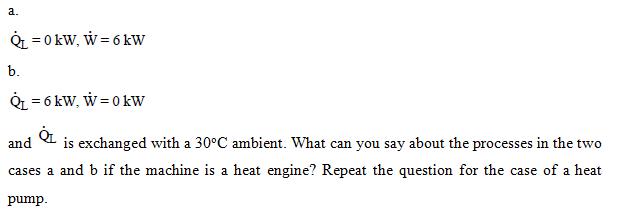
Assume a cyclic machine that exchanges 6 kW with a 250oC reservoir and has
Discuss the factors that would make the heat pump described in Problem 6.106 an irreversible cycle.
The water in a shallow pond heats up during the day and cools down during the night. Heat transfer by radiation, conduction and convection with the ambient thus cycles the water temperature. Is such a cyclic process reversible or irreversible?
Consider a heat engine and heat pump connected as shown in figure P.7.38. Assume TH1 = TH2 > Tamb and determine for each of the three cases if the setup satisfy the first law and/or violates the 2nd law.
Consider the four cases of a heat engine in problem 7.25 and determine if any of those are perpetual machines of the first or second kind.a.b.c.d.
Assume we have a refrigerator operating at steady state using 500 W of electric power with a COP of 2.5. What is the net effect on the kitchen air?
Calculate the thermal efficiency of a Carnot cycle heat engine operating between reservoirs at 300oC and 45oC. Compare the result to that of Problem 7.18.
At a few places where the air is very cold in the winter, like –30oC it is possible to find a temperature of 13oC down below ground. What efficiency will a heat engine have operating between these two thermal reservoirs?
Calculate the coefficient of performance of a Carnot-cycle heat pump operating between reservoirs at 0°C and 45°C. Compare the result with that of Problem 7.21.
Find the power output and the low T heat rejection rate for a Carnot cycle heat engine that receives 6 kW at 250oC and rejects heat at 30oC as in Problem 7.35.
A car engine burns 5 kg fuel (equivalent to addition of QH) at 1500 K and rejects energy to the radiator and the exhaust at an average temperature of 750 K. If the fuel provides 40 000 kJ/kg what is the maximum amount of work the engine can provide?
Differences in surface water and deep water temperature can be utilized for power generation. It is proposed to construct a cyclic heat engine that will operate near Hawaii, where the ocean temperature is 20°C near the surface and 5°C at some depth. What is the possible thermal efficiency of such
Find the maximum coefficient of performance for the refrigerator in your kitchen, assuming it runs in a Carnot cycle.
An air-conditioner provides 1 kg/s of air at 15°C cooled from outside atmospheric air at 35°C. Estimate the amount of power needed to operate the air-conditioner. Clearly state all assumptions made.
We propose to heat a house in the winter with a heat pump. The house is to be maintained at 20°C at all times. When the ambient temperature outside drops to −10°C, the rate at which heat is lost from the house is estimated to be 25 kW. What is the minimum electrical power required to drive the
A sales person selling refrigerators and deep freezers will guarantee a minimum coefficient of performance of 4.5 year round. How would you evaluate that? Are they all the same?
A window air-conditioner unit is placed on a laboratory bench and tested in cooling mode using 750 W of electric power with a COP of 1.75. What is the cooling power capacity and what is the net effect on the laboratory?
A cyclic machine, shown in Fig. P7.50, receives 325 kJ from a 1000 K energy reservoir. It rejects 125 kJ to a 400 K energy reservoir and the cycle produces 200 kJ of work as output. Is this cycle reversible, irreversible, or impossible?
An inventor has developed a refrigeration unit that maintains the cold space at −10°C, while operating in a 25°C room. A coefficient of performance of 8.5 is claimed. How do you evaluate this?
A household freezer operates in a room at 20°C. Heat must be transferred from the cold space at a rate of 2 kW to maintain its temperature at −30°C. What is the theoretically smallest (power) motor required to operate this freezer?
In a cryogenic experiment you need to keep a container at −125°C although it gains 100 W due to heat transfer. What is the smallest motor you would need for a heat pump absorbing heat from the container and rejecting heat to the room at 20°C?a) 95.84kWb) 98.84kWc) 99.84kWd) 97.84 kW
A temperature of about 0.01 K can be achieved by magnetic cooling. In this process a strong magnetic field is imposed on a paramagnetic salt, maintained at 1 K by transfer of energy to liquid helium boiling at low pressure. The salt is then thermally isolated from the helium, the magnetic field is
The lowest temperature that has been achieved is about 1 × 10⁻⁶ K. To achieve this an additional stage of cooling is required beyond that described in the previous problem, namely nuclear cooling. This process is similar to magnetic cooling, but it involves the magnetic moment associated with
A certain solar-energy collector produces a maximum temperature of 100°C. The energy is used in a cyclic heat engine that operates in a 10°C environment. What is the maximum thermal efficiency? What is it, if the collector is redesigned to focus the incoming light to produce a maximum temperature
Showing 3000 - 3100
of 7586
First
24
25
26
27
28
29
30
31
32
33
34
35
36
37
38
Last
Step by Step Answers

 Get 50% OFF
Claim Now
Get 50% OFF
Claim Now


.png)
.png)
-1.png)
-1.png)
-2.png)
-3.png)
-1.png)
-2.png)
-3.png)
.png)
-1.png)
-2.png)
-3.png)


