New Semester
Started
Get
50% OFF
Study Help!
--h --m --s
Claim Now
Question Answers
Textbooks
Find textbooks, questions and answers
Oops, something went wrong!
Change your search query and then try again
S
Books
FREE
Study Help
Expert Questions
Accounting
General Management
Mathematics
Finance
Organizational Behaviour
Law
Physics
Operating System
Management Leadership
Sociology
Programming
Marketing
Database
Computer Network
Economics
Textbooks Solutions
Accounting
Managerial Accounting
Management Leadership
Cost Accounting
Statistics
Business Law
Corporate Finance
Finance
Economics
Auditing
Tutors
Online Tutors
Find a Tutor
Hire a Tutor
Become a Tutor
AI Tutor
AI Study Planner
NEW
Sell Books
Search
Search
Sign In
Register
study help
business
business intelligence and analytics
Decision Support And Business Intelligence Systems 9th Edition Dursun Delen Efraim Turban, Ramesh Sharda - Solutions
12. Go to kdnuggets.com. Explore the sections on applications as well as software. Find names of at least three additional packages for data mining and text mining.
11. Go to rulequest.com. Download at least three white papers on applications. Which of these applications may have used the data/text/Web mining techniques discussed in this chapter?
10. Go to salfordsystems.com. Download at least three white papers on applications. Which of these applications may have used the data/text/Web mining techniques discussed in this chapter?
9. Go to fairisaac.com. Download at least three white papers on applications. Which of these applications may have used the data/text/Web mining techniques discussed in this chapter?
8. Go to teradata.com. Download at least three white papers on applications. Which of these applications may have used the data/text/Web mining techniques discussed in this chapter?
7. Go to spss.com. Download at least three white papers on applications. Which of these applications may have used the data/text/Web mining techniques discussed in this chapter?
6. Go to sas.com. Download at least three white papers on applications. Which of these applications may have used the data/text/Web mining techniques discussed in this chapter?
5. Go to statsoft.com. Download at least three white papers on applications. Which of these applications may have used the data/text/Web mining techniques discussed in this chapter?
4. Go to vendor Web sites (especially those of SAS, SPSS, Cognos, Teradata, StatSoft, and Fair Isaac) and look at success stories for BI (OLAP and data mining) tools. What do the various success stories have in common? How do they differ?
3. Find recent cases of successful data mining applications.Visit the Web sites of some data mining vendors and look for cases or success stories. Prepare a report summarizing five new case studies.
2. Survey some data mining tools and vendors. Start with fairisaac.com and egain.com. Consult dmreview.com and identify some data mining products and service providers that are not mentioned in this chapter.
1. Visit the AI Exploratorium at cs.ualberta.ca/~aixplore/.Click the Decision Tree link. Read the narrative on basketball game statistics. Examine the data and then build a decision tree. Report your impressions of the accuracy of this decision tree. Also, explore the effects of different
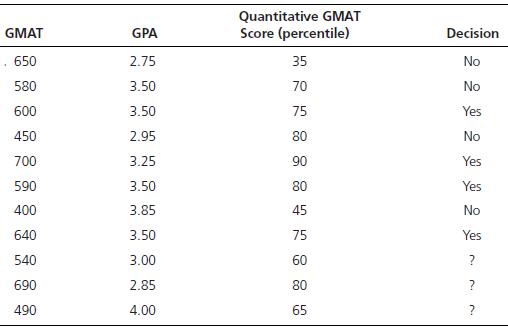
4. Consider the following dataset, which includes three attributes and a classification for admission decisions into an MBA program:a. Using the data shown, develop your own manual expert rules for decision making.b. Use the Gini index to build a decision tree. You can use manual calculations or a
3. A very good repository of data that has been used to test the performance of many machine-learning algorithms is available at ics.uci.edu/~mlearn/MLRepository.html. Some of the datasets are meant to test the limits of current machine-learning algorithms and to compare their performance with new
2. Interview administrators in your college or executives in your organization to determine how data warehousing, data mining, OLAP, and visualization BI/DSS tools could assist them in their work. Write a proposal describing your findings. Include cost estimates and benefits in your report.
1. Examine how new data-capture devices such as radio frequency identification (RFID) tags help organizations accurately identify and segment their customers for activities such as targeted marketing. Many of these applications involve data mining. Scan the literature and the Web and then propose
4. For this exercise, you will replicate (on a smaller scale)the box-office prediction modeling explained in the opening vignette. Download the training dataset from Online File W5.2, MovieTrain.xlsx, which has 184 records and is in Microsoft Excel format. Use the data description given in the
3. For this exercise, your goal is to build a model to identify inputs or predictors that differentiate risky customers from others (based on patterns pertaining to previous customers) and then use those inputs to predict new risky customers. This sample case is typical for this domain.The sample
2. Go to teradatastudentnetwork.com or a URL provided by your instructor. Locate Web seminars related to data mining. In particular, locate a seminar given by C. Imhoff and T. Zouqes. Watch the Web seminar. Then answer the following questions:a. What are some of the interesting applications of data
1. Visit teradatastudentnetwork.com. Identify cases about data mining. Describe recent developments in the field.
14. What are the most common myths and mistakes about data mining?
13. Moving beyond the chapter discussion, where else can association be used?
12. What is the main difference between classification and clustering? Explain using concrete examples.
11. Discuss the reasoning behind the assessment of classification models.
10. Why do we need data preprocessing? What are the main tasks and relevant techniques used in data preprocessing?
9. Are data mining processes a mere sequential set of activities?
8. Discuss the differences between the two most commonly used data mining process.
7. Why do we need a standardized data mining process?What are the most commonly used data mining processes?
6. What are the main data mining application areas? Discuss the commonalities of these areas that make them a prospect for data mining studies.
5. Discuss the main data mining methods. What are the fundamental differences among them?
4. Distinguish data mining from other analytical tools and techniques.
3. Discuss what an organization should consider before making a decision to purchase data mining software.
2. What are the main reasons for the recent popularity of data mining?
1. Define data mining. Why are there many names and definitions for data mining?
3. What are the most common data mining mistakes? How can they be minimized and/or eliminated?
2. What do you think are the reasons for these myths about data mining?
1. What are the most common myths about data mining?
5. What would be your top five selection criteria for a data mining tool? Explain.
4. What are the main differences between commercial and free data mining software tools?
3. What are the most popular free data mining tools?
2. Why do you think the most popular tools are developed by statistics companies?
1. What are the most popular commercial data mining tools?
10. Give examples of situations in which association would be an appropriate data mining technique.
9. What are some of the methods for cluster analysis?
8. What is the major difference between cluster analysis and classification?
7. Give examples of situations in which cluster analysis would be an appropriate data mining technique.
6. Define Gini index. What does it measure?
5. Briefly describe the general algorithm used in decision trees.
4. What are some of the criteria for comparing and selecting the best classification technique?
3. List and briefly define at least two classification techniques.
2. Give examples of situations in which classification would be an appropriate data mining technique.Give examples of situations in which regression would be an appropriate data mining technique.
1. Identify at least three of the main data mining methods.
5. What are the key differences between the major data mining methods?
4. What are some major data mining methods and algorithms?
3. Is data mining a new discipline? Explain.
2. What recent factors have increased the popularity of data mining?
1. Define data mining. Why are there many different names and definitions for data mining?
4. Can you think of other application areas for data mining not discussed in this section? Explain.
3. What do you think is the most prominent application area for data mining? Why?
2. Identify at least five specific applications of data mining and list five common characteristics of these applications.
1. What are the major application areas for data mining?
7. What can be done to further improve the prediction models explained in this case?
6. Do you think the decision makers would easily adapt to such an information system?
5. How do you think these prediction models can be used? Can you think of a good production system for such models?
4. Why do you think the researchers chose to convert a regression problem into a classification problem?
3. Do you think the researchers used all of the relevant data to build prediction models?
2. What are the top challenges for Hollywood managers? Can you think of other industry segments that face similar problems?
1. Why should Hollywood decision makers use data mining?
8. Understand the pitfalls and myths of data mining
7. Build awareness of the existing data mining software tools
6. Learn different methods and algorithms of data mining
5. Understand the steps involved in data preprocessing for data mining
4. Learn the standardized data mining processes
3. Recognize the wide range of applications of data mining
2. Understand the objectives and benefits of business analytics and data mining
1. Define data mining as an enabling technology for business intelligence
6. What benefits did HP derive from implementation of the models?HP’s ground-breaking use of operations research not only enabled the high-tech giant to successfully transform its product portfolio program and return $500 million over a 3-year period to the bottom line, it also earned HP the
5. Why would there be a need for such a system in an organization?HP’s ground-breaking use of operations research not only enabled the high-tech giant to successfully transform its product portfolio program and return $500 million over a 3-year period to the bottom line, it also earned HP the
4. Perform an online search to find more details of the algorithms.HP’s ground-breaking use of operations research not only enabled the high-tech giant to successfully transform its product portfolio program and return $500 million over a 3-year period to the bottom line, it also earned HP the
3. Summarize your understanding of the models and the algorithms.HP’s ground-breaking use of operations research not only enabled the high-tech giant to successfully transform its product portfolio program and return $500 million over a 3-year period to the bottom line, it also earned HP the
2. Why is there a possible conflict between marketing and operations?HP’s ground-breaking use of operations research not only enabled the high-tech giant to successfully transform its product portfolio program and return $500 million over a 3-year period to the bottom line, it also earned HP the
1. Describe the problem that a large company such as HP might face in offering many product lines and options.HP’s ground-breaking use of operations research not only enabled the high-tech giant to successfully transform its product portfolio program and return $500 million over a 3-year period
4. Go to baselinemag.com and access the online articles by M. Duvall, “Billy Beane: What MBAs Can Learn from MLB,”May 20, 2004; D. F. Carr, “Gotcha! Weigh Your Human-Resources Software Options with Care,” May 14, 2004; and M. Duvall, “Roadblock: Getting Old-Line Managers to Think in New
3. Explore decision analysis software vendor Web sites.Identify the purpose of the package(s) that the vendor offers and the organizations that have had successes with them.
2. Use TreeAge Pro decision tree software and then describe how it works and what kinds of problems can be solved with it.
1. Search the Internet for literature and information about DSS and its relationship to BI, BA, and predictive analytics.Describe what you find.
8. Expert Choice software familiarity. Have a group meeting and discuss how you chose a place to live when you relocated to start your college program (or relocated to where you are now). What factors were important for each individual then, and how long ago was it? Have the criteria changed? As a
7. Software demonstration. Each group should review, examine, and demonstrate in class a different state-ofthe-art DSS software product. The specific packages depend on your instructor and the group interests. You may need to download a demo from a vendor’s Web site, depending on your
6. Solve the MBI product-mix problem described in this chapter, using either Excel’s Solver or a student version of an LP solver, such as Lindo or Win QSB. Lindo is available from Lindo Systems, Inc., at lindo.com; others are also available—search the Web. Examine the solution(output) reports
5. Set up spreadsheet models for the decision table models from Section 4.6 and solve them.
4. It has been argued in a number of venues that a higher education level indicates a greater average income. The question for a college student might therefore be “Should I stay in school?”a. Using publicly available U.S. Census data for the 50 states and Washington, DC, develop a linear
3. As a class, build a predictive model. Everyone in the class should write his or her weight, height, and gender on a piece of paper (no names please!). If the sample is too small (you need about 20–30 students), add more students from another class.a. Create a regression (causal) model for
2. Create the spreadsheet models shown in Figures 4.3 and 4.4.a. What is the effect of a change in the interest rate from 8 percent to 10 percent in the spreadsheet model shown in Figure 4.3?b. For the original model in Figure 4.3, what interest rate is required to decrease the monthly payments by
1. People do not like to wait in line. Many models have been developed and solved for waiting-line models to assist organizations such as banks, theme parks, airports(for security, ticket counters, and gate counters), fast-food outlets, movie theaters, and post offices. These models are known as
7. Read S. Boehle, “Simulations: The Next Generation of E-Learning,” Training, Vol. 42, No. 1, January 2005, pp. 22–31. Investigate and write a report about the types of systems that have been deployed for the development of e-learning simulations and what kinds of e-learning systems have
6. Read M. S. Sodhi, “Breast Cancer and O.R.,” OR/MS Today, Vol. 32, No. 6, 2005, p. 14. Consider the problem of accurately diagnosing diseases such as breast cancer and how modeling and simulation can help improve accuracy.Investigate this topic and write a detailed report. Include in your
5. Investigate via a Web search how models and their solutions are used by the U.S. Department of Homeland Security in the “war against terrorism.” Also investigate how other governments or government agencies are using models in their missions.
4. Go to orms-today.com and access the article “The ‘Sound’Science of Scheduling” by L. Gordon and E. Erkut from OR/MS Today, Vol. 32, No. 2, April 2005. Describe the overall problem, the DSS developed to solve it, and the benefits.
3. Each group in the class should access a different online Java-based optimization system and run it. Write up your experience and present it to the class.
2. Each group in the class should access a different online Java-based Web simulation system (especially those systems from visual interactive simulation vendors) and run it. Write up your experience and present it to the class.
Showing 700 - 800
of 1875
1
2
3
4
5
6
7
8
9
10
11
12
13
14
15
Last
Step by Step Answers

 Get 50% OFF
Claim Now
Get 50% OFF
Claim Now