New Semester
Started
Get
50% OFF
Study Help!
--h --m --s
Claim Now
Question Answers
Textbooks
Find textbooks, questions and answers
Oops, something went wrong!
Change your search query and then try again
S
Books
FREE
Study Help
Expert Questions
Accounting
General Management
Mathematics
Finance
Organizational Behaviour
Law
Physics
Operating System
Management Leadership
Sociology
Programming
Marketing
Database
Computer Network
Economics
Textbooks Solutions
Accounting
Managerial Accounting
Management Leadership
Cost Accounting
Statistics
Business Law
Corporate Finance
Finance
Economics
Auditing
Tutors
Online Tutors
Find a Tutor
Hire a Tutor
Become a Tutor
AI Tutor
AI Study Planner
NEW
Sell Books
Search
Search
Sign In
Register
study help
business
construction cost estimating
Construction Cost Estimating 1st Edition John E. Schaufelberger, Len Holm - Solutions
Draft a preconstruction proposal with a stated scope and fee andduration and include a space for your client to sign it.
Why would the GC offer to chair the weekly design coordination meetings and prepare meeting notes?
Prepare three value engineering ideas from one of our case study projects and include them in a VE log.
Why does estimating typically precede scheduling?
Provide a three-point argument why the client should hire the GC earlier rather than later during preconstruction.
A VE log may also be known as a _____________ log.
As the architect or client, why would you NOT want to hire the GC early during design?
What is the difference between TVD and VE?
Other than the preconstruction services described earlier, what service might a consultant or contractor offer the client during design?
What is the difference between an LOI and a precon agreement?
Assume a major subcontractor, such as mechanical or electrical or elevator or laboratory casework, is added to the precon team. Describe the process when and how they should be chosen, contracted, paid, and what their deliverables would include.
As a GC, which would you prefer, a LOI, precon agreement, or construction contract?
Building on Exercise 6, how does the precon process with a subcontractor conclude? How are these situations handled and what are the implications if:(A) The subcontractor is dismissed or, alternatively,(B) They are employed as a member of the construction team?Data from Exercise 6Assume a major
What is the difference between a post-contract VE proposal and a COP?
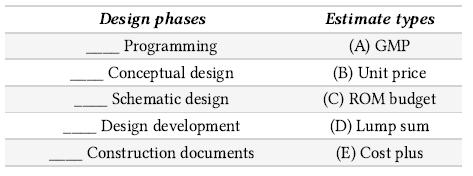
Match these estimate types with the design phases. You can use each answer more than once or not at all, and some may have more than one answer. Design phases Programming Conceptual design Schematic design Design development Construction documents Estimate types (A) GMP (B) Unit price (C) ROM
How would your answers to Exercises 6 and 7 change if the mechanical, electrical, and plumbing subcontractors were:(A) Design-bid-build, with a separate designer working for the architect, or (B) Design-build, where the subcontractors performed their own design?Data from Exercise 6Assume a major
In your opinion, should GCs receive an incentive bonus for VE proposals, or, conversely, should they credit back the fee on VE cost deductions?
What might cause a project not to proceed ‘as planned’ such that the LOI does not roll into a construction contract? There are several possibilities.
Looking back to the organization charts presented in the previous chapters, and those that you may have prepared for an outside case study project, list three members from the GC’s team who should participate on the preconstruction team and three members from outside of the GC’s organization
What happens if an estimator assumes neat-cut footings, but the superintendent chooses to form them?
Anchor bolt templates are used to locate ABs before placing concrete and often hold them in place until the concrete is set. This is not an error-proof process. What would happen if an AB was out of place? What is the remedy? When should this be discovered and resolved?
Why would a contractor prefer to use expansion bolts for steel columns versus anchor bolts?
What would happen to the superintendent who, instead of disposing of the surplus excavation materials properly, dumped them in nearby wetlands?
What would happen to the contractor if the estimator assumed all of the foundation excavation material could be reused as backfill, but then it was rained on and the inspector rejected it?
What size of lumber is typically utilized to form a 10″ deep continuous footing? What is the lumber’s actual (or planed) size? How is the difference accommodated by the formwork crew?
Perform a QTO for a substructure system introduced in this chapter for one of our case study projects included on the book’s eResource. Electronic copies of all of the estimating forms used in this book are also included on that source.
Place the work items from the bullet list in question 4 in the logical order that the work will be performed.
If one pre-cast concrete element was to be connected in the field to another pre-cast element, how is that connection accomplished?
Assume a concrete tilt-up building with an outside footprint of 200′ × 250′. Assume that panels are 9 inches thick and no larger than 30 feet wide and all panels are 27 feet tall. The building has two man-doors on each face and eight each 14′ wide by 14′ high truck doors on one
When would a contractor choose to cast concrete in place or pre-cast concrete?
Match the labor craft (laborer, electrician, surveyor, cement mason, operating engineer, ironworker, and carpenter) with the following concrete activities. Note some crafts are utilized more than once and others not at all for this exercise.a. Crane operation,b. Grout placement,c. Embedded steel
When would a contractor choose to site-cast pre-cast concrete rather than purchase from a supplier?
What is one large cost savings of a tilt-up wall compared to a CIP wall, and what is one large extra cost?
Why does the structural engineer ‘of record’, or the building structural engineer, not provide design for concrete formwork or shoring or tiltup bracing and others?
How many pounds are there in a ton?
Looking back to Chapter 5’s discussion of constructability, what suggestions might a GC make to the structural engineer with respect to the structural steel drawings?Data from chapter 5One important contribution contractor make during the preconstruction phase is to review progress drawings from
Why do we separate different estimating categories by types of craftsmen, for example, carpenters versus ironworkers?
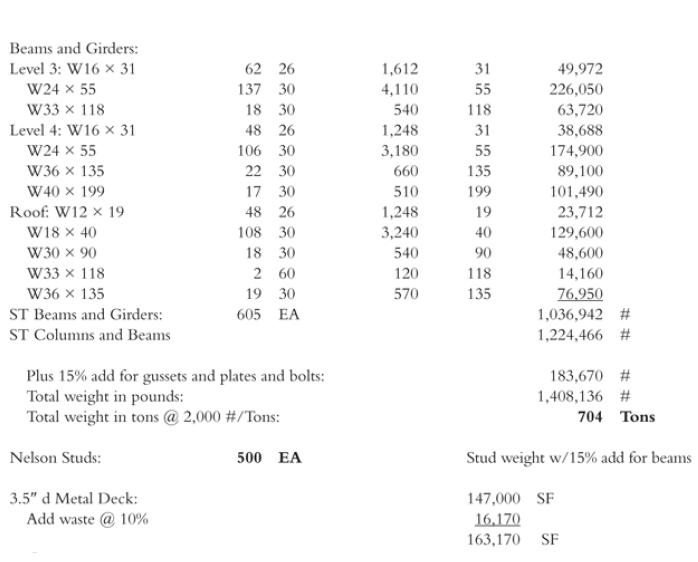
Figure 8.1 is an abridged QTO for the Dunn Lumber case study project utilized in the book. The actual steel QTO would be several pages long. Compare this QTO to the drawings on the book’s eResource: What did we miss?Figure 8.1 Beams and Girders: Level 3: W16 x 31 W24 x 55 W33 x 118 Level 4: W16 x
What are the average wage rates in Exercise 3? What are the systems costs? Are those reasonable? How might you verify?Data from Exercise 3Utilizing a standard database and making whatever assumptions are necessary (yes, estimators do this), price up Chapter 9’s Exercises 3, 4, or 5. Utilize
Should the rental equipment necessary to erect structural steel be included with the labor cost to install the steel or with the jobsite general conditions, and why there?
Although our Lee Street Lofts case study included on the book’s eResource is primarily a wood-framed building atop cast-in-place concrete walls, there was a substantial amount of structural steel – some of it left exposed as interior architectural features. Prepare a steel QTO for this project.
Wide flange columns and beams have the abbreviation of WF. What are some of the other past and present abbreviations for wide flanges?
Including allowances for gussets, etc., compute the total tonnage for the following quantities and sizes of rolled steel members. You will have to look up the weights of the steel members for this exercise.a. 100 LF of 3.5 × 3.5 × 1/4 angleb. 250 LF of 12 × 3 × 5/16 channelc. 85 LF of W36 ×
Why would an angle iron not necessarily make a good column choice?
How many LF of bar joist are there in an area measuring 100′ × 100′ where the joists are 30 inches on center?
Why are different steel categories (rolled shapes, bar joist, miscellaneous steel, and decking) usually supplied by different vendors?
Building on the joist question in Exercise 5, assume that WF girders sit atop steel columns which are 33′ apart and the joist span from girder to girder. How many joists will be in this 100′ square grid? You may want to draw a sketch for this question.Data from Exercise 5How many LF of bar
If a GC were to install only one of the four categories of steel, which one would it be, and why that one?
Looking to the list of materials in Exercise 4, and assuming that each steel member was the same length, let’s say approximately 30′, and all things being equal (which they never are, but…), which element would take the most labor to install?Data from Exercise 4Including allowances for
Why would a GC prefer para-bolts over anchor bolts?
How many BF are there in MBF?
(A) List three reasons why a GC may choose to subcontract an item of work that they might normally self-perform or for which they are signatory to that particular trade union, and conversely,(B) List three reasons the GC should do the work with their own forces.
Why do we separate different estimating categories by types of craftsmen, for example carpenters versus ironworkers versus glaziers?
How many total MBF are there in this group of lumber sizes and lengths?A. 1,000 LF of 2 × 4 studs and plates.B. 500 LF of 2 × 6 studs and plates.C. 820 LF of 2 × 8 joist.D. 160 LF of 4 × 8 door header.E. 60 LF of 4 × 4 posts.F. 40 LF of 6 × 6 treated columns.G. 80 LF of 4 × 12 girder.
Quantify all of the different types of lumber in Len’s Shed. You are going to have to make some assumptions for this exercise, and likely develop a sketch or two, but these are both common estimating activities. Here are the parameters:• 12′ square floor plate.• 8′ high interior space
How many 2 × 12s would it take to build up a 12 × 12 column cut from individual members or sticks?
If we have a residential kitchen that measures 12′ × 16′ which has full upper and lower cabinets on one 12′ side and one 16′ side, and an 8′x 3′ island in the middle without upper cabinets, how many cabinets will we have, and how many SF of granite countertops? Assume that we have a
If the GC is confident it will receive competitive subcontractor bids on items described in this and previous chapters, why is it prudent for the estimator to do a detailed QTO anyhow?
Perform detailed carpentry QTOs for the Lee Street Lofts case study included on the book’s eResource. There are a variety of systems available for this exercise including rough carpentry, siding, finish carpentry, DFH, windows, and specialties.
In what part of the country do HF trees grow?
Which person costs the contractor a higher percentage of labor burden, the CEO or the carpenter foreman?
What is the difference between labor taxes and labor benefits?
What is the difference between a loaded wage rate and a blended wage rate?
When is a summary recap page used?
Create a pricing recap sheet for the concrete walls quantified in Exercise 1 of Chapter 7. Using a current published database, price the material. Price the labor costs using the productivity factors, also from the reference, but with current wage rates for the trades in your state.How do the labor
How is a crosscheck performed?
Combine the wage rates of one each laborer, carpenter, cement mason, operating engineer, and ironworker from Chapter 10 and calculate an average wage rate. Why would a GC(A) Use the average wage for all its work, or conversely.(B) Not use an average wage rate?(C) Which craft wage rate is closest
Looking back at the CIP elevated slab formwork example at the end of the CIP concrete systems section, which of the three estimating options would be the best choice:(A) In a budget estimate.(B) In a GMP.(C) In a pre-bid day summary estimate.(D) On bid day, and/or(E) During buyout?
What can an assemblies check indicate?
If concrete redi-mix supply prices came in on bid day of $95/CY and $102/CY and $107/CY for 3,000, 4,000, and 6,000 psi mixes, respectively, what would be a potential bid adjustment the estimator might make?Refer to the quantities in the example shown in the CIP concrete systems section. Provide an
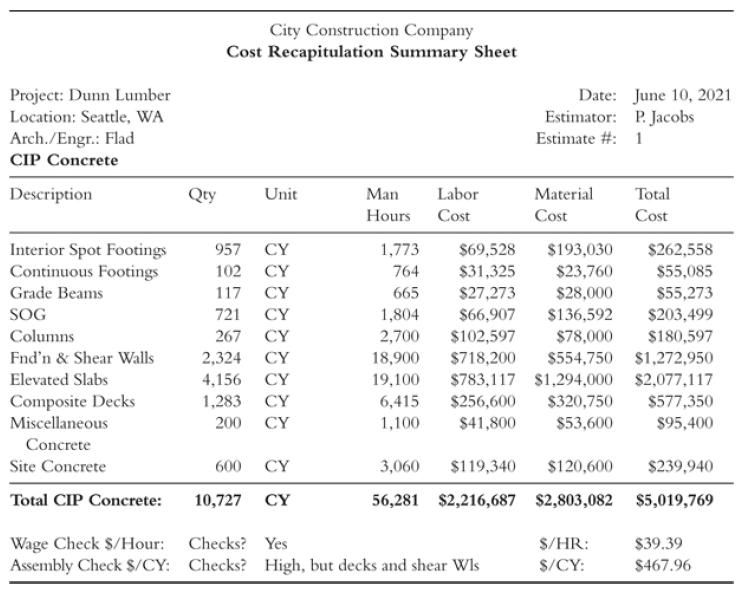
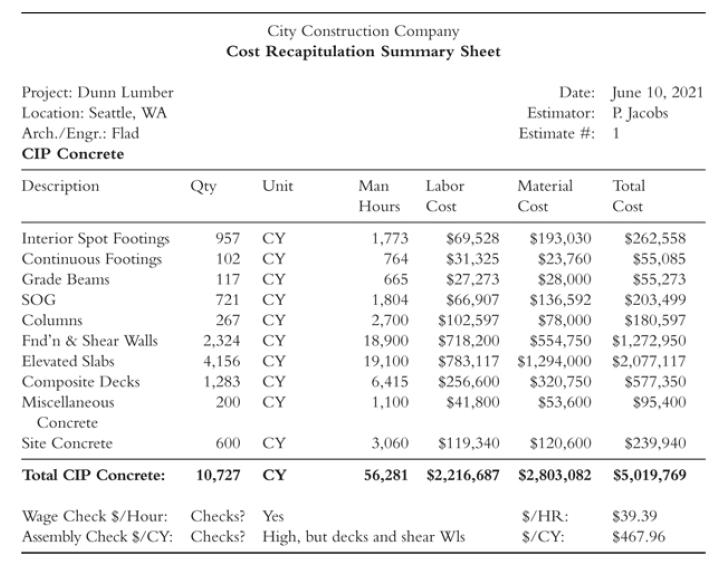
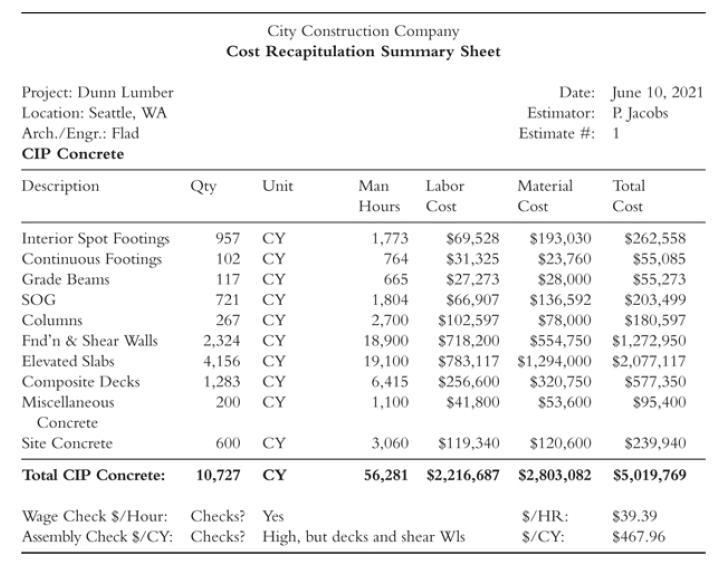
What are the assembly costs/CY of each of the concrete systems in Figure 11.3?Figure 11.3 Project: Dunn Lumber Location: Seattle, WA Arch./Engr.: Flad CIP Concrete Description Interior Spot Footings Continuous Footings Grade Beams SOG Columns Fnd'n & Shear Walls Elevated Slabs Composite
If the estimator (not you) made the mistake of using the wrong units on the pricing recap, as in the example given at the beginning of this chapter, how much would have been included for the plywood? How much should have been included?
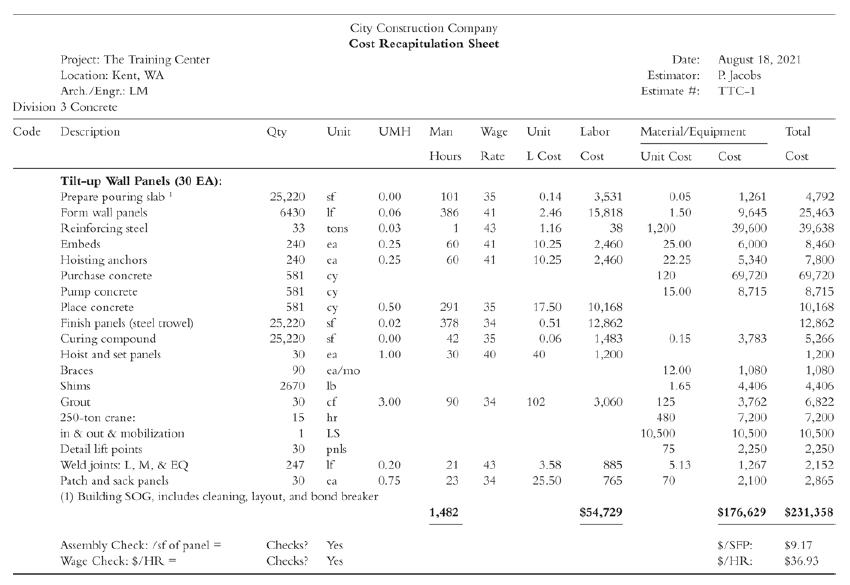
What is the cost/CY of our tilt-up example shown in Figure 11.2?Figure 11.2 Project: The Training Center Location: Kent, WA Arch./Engr.: LM Division 3 Concrete Code Description Tilt-up Wall Panels (30 EA): Prepare pouring slab Form wall panels Reinforcing steel Embeds Hoisting anchors Purchase
Why should CIP concrete systems be priced separate from pre-cast or tilt-up concrete?
In Chapter 6 we discussed both detailed and rule-of-thumb methods for quantifying rebar weights. We have not given you rebar solutions for each CIP concrete system. Using 100#/CY as an average and the summary recap Figure 11.3, what is the approximate total tonnage for our case study rebar? Using
What is an advantage of using UMH over labor unit costs?
Why do the dollar totals in the self-performed option of boxed-in elevated CIP slab example included in this chapter not exactly match the values in Figure 11.3?Figure 11.3 Project: Dunn Lumber Location: Seattle, WA Arch./Engr.: Flad CIP Concrete Description Interior Spot Footings Continuous
Should a GC issue a purchase order or a subcontract agreement for each of the following different concrete scopes:a Form purchase.b Form rental. c Rebar supply.d Rebar installation.e Concrete pump.f Concrete purchase.g Slab finishing h Tilt-up crane.
Why should estimators utilize standard estimating forms?
Prepare a pricing recapitulation page for the lumber quantities from Chapter 9 Review Question 3. Utilize published database productivity rates and material unit prices. Utilize the carpenter wage rate presented in Chapter 10.Data from Review Question 3How many total MBF are there in this group of
What is the downside of using labor unit rates, such as $3.55/SF, versus labor productivity rates, such as 0.1 MH/SF?
How would mistakes from the QTO process discussed in the four earlier QTO chapters affect the pricing processes in these four pricing chapters?
Utilizing a standard database and making whatever assumptions are necessary (yes, estimators do this), price up Chapter 9’s Exercises 3, 4, or 5. Utilize standard pricing recap forms.Data from Exercise 3Quantify all of the different types of lumber in Len’s Shed. You are going to have to make
What happens if the estimator’s hours and the superintendent’s hours do not agree?
In addition to IWs, what other crafts may be involved with steel erection?
Some estimators used ‘loaded’ wage rates on their pricing recap sheets; others use bare wage rates. What are the advantages and disadvantages of each approach?
In addition to carpenters and laborers, what crafts may be involved with concrete system construction?
Prepare an argument why an estimator would choose to(A) Use one standard average wage rate for all work and, conversely.(B) Use different wage rates for different crafts.
What is wrong with a residential wood framing subcontractor figuring a labor estimate for a new house on a $/SFF basis? They often do that.
What are four sources that might be used to obtain construction equipment needed for a construction project?
Without looking ahead to our general conditions chapter, what equipment not addressed in this chapter might also be estimated and cost-coded to jobsite general conditions?
Even if it is not a union project such that a full-time operating engineer was required to run the forklift, why is that still a good idea?
Where is the rental cost shown for equipment that is specific to an activity of work such as concrete tilt-up or structural steel?
A contractor needs a concrete pump for a project that can pump concrete a distance of at least 150 feet. The concrete placement will last six hours and involve the placement of 150 CY of concrete. What is the estimated pumping cost in $/CY for this concrete placement?
Make a list of ten pieces of equipment that might be used on a construction project and identify how each might be procured. Are they subject to ABC or costed to jobsite general conditions? Will they be obtained with a subcontract agreement or a lease agreement and operated by the GC’s craftsmen?
What type of cost information can be obtained from an equipment lease agreement?
What is the cost of a 20 FT × 20 FT × 8 FT concrete tower crane footing based on the following parameters? The process to be used is similar to the process described in Chapter 6 for quantity take-off of a spot footing and the pricing process described in Chapter 11. Make sure you perform a $/MH
What is the difference between the rigger and the operator? What labor craft is the rigger usually, and why that choice?
What portion of the tower crane estimate is based on time?
With whom should the estimator discuss the tower crane estimate before completing it?
Showing 500 - 600
of 654
1
2
3
4
5
6
7
Step by Step Answers

 Get 50% OFF
Claim Now
Get 50% OFF
Claim Now