New Semester Started
Get
50% OFF
Study Help!
--h --m --s
Claim Now
Question Answers
Textbooks
Find textbooks, questions and answers
Oops, something went wrong!
Change your search query and then try again
S
Books
FREE
Study Help
Expert Questions
Accounting
General Management
Mathematics
Finance
Organizational Behaviour
Law
Physics
Operating System
Management Leadership
Sociology
Programming
Marketing
Database
Computer Network
Economics
Textbooks Solutions
Accounting
Managerial Accounting
Management Leadership
Cost Accounting
Statistics
Business Law
Corporate Finance
Finance
Economics
Auditing
Tutors
Online Tutors
Find a Tutor
Hire a Tutor
Become a Tutor
AI Tutor
AI Study Planner
NEW
Sell Books
Search
Search
Sign In
Register
study help
business
dynamic macroeconomics
Macroeconomics 4th Edition Glenn Hubbard, Anthony O'Brien - Solutions
What is the theory of purchasing power parity? Does the theory give a complete explanation for movements in exchange rates in the long run? Briefly explain.
After World War II, why might countries have preferred the Bretton Woods system to reestablishing the gold standard?In your answer, be sure to note the important ways in which the Bretton Woods system differed from the gold standard.
If a country is using the gold standard, what is likely to happen to the country’s money supply if new gold deposits are discovered in the country, as happened in the United States with the gold discoveries in California in 1849? Is this change in the money supply desirable? Briefly explain.
The United States and most other countries abandoned the gold standard during the 1930s. Why would the 1930s have been a particularly difficult time for countries to have remained on the gold standard? (Hint: Think about the macroeconomic events of the 1930s and about the possible problems with
[Related to the Don’t Let This Happen to You on page 641]Briefly explain whether you agree with the following statement:“The Federal Reserve is limited in its ability to issue paper currency by the amount of gold the federal government has in Fort Knox. To issue more paper currency, the
An economist remarks, “In the 1960s, fiscal policy would have been a better way to stabilize the economy, but now I believe that monetary policy is better.” What has changed about the U.S. economy that might have led the economist to this conclusion?
Suppose that Federal Reserve policy leads to higher interest rates in the United States.a. How will this policy affect real GDP in the short run if the United States is a closed economy?b. How will this policy affect real GDP in the short run if the United States is an open economy?c. How will your
An article in the Economist magazine describes Ireland as “an extraordinarily open economy.” Is fiscal policy in Ireland likely to be more or less effective than it would be in a less open economy? Briefly explain.
[Related to the Making the Connection on page 626]Why might “the continued willingness of foreign investors to buy U.S. stocks and bonds and foreign companies to build factories in the United States” result in the United States running a current account deficit?
The text states, “The budget surpluses of the late 1990s occurred at a time of then-record current account deficits.”Holding everything else constant, what would the likely impact have been on domestic investment in the United States if the current account had been balanced instead of being in
According to an article in the Wall Street Journal:Economists at China International Capital Corp., or CICC, say the companies that will suffer most from a stronger yuan are textile and apparel makers and office equipment producers. . . . That could also mean a sting for clothing retailers such as
Tim Condon, an economist at the European bank ING, was quoted in the Wall Street Journal in 2011 as predicting that “China’s current account or saving-investment surplus[will be in] the 1–2% of GDP range . . . ” Is he correct in referring to China’s current account as being the same as
According to a May 2009 article from Reuters:Net capital inflows into the United States were$23.2 billion in March, reversing a revised net outflow of $91.1 billion in the previous month . . . . It shows that money was returning into U.S. dollars . . . . The dollar extended gains against the euro,
Former congressman and presidential candidate Richard Gephardt once proposed that tariffs be imposed on imports from countries with which the United States has a trade deficit. If this proposal were enacted and if it were to succeed in reducing the U.S. current account deficit to zero, what would
[Related to Solved Problem 18.3 on page 624] Look again at Solved Problem 18.3, in which we derived the saving and investment equation S = I + NX. In deriving this equation, we assumed that national income was equal to Y. But Y only includes income earned by households. In the modern U.S. economy,
Briefly explain whether you agree with the following statement:“Because in 2010 national saving was a smaller percentage of GDP in the United States than in the United Kingdom, domestic investment must also have been a smaller percentage of GDP in the United States than in the United Kingdom.
In 2010, France’s net foreign investment was negative.Which was larger in France in 2010: national saving or domestic investment? Briefly explain.
In 2010, domestic investment in Japan was 20.6 percent of GDP, and Japanese net foreign investment was 1.3 percent of GDP. What percentage of GDP was Japanese national saving?
Writing in the Wall Street Journal, David Wessel makes the following observation:Trend one: The U.S. has been buying more than $1 billion a day more from the rest of the world than it has been selling. . . . Trend two:Foreigners have been investing more than $1 billion a day of their savings in
[Related to the Making the Connection on page 619]The following is from an article in the Wall Street Journal:[Peter] Schiff ’s Darien, Conn., broker-dealer firm, Euro Pacific Capital Inc., advised its clients to bet that the dollar would weaken significantly and that foreign stocks would outpace
[Related to the Making the Connection on page 619]The humorist Dave Barry once wrote the following: “In economic news, the Federal Reserve Board, responding to recession fears and the continued weakening of the dollar, votes unanimously to be paid in euros.” Granted that Barry was joking, what
The following is from an article from Reuters:The dollar rallied broadly for its best day in more than a month on Thursday and the euro tumbled to an eight-month low as mounting concerns about the global economy drove investors to seek safety and liquidity.What assets were investors purchasing to
[Related to the Chapter Opener on page 609] An article describing global sales for McDonald’s contains the following information: “However, global sales in dollar terms declined 4.6 per cent for the month, but would have increased 3.2 per cent in constant currencies.”a. What does the article
An article about U.S. wheat exports is titled “Wheat Gains as Export Demand May Rise on Dollar Drop . . . ”a. What does the title mean by a “dollar drop”?b. Why would the dollar’s drop increase the demand for U.S. wheat exports?From Whitney McFerron, “Wheat Gains as Export Demand May
[Related to Solved Problem 18.2 on page 621] When a country’s currency appreciates, is this generally good news or bad news for the country’s consumers? Is it generally good news or bad news for the country’s businesses? Explain your reasoning.
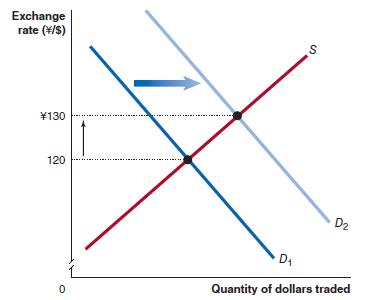
Use the graph to answer the following questions.a. Briefly explain whether the dollar appreciated or depreciated against the yen.b. Which of the following events could have caused the shift in demand shown in the graph?i. Interest rates in the United States have declined.ii. Income rises in
Graph the demand and supply of U.S. dollars for euros and label each axis. Suppose that higher federal budget deficits result in higher U.S. interest rates. Use your graph to show the effect higher U.S. interest rates on the demand and supply of dollars and the resulting change in the exchange rate
Graph the demand and supply of U.S. dollars for euros and label each axis. Show graphically and explain the effect of an increase in interest rates in Europe by the European Central Bank (ECB) on the demand and supply of dollars and the resulting change in the exchange rate of euros for U.S.
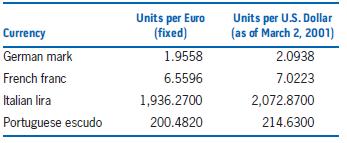
[Related to the Making the Connection on page 615]In January 1, 2002, there were 15 member countries in the European Union. Twelve of those countries eliminated their own individual currencies and began using a new common currency, the euro. For a three-year period from January 1, 1999, through
[Related to the Don’t Let This Happen to You on page 621]If we know the exchange rate between Country A’s currency and Country B’s currency and we know the exchange rate between Country B’s currency and Country C’s currency, then we can compute the exchange rate between Country A’s
Why do foreign households and foreign firms demand U.S. dollars in exchange for foreign currency? Why do U.S.households and U.S. firms supply U.S. dollars in exchange for foreign currency?
Suppose that the current exchange rate between the dollar and the euro is :0.7 = +1. If the exchange rate changes to :0.8 = +1, has the euro appreciated or depreciated against the dollar?
If the exchange rate between the Japanese yen and the U.S.dollar expressed in terms of yen per dollar is ¥ 75 = +1, what is the exchange rate when expressed in terms of dollars per yen?
An article in the New York Times observes that, “China is quickly shifting from being a country known for exports to one capable of making huge investments in global financial markets, analysts say.” Is there a connection between China’s exports and its financial investments in other
According to this chapter, the U.S. trade deficit is almost always larger than the U.S. current account deficit. Why is this true?
The only year since 1982 that the United States has run a current account surplus was 1991. In that year, Japan made a large payment to the United States to help pay for the Gulf War. Explain the connection between these two facts.(Hint: Where would Japan’s payment to the United States appear in
[Related to Solved Problem 18.1 on page 614] The United States ran a current account surplus every year during the 1960s. What must have been true about the U.S.financial account balance during those years?
[Related to Solved Problem 18.1 on page 614] Suppose we know that a country has been receiving large inflows of foreign investment. What can we say about the country’s current account balance?
[Related to Solved Problem 18.1 on page 614] Is it possible for a country to run a trade deficit and a financial account deficit simultaneously? Briefly explain.
[Related to the Don’t Let This Happen to You on page 613]In 2010, Germany had a trade surplus of $204 billion and a current account balance of $188 billion. Explain how Germany’s current account surplus could be smaller than its trade surplus. In 2010, would we expect that Germany’s balance
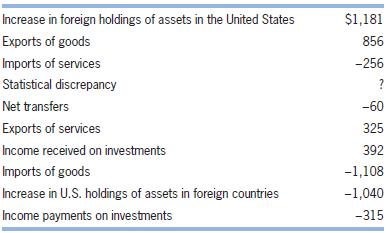
Use the information in the following table to prepare a balance of payments account, like the one shown in Table 18.1 on page 611. Assume that the balance on the capital account is zero. Increase in foreign holdings of assets in the United States $1,181 Exports of goods 856 Imports of services
In 2010, France had a current account deficit of €41.0 billion(approximately $54.4 billion). Did France experience a net capital outflow or a net capital inflow during 2010?Briefly explain.
Explain whether you agree with the following statement:“The United States has run a balance of payments deficit every year since 1982.”
Arriving at the Saving and Investment Equation Use the definitions of private and public saving, the equation for GDP or national income, and the fact that net exports must equal net foreign investment to arrive at the saving and investment equation.
The Effect of Changing Exchange Rates on the Prices of Imports and Exports In June 2011, the average price of goods imported into the United States from Canada fell 2.1 percent. Is it likely that the value of the U.S. dollar appreciated or depreciated versus the Canadian dollar during this period?
Understanding the Arithmetic of Open Economies Test your understanding of the relationship between the current account and the financial account by evaluating the following assertion by a political commentator:The industrial countries are committing economic suicide. Every year, they invest more
During the 2012 presidential election campaign, Texas Governor Rick Perry criticized the actions of Fed Chair Ben Bernanke. Perry argued that, “Printing more money to play politics at this particular time in American history is almost . . . treasonous in my opinion.” An article in the Wall
Robert Lucas has been quoted as saying: “In practice, it is much more painful to put a modern economy through a deflation than the monetary theory we have would lead us to expect. I take this to mean that we have ‘price stickiness.’”What does Lucas mean by “the monetary theory we have”?
According to an article in the Wall Street Journal,“J.P. Morgan Chase economist Michael Feroli finds that in the past two decades it has taken a far larger drop in the jobless rate to boost inflation by one percentage point than it did in the previous 25 years.” If this economist is correct,
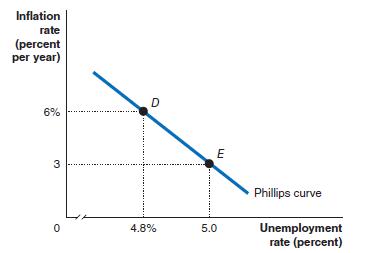
During the recession of 2007–2009, some economists were concerned that the U.S. economy might begin experiencing deflation. An article in the Federal Reserve Bank of San Francisco’s Economic Letter stated: “A popular version of the well-known Phillips curve model of inflation predicts that we
[Related to Solved Problem 17.4 on page 593] In 1995, some economists argued that the natural rate of unemployment was 6 percent. Then Fed Chairman Alan Greenspan was convinced that the natural rate was actually about 5 percent. If Greenspan had accepted the view that the natural rate was 6
[Related to Solved Problem 17.4 on page 593] Suppose the inflation rate has been 15 percent for the past four years. The unemployment rate is currently at the natural rate of unemployment of 5 percent. The Federal Reserve decides that it wants to permanently reduce the inflation rate to 5 percent.
Suppose the current inflation rate and the expected inflation rate are both 4 percent. The current unemployment rate and the natural rate of unemployment are both 5 percent.Use a Phillips curve graph to show the effect on the economy of a severe supply shock. If the Federal Reserve keeps monetary
[Related to the Don’t Let This Happen to You on page 593]Look again at the table on prices during the early 1930s on page 593. Was there disinflation during 1933? Briefly explain.
According to an article in BusinessWeek, many workers who retired in the year 2000 expected to live off the interest they would receive from bank certificates of deposit or money market mutual funds. “Then came disinflation—and a steep fall in interest rates.” What is disinflation, and why
Why do most economists believe that it is important for a country’s central bank to be independent of the rest of the country’s central government?
Why is the credibility of the Fed’s policy announcements particularly important?
An article in the Wall Street Journal contains the following about the views of William Poole, who was then the president of the Federal Reserve Bank of St. Louis:Mr. Poole said both inflation expectations and the output gap—the spare room the economy has between what it’s producing and what it
If both the short-run and long-run Phillips curves are vertical, what will be the effect on the inflation rate and the unemployment rate of an expansionary monetary policy?Use a Phillips curve graph to illustrate your answer.
Would a monetary policy intended to bring about disinflation cause a greater increase in unemployment if workers and firms have adaptive expectations or if they have rational expectations? Briefly explain.
An article in the Economist magazine contains the following:“Robert Lucas . . . showed how incorporating expectations into macroeconomic models muddled the framework economists prior to the ‘rational expectations revolution’ thought they saw so clearly.” What economic framework did
During a time when the inflation rate is increasing each year for a number of years, are adaptive expectations or rational expectations likely to give the more accurate forecasts?Briefly explain.
Why do workers, firms, banks, and investors in financial markets care about the future rate of inflation? How do they form their expectations of future inflation? Do current conditions in the economy have any bearing on how they form their expectations?
[Related to the Making the Connection on page 586]An article in a publication of the Federal Reserve Bank of San Francisco described the natural rate of unemployment in 2011:Recent labor market developments, including mismatches in the skills of workers and jobs, extended unemployment benefits, and
[Related to the Making the Connection on page 586]In 2011, an article in the Economist magazine argued that the natural rate of unemployment in the United States may have risen as high as 7.5 percent. The article suggested that:Lowering this new natural rate of unemployment will require structural
In Congressional testimony, Federal Reserve Chairman Ben Bernanke said:Another significant factor influencing medium-term trends in inflation is the public’s expectations of inflation. These expectations have an important bearing on whether transitory influences on prices, such as changes in
In testifying before Congress, former Federal Reserve Chairman Alan Greenspan remarked, “The challenge of monetary policy is to interpret data on the economy and financial markets with an eye to anticipating future inflationary forces and to countering them by taking action in advance.” Why
[Related to Solved Problem 17.2 on page 587] In a speech in September 1975, then Fed Chairman Arthur Burns said the following:There is no longer a meaningful trade-off between unemployment and inflation. In the current environment, a rapidly rising level of consumer prices will not lead to the
In 1968, Herbert Stein, who would later serve on President Nixon’s Council of Economic Advisers, wrote, “Some who would opt for avoiding inflation would say that in the long run such a policy would cost little, if any, additional unemployment.”Was Stein correct? Did most economists in 1968
Use the following information to draw a graph showing the short-run and long-run Phillips curves:Natural rate of unemployment = 5 percent Current rate of unemployment = 4 percent Expected inflation rate = 4 percent Current inflation rate = 6 percent Be sure your graph shows the point where the
Suppose that the expected inflation rate increases from 4 percent to 6 percent. What will happen to the short-run Phillips curve?
[Related to the Chapter Opener on page 577] Why might a firm such as CarMax, which we discussed in the chapter opener, pay more attention than firms in, say, the restaurant or clothing industries, to the Federal Reserve raising or lowering interest rates? In other words, why are movements in
[Related to the Making the Connection on page 582]When Shiller asked a sample of the general public what they thought caused inflation, the most frequent answer he received was “greed.” Do you agree that greed causes inflation?Briefly explain.
[Related to the Making the Connection on page 582]Robert Shiller asked a sample of the general public and a sample of economists the following question: “Do you agree that preventing high inflation is an important national priority, as important as preventing drug abuse or preventing
This chapter argues that if the price level increases over time, the average wage should increase by the same amount. Why is this true?
General Juan Perón, the former dictator of Argentina, once said of the labor market in his country, “Prices have gone up the elevator, and wages have had to use the stairs.” In this situation, what was happening to real wages in Argentina?Was unemployment likely to have been relatively high or
In macroeconomics courses in the 1960s and early 1970s, some economists argued that one of the U.S. political parties was willing to have higher unemployment in order to achieve lower inflation and that the other major political party was willing to have higher inflation in order to achieve lower
Briefly explain whether you agree with the following statement:“Any economic relationship that changes as economic policy changes is not a structural relationship.”
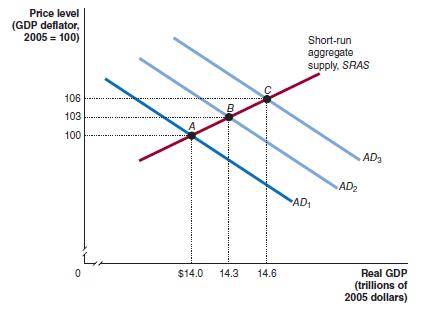
Use these two graphs to answer the following questions:a. Briefly explain which point on the Phillips curve graph represents the same economic situation as point B on the aggregate demand and aggregate supply graph.b. Briefly explain which point on the Phillips curve graph represents the same
In October 2011, Christina Romer, former chair of the Council of Economic Advisers, noted that, “Today, inflation is still low, but unemployment is stuck at a painfully high level.” Why might we normally expect that inflation will be low when unemployment is high? What economic concept is used
Why did Milton Friedman argue that the Phillips curve did not represent a permanent trade-off between unemployment and inflation? In your answer, be sure to explain what Friedman meant by the “natural rate of unemployment.”
Why did economists during the early 1960s think of the Phillips curve as a “policy menu”? Were they correct to think of it in this way? Briefly explain.
Using your understanding of multipliers, explain why an increase in the tax rate would decrease the size of the government purchases multiplier. Similarly, explain why a decrease in the marginal propensity to import would increase the size of the government purchases multiplier.
Use a graph to show the change in the aggregate demand curve resulting from an increase in government purchases if the government purchases multiplier equals 2.Now, on the same graph, show the change in the aggregate demand curve resulting from an increase in government purchases if the government
Assuming a fixed amount of taxes and a closed economy, calculate the value of the government purchases multiplier, the tax multiplier, and the balanced budget multiplier if the marginal propensity to consume equals 0.6.
Writing in the Wall Street Journal, Martin Feldstein, an economist at Harvard University, argues that “behavioral responses” of taxpayers to the cuts in marginal tax rates enacted in 1986 resulted in “an enormous rise in the taxes paid, particularly by those who experienced the greatest
Suppose that an increase in marginal tax rates on individual income affects both aggregate demand and aggregate supply. Briefly describe the effect of the tax increase on equilibrium real GDP and the equilibrium price level. Will the changes in equilibrium real GDP and the price level be larger or
Some economists and policymakers have argued in favor of a “flat tax.” A flat tax would replace the current individual income tax system, with its many tax brackets, exemptions, and deductions, with a new system containing a single tax rate and few, or perhaps no, deductions and
A political columnist wrote the following:Today . . . the main purpose [of government’s issuing bonds] is to let craven politicians launch projects they know the public, at the moment, would rather not fully finance. The tab for these projects will not come due, probably, until after the
An article in the Economist described the situation in Japan in mid-2009: “Nor is there much sign that Japan’s gaping budget deficits have crowded out private investment. [Interest rates] on long-term Japanese bonds . . . are still only 1.45%, even as gross public debt is heading for 200% of
An editorial in the Wall Street Journal declares, “We don’t put much stock in future budget forecasts because they depend on so many variables.” What variables would a forecast of future federal budget deficits depend on? What is it about these variables that makes future budget deficits
According to an article in the Wall Street Journal, “Federal Reserve Chairman Ben Bernanke warned Congress and the White House that the U.S. economy will suffer if they don’t move soon to rein in the federal budget deficit.” How might the economy suffer from large federal deficits? How can
[Related to the Making the Connection on page 554]The following is from a message by President Hoover to Congress, dated May 5, 1932:I need not recount that the revenues of the Government as estimated for the next fiscal year show a decrease of about $1,700,000,000 below the fiscal year 1929, and
The federal government calculates its budget on a fiscal year that begins each year on October 1 and ends the following September 30. At the beginning of the 2005 fiscal year, the Congressional Budget Office (CBO) forecast that the federal budget deficit would be $368 billion. The actual budget
[Related to Solved Problem 16.6 on page 555] The federal government’s budget surplus was $189.4 billion in 2000 and $41.8 billion in 2001. What does this information tell us about fiscal policy actions that Congress and the president took during those years?
In a column in the Financial Times, the prime minister and the finance minister of the Netherlands argue that the European Union, an organization of 27 countries in Europe, should appoint “a commissioner for budgetary discipline.”They believe that “The new commissioner should be given clear
What is the difference between the federal budget deficit and federal government debt?
Why do few economists argue that it would be a good idea to balance the federal budget every year?
What is the cyclically adjusted budget deficit or surplus?Suppose that the economy is currently at potential GDP, and the federal budget is balanced. If the economy moves into recession, what will happen to the federal budget?
[Related to the Making the Connection on page 550]Why would recessions accompanied by a financial crisis be more severe than recessions that do not involve bank crises?Were the large budget deficits of $1.4 trillion in fiscal year 2009 and $1.3 trillion in fiscal year 2010 primarily the result of
Showing 2400 - 2500
of 5072
First
18
19
20
21
22
23
24
25
26
27
28
29
30
31
32
Last
Step by Step Answers

 Get 50% OFF
Study Help!
Claim Now
Get 50% OFF
Study Help!
Claim Now