New Semester Started
Get
50% OFF
Study Help!
--h --m --s
Claim Now
Question Answers
Textbooks
Find textbooks, questions and answers
Oops, something went wrong!
Change your search query and then try again
S
Books
FREE
Study Help
Expert Questions
Accounting
General Management
Mathematics
Finance
Organizational Behaviour
Law
Physics
Operating System
Management Leadership
Sociology
Programming
Marketing
Database
Computer Network
Economics
Textbooks Solutions
Accounting
Managerial Accounting
Management Leadership
Cost Accounting
Statistics
Business Law
Corporate Finance
Finance
Economics
Auditing
Tutors
Online Tutors
Find a Tutor
Hire a Tutor
Become a Tutor
AI Tutor
AI Study Planner
NEW
Sell Books
Search
Search
Sign In
Register
study help
business
dynamic macroeconomics
Macroeconomics 4th Edition Glenn Hubbard, Anthony O'Brien - Solutions
7. A shift in a curve represents a change ina. the variable on the horizontal axis.b. the variable on the vertical axis.c. a third variable that is not on either axis.d. any variable that is relevant to the relationship being graphed.
2. Assume a research fi rm collects survey sales data that reveal the relationship between the possible selling prices of hamburgers and the quantity of hamburgers consumers would purchase per year at alternative prices. The report states that if the price of a hamburger is$4, 20,000 will be
1. Draw a graph without specifi c data for the expected relationship between the following variablesa. The probability of living and ageb. Annual income and years of educationc. Inches of snow and sales of bathing suitsd. The number of football games won and the athletic budget In each case, state
15. A model (or theory)a. is a general statement about the causal relationship between variables based on facts.b. helps explain and predict the relationship between variables.c. when expressed as a downward (negatively)sloping graph implies an inverse relationship between the variables.d. all of
14. Which of the following would not be classifi ed as a capital resource?a. The Empire State Building.b. A Caterpillar bulldozer.c. A Macintosh computer.d. 100 shares of stock in General Motors.
13. Computer programs, or software, are an example ofa. land.b. labor.c. capital.d. none of the above.
12. Select the normative statement that completes the following sentence: If the minimum wage is raised rapidly, thena. infl ation will increase.b. workers will gain their rightful share of total income.c. profi ts will fall.d. unemployment will rise.
11. Which of the following is a statement of normative economics?a. The minimum wage is good because it raises wages for the working poor.b. The minimum wage is supported by unions.c. The minimum wage reduces the number of jobs for less-skilled workers.d. The minimum wage encourages fi rms to
10. Which of the following is a statement of positive economics?a. An unemployment rate greater than 8 percent is good because prices will fall.b. An unemployment rate of 7 percent is a serious problem.c. If the overall unemployment rate is 7 percent, unemployment rates among African Americans will
9. Which of the following is a statement of positive economics?a. The income tax system collects a lower percentage of the incomes of the poorb. A reduction in tax rates of the rich makes the tax system more fairc. Tax rates ought to be raised to fi nance health cared. All of the above are
8. An economist notices that sunspot activity is high just prior to recessions and concludes that sunspots cause recessions. The economist hasa. confused association and causation.b. misunderstood the ceteris paribus assumption.c. used normative economics to answer a positive question.d. built an
7. An economic theory claims that a rise in gasoline prices will cause gasoline purchases to fall, ceteris paribus. The phrase ceteris paribus means thata. other relevant factors like consumer incomes must be held constant.b. gasoline prices must fi rst be adjusted for infl ation.c. the theory is
6. A review of the performance of the U.S.economy during the 1990s is primarily the concern ofa. macroeconomics.b. microeconomics.c. both macroeconomics and microeconomics.d. neither macroeconomics nor microeconomics.
5. Microeconomics approaches the study of economics from the viewpoint ofa. individual or specifi c markets.b. the operation of the Federal Reserve.c. economywide effects.d. the national economy.
4. Economics is the study ofa. how to make money.b. how to operate a business.c. people making choices because of the problem of scarcity.d. the government decision-making process.
3. Which of the following is not a resource?a. Landb. Laborc. Moneyd. Capital
2. Which of the following would eliminate scarcity as an economic problem?a. Moderation of people’s competitive instinctsb. Discovery of suffi ciently large new energy reservesc. Resumption of steady productivity growthd. None of the above because scarcity cannot be eliminated
1. Scarcity existsa. when people consume beyond their needs.b. only in rich nations.c. in all countries of the world.d. only in poor nations.
12. Analyze the positive versus normative arguments in the following case. What statements of positive economics are used to support requiring air bags? What normative reasoning is used?For an explanation of the correct answers, visit the Tucker Web site at www.cengage.com/economics/tucker.
11. “The government should collect higher taxes from the rich and use the additional revenues to provide greater benefi ts to the poor.” This statement is an illustration of aa. testable statement.b. basic principle of economics.Study Questions and Problems Copyright 2010 Cengage Learning. All
10. Which of the following is an example of a proposition from positive economics?a. If Candidate X had been elected president, taxpayers would have been treated more fairly than under President Y.b. The average rate of infl ation was higher during President X’s presidency than during Presdient
9. Suppose Congress cuts spending for the military, and then unemployment rises in the U.S. defense industry. Is there causation in this situation, or are we observing an association between events?
8. Explain the importance of the ceteris paribus assumption for an economic model.
7. Explain why it is important for an economic model to be an abstraction from the real world.
6. A model is defi ned as aa. value judgment of the relationship between variables.b. presentation of all relevant aspects of realworld events.c. simplifi ed description of reality used to understand the way variables are related.d. data set adjusted for irrational actions of people.
5. Which of the following are microeconomic issues? Which are macroeconomic issues?a. How will an increase in the price of Coca-Cola affect the quantity of Pepsi-Cola sold?b. What will cause the nation’s infl ation rate to fall?c. How does a quota on textile imports affect the textile industry?d.
4. Explain the difference between macroeconomics and microeconomics. Give examples of the areas of concern to each branch of economics.
3. Computer software programs are an example ofa. capital.b. labor.c. a natural resource.d. none of the above.
2. Why isn’t money considered capital in economics?
1. Explain why both nations with high living standards and nations with low living standards face the problem of scarcity. If you won $1 million in a lottery, would you escape the scarcity problem?
3. Explain your position on this issue. Identify positive and normative reasons for your decision. Are there alternative ways to aid the working poor?
2. Give a positive and a normative argument why a business leader would oppose raising the minimum wage. Give a positive and a normative argument why a labor leader would favor raising the minimum wage.
1. Identify two positive and two normative statements given above concerning raising the minimum wage. List other minimum-wage arguments not discussed in this You’re the Economist, and classify them as either positive or normative economics.
An article in the Economist magazine refers to “The Great Delusion of a Great Moderation. . . .” What is the Great Moderation? By 2011, why might some people have considered the Great Moderation to have been a delusion?
Imagine that you own a business and that during the next recession, you lay off 10 percent of your workforce.When economic activity picks up and your sales begin to increase, why might you not immediately start rehiring workers?
[Related to the Making the Connection on page 321]As we have seen, some firms prosper by expanding during recessions. What risks do firms take when they pursue this strategy? Are there circumstances in particular industries under which a more cautious approach might be advisable?Briefly explain.
[Related to the Don’t Let This Happen to You on page 325]“Real GDP in 2010 was $13.1 trillion. This value is a large number. Therefore, economic growth must have been high during 2010.” Briefly explain whether you agree with this statement.
The National Bureau of Economic Research, a private group, is responsible for declaring when recessions begin and end. Can you think of reasons the Bureau of Economic Analysis, part of the federal government, might not want to take on this responsibility?
[Related to the Chapter Opener on page 303] Briefly explain whether production of each of the following goods is likely to fluctuate more or less than real GDP does during the business cycle:a. Ford F-150 trucksb. McDonald’s Big Macsc. Kenmore refrigeratorsd. Huggies diaperse. Boeing passenger
Briefly compare the severity of recessions before and after 1950. What explanations have economists offered for the period of relative macroeconomic stability from 1950 to 2007?
Briefly describe the effect of the business cycle on the inflation rate and the unemployment rate. Why might the unemployment rate continue to rise during the early stages of a recovery?
What are the names of the following events that occur during a business cycle?a. The high point of economic activityb. The low point of economic activityc. The period between the high point of economic activity and the following low pointd. The period between the low point of economic activity and
[Related to the Making the Connection on page 316]The Making the Connection claims that Ebenezer Scrooge promoted economic growth more when he was a miser and saved most of his income than when he reformed and began spending freely. Suppose, though, that most of his spending after he reformed
[Related to Solved Problem 10.2 on page 319] Savers are taxed on the nominal interest payments they receive rather than the real interest payments. Suppose the government shifted from taxing nominal interest payments to taxing only real interest payments. (That is, savers could subtract the
The federal government in the United States has been running very large budget deficits.a. Use a market for loanable funds graph to illustrate the effect of the federal budget deficits. What happens to the equilibrium real interest rate and the quantity of loanable funds? What happens to the
Firms care about their after-tax rate of return on investment projects. In the market for loanable funds, graph and explain the effect of an increase in taxes on business profits.(For simplicity, assume no change in the federal budget deficit or budget surplus.) What happens to the equilibrium real
Suppose that the economy is currently in a recession and that economic forecasts indicate that the economy will soon enter an expansion. What is the likely effect of the expansion on the expected profitability of new investment in plant and equipment? In the market for loanable funds, graph and
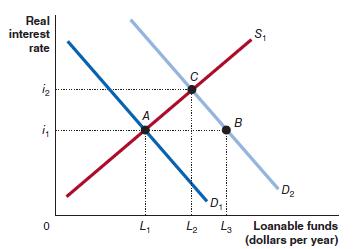
Use this graph to answer the following questions:a. With the shift in the demand for loanable funds, what happens to the equilibrium real interest rate and the equilibrium quantity of loanable funds?b. How can the equilibrium quantity of loanable funds increase when the real interest rate
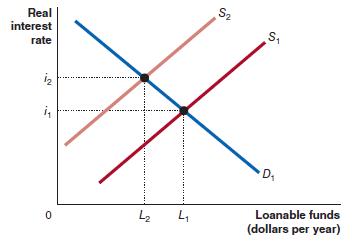
Use the graph on the next page to answer the following questions:a. Does the shift from S1 to S2 represent an increase or a decrease in the supply of loanable funds?b. With the shift in supply, what happens to the equilibrium quantity of loanable funds?c. With the change in the equilibrium quantity
In problem 2.8, suppose that government purchases increase from $2 trillion to $2.5 trillion. If the values for Y and C are unchanged, what must happen to the values of S and I? Briefly explain.
Consider the following data for a closed economy:Y = $12 trillion C = $8 trillion G = $2 trillion SPublic = -$0.5 trillion T = $2 trillion Use these data to calculate the following:a. Private savingb. Investment spendingc. Transfer paymentsd. The government budget deficit or budget surplus
Consider the following data for a closed economy:Y = $11 trillion C = $8 trillion I = $2 trillion TR = $1 trillion T = $3 trillion Use these data to calculate the following:a. Private savingb. Public savingc. Government purchasesd. The government budget deficit or budget surplus
An International Monetary Fund Factsheet makes the following observation regarding stable financial systems: “A sound financial system is . . . essential for supporting economic growth.” Do you agree with this observation? Briefly explain.Based on “Financial System Soundness,” International
Suppose you can receive an interest rate of 3 percent on a certificate of deposit at a bank that is charging borrowers 7 percent on new car loans. Why might you be unwilling to loan money directly to someone who wants to borrow from you to buy a new car, even if that person offers to pay you an
Briefly explain why the total value of saving in the economy must equal the total value of investment.
How does the financial system—either financial markets or financial intermediaries—provide risk sharing, liquidity, and information for savers and borrowers?
Why is the financial system of a country important for long-run economic growth? Why is it essential for economic growth that firms have access to adequate sources of funds?
[Related to the Making the Connection on page 310] If the keys to Botswana’s rapid economic growth seem obvious, why have other countries in the region had so much difficulty following them
A newspaper article on labor productivity in the United States observes that, “ . . . the best measure of productivity is probably output per hour, not output per person.” Briefly explain whether you agree.From David Leonhardt, “Even More Productive than Americans,”New York Times, January
[Related to Solved Problem 10.1 on page 309] An article in the Economist magazine compares Panama to Singapore.It quotes Panama’s president as saying: “We copy a lot from Singapore and we need to copy more.” The article observes that: “Panama is not even one-fifth as rich as its Asian model
A study conducted by the Moscow-based management consulting firm Strategy Partners found that average labor productivity in Russia is only 17 percent of labor productivity in the United States. What factors would cause U.S. labor productivity to be nearly six times higher than Russian labor
Real GDP per capita in the United States, as mentioned in the chapter, grew from about $5,600 in 1900 to about$42,200 in 2010, which represents an annual growth rate of 1.8 percent. If the United States continues to grow at this rate, how many years will it take for real GDP per capita to double?
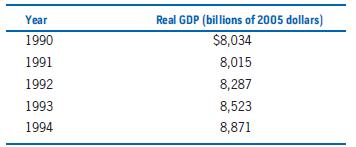
Use the table to answer the following questions.a. Calculate the growth rate of real GDP for each year from 1991 to 1994.b. Calculate the average annual growth rate of real GDP for the period from 1991 to 1994. Year 1990 Real GDP (billions of 2005 dollars) $8,034 1991 8,015 1992 8,287 1993 8,523
[Related to the Making the Connection on page 306]Think about the relationship between economic prosperity and life expectancy. What implications does this relationship have for the size of the health care sector of the economy? In particular, is this sector likely to expand or contract in coming
A question from Chapter 8 asked about the relationship between real GDP and the standard of living in a country.Based on what you read about economic growth in this chapter, elaborate on the importance of growth in GDP, particularly real GDP per capita, to the quality of life of a country’s
Briefly discuss whether you would rather live in the United States of 1900 with an income of $1,000,000 per year or the United States of 2012 with an income of $50,000 per year.Assume that the incomes for both years are measured in 2012 dollars.
What is the most important factor in explaining increases in real GDP per capita in the long run?
What is the rule of 70? If real GDP per capita grows at a rate of 7 percent per year, how many years will it take to double?
By how much did real GDP per capita increase in the United States between 1900 and 2010? Discuss whether the increase in real GDP per capita is likely to be greater or smaller than the true increase in living standards.
[Related to the Making the Connection on page 291]During the late nineteenth century in the United States, many farmers borrowed heavily to buy land. During most of the period between 1870 and the mid-1890s, the United States experienced mild deflation: The price level declined each year. Many
Suppose that News Corporation, the owner of the Wall Street Journal, and the investors buying the firm’s bonds both expect a 2 percent inflation rate for the year. Given this expectation, suppose the nominal interest rate on the bonds is 6 percent and the real interest rate is 4 percent.Suppose
Suppose James and Frank both retire this year. For income from retirement, James will rely on a pension from his company that pays him a fixed $2,500 per month for as long as he lives. James hasn’t saved anything for retirement.Frank has no pension but has saved a considerable amount, which he
Suppose that the inflation rate turns out to be much higher than most people expected. In that case, would you rather have been a borrower or a lender? Briefly explain.
What are menu costs? What effect has the Internet had on the size of menu costs?
Which is a greater problem: anticipated inflation or unanticipated inflation? Briefly explain.7.4 What problems does deflation cause?
How can inflation affect the distribution of income?
Why do nominal incomes generally increase with inflation?If nominal incomes increase with inflation, does inflation reduce the purchasing power of the average consumer?Briefly explain.
During the 1990s, Japan experienced periods of deflation and low nominal interest rates that approached zero percent.Why would lenders of funds agree to a nominal interest rate of almost zero percent? (Hint: Were real interest rates in Japan also low during this period?)
Suppose that the only good you purchase is hamburgers and that at the beginning of the year, the price of a hamburger is $2.00. Suppose you lend $1,000 for one year at an interest rate of 5 percent. At the end of the year, a hamburger costs $2.08. What is the real rate of interest you earned on
Describing the situation in England in 1920, the historian Robert Skidelsky wrote the following: “Who would not borrow at 4 percent a year, with prices going up 4 percent a month?” What was the real interest rate paid by borrowers in this situation? (Hint: What is the annual inflation rate, if
Suppose you were borrowing money to buy a car. Which of these situations would you prefer: The interest rate on your car loan is 20 percent and the inflation rate is 19 percent or the interest rate on your car loan is 5 percent and the inflation rate is 2 percent? Briefly explain.
The following appeared in a newspaper article: “Inflation in the Lehigh Valley during the first quarter of [the year]was less than half the national rate. . . . So, unlike much of the nation, the fear here is deflation—when prices sink so low the CPI drops below zero.” Do you agree with the
If the economy is experiencing deflation, will the nominal interest rate be higher or lower than the real interest rate?
The chapter explains that it is impossible to know whether a particular nominal interest rate is “high” or “low.” Briefly explain why.
If inflation is expected to increase, what will happen to the nominal interest rate? Briefly explain.
What is the difference between the nominal interest rate and the real interest rate?
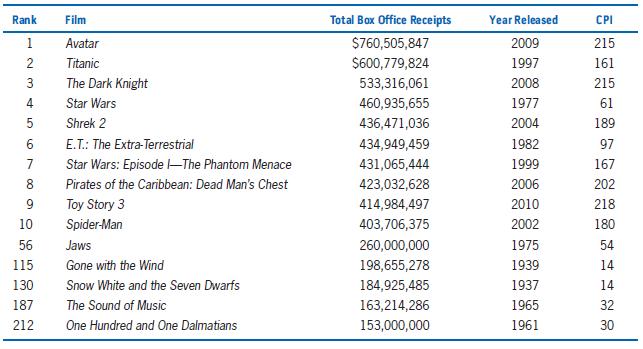
[Related to Solved Problem 9.5 on page 287] The following table shows the top 10 films of all time through October 2011, measured by box office receipts in the United States, as well as several other notable films farther down the list.The CPI in 2010 was 218. Use this information and the data in
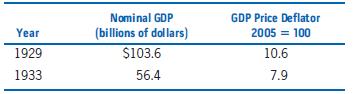
[Related to Solved Problem 9.5 on page 287] The Great Depression was the worst economic disaster in U.S. history in terms of declines in real GDP and increases in the unemployment rate. Use the data in the table on the next page to calculate the percentage decline in real GDP between 1929 and 1933:
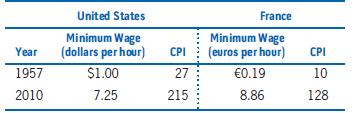
[Related to Solved Problem 9.5 on page 287] Use the information in the following table to determine the percentage changes in the U.S. and French real minimum wages between 1957 and 2010. Does it matter for your answer that you have not been told the base year for the U.S.CPI or the French CPI? Was
[Related to Solved Problem 9.5 on page 287] In 1924, the famous novelist F. Scott Fitzgerald wrote an article for the Saturday Evening Post titled “How to Live on $36,000 a Year,” in which he wondered how he and his wife had managed to spend all of that very high income without saving any of
Briefly explain how you can use data on nominal wages for 2004 to 2011 and data on the consumer price index for the same years to calculate the real wage for these years.
What is the difference between a nominal variable and a real variable?
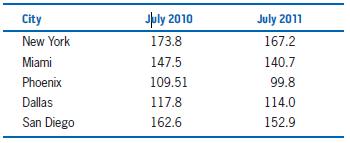
The Standard & Poor’s/Case-Shiller Home Price Index is one of the leading indicators of housing price trends in the United States. The base year for the index is January 2000.The following table lists index numbers for July 2010 and July 2011 for five cities:a. Calculate the percentage change
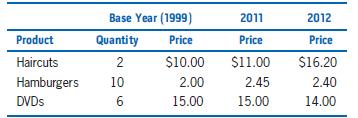
Consider a simple economy that produces only three products:haircuts, hamburgers, and DVDs. Use the information in the following table to calculate the inflation rate for 2010, as measured by the consumer price index. Base Year (1999) 2011 2012 Product Quantity Price Price Price Haircuts 2 $10.00
In October 2011, Apple introduced the iPhone 4S, which had new features, including an improved camera and voice control, but sold at the same price as the previous iPhone model. How was the consumer price index affected by the introduction of the iPhone 4S?Based on Ian Sherr and Greg Bensinger,
In calculating the consumer price index for the year, why does the BLS use the quantities in the market basket, rather than the quantities purchased during the current year?
[Related to the Don’t Let This Happen to You on page 285]Briefly explain whether you agree or disagree with the following statement: “I don’t believe the government price statistics. The CPI for 2010 was 218, but I know that the inflation rate couldn’t have been as high as 118 percent in
What is the difference between the consumer price index and the producer price index?
What potential biases exist in calculating the consumer price index? What steps has the Bureau of Labor Statistics taken to reduce the size of the biases?
Which price index does the government use to measure changes in the cost of living?
Showing 3100 - 3200
of 5072
First
25
26
27
28
29
30
31
32
33
34
35
36
37
38
39
Last
Step by Step Answers

 Get 50% OFF
Study Help!
Claim Now
Get 50% OFF
Study Help!
Claim Now