New Semester Started
Get
50% OFF
Study Help!
--h --m --s
Claim Now
Question Answers
Textbooks
Find textbooks, questions and answers
Oops, something went wrong!
Change your search query and then try again
S
Books
FREE
Study Help
Expert Questions
Accounting
General Management
Mathematics
Finance
Organizational Behaviour
Law
Physics
Operating System
Management Leadership
Sociology
Programming
Marketing
Database
Computer Network
Economics
Textbooks Solutions
Accounting
Managerial Accounting
Management Leadership
Cost Accounting
Statistics
Business Law
Corporate Finance
Finance
Economics
Auditing
Tutors
Online Tutors
Find a Tutor
Hire a Tutor
Become a Tutor
AI Tutor
AI Study Planner
NEW
Sell Books
Search
Search
Sign In
Register
study help
business
dynamic macroeconomics
Macroeconomics For Today 7th Edition Irvin B. Tucker - Solutions
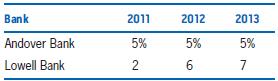
Andover Bank and Lowell Bank each sell one-year certificates of deposit (CDs). The interest rates on these CDs are given in the following table for a three-year period:Suppose you deposit $1,000 in a CD in each bank at the beginning of 2011. At the end of 2011, you take your $1,000 and any interest
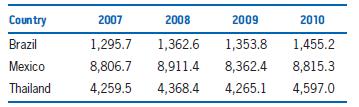
Use the data on real GDP in this table to answer the following questions.a. Which country experienced the highest rate of economic growth during 2008 (that is, for which country did real GDP increase the most from 2007 to 2008)?b. Which country experienced the worst economic recession during 2009?
[Related to the Making the Connection on page 339]Economists Carol Shiue and Wolfgang Keller of the University of Texas at Austin published a study of “market efficiency” in the eighteenth century in England, other European countries, and China. If the markets in a country are efficient, a
Explain the difference between the total percentage increase in real GDP between 1999 and 2009 and the average annual growth rate in real GDP between the same years.
Why does a country’s rate of economic growth matter?
10. Briefl y describe the effect on the money supply of the following monetary policies:a. The Fed purchases $20 million worth of U.S. Treasury bonds.b. The Fed increases the discount rate.c. The Fed decreases the discount rate.d. The Fed sells $40 million worth of U.S.T-bills.e. The Fed decreases
9. Assume the required reserve ratio is 10 percent and a bank’s excess reserves are $50 million.Explain why checkable deposits resulting from new loans based on excess reserves are not likely to generate the maximum of $500 million.
8. Suppose the Federal Reserve’s trading desk buys $500,000 in T-bills from a securities dealer who then deposits the Fed’s check in Best National Bank. Use a balance sheet to show the impact on the bank’s loans. Consider the money multiplier and assume the required reserve ratio is 10
7. Suppose it is the holiday season and you withdraw $1,000 from your account at First National Bank to purchase presents. Using a balance sheet, show the impact on this bank’s assets and liabilities. If the required reserve ratio is 20 percent, what is the impact on the bank’s loans?
6. Suppose you remove $1,000 from under your mattress and deposit it in First National Bank.Using a balance sheet, show the impact of your deposit on the bank’s assets and liabilities. If the required reserve ratio is 10 percent, what is the maximum amount the bank can loan from this deposit?
5. Suppose you deposit your paycheck drawn on another bank. Explain the impact on the money supply.
4. In what form does a bank hold its required reserves? Assume the Fed has a 20 percent required reserve ratio. What amount of checkable deposits can be supported by $10 million in required reserves?
3. Consider this statement: “Banks do not create money because this is the Fed’s responsibility.”Do you agree or disagree? Explain.
2. If you deposit a $20 bill into a checking account and your bank has a 10 percent reserve requirement, by how much will the bank’s excess reserves rise?
1. Relate Shakespeare’s admonition “Neither a borrower nor a lender be” to the goldsmiths’evolutionary use of fractional reserve banking.
15. Which of the following is not part of the Federal Reserve System?a. Council of Economic Advisersb. Board of Governorsc. Federal Open Market Committeed. 12 Federal Reserve District Bankse. Federal Advisory Council
14. The major protection against sudden mass attempts to withdraw cash from banks is thea. Federal Reserve.b. Consumer Protection Act.c. deposit insurance provided by the FDIC.d. gold and silver backing the dollar.
13. Which of the following is in charge of the buying and selling of government securities by the Fed?a. The presidentb. Federal Open Market Committee (FOMC)c. Congressd. None of the above
12. Which of the following is not one of the functions of the Federal Reserve?a. Clearing checksb. Printing currencyc. Supervising and regulating banksd. Controlling the money supply
11. Which of these institutions has the responsibility to control the money supply?a. Commercial banksb. Congressc. U.S. Treasury Departmentd. Federal Reserve System
10. Which defi nition of the money supply includes credit cards, or “plastic money”?a. M1b. M2c. Both (a) and (b)d. Neither (a) nor (b)
9. Which of the following is not part of M1?a. Checking accountsb. Coinsc. Credit cardsd. Paper currency
8. Which of the following is part of the M2 defi nition of the money supply, but not part of M1?a. Checkable depositsb. Currency held in banksc. Currency in circulationd. Money market mutual fund shares
7. Which of the following items is not included when computing M1?a. Coins in circulationb. Currency in circulationc. Savings accountsd. Checking account entries
6. The M1 defi nition of the money supply consists ofa. coins and currency in circulation.b. coins and currency in circulation and checkable deposits.c. Federal Reserve notes, gold certifi cates, and checkable deposits.d. Federal Reserve notes and bank loans.
5. M1 refers toa. the most narrowly defi ned money supply.b. currency held by the public plus checking account balances.c. the smallest dollar amount of the money supply defi nitions.d. all of the above.
4. The easier it is to convert an asset directly into goods and services without loss, thea. less secure it is.b. more secure it is.c. more liquid it is.d. less liquid it is.
3. Which of the following is not a store of value?a. Dollarb. Money market mutual fund sharec. Checking account balanced. Credit card
1. Which of the following is a problem with barter?a. Individuals will not exchange goods.b. Individuals’ wants must coincide in order for there to be exchange.c. Goods can be exchanged, but services cannot.d. None of the above is a problem.
10. Briefly discuss the importance of the Depository Institutions Deregulation and Monetary Control Act of 1980.
9. Which banks must be insured by the FDIC?Which banks can choose not to be insured by the FDIC?
8. Should the Fed be independent or a government agency subordinate to Congress and the president?
7. What is the major purpose of the Federal Reserve System? What is the major responsibility of the Board of Governors and the Federal Open Market Committee?
6. Distinguish between M1 and M2. What are near monies?
5. What are the components of the most narrowly defi ned money supply in the United States?
4. What backs the U.S. dollar? Include the distinction between commodity money and fi at money in your answer.● The supply of money must be great enough to meet ordinary transaction needs, but not be so plentiful that it becomes worthless.● An item’s ability to serve as money does not depend
3. Consider each of the items in question 2 in terms of scarcity, portability, divisibility, and uniformity.
2. Could each of the following items potentially serve as money? Consider each as (1) a medium of exchange, (2) a unit of account, and(3) a store of value.a. Visa credit cardb. Federal Reserve notec. Dogd. Beer mug
1. Discuss this statement: “A man with a million dollars who is lost in the desert learns the meaning of money.”
15. Supply-side economists argue that less government spendinga. will contract the productive side of the economy.b. will result in more crowding out.c. causes higher rates of unemployment and infl ation.d. would cause interest rates to increase dramatically.e. would make more investment capital
14. The national debt is unlikely to cause national bankruptcy because thea. national debt can be refi nanced by issuing new bonds.b. interest on the public debt equals GDP.c. national debt cannot be shifted to future generations for repayment.d. federal government cannot repudiate the outstanding
13. When measured as a percentage of GDP, the U.S. national debt reached its highest levels as a result ofa. World War II.b. the Vietnam War.c. the Reagan defense buildup and tax cuts.d. the Bush economic recovery program.
12. “Crowding in” refers to federal government defi citsa. used for public infrastructure, which will offset any decline in business investment.b. which reduce private business and consumption spending.c. which reduce future rates of economic growth.d. all of the above.
10. Which of the following statements about crowding out is true?a. It is caused by a budget surplus.b. It is not caused by a budget defi cit.c. It cannot completely offset the multiplier effect of defi cit government spending.d. It affects interest rates and, in turn, consumption and investment
9. The portion of the U.S. national debt held by foreignersa. represents a burden because it transfers purchasing power from U.S. taxpayers to other countries.b. is an accounting entry that represents no real burden.c. decreased as a proportion of the total debt during the 2000s.d. has been
8. Which of the following own a portion of the national debt?a. Federal, state, and local governmentsb. Private U.S. citizensc. Banksd. Foreignerse. All of the above
7. In 2009, approximately what percentage of the U.S. national debt was owed to foreigners?a. 2.5 percentb. 30 percentc. 20 percentd. 60 percent
6. Which of the following is true?a. The national debt’s size increased sharply after 1980.b. The national debt increases in size whenever the federal government has a budget defi cit.c. The national debt as a percentage of GDP is currently about the same size as it was in the late 1950s.d. All
5. Which of the following countries has the smallest national debt as a percentage of GDP in 2009?a. Italyb. Canadac. Australiad. Japane. France
4. The national debt to GDP ratio in 2009a. was about seven times its size in 1982.b. was twice as large in 2000.c. was approximately the same size in 1945.d. was approximately the same size in 1951.
3. In 2009, the national debt was approximatelya. $60 billion.b. $600 billion.c. $12 trillion.d. $20 trillion.
2. The federal government fi nances a budget bya. taxing businesses and households.b. selling Treasury securities.c. printing more money.d. reducing its purchases of goods and services.
1. During 1998–2001, federal government budget defi citsa. were completely removed.b. dropped signifi cantly from a high of $300 billion.c. remained fairly stable at about $150 billion per year.d. exceeded $200 billion in each year.
7. Suppose the federal government has no national debt and spends $100 billion, while raising only $50 billion in taxes.a. What amount of government bonds will the U.S. Treasury issue to fi nance the defi cit?b. Next year, assume tax revenues remain at $50 billion. If the government pays a 10
5. Suppose the percentage of the federal debt owned by foreigners increases sharply. Would this trend concern you? Why or why not?6. Explain the theory that crowding out can weaken or nullify the effect of expansionary fi scal policy fi nanced by federal government borrowing.
4. Explain this statement: “The most unlikely problem of the national debt is that the government will go bankrupt.”
3. Explain this statement: “The national debt is like taking money out of your left pocket and putting it into your right pocket.”
2. Discuss various ways of measuring the size of the national debt.
1. Explain the relationship between budget defi cits and the national debt.
2. Critics of “new accounting” for federal borrowing argue that it does not matter what the government spends the money for. What matters is the total amount that the government spends minus taxes collected.Explain this viewpoint.
1. Do households make a distinction between spending for current expenses and spending for capital expenses?Compare borrowing$5,000 to take a vacation in Hawaii to borrowing $125,000 to buy a condominium and move out of your rented apartment.
15. According to the shortsightedness effect, politicians tend to favor projects witha. short-run benefi ts and short-run costs.b. short-run benefi ts and long-run costs.c. long-run benefi ts and short-run costs.d. long-run benefi ts and long-run costs
14. Which of the following statements relating to public choice is true?a. A low voter turnout may result when voters perceive that the marginal cost of voting exceeds its marginal benefi t.b. If the marginal cost of voting exceeds its marginal benefi t, the vote is unimportant.c. Special-interest
13. Margaret pays a local income tax of 2 percent, regardless of the size of her income. This tax isa. proportional.b. regressive.c. progressive.d. a mix of (a) and (b).
12. A 5 percent sales tax on food is an example of aa. fl at tax.b. progressive tax.c. proportional tax.d. regressive tax.
11. The federal personal income tax is an example of a (an)a. excise tax.b. proportional tax.c. progressive tax.d. regressive tax.
10. Generally, most economists feel that a type of income tax is a fairer way to raise government revenue than a sales tax.a. regressiveb. proportionalc. fl at-rated. progressive
9. A tax that is structured so that people with higher incomes pay a larger percentage of their incomes for the tax than do people with smaller incomes is called a (an)a. income tax.b. regressive tax.c. property tax.d. progressive tax.
8. Which of the following statements is true?a. A sales tax on food is a regressive tax.b. The largest source of federal government tax revenue is individual income taxes.c. The largest source of state and local government tax revenue is sales taxes.d. All of the above are true.
7. Which of the following statements is true?a. The most important source of tax revenue for the federal government is individual income taxes.b. The taxation burden, measured by taxes as a percentage of GDP, is lighter in the United States than in most other advanced industrial countries.c. Both
6. Some cities fi nance their airports with a departure tax: Every person leaving the city by plane is charged a small fi xed dollar amount that is used to help pay for building and running the airport. The departure tax follows thea. benefi ts-received principle.b. ability-to-pay principle.c. fl
5. “The poor should not pay income taxes.”This statement refl ects which of the following principles of taxation?a. Fairness of contributionb. Benefi ts-receivedc. Inexpensive-to-collectd. Ability-to-pay
4. Which of the following countries devotes about the same percentage of its GDP to taxes as the United States?a. Swedenb. Italyc. United Kingdomd. Japan
3. Which of the following contributed the largest percentage of total federal government expenditures in 2009?a. Interest on the national debtb. Education and healthc. National defensed. Income security
2. Which of the following accounted for the second largest percentage of total federal government expenditures in 2009?a. Income securityb. National defensec. Interest on the national debtd. Education and health
1. Since 1975, total government expenditures as a percentage of GDP in the United States havea. grown from one-third to about 40 percent.b. remained fairly constant at about one-third.c. grown from one-fourth to one-half.d. grown from one-quarter to one-third.
11. Compare “dollar voting” in private markets with “majority voting” in the political decision-making system
10. Calculate the average and the marginal tax rates in the following table, and indicate whether the tax is progressive, proportional, or regressive. What observation can you make concerning the relationship between marginal and average tax rates?
9. Complete the following table, which describes the sales tax paid by individuals at various income levels. Indicate whether the tax is progressive, proportional, or regressive.
8. Explain why each of the following taxes is progressive or regressive:a. A $1 per pack federal excise tax on cigarettesb. The federal individual income taxc. The federal payroll tax
7. Ms. Jones has a taxable income of $30,000, and she must pay $3,000 in taxes. Mr. Smith has a taxable income of $60,000. How much tax must Mr. Smith pay for the tax system to bea. progressive?b. regressive?c. proportional?
6. Explain why a 5 percent sales tax on gasoline is regressive.
5. What is the difference between the marginal tax rate and the average tax rate?
4. Which of the following taxes satisfy the benefi ts-received principle, and which satisfy the ability-to-pay principle?a. Gasoline taxb. Federal income taxc. Tax on Social Security benefi ts
3. What are the primary tax revenue sources at the federal, state, and local levels of government?
2. Identify the major differences between federal government outlays and spending by state and local governments.
1. Explain why federal, state, and local expenditures account for more than 30 percent of GDP, but total government spending (G in GDP) is only about 20 percent of GDP.
15. The marginal propensity to save isa. the change in saving induced by a change in consumption.b. (change in S) / (change in Y).c. 1 2 MPC / MPC.d. (change in Y 2 bY) / (change in Y).e. 1 2 MPC.
14. The sum of the marginal propensity to consume(MPC) and the marginal propensity to save(MPS) always equalsa. 1.b. 0.c. the interest rate.d. the marginal propensity to invest (MPI).
13. Which of the following statements is true?a. A reduction in tax rates along the downward-sloping portion of the Laffer curve would increase tax revenues.b. According to supply-side fi scal policy, lower tax rates would shift the aggregate demand curve to the right, expanding the economy and
12. Supply-side economics is most closely associated witha. Karl Marx.b. John Maynard Keynes.c. Milton Friedman.d. Ronald Reagan.
11. Which of the following is not an automatic stabilizer?a. Defense spendingb. Unemployment compensation benefi tsc. Personal income taxesd. Welfare payments
10. If no fi scal policy changes are implemented, suppose the future aggregate demand curve will shift and exceed the current aggregate demand curve by $900 billion at any level of prices. Assuming the marginal propensity to consume(MPC) is 0.90, this increase in aggregate demand could be prevented
9. Suppose infl ation is a threat because the current aggregate demand curve will increase by$600 billion at any price level. If the marginal propensity to consume (MPC) is 0.75, federal policymakers could follow Keynesian economics and restrain infl ation bya. decreasing taxes by $600 billion.b.
8. If no fi scal policy changes are implemented, suppose the future aggregate demand curve will exceed the current aggregate demand curve by $500 billion at any level of prices. Assuming the marginal propensity to consume (MPC) is 0.80, this increase in aggregate demand could be prevented bya.
7. If no fi scal policy changes are made, suppose the current aggregate demand curve will increase horizontally by $1,000 billion and cause infl ation.If the marginal propensity to consume(MPC) is 0.80, federal policymakers could follow Keynesian economics and restrain infl ation by decreasinga.
6. Assume the marginal propensity to consume(MPC) is 0.75 and the government increases taxes by $250 billion. The aggregate demand curve will shift to thea. left by $1,000 billion.b. right by $1,000 billion.c. left by $750 billion.d. right by $750 billion.
4. Assume the economy is in recession and real GDP is below full employment. The marginal propensity to consume (MPC) is 0.80, and the government increases spending by $500 billion.As a result, aggregate demand will rise bya. zero.b. $2,500 billion.c. more than $2,500 billion.d. less than $2,500
3. If the marginal propensity to consume (MPC) is 0.60, the value of the spending multiplier isa. 0.4.b. 0.6.c. 1.5.d. 2.5.
2. The spending multiplier is defi ned asa. 1/(1 2 marginal propensity to consume).b. 1/(marginal propensity to consume).c. 1/(1 2 marginal propensity to save).d. 1/(marginal propensity to consume +marginal propensity to save).
Showing 2700 - 2800
of 5072
First
21
22
23
24
25
26
27
28
29
30
31
32
33
34
35
Last
Step by Step Answers

 Get 50% OFF
Study Help!
Claim Now
Get 50% OFF
Study Help!
Claim Now