New Semester Started
Get
50% OFF
Study Help!
--h --m --s
Claim Now
Question Answers
Textbooks
Find textbooks, questions and answers
Oops, something went wrong!
Change your search query and then try again
S
Books
FREE
Study Help
Expert Questions
Accounting
General Management
Mathematics
Finance
Organizational Behaviour
Law
Physics
Operating System
Management Leadership
Sociology
Programming
Marketing
Database
Computer Network
Economics
Textbooks Solutions
Accounting
Managerial Accounting
Management Leadership
Cost Accounting
Statistics
Business Law
Corporate Finance
Finance
Economics
Auditing
Tutors
Online Tutors
Find a Tutor
Hire a Tutor
Become a Tutor
AI Tutor
AI Study Planner
NEW
Sell Books
Search
Search
Sign In
Register
study help
business
dynamic macroeconomics
Macroeconomics 4th Edition Glenn Hubbard, Anthony O'Brien - Solutions
We saw that in calculating the stimulus package’s effect on real GDP, economists in the Obama administration estimated that the government purchases multiplier has a value of 1.57. John F. Cogan, Tobias Cwik, John B. Taylor, and Volker Wieland argue that the value is only 0.61.a. Briefly explain
In 2011, an article in the Economist argued that “heavy public debt risks more than just crowding out private investment.It can, in the extreme, bring on insolvency.”What does the article mean by “heavy public debts”? How might heavy public debts lead to insolvency?From “Running Out of
Some economists argue that because increases in government spending crowd out private spending, increased government spending will reduce the long-run growth rate of real GDP.a. Is this most likely to happen if the private spending being crowded out is consumption spending, investment spending, or
If the short-run aggregate supply (SRAS) curve were a horizontal line at the current price level, what would be the effect on the size of the government purchases and tax multipliers?
A Federal Reserve publication discusses an estimate of the tax multiplier that gives it a value of 1.2 after one year and 2.8 after two years. Briefly explain why the tax multiplier might have a larger value after two years than after one year.
[Related to Solved Problem 16.4 on page 544] Briefly explain whether you agree with the following statement:Real GDP is currently $14.7 trillion, and potential real GDP is $14.4 trillion. If Congress and the president would decrease government purchases by $300 billion or increase taxes by$300
Suppose that real GDP is currently $13.1 trillion, potential real GDP is $13.5 trillion, the government purchases multiplier is 2, and the tax multiplier is –1.6.a. Holding other factors constant, by how much will government purchases need to be increased to bring the economy to equilibrium at
In The General Theory of Employment, Interest, and Money, John Maynard Keynes wrote:If the Treasury were to fill old bottles with banknotes, bury them at suitable depths in disused coal mines which are then filled up to the surface with town rubbish, and leave it to private enterprise . . . to dig
[Related to the Chapter Opener on page 531] Why would the Caldecott tunnel in Northern California and similar construction projects elsewhere in the country be expected to help the economy in the short run? A spokesperson for the California state agency in charge of the project mentioned that the
Why does a $1 increase in government purchases lead to more than a $1 increase in income and spending?
Use a dynamic aggregate demand and aggregate supply graph to illustrate the change in macroeconomic equilibrium from 2015 to 2016, assuming that the economy experiences deflation during 2016. In order for deflation to take place in 2016, does the economy also have to be experiencing a recession?
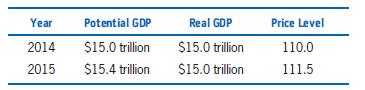
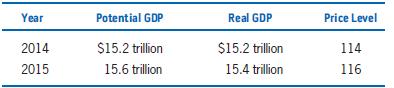
The hypothetical information in the following table shows what the situation will be in 2015 if the Fed does not use fiscal policy:a. If Congress and the president want to keep real GDP at its potential level in 2015, should it use an expansionary policy or a contractionary policy? In your answer,
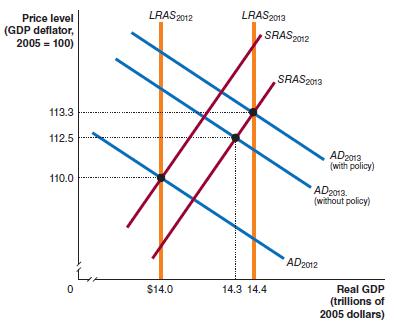
Use the graph to answer the following questions.a. If the government takes no policy actions, what will be the values of real GDP and the price level in 2013?b. What actions can the government take to bring real GDP to its potential level in 2013?c. If the government takes no policy actions, what
[Related to the Don’t Let This Happen to You on page 538]Is it possible for Congress and the president to carry out an expansionary fiscal policy if the money supply does not increase? Briefly explain.
Use an aggregate demand and aggregate supply graph to illustrate the situation where the economy begins in equilibrium at potential GDP and then the demand for housing sharply declines. What actions can Congress and the president take to move the economy back to potential GDP?Show the results of
Identify each of the following as (i) part of an expansionary fiscal policy, (ii) part of a contractionary fiscal policy, or (iii) not part of fiscal policy.a. The corporate income tax rate is increased.b. Defense spending is increased.c. The Federal Reserve lowers the target for the federal funds
If Congress and the president decide that an expansionary fiscal policy is necessary, what changes should they make in government spending or taxes? What changes should they make if they decide that a contractionary fiscal policy is necessary?
[Related to the Making the Connection on page 535]According to a Congressional Budget Office report, “During the next decade alone, the number of people over the age of 65 is expected to rise by more than a third. Over the longer term, the share of people age 65 or older is projected to grow from
[Related to the Making the Connection on page 535]According to a Congressional Budget Office report:By the end of this decade, an increasing number of baby boomers will have reached retirement age. . . . CBO therefore estimates that, unless changes are made to Social Security, spending for the
Based on the discussion in this chapter, which source of government revenue shown in Figure 16.4 on page 534 do you think is likely to increase the most in the future? Briefly explain.
In 2009, Congress and the president enacted “cash for clunkers” legislation that paid people buying new cars up to $4,500 if they traded in an older, low-gas-mileage car.Was this piece of legislation an example of fiscal policy?Does it depend on what goals Congress and the president had in mind
What is the difference between federal purchases and federal expenditures? Are federal purchases higher today as a percentage of GDP than they were in 1960? Are federal expenditures as a percentage of GDP higher?
What is the difference between fiscal policy and monetary policy?
What is fiscal policy? Who is responsible for fiscal policy?
[Related to the Making the Connection on page 518]Suppose you buy a house for $150,000. One year later, the market price of the house has risen to $165,000.What is the return on your investment in the house if you made a down payment of 20 percent and took out a mortgage loan for the other 80
In the fall of 2011, investors began to fear that some European governments, particularly Greece and Italy, might default on the bonds they had issued, making the prices of the bonds fall sharply. Many European banks owned these bonds, and some investors worried that these banks might also be in
Recall that “securitization” is the process of turning a loan, such as a mortgage, into a bond that can be bought and sold in secondary markets. An article in the Economist notes:That securitization caused more subprime mortgages to be written is not in doubt. By offering access to a much
Charles Calomiris, an economist at Columbia University, was quoted as saying the following of the initiatives of the Treasury and Fed during the financial crisis of 2007–2009: “It has been a really head-spinning range of unprecedented and bold actions. . . . That is exactly as it should be. But
An article in a Federal Reserve publication observes that“20 or 30 years ago, local financial institutions were the only option for some borrowers. Today, borrowers have access to national (and even international) sources of mortgage finance.” What caused this change in the sources of mortgage
Some economists argue that one cause of the financial problems resulting from the housing crisis was the fact that lenders who grant mortgages no longer typically hold the mortgages until they are paid off. Instead, lenders usually resell their mortgages in secondary markets. How might a lender
Beginning in 2008, the Federal Reserve and the U.S. Treasury Department responded to the financial crisis by intervening in financial markets in unprecedented ways. Briefly summarize the actions of the Fed and Treasury.
[Related to the Making the Connection on page 514] If the core PCE is a better measure of the inflation rate than is the CPI, why is the CPI more widely used? In particular, can you think of reasons the federal government uses the CPI when deciding how much to increase Social Security payments to
While serving as the president of the Federal Reserve Bank of St. Louis, William Poole stated, “Although my own preference is for zero inflation properly managed, I believe that a central bank consensus on some other numerical goal of reasonably low inflation is more important than the exact
Glenn Rudebusch, an economist at the Federal Reserve Bank of San Francisco, argues that if the Fed had followed the Taylor rule during the recession of 2007–2009, then by the end of 2009 the target for the federal funds rate would have been −5 percent. Provide values for the Taylor rule
According to an article in the Economist:Calculations by David Mackie, of J.P. Morgan, show that virtually throughout the past six years, interest rates in the euro area have been lower than a Taylor rule would have prescribed, refuting the popular wisdom that the [European Central Bank] cares less
Suppose that the equilibrium real federal funds rate is 2 percent and the target rate of inflation is 2 percent. Use the following information and the Taylor rule to calculate the federal funds rate target:Current inflation rate 5 4 percent Potential real GDP 5 $14.0 trillion Real GDP 5 $14.14
What is a monetary rule, as opposed to a monetary policy?What monetary rule would Milton Friedman have liked the Fed to follow? Why has support for a monetary rule of the kind advocated by Friedman declined since 1980?
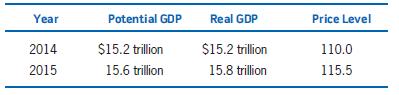
[Related to Solved Problem 15.4 on page 509] The hypothetical information in the following table shows what the situation will be in 2015 if the Fed does not use monetary policy.a. If the Fed wants to keep real GDP at its potential level in 2015, should it use an expansionary policy or a
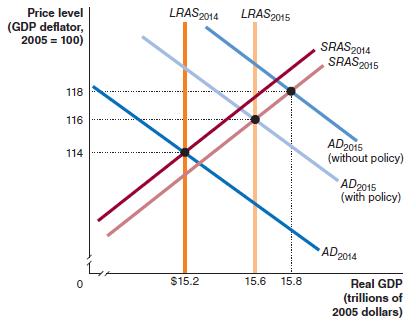
[Related to Solved Problem 15.4 on page 509] Use this graph to answer the following questions.a. If the Fed does not take any policy action, what will be the level of real GDP and the price level in 2015?b. If the Fed wants to keep real GDP at its potential level in 2015, should it use an
Explain whether you agree with this argument:If the Fed actually ever carried out a contractionary monetary policy, the price level would fall. Because the price level has not fallen in the United States over an entire year since the 1930s, we can conclude that the Fed has not carried out a
[Related to the Don’t Let This Happen to You on page 506]Briefly explain whether you agree with the following statement:“The Fed has an easy job. Say it wants to increase real GDP by $200 billion. All it has to do is increase the money supply by that amount.”
[Related to the Making the Connection on page 504] If policymakers at the Fed are aware that GDP data are sometimes subject to large revisions, how might this affect their views about how best to conduct policy?
[Related to the Making the Connection on page 504]The following is from a Federal Reserve publication:In practice, monetary policymakers do not have up-to-the-minute, reliable information about the state of the economy and prices. Information is limited because of lags in the publication of data.
[Related to the Making the Connection on page 502]Martin Feldstein, an economist at Harvard University, has argued that QE2 led consumers to decrease saving and increase spending: “A likely reason for the fall in the saving rate and the resulting rise in consumer spending was the sharp increase
[Related to the Making the Connection on page 502]John Maynard Keynes is said to have remarked that using an expansionary monetary policy to pull an economy out of a deep recession can be like “pushing on a string.”Briefly explain what Keynes is likely to have meant.
Former president Ronald Reagan once stated that inflation“has one cause and one cause alone: government spending more than government takes in.” Briefly explain whether you agree.From Edward Nelson, “Budget Deficits and Interest Rates,” Monetary Trends, Federal Reserve Bank of St. Louis,
[Related to the Chapter Opener on page 491] At the beginning of 2005, Robert Toll, CEO of Toll Brothers, argued that the United States was not experiencing a housing bubble.Instead, he argued that higher house prices reflected restrictions imposed by local governments on building new houses. He
An article by three economists at the Federal Reserve Bank of Richmond notes that by the fall of 2011, many unemployed people in the United States had been out of work for more than six months. The economists argue that:“ After a long period of unemployment, affected workers may become
According to an article in the Wall Street Journal:In February. . . [Japan’s] gauge of core consumer prices slipped 0.1% from a year earlier.. . . The Bank of Japan said last year it would regard prices as stable if they rose from zero to 2% a year. . . . The Bank of Japan’s target for
In explaining why monetary policy did not pull Japan out of a recession in the early 2000s, an official at the Bank of Japan was quoted as saying that despite “major increases in the money supply,” the money “stay[ed] in banks.” Explain what the official meant by saying that the money
[Related to the Chapter Opener on page 491] An article in the New York Times in March 2002 reported that the housing market had been surprisingly strong during the previous year. According to the article, “In trying to explain the resilience of the housing market in the face of rising
What were “quantitative easing” and “Operation Twist”and what was the Fed’s objective in using them?
If the Fed believes the economy is about to fall into recession, what actions should it take? If the Fed believes the inflation rate is about to increase, what actions should it take?
How does an increase in interest rates affect aggregate demand?Briefly discuss how each component of aggregate demand is affected.
In a column in the Wall Street Journal, two economists at the Council on Foreign Relations argue: “Simply put, the Fed must choose between managing the level of reserves and managing rates. It cannot do both.” Do you agree?Briefly explain.
In response to problems in financial markets and a slowing economy, the Federal Open Market Committee (FOMC)began lowering its target for the federal funds rate from 5.25 percent in September 2007. Over the next year, the FOMC cut its federal funds rate target in a series of steps.Writing in the
If the Federal Reserve purchases $100 million worth of U.S. Treasury bills from the public, predict what will happen to the money supply. Explain your reasoning.
The following is from a December 2008 article in the Wall Street Journal:The Federal Reserve cut its target interest rate Tuesday to historic lows between zero and a quarter percentage point. . . . After two days of discussion among Fed officials, the central bank said it would use every weapon
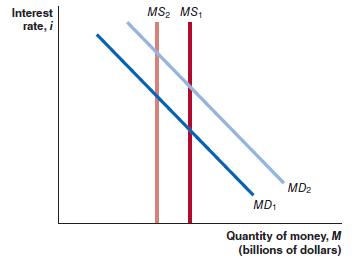
In the graph of the money market below, what could cause the money supply curve to shift from MS1 to MS2? What could cause the money demand curve to shift from MD1 to MD2? Interest rate, i MS2 MS MD MD2 Quantity of money, M (billions of dollars)
What do economists mean by the demand for money?What is the advantage of holding money? What is the disadvantage?
Stock prices rose rapidly in 2005, as did housing prices in many parts of the country. By 2008, both stock prices and housing prices were declining sharply. Some economists have argued that rapid increases and decreases in the prices of assets such as shares of stock or houses can damage the
Why is price stability one of the Fed’s monetary policy goals?What problems can high inflation rates cause for the economy?
What is a bank panic? What role did bank panics play in the decision by Congress to establish the Federal Reserve?
Why is the Fed sometimes said to have a “dual mandate”?
The Effects of Monetary Policy The hypothetical information in the following table shows what the values for real GDP and the price level will be in 2015 if the Fed does not use monetary policy:a. If the Fed wants to keep real GDP at its potential level in 2015, should it use an expansionary policy
[Related to the Making the Connection on page 479]During the German hyperinflation of the 1920s, many households and firms in Germany were hurt economically.Do you think any groups in Germany benefited from the hyperinflation? Briefly explain.
[Related to the Chapter Opener on page 455] A New York Times article on Zimbabwe describes conditions in summer 2008 as follows: “Official inflation soared to 2.2 million percent in Zimbabwe—by far the highest in the world . . . [and] unemployment has reached 80 percent.”Is there a connection
[Related to the Chapter Opener on page 455] In April 2009, the African nation of Zimbabwe suspended the use of its own currency, the Zimbabwean dollar. According to an article from the Voice of America, “Hyperinflation in 2007 and 2008 made Zimbabwe’s currency virtually worthless despite the
During the Civil War, the Confederate States of America printed lots of its own currency—Confederate dollars—to fund the war. By the end of the war, the Confederate government had printed nearly 1.5 billion paper dollars. How would such a large quantity of Confederate dollars have affected the
In an article titled “We Should Celebrate Price Deflation”in the American Free Press, Professor Peter Spencer of York University in England is quoted as saying: “This printing of money ‘will keep the [deflation] wolf from the door.’”In the same article, Ambrose Evans-Pritchard, a writer
Suppose that during one period, the velocity of money is constant and during another period, it undergoes large fluctuations. During which period will the quantity theory of money be more useful in explaining changes in the inflation rate? Briefly explain.
If the money supply is growing at a rate of 6 percent per year, real GDP is growing at a rate of 3 percent per year, and velocity is constant, what will the inflation rate be? If velocity is increasing 1 percent per year instead of remaining constant, what will the inflation rate be?
When the Federal Reserve steps in as the lender of last resort to prevent a bank panic, does this constitute a “bail out of the banks”? Briefly explain.
In a speech delivered in June 2008, Timothy Geithner, then president of the Federal Reserve Bank of New York and later U.S. Treasury secretary, said:The structure of the financial system changed fundamentally during the boom. . . . [The]non-bank financial system grew to be very large. . . . [The]
Suppose that the Federal Reserve makes a $10 million discount loan to First National Bank (FNB) by increasing FNB’s account at the Fed.a. Use a T-account to show the impact of this transaction on FNB’s balance sheet. Remember that the funds a bank has on deposit at the Fed count as part of its
Suppose that you are a bank manager, and the Federal Reserve raises the required reserve ratio from 10 percent to 12 percent. What actions would you need to take? How would your actions and those of other bank managers end up affecting the money supply?
The text explains that the United States has a “fractional reserve banking system.” Why do most depositors seem to be unworried that banks loan out most of the deposits they receive?
Why did Congress decide to set up the Federal Reserve System in 1913?
[Related to the Don’t Let This Happen to You on page 467]Briefly explain whether you agree with the following statement: “Assets are things of value that people own.Liabilities are debts. Therefore, a bank will always consider a checking account deposit to be an asset and a car loan to be a
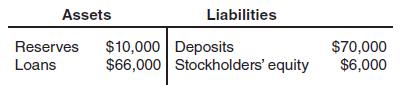
Consider the following simplified balance sheet for a bank:a. If the required reserve ratio is 0.10, or 10 percent, how much in excess reserves does the bank hold?b. What is the maximum amount by which the bank can expand its loans?c. If the bank makes the loans in partb, show the immediate impact
[Related to Solved Problem 14.3 on page 468] Suppose you deposit $2,000 in currency into your checking account at a branch of Bank of America, which we will assume has no excess reserves at the time you make your deposit. Also assume that the required reserve ratio is 0.20, or 20 percent.a. Use a
Would a series of bank runs in a country decrease the total quantity of M1? Wouldn’t a bank run simply move funds in a checking account to currency in circulation? How could that movement of funds decrease the quantity of money?
“Most of the money supply of the United States is created by banks making loans.” Briefly explain whether you agree with this statement.
The following is from an article on community banks:“Their commercial-lending businesses, funded by their stable deposit bases, make them steady earners.” What is commercial lending? In what sense are loans “funded” by deposits?From Karen Richardson, “Clean Books Bolster Traditional
An article on The Motley Fool Web site states:Deposits are the lifeblood of banks. Bank of America for example, had nearly $1 trillion in deposits at the end of March, representing nearly half of its total liabilities. Citigroup and Wells Fargo held around $800 billion each in deposits at the end
What causes the real-world money multiplier to be smaller than the simple deposit multiplier?
Give the formula for the simple deposit multiplier. If the required reserve ratio is 20 percent, what is the maximum increase in checking account deposits that will result from an increase in bank reserves of $20,000?
[Related to the Making the Connection on page 461]There are currently about 1.4 billion pennies in circulation.Suppose the proposal of economist François Velde to make the current penny worth 5 cents were adopted. What would be the effect on the value of M1? Is this change likely to have much
[Related to the Making the Connection on page 461]In the nineteenth century, the Canadian government had difficulty getting banks and the public to accept the penny, which had been introduced a few years before. As a result, the government offered pennies for sale at a 20 percent discount. One
The paper currency of the United States is technically called “Federal Reserve Notes.” The following excerpt is from the Federal Reserve Act: “Federal Reserve Notes . . .shall be redeemed in lawful money on demand at the Treasury Department of the United States, in the city of Washington,
[Related to the Don’t Let This Happen to You on page 462]A newspaper article contains the statement: “Income is only one way of measuring wealth.” Do you agree that income is a way of measuring wealth?From Sam Roberts, “As the Data Show, There’s a Reason the Wall Street Protesters Chose
[Related to the Don’t Let This Happen to You on page 462]Briefly explain whether you agree with the following statement: “I recently read that more than half of the money issued by the government is actually held by people in foreign countries. If that’s true, then the United States is less
[Related to Solved Problem 14.2 on page 463] Suppose you decide to withdraw $100 in currency from your checking account. What is the effect on M1? Ignore any actions the bank may take as a result of your having withdrawn the $100.
[Related to Solved Problem 14.2 on page 463] Suppose you have $2,000 in currency in a shoebox in your closet.One day, you decide to deposit the money in a checking account. Briefly explain how this will affect M1 and M2.
What is the main difference between the M1 and M2 definitions of the money supply?
[Related to the Making the Connection on page 459]Suppose that Congress changes the law to require all firms to accept paper currency in exchange for whatever they are selling. Briefly discuss who would gain and who would lose from this legislation.
According to Peter Heather, a historian at the University of Oxford, during the Roman Empire, the German tribes east of the Rhine River produced no coins of their own but used Roman coins instead:Although no coinage was produced in Germania, Roman coins were in plentiful circulation and could
In the late 1940s, the Communists under Mao Zedong were defeating the government of China in a civil war. The paper currency issued by the Chinese government was losing much of its value, and most businesses refused to accept it. At the same time, there was a paper shortage in Japan.During these
[Related to the Chapter Opener on page 455] An article in the New York Times provides the following description of a hospital in Zimbabwe: “People lined up on the veranda of the American mission hospital here from miles around to barter for doctor visits and medicines, clutching scrawny chickens,
The English economist William Stanley Jevons described a world tour during the 1880s by a French singer, Mademoiselle Zélie. One stop on the tour was a theater in the Society Islands, part of French Polynesia in the South Pacific. She performed for her usual fee, which was onethird of the
Showing 2500 - 2600
of 5072
First
19
20
21
22
23
24
25
26
27
28
29
30
31
32
33
Last
Step by Step Answers

 Get 50% OFF
Study Help!
Claim Now
Get 50% OFF
Study Help!
Claim Now