New Semester
Started
Get
50% OFF
Study Help!
--h --m --s
Claim Now
Question Answers
Textbooks
Find textbooks, questions and answers
Oops, something went wrong!
Change your search query and then try again
S
Books
FREE
Study Help
Expert Questions
Accounting
General Management
Mathematics
Finance
Organizational Behaviour
Law
Physics
Operating System
Management Leadership
Sociology
Programming
Marketing
Database
Computer Network
Economics
Textbooks Solutions
Accounting
Managerial Accounting
Management Leadership
Cost Accounting
Statistics
Business Law
Corporate Finance
Finance
Economics
Auditing
Tutors
Online Tutors
Find a Tutor
Hire a Tutor
Become a Tutor
AI Tutor
AI Study Planner
NEW
Sell Books
Search
Search
Sign In
Register
study help
business
probability and stochastic modeling
An Introduction To Stochastic Modeling 3rd Edition Samuel Karlin, Howard M. Taylor - Solutions
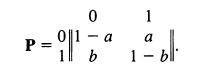
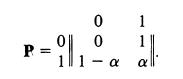
2.1. Let {X,,; n = 0, 1, ...) be a two-state Markov chain with the transition probability matrixState 0 represents an operating state of some system, while state 1 represents a repair state. We assume that the process begins in state X0 = 0, and then the successive returns to state 0 from the
1.4. Let y, be the excess life and S, the age in a renewal process having interoccurrence distribution function F(x). Determine the conditional probability Pr{ y, > yes, = x} and the conditional mean E[y,IS, = x].
1.3. A fundamental identity involving the renewal function, valid for all renewal processes, is E[Wv(,,+i] = E[X1](M(t) + 1).See equation (1.7). Using this identity, show that the mean excess life can be evaluated in terms of the renewal function via the relation E[y] = E[X,](1 + M(t)) - t.
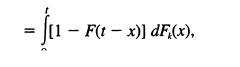
1.2. From equation (1.5), and for k ? 1, verify that Pr{N(t)=k} =Pr{Wk:tand carry out the evaluation when the interoccurrence times are exponentially distributed with parameter A, so that dFk is the gamma density = fu - F(t - x)] dF(x),
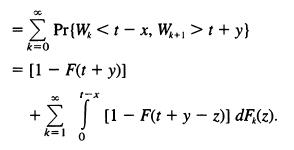
1.1. Verify the following equivalences for the age and the excess life in a renewal process N(t): (Assume t > x.)Pr{S,?x,y,>y} =Pr{N(t-x)=N(t+y)}Carry out the evaluation when the interoccurrence times are exponentially distributed with parameter A, so that dFk is the gamma density - = Pr{ W
1.4. Consider a renewal process for which the lifetimes X,, X,, ... are discrete random variables having the Poisson distribution with mean A.That is, e-An Pr{Xk=n}_ A forn=0,1,....n!(a) What is the distribution of the waiting time Wk?(b) Determine Pr{N(t) = k).
1.3. Which of the following are true statements?(a) N(t) < k if and only if Wk > t.(b) N(t) :5 k if and only if W4. ?t.(c) N(t) > k if and only if Wk < t.
1.2. Consider a renewal process in which the interoccurrence times have an exponential distribution with parameter A:f(x) = Ae-', and F(x) = 1 - e-a" for x > 0.Calculate F(t) by carrying out the appropriate convolution [see the equation just prior to (1.3)] and then determine Pr(N(t) = 1 } from
1.1. Verify the following equivalences for the age and the excess life in a renewal process N(t):y, > x if and only if N(t + x) - N(t) = 0;and for 0 < x < t, S,>x if and only if N(t)-N(t-x)=0.Why is the condition x < t important in the second case but not the first?
7.12. 'Let T be the time of the first event in a (O, A) Cox process. Let the 0 and A states represent "OFF" and "ON," respectively.(a) Show that the total duration in the (0, T] interval that the system is ON is exponentially distributed with parameter A and does not depend ona, f3 or the starting
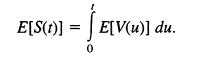
7.11. A Stop-and-Go Traveler The velocity V(t) of a stop-and-go traveler is described by a two-state Markov chain. The successive durations in which the traveler is stopped are independent and exponentially distributed with parametera, and they alternate with independent exponentially distributed
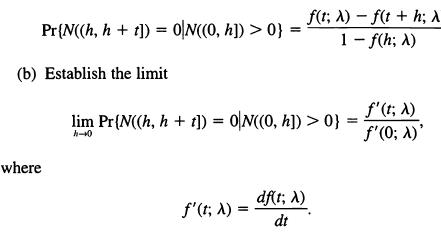
7.10. Consider a stationary (0, A) Cox process.(a) Show that Pr{N((0, h]) > 0, N((h, h + t]) = 0) = f(t; A) - f(t + h; A), whence(c) We interpret the limit in (b) as the conditional probability Pr (N((O, t]) = 01 Event occurs at time 0).Show that Pr{N((0, t]) = 01 Event at time 01 = p+e-K+' +
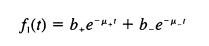
7.9. Show thatandwithsatisfy the differential equations (7.7) and (7.8) subject to the initial conditions (7.9) and (7.10). fo(t) = a+e+a_e_
7.8. Consider a stationary (0, A) Cox process. A long duration during which no events were observed would suggest that the intensity process is in state 0. Show thatwhere fo(t) is defined in (7.5). Pr{A(t) =0|N((0, 1]) = 0} fo(t) f(t)'
7.7. Consider a (0, A) stationary Cox process with a = /3 = 1 and A = 2. Show that g(t; 0) = f(t; (1 - 0)A) is given bywhereUse this to evaluate Pr{N((0, 1]) = 11. 1 g(t; 0) ecosh (Rt) + = a-n cosh(Rr) + sinh(R), R
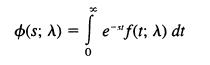
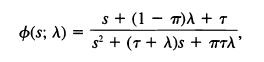
7.6. Show that the Laplace transformis given bywhere T = a + /3 and IT = a/(a + /3). Evaluate the limit (a) as T -* 00, and (b) as T -3 0. (s; ) 0 ef(t; ) dt
7.5. Determine the conditional probability of no points in the interval(t, t + s], given that there are no points in the interval (0, t] for a stationary Cox process driven by a two-state Markov chain. Establish the limit lim Pr{N((t, t + s]) = 0IN((0, t]) = 0} = e-'"-5, s > 0.
7.4. Let T be the time to the first event in a stationary (0, A) Cox process.Find the expected value E[T]. Show that E[T] = 1 when a = 6 = 1 and A = 2. What is the average duration between events in this process?
7.3. Let T be the time to the first event in a stationary (0, A) Cox process. Find the probability density function 4)(t) for T. Show that when a = /3 = 1 and A = 2, this density function simplifies to ¢(t) = exp{ -2t}cosh(Vt).
7.2. The excess life y(t) in a point process is the random length of the duration from time t until the next event. Show that the cumulative distribution function for the excess life in a Cox process is given by Pr{y(t) : x} = 1 - Pr{N((t, t + x]) = 0}.
7.1. Consider a stationary Cox process driven by a two-state Markov chain. Let it = a/(a + 3) be the probability that the process begins in state A.(a) By using the transition probabilities given in (3.14a-d), show that Pr{A(t) = A } = 7r for all t > 0.(b) Show that E[N((O, t])] = TTAt for all t >
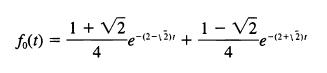
7.2. Suppose that a (0, A) Cox process has a = /3 = 1 and A = 2. Show thatandsatisfy the differential equations (7.7) and (7.8) with the initial conditions (7.9) and (7.10). 1+ 2 fo(t) e-(2-13)1 + 1-2 e-(2+12) 4 4
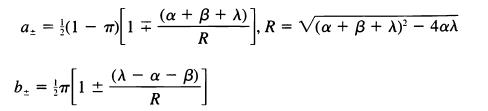
7.1. Suppose that a (0, A) Cox process has a = /3 = 1 and A = 2. Show that μ. = 2 ± \, and c_ =;(2+ V) = 1 - c+, whence Pr{N((0, t]) = 0) =e- 2 '[cosh(V2-t) + 2 sinh(\t)].
6.4. A system consists of two units, both of which may operate simultaneously, and a single repair facility. The probability that an operating system will fail in a short time interval of length At is μ(4t) + o(Ot). Repair times are exponentially distributed, but the parameter depends on whether
6.3. Let X, (t), X, (t), ... , XN(t) be independent two-state Markov chains having the same infinitesimal matrixDetermine the infinitesimal matrix for the Markov chain Z(t) _ XI(t) + + XN(t). A = 0 1 0 -
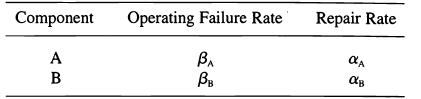
6.2. A certain type component has two states: 0 = OFF and 1 =OPERATING. In state 0, the process remains there a random length of time, which is exponentially distributed with parametera, and then moves to state 1. The time in state 1 is exponentially distributed with parameter J3, after which the
6.1. Let Y,,, n = 0, 1, . . . , be a discrete time Markov chain with transition probabilities P = lPA, and let {N(t); t ? 0) be an independent Poisson process of rate A. Argue that the compound process X(t) = Y,N(,), t ? 0, is a Markov chain in continuous time and determine its infinitesimal
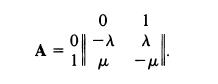
6.2. Let X,(t) and X,(t) be independent two-state Markov chains having the same infinitesimal matrixArgue that Z(t) = X,(t) + XZ(t) is a Markov chain on the state space S = (0, 1, 2) and determine the transition probability matrix P(t) for Z(t). 0 1 -A A = 17
6.1. A certain type component has two states: 0 = OFF and 1 = OPERATING.In state 0, the process remains there a random length of time, which is exponentially distributed with parametera, and then moves to state 1. The time in state 1 is exponentially distributed with parameter 13, after which the
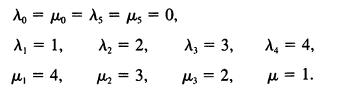
5.2. Consider a birth and death process on the states 0, 1, ... , 5 with parametersNote that 0 and 5 are absorbing states. Suppose the process begins in state X(0) = 2.(a) What is the probability of eventual absorption in state 0?(b) What is the mean time to absorption? = o = s = s = 0, A = 1, =
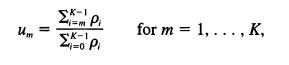
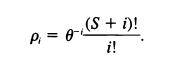
5.1. Consider the sterile male control model as described in the example entitled "Sterile Male Insect Control" and let u,,, be the probability that the population becomes extinct before growing to size K starting with X(O) = m individuals. Show thatwhere 'm K-1 =m Pi SK-1 21-0 Pi =0 for m =
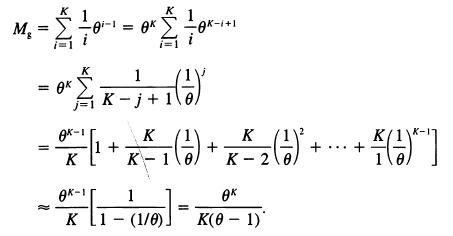
5.2. Assume that 0 > 1 and verify the following steps in the approximation to Mg, the mean generation to extinction as given in (5.12): Ms -0-1 = 0x 8x-1 1 K-j+16 + K K-1 () K OK-1 K 1 = (1/10)] + K-2 K(0-1) ( +.. + K *()*]
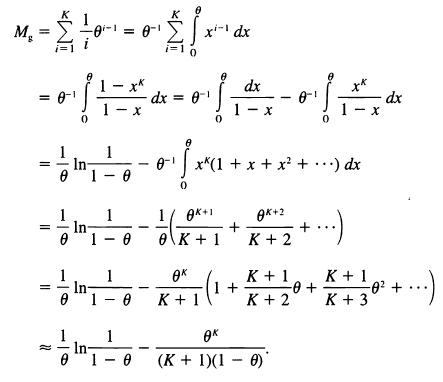
5.1. Assuming 0 M& K 0-1 = 0xdx -x* dx = 0-1 = 0-1 - x dx xx - 0-1 dx - x 1-x 0-1 x ^ ( 1 + x + x + ...) dx 1 In- 1-0 0 1 10K+1 +1 + 1-0 In- 8K+2 .+...) K+1 K + 2 + ...) = 11-1 (1 + x + 10 + K + 10 + - ) K+1 1+ K+2 -0+ K+ 3 ...) 1 1-0 (K + 1)(1 - 0)
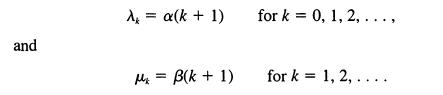
4.8. A birth and death process has parametersAssuming that a Simplify your answer as much as possible. = a(k + 1) for k 0, 1, 2,..., and M = B(k+1) Mk for k = 1, 2,....
4.7. A system consists of three machines and two repairmen. At most two machines can operate at any time. The amount of time that an operating machine works before breaking down is exponentially distributed with mean 5. The amount of time that it takes a single repairman to fix a machine is
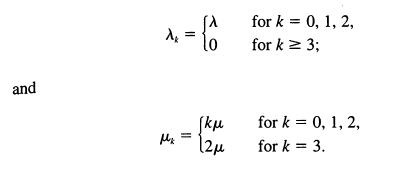
4.6. A time-shared computer system has three terminals that are attached to a central processing unit (CPU) that can simultaneously handle at most two active users. If a person logs on and requests service when two other users are active, then the request is held in a buffer until it can receive
4.5. A chemical solution contains N molecules of type A and an equal number of molecules of type B. A reversible reaction occurs between type A and B molecules in which they bond to form a new compound AB. Suppose that in any small time interval of length h, any particular unbonded A molecule will
4.4. This problem considers a continuous time Markov chain model for the changing pattern of relationships among members in a group. The group has four members:a, b,c, andd. Each pair of the group may or may not have a certain relationship with each other. If they have the relationship, we say that
4.3. A factory has five machines and a single repairman. The operating time until failure of a machine is an exponentially distributed random variable with parameter (rate) 0.20 per hour. The repair time of a failed machine is an exponentially distributed random variable with parameter(rate) 0.50
4.2. Determine the stationary distribution, when it exists, for a birth and death process having constant parameters A,, = A for n = 0, 1, ... and n= 1,2.....
4.1. For the repairman model of the second example of this section, suppose that M = N = 5,R = 1, A = 2, and μ = 1. Using the limiting distribution for the system, determine(a) The average number of machines operating.(b) The equipment utilization.(c) The average idle repair capacity.How do these
4.6. A birth and death process has parameters A,, = A and μ = nμ, for n = 0, 1. .... Determine the stationary distribution
4.5. Consider the birth and death parameters A,, = 0 < 1, and nl(n + 1) for n = 0, 1. .... Determine the stationary distribution.
4.4. Consider two machines, operating simultaneously and independently, where both machines have an exponentially distributed time to failure with mean 1/μ (p. is the failure rate). There is a single repair facility, and the repair times are exponentially distributed with rate A.(a) In the long
4.3. Determine the stationary distribution for a birth and death process having infinitesimal parameters A,, = a(n + 1) and μ = /3n2 for n = 0, 1, ...,where 0
4.2. Let X(t) be a birth and death process where the possible states are 0, 1, . . . , N, and the birth and death parameters are, respectively, A,, = a(N - n) and μ = On. Determine the stationary distribution.
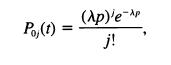
4.1. In a birth and death process with birth parameters A,, = A for n = 0, 1, ... and death parameters μ = An for n = 0, 1, ... , we havewhereVerify that these transition probabilities satisfy the forward equations (4.4), with i = 0. Po,(t) = (Ap)'exp j!
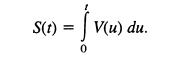
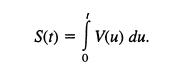
3.4. A Stop-and-Go Traveler The velocity V(t) of a stop-and-go traveler is described by the two state Markov chain whose transition probabilities are given by (3.14a-d). The distance traveled in time t is the integral of the velocity:Assuming that the velocity at time t = 0 is V(0) = 0, determine
3.3. Let {V(t) } be the two state Markov chain whose transition probabilities are given by (3.14a-d). Suppose that the initial distribution is(1 - ir, 7r). That is, assume that Pr { V(0) = 0) = 1 - rr and Pr(V(0) = I) = nr. For 0 < s < t, show that E[V(s)V(t)] = 1r - arPa(t - s), whence Cov[V(s),
3.2. Collards were planted equally spaced in a single row in order to provide an experimental setup for observing the chaotic movements of the flea beetle (P. cruciferae). A beetle at position k in the row remains on that plant for a random length of time having mean mk (which varies with
3.1. Let 6,,, n = 0, 1, ... , be a two state Markov chain with transition probability matrixLet {N(t); t ? 0) be a Poisson process with parameter A. Show that X(t) = Sev(r), t j 0, is a two state birth and death process and determine the parameters Ao and μ, in terms of a and A. 0 1 P = 0 11- 11
3.3. Let {V(t) } be the two state Markov chain whose transition probabilities are given by (3.14a-d). Suppose that the initial distribution is (1 - ir, 7r). That is, assume that Pr{ V(0) = 01 = 1 - 7r and Pr{V(0) = 11 = 7r. In this case, show that Pr{V(t) = 1 } = 7r for all times t > 0.
3.2. Patients arrive at a hospital emergency room according to° a Poisson process of rate A. The patients are treated by a single doctor on a first come, first served basis. The doctor treats patients more quickly when the number of patients waiting is higher. An industrial engineering time study
3.1. Particles are emitted by a radioactive substance according to a Poisson process of rate A. Each particle exists for an exponentially distributed length of time, independent of the other particles, before disappearing. Let X(t) denote the number of particles alive at time t. Argue that X(t) is
2.6. Let T be the time to extinction in the linear death process with parameters X(O) = N and a (see Section 2.1).(a) Using the sojourn time viewpoint, show thatHint: Let y = 1 - e-°". E[T] + 1] = 1 N-1 + ... + }}
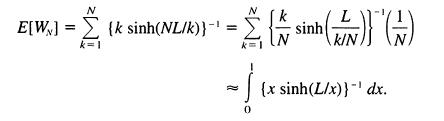
2.5. Consider a cable composed of fibers following the breakdown rule K[1] = sinh(l) = ;(e' - e-') for l L- 0. Show that the mean cable life is given by N (k sinh (NL/L)) = = - sinh (N) () E[W] = 2 {k sinh(NL/k)} ~ 0 k/N {x sinh(L/x)}=' dx.
2.4. A chemical solution contains N molecules of type A and M molecules of type B. An irreversible reaction occurs between type A and B molecules in which they bond to form a new compound AB. Suppose that in any small time interval of length h, any particular unbonded A molecule will react with any
2.3. A pure death process X(t) with parameters AI, p2, ... starts at X(O) = N and evolves until it reaches the absorbing state 0. Determine the mean area under the X(t) trajectory.Hint: This is E[W, + W + + WA,J.
2.2. Let X(t) be a pure death process with constant death rates μ,. = 0 for k = 1, 2, . . ., N. If X(O) = N, determine Pr(X(t) = n} for n=0,1,...,N.
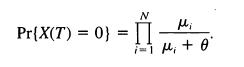
2.1. Let X(t) be a pure death process starting from X(O) = N. Assume that the death parameters are μ,, μ,, ... , μ,,,. Let T be an independent exponentially distributed random variable with parameter 0. Show that N Pr{X(T) = 0} = []
2.4. Consider the linear death process (Section 2.1) in which X(0) = N = 5 and a = 2. Determine Pr(X(t) = 2}.Hint: Use equation (2.3).
2.3. Give the transition probabilities for the pure death process described by X(0) = 3, μ, = 1, p2 = 2, and μ, = 3.
2.2. A pure death process starting from X(0) = 3 has death parameters Ao = 0, μ, = 3,A2= 2,A3 = 5. Let W, be the random time that it takes the process to reach state 0.(a) Write W, as a sum of sojourn times and thereby deduce that the mean time is E[W,] = o.(b) Determine the mean of W, + W, +
2.1. A pure death process starting from X(0) = 3 has death parametersμ0 = 0, μ, = 3, p, = 2, μ, = 5. Determine for n = 0, 1, 2, 3.
1.13. Using (1.5), derive when all birth parameters are the same constant A and show thatThus, the postulates of Section 1.1 serve to define the Poisson processes P(t)= (At)"e n = 0, 1,.... n!
1.12 Verify that P,(t), as given by (1.8), satisfies (1.5) by following the calculations in the text that showed that P,(t) satisfies (1.5).
1.11. Beginning with Pa(t) = e-a°' and using equation (1.5), calculate P,(t), P,(t), and P,(t) and verify that these probabilities conform with equation(1.7), assuming distinct birth parameters.
1.10. Consider a pure birth process on the states 0, 1, . . . , N for which A, = (N - k)A for k = 0, 1, . . . , N. Suppose that X(0) = 0. Determine = P(t) Pr{X(t) n} for n = 0, 1, and 2.
1.9. Under the conditions of Problem 1.8, determine E[N(t)].
1.8. Let N(t) be a pure birth process for which Pr{an event happens in (t, t + h)IN(t) is odd} = ah + o(h), Pr{an event happens in (t, t + h)IN(t) is even} _ 6h + o(h), where o(h)/h -* 0 as h 1 0. Take N(O) = 0. Find the following probabilities:Po(t) = Pr{N(t) is even}; P,(t) = Pr(N(t) is
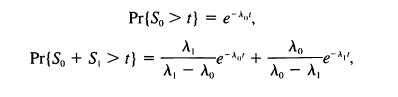
1.7. Let A0, A, and A, be the parameters of the independent exponentially distributed random variables S,, S, and S,. Assume that no two of the parameters are equal.(a) Verify thatand evaluate in similar terms(b) Verify equation (1.8) in the case that n = 2 by evaluating
1.6. A fatigue model for the growth of a crack in a discrete lattice proposes that the size of the crack evolves as a pure birth process with parametersThe theory behind the model postulates that the growth rate of the crack is proportional to some power of the stress concentration at its ends, and
1.5. Let W. be the time to the kth birth in a pure birth process starting from X(0) = 0. Establish the equivalenceFrom this relation together with equation (1.7), determine the joint density for W, and W,, and then the joint density of S = W, and S, _ W,-W,. Pr{W,>t, W> t + s} = P(t)[Po(s) + P(s)].
1.4. A new product (a "Home Helicopter" to solve the commuting problem)is being introduced. The sales are expected to be determined by both media (newspaper and television) advertising and word-of-mouth advertising, wherein satisfied customers tell others about the product. Assume that media
1.3. Consider a population comprising a fixed number N of individuals.Suppose that at time t = 0 there is exactly one infected individual and N - 1 susceptible individuals in the population. Once infected, an individual remains in that state forever. In any short time interval of length h, any
1.2. A Yule process with immigration has birth parameters Ak = a + k/3 for k = 0, 1, 2, .... Here a represents the rate of immigration into the population, and 6 represents the individual birth rate. Supposing that X(0) = 0, determine P(t) for n = 0, 1, 2, ... .
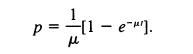
1.1. Let X(t) be a Yule process that is observed at a random time U, where U is uniformly distributed over [0, 1). Show that Pr{X(U) = k} _ pk/(/3k) for k = 1, 2, . . . , with p = I - e-a.Hint: Integrate (1.10) over t between 0 and 1.
1.6. Operations 1, 2, and 3 are to be performed in succession on a major piece of equipment. Operation k takes a random duration Sk that is exponentially distributed with parameter Ak for k = 1, 2, 3, and all operation times are independent. Let X(t) denote the operation being performed at time t,
1.5. Using equation (1.10), calculate the mean and variance for the Yule process where X(0) = 1.
1.4. Consider an experiment in which a certain event will occur with probability ah and will not occur with probability 1 - ah, where a is a fixed positive parameter and h is a small (h (a) The probability that the event never occurs during the n trials is 1 - nah + o(h);(b) The probability that
1.3. A population of organisms evolves as follows. Each organism exists, independent of the other organisms, for an exponentially distributed length of time with parameter 0, and then splits into two new organisms, each of which exists, independent of the other organisms, for an exponentially
1.2. A pure birth process starting from X(O) = 0 has birth parameters,, = 1, A, = 3, A, = 2, A, = 5. Let W, be the random time that it takes the process to reach state 3.(a) Write W, as a sum of sojourn times and thereby deduce that the mean time is E[W] = 6.(b) Determine the mean of W, + W, +
1.1. A pure birth process starting from X(O) = 0 has birth parameters k = 1, A = 3, A, = 2, A, = 5. Determine for n = 0, 1, 2, 3.
6.10. A Bidding Model Let U,, U,, . . . be independent random variables, each uniformly distributed over the interval (0, 1]. These random variables represent successive bids on an asset that you are trying to sell, and that you must sell by time t = 1, when the asset becomes worthless.As a
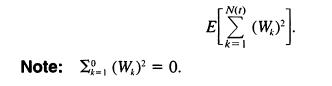
6.9. Let W,, W,, ... be the event times in a Poisson process of rate A, and let N(t) = N((0, t]) be the number of points in the interval (0, t].Evaluate Note: (W) = 0. E N(t)
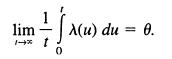
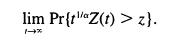
6.8. Let {N(t); t ? 0) be a nonhomogeneous Poisson process of intensity A(t), t > 0, and let Y Y,, . . . be independent and identically distributed nonnegative random variables with cumulative distribution function G(y)=y" for0LetDetermine lim 1-4x t (u) du = 0. 0
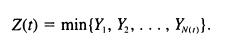
6.7. Let {N(t); t ? 01 be a Poisson process of intensity A, and let Y Y,, . . . be independent and identically distributed nonnegative random variables with cumulative distribution function G(y) = y° for 0 < y < 1.Determine Pr{Z(t) > zIN(t) > 0), where Z(t) = min{Y,, Describe the behavior for
6.6 Let W,, W,, . . . be the event times in a Poisson process {X(t); t ? 0}of rate A. A new point process is created as follows: Each point WA is replaced by two new points located at W,, + Xk and Wk + YA, where X, Y, X,, Y,, . . . are independent and identically distributed nonnegative random
6.5. Let (X(t); t ? 0) and (Y(t); t ? 0) be independent Poisson processes with respective parameters A and μ. Let T = min { t ? 0;Y(t) = I) be the random time of the first event in the Y process. Determine Pr{X(T/2) = k) fork = 0, 1.... .
6.4. Let {X(t); t ? 0} and {Y(t); t ? 0} be independent Poisson processes with respective parameters A and μ. For a fixed integera, let T = min { t ? 0; Y(t) =a) be the random time that the Y process first reaches the valuea. Determine k} for k = 0, 1, ... .Hint: First consider = X(T,) in the case
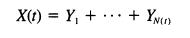
6.3. Shocks occur to a system according to a Poisson process of intensity A. Each shock causes some damage to the system, and these damages accumulate. Let N(t) be the number of shocks up to time t, and let Y; be the damage caused by the ith shock. Then X(t)=Y,+...+YN(,)is the total damage up to
6.2. Suppose that particles are distributed on the surface of a circular region according to a spatial Poisson process of intensity A particles per unit area. The polar coordinates of each point are determined, and each angular coordinate is shifted by a random amount, the amounts shifted for
6.1. Suppose that points are distributed over the half line [0, 00) according to a Poisson process of rate A. A sequence of independent and identically distributed nonnegative random variables Y Y2, . . . is used to reposition the points so that a point formerly at location WA is moved to the
6.5. Alpha particles are emitted from a fixed mass of material according to a Poisson process of rate A. Each particle exists for a random duration and is then annihilated. Suppose that the successive lifetimes Y Y,, . . . of distinct particles are independent random variables having the common
6.4. Men and women enter a supermarket according to independent Poisson processes having respective rates of two and four per minute.(a) Starting at an arbitrary time, what is the probability that at least two men arrive before the first woman arrives? (b) What is the probability that at least two
6.3. Let {N(t); t ? 01 be a Poisson process of intensity A, and let Y,, YZ, ... be independent and identically distributed nonnegative random variables with cumulative distribution function G(y) = Pr{Y zjN(t) > 0}, where Z(t) min(Y, Y2,YN} =
6.2. Shocks occur to a system according to a Poisson process of intensity A. Each shock causes some damage to the system, and these damages accumulate. Let N(t) be the number of shocks up to time t, and let Y be the damage caused by the ith shock. Thenis the total damage up to time t. Determine the
6.1. Customers demanding service at a central processing facility arrive according to a Poisson process of intensity 6 = 8 per unit time. Independently, each customer is classified as high priority with probability a = 0.2, or low priority with probability 1 - a = 0.8. What is the probability that
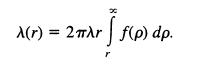
5.7. Consider a collection of circles in the plane whose centers are distributed according to a spatial Poisson process with parameter AJAI, where J denotes the area of the set A. (In particular, the number of centers (A)in the set A follows the distribution law Pr(e(A) = k} = e AA[(A[AJ)'1k!].)The
5.6. Suppose that stars are distributed in space following a Poisson point process of intensity A. Fix a star alpha and let R be the distance from alpha to its nearest neighbor. Show that R has the probability density function -4 f(x)=(4x) exp x > 0. 3
Showing 4700 - 4800
of 6914
First
41
42
43
44
45
46
47
48
49
50
51
52
53
54
55
Last
Step by Step Answers

 Get 50% OFF
Claim Now
Get 50% OFF
Claim Now