New Semester
Started
Get
50% OFF
Study Help!
--h --m --s
Claim Now
Question Answers
Textbooks
Find textbooks, questions and answers
Oops, something went wrong!
Change your search query and then try again
S
Books
FREE
Study Help
Expert Questions
Accounting
General Management
Mathematics
Finance
Organizational Behaviour
Law
Physics
Operating System
Management Leadership
Sociology
Programming
Marketing
Database
Computer Network
Economics
Textbooks Solutions
Accounting
Managerial Accounting
Management Leadership
Cost Accounting
Statistics
Business Law
Corporate Finance
Finance
Economics
Auditing
Tutors
Online Tutors
Find a Tutor
Hire a Tutor
Become a Tutor
AI Tutor
AI Study Planner
NEW
Sell Books
Search
Search
Sign In
Register
study help
business
probability and stochastic modeling
An Introduction To Stochastic Modeling 3rd Edition Samuel Karlin, Howard M. Taylor - Solutions
3.5. The number of accidents occurring in a factory in a week is a Poisson random variable with mean 2. The number of individuals injured in different accidents is independently distributed, each with mean 3 and variance 4. Determine the mean and variance of the number of individuals injured in a
3.4. A six-sided die is rolled, and the number N on the uppermost face is recorded. From a jar containing 10 tags numbered 1 , 2, ... , 10 we then select N tags at random without replacement. Let X be the smallest number on the drawn tags. Determine Pr (X = 2) and E[X].
3.3. Suppose that upon striking a plate a single electron is transformed into a number N of electrons, where N is a random variable with mean p.and standard deviation o. Suppose that each of these electrons strikes a second plate and releases further electrons, independently of each other and each
3.2. Six nickels are tossed, and the total number N of heads is observed.Then N dimes are tossed, and the total number Z of tails among the dimes is observed. Determine the mean and variance of Z. What is the probability that Z = 2?
3.1. A six-sided die is rolled, and the number N on the uppermost face is recorded. Then a fair coin is tossed N times, and the total number Z of heads to appear is observed. Determine the mean and variance of Z by viewing Z as a random sum of N Bernoulli random variables. Determine the probability
2.2. Consider a pair of dice that are unbalanced by the addition of weights in the following manner: Die #1 has a small piece of lead placed near the four side, causing the appearance of the outcome 3 more often than usual, while die #2 is weighted near the three side, causing the outcome 4 to
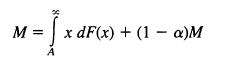
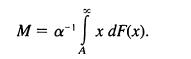
2.1. Let X X,, . . . be independent identically distributed positive random variables whose common distribution function is F. We interpret X X ... as successive bids on an asset offered for sale. Suppose that the policy is followed of accepting the first bid that exceeds some prescribed number A.
2.3. Determine the win probability when the dice are shaved on the 1-6 faces and p+ = 0.206666....... and p_ = 0.146666....... .
2.2. Verify the win probability of 0.5029237 by substituting from (2.6)into (2.5).
2.1. A red die is rolled a single time. A green die is rolled repeatedly.The game stops the first time that the sum of the two dice is either 4 or 7.What is the probability that the game stops with a sum of 4?
1.10. Do men have more sisters than women have? In a certain society, all married couples use the following strategy to determine the number of children that they will have: If the first child is a girl, they have no more children. If the first child is a boy, they have a second child. If the
1.9. Let N have a Poisson distribution with parameter A = 1. Conditioned on N = n, let X have a uniform distribution over the integers 0, 1, ... , n+ 1. What is the marginal distribution for X?
1.8. Initially an urn contains one red and one green ball. A ball is drawn at random from the urn, observed, and then replaced. If this ball is red, then an additional red ball is placed in the urn. If the ball is green, then a green ball is added. A second ball is drawn. Find the conditional
1.7. The probability that an airplane accident that is due to structural failure is correctly diagnosed is 0.85, and the probability that an airplane accident that is not due to structural failure is incorrectly diagnosed as being due to structural failure is 0.35. If 30 percent of all airplane
1.6. A dime is tossed repeatedly until a head appears. Let N be the trial number on which this first head occurs. Then a nickel is tossed N times.Let X count the number of times that the nickel comes up tails. Determine Pr{X = 0), Pr{X = 11, and E[X].
1.5. A nickel is tossed 20 times in succession. Every time that the nickel comes up heads, a dime is tossed. Let X count the number of heads appearing on tosses of the dime. Determine Pr{X = 0).
1.4. Suppose that X has a binomial distribution with parameters p =and N, where N is also random and follows a binomial distribution with parameters q = ; and M = 20. What is the mean of X?
1.3. Let X and Y denote the respective outcomes when two fair dice are thrown. Let U = min(X, Y}, V = max{X, Y}, and S = U + V, T = V - U.(a) Determine the conditional probability mass function for U given V=v.(b) Determine the joint mass function for S and T.
1.2. A card is picked at random from N cards labeled 1, 2, ... , N, and the number that appears is X. A second card is picked at random from cards numbered 1, 2, ... , X and its number is Y. Determine the conditional distribution of X given Y = y, for y = 1, 2. ... .
1.1. Let M have a binomial distribution with parameters N and p. Conditioned on M, the random variable X has a binomial distribution with parameters M and ir.(a) Determine the marginal distribution for X.(b) Determine the covariance between X and Y = M - X.
1.6. Suppose U and V are independent and follow the geometric distribution p(k) = p(1 - p)k fork = 0, 1, ... .Define the random variable Z = U + V.(a) Determine the joint probability mass function pU,Z(u, z) _ Pr{U=u,Z=z}.(b) Determine the conditional probability mass function for U given that Z =
1.5. Let X be a Poisson random variable with parameter A. Find the conditional mean of X given that X is odd.
1.4. A six-sided die is rolled, and the number N on the uppermost face is recorded. From ajar containing 10 tags numbered 1 , 2, ... , 10 we then select N tags at random without replacement. Let X be the smallest number on the drawn tags. Determine Pr(X = 2}.
1.3. A poker hand of five cards is dealt from a normal deck of 52 cards.Let X be the number of aces in the hand. Determine Pr{X > lix ? 1).This is the probability that the hand contains more than one ace, given that it has at least one ace. Compare this with the probability that the hand contains
1.2. Four nickels and six dimes are tossed, and the total number N of heads is observed. If N = 4, what is the conditional probability that exactly two of the nickels were heads?
1.1. 1 roll a six-sided die and observe the number N on the uppermost face. I then toss a fair coin N times and observe X, the total number of heads to appear. What is the probability that N = 3 and X = 2? What is the probability that X = 5? What is E[X], the expected number of heads to appear?
Suppose X has a negative binomial distribution with parameters p and N, where N has the geometric distributionWhat is the marginal distribution for X? = P(n) (1B)"-1 for n = 1, 2,....
Suppose X has a binomial distribution with parameters p and N where N has a Poisson distribution with mean A. What is the marginal distribution for X?
5.9. A flashlight requires two good batteries in order to shine. Suppose, for the sake of this academic exercise, that the lifetimes of batteries in use are independent random variables that are exponentially distributed with parameter h = 1. Reserve batteries do not deteriorate. You begin with
5.8. Let U, U, ..., U be independent uniformly distributed random variables on the unit interval [0, 1]. Define the minimum V = min{U, U,,, U}. 2 (a) Show that Pr{V> v} = (1-v)" for 0 y 1. (b) Let W, nV,,. Show that Pr{ W> w} = [1 (w/n)]" for 0 w n, and thus lim Pr{W, w} = e"" for w 0.
5.7. Let X1, X2,..., X, be independent random variables that are expo- nentially distributed with respective parameters A, A2, ..., A.,. Identify the distribution of the minimum V = min{X,, X, X). Hint: For any real number v, the event (V> v} is equivalent to {X, >v, X>v,...,x,>v).
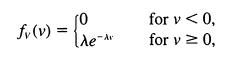
5.6. Determine the upper tail probabilities Pr{V > t} and mean E[V]for a random variable V having the exponential densitywhere A is a fixed positive parameter. fv Fv (v) = {* for v < 0, for v 0,
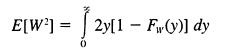
5.5. Show thatfor a nonnegative random variable W. E[W] = 2y[1 - Fw (y)] dy
5.4. Let V be a continuous random variable taking both positive and negative values and whose mean exists. Derive the formula E[V]= = Ju [1 - Fy(v)] dv } Fy(v) dv. -x
5.3. Suppose that X is a discrete random variable having the geometric distribution whose probability mass function is p(k) = p(1 - p)* for k = 0, 1, .... (a) Determine the upper tail probabilities Pr{X> k} for k = 0, 1, .... (b) Evaluate the mean via E[X] =20 Pr{X>k).
5.2. Let X1, X2,.,X,, be independent random variables, all exponen- tially distributed with the same parameter A. Determine the distribution function for the minimum Z = min{X,..., X}.
5.1. Let X1, X2, ... be independent and identically distributed random variables having the cumulative distribution function F(x) = Pr{X x}. For a fixed number , let N be the first index k for which X > . That is, N = 1 if X > ; N = 2 if X, and X,> ; etc. Determine the proba- bility mass function
5.5. Consider a post office with two clerks. John, Paul, and Naomi enter simultaneously. John and Paul go directly to the clerks, while Naomi must wait until either John or Paul is finished before she begins service.(a) If all of the service times are independent exponentially distributed random
5.4. A system has two components: A and B. The operating times until failure of the two components are independent and exponentially distributed random variables with parameters 2 for component A, and 3 for B.The system fails at the first component failure.(a) What is the mean time to failure for
5.3. Let X be an exponentially distributed random variable with parameter A. Determine the mean of X(a) by integrating by parts in the definition in equation (2.7) with m =1(b) by integrating the upper tail probabilities in accordance with equation(5.3).Which method do you find easier?
5.2. Ajar has four chips colored red, green, blue, and yellow. A person draws a chip, observes its color, and returns it. Chips are now drawn repeatedly, without replacement, until the first chip drawn is selected again.What is the mean number of draws required?
5.1. Let X have a binomial distribution with parameters n = 4 and p = ;.Compute the probabilities Pr{X ? k} for k = 1, 2, 3, 4, and sum these to verify that the mean of the distribution is 1.
4.5. If X follows an exponential distribution with parameter a = 2, and independently, Y follows an exponential distribution with parameter 8 =3, what is the probability that X < Y?
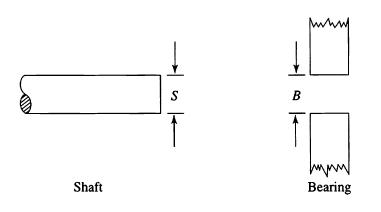
4.4. Suppose that the diameters of bearings are independent normally distributed random variables with mean μ$ = 1.005 inch and variance o= (0.003)2 inch2. The diameters of shafts are independent normally distributed random variables having mean μs = 0.995 inch and variance os= (0.004)2 inch2.Let
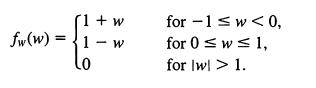
4.3. Let X and Y be independent random variables uniformly distributed over the interval [6 -Z, 0 + Z] for some fixed 0. Show that W = X - Yhas a distribution that is independent of 0 with density function fw(w) + w for 1 - W 1w 1.
4.2. Let W be an exponentially distributed random variable with parameter 0 and mean p. = 1/0.(a) Determine Pr{ W > p.).(b) What is the mode of the distribution?
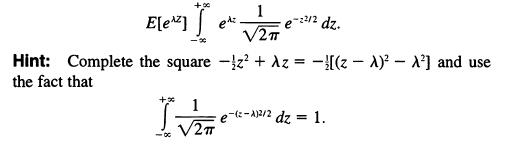
4.1. Evaluate the moment E[e '], where A is an arbitrary real number and Z is a random variable following a standard normal distribution, by integrating E[e] -* 1 2 -22/2 dz. Hint: Complete the square -z + Az = [(z-A) - A] and use the fact that +% I 1 -(-A)/dz = 1.
4.8. Let Z be a random variable with the geometric probability mass function p(k) = (1 - ir)#rk, k = 0, 1, ... , where 0 < ?r < 1.(a) Show that Z has a constant failure rate in the sense that Pr{Z=kIZ?k}=1- 7r fork=0,1,....(b) Suppose Z' is a discrete random variable whose possible values are 0, 1,
4.7. Given independent exponentially distributed random variables S and T with common parameter A, determine the probability density function of the sum R = S + T and identify its type by name.
4.6. Suppose that U has a uniform distribution on the interval [0, 1]. Derive the density function for the random variables(a) Y = -ln(1 - U).(b) W,, = U" for n > 1.Hint: Refer to Section 2.6.
4.5. Let X and Y have the joint normal distribution described in equation(4.16). What value of a minimizes the variance of Z = aX +(1 - a)Y? Simplify your result when X and Y are independent.
4.4. Twelve independent random variables, each uniformly distributed over the interval (0, 1], are added, and 6 is subtracted from the total. Determine the mean and variance of the resulting random variable.
4.3. The lengths, in inches, of cotton fibers used in a certain mill are exponentially distributed random variables with parameter A. It is decided to convert all measurements in this mill to the metric system. Describe the probability distribution of the length, in centimeters, of cotton fibers in
4.2. The median of a random variable X is any value a for which Pr{X s a} >_ 2and Pr{X ?a) ? Z. Determine the median of an exponentially distributed random variable with parameter A. Compare the median to the mean.
4.1. The lifetime, in years, of a certain class of light bulbs has an exponential distribution with parameter A = 2. What is the probability that a bulb selected at random from this class will last more than 1.5 years?What is the probability that a bulb selected at random will last exactly 1.5
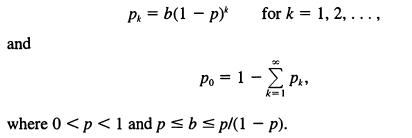
3.16. Consider the generalized geometric distribution defined by(a) Evaluate po in terms of b and p.(b) What does the generalized geometric distribution reduce to when b=p?When b=pl(1 -p)?(c) Show that N = X + Z has the generalized geometric distribution when X is a Bernoulli random variable for
3.15. Suppose that X is a Poisson distributed random variable with mean A = 2. Determine Pr(X
3.14. Suppose that a random variable Z has the geometric distribution Pz(k) = p(1 - p)k for k = 0, 1, ... , where p = 0.10.(a) Evaluate the mean and variance of Z.(b) What is the probability that Z strictly exceeds 10?
3.13. Suppose that a sample of 10 is taken from a day's output of a machine that produces parts of which 5 percent are normally defective. If 100 percent of a day's production is inspected whenever the sample of 10 gives 2 or more defective parts, then what is the probability that 100 percent of a
3.12. Suppose that the telephone calls coming into a certain switchboard during a one-minute time interval follow a Poisson distribution with mean A = 4. If the switchboard can handle at most 6 calls per minute, what is the probability that the switchboard will receive more calls than it can handle
3.11. Let X and Y be independent random variables sharing the geometric distribution whose mass function is p(k) = (1 - ir)irk for k = 0, 1, ... , where 0
3.10. Determine numerical values to three decimal places for Pr{X = k},k= 0, 1,2,when(a) X has a binomial distribution with parameters n = 10 and p = 0.1.(b) X has a binomial distribution with parameters n = 100 and p =0.01.(c) X has a Poisson distribution with parameter A = 1.
3.9. Suppose that X and Y are independent random variables with the geometric distribution p(k) = (1 - ir)iTk for k = 0, 1, ... .Perform the appropriate convolution to identify the distribution of Z = X+ Y as a negative binomial.
3.8. Let X and Y be independent binomial random variables having parameters(N, p) and (M, p), respectively. Let Z = X + Y.(a) Argue that Z has a binomial distribution with parameters (N + M, p)by writing X and Y as appropriate sums of Bernoulli random variables.(b) Validate the result in (a) by
3.7. Let X and Y be independent Poisson distributed random variables having means μ and v, respectively. Evaluate the convolution of their mass functions to determine the probability distribution of their sum Z =X+Y.
3.6. Suppose (X,, X,, )(,) has a multinomial distribution with parameters M and ir, > 0 for i = 1, 2, 3, with 7r,+7r,+ir,= 1.(a) Determine the marginal distribution for X,.(b) Find the distribution for N = X, + X,.(c) What is the conditional probability Pr{X1 = kIN = n} for 0
3.5. Let Y = N - X where X has a binomial distribution with parameters N and p. Evaluate the product moment E[XY] and the covariance Cov[X, Y].
3.4. Let U be a Poisson random variable with mean μ. Determine the expected value of the random variable V = 1/(1 + U).
3.3. Let X be a Poisson random variable with parameter A. Determine the probability that X is odd.
3.2. The mode of a probability mass function p(k) is any value k* for which p(k*) >_ p(k) for all k. Determine the mode(s) for(a) The Poisson distribution with parameter A > 0.(b) The binomial distribution with parameters n and p.
3.1. Suppose that X has a discrete uniform distribution on the integers 0, 1, ... , 9, and Y is independent and has the probability distribution Pr{Y = k} = ak for k = 0, 1, .... What is the distribution of Z = X + Y(mod 10), their sum modulo 10?
3.6. The discrete uniform distribution on { 1, ... , n) corresponds to the probability mass function(a) Determine the mean and variance.(b) Suppose X and Y are independent random variables, each having the discrete uniform distribution on 10, . . . , n}. Determine the probability mass function for
3.5. The number of bacteria in a prescribed area of a slide containing a sample of well water has a Poisson distribution with parameter 5. What is the probability that the slide shows 8 or more bacteria?
3.4. A Poisson distributed random variable X has a mean of A = 2.What is the probability that X equals 2? What is the probability that X is less than or equal to 2?
3.3. A fraction p = 0.05 of the items coming off of a production process are defective. The output of the process is sampled, one by one, in a random manner. What is the probability that the first defective item found is the tenth item sampled?
3.2. A fraction p = 0.05 of the items coming off a production process are defective. If a random sample of 10 items is taken from the output of the process, what is the probability that the sample contains exactly one defective item? What is the probability that the sample contains one or fewer
3.1. Consider tossing a fair coin five times and counting the total number of heads that appear. What is the probability that this total is three?
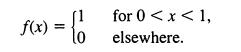
2.13. Let X and Y be independent random variables each with the uniform probability density functionFind the joint probability density function of U and V, where U = max{X, Y} and V = min{X, Y}. f(x) 10 for 0 < x < 1, elsewhere.
2.12. Let U, V, and W be independent random variables with equal variances o.'-. Define X = U + W and Y = V - W. Find the covariance between X and Y.
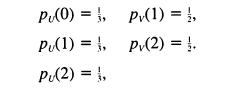
2.11. Random variables U and V are independent and have the probability mass functionsDetermine the probability mass function of the sum W = U + V. Pu(0) = P(1) = , Pu(1) = P(2) = . Pu(2) = 1,
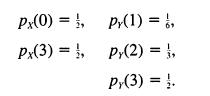
2.10. Random variables X and Y are independent and have the probability mass functionsDetermine the probability mass function of the sum Z = X + Y. Px(0) = P(1)=1, Px(3) = P(2) = 1, Py(3) = .
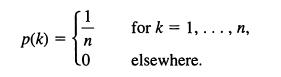
2.9. Determine the mean and variance for the probability mass function p(k) 2(n-k) n(n - 1) for k 1, 2,..., n.
2.8. Suppose X is a random variable with finite mean μ and variance 0-', and Y = a + bX for certain constantsa, b ± 0. Determine the mean and variance for Y.
2.7. Let U and W be jointly distributed random variables. Show that U and W are independent if Pr{U>uand W>w} =Pr{U>u} Pr{W>w} forallu,w.
2.6. A pair of dice is tossed. If the two outcomes are equal, the dice are tossed again, and the process repeated. If the dice are unequal, their sum is recorded. Determine the probability mass function for the sum.
2.5. Two players, A and B, take turns on a gambling machine until one of them scores a success, the first to do so being the winner. Their probabilities for success on a single play are p for A and q for B, and successive plays are independent.(a) Determine the probability that A wins the contest
2.4. A fair coin is tossed until the first time that the same side appears twice in succession. Let N be the number of tosses required.(a) Determine the probability mass function for N.(b) Let A be the event that N is even and B be the event that N : 6.Evaluate Pr{A}, Pr{B}, and Pr{AB}.
2.3. A population having N distinct elements is sampled with replacement.Because of repetitions, a random sample of size r may contain fewer than r distinct elements. Let S, be the sample size necessary to get r distinct elements. Show that E[S] = N(+ 1 + N-1 1 N-r+1/
2.2. Let N cards carry the distinct numbers x ... , x,,. If two cards are drawn at random without replacement, show that the correlation coefficient p between the numbers appearing on the two cards is - lI(N - 1).
2.1. Thirteen cards numbered 1, ... , 13 are shuffled and dealt one at a time. Say a match occurs on deal k if the kth card revealed is card number k. Let N be the total number of matches that occur in the thirteen cards.Determine E[N].Hint: Write N = 1 (A,) + + 1 where Ak is the event that a match
2.10. Let 1(A) be the indicator random variable associated with an event A, defined to be one if A occurs, and zero otherwise. Define A`, the complement of event A, to be the event that occurs when A does not occur.Show(a) 1{A`} = 1 - 1{A}.(b) 1{A fl B) = 1(A)1{B} = min{1{A}, 1{B}}.(c) 1{A U B) =
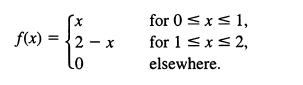
2.9. Determine the distribution function, mean, and variance corresponding to the triangular density. f(x)=2x LO for 0 x 1, for 1 x 2, elsewhere.
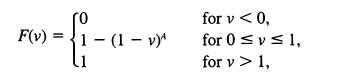
2.8. A random variable V has the distribution functionwhere A > 0 is a parameter. Determine the density function, mean, and variance. F(v) -(1-v)A for v 1,
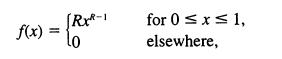
2.7. Suppose X is a random variable having the probability density functionwhere R > 0 is a fixed parameter.(a) Determine the distribution function FX(x).(b) Determine the mean E[X].(c) Determine the variance Var[X]. [Rx-1 for 0 x 1, f(x) LO elsewhere,
2.6. Let X and Y be independent random variables having distribution functions F, and F, respectively.(a) Define Z = max{X, Y} to be the larger of the two. Show that F,(z) = FX(z)FY(z) for all z.(b) Define W = min{X, Y} to be the smaller of the two. Show that F,,,(w) = 1 - [I - FX(w)] [ 1 - F,.(w)]
2.5. Let A, B, and C be arbitrary events. Establish the addition law Pr{A U B U C} = Pr{A} + Pr{B} + Pr{C} - Pr{AB}- Pr{AC} - Pr{BC} + Pr{ABC}.
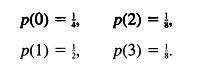
2.4. Let Z be a discrete random variable having possible values 0, 1, 2, and 3 and probability mass function(a) Plot the corresponding distribution function.(b) Determine the mean E[Z].(c) Evaluate the variance Var[Z]. P(0)= p(1) = 1, p(2) = 1, p(3)=1.
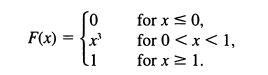
2.3.(a) Plot the distribution function(b) Determine the corresponding density function f(x) in the three regions (i) x : 0, (ii) 0 (c) What is the mean of the distribution?(d) If X is a random variable following the distribution specified in (a), evaluate Pr{; X F(x) = for x 0, for 0 < x < 1, for
2.2. Let A and B be arbitrary, not necessarily disjoint, events. Establish the general addition law Pr(A U B} = Pr{A} + Pr{B} - Pr{AB}.Hint: Apply the result of Exercise 2.1 to evaluate Pr{AB'} = Pr(A) - Pr{AB}. Then apply the addition law to the disjoint events AB and AB`*, noting that A = (AB) U
2.1. Let A and B be arbitrary, not necessarily disjoint, events. Use the law of total probability to verify the formula Pr{A} = Pr{AB} + Pr{AB`}, where B` is the complementary event to B. (That is, B` occurs if and only if B does not occur.)
Showing 5300 - 5400
of 6914
First
47
48
49
50
51
52
53
54
55
56
57
58
59
60
61
Last
Step by Step Answers

 Get 50% OFF
Claim Now
Get 50% OFF
Claim Now