New Semester
Started
Get
50% OFF
Study Help!
--h --m --s
Claim Now
Question Answers
Textbooks
Find textbooks, questions and answers
Oops, something went wrong!
Change your search query and then try again
S
Books
FREE
Study Help
Expert Questions
Accounting
General Management
Mathematics
Finance
Organizational Behaviour
Law
Physics
Operating System
Management Leadership
Sociology
Programming
Marketing
Database
Computer Network
Economics
Textbooks Solutions
Accounting
Managerial Accounting
Management Leadership
Cost Accounting
Statistics
Business Law
Corporate Finance
Finance
Economics
Auditing
Tutors
Online Tutors
Find a Tutor
Hire a Tutor
Become a Tutor
AI Tutor
AI Study Planner
NEW
Sell Books
Search
Search
Sign In
Register
study help
business
probability and stochastic modeling
An Introduction To Stochastic Modeling 3rd Edition Samuel Karlin, Howard M. Taylor - Solutions
5.5. Consider a two-dimensional Poisson process of particles in the plane with intensity parameter v. Determine the distribution Fo(x) of the distance between a particle and its nearest neighbor. Compute the mean distance.
5.4. Consider spheres in three-dimensional space with centers distributed according to a Poisson distribution with parameter AIAJ, where CAI now represents the volume of the set A. If the radii of all spheres are distributed according to F(r) with densityf(r) and finite third moment, show that the
5.3. Let {N(A); A E R2) be a homogeneous Poisson point process in the plane, where the intensity is A. Divide the (0, t] X (0, t] square into n2 boxes of side length d = t/n. Suppose there is a reaction between two or more points whenever they are located within the same box. Determine the
5.2. Points are placed on the surface of a circular disk of radius one according to the following scheme. First, a Poisson distributed random variable N is observed. If N = n, then n random variables 0...... 0,, are independently generated, each uniformly distributed over the interval[0, 2ir), and
5.1. A piece of a fibrous composite material is sliced across its circular cross section of radius R, revealing fiber ends distributed across the circular area according to a Poisson process of rate 100 fibers per cross section.The locations of the fibers are measured, and the radial distance of
5.3. Defects (air bubbles, contaminants, chips) occur over the surface of a varnished tabletop according to a Poisson process at a mean rate of one defect per top. If two inspectors each check separate halves of a given table, what is the probability that both inspectors find defects?
5.2. Customer arrivals at a certain service facility follow a Poisson process of unknown rate. Suppose it is known that 12 customers have arrived during the first three hours. Let Ni be the number of customers who arrive during the ith hour, i = 1, 2, 3. Determine the probability that N, = 3, N, =
5.1. Bacteria are distributed throughout a volume of liquid according to a Poisson process of intensity 0 = 0.6 organisms per mm'. A measuring device counts the number of bacteria in a 10 mm' volume of the liquid.What is the probability that more than two bacteria are in this measured volume?
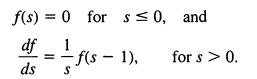
4.11. Computer Challenge Let U0, U,, . . . be independent random variables, each uniformly distributed on the interval (0, 1). Define a stochastic process {S,,} recursively by setting(This is an example of a discrete-time, continuous-state, Markov process.)When n becomes large, the distribution of
4.10. Compare and contrast the example immediately following Theorem 4.1, the shot noise process of Section 4.1, and the model of Problem 4.8. Can you formulate a general process of which these three examples are special cases?
4.9. Customers arrive at a service facility according to a Poisson process of rate k customers per hour. Let N(t) be the number of customers that have arrived up to time t, and let W, , W,, . . . be the successive arrival times of the customers. Determine the expected value of the product of the
4.8. Electrical pulses with independent and identically distributed random amplitudes 6 62, . . . arrive at a detector at random times W,, W, ... according to a Poisson process of rate A. The detector output 0k(t)for the kth pulse at time t is 0k(t) =0 fort < Wk, k exp{-a(t - W)} fort ? W.That is,
4.7. Let W W,, . . . be the event times in a Poisson process (X(t);t ? 0) of rate A, and letf(w) be an arbitrary function. Verify that X(t) t E[> .f(W )] = A Jf(w) dw.i=1 0
4.6. Customers arrive at a service facility according to a Poisson process of rate A customers/hour. Let X(t) be the number of customers that have arrived up to time t. Let W, W,, . . . be the successive arrival times of the customers.(a) Determine the conditional mean E[W X(t) = 2].(b) Determine
4.5. Let W,, W,, . . . be the waiting times in a Poisson process {N(t);t ? 0) of rate A. Determine the limiting distribution of W under the condition that N(t) = n as n -* - and t - oo in such a way that nit = (3 > 0.
4.4. Let W,, W, . . . be the waiting times in a Poisson process {X(t);t ? 0} of rate A. Independent of the process, let Z, ZZ, . . . be independent and identically distributed random variables with common probability density function f(x), 0 < x < oo. Determine Pr{Z > z1, where Z=min
4.3. Let W,, W,, ... be the waiting times in a Poisson process {X(t);t ? 01 of rate A. Under the condition that X(1) = 3, determine the joint distribution of U = W1IW, and V = (1 - W3)/(1 - W,).
4.2. Let {N(t); t ? 0} be a Poisson process of rate A, representing the arrival process of customers entering a store. Each customer spends a duration in the store that is a random variable with cumulative distribution function G. The customer durations are independent of each other and of the
4.1. Let W, W2, ... be the event times in a Poisson process {X(t);t ? 0) of rate A. Suppose it is known that X(1) = n. For k < n, what is the conditional density function of W, ... , W _ W,,,,, ... , W,,, given that W = w?
4.5. Customers arrive at a certain facility according to a Poisson process of rate A. Suppose that it is known that five customers arrived in the first hour. Each customer spends a time in the store that is a random variable, exponentially distributed with parameter a and independent of the other
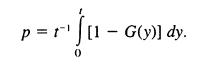
4.4. Customers arrive at a service facility according to a Poisson process of intensity A. The service times Y,, Y,, . . . of the arriving customers are independent random variables having the common probability distribution function G(y) = Pr{Yx p = t G(y)] dy. 0
4.3. Customers arrive at a certain facility according to a Poisson process of rate A. Suppose that it is known that five customers arrived in the first hour. Determine the mean total waiting time E[W, + W, + + WS].
4.2. Let [X(t); t > 0) be a Poisson process of rate A. Suppose it is known that X(1) = 2. Determine the mean of W, W,, the product of the first two arrival times.
4.1. Let [X(t); t ? 0} be a Poisson process of rate A. Suppose it is known that X(1) = n. For n = 1, 2, ... , determine the mean of the first arrival time W,.
3.10. Let (W,} be the sequence of waiting times in a Poisson process of intensity A = 1. Show that X = 2" defines a nonnegativemartingale. exp{-W)
3.9. The following calculations arise in certain highly simplified models of learning processes. Let X,(t) and X2(t) be independent Poisson processes having parameters A, and k,, respectively.(a) What is the probability that XI(t) = 1 before X2(t) = 1?(b) What is the probability that X,(t) = 2
3.8. Consider a Poisson process with parameter A. Given that X(t) = n events occur in time t, find the density function for W the time of occurrence of the rth event. Assume that r I n.
3.7. A critical component on a submarine has an operating lifetime that is exponentially distributed with mean 0.50 years. As soon as a component fails, it is replaced by a new one having statistically identical properties.What is the smallest number of spare components that the submarine should
3.6. Customers arrive at a holding facility at random according to a Poisson process having rate A. The facility processes in batches of size Q.That is, the first Q - 1 customers wait until the arrival of the Qth customer.Then all are passed simultaneously, and the process repeats. Service times
3.5. Let X(t) be a Poisson process with parameter A. Independently, let T be a random variable with the exponential density fT(t) = Oe for t > 0.Determine the probability mass function for X(T).Hint: Use the law of total probability and I, (6.4). Alternatively, use the results of I, Section 5.2.
3.4. The joint probability density function for the waiting times W, and W, is given by f(w W,) = A2 exp{-Aw,} for 0 < w, < w,.Determine the marginal density functions for W, and W2, and check your work by comparison with Theorem 3.1.
3.3. The joint probability density function for the waiting times W, and W, is given by f(w,, w,) = A2 exp{-Aw,} for 0 < w, < w,.Change variables according to So=W, and S,=W-W, and determine the joint distribution of the first two sojourn times. Compare with Theorem 3.2.
3.2. The joint probability density function for the waiting times W, and W, is given by f(w w,) = A2 exp{-,1w,} for 0 < w, < w,.Determine the conditional probability density function for W given that W, = w,. How does this result differ from that in Theorem 3.3 when n = 2 and k = 1?
3.1. Let X(t) be a Poisson process of rate A. Validate the identity{W,>W,W,>w,}if and only if{X(w,) = 0, X(w,) - X(w,) = 0 or 1).Use this to determine the joint upper tail probability Pr{W, > w, W, > w,} = Pr{X(w1) = 0, X(w,) - X(w,) = 0 or 1 }Finally, differentiate twice to obtain the
3.9. Let X(t) be a Poisson process of rate A. Determine the cumulative distribution function of the gamma density as a sum of Poisson probabilities by first verifying and then using the identity W,. t if and only if X(t) ? r.
3.8. Customers arrive at a service facility according to a Poisson process of rate A = 5 per hour. Given that 12 customers arrived during the first two hours of service, what is the conditional probability that 5 customers arrived during the first hour?
3.7. Customers arrive at a service facility according to a Poisson process of rate A customers/hour. Let X(t) be the number of customers that have arrived up to time t. Let W W, . . . be the successive arrival times of the customers. Determine the conditional mean E[WSIX(t) = 3].
3.6. For i = 1, . . ., n, let {X;(t); t ? 0} be independent Poisson processes, each with the same parameter A. Find the distribution of the first time that at least one event has occurred in every process.
3.5. Let X(t) be a Poisson process of rate 6 per hour. Find the conditional probability that there were m events in the first t hours, given that there were n events in the first T hours. Assume 0 s m
3.4. Let X(t) be a Poisson process of rate 6 = 3 per hour. Find the conditional probability that there were two events in the first hour, given that there were five events in the first three hours.
3.3. Customers enter a store according to a Poisson process of rate A = 6 per hour. Suppose it is known that but a single customer entered during the first hour. What is the conditional probability that this person entered during the first fifteen minutes?
3.2. A radioactive source emits particles according to a Poisson process of rate A = 2 particles per minute.(a) What is the probability that the first particle appears some time after three minutes but before five minutes?(b) What is the probability that exactly one particle is emitted in the
3.1. A radioactive source emits particles according to a Poisson process of rate A = 2 particles per minute. What is the probability that the first particle appears after three minutes?
2.12. Computer Challenge Most computers have available a routine for simulating a sequence U,,, U . . . of independent random variables, each uniformly distributed on the interval (0, 1). Plot, say, 10,000 pairs on the unit square. Does the plot look like what you would expect?Repeat the experiment
2.11. Let X and Y be jointly distributed random variables and B an arbitrary set. Fill in the details that justify the inequality JPr{X in B} -Pr{Yin B}1 Pr [X * Y}.Hint: Begin with{XinB} = {XinBandYinB) or {XinBand YnotinB}C(Yin B} or {X/Y}.
2.10. Review the proof of Theorem 2.1 in Section 2.2 and establish the stronger resultfor any set of nonnegative integers I. Pr{S, in I} Pr{X() in I}| - p k=1
2.9. Using (2.3), evaluate the exact probabilities for S,, and the Poisson approximation and error bound in (2.4) when n = 4 and p, = 0.1, P2 = 0.1, p3=0.1,andp4=0.2.
2.8. Using (2.3), evaluate the exact probabilities for S,, and the Poisson approximation and error bound in (2.4) when n = 4 and p, = 0.1, p2 = 0.2, p., = 0.3, and p4= 0.4.
2.7. N bacteria are spread independently with uniform distribution on a microscope slide of area A. An arbitrary region having area a is selected for observation. Determine the probability of k bacteria within the region of areaa. Show that as N oc and a -3 0 such that (alA)N -3 c (0 < c < oo),
2.6. Certain computer coding systems use randomization to assign memory storage locations to account numbers. Suppose that N = MA different accounts are to be randomly located among M storage locations.Let X; be the number of accounts assigned to the ith location. If the accounts are distributed
2.5. Suppose that N points are uniformly distributed over the surface of a circular disk of radius r. Determine the probability distribution for the number of points within a distance of one of the origin as N -* co, r - co, N/(7rr2)_A.
2.4. Suppose that N points are uniformly distributed over the interval[0, N). Determine the probability distribution for the number of points in the interval [0, 1) as N - c.
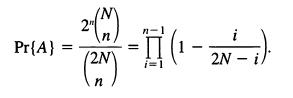
2.3. Suppose that N pairs of socks are sent to a laundry, where they are washed and thoroughly mixed up to create a mass of unmatched socks.Then n socks are drawn at random without replacement from the pile. Let A be the event that no pair is among the n socks so selected. Show thatUse the
2.2. Suppose that 100 tags, numbered 1 , 2, ... , 100, are placed into an urn, and 10 tags are drawn successively, with replacement. Let A be the event that no tag is drawn twice. Show thatUse the approximationto getInterpret this in terms of the law of rare events. - - Pr{A} (1)(1) (1) =
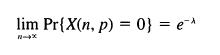
2.1. Let X(n, p) have a binomial distribution with parameters n and p.Let n --> x and p - 0 in such a way that np = A. Show thatand lim Pr{X(n, p) = 0} = e^ 11-x
2.4. Suppose that a book of 600 pages contains a total of 240 typographical errors. Develop a Poisson approximation for the probability that three particular successive pages are error-free.
2.3. A large number of distinct pairs of socks are in a drawer, all mixed up. A small number of individual socks are removed. Explain in general terms why it might be plausible to assume that the number of pairs among the socks removed might follow a Poisson distribution.
2.2. Explain in general terms why it might be plausible to assume that the following random variables follow a Poisson distribution:(a) The number of customers that enter a store in a fixed time period.(b) The number of customers that enter a store and buy something in a fixed time period.(c) The
2.1. Determine numerical values to three decimal places for Pr{X = k}, k = 0, 1, 2, when(a) X has a binomial distribution with parameters n = 20 and p = 0.06.(b) X has a binomial distribution with parameters n = 40 and p = 0.03.(c) X has a Poisson distribution with parameter A = 1.2.
(b) Show thatso that X'(t) and the increment X'(t + s) - X'(t) are not independent random variables, in contrast to the simple Poisson process as defined in Section 1.2. 1 Pr{X'(t) j, X'(t+s) j + k) = \1+s+t +k+1
1.12. Consider the mixed Poisson process of Section 1.4, and suppose that the mixing parameter 0 has the exponential density f(O) = e-0 for 0>0.(a) Show that equation (1.3) becomes Pr(X'(1) = j} = (1 + 1)(1 + 1) for j = 0, 1,....
1.11. Assume that a device fails when a cumulative effect of k shocks occurs. If the shocks happen according to a Poisson process of parameter A, what is the density function for the life T of the device?
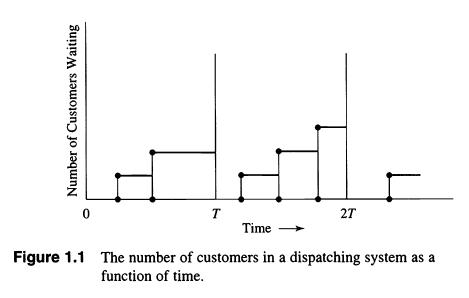
1.10. Customers arrive at a facility at random according to a Poisson process of rate A. There is a waiting time cost of c per customer per unit time. The customers gather at the facility and are processed or dispatched in groups at fixed times T, 2T, 3T, .... There is a dispatch cost of K. The
1.9. Arrivals of passengers at a bus stop form a Poisson process X(t)with rate A = 2 per unit time. Assume that a bus departed at time t = 0 leaving no customers behind. Let T denote the arrival time of the next bus.Then the number of passengers present when it arrives is X(T). Suppose that the bus
1.8. Find the probability Pr(X(t) = 1, 3, 5, ... } that a Poisson process having rate A is odd.
1.7 Shocks occur to a system according to a Poisson process of rate A.Suppose that the system survives each shock with probabilitya, independently of other shocks, so that its probability of surviving k shocks is a'.What is the probability that the system is surviving at time t?
1.6. Let (X(t); t ? 0) be a Poisson process of rate A. For s, t > 0, determine the conditional distribution of X(t), given that X(t + s) = n.
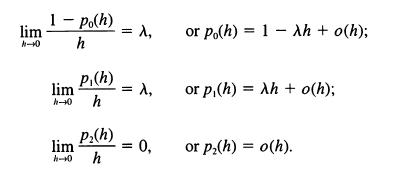
1.5. For each value of h > 0, let X(h) have a Poisson distribution with parameter Ah. Let pk(h) = Pr{X(h) = k} for k = 0, 1, .... Verify thatHere o(h) stands for any remainder term of order less than h as h - 0. lim 0+11 1 - po(h) h = , or po(h) 1 Ah + o(h); P(h) lim h-10h P(h) = , or p,(h) Ah +
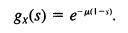
1.4. (Continuation) Let X and Y be independent random variables, Poisson distributed with parameters a and /3, respectively. Show that the generating function of their sum N = X + Y is given byHint: Verify and use the fact that the generating function of a sum of independent random variables is the
1.3. The generating function of a probability mass function pk =Pr{X = k}, for k = 0, 1, ... , is defined byShow that the generating function for a Poisson random variable X with mean μ is given by 8x(s) = E[s] =P.sk for s
1.2. Suppose that minor defects are distributed over the length of a cable as a Poisson process with ratea, and that, independently, major defects are distributed over the cable according to a Poisson process of rate/3. Let X(t) be the number of defects, either major or minor, in the cable up to
1.1. Let ,, 62.... be independent random variables, each having an exponential distribution with parameter A. Define a new random variable X as follows: If 6, > 1, then X = 0; if 6, 1, then set X = 1; in general, set X = kShow that X has a Poisson distribution with parameter A. (Thus the method
1.9. Let {X(t); t ? 0) be a Poisson process having rate parameter A = 2.Determine the following expectations:(a) E[X(2)].(b) E[{X(1)}2].(c) E[X(1) X(2)].
1.8. Let {X(t); t ? 0) be a Poisson process having rate parameter A = 2.Determine the numerical values to two decimal places for the following probabilities:(a) Pr{X(1) s 2}.(b) Pr{X(1) = 1 and X(2) = 3).(c) Pr{X(1) >- 21X(1) ? I).
1.7. Suppose that customers arrive at a facility according to a Poisson process having rate A = 2. Let X(t) be the number of customers that have arrived up to time t. Determine the following probabilities and conditional probabilities:(a) Pr{X(1) = 2).(b) Pr{X(1) = 2 and X(3) = 6}.(c) Pr{X(1) =
1.6. Messages arrive at a telegraph office as a Poisson process with mean rate of 3 messages per hour.(a) What is the probability that no messages arrive during the morning hours 8:00 A.M. to noon?(b) What is the distribution of the time at which the first afternoon message arrives?
1.5. Suppose that a random variable X is distributed according to a Poisson distribution with parameter A. The parameter A is itself a random variable, exponentially distributed with density f(x) = 0e-°' for x ? 0. Find the probability mass function for X.
1.4 Customers arrive at a service facility according to a Poisson process of rate A customer/hour. Let X(t) be the number of customers that have arrived up to time t.(a) What is Pr{X(t) = k} for k = 0, 1, ... ?(b) Consider fixed times 0 < s < t. Determine the conditional probability Pr(X(t) = n +
1.3 Let X and Y be independent Poisson distributed random variables with parameters a and 0, respectively. Determine the conditional distribution of X, given that N = X + Y = n.
1.2. Let pk = Pr{X = k} be the probability mass function corresponding to a Poisson distribution with parameter A. Verify that p0 = exp{-A}, and that pk may be computed recursively by pk = (A/k)pk_ I.
1.1. Defects occur along the length of a filament at a rate of A = 2 per foot.(a) Calculate the probability that there are no defects in the first foot of the filament.(b) Calculate the conditional probability that there are no defects in the second foot of the filament, given that the first foot
Customers arrive in a certain store according to a Poisson process of rate A = 4 per hour. Given that the store opens at 9:00 A.M., what is the probability that exactly one customer has arrived by 9:30 and a total of five have arrived by 11:30 A.M.?
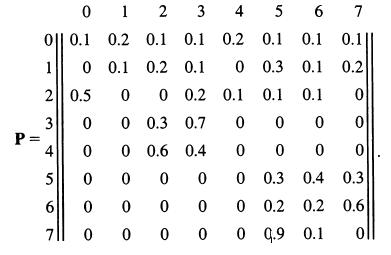
5.2. Determine the limiting behavior of the Markov chain whose transition probability matrix is 012 3 4 5 6 7 0|| 0.1 0.2 0.1 0.1 0.2 0.1 0.1 0.11 1 0 0.1 0.2 0.1 0 0.3 0.1 0.2 2 0.5 0 0 0.2 0.1 0.1 0.1 0 3 0 0 0.3 0.7 0 0 0 0 P= 4 0 0 0.6 0.4 0 0 0 0 5 0 0 0 0 0 0.3 0.4 0.3 6 0 0 0 0 0 0.2 0.2 0.6
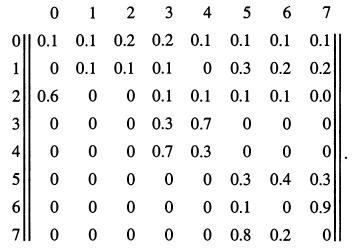
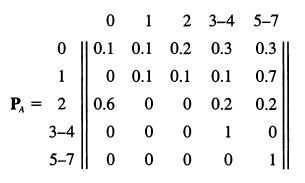
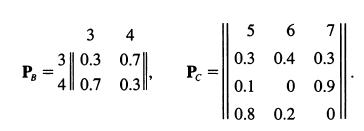
5.1. Describe the limiting behavior of the Markov chain whose transition probability matrix isHint: First consider the matricesand 0 1 2 3 4 5 6 7 0|| 0.1 0.1 0.1 0.2 0.2 0.1 0.1 0.1 110 0.1 1 0 0.1 0.1 0.1 0 0.3 0.2 0.2 2 0.6 0 0 0.1 0.1 0.1 0.1 0.0 3 0 0 0 0.3 0.7 0 0 0 4 0 0 0 0.7 0.3 0 0 0 5 0
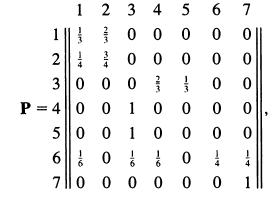
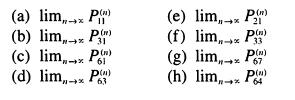
5.2. Given the transition matrixderive the following limits, where they exist: 1 2 3 4 5 6 7 13 0 0 0 0 0 200 000 300 000 P=400 10000, 500 10000 6001 1 7 0 0 0 0 0 0 1
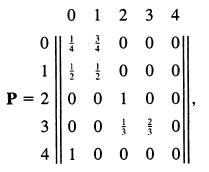
5.1. Given the transition matrixdetermine the limits, as n --4 oo, of P,") for i = 0, 1, ... , 4. 0 0 1 2 3 4 0 0 0 100 0 0 P=200 10 300 00 4 10 1 0 0 0
4.8. A Markov chain on states 0, 1, . . . has transition probabilitiesFind the stationary distribution 1 Pij for j 0, 1,...,i,i+1.. i + 2
4.7. An individual either drives his car or walks in going from his home to his office in the morning, and from his office to his home in the afternoon.He uses the following strategy: If it is raining in the morning, then he drives the car, provided it is at home to be taken. Similarly, if it is
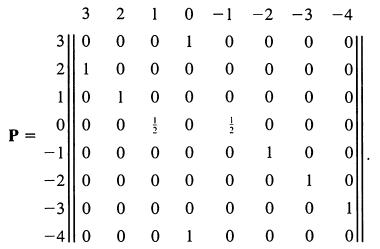
4.6. Determine the period of state 0 in the Markov chain whose transition probability matrix is 0 0 1 0 1 0 0 1 0 0 0 0 0 0 0 1 0 0 -2-3-4 0 0 0 0 0 0 0 0 -3 0 00 -4|| 0 0 0 000 0 00 0 0 1 0 -1 0 -20 3 2 3|| 0 00 2 1 00 1 0 10 00 01 10-1 P =
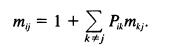
4.5. Let P be the transition probability matrix of a finite state regular Markov chain. Let M = Ilm;jll be the matrix of mean return times.(a) Use a first step argument to establish that(b) Multiply both sides of the preceding by ir, and sum to obtainSimplify this to show (see equation (4.5)) m = 1
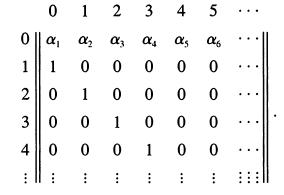
4.4. Let {a; : i = 1, 2, ...} be a probability distribution, and consider the Markov chain whose transition probability matrix isWhat condition on the probability distribution { a; : i = 1, 2, ... } is necessary and sufficient in order that a limiting distribution exist, and what is this limiting
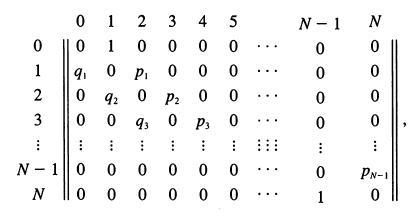
4.3. Consider a random walk Markov chain on state 0, 1, ... , N with transition probability matrixwhere pi +q; = l,pi> O,q;> 0foralli.The transition probabilities from state 0 and N "reflect" the process back into state 1, 2, . . . , N - 1. Determine the limiting distribution. 0123 0 0 1 2 3
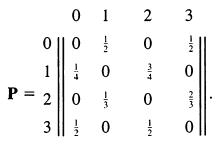
4.2. Determine the stationary distribution for the Markov chain whose transition probability matrix is P = 0 1 2 3 00 1 0 0 21 3 } -IN NIM 12 13 0 } } 0 0 0
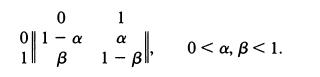
4.1. Consider the Markov chain on (0, 1} whose transition probability matrix is(a) Verify that (Iro, ir,) = ((3/(a + /3), al(a + (3)) is a stationary distribution.(b) Show that the first return distribution to state 0 is given by f.(') _ (1 -a) and f . " ' ) = a/3(1 - /3)i-2 f o r n = 2, 3, ...
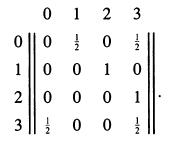
4.3. Determine the stationary distribution for the periodic Markov chain whose transition probability matrix is 1 P = 2 2 0 3 0 0 1 2 3 0 ollo 0 1121 0 112 41 0 0 WIN 0
4.2. Consider the Markov chain whose transition probability matrix is given by(a) Determine the limiting probability .7ro that the process is in state 0.(b) By pretending that state 0 is absorbing, use a first step analysis (III, Section 4) and calculate the mean time m,0 for the process to go from
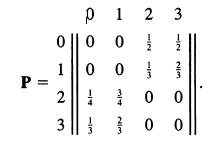
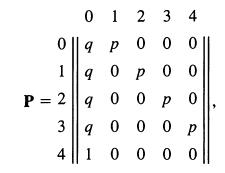
4.1. Determine the limiting distribution for the Markov chain whose transition probability matrix iswherep > 0, q > 0, andp + q = 1. 0 1 2 3 4 0 q p 0 0 0 19 0 p 0 0 0 P = 2 9 0 0 P P0 3 q 4 000 0 0 0 p 1000 0 0
3.3. Recall the first return distribution (Section 3.3) f = Pr{X, i, X #i,..., X, i, X = iX = i} for n = 1, 2,...,
3.2. Show that a finite state aperiodic irreducible Markov chain is regular and recurrent.
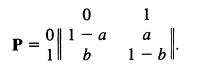
3.1. A two state Markov chain has the transition probability matrix(a) Determine the first return distribution(b) Verify equation (3.2) when i = 0. (Refer to III, (5.2).) P = 0 1 01-a a 19 b 1-b
Showing 4800 - 4900
of 6914
First
42
43
44
45
46
47
48
49
50
51
52
53
54
55
56
Last
Step by Step Answers

 Get 50% OFF
Claim Now
Get 50% OFF
Claim Now