New Semester
Started
Get
50% OFF
Study Help!
--h --m --s
Claim Now
Question Answers
Textbooks
Find textbooks, questions and answers
Oops, something went wrong!
Change your search query and then try again
S
Books
FREE
Study Help
Expert Questions
Accounting
General Management
Mathematics
Finance
Organizational Behaviour
Law
Physics
Operating System
Management Leadership
Sociology
Programming
Marketing
Database
Computer Network
Economics
Textbooks Solutions
Accounting
Managerial Accounting
Management Leadership
Cost Accounting
Statistics
Business Law
Corporate Finance
Finance
Economics
Auditing
Tutors
Online Tutors
Find a Tutor
Hire a Tutor
Become a Tutor
AI Tutor
AI Study Planner
NEW
Sell Books
Search
Search
Sign In
Register
study help
business
retail management
Waste Management Practices 2nd Edition John Pichtel - Solutions
After a satellite container becomes full, within how many days must it be removed and transferred to the central accumulation area or shipped to an off-site facility?
List the criteria required for a RCRA-approved secondary containment unit.
An SQG, as defined under RCRA, generates at least ____________ pounds of hazardous waste in a calendar month, whereas an LQG generates at least ___________ pounds of hazardous waste per month.
The hazardous waste accumulation period normally begins at what point? (a) when wastes are first added to the container, (b) when the container is full, (c) when the hazardous label is affixed to the drum, (d) when the waste is determined to be listed hazardous waste.
How often is a facility hazardous waste report to be submitted to EPA?
List the instances when containers of hazardous waste can be opened at the generator’s facility.
Under RCRA, up to what height should drums containing ignitable wastes be stacked(i.e., two drums, three drums, etc.)?
An LQG may ship its hazardous wastes to a landfill that is approved only by the state, to handle municipal or industrial waste (true or false).
LQGs must have double liners on all new containers for hazardous wastes stored on-site(true or false).
Which of the following are acceptable management practices for a satellite accumulation point? (a) stores a maximum of 55 gal of hazardous waste, (b) stores a maximum of 1 qt of acute hazardous waste, (c) it is under the continuous control of the personnel who generate the waste.
What are the requirements for an acceptable container used at a satellite accumulation area?
As a result of a new manufacturing process, the Hi-Jinx Chemical Company is generating a new waste stream. The waste has the following properties: pH = 10, flashpoint =75°F, high concentrations of Cd and Cr (which exceed TCLP limits), approximately 2500 lb/month. Based on the waste alone, is the
Based on question 13, is the waste to be classified as corrosive, ignitable, or toxic?
Based on the waste properties given in question 13, can the waste be stored in a single-lined tank on the premises? How far must it be stored from the property line? To what type of facility(e.g., state-approved, EPA-approved) must the waste be shipped for final disposal?
If the waste in question 13 could be used (recycled) at another facility, must it be considered a RCRA hazardous waste?
The waste in question 13 may possibly serve as a boiler fuel and therefore need not be managed as a waste at all (true or false).
At Bogus Metalworks, 2500 lb of tetrachloroethylene (a listed hazardous waste) was transferred to a machine degreasing booth and reused a total of four times in September. How much waste must be counted at the end of the month?
At the Hi-Jinx facility, pentachlorophenol, a listed hazardous waste, was mixed with clean soil during a small spill. Is the new mixture still a hazardous waste? Justify your answer.
Also at the Hi-Jinx plant, the tops and bungs of several drums of pentachlorophenol are damaged and severely rusting. Since wastes are not leaking, can they remain in these containers until they are to be transported?
By what specific requirements are individual households subject to RCRA?
For how long do RCRA regulations require that manifests be retained?
List and discuss what is incorrect about the Uniform Hazardous Waste Manifest shown in Figure 12.6.
If the signed return copy of a manifest is not received by an LQG within 35 days, an investigation must be conducted to locate the return copy. When must exception reports be submitted to the state?
If an SQG does not receive a return copy of the manifest within 60 days, what action is required?
A generator of hazardous waste determines that more than 100 kg of waste will be generated in a calendar month. What documentation, identification, and so on, must they acquire?
What is the maximum quantity of hazardous waste that can be accumulated in a satellite accumulation point?
Accumulation points for containers must be inspected weekly. What specific items should be inspected?
How frequently should hazardous waste storage tanks be inspected?
While in satellite accumulation points, what must all hazardous waste containers be marked with?
While in primary accumulation points, what must all hazardous waste containers be marked with?
Tanks used for accumulation of hazardous waste must be equipped with secondary containment, leak detection, and overflow protection. How often should this equipment be inspected?
What are the differences, in terms of content, between the Bill of Lading for hazardous wastes and the Uniform Hazardous Waste Manifest? Who is responsible for initiating each document?
The uniform hazardous manifest is: (a) required under RCRA/HSWA, (b) to be completed where applicable by the waste generator, (c) to be utilized by all LQGs and SQGs, (d) essential in “cradle-to-grave” waste management, (e) all of the above.
The uniform hazardous waste manifest serves which of the following purposes?(a) certification of treatment and disposal, (b) tracking document for delivery to designated TSDF, (c) shipping document for hazardous materials per DOT regulations, (d) b and c only.
List the ten classes of DOT hazardous materials. Which of the classes do not contain divisions?
What is the purpose of a packing group? How many packing groups exist?
Which of the following is not one of DOT’s hazard classes? (a) Class 1—explosive,(b) ORM-D, (c) ORM-F, (d) Class 9—miscellaneous material.
According to federal regulations, what is the primary purpose of transportation placards?
How do hazardous placards differ from labels and markings in terms of size, shape, and location to be affixed? Explain how the requirements for their use differ for bulk and nonbulk packaging.
For a truck transporting hazardous wastes, on which side(s) is (are) the placard(s) to be placed?
A citizen contacts the local emergency response agency with the following information from an overturned tank truck. Which information will best assist the agency in identifying its contents? (a) company name on the truck, (b) license plate number, (c) PG II, (d) UN 1272.
When shipping a truckload of 25 drums of the same hazardous material, what is the total number of drums that must be labeled?
What is the difference between primary and subsidiary hazard warning labels on nonbulk packages of hazardous waste?
What details can you provide about a container with the following information stamped on its base? (a) 1A2 UN X, (b) 4G UN Z.
The shipper is required to provide emergency response information for each hazardous material listed on the shipping papers (e.g., Bill of Lading). List the specific information that must be included on those papers.
Refer to the DOT waste compatibility table (Figure 13.10). State whether or not the following wastes be placed in the same shipment: (a) spent hydrochloric acid and a class 4.1 waste, (b) waste classes 1.1 and 4.1, (c) flammable gases and explosives.
Which of the following situations does not require an incident report involving hazardous materials to DOT? (a) a person is killed; (b) property damage exceeds $50,000; (c) a person is injured but does not require hospitalization; (d) fire, breakage, spillage, or suspected contamination involving
What is the name of the table that must be used to select the proper container for accumulation and transportation of hazardous waste?
Suppose a facility’s hazardous waste is stored in a 55-gal metallic drum. Locate the regulation number where the drum is listed (i.e., which column?).
According to DOT regulations, containers used to accumulate and transport hazardous waste must be in good condition. In this context, what is the definition of “good condition”?
Refer to 49 CFR 172.101 and the HMT. Find the regulatory reference for drums (i.e., nonbulk containers) for storage of waste methyl ethyl ketone (MEK).
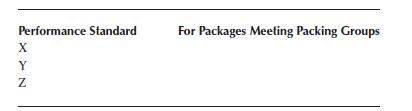
Insert the packing groups authorized for containers meeting the performance standards identified below Performance Standard X Y Z For Packages Meeting Packing Groups
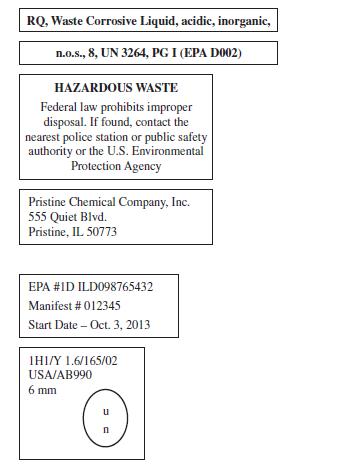
The following labels and markings occur on a drum of hazardous waste:Identify the following:Hazardous Substance Designation DOT Proper Shipping Name Hazard class DOT identifi cation number Hazardous waste warning Generator name RQ, Waste Corrosive Liquid, acidic, inorganic, n.o.s., 8, UN 3264, PG I
Based on the manufacturer’s mark, answer the following:(a) What is the minimum drum wall thickness for reuse of the drum?(b) What is the limit of specific gravity of the contents?(c) What is the drum type?
Who is responsible for ensuring that containers are properly marked and labeled (i.e., hazardous waste generator, transporter, TSDF, regulatory agency)?
Which permitted TSDFs are required to obtain an EPA identification number? To whom is the completed EPA Form 8700-12, Notification of Hazardous Waste Activity, to be submitted?How frequently is the form to be sent to this agency?
Is a WAP required for all TSDFs? Which agency must approve the WAP as part of the permit application?
Provide the specific components of a facility WAP.
At the Hi-Jinx Corporation Central Waste Incineration facility, how often should the following areas be inspected by plant personnel? (a) loading areas, (b) tank systems,(c) incinerator units, (d) container storage buildings.
For what types of TSDFs is a CQA program required? Under whose direction is the program developed and implemented? Which physical components must the CQA program address?
The TSDF must develop and implement a written CQA plan. What is the overall purpose of the CQA plan? What must it include?
TSDFs must be equipped with internal communication systems and fire control equipment.What additional emergency equipment is required?
In preparation for any site emergency, the facility must make numerous arrangements with local authorities. List these arrangements.
Whenever there is a release, fire, or explosion, what specifics regarding the released materials is the emergency coordinator to identify immediately? How is the identification to be carried out? How are the findings to be reported?
What types of equipment must the TSDF be equipped with in order to minimize the possibility of fire, explosion, or the release of hazardous wastes?
What is the general purpose of a contingency plan? What are the major components of the plan? To whom in the community should copies of the plan be given?
Under what conditions are TSDF contingency plans revised?
The TSDF is the final stage of cradle-to-grave hazardous waste management. What are the responsibilities of the TSDF regarding the Uniform Hazardous Waste Manifest? For how long is the manifest to be kept on the premises? How are manifest discrepancies handled?
The groundwater monitoring program at a TSDF must include sampling and analysis procedures that provide a reliable indication of groundwater quality below the waste management area. List the minimum procedures to be included in the program.
In your community, is there a comprehensive household hazardous waste management program currently in place? How are household hazardous wastes collected, treated, and disposed? What agency or company is responsible for administering such a program?
Which two major sets of regulations are included in the federal standards for hazardous waste thermal technologies? How do they differ in terms of regulatory coverage?
Combustion involves chemical transformations in which solid materials are converted to gases and solid residues. What factors, with regard to both incinerator design and operation and waste properties, affect the composition and quantities of gases produced? What factors will influence the quantity
Whenever an organic material is to be incinerated, air (oxygen) is necessary to complete combustion. For what other purposes is air required? Be specific.
List the engineering and design factors that serve to enhance combustion in an incinerator.
Discuss how each of the major types of gaseous emissions from an incinerator may be effectively removed from flue gas.
Compare and contrast the rotary kiln injection system and the liquid injection incinerator in terms of overall design, efficiency, and problems during use. Which is most suited to the destruction of organic sludges, organic solids, liquid solvents, and metal-enriched acidic solutions?
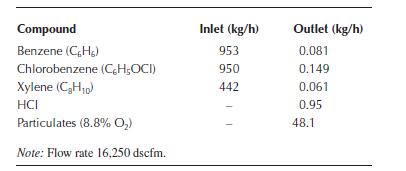
A waste mixture consisting of benzene and chlorophenol is being incinerated. Is the unit in compliance for each compound? Compound Inlet (kg/h) Outlet (kg/h) Benzene (CH) 953 0.081 Chlorobenzene (CHOCI) 950 0.149 Xylene (CH,D) 442 0.061 HCI 0.95 Particulates (8.8% O) 48.1 Note: Flow rate 16,250
For the data in the previous question, determine if the emissions meet federal requirements for particulates.
Calculate the solids retention (θ) time in a rotary kiln incinerator with the following data:kiln length = 6 m kiln rotational velocity = 0.8 r/min kiln diameter = 1.8 m kiln slope = 0.085 m/m
For question number 9, if the desired retention time is actually 12.0 min, what should the rotational velocity be adjusted to?
In a regulatory sense, how might hazardous waste incinerator ash be designated “hazardous”?Consider both listed and characteristic hazardous wastes.
Boilers and most industrial furnaces must follow a tiered system for the regulation of both hydrogen chloride and chlorine gas. How do the tiers differ in terms of monitoring requirements, dispersion modeling, and point of compliance? Which factors may be considered when a facility selects a tier?
Provide two examples of incinerator fugitive emissions. How can their releases to the environment be controlled?
A RCRA permit for a hazardous waste incinerator sets operating conditions and allowable ranges for certain critical parameters, and also requires their continuous monitoring. List the important parameters.
Suppose there are several facilities in your county that generate liquid organic hazardous waste that must be shipped off-site for treatment or disposal. Based on economic and practical factors for the generator, incineration is considered the safest and most effective disposal option. Locate the
Flue gas from a liquid injection incinerator contains 550 kg/h of SO2 and 475 kg/h of HCl.The dry scrubber lime feed rate is 1.5 × stoichiometric rate and is known to be about 82%efficient in removing SO2 and 90% efficient in HCl removal. Calculate the lime feed rate in kg/h. How many kg/h of SO2
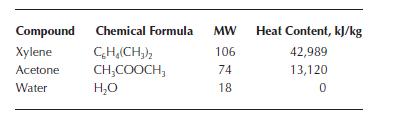
A liquid waste mixture of 64% xylene, 32% acetone, and 4% water is to be combusted in a liquid injection incinerator at 1275 kg/h. There is 35% excess air in the combustion chamber.Properties of the waste constituents are as follows:(a) Calculate the total heat release in the incinerator.(b)
List some of the key reagents used to neutralize acidic wastes. What factors are involved in choosing a neutralizing agent? What hazards may be involved in the use of certain agents?
Which of the neutralizing agents discussed in this chapter have the benefit of buffering the reaction medium?
Precipitation processes are typically focused on the removal of what types of compounds or elements? List the common counter-ions involved in precipitation.
What are the drawbacks to using an oxidizing agent such as O3 to treat a waste stream consisting of numerous organic and inorganic components, only one of which is deemed hazardous?
What is the principle of stabilization of hazardous waste? Is stabilization solely a physical process or are chemical reactions also possible?
In order to remove hexavalent chromium from a waste stream, what pretreatment step is necessary?
A metal plating solution contains 32.2 mg/L of zinc. Calculate the concentration (mol/L)of [OH−] needed to precipitate all but 0.80 mg/L of the copper. The Ksp of zinc hydroxide is 7.68 × 10⁻¹⁷. What is the final pH?
Can aerobic thermophilic composting be used to treat hazardous waste? Explain.
At a metal plating facility, a precipitation system is being installed to remove zinc from the process solution. A pH meter will be used to control the feed of the hydroxide solution to the mix tank. To what pH should the instrument be set to achieve a Zn effluent concentration of 1.0 mg/L?
Aqueous sodium cyanide wastes at a metal processing industry are to be treated with chlorine and NaOH. Calculate the stoichiometric quantity of Cl2 required daily to remove the cyanide from 5 kg of NaCN.
The LDR program includes treatment standards for all hazardous wastes scheduled for land disposal. It has three major components that address hazardous waste disposal, dilution, and storage. Discuss these components.
What waste types are restricted from secure landfills under current federal regulations? Be specific.
Under what conditions may the double liner requirement be waived for a hazardous waste facility?
Showing 700 - 800
of 1226
1
2
3
4
5
6
7
8
9
10
11
12
13
Step by Step Answers

 Get 50% OFF
Claim Now
Get 50% OFF
Claim Now