New Semester
Started
Get
50% OFF
Study Help!
--h --m --s
Claim Now
Question Answers
Textbooks
Find textbooks, questions and answers
Oops, something went wrong!
Change your search query and then try again
S
Books
FREE
Study Help
Expert Questions
Accounting
General Management
Mathematics
Finance
Organizational Behaviour
Law
Physics
Operating System
Management Leadership
Sociology
Programming
Marketing
Database
Computer Network
Economics
Textbooks Solutions
Accounting
Managerial Accounting
Management Leadership
Cost Accounting
Statistics
Business Law
Corporate Finance
Finance
Economics
Auditing
Tutors
Online Tutors
Find a Tutor
Hire a Tutor
Become a Tutor
AI Tutor
AI Study Planner
NEW
Sell Books
Search
Search
Sign In
Register
study help
business
software testing and quality assurance
Software Testing And Quality Assurance Theory And Practice 1st Edition Sagar Naik, Kshirasagar Naik - Solutions
Explain what are computation error and domain error.
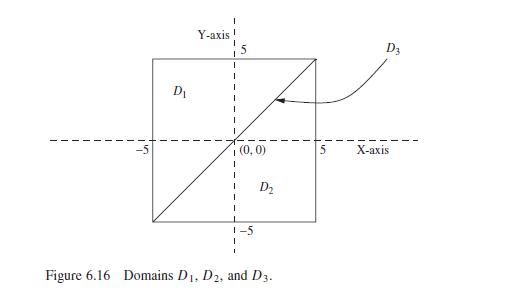
Give an example of code showing a domain error. D Y-axis (0, 0) 5 X-axis D 1-5 Figure 6.16 Domains D1, D2, and D3. D3
Explain the difference between control flow–based testing and domain error–based testing.
Recall that the domain testing strategy requires us to select test points on and/or very close to domain boundaries. Why do we not select test points far from the boundaries?
Consider the three domains D1, D2, and D3 shown in Figure 6.16. Domain D3 consists of all those points lying on the indicated straight line. Assuming that the maximum X and Y span of all the three domains are [−5, 5]and [−5, 5], respectively, give concrete values of test points for domain D3.
State four kinds of domain errors and explain how they occur.
Explain the following terms: closed boundary, open boundary, closed domain, open domain, extreme point, adjacent domain.
Explain the idea of ON points and OFF points.
Clearly explain the test selection criterion in domain-based testing and show the closed inequality error (boundary shift resulting in a reduced domain) is detected by the test points chosen by the selection criterion.
Identify some difficulties in applying the concept of domain testing to actual program testing.
Describe the difference between black-box and white-box testing techniques?
If a program passes all the black-box tests, it means that the program should work properly. Then, in addition to black-box testing, why do you need to perform white-box testing?
Describe the difference between unit testing and integration testing?
Why should integration testing be performed? What types of errors can this phase of testing reveal?
Discuss the advantages and disadvantages of top-down and bottom-up approaches to integration testing.
Does automation of integration tests help the verification of the daily build process? Justify your answer.
Using the module hierarchy given in Figure 7.13, show the orders of module integration for the top-down and bottom-up integration approaches. Estimate the number of stubs and drivers needed for each approach. Specify the integration testing activities that can be done in parallel, assuming you have
Suppose that you plan to purchase COTS components and integrate them with your communication software project. What kind of acceptance criteria will you develop to conduct acceptance testing of the COTS components?
During integration testing of COTS components with a software system, it may be required to develop a wrapper software around the OTS component to limit what it can do. Discuss the general characteristics that a wrapping software should have in order to be able to integrate COTS with the software
Describe the circumstances under which you would apply white-box testing, back-box testing, or both techniques to evaluate a COTS component.
For your current test project, develop an integration test plan.
Complete Section 5 (i.e., actual test results for each integration test phase) of the integration test plan after executing the integration test cases you developed in exercise 11.
What is an element management system (EMS)? How is it different from a network management station (NMS)?
What are the differences between configuration, compatibility, and interoperability testing?
What are the differences between performance, stress, and scalability testing?What are the differences between load testing and stress testing?
What is the difference between performance and speed?
Buffer overflow is the most commonly found vulnerability in network-aware code that can be exploited to compromise a system. Explain the reason.
What are zero-day attacks? Discuss its significance with respect to security testing.
Discuss the importance of regression testing when developing a new software release. What test cases from the test suite would be more useful in performing a regression test?
What are the differences between safety and reliability? What are the differences between safety testing and security testing?
What is the similarity between software safety and fault tolerance?
For each of the following situations, explain whether it is a hazard or a mishap:(a) Water in a swimming pool becomes electrified.(b) A room fills with carbon dioxide.(c) A car stops abruptly.(d) A long-distance telephone company suffers an outage.(e) A nuclear weapon is destroyed in an unplanned
What are the similarities and differences between quality assurance (QA) and safety assurance (SA)?
For your current test project, develop a taxonomy of system tests that you plan to execute against the implementation.
(a) What is the central idea in Howden’s theory of functional testing?(b) What is a functionally identifiable substructure?(c) All combinations of special values of input variables can lead to a large number of test cases being selected. What technique can be used to reduce the number of
Consider the system S in Figure 9.7, which has three input parameters X, Y, and Z. Assume that set D, a set of input test data values, has been selected for each of the input variables such that D(X) = {True, False}, D(Y) = {0, 5}, and D(Z) = {P,Q,R}. Using the orthogonal array method discussed in
Discuss the drawback of the orthogonal array methodology compared to the IPO algorithm.
Consider the system S which can take n input parameters and each parameter can take on m values. For this system answer the following questions:(a) What is the maximum number of pairs a single test case for this system can cover?(b) In the best case, how many test cases can provide full pairwise
What is the minimum number of test cases to be selected to achieve pairwise coverage?
Consider the following triangle classification system, originally used by Myers[16]: The system reads in three positive values from the standard input. The three values A,B, and C are interpreted as representing the lengths of the sides of a triangle. The system then prints a message on the
Consider again the triangle classification program with a slightly different specification:The program reads floating values from the standard input. The three values A, B, and C are interpreted as representing the lengths of the sides of a triangle. The program then prints a message to the
Consider the triangle classification specification. The system reads in three positive values from the standard input. The three values A,B, and C are interpreted as representing the lengths of the sides of a triangle. The system then prints a message to the standard output saying whether the
What are the advantages and disadvantages of random testing?
What is a test oracle? What are the differences between a parametric oracle and a statistical oracle?
Discuss the similarity between the decision table–based and category partition–based testing methodology.
Considering the FSM of Figure 10.17 discussed in this chapter, provide a test sequence table, similar to Table 10.12, for the state transition (D, B, b/y).
What are the fundamental differences between UIO sequence and distinguishing sequence methods of state verification?
Consider the FSM G = , shown in Figure 10.49, where S = {A,B,C} is the set of states, I = {a,b, c} is the set of inputs, O = {e, f }is the set of outputs, A is the initial state, δ : S × I →S is the next-state function, and λ : S × I → O is the output function.(a) Generate a distinguishing
Consider the FSM H = of Figure 10.50, where S = {A,B,C,D,E, F,G} is the set of states, I = {ri,a, c, x, z} is the set of inputs, O = {null,b, f, d} is the set of outputs, A is the initial state,δ : S × I → S is the next-state function, and λ : S × I → O is the output function.(a) Generate
Consider the FSM K = of Figure 10.51, where S = {A,B,C} is the set of states, I = {a, b} is the set of inputs, O = {x, y}is the set of outputs, A is the initial state, δ : S × I →S is the next-state function, and λ : S × I → O is the output function.(a) Show that the FSM K does not possess
Consider the nondeterministic FSM NFSM = of Figure 10.52, where S = {A,B,C,D,E, F,G} is the set of states, I = {ri,a, c, x, z}is the set of inputs, O = {null,b, f, d} is the set of outputs, A is the initial state, δ : S × I → S is the next-state function, and λ : S × I → O is the output
Discuss the effectiveness of the error detection capabilities among the abstract test architectures presented in this chapter.
Design a test component to test the system, represented in Figure 10.8, from the standpoint of a local phone alone. In your test component, consider the partial transition tour OH–AD–RNG–TK.
Assuming that a called (remote) phone is far away from the calling (local)phone, explain the difficulty you will encounter while designing a test case in TTCN-3 from the following transition tour in Figure 10.8: OH–AD–RNG–TK–LON–TK–RON–AD–OH.
Explain the concept of test case verdicts.
Do we have to upgrade the software image sequentially on each of the network elements or at the same time on all the 100 elements? Or, do we proceed in a batch of 20 elements at a time?
What is the source of the upgrade? Will the source be on an element management server?
What does “easy” mean here? Does it refer to the length of time, say, 200 seconds, taken by the upgrade process?
Can we have a mix of old and new software images on different network elements on the same network? In other words, is a new software image compatible with the old image?
If we support old and new software images on different network elements on the same network, then the EMS should be capable of managing two versions of a software installed on the same network. Is it possible for an EMS to manage network elements running different software versions?
To what release will the software be downgraded? Suppose the software image is upgraded to the nth release from the (n − 1)th release. Now, if the software image is to be downgraded, to what release should it be downgraded—(n − 1)th or (n − 2)th release?
While a system is being upgraded, do we need to observe the CPU utilization of the network elements and the EMS server? What is the expected CPU utilization?
Explain the difference between coverage metrics and traceability matrix.
Explain the difference between requirement testability and software testability.
Justify the statement that software testability and fault tolerant are opposites to each other, and attaining both at the same time for the same piece of software is not feasible. When do you want high testability and when don’t you during the life cycle of a critical software system? Justify
What are the differences between software testability and reliability? What is more important in a software: high testability or high reliability? Justify your answer.
In a software test project, the number of unit-, integration-, and system-level test cases specified are 250, 175, and 235, respectively. The number of test cases added during the unit, integration, and system testing phases are 75, 60, and 35, respectively. Calculate the TCDY for unit,
Prepare a checklist of items that will serve as the focal point for reviewing test cases.
Under what circumstances can the execution result of a test case be declared as blocked?
Implement the requirement model discussed in this chapter.
Implement the test factory model discussed in this chapter.
For your current test project, develop the test suite hierarchy and identify a test objective for each test case within each test (sub)group.
Develop detailed test cases using the schema defined in Table 11.6 as a template for the test objectives you identified in the previous exercise.
What is the purpose of having a system test plan ready before the start of system test cycles?
What are some essential items a tester should include in a system test plan?
What are the advantages and disadvantages of having separate unit, integration, and system test plans as opposed to an inclusive test plan containing all three in the same document?
Study the test plan proposed in the IEEE standard 829 standard described in the literature review section of this chapter. What are the essential items not addressed in this test plan?
Why are multiple test environments set up for the execution of system-level test cases? Why should these test environments not be shared for software development activities?
What are the parameters of the multicycle system test execution strategy? What is the idea behind the parameterized system test cycle?
Why must the entry criteria be satisfied before the start of the first system test cycle?
What are the objectives of the first, second, and the third system test cycles?
If the test case failure rate is high, why does it slow down the test execution rate?
Develop a system test plan for your current test project.
What are the advantages and disadvantages of early test automation, that is, for the first release of a product?
What are the advantages and disadvantages of late test automation, that is, after the first release of the product?
Develop evaluation criteria for the selection of a defect tracking tool.
Evaluate the ClearQuest defect tracking system by getting a trial copy of the tool from IBM using the criteria developed for exercise 13.
What are the components of a test automation infrastructure? What is the role of a test automation framework administrator?
Why is it important to assign both severity and priority levels to a defect?
Implement the schema and the defect model discussed in this chapter using a commercially available defect tracking tool (viz., ClearQuest of IBM).
Why do in-process metrics need to be tracked on daily or weekly basis during system testing?
What is the difference between causal analysis, statistical analysis, and Pareto analysis? The ODC method belongs to which category?
Modify the schema shown in Table 13.2, including values of the fields and the state transition diagram in Figure 13.1, to model ODC.
The projected number of defects submitted, resolved, and remaining open in the first four weeks of a test project are given in the upper half of Table 13.18.The actual numbers of submitted and resolved defects are shown in the lower half of the table. Calculate the actual number of open defects.
For your current system testing project, select a set of in-process metrics discussed in this chapter and track it during the system test execution phase.
Develop a set of beta release criteria for your current test project.
Write a system test report after the completion of your current test project.
In a test project, the number of defects found in different phases of testing are as follows: unit testing, 163 defects; integration testing, 186 defects; system testing, 271 defects. The number of defects found by sustaining test engineers by conducting fault seeding experimentation is
What is the value of DRE?Calculate the value of the system test DRE?
Modify the schema shown in Table 13.2, including values of the fields to capture in the defect dynamic model.
Showing 3800 - 3900
of 3990
First
26
27
28
29
30
31
32
33
34
35
36
37
38
39
40
Step by Step Answers

 Get 50% OFF
Claim Now
Get 50% OFF
Claim Now