New Semester
Started
Get
50% OFF
Study Help!
--h --m --s
Claim Now
Question Answers
Textbooks
Find textbooks, questions and answers
Oops, something went wrong!
Change your search query and then try again
S
Books
FREE
Study Help
Expert Questions
Accounting
General Management
Mathematics
Finance
Organizational Behaviour
Law
Physics
Operating System
Management Leadership
Sociology
Programming
Marketing
Database
Computer Network
Economics
Textbooks Solutions
Accounting
Managerial Accounting
Management Leadership
Cost Accounting
Statistics
Business Law
Corporate Finance
Finance
Economics
Auditing
Tutors
Online Tutors
Find a Tutor
Hire a Tutor
Become a Tutor
AI Tutor
AI Study Planner
NEW
Sell Books
Search
Search
Sign In
Register
study help
business
strategic compensation
Strategic Compensation In Canada 5th Edition Richard J. Long - Solutions
Identify circumstances that may necessitate changes to the compensation system.
Explain how to evaluate the effectiveness of a compensation system.
Develop a process for communicating the compensation system.
Describe the steps necessary for implementing a compensation system.
Develop an implementation plan for a new compensation system.
Identify the key issues in preparing to implement a compensation system.
2. Analyze the "Plastco Packaging" case in the Appendix, and identify the ben- efits system (including specific benefits) that would make the most sense for this firm.
1. Analyze "The Fit Stop" case in the Appendix, and identify the benefits system (including specific benefits) that would make the most sense for this firm.
2. Three firms are described briefly below. For each firm, identify the role (if any) that you believe indirect pay should play in the compensation system, and the specific benefits that it would make the most sense to offer. Explain why. A company offers lawn maintenance and yard cleanup services
1. In a small group, discuss how important benefits will be to you in choosing your next job. Then identify the three specific benefits listed in Compensation Notebook 12.1 that are most important to you. Do choices vary in your group? If so, discuss why.
2. The report on wellness programs produced by the Canadian Labour and Business Centre came to nine conclusions, listed on pages 31-33 of its report at http://www.clbc.ca/files/Reports/summary of key conclusions-final-e.pdf. Which of these conclusions did you find the most interesting or surprising?
1. Go to the Web links for the Benefits and Pension Monitor and the Canadian Human Resources Reporter listed above and make a list of the key issues that came up most frequently in these publications in the past two months. Which of these issues do you think is the most important?
3. "Flexible benefits plans are beneficial to both employers and employees because they allow both groups to satisfy their needs." Do you agree with this statement? Discuss why or why not.
2. "Wellness and work-life balance programs are all very nice, but other than providing a safe working environment, why should it be up to the employer to look after an employee's health and wellness? Don't individuals have the responsibility to look after their own health and wellness?" Do you
1. "Defined contribution pension plans are nothing more than an attempt by employers to shift risk from themselves to employees, who are much less able to bear this risk." Do you agree or disagree with this statement? Discuss why.
Describe the issues that must be addressed in designing a benefits system.
Discuss the advantages and disadvantages of fixed versus flexible benefits plans and the circumstances in which each would be most appropriate.
Identify the six major categories of employee benefits and the specific types of benefits included in each category.
2. You have decided that The Fit Stop (in the Appendix) would be well suited to an organizational performance pay plan. Select the specific organization pay plan that would seem to work best; then design it, describing specifically how you would deal with the various design issues. When you are
1. You are a team of top-notch compensation consultants hired by Alliston Instruments, in the case study in the Appendix. After analyzing the various options available, you have decided that a group pay plan would be beneficial to this organization. Select the specific group plan that would seem to
2. Assume you are an employee in a firm that is planning to implement profit sharing. As an employee, identify the design features you would like to see included. Then, in a small group, compare your desired plans. How do they differ, and what do you think are the reasons for the differences?
1. Examine the two profit-sharing plans described in Compensation Today 11.3. Evaluate the possible impact of each. Which do you think will be most effective, and why do you think so? What additional information would be useful in order to draw firm conclusions?
Go to the National Center for Employee Ownership website (http://www.nceo .org), and identify the factors that they suggest are important to the success of employee share ownership plans.
4. Discuss the pros and cons of nonmonetary reward programs.
3. Of the various types of employee share plans, which do you think would best fit a privately held corporation?
2. When designing a profit-sharing plan, what design issues do you think would prove to be the most difficult to decide?
1. Gain-sharing and goal-sharing programs have high discontinuation rates. Why do you think that may be?
Discuss the considerations in designing a nonmonetary rewards program.
Identify the main types of employee stock plans and key issues in their design.
Identify the main types of profit-sharing plans and key issues in their design.
Identify the main types of goal-sharing plans and key issues in their design.
Identify the main types of gain-sharing plans and key issues in their design.
If you are using Strategic Compensation: A Simulation in conjunction with this text, you will find that the concepts in Chapter 10 are helpful in preparing Section K of the simulation.
2. CEO Henderson has decided to go ahead with a performance appraisal system, and she has decided to link it to merit pay. Impressed with your ear- lier work for the company (see Question 1), she has hired you to design the performance appraisal system and a merit pay system that will be linked to
1. "Henderson Printing" (in the Appendix) currently has no formal perfor- mance appraisal system. The CEO, Georgette Henderson, thinks that a per- formance appraisal system might be useful, and she has hired you to assess the company and recommend whether to implement one. She also wants to know
In groups of six to eight, share your experiences with performance appraisal. Group members who have been subject to a performance appraisal system should indicate whether they believe their performance was fairly evaluated, and if not, why not. After that, the groups should come together and
On the website http://www.businessballs.com/performanceappraisalform .pdf, you will find a template for a performance appraisal form. Using the material in this chapter, assess the pros and cons of this form. Which type of performance appraisal method do you think it represents?
2. One alleged problem with performance appraisal is that most employees seem to think they are above average and do not like to be told other- wise. Do you think this is actually true, and if so, how could you design an appraisal system that might avoid this problem?
1. Take several jobs that you or other members of your class have held or are currently holding and discuss whether and how you would go about designing a useful performance appraisal and merit system for them.
Identify the key design issues in developing an effective merit pay system.
Discuss how to link merit pay to performance appraisals.
Explain the concept of "performance management."
Identify the possible sources of performance appraisals, and discuss the circum- stances under which each would be appropriate.
Identify and describe the different methods for appraising performance, along with their strengths and weaknesses.
Explain why many performance appraisal systems fail to accurately measure employee performance.
Identify and explain the four main reasons for conducting performance appraisals.
You are the head of human resources at "Alliston Instruments" (a case in the Appendix). You would like to do a compensation survey to determine whether your pay rates are in line with those in the industry. Using the steps described in this chapter, design the process for so doing.
3. In a large group, survey the hourly pay levels for all those group members who are currently employed or were recently employed in common jobs such as salesclerk, cashier, or fast-food worker. If there are differences in pay within the same job type, discuss why these may exist.
2. After completing Question 1, develop a compensation structure for the same firm; but this time, assume it uses the human relations managerial strategy. Then do the same for the classical managerial strategy. How do these three compensation structures differ?
1. Table 9.2 provides data from a compensation survey for the job of industrial engineer, collected from the same employers as the compensation survey for accounting clerks discussed earlier in the chapter. Assume you are managing a high-involvement firm that employs about 800 people and you employ
2. How fair is the pay of NHI. hockey players relative to their performance? Use the Canadian Business website (as http://list.canadianbusiness.com/ rankings/hockey salaries/2009/Default.aspx?sp2=1&d1=d&sc1=2 your information source on what the market is paying NHL hockey players relative to their
1. Take four jobs that are of interest to you and that are included in both the PayScale (http://www.payscale.com/resources.aspx?nc=lp_calculator canada01) and Salary Wizard databases (http://monsterca.salary.com). Using your own geographic area as the basis for your search, identify what
2. Based on the concept of "compensating differentials," develop a list of job/ organizational characteristics that would make you willing to work for less money. Then develop a list of job/organizational characteristics that would cause you to want more money to accept a given job. Rank each list
1. Examine the list of industries and pay rates in the opening vignette. Discuss possible reasons why each industry has the relative pay level that it does.
Analyze, interpret, and apply compensation survey data.
Describe the steps for conducting compensation surveys.
Identify possible sources of compensation data.
Discuss the key considerations in understanding labour markets.
2. After completing Question 1, apply the procedures required under the Ontario Pay Equity Act to determine whether pay equity exists for the female job classes at Eastern Provincial University. The following are the annual salaries in the four job classes (as of 2012): Clerk Steno 1: $36,341; II:
1. Using the point method and the four basic factor categories, develop a job evaluation system for the "Eastern Provincial University" case in the Appendix. Then apply your system to the different jobs to derive a single hierarchy of jobs. Summarize this information in a table similar to Table 8.2.
2. In a small group or on your own, use Figure 8.2 to develop a base pay structure for a Canadian hospital, including pay grades and ranges, and criteria for salary movement within the range.
1. Rank the hospital jobs shown in Table 8.2 according to your own impressions of how valuable each job is to the hospital, disregarding the hypothetical job evaluation results. Share your rankings with other classmates, and discuss any differences in your rankings. Also discuss any differences
2. After completing Question 1, use Microsoft Excel to prepare a market line based on data from your benchmark jobs and market comparator jobs. Examine the resulting line, and discuss all of the possible issues surrounding its validity, including the correlation coefficient, the outliers, and the
1. In a small group or on your own, select benchmark jobs for the Canadian hospital in Table 8.2. Then use Monster's Salary Wizard (http://monsterca .salary.com) as your market database to find appropriate market comparator jobs and price them out. For the purposes of the market survey data, assume
2. Discuss the hierarchy of jobs for a Canadian hospital shown in Table 8.2. Does everything about this ranking of job values make sense to you? Are there specific jobs that seem out of order to you? If so, which ones? Why do you think so?
1. Discuss the issue of gender bias in compensation and the ways it can affect the development of a base pay structure. In your employment experience, have you noticed possible examples of gender bias in compensation?
Design a base pay structure, including pay grades and pay ranges.
Identify the possible pitfalls in designing a point system of job evaluation.
Describe the steps in designing a point system of job evaluation.
Examine the job descriptions that are used in the "Eastern Provincial University" case in the Appendix. What are their strengths and weaknesses? What would you change about them?
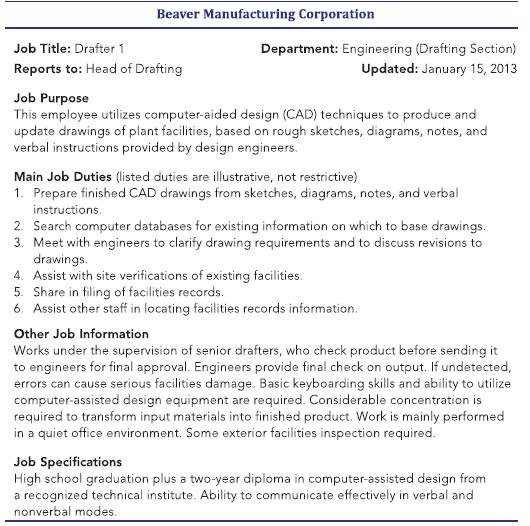
2. To see how information for job analysis is collected, apply a position analysis questionnaire to your most recent job. To find the form to use, go to http://www.asu.edu/hr/documents/PAQuestionnaire.pdf. Beaver Manufacturing Corporation Job Title: Drafter 1 Reports to: Head of Drafting Job
1. To trace through the steps required to create a gender-neutral job evaluation system that complies with Ontario Pay Equity legislation, go to http://www.payequity.gov.on.ca/en/resources/elearn/index.php.
5. Discuss the general process for conforming to pay equity legislation. Does legislating pay equity seem like a good idea to you?
4. Discuss the issue of red-circled employees and the way they should be handled. Assume that your current or most recent employer has developed a new pay structure and that 20 percent of current employees are above their new maximum pay ranges. How should you deal with this problem?
3. Discuss the key issues in managing the job evaluation process.
2. Discuss the advantages and disadvantages of job analysis.
1. Discuss the purpose of job evaluation and the main steps in conducting job evaluation.
Describe the general process for conforming to pay equity legislation.
Describe the key issues in managing the job evaluation process.
Identify and briefly describe the five main methods of job evaluation.
Prepare useful job descriptions.
Describe the process for job analysis and the key steps in that process.
Explain the purpose of job evaluation and the main steps in the job evaluation process.
2. Using the five-step compensation strategy formulation process (Figure 6.1), formulate a compensation strategy for production workers in the "Multi- Products Corporation" case in the Appendix and summarize it using a strategic template similar to that shown in Figure 6.2. Justify your
1. Susan Superfit, CEO in "The Fit Stop" case in the Appendix, has hired you to formulate a compensation strategy for her firm. Using the five-step compensation strategy formulation process (Figure 6.1), formulate such a strategy, and summarize it using a strategic template similar to that shown in
3. Canada Chemicals Corporation has decided to move to a high-involvement managerial strategy and has hired you as a consultant to implement that process. Aside from the compensation strategy, what other changes need to be made if this conversion is to succeed? Is there any way to increase the
2. You are a prominent compensation consultant and you have been hired by the board of directors of Canada Chemicals Corporation to recommend a compensation strategy for the firm's top executives. In your report, be sure to provide the reasoning for each of your recommendations, along with the
1. In your role as CEO of Canada Chemicals Corporation (described earlier in the chapter), you have just finished formulating a new compensation strategy for sales engineers. It occurs to you that given your movement toward high-involvement management, your firm may also need a new compensation
2. To what extent do you think employees in different occupations are attracted by different workplace characteristics? What about employees in the financial services industry, such as banking or insurance? Go to the Towers Perrin website, What Employees Really Want, at
1. How do the employment standards in your province vary from those in other provinces? Go to the Human Resources and Skills Development Canada (HRSDC) website, Employment Standards Legislation in Canada, at http://srv116.services.gc.ca/dimt-wid/sm-mw/rpt1 .aspx?lang=eng#ftb2-ref, and compare the
4. Discuss specific considerations in deciding whether to adopt a lead, lag, or match compensation level policy.
3. Discuss and explain the five main steps in the compensation strategy formulation process (Figure 6.1). Which do you think is the most difficult step?
2. Discuss the constraints that set the parameters for the compensation strategy.
1. Managers need to possess four key understandings in order to formulate an effective compensation strategy. Discuss how each understanding contributes to effective compensation strategy formulation.
Discuss the special issues involved in compensating contingent workers, executives, and international employees.
Explain how to evaluate a compensation strategy prior to implementation.
Apply the compensation strategy formulation process to specific organizations.
Describe utility analysis and explain how it can be used.
Discuss the considerations in deciding whether to adopt a lead, lag, or match compensation-level policy.
Explain the compensation strategy formulation process and describe each step.
Showing 400 - 500
of 1030
1
2
3
4
5
6
7
8
9
10
11
Step by Step Answers

 Get 50% OFF
Claim Now
Get 50% OFF
Claim Now