New Semester
Started
Get
50% OFF
Study Help!
--h --m --s
Claim Now
Question Answers
Textbooks
Find textbooks, questions and answers
Oops, something went wrong!
Change your search query and then try again
S
Books
FREE
Study Help
Expert Questions
Accounting
General Management
Mathematics
Finance
Organizational Behaviour
Law
Physics
Operating System
Management Leadership
Sociology
Programming
Marketing
Database
Computer Network
Economics
Textbooks Solutions
Accounting
Managerial Accounting
Management Leadership
Cost Accounting
Statistics
Business Law
Corporate Finance
Finance
Economics
Auditing
Tutors
Online Tutors
Find a Tutor
Hire a Tutor
Become a Tutor
AI Tutor
AI Study Planner
NEW
Sell Books
Search
Search
Sign In
Register
study help
business
understanding management
Quantitative Techniques In Management 4th Edition N D VOHRA - Solutions
16. With same inputs of annual demand, ordering/set up cost, and holding cost, the economic lot size in the build-up model is greater than economic order quantity in the classical EOQ model.Mark the statement as T (True) or F (False).
17. In the inventory model applicable to production runs, the production rate,p, must be greater than the demand rate, d.Mark the statement as T (True) or F (False).
18. An increase in set-up cost per production run leads to a decrease in the economic lot size.Mark the statement as T (True) or F (False).
19. For economic lot size, the total set-up cost need not be equal to the total holding cost.Mark the statement as T (True) or F (False).
20. It is permissible to incur both holding and shortage costs in the same inventory model.Mark the statement as T (True) or F (False).
21. The inventory model with planned shortages is applicable only when back-ordering is possible.Mark the statement as T (True) or F (False).
22. If back-ordering is allowed, the shortage cost can be an important cost component in the inventory model.Mark the statement as T (True) or F (False).
23. The total variable cost in the planned shortages model is split evenly between ordering cost on the one hand and holding cost and shortage cost on the other.Mark the statement as T (True) or F (False).
24. The economic order quantity increases with an increase in the back-ordering cost.Mark the statement as T (True) or F (False).
25. The total variable cost for the planned shortages model would be greater than that for the classical EOQ model because of the inclusion of an additional component of shortage cost.Mark the statement as T (True) or F (False).
26. The economic order quantity for the planned shortages model would be greater than that for the classical EOQ model with the same input data.Mark the statement as T (True) or F (False).
27. As the holding cost becomes large in relation to the back-ordering cost, the number of units backordered would be large.Mark the statement as T (True) or F (False).
28. The four inventory models are deterministic in nature.Mark the statement as T (True) or F (False).
29. Under the assumptions made in the inventory models, the stock is always replenished at the designated time and no safety stock is needed.Mark the statement as T (True) or F (False).
30. A 100% customer service level requires an amount of safety stock determined as follows:Safety Stock= maximum DDL T - expected DDL T Mark the statement as T (True) or F (False).
31. Where demand during lead time is assumed to be normally distributed with a certain mean and standard deviation, the service level corresponding to a given safety stock level shall be equal to the area under the normal curve to the left of the re-order point. Mark the statement as T (True) or F
32. Both mean and standard deviation are necessary to be known for determining the service level corresponding to a given amount of safety stock, when the DDL T is given to be normally distributed. Mark the statement as T (True) or F (False).
33. The system of periodic reviews generally requires larger provisions for safety stock than does the fixed order quantity system. Mark the statement as T (True) or F (False).
34. The Ss system embodies the re-order feature of the fixed order quantity system and variable order quantity characteristic of the periodic review system. Mark the statement as T (True) or F (False).
35. The Ss system requires high safety stock volumes. Mark the statement as T (True) or F (False).
36. In ABC analysis, the inventory items are classified into three categories on the basis of their usage quantities. Mark the statement as T (True) or F (False).
37. The A-category items are those which fall in steep-rise segment of the curve ofmal-distribution. Mark the statement as T (True) or F (False).
38. The VED analysis deals with classification of items on the basis of their availability. Mark the statement as T (True) or F (False).
39. HML classifies items accordingly as they are high-usage, medium-usage or low-usage. Mark the statement as T (True) or F (False).
40. FNSD is the speed classification of items, accordingly as they are fast-moving, normal-moving, slowmoving and dead items. Mark the statement as T (True) or F (False).
1. What are different types of inventories? Explain
2. What functions does inventory perform? State the two basic inventory decisions management must make as they attempt to accomplish the functions of inventory just described by you.
3. Distinguish between the fixed order quantity system and the periodic review system. Also explain the Ss system.
4. With the help of quantitY-cost curve, explain the significance of EOQ. What are the limitations of using the formula for an EOQ?
5. Discuss the assumptions underlying the basic EOQ formula. Also, state the economic order quantity model, discuss its sensitivity, and explain its major extensions.
6. (a) Give the different motives to keep inventory in an organisation. Do You consider hoarding as inventory?(b) Give the role of inflation and credit system in inventory management.
7. "Although the classical inventory decision model, known as the EOQ model, is too oversimplified to represent many of the real-world situations, it is an excellent starting point to develop more realistic and complex inventory decision models." In the light of this statement, explain the major
8. (a) Explain, in detail, what constitutes the ordering cost and carrying cost. Draw a rough sketch to show the movement of these two cost curves in opposite directions with increase in the order quantity.(b) What is a re-order point? Draw a rough sketch of a simple inventory model showing the
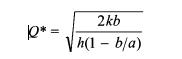
9. Discuss, in brief, the costs associated with inventory management. Derive the formula for EOQ, Q*.where, k = ordering cost per set-up h = holding cost of unit per time b = usage rate per unit of time a= production rate per unit of time (a;;::: b). 10* = 2kb h(1 - b/a)
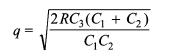
10. In a certain manufacturing situation, the production is instantaneous and the demand per day is R.Show that the optimal order quantity q per run which minimises that total cost is,where, C1 is the cost of holding one unit of inventory per day C2 is the unit cost of shortage per day C3 is the
11. What are the relevant costs for inventory decisions? How are they obtained in real life situations?
12. "An important characteristic of the EOQ model is the robustness which draws from the fact that the total cost curve is relatively flat at the bottom." In light of this, investigate the sensitivity of the model by considering the effect of a 30 per cent change ( on either side) in order quantity
13. 'EOQ models, however complex, are restricted by so many assumptions that they have very limited practical value.' Do you agree with this statement? Illustrate your answer.
14. (i) The annual demand for an item of inventory is D units, ordering costs are B rupees per order, transportation costs per order (irrespective of the number of units transported) is Trupees, annual interest charges are x % of the value of inventory, insurance and warehousing charges amount to y
15. What is 'safety stock'? Why should it be kept by an organisation?
16. State whether the following statements are correct. Give reasons:(i) Safety stock increases as demand increases.(ii) In ABC analysis high cost items are most likely to fall in category A, and least cost items are likely to fall in Category C.(iii) To protect against stockouts, a large batch
17. Discuss the marginal analysis to the determination of the optimal ordering size. In what conditions is it employed?
18. Explain the basics of selective inventory control and state different selection techniques adopted in Inventory Control System. Give a brief note on each. (JCWA, December, 1983)
19. (a) "ABC analysis is a very useful approach for selective inventory control but has some major limitations."Do you agree with this statement? Explain how these limitations, if anY, can be overcome.(b) Explain the concept of the Q-sYstem, the P-sYstem and the Two-Bin system for management of
20. Define selective inventory control. Explain the ABC, VED, HML, SDE, S-OS, and FSN bases of inventory classification. Are they mutually exclusive?
1. A company has determined from its analysis of production and accounting data that, for a part number KC-438, the annual demand is equal to 10,000 units, the cost to purchase the item is Rs 36 per order, and the holding cost is Rs 2/unit/year.Determine(a) What should the Economic Order Quantity
2. A factory follows an economic order quantity system for maintaining stocks of one of its component requirements. The annual demand is for 24,000 units, the cost of placing an order is Rs 300, the component cost is Rs 60 per unit. The factory has imputed 24% as the inventory carrying rate.(i)
3. (a) For an item, the annual demand is known to be 3,000 units which is uniformly distributed over the year. The unit cost of the item is Rs 300 and the holding cost is 10% of the value. It costs Rs 450 to place an order for this product.Determine(i) the economic ordering quantity, EOQ,(ii) the
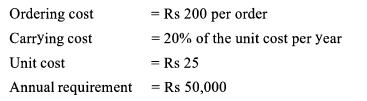
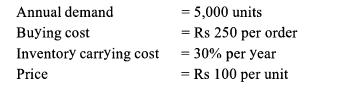
4. (a) Determine EOQ from the following data:(b) Now, if the annual requirement becomes as large as Rs 200,000 (i.e. 4 times the demand), would the EOQ become four times as large as obtained in (a)? Why? Ordering cost Carrying cost Unit cost = Rs 200 per order 20% of the unit cost per year = Rs 25
5. The following is the general information and information pertaining to a product component TT-4 used by Kay Engineering Works:Required:(a) calculate the EOQ for the component TT-4, (b) calculate the percentage change in total annual variable costs ( of ordering and holding) relating to the
6. A company uses a certain component at the rate of 8,000 units per year. Each component part is valued at Rs 18. The company estimates that the cost of holding inventory is 20% of the value of the item, per year. The company has the option to produce the part on either of the two machines, A or
7. The daily demand for a product is approximately 100 units. The ordering cost per order is Rs 100 and the average daily holding cost per unit is 2 paise. If the lead time is 14 days, determine the economic lot size for placing an order and also the re-order level.If the lead time is reduced to 7
8. Fill in the blanks:For your calculations, assume the number of working days in the year equal to 250. Item Annual demand Ordering cost Unit holding cost Lead time EOQ Re-order level (units) (Rs) (Rs) ABC 8,000 15 0.06 10 days ? ? ? 40 0.18 6 days ? 216 7,500 ? 30.00 ? 300 210
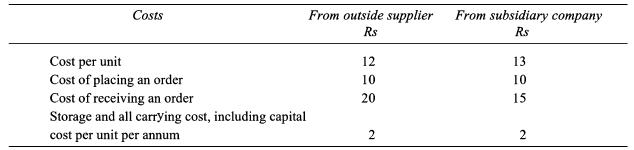
9. The annual demand of a particular item used by a company is 10,000 units. This item may be obtained from either an outside supplier or subsidiary company. The relevant data for the procurement of the item are given below:(i) What purchase quantity and from which source should you recommend to
10. The Heavy Nitro Company is considering the optimal batch size for re-order of concentrated sulphuric acid. The management has supplied the following information:The purchase price ofH2S04 is Rs 2 per gallon. The clerical and data processing costs are Rs 10.625 per order. All the transport is
11. (a) Finance managers regularly deal with the problem of determining the optimal level of cash to keep in hand. Consider a company that has regular cash needs during a period. The problem for the finance manager of this company is to determine the optimal amount of new funds to obtain from
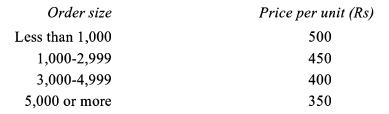
12. The Purchase Manager of Sigma Company is contacted by a new supplier who offers a quantity discount on an item KR-100 being used by the company. The ordering cost is Rs 80 per order and the holding cost 25 per cent of the average inventory value, on a yearly basis. The annual demand for this
13. A purchase manager has decided to place an order for a minimum quantity of500 units ofa particular item of inventory in order to get a discount of 10%. Past records reveal that last year 8 orders ( each of 200 units) were placed. Given the ordering cost= Rs 500 per order, inventory carrying
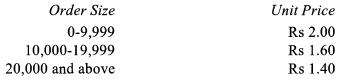
14. Obtain the optimal order quantity using the information given here:Annual requirement: 1 million units Ordering and processing cost: Rs 28.80 per order Holding cost: 20% of the unit cost Price Schedule: Order Size 0-9,999 10,000-19,999 Unit Price Rs 2.00 Rs 1.60 20,000 and above Rs 1.40
15. The annual demand for an item of inventory is 2400 units. The order processing costs amount to Rs 350 per order. Inventory holding costs are estimated to be 2 per cent per month of the value of inventory. The normal price of the product is Rs 10 per unit. However, the supplier offers a quantity
16. A shopkeeper has a uniform demand of an item at the rate of 50 units per month. He buys the item from the supplier at the cost of Rs 6 per unit and the cost of placing an order is Rs 10 every time. If the stock holding cost is 20% p.a. of the stock value, how frequently should he replenish his
17. The Honolulu Company has a contract to supply 5,000 units of an item per year to a dealer. For this item, the company estimates that the ordering cost is Rs 150 every time that an order is made while the carrying cost (p.a.) is reckoned to be 20 per cent of the unit price.The company is
18. A manufacturing company of microwave ovens uses Rs 75,000 worth of LED readout circuits annually in its production process. Cost per order is Rs 45, and the carrying charge assessed against this classification of inventory is 25% of the average balance per year. This company follows an EOQ
19. For one of the A-class items, the following data are available:The purchase manager has placed an order for 500 items in the beginning of the year availing 5%discount. At the beginning of the seventh month he procured 250 items without any discount. At the beginning of the eighth month he
20. (a) In respect of a component costing Rs 10 each, the annual demand is known to be 5,000 units. The cost of placing an order is Rs 200 and the total holding cost is 20% of the average inventory investment.Determine,(i) the most economical order size,(ii) the optimal number of orders during a
21. An item sells for Rs 4 per unit but 10% discount is offered on lots of 150 units or more. A manufacturing unit that consumes this item at the rate of 20 items per day wants to decide whether or not to take advantage of the discount. The setup cost for ordering a lot is Rs 50 and the holding
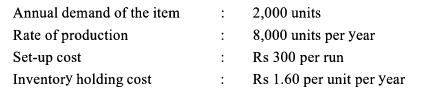
22. The annual demand for a product is 1,00,000 units. The rate of production is 2,00,000 units per year.The set-up cost per production run is Rs 5,000 and the variable production cost of each item is Rs 10.The annual holding cost per unit is 20% of its value. Find the optimum production lot size
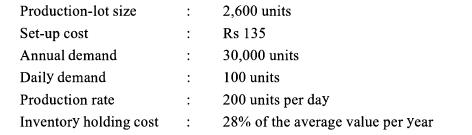
23. A company is presently having a production run of 500 units every 3 months. He is considering a review of its production-lot size decision. The relevant information is given below:Would you recommend a change in the current production-lot size? Why?What will be the cost saving, if anY, as a
24. Kobo Bearing Limited is committed to supply 24,000 bearings per annum to Mis Deluxe Fans on a daily basis. It is estimated that it costs 10 paise as inventory holding cost per bearing per month and that the set-up cost per run of bearing manufacture is Rs 324.(a) What should be the optimal run
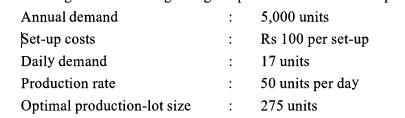
25. You are given the following information regarding the production-lot size of a particular product:Rising interest rates and other costs have caused a 10% increase in the annual holding costs. Determine the new optimum production lot size for the product. (M Com, Delhi, 1995) Annual demand :
26. The Clean-Well Company of India has introduced a new detergent KIN of which it can produce 20,000 packs per month of20 working days. The annual demand for this detergent is forecasted to be 1,92,000 packs, at a uniform rate. The set-up cost for the production of KIN is Rs 1,080 while the
27. Company A wants to know that production cost its major competitor, Company B, has assigned to product item P7• After a bit of investigation, Company A has collected the following data about company B's production of item P 7:Company A has further learnt that company B produces according to
28. A manufacturer of food processors has annual sales of 20,000 units. The manufacturer operates 250 days a year and produces 200 units per day. The setup cost is Rs 600 for a production run. The food processors cost Rs 400 to produce. The inventory holding cost fraction is 0.025 per year.(a) What
29. An item used by a company may be purchased from a supplier for Rs 32 per unit or manufactured in its plant at a rate of 10,000 units per annum, for Rs 30 per unit. If the item is purchased, the ordering cost is Rs 12 per order while if it is produced internally, the set-up cost per production
30. A manufacturing company needs 2,500 units of a particular part every year. The company buys it at the rate of Rs 30 per unit. The cost of placing an order for the part is estimated at Rs 15 and the cost of carrying a part in stock comes to about Rs 4 per year.The company can manufacture the
31. The demand of an item is uniform at a rate of 20 units per month. The fixed cost is Rs 10 each time a production run is made. The production cost is one rupee per item and the inventory carrying cost is Re 0.25 per item per month. If the shortage cost is Rs 15 per item per year, determine how
32. (a) A retailer gets discount for large orders. The discount is 4 per cent if the quantity ordered is 500 or more, and an additional 1 per cent discount is received if the quantity ordered is 1,000 or more. The product costs Rs 50 and sells uniformly at the rate of 2,500 per year. The fixed
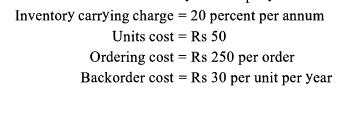
33. A furniture dealer sells special typist chairs. Each purchase order costs Rs 50 to the dealer and the holding costs amount to Rs 80 per chair per Year. The dealer sells 90 chairs per month. He had estimated a back-ordering cost of Rs 20 per chair per Year.(i) What is the EOQ for the chair?(ii)
34. The manager of a company is facing an inventory problem with regard to an item whose demand is known to be evenly distributed with an annual value of 8,000 units. The cost of placing an order is Rs 50 while the annual carrying cost of one unit in inventory is Rs 5. Because of the high carrying
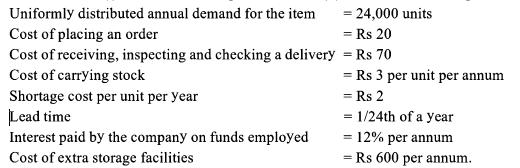
35. Using the relevant data from the following information, calculate economic order quantity and reorder level when (i) stockouts are not permitted, and (ii) when stockouts are permitted Uniformly distributed annual demand for the item Cost of placing an order = 24,000 units = Rs 20 Cost of
36. A dealer supplies you the following information with regard to a product dealt with by him:The dealer is considering the possibility of allowing some back-orders to occur for the product. He has estimated that the annual cost of back-ordering ( allowing shortage of) the product will be Rs 10
3 7. Higley Radio Components Company has a product for which the assumptions of the inventory model with backorders are valid. information obtained by the company is as follows:Calculate (i) economic order quantity; (ii) maximum stock level; (iii) maximum number of units back-ordered; and (iv)
38. The annual requirement of a commodity is 3,000 units, the cost of placing an order is Rs 300 and the cost of carrying an item in inventory for one year is Rs 20.(a) Determine the EOQ.(b) Determine the re-order level if the number of working days in a year is 300 and the lead time is 15 days.(c)
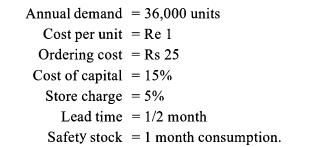
39. Obtain (i) Economic Order Quantity, (ii) Number of orders, (iii) Re-order level, (iv) Safety stock, for the following inventory problem: Annual demand = 36,000 units Cost per unit = Re 1 Ordering cost Rs 25 Cost of capital 15% = Store charge = 5% 1/2 month Lead time Safety stock 1 month
40. The daily demand for an electronic machine is approximately 25 items. EverYtime an order is placed, a fixed cost of Rs 25 is incurred. The daily holding cost per item inventory is Re 0.40. If the lead time is 16 days, determine the economic lot size and re-order point. (JCWA, December, 1986)
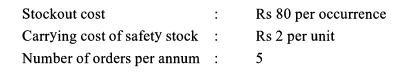
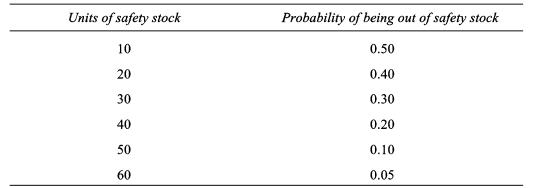
41. A company purchases a component from another factory. Based on the past records, the EOQ for the component is 3,600 units, with an average usage of50 units a day. The normal lead time is 6 days and the carrying cost per unit is Rs 10 per year. The cost of being out-of-stock for this component
42. A company is using fixed-order quantity system of inventory management. For one of the items, the re-order quantity is 400 units and the re-order level is 350 units. The weekly demand of the product is known to be normally distributed with a mean of 100 units and a standard deviation equal to
43. The daily demand for a component assembly items is normally distributed with a mean of 90 and a standard deviation of 10 units. Further, the source of supply is dependable and maintains a constant lead time of five days. If the cost of placing the order is Rs 30 and the annual holding costs are
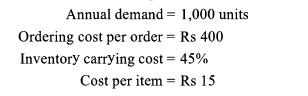
44. (a) The following information relates to the Beta company:Units required per annum = 30,000 Cost of placing an order = Rs 400 Carrying cost = Rs 600 per unit per annum.Assuming that the demand for the product is uniformly distributed throughout the year, what is the EOQ?(i) 200, (ii) 300, (iii)
45. Auto Care Limited provides several auto parts to local garages in a small city. The company purchases parts from manufacturers in accordance with the EOQ model and sends the parts from its regional warehouse direct to its customers. For a particular part, the analysis recommends orders with EOQ
46. A firm with an annual demand of approximately 3,000 units has an ordering cost of Rs 30 per order and a holding cost of Rs 8 per unit per year. The demand exhibits some variability such that the lead time demand follows normal distribution withμ= 120 units and a= 20 units.(a) What is the
4 7. An item is ordered by New Star Manufacturing Company in quantities of five thousand units at a time.The cost price of the item is Rs 4 per unit. The average weekly demand for this item is 400 units with a mean absolute deviation (MAD) of250 units. The lead time is known to be equal to 2 weeks
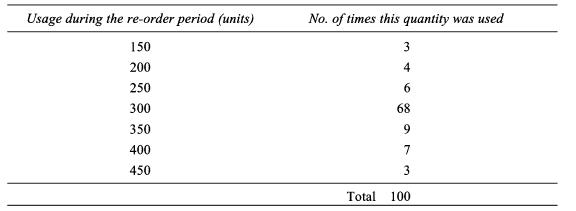
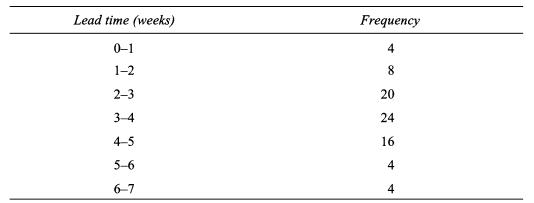
48. The distribution oflead time in respect of a certain component is given in the following table:The management of the company wishes to set safety stock level that would ensure that the risk of being out of stock for reason of delayed delivery should be no more than 10%. Assuming that the demand
49. The daily demand of an item VP-100 is known to be normally distributed with a mean of 20 units and MAD of 5 units. For the item, the lead time is 9 days. You are required to determine:(a) the re-order point corresponding to a 50% service level,(b) the service level corresponding to a zero
50. A company uses a component for which its forecast of usage is normally distributed with MAD= 40 units. The company management adopts a policy which limits the stockouts to be no more than one order cycle during a year.(i) How much safety stock should be kept if the order quantity is generally a
51. A ship building company has launched a programme for the construction of a new class of ships.Certain spare units like prime mover, each costing Rs 2,00,000 have to be purchased. If these units are not available when needed, a very serious loss is incurred, which is of the order of Rs 10,00,000
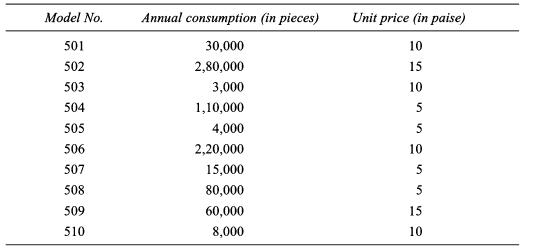
52. The following information is known about a group ofitems. Classify the materials in ABC classification: Model No. Annual consumption (in pieces) Unit price (in paise) 501 30,000 10 502 503 2,80,000 3,000 15 10 504 505 506 1,10,000 4,000 2,20,000 5 5 10 507 15,000 508 80,000 509 60,000 15 510
53. What is selective inventory control? From the following details, draw a plan of ABC selective control Item Units ('000): : 1 2 3 4 5 6 7 89 10 11 12 7 24 1.5 0.6 38 40 Unit cost : 5 3 10 22 1.5 0.5 0.2 6:2 60 3 0.3 29 11.5 4.1 3.5 8 0.4 7.1 6.2
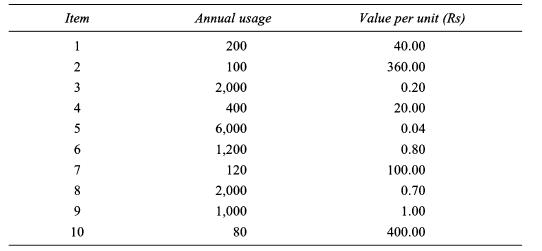
54. Ten items kept in inventory by the School of Management Studies at State University are listed below.Which items should be classified as 'A' items, 'B' items and 'C' items? What percentage of items is in each class? What percentage of total annual value is in each case? Item Annual usage Value
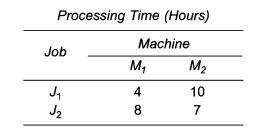
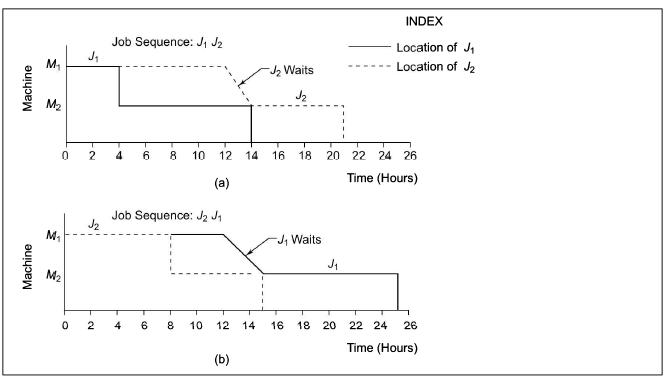
Suppose that there are two jobs J1 and J2, each requiring work on two machines M1 and M2, in this order, with the required processing times given as follows:What order of performance of the jobs will involve the least time?For processing the two jobs, two orders are possible J1-J2 and J2-J1. Both
Showing 1800 - 1900
of 7324
First
12
13
14
15
16
17
18
19
20
21
22
23
24
25
26
Last
Step by Step Answers

 Get 50% OFF
Claim Now
Get 50% OFF
Claim Now