New Semester
Started
Get
50% OFF
Study Help!
--h --m --s
Claim Now
Question Answers
Textbooks
Find textbooks, questions and answers
Oops, something went wrong!
Change your search query and then try again
S
Books
FREE
Study Help
Expert Questions
Accounting
General Management
Mathematics
Finance
Organizational Behaviour
Law
Physics
Operating System
Management Leadership
Sociology
Programming
Marketing
Database
Computer Network
Economics
Textbooks Solutions
Accounting
Managerial Accounting
Management Leadership
Cost Accounting
Statistics
Business Law
Corporate Finance
Finance
Economics
Auditing
Tutors
Online Tutors
Find a Tutor
Hire a Tutor
Become a Tutor
AI Tutor
AI Study Planner
NEW
Sell Books
Search
Search
Sign In
Register
study help
business
understanding management
Quantitative Techniques In Management 4th Edition N D VOHRA - Solutions
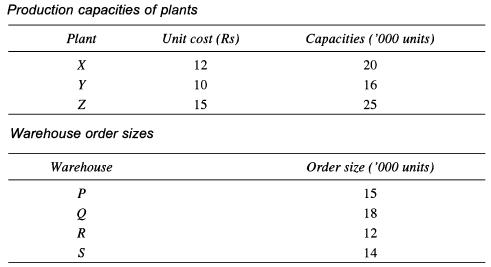
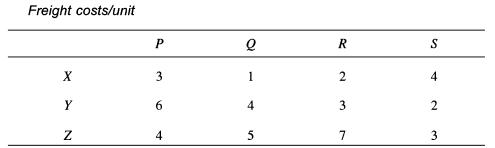
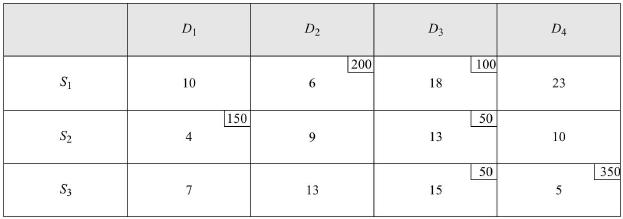
5. The data relating to production capacities of plants, orders from warehouses and freight costs for a company manufacturing consumer products are given below:From the above information, determine the optimum distribution for minimising the total costs to make and ship the product to warehouses.
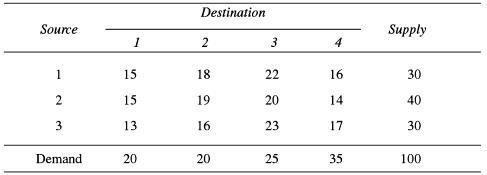
Solve the following transportation problem:Is the optimal solution obtained by you a unique one? If not, why? What are the alternate optima then? Destination Source Supply 1 2 3 4 1 2 15 3 553 15 18 19 13 16 896 22 16 30 20 14 40 23 17 30 Demand 20 20 20 25 35 100
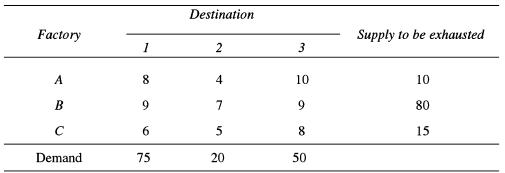
Consider the following data for the transportation problem:Since there is not enough supply, some of the demands at the three destinations may not be satisfied.For the unsatisfied demands let the penalty costs be rupees 4, 5 and 6 for destinations (1), (2) and (3), respectively. Find the optimal
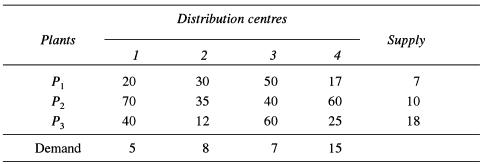
8. A company is spending Rs 1,200 on transportation of its units from three plants to four distribution centres. The supply and demand of units with unit cost of transportation are given as under:What can be the maximum saving by optimal scheduling? Distribution centres Plants Supply 1 2 3 4 P 20
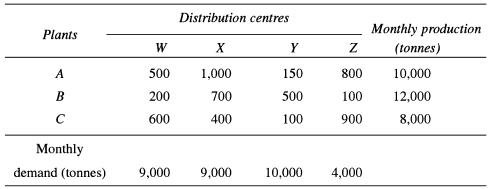
9. A company has three cement plants from which cement has to be transported to four distribution centres. With identical costs of production at the three plants, the only variable costs involved are transportation costs. The monthly demand at the four distribution centres and the distance from the
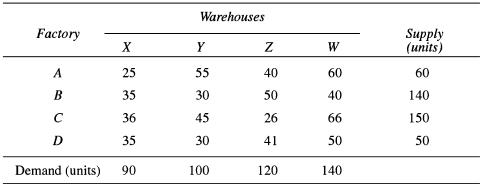
10. A company has four factories manufacturing the same commodity, which are required to be transported to meet the demands in four warehouses. The supplies and demands as also the cost per transportation from factory to warehouse in rupees per unit of product are given in the following table:(a)
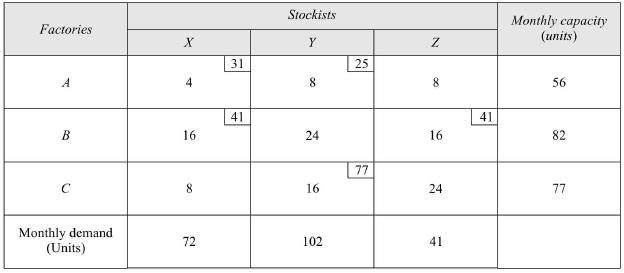
11. The table given below has been taken from the solution procedure of a transportation problem, involving minimisation of cost (in rupees):(i) Show that the above solution in not optimal.(ii) Find an optimal solution.(iii) Does the problem have multiple optimal solutions? Give reasons. If so,
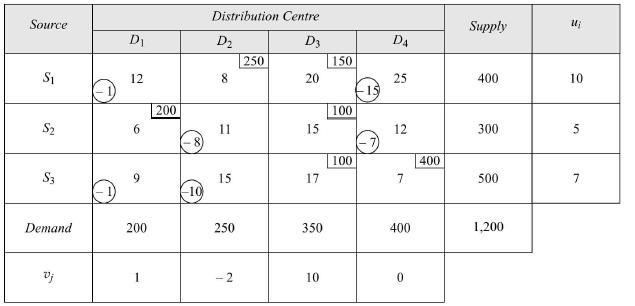
12. The following table gives one of the possible solutions to a transportation probelm involving three sources and four destinations:(i) Is the above solution degenerate?(ii) Is the above solution optimal? Is it a unique solution? If yes, why?(iii) What is the opportunity cost of transporting one
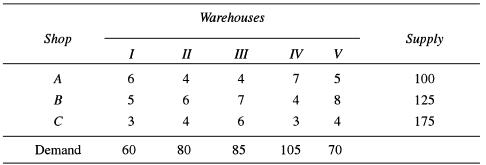
13. ABC Limited has three production shops supplying a product to five warehouses. The cost of production varies from shop to shop and cost of transportation from one shop to a warehouse also varies.Each shop has a specific production capacity and each warehouse has certain amount of
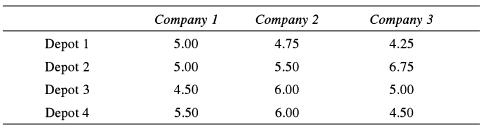
14. The purchase manager, Mr Shah of the State Road Transport Corporation must decide on amounts of fuel to buy from three possible vendors. The corporation refuels its buses regularly at four depots within the area of its operations.The three oil companies have said that they can furnish up to the
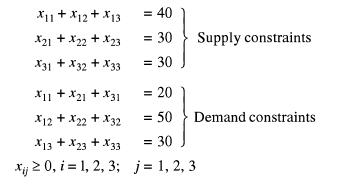
15. Given:MinimiseSubject to(a) Formulate and solve it as a transportation problem for optimal transportation pattern.(b) Write the dual of the transportation problem and, from this, verify the objective function value obtained in (a) above. Z = 12x11+8x12+2x13+9x21 + 10x22+9x23+7x31 + 15x32 + 6x33
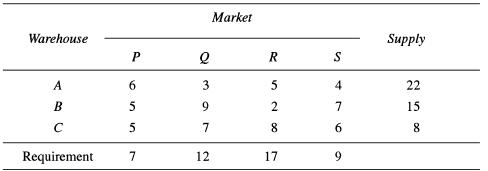
16. The following table shows all necessary information on the availability of supply to each warehouse, the requirement of each market and the unit transportation cost from each warehouse to each market:The shipping clerk has worked out the following schedule from experience: 12 units from A to Q,
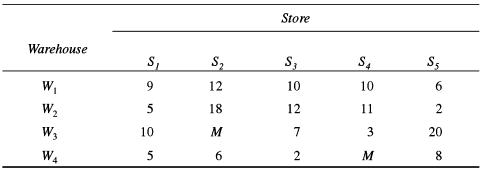
17. A company has four warehouses and five stores. The warehouses have total surplus of 430 units of a given commodity that is divided among them as follows:The five stores have, in all, a requirement of 450 units of the commodity. Individual requirements are:Cost of shipping one unit from the ith
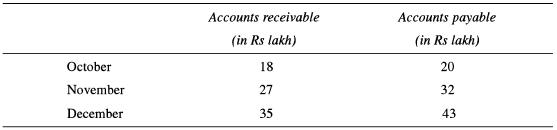
18. A firm is faced with a short-term cash flow problem, which would necessitate obtaining a loan from its bank. The bank loan will be used to balance the cash inflows from accounts receivable and cash outflows from accounts payable, which are estimated as follows:It may be assumed that both
19. A transportation problem involving three sources and four distribution centres is presented in the following table.You are required to answer the following questions:(a) Is the solution feasible?(b) Is the solution degenerate?(c) Is the solution optimal? Is it unique? Why?(d) What is the
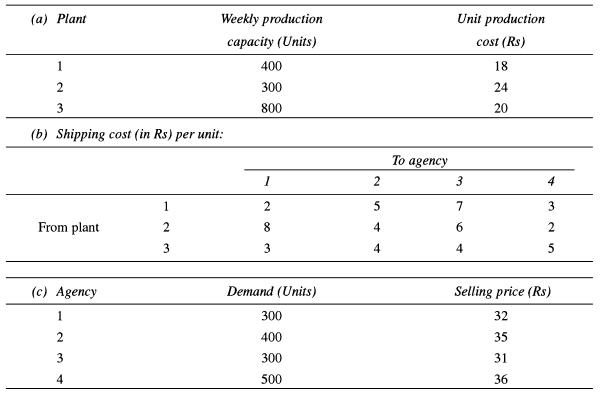
20. A company has three plants in which it produces a standard product. It has four agencies in different parts of the country where this product is sold. The production cost varies from factory to factory and the selling price from market to market. The shipping cost per unit of the product from
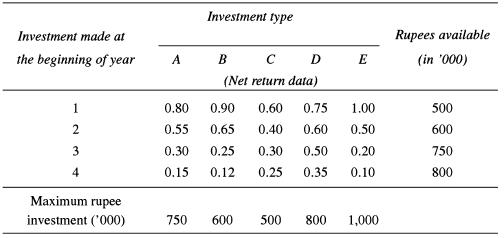
21. A company wishes to determine an investment strategy for each of the next four years. Five investment types have been selected, investment capital has been allocated for each of the coming four years, and maximum investment levels have been established for each investment type. An assumption is
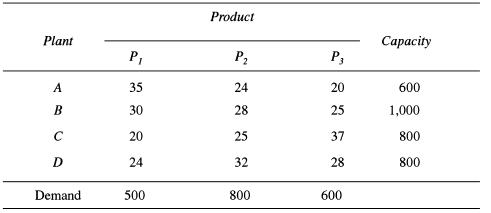
22. A company is producing three products P 1, P 2 and P 3 at two of its plants situated in cities A and B. The company plans to start a new plant either in city Corin city D. The unit profits from the various plants are listed in the table, along with the demand for various products and capacity
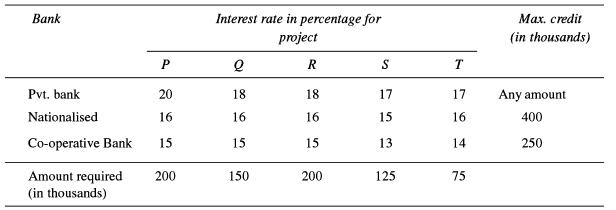
23. Stronghold Construction Company is interested in taking loans from banks for some of its projects, P, Q, R, S, T. The rates of interest and the lending capacity differ from bank to bank. All these projects are to be completed. The relevant details are provided in the following table. Assuming
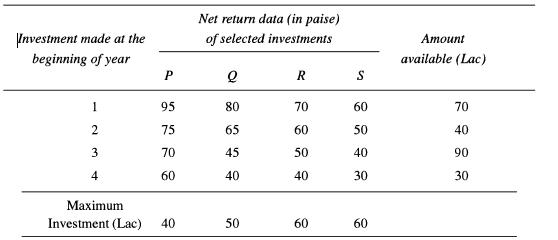
24. XYZ and Co has provided the following data seeking your advice on optimum investment strategy:\The following additional information is also provided:(i) P, Q, R and S represent the selected investments.(ii) The company has decided to have four years' investment plan.(iii) The policy of the
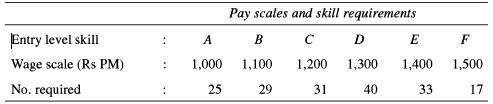
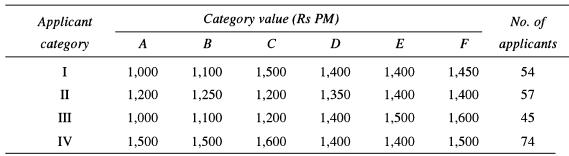
25. The personnel manager of a manufacturing company is in the process of filling 175 jobs in six different entry level skills due to the establishment of a third shift by the company. Union wage scales and requirements for the skills are shown in the following table:Two hundred and thirty
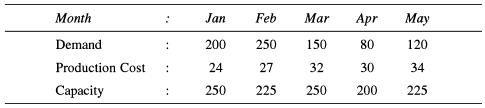
26. The demand and production costs vary from month to month in an industry. The following table contains budgeted information of a firm in this industry on the quantity demanded, the production cost per unit and the production capacity in each of the coming five months.It is known that the
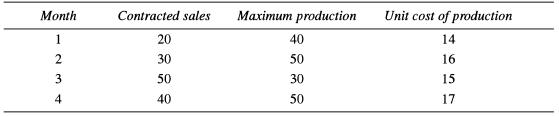
27. A manufacturer must produce a product in sufficient quantity to meet contractual sales in the next four months. The production capacity and unit cost of production vary from month to month. The product produced in one month may be held for sale in later months, but at an estimated storage cost
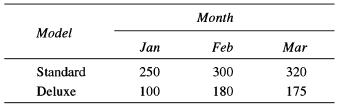
28. A company produces two models of a product: Standard and Deluxe. The production cost of the standard model during normal working hours is Rs 400, while the deluxe model costs Rs 750. It is possible to produce both these models through overtime working at a unit cost of Rs 450 and Rs 820,
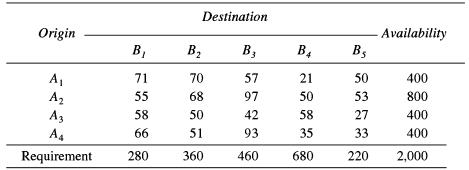
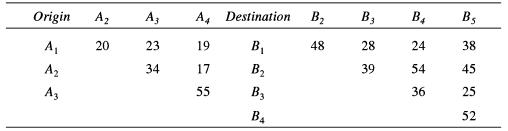
29. (a) Find optimal solution to the transportation problem given in the following table:(b) For the problem given in (a), assume that transhipment will be allowed from any origin to another origin and from any destination to another destination or origin. The unit transportation costs between
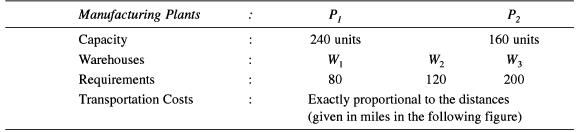
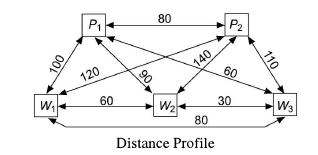
30. Using the information given here, determine the optimal solution under the assumption (a) that interplant and inter-warehouse transfers are not allowed, and (b) that the units may be transhipped. Manufacturing Plants Capacity Warehouses Requirements Transportation Costs : P 240 units W 80 W 120
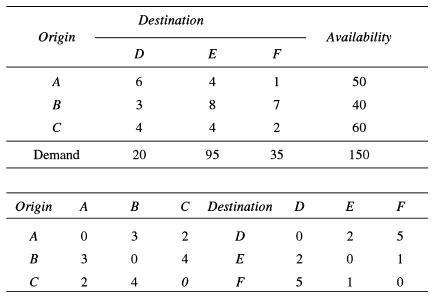
31 . Solve the following transhipment problem for minimum cost: Destination Origin Availability D E F A 6 4 1 B 3 00 8 7 450 50 40 4 4 2 60 Demand 20 20 95 35 150 Origin A B C Destination D A 0 B 3 30 2 D 4 E C 2 4 0 F 5 1 0 025 E F 2 5 0 1
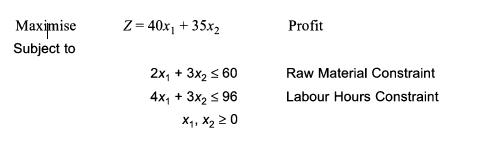
Consider the linear programming problem given Maximise Subject to Z=40x + 35x2 Profit 2x + 3x2 60 4x + 3x2 96 Raw Material Constraint Labour Hours Constraint
A firm produces three products A, B, and C, each of which passes through three departments:Fabrication, Finishing and Packaging. Each unit of product A requires 3, 4 and 2; a unit of product B requires 5, 4 and 4, while each unit of product C requires 2, 4 and 5 hours respectively in the three
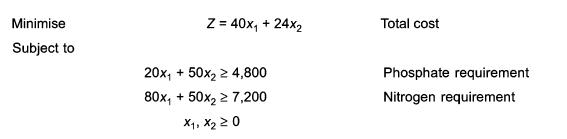
The solution procedure for the linear programming problems that have the objective function of the minimisation type, is similar to the one for the maximisation problems, except for some differences. To illustrate, let us consider Minimise Subject to Z = 40x + 24x2 Total cost 20x +50x2 4,800 80x
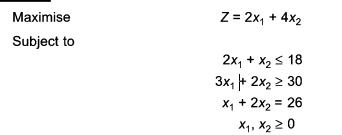
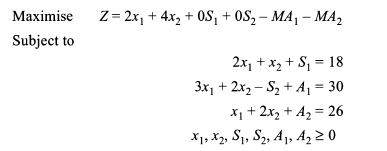
Solve the following LPP.After introducing the necessary slack, surplus, and artificial variables, the augmented problem is given here: Maximise Subject to Z=2x Z = 2x + 4x2 2x + x2 18 3x + 2x2 30 X + 2x2 = 26 X1, X2 0
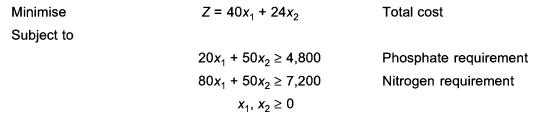
Solve the problem given in Example 3.3 by using the two-phase method. The problem is: Minimise Subject to Z = 40x + 24x2 20x+50x2 4,800 80x +50x227,200 X1, X20 Total cost Phosphate requirement Nitrogen requirement
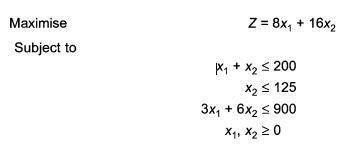
Solve this problem using simplex algorithm Maximise Subject to Z = 8x + 16x2 Xx + x2 200 S X2 125 3x + 6x2 900 X1, X2 0
Apply simplex algorithm, to determine which variable would be the outgoing variable, when a non-optimal solution is sought to be improved, we select the row which has the smallest non-negative replacement ratio, b/a;p If, in a certain situation, there are no non-negative replacement ratios (so that
Degeneracy in a LPP occurs when one or more of the basic variables assume a value of zero. As stated already, for a n-variable, m-constraint problem, there would be m basic and n - m non-basic variables, and the basic variables would assume positive values. However, in case a basic variable assumes
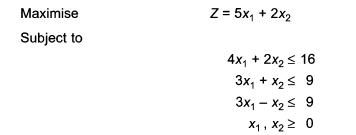
Solve the problem given below, both graphically and using simplex method. Maximise Subject to Z = 5x + 2x2 4x + 2x2 16 3x + x29 3x1-X2 9 X1, X2 0
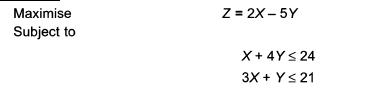
Consider the following linear programming model: Maximise Subject to Z=2X-5Y X+ 4Y 24 3X + Y 21
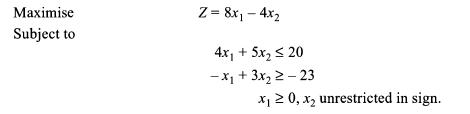
Solve the following LPP: Maximise Subject to Z=8x-4x2 4x + 5x2 20 -x + 3x2 -23 x 0, X2 unrestricted in sign
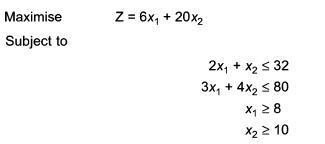
Solve the following LPP: Maximise Z=6x + 20x2 Subject to 2x + x2 32 3x + 4x2 80 X 8 X2 10
A finished product must weigh exactly 150 grams. The two raw materials used in manufacturing the product are A, with a cost of Rs 2 per unit and B with a cost of Rs 8 per unit. At least 14 units of Band not more than 20 units of A must be used. Each unit of A and B weighs 5 and 10 grams
Ashok Chemicals Company manufactures two chemicals A and B which are sold to the manufacturers of soaps and detergents. On the basis of the next month's demand, the management has decided that the total production for chemicals A and B should be at least 350 kilograms. Moreover, a major customer's
A firm uses three machines in the manufacture of three products. Each unit of product A requires 3 hours on machine 1, 2 hours on machine II and one hour on machine Ill. Each unit of product B requires 4 hours on machine I, one hour on machine II and 3 hours on machine 111, while each unit of
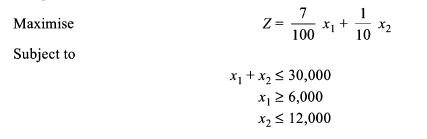
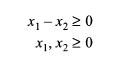
Reconsider the problem given in Example 2.19. Solve it using the simplex method. Hence, show that each simplex tableau containing a feasible solution corresponds to a corner point of the feasible region obtained graphically.The LPP is reproduced below: Maximise Subject to 7 1 Z x1 + 100 10 x1 + x2
A company produces three products, P1, P2 and P3 from two raw materials A and B, and labour L One unit of product P1 requires one unit of A, 3 units of B and 2 units of L One unit of product P2 requires 2 units of A and Beach, and 3 units of L, while one unit of P3 needs 2 units of A, 6 units of
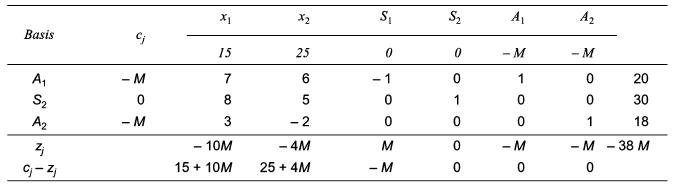
From the following initial simplex tableau:Write down the original problem represented by the above tableau.Find out the optimal solution of this problem. Is it a unique solution? Why? x1 x2 S S A A Basis Cj 15 25 0 0 -M - M A - M 7 6 -1 0 1 0 20 S 0 8 5 0 1 0 0 30 A2 Zj - M 3 -2 0 0 0 1 18 -10M -
1. The simplex method is an iterative process which involves the substitution of variables for obtaining successively better solutions. Mark the statement as T (True) or F (False).
2. To solve a linear programming problem by Simplex method, it is essential that all variables in it be non-negative. Mark the statement as T (True) or F (False).
3. Solution by Simplex method requires that an LPP should have no negative values in the righthand-sides of the constraints. Mark the statement as T (True) or F (False).
4. For solving a linear programming problem by the Simplex method, it is necessary that any unrestricted variables are first replaced by non-negative variables. Mark the statement as T (True) or F (False).
5. For solving an LPP by Simplex method, all the constraints involving inequalities should be converted into equations by introducing slack/surplus variables. Mark the statement as T (True) or F (False).
6. In a maximisation problem, there is never a need to introduce artificial variables. Mark the statement as T (True) or F (False).
7. If a variable in an LPP is a free variable, it may be replaced by the difference of two non-negative variables. Mark the statement as T (True) or F (False).
8. In solving a linear programming problem, every constraint which involves an equality should be replaced equivalently by a pair of inequalities. Mark the statement as T (True) or F (False).
9. In improving a non-optimal solution, the key element may be positive, negative or zero. Mark the statement as T (True) or F (False).
10. An LPP may have a feasible solution although an artificial variable appears with a positive value in the final solution to the problem. Mark the statement as T (True) or F (False).
11. If the slack variable corresponding to a resource appears in the basis of the Simplex tableau containing optimal solution to an LPP, it is bound to have 111 = 0. Mark the statement as T (True) or F (False).
12. In solution to an LPP by the Simplex method, once a variable is designated as an outgoing variable and it leaves the basis, it cannot re-enter the basis. Mark the statement as T (True) or F (False).
13. Successive solutions obtained in the Simplex algorithm always Yield higher and higher values of Z. Mark the statement as T (True) or F (False).
14. In order to decide upon the outgoing variable in a Simplex tableau giving a non-optimal solution, the least non-negative replacement ratio is selected. Mark the statement as T (True) or F (False).
15. In the Simplex method, the optimal solution to a minimisation LPP is reached only when all 11/s(= c1 - z) are found positive.Mark the statement as T (True) or F (False).
16. Surplus variables cannot appear in the basis of the optimal solution to an LPP. Mark the statement as T (True) or F (False).
17. The Big-M method and the Two-Phase method require the same number of iterations for solving a linear programming problem. Mark the statement as T (True) or F (False).
18. The artificial variables serve as catalysts in obtaining (optimal) solution to an LPP. Mark the statement as T (True) or F (False).
19. An artificial variable column can be dropped for further calculations once the artificial variable involved becomes non-basic. Mark the statement as T (True) or F (False).
20. For each of the basic variables in a given solution, whether optimal or not, the 111 equals zero. Mark the statement as T (True) or F (False).
21. The solution to a maximisation LPP is unique if 111 < 0 for each of the non-basic variables. Mark the statement as T (True) or F (False).
22. The maximisation of a function Z is equivalent to the minimisation of G = - Z with the same constraints except that min G = max - Z. Mark the statement as T (True) or F (False).
23. If the outgoing variable does not correspond to the least non-negative replacement ratio, at least one basic variable would become negative in the next iteration. Mark the statement as T (True) or F (False).
24. A linear programming problem may have no optimal solution, one optimal solution, multiple optimal solutions or unbounded solution. Mark the statement as T (True) or F (False).
25. Multiple optimal solutions to an LPP would all have the same objective function values and would consume the same amount of each of the resources. Mark the statement as T (True) or F (False).
26. In the optimal solution, if a basic variable has a solution value equal to zero, then multiple optimal solutions are indicated. Mark the statement as T (True) or F (False).
27. If an LPP has an unbounded solution space, the objective function value will always be unbounded. Mark the statement as T (True) or F (False).
28. The optimal solution to a profit maximising LPP always implies maximum profit obtainable from the given resources and a full utilisation of them all. Mark the statement as T (True) or F (False).
29. If a certain solution to an LPP is degenerate and non-optimal, the next solution would necessarily be degenerate. Mark the statement as T (True) or F (False).
30. If the non-negative replacement ratios are tied, then multiple optimal solutions are indicated. Mark the statement as T (True) or F (False).
1. Explain the concept and computational steps of the simplex method for solving linear programming problems. How would you identify whether an optimal solution to a problem obtained using simplex algorithm is unique or not?
2. (a) What is the difference between a feasible solution, a basic feasible solution, and an optimal solution of a linear programming problem?(b) What is the difference between simplex solution procedure for a 'maximisation' and a'minimisation' problem?(c) Using the concept of net contribution,
3. Outline the steps involved in the simplex algorithm for solving a linear programming maximisation problem. Also define the technical terms used therein.
4. What is the difference between slack, surplus, and artificial variables? How do they differ in their structure and use?
5. State the conditions required for applying simplex method to a linear programming problem. How do we proceed in a case when both of these are not met?
6. In solving a linear programming problem by simplex method, explain how you would move from a given basic feasible solution to another basic feasible solution with an improved value of the objective function.
7. How are key column and key row determined in a simplex tableau containing a non-optimal solution?How would you proceed if a tie is obtained in either of them?
8. Describe the two-phase method for solving the linear programming problems.
9. Consider each of the following statements and state whether it is true or false. In case it is false, write the correct statement.(i) Each inequality constraint in a linear programming problem adds only one variable, when it is solved by the simplex method.(ii) All the slack, surplus and
10. Explain and graphically illustrate infeasibility and unboundedness. How can each of these be detected while applying simplex technique?
11. 'In a given problem, the value of objective function improves with successive iterations.' Is there any exception to this? Explain clearly.
12. Define the following and indicate their significance to decision-making with linear programming and the simplex method:(a) Key column, (b) Key row, (c) Degeneracy, (d) Cycling, and (e) Multiple optima.
13. Consider the following statements and state, in each case, whether it is true or false. In case the statement is false, state the correct position:(i) The addition of a new constraint in a linear programming problem can improve the value of the objective function.(ii) In the simplex method, any
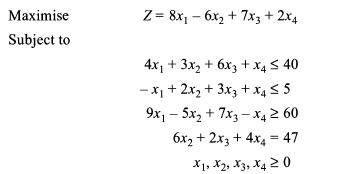
1. Rewrite the following LPP in standardised form for application of simplex method: Maximise Subject to Z=8x16x2+7x3 + 2x4 4x1 + 3x2+6x3 + x440 -x+2x2 + 3x3 + x 5 9x15x2+7x3x4 60 6x2+2x3 + 4x4 = 47 X1, X2, X3, X40
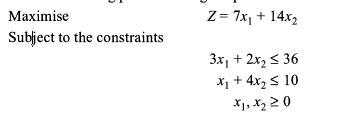
2. Solve the following problem using simplex method: 5 Maximise Subject to the constraints Z=7x + 14x2 3x + 2x2 36 x + 4x2 10
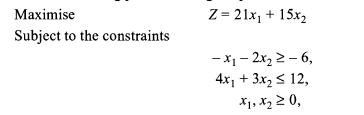
3. Solve the following problem using simplex method: Maximise Z=21x1 + 15x2 Subject to the constraints -x1-2x2-6, 4x1 + 3x2 12, x1,x20
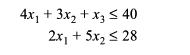
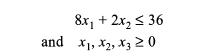
4. Maximise Subject to Z=20x130x2+5x3
5. Solve the following linear programming problem using simplex method: Maximise Subject to Z=8x-4x2 4x +5x 20 -x+3x2-23 x0, x unrestricted in sign.
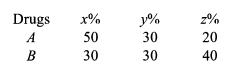
6. A pharmaceutical company produces two popular drugs A and B which are sold at the rate of Rs 9.60 and Rs 7 .80, respectively. The main ingredients are x, y and z and they are required to the following proportions:The total available quantities (gm) of different ingredients are 1,600 in x, 1,400
7. A company makes two kinds ofleatherbelts. Belt A is a high quality belt, and beltB is oflower quality.The respective profits are Rs 20 and Rs 15 per belt. Each belt of type A requires twice as much time as belt of type B, and if all belts were of type B, the company could make 1,000 per day. The
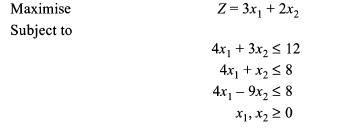
8. Show that the following linear programming problem is temporarily degenerate: Maximise Subject to Z=3x+2x2 4x1 + 3x2 12 4x1 + x28 4x-9x2 8 10
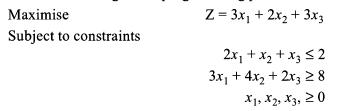
9. Solve the following linear programming problem:Is there any alternate optimal solution to this problem? Maximise Subject to constraints Z=3x+2x2+3x3 2x1 + x2 + x 2 3x+4x2+2x328 X1, X2, X3, 20
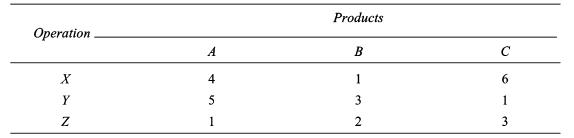
10. A factory produces three different products viz. A, Band C, the profit (Rs) per unit of which are 3, 4 and 6 respectively. The products are processed in three operations viz. X, Yand Zand the time (hour)required in each operation for each unit is given below:The factory works 25 days in a
11. A manufacturer of baby dolls makes three types of dolls: Doll A, Doll B, and Doll C. Processing of these dolls is done on three machines, M1, M2 and M3• Doll A requires 2 hours on machine M1 and 3 hours on machine M3• Doll B requires 3 hours on machine M1, 2 hours on machine M2 and 2 hours
12. A factory engaged in the manufacturing of pistons, rings and valves for which the profits per unit are Rs 10, 6 and 4, respectively, wants to decide the most profitable mix. It takes one hour of preparatory work, ten hours of machining and two hours of packing and allied formalities for a
Showing 2100 - 2200
of 7324
First
15
16
17
18
19
20
21
22
23
24
25
26
27
28
29
Last
Step by Step Answers

 Get 50% OFF
Claim Now
Get 50% OFF
Claim Now