New Semester
Started
Get
50% OFF
Study Help!
--h --m --s
Claim Now
Question Answers
Textbooks
Find textbooks, questions and answers
Oops, something went wrong!
Change your search query and then try again
S
Books
FREE
Study Help
Expert Questions
Accounting
General Management
Mathematics
Finance
Organizational Behaviour
Law
Physics
Operating System
Management Leadership
Sociology
Programming
Marketing
Database
Computer Network
Economics
Textbooks Solutions
Accounting
Managerial Accounting
Management Leadership
Cost Accounting
Statistics
Business Law
Corporate Finance
Finance
Economics
Auditing
Tutors
Online Tutors
Find a Tutor
Hire a Tutor
Become a Tutor
AI Tutor
AI Study Planner
NEW
Sell Books
Search
Search
Sign In
Register
study help
business
understanding management
Quantitative Techniques In Management 4th Edition N D VOHRA - Solutions
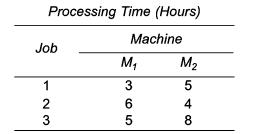
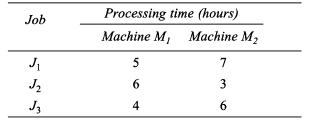
Three jobs, 1, 2 and 3, are to be processed on two machines M1 and M2 in the order~ for which the processing times are given below.In what sequence should the jobs be performed so that the elapsed time, T, is the least? Processing Time (Hours) Job Machine M M2 548 365 123
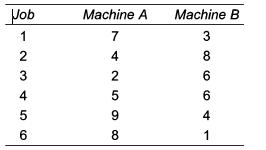
In a factory, there are six jobs to perform, each of which should go through two machines A and B, in the order AB. The processing timings (in hours) for the jobs are given here. You are required to determine the sequence for performing the jobs that would minimise the total elapsed time, T. What
Ten jobs are required to be processed on two machines M1 and M2 in the order 'M1 followed by M2'. Processing times are given here. Determine the optimal sequence(s) and evaluate for total elapsed time.(a) Minimum time is 2 hours each for jobs J2 and J7 on machine M2. So rank J7 in the end, preceded
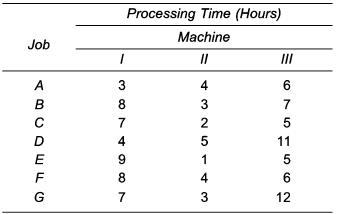
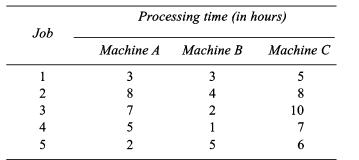
You are given the following data regarding the processing times of some jobs on three machines,/, II and Ill. The order of processing is I-II-Ill. Determine the sequence that minimises the total elapsed time (7) required to complete the jobs. Also evaluate T and the idle time of II and Ill.
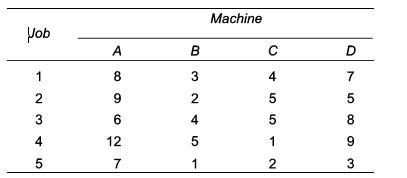
Determine the optimal sequence of performing 5 jobs on 4 machines. The machining of each job is required in the order ABCD and the process timings are as follows:Here Min A;= 6, Max B; = 5, Max C; = 5 and Min D; = 3.Also since Min A;> Max B;, Max C; the first of the conditions is satisfied.
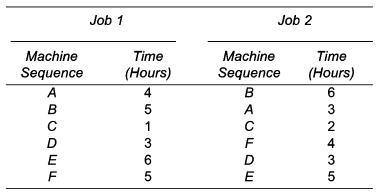
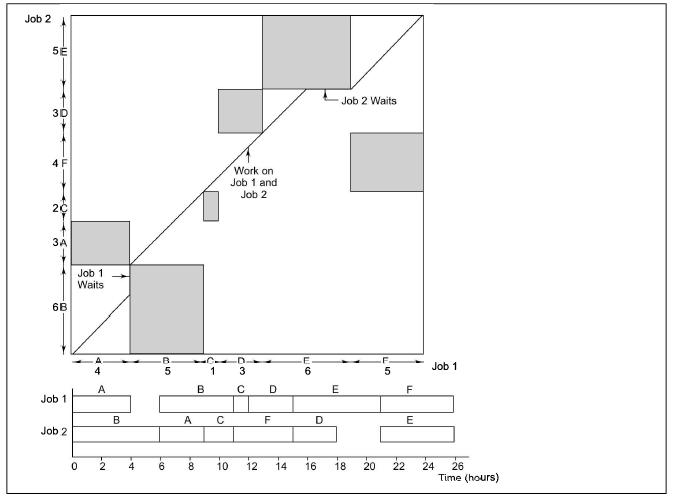
Using graphical method, determine the minimum time needed to process the two jobs on six machines. The information about the machine sequence and the time required by each job on each machine is given here. Job 1 Job 2 Time Machine Time Sequence (Hours) Machine Sequence (Hours) A 4 B 6 BCDE F
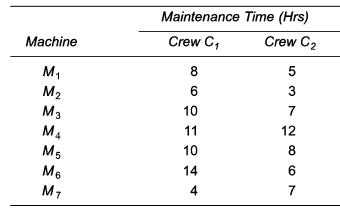
The maintenance crew of a company is divided in two groups, C1 and C2, which cares for the maintenance of the machines. Crew C1 is responsible for replacement of parts which are worn out while crew C2 oils and resets the machines back for operation. The times required by crews C1 and C2 on
A company plans to fill six positions. Since the positions are known to vary considerably with respect to skill and responsibility, different types of aptitude tests and interviews are required for each.While the aptitude tests are conducted by people from the clerical positions, the job interviews
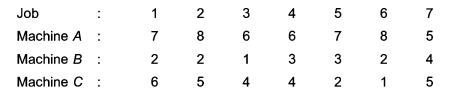
A firm works 40 hours a week and has a capacity of overtime work to the extent of 20 hours in a week. It has received seven orders to be processed on three machines A, B, and C, in the order A, B, C to be delivered in a week's time from now. The process times (in hours) are recorded in the given
Find the sequence that minimises the total elapsed time required (T) in completing the following jobs. Each job is processed in the order ABC. Also, calculate T. Job 1 Machine A 10 Machine B : Machine C 160 8 7925 6146 5030 6 4551 3265 2847 10 9
10. In a two-machine sequencing problem, if the lowest times are both on the second machine and they are tied for jobs, say 2 and 7, then the job 2 should be done in the end while job 7 in the first place.Mark the statement as T (True) or F (False).
9. The principle used for processing optimally certain jobs on two machines can be summarised as follows:Job j precedes job j + 1 if Min (A1, B1 + 1) < Min (A1+ 1, B).Mark the statement as T (True) or F (False).
8. Since the times that the different jobs take on different machines are known and constant, it makes no difference as to in what order are they performed.Mark the statement as T (True) or F (False).
7. Total elapsed time is determined by the point of time at which the first of then jobs goes to machine A until the point on which the last job comes off machine B.Mark the statement as T (True) or F (False).
6. Ten jobs required to be performed on three machines A, B and C, in that order, can be performed in 3,628,800 ways.Mark the statement as T (True) or F (False).
5. Gantt Chart provides a very effective technique for solving large-sized sequencing problems.Mark the statement as T (True) or F (False).
11. Every sequencing problem must have a unique optimal solution.Mark the statement as T (True) or F (False).
4. The optimal sequence for an n-job, 2-machine problem implies that the sequence of performance of jobs which would ensure their completion in the minimum time as well as minimisation of idle time on the second machine.Mark the statement as T (True) or F (False).
3. In sequencing problems involving n jobs and 3 machines, the algorithm is based on the assumption that each of the jobs requires processing on three machines in the same order.Mark the statement as T (True) or F (False).
12. There is no general solution available for solving sequencing problems involving processing of n jobs through 3 machines.Mark the statement as T (True) or F (False).
2. First-come-first-served basis of job performance is the ideal one since it involves a sense of fair play.Mark the statement as T (True) or F (False).
1. In sequencing problems, the effectiveness is a function of the order in which the given tasks are performed. Mark the statement as T (True) or F (False).
13. In an n-job, 3-machine sequencing problem, if the minimum times on the first and the third machines are both equal to or greater than the maximum time on the second machine, then the problem can be solved by a standard method.Mark the statement as T (True) or F (False).
14. If Min A;~ MaxB;orMin C;~ MaxB; or both, then the problem is replaced by an equivalent problem involving n jobs and 2 fictitious machines G and H, where G; =A;+ B; and H; = B; + C;,Mark the statement as T (True) or F (False).
15. Ifan n-job, 3-machine sequencing problem is solved as a two-machine problem, then the total elapsed time, T, whether obtained from the 3 machines or the two fictitious machines data would be the same.Mark the statement as T (True) or F (False).
16. If some jobs are processed on K machines in the order A, B, C, ... , K, then a standard method can be employed when Min A; ~ Max B; ~ Max C; ~ ... ~ Max J; and/or Min K; ~ Max B; ~ Max C; ~ ...~MaxJ;,Mark the statement as T (True) or F (False).
17. Sequencing problems involving processing of 2 jobs on K machines can be solved graphically.Mark the statement as T (True) or F (False).
18. In case of sequencing problems involving 2 jobs on K machines, it is necessary that the processing of the two jobs must be in the same order.Mark the statement as T (True) or F (False).
19. A 45-degree line on a graph, where two jobs are shown on the two axes, indicates simultaneous work on the jobs.Mark the statement as T (True) or F (False).
20. Maintenance crew scheduling problems can also be programmed as sequencing problems.Mark the statement as T (True) or F (False).
1. (a) What is a sequencing problem? Explain and illustrate.(b) What assumptions are generally made in solving sequencing problems?
2. Give the various sequencing models that are available for solving sequencing problems. Give suitable examples.
3. How would you use Gantt chart for solving sequencing problems? Why is it not employed for solving larger problems?
4. How does the sequencing technique help the manager? Draw a flow chart to show the method of solution of sequencing problems.
5. Explain the general method for solving sequencing problem where n jobs are required to be processed on a pair of machines, with the machining to be done on all the jobs in the same order.
6. State the condition(s) to be satisfied in order to apply the algorithm used in solving sequencing problems involving processing of n jobs on 2 machines, to the problems involving processing of n jobs on 3 machines. Also explain the method of solution in such cases.
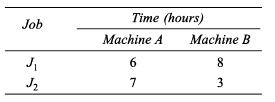
1. The following are the timings in regard to two jobs J1 and J2, each of which requires to be processed on two machines A and Bin the order 'A following B'. In what sequence should they be performed so that the total processing time involved is the least? Also obtain the time involved.Use
2. Use Gantt chart technique to obtain the sequence in which the three jobs J, J2, and J3 should be performed on two machines M, and M for completion in the minimum time. The machining is to be done in the order M-M, and the timings are given in the following table. Job 555 Processing time (hours)
3. Determine the optimal sequencing of jobs from the following data and obtain the value of T, the total elapsed time involved:Processing order for all jobs is M1-M2• 8 3 8 9 746 655 7 5 6 567 +484 362 Job Machine M: Machine M: 1 238 878 2 3 8 8 2
4. Find the sequence that minimises the total elapsed time required to complete the following tasks on machines M1 and M2, in the order M1, M2• Also, find the minimum total elapsed time. 126 858 Task A B M M D 893 160 142 4 E 6 F G 013 689 7 H58 4 11
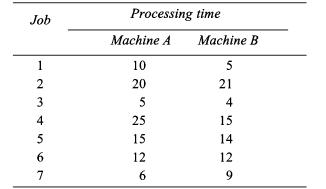
5. Seven jobs are required to be processed through two machines A and B. The processing time (in hours)of each jobs on the two machines is given below:Suggest optimal sequence of processing the jobs and total minimum elapsed time. Processing time Job Machine A Machine B 1234567 10 5 20 21 5 4 25 15
6. A company has categorised its investment proposals into seven types. The financial analysts are needed to analyse the risk and return characteristics of these types. Then the proposals are examined by a committee for approval. The time that the analysts and the committee take is based on the
7. There are six jobs which must go through two machines A andB in the order A-B. Processing time (in hours) is given here:Determine the optimum sequence and the total elapsed time. Job : Machine A: Machine B 8 7 187 205 3 11 10 421 5 6 12 16 20 14 13 9
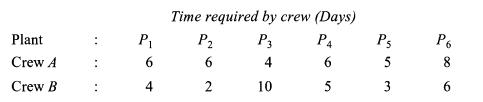
8. A refrigeration company has six plants located in different parts of a city. Every Year, it is necessary for each plant to be completely overhauled. The overhauling is carried out in two stages A and B, and each stage requires a crew of workmen with completely different skills. The work on stage
9. A book-binder has one printing press, one binding machine and the manuscripts of a number of different books. The time required to perform the printing and binding operations for each book are shown as follows:Determine the order in which the books should be processed in order to minimise the
10. A lathe operator has to perform two operations, turning and knurling, on a number of different jobs.The time required to perform these operations (in minutes) for each job is known. Determine the sequence in which the jobs should be processed in order to minimise the total time required to tum
11. Find the sequence that minimises the total elapsed time required to complete the following jobs. Each job is processed in the order A CB. : 4273 12 Jobs Time on Machine A Time on Machine B: Time on Machine C: J2 1804 9 3722 11 4065 10 10 3002 6 16544
12. With the help of the following example, describe the algorithm for solving an 'n-job, 3-machines'sequencing problem: Processing time (in hours) Job Machine A Machine B Machine C 34215 38752 12345 3 3 5 8 2 10 7 6
13. There are five jobs, each of which must go through machines A, Band C in the order ABC. Processing times (in hours) are given below:Determine the optimal processing sequence. Job Machine A (4) Machine B (B) Machine C (C) 5628 4736 3854 2145 6901
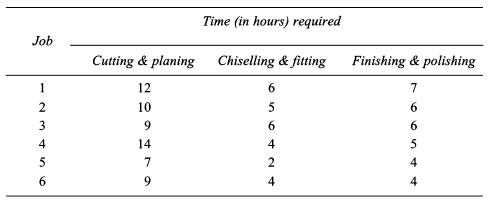
14. A firm has three groups of workers, performing exclusively the jobs of either cutting and planing, or chiselling and fitting, or finishing and polishing. It has received six orders which are to be completed and delivered at the earliest. The orders are marked as 1, 2, ... , 6, in the sequence
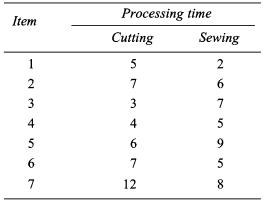
15. A readY-made garments manufacturer has to process 7 items through two stages of production, viz.cutting and sewing. The time taken by each of these items at the different stages are given in appropriate units.(a) Find an order in which these items are to be processed so as to minimise the total
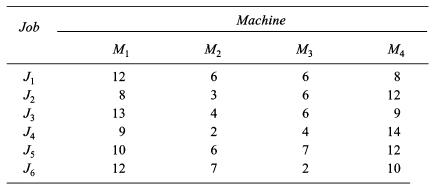
16. Sixjobs,J1,J2, ••• , J6, are required to be processed on four machines, M1, M2, M3 and M4, in that order.Using the processing times given below, determine the optimal sequence(s) of job performance. Machine Job M M M3 M4 J 555458 12 6 6 2 8 3 6 82 12 13 4 6 9 JA 9 Js J6 02 10 12 267 4 7
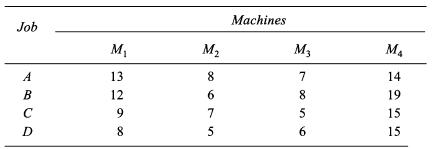
17. Solve the following sequencing problem, giving an optimal solution, if passing is not allowed. Machines Job M M M3 Ma ABCD 13 8 7 14 12 6 8 19 9 7 5 15 8 5 6 15
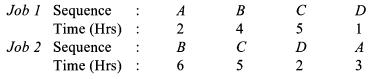
18. Using graphical method, find the minimum elapsed time to perform jobs J1 and J2 on machines A through D, the sequence and process timing for which are given as follows: Job 1 Sequence Time (Hrs): Job 2 Sequence Time (Hrs): 42 A B 4 B C 6 5 7552 C D 1 D A 3
19. Determine the least time in which the two jobs can be performed on the eight machines. The processing times and the machine sequence for the jobs are given here: . HSHA GH 5 F 1419 4 G 276 D E F E7E4 D5D4 A C543 B4B6 A C 1695 Job Machine sequence Time (Hours) Job 2 Machine sequence Time (Hours)
20. Two jobs, A and B, are to be processed on 6 machines. The sequence of machines and the processing times are given in the following tableWhat is the minimum time in which both the jobs can be completed? Job A Machine sequence Time (Hours) Job B Machine sequence Time (Hours) : M M M3 M4 Ms M6 6 4
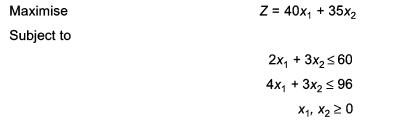
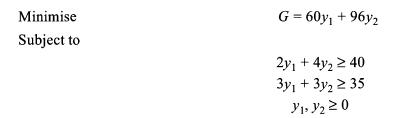
For the LPP given in Example 3.1 reproduced below, write the dualIn accordance with above, its dual shall beObserving a little closely, we find that(a) the primal problem is of the maximisation type while the dual is of the minimisation type.(b) the constraint values 60 and 96 of the primal have
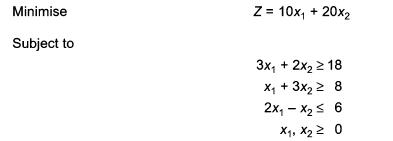
Write the dual of the following LPP: Minimise Subject to Z = 10x + 20x2 3x + 2x2 18 X + 3x28 2x - X2 6 X1, X2 0
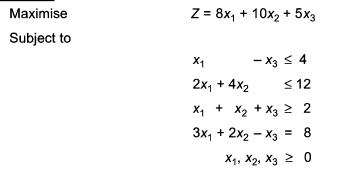
Obtain the dual of the LPP given here: Maximise Subject to Z=8x+10x2+5x3 X -X3 4 2x + 4x2 12 X + x2 + X3 2 3x 2x2 x3 = 8 + - X1, X2, X3 0
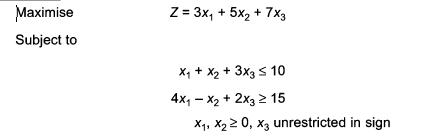
Obtain the dual of the following LPP: Maximise Subject to Z=3x + 5x2+7x3 X + x2 + 3x3 10 4x-x2 + 2x315 X1, X220, x3 unrestricted in sign
Given the following linear programming problem and the simplex tableau (Table 4.5)containing the solution to it, (i) formulate the dual to the given problem, and (ii) obtain the solution to the dual from the tableau. Also verify that the objective function values of both the problems are same.
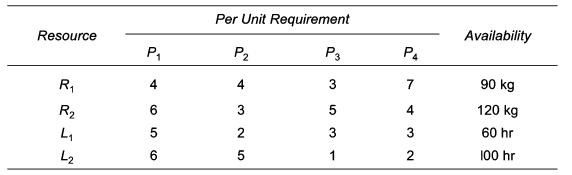
A firm has the choice of producing four similar products: P1, P2, P3 and P4 in any combination. These products have profit rates of Rs 70, 65, 80 and 75, respectively. They all require two types of raw materials R1 and R2, and two types of labour L1 and L2. The per unit requirements and
Consider Example 4.6. Examine whether the current basis (i.e. the one of the optimal(solution) would remain unchanged under each of the two cases:(a) The profit per unit of P1 increases to Rs 90, and the profit per unit of P4 decreases to Rs 62.(b) The unit profit for P1 increases to Rs 110, while
For Example 4.6, determine whether the current basis would change for each of the following cases:(a) The profit per unit of P2 increases to Rs 85, while profit per unit of P3 declines to Rs 70. What is the new optimal value of Z?(b) The profit per unit of P1, P2 and P3 change as follows:P1 : Rs 80
Does the current basis remain optimal in each of the following cases, in context of the Example 4.6?(a) Raw material R2 reduced to 100 kg and labour L2 increased to 150 hours.(b) Supply of raw material R2 increased to 160 kg and labour L2 supply reduced to 80 hours.
In the context of Example 4.6 data, state whether the current basis remains optimal in each of the following two cases:(a) Availability of R1 : 80 kg Availability of L1 : 67 hours(b) Availability of various resources:R1 = 92 kg, R2 = 100 kg, L1 = 65 hours and L2 = 120 hours.
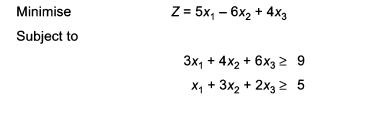
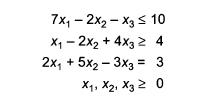
Find the dual problem for the following Minimise Z=5x-6x2+4x3 Subject to 3x + 4x2 + 6x3 9 X+3x2+2x325
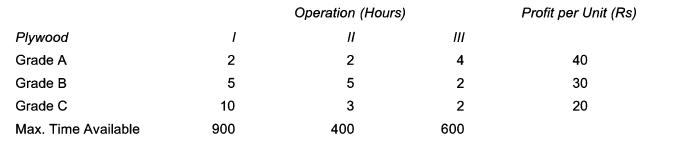
A timber merchant manufactures three types of plywood. The data below give the production hours per unit in each of three production operations, maximum time available, and profit per unitHow many units of each grade of plywood should be produced to maximise the total profit? Write the dual and use
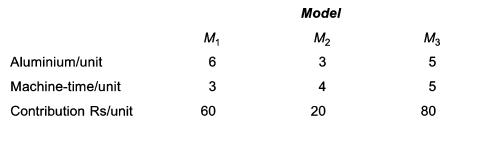
A company manufactures and sells three models of large sized pressure cookers for canteen use. While market demands pose no constraints, supplies of aluminum limited to 750 kgs per week and availability of machine time limited to 600 hours per week restrict the product-mix. The resource usage of
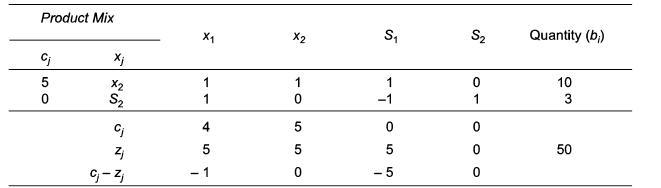
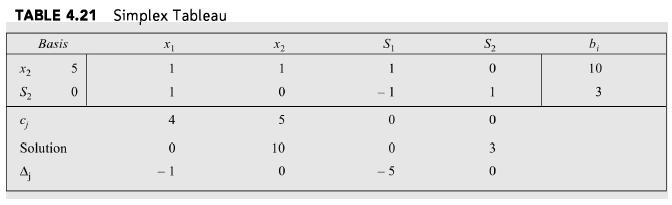
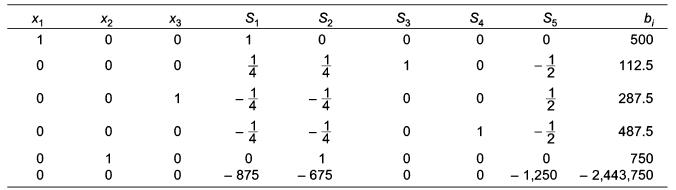
The simplex tableau for a maximisation problem of linear programming is given as follows:Answer the following questions, giving reasons in brief:(a) Is this solution optimal?(b) Are there more than one optimal solutions?(c) Is this solution degenerate?(d) Is this solution feasible?(e) If S1 is
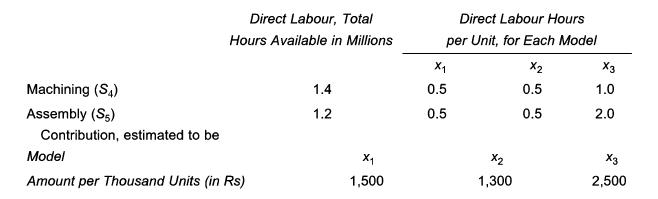
(a) The following details are taken from the forecasts for l 9xx of XYZ Limited.Production: Two production facilities are required, machining and assembly, and these are common to each model. Capacity in each facility is limited by the number of direct labour hours available.Set up the first
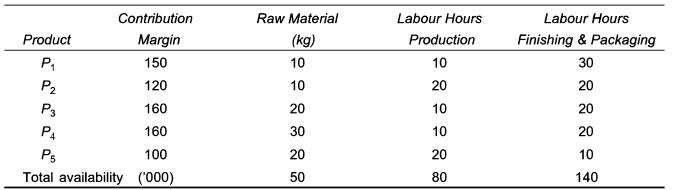
A company has facilities for producing 5 products which require the same raw material and same type of production, finishing and packaging facilities. The unit contribution margin and the material and labour requirements for each of the products are given here:The manager of the company insists
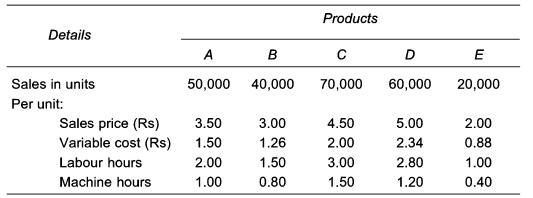
The company, Portland p.l.c. has five products in its range and is currently running the following sales/production programme:This programme fully utilises the availability of labour and machine time.A linear programme reveals that the labour and machine hours have a shadow price of Re 1 and Re
1. It is necessary to convert the equality constraints into inequality constraints for writing the dual to a linear programming problem. Mark the statement as T (True) or F (False).
2. For a 4-variable and 5-constraint primal problem, the dual would be a 5-variable and 4-constraint problem. Mark the statement as T (True) or F (False).
3. The dual to given LPP would have as many variables as the number of constraints in the primal. Mark the statement as T (True) or F (False).
4. If the variables in a primal problem are all greater than, or equal to zero, then the variables in the dual problem would be all less than or equal to zero. Mark the statement as T (True) or F (False).
5. Corresponding to every unrestricted primal variable, an equality dual constraint is obtained. Mark the statement as T (True) or F (False).
6. The dual to the dual of an LPP is the primal LPP itself. Mark the statement as T (True) or F (False).
7. The optimal solution to the dual problem is readily available from the optimal solution to a primal problem. Mark the statement as T (True) or F (False).
8. If the number of primal variables is very small and the number of constraints is very large, then it is more efficient to solve the dual to obtain the optimal solution to the primal problem. Mark the statement as T (True) or F (False).
9. Duality plays a significant role in the development of sensitivity analysis. Mark the statement as T (True) or F (False).
10. At the optimal solution of a profit maximisation linear programming problem, the total (optimal)profit must be equal to the total worth of the resources. Mark the statement as T (True) or F (False).
11. For an unbounded primal problem, the dual would be infeasible. Mark the statement as T (True) or F (False).
12. Theil1 values, in the Simplex tableau containing optimal solution, corresponding to the slack variables indicate the marginal profitability of the respective resources they represent. Mark the statement as T (True) or F (False).
13. A resource, whose worth is positive, must necessarily be a scarce one. Mark the statement as T (True) or F (False).
14. The optimal Simplex tableau provides information about the status and worth of the resources in addition to the optimal values of the decision variables. Mark the statement as T (True) or F (False).
15. If the slack variable corresponding to a given constraint has il1 = - 5/2 in the optimal solution, it implies that any number of units of this resource added will increase the profit by 5/2 and, similarly, any number of units of this resource reduced would reduce the profit by 5/2 per unit.
16. For any changes in the objective function coefficients, the optimal values of the decision variables would change.Mark the statement as T (True) or F (False).
17. Changes in the right-hand side values of the constraints within the allowable limits would neither change the basis nor the objective function value of an LPP. Mark the statement as T (True) or F (False).
18. The addition of a new constraint in an LPP can never improve the optimal value of the objective function. Mark the statement as T (True) or F (False).
19. The 100% Rule, as applied to changes in the coefficients in the objective function, states that if Lr1 ~ 1, then there would be no change in the basis of the optimal solution. Mark the statement as T (True) or F (False).
20. The 100% Rule dictates that if Lr;> 1, then it cannot be stated for sure as to whether or not the set of changes in the b; values would affect the current basis of the LPP. Mark the statement as T (True) or F (False).
1. 'Every linear programming problem has a mirror image in the form of another linear programming problem, called its dual.' Do you agree? Explain the primal-dual relationship in detail. How is the knowledge of this relationship beneficial?
2. What is the significance of the duality theory of linear programming? Describe the general rules for writing the dual of a linear programming problem.
3. "Linear programming is one of the most frequently and successfully employed Operations Research techniques to managerial and business decisions." Elucidate this statement with some examples.
4. (a) What is shadow price? How does the concept relate to the dual of an LP problem? How does it relate to the primal?(b) 'The range of validity of a shadow price can have a finite lower bound and an infinite upper bound.'Do you agree? Explain.
5. Write a note on the economic interpretation of the dual.
6. (a) Explain the mechanism and managerial significance of post-optimality analysis ofa simplex linear programming solution.(b) Explain the proportionality and continuity (of variables) assumptions oflinear programming.(c) How does the simplex algorithm indicate that:(i) there is an alternate
7. If the right-hand side constant of a constraint of an LP problem is replaced with another, within the range of validity of the shadow price for the relevant resource, and the problem is re-solved, the new optimal solution would have the same basic variables and the value of objective function.
Showing 1900 - 2000
of 7324
First
13
14
15
16
17
18
19
20
21
22
23
24
25
26
27
Last
Step by Step Answers

 Get 50% OFF
Claim Now
Get 50% OFF
Claim Now