New Semester
Started
Get
50% OFF
Study Help!
--h --m --s
Claim Now
Question Answers
Textbooks
Find textbooks, questions and answers
Oops, something went wrong!
Change your search query and then try again
S
Books
FREE
Study Help
Expert Questions
Accounting
General Management
Mathematics
Finance
Organizational Behaviour
Law
Physics
Operating System
Management Leadership
Sociology
Programming
Marketing
Database
Computer Network
Economics
Textbooks Solutions
Accounting
Managerial Accounting
Management Leadership
Cost Accounting
Statistics
Business Law
Corporate Finance
Finance
Economics
Auditing
Tutors
Online Tutors
Find a Tutor
Hire a Tutor
Become a Tutor
AI Tutor
AI Study Planner
NEW
Sell Books
Search
Search
Sign In
Register
study help
business
understanding management
Quantitative Techniques In Management 4th Edition N D VOHRA - Solutions
8. Write a note on graphic approach to sensitivity analysis of LPPs. Take a two-variable linear programming problem and carry out the sensitivity analysis to determine the range within which (i)changes in the objective function coefficients, and (ii) changes in the right-hand side values of
9. A firm has a given product-mix, determined by application of simplex method. It is planning to introduce a new product with a certain profit rate and known requirement of resources already in use.How would you decide whether or not should this product be introduced?
10. How is sensitivity analysis carried out in case there are multiple changes in parameters? In this context, explain the 100% Rule.
1. Write dual of the following linear programming problem: Maximise Subject to Z=x-x2 + 3x3 x1 + x2 + x 10 2x1 -x3 2 2x12x2 + 3x3 6 and x1, x2, x320
2. Write the dual: (a) Maximise Z=10y+8y2 6y3 Subject to 3y+y2-2y310 -2y+3y2 y32 12 JJJ> 0
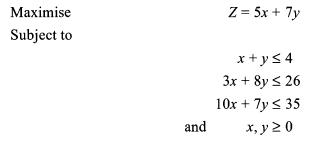
3. Write the dual corresponding to the following linear programming problemNext, find dual of the dual problem and show that it is the same as the given problem. Maximise Subject to and Z= 5x + 7y x + y 4 3x+8y 26 10x + 7y 35 x, y 0
4. Give the dual in complete mathematical form for the following primal of a linear programming problem: Maximise x4; x 6; x1+x25;-x2-1 and x1, x20 Z=3x-2x2
5. Using dual, convert the following problem into a maximisation problem: Minimise Subject to Z=2x+9x2+3x3 x + 4x2 + 2x3 5 3x1 + x2 + 2x3 4 x1, x2 0, x3 unrestricted in sign
6. Write the dual of the following linear programming problem: Maximise Z=3x+4x2+7x3 Subject to x1+x+x3 10 4x - x2-x3 15 x+x+x3 = 7 x1,x20, x3 unrestricted
7. Given:(a) Write the dual problem for this linear programme.(b) Solve it for the optimal values of x I and x2• Minimise Subject to Z=4x1 + x2 3x1 + x2 = 2 4x1 + 3x226 x+2x2 3 and x1, x20
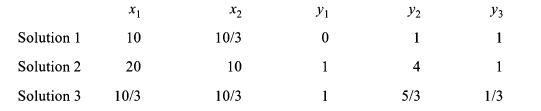
8. Given the following problem:(a) Construct the dual withy1,y2,y3 as dual variables.(b) The following is a list of solutions with respect to the primal and dual of the above problem:Determine whether the listed solutions are optimal.(c) Construct the dual of the following problem: Maximise Subject
9. A company manufactures three models of cars. There is a backlog of orders with the company. Model A requires 60, 100 and 80 worker-days in three production processes I, II, and III respectively. Model B requires 100, 240 and 100 worker-days, while Model C requires 200, 360, and 160 worker-days
10. A firm manufacturing office furniture provides the following information regarding resource consumption, availability, and profit contribution:(a) The firm wants to determine its optimal product mix. Formulate the linear programming problem using the above data.(b) Solve the problem with
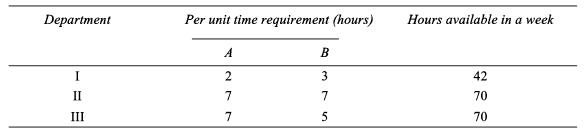
11. A manufacturing company has three major departments for the manufacture of its two products A and B.The weekly capacities are given as follows:The marginal profit perunit from models A and Bare Rs 800 and Rs 500 respectively. Assuming thatthe company can sell any quantity that it produces,
12. A company makes two productsXand Y. ProductXhas a contribution of Rs 124 per unit and product Y Rs 80 per unit.Both products pass through two departments for processing and the times in minutes per unit areCurrently, there is a maximum of 225 hours per week available in department 1 and 200
13. A manufacturer makes three types of decorative lamps; model A, model B, and model C. The raw material requirement for all lamps is the same, but the cost of production differs due to different labour requirements. Each model A lamp requires 0.1 hr of assembly time, 0.2 hr of wiring time, and
14. A metal products company produces waste cans, filing cabinets, file boxes for correspondence, and lunch boxes. Its inputs are sheet metal of two different thickness, called A and B, and manual labour.Input-output relationships for the company are shown in the table given below:The sales revenue
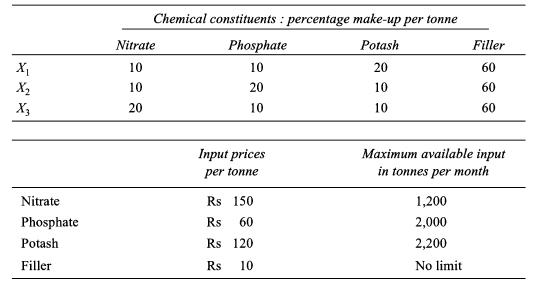
15. A chemical manufacturer is developing three fertiliser compounds for the agricultural industry. The product codes for these products are X1, X2 and X3 and the relevant information is summarised below:The fertilisers will be sold in bulk and managers have proposed the following prices per
16. Fill in the blanks: Variable Primal problem Solution Dual problem A, Variable Solution x1 8/3 0 20/3 0 32 80/3 0 y3 0 4/15 y4 0 1/15 Ys 160/3 0 Y6* A A,
17. The Alloy Metal Company plans to purchase at least 200 quintals of scrap metal. The company decides that the scrap metal to be purchased must contain at least 100 quintals of a valuable metal M1 and no more than 35 quintals of a base metal M2. The company can purchase the scrap metal from two
18. D Electronics produces three models of satellite dishes-Alpha, Beta and Gamma-which have contributions per unit of Rs 400, Rs 200 and Rs 100, respectively.There is a two-stage production process and the number of hours per unit for each process are:There is an upper limit on process hours of
19. A diet conscious housewife wishes to ensure certain minimum intake of vitamins A, B and C for the family. The minimum daily needs of vitamins A, B and C for the family are 60, 40 and 32 units, respectively. For the supply of these vitamins, the housewife relies on two fresh foods F 1 and F2•
20. A company produces three kinds of light bulbs: a 60-watt soft-lite bulb, a 60-watt regular bulb, and a 100-watt bulb. Each bulb takes one hour per case in production line 1. In production line 2, a case of the soft-lite takes 2 hours and a case of each of the others takes 1 hour. Production
21. An electronics firm is undecided as to the most profitable mix for its products. The products now manufactured are transistors, resistors, and electron tubes, with a profit (per 100 units) of Rs 100, Rs 60 and Rs 40, respectively.To produce a shipment of transistors containing 100 units
22. A manufacturing company makes three products, each of which requires three operations as part of the manufacturing process. The company can sell all of the products it can manufacture but its production capability is limited by the capacity of its operations centres. Additional data concerning
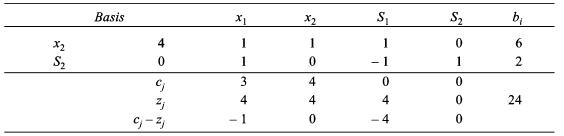
23. Given below is the simplex tableau for a maximisation type of linear programming problem:Giving reasons in brief, answer the following questions:(i) Does the tableau represent an optimal solution?(ii) Are there more than one optimal solution?(iii) Is this solution degenerate?(iv) Is this
24. A manufacturing firm has just discontinued production of an unprofitable product line which has resulted in excess capacity. The management is contemplating to use this capacity for the production of three products A, B, and C. The per unit contribution margin of the three products is,
25. When the primal is infeasible, its dual is unbounded. Prove, with the help of this illustration, that this rule is not always true: Maximise Subject to Z = 8x + 6x2 x1-x23/5 xx 2 10
26. You are told that the objective row of the final tableau of a linear programming solution to a contribution maximisation problem showed shadow price values of +2 and 0, respectively, in the columns for products A and B. A third product which was included in the initial formulation is shown by
27. Given below is a table obtained after a few iterations using simplex method to solve a linear programming problem to maximise total contribution margin from products A and B:Give short answers to the following questions giving reasons as well:(i) Is the above solution optimal?(ii) Is the above
28. In a product-mix problem, x1, x2, x3, andx4 indicate the units of products A, B, C, andD respectively and we have:(a) Solve it with simplex method and find out the optimal product-mix as well as the total maximum profit contribution.(b) Is there any other optimal solution to the problem?(c)
29. A company is manufacturing two products, A and B. The manufacturing time required to make them, the profit, and capacity available at each work centre are as follows:If x1 and x2 represent the number of units of products A and B, respectively, while S1, S2 and S3 represent the slack variables
30. Solve the following LP problem and answer the questions regarding a firm that manufactures both lawn mowers (x1) and snowblowers (x2).(i) What is the best product mix? What is the optimal profit?(ii) What are the shadow prices of the resources? When the optimal solution has been reached, which
A firm owns facilities at seven places. It has manufacturing plants at places A, Band C with daily output of 500, 300, and 200 units of an item respectively. It has warehouses at places P, Q, Rand S with daily requirements of 180, 150, 350 and 320 units respectively. Per unit shipping charges on
Given the following transportation problem:It is known that currently nothing can be sent from warehouse 1 to market A and from warehouse 3 to market C. Solve the problem and determine the least cost transportation schedule. Is the optimal solution obtained by you unique? If not, what is/are the
Determine optimal solution to the problem given below. Obtain the initial solution by VAM.Since the aggregate supply is 220 units and the aggregate demand is 200 units, we introduce a dummy market, M5, for an amount equal to 20 (the difference between the aggregate supply and demand), with all cost
Solve the following transportation problem. Obtain the initial solution by NW corner ruleThe initial basic feasible solution is given in Table 5 .22. It is not optimal. From Demand ABC To 1 2 3 4 Supply 7 3 4 2 2 6 855 8 6 60 10 100 5 1 40 20 20 50 50 50 80 80 200
Solve the following transportation problem for maximum profit. Per Unit Profit (Rs) Market C D A B X 12 18 6 25 Warehouse Y 8 7 10 18 14 3 11 20 20 Z Availability at warehouses: X: 200 units Y: 500 units Z: 300 units Demand in the markets: A: 180 units B: 320 units C: 100 units D: 400 units
A manufacturer of a certain component has the following estimates of the demand for its product:The regular production capacity for each period is 60 units while with overtime working, and additional of upto 20 units can be produced in each period. The unit cost of production in regular time is
Solve the following problem using transportation method, obtaining the initial feasible solution by VAM. The cell entries in the table are unit costs (in rupees). To From Supply 1 2 3 5 80 69 103 64 61 23 47 100 72 65 40 16 16 103 87 36 94 262 12 20 86 15 57 19 25 8 5 27 20 72 94 19 8 Demand 16 14
A company has three plants at locations A, Band C which produce the same product. It has to supply this to buyers located at D, E and F. The weekly plant capacities for A, Band Care 100, 800 and 150 units respectively, while the buyer requirements are 750, 200 and 500 units respectively for D, E
Consider the following transportation problem:(a) Find optimal solution to this problem and determine the total cost of transportation. (b) Is the optimal solution unique? If there is an alternate optimal solution, identify it. (c) If the transporter agrees to reduce the transportation charges on
A company has seven manufacturing units situated in different parts of the country. Due to recession it is proposing to close four of these and to concentrate production in the remaining three units Production in these units will actually be increased from present levels and will require an
A manufacturer of jeans is interested in developing an advertising campaign that will reach four different age groups. Advertising campaigns can be conducted through TV, radio and magazines. The following table gives the estimated cost in paise per exposure for each age group according to the
A cement company has three factories which manufacture cement which is then transported to four distribution centres. The quantity of monthly production of each factory, the demand of each distribution centre and the associated transportation cost per quintal are given as follows:(i) Suggest the
ABC Enterprises has three plants manufacturing dry cells, located at different locations.Production cost differs from plant to plant. There are five offices of the company located in different regions of the country. The selling prices can differ from region to region. The shipping cost from each
The XVZ Tobacco Company purchases tobacco and stores in warehouses located in the following four cities:The warehouses supply tobacco to cigarette companies in three cities that have the following demand:The following railroad shipping costs per tonne (in hundred rupees) have been
1. A transportation problem is a special type of linear programming problem. Mark the statement as T (True) or F (False).
2. It is not necessary for the aggregate demand to be equal to the aggregate supply in a transportation problem.Mark the statement as T (True) or F (False).
3. A transportation problem is said to be unbalanced when the number of origins (sources) does not match with the number of destinations (markets).Mark the statement as T (True) or F (False).
4. An unbalanced transportation problem must be converted into a balanced problem before solving it.Mark the statement as T (True) or F (False).
5. It is possible that in some cases both, the dummy source and dummy destination, be required to be introduced to convert an unbalanced transportation problem into a balanced one.Mark the statement as T (True) or F (False).
6. The cost elements in the dummy row/column shall always be taken equal to zero.Mark the statement as T (True) or F (False).
7. The cost differences in the Vogel's Approximation Method indicate the penalties for not using the respective least cost routes.Mark the statement as T (True) or F (False).
8. V AM cannot be used to find an initial solution to a transportation problem if some routes are given to be prohibited.Mark the statement as T (True) or F (False).
9. The initial solution obtained by the least-cost-method would invariably be optimal.Mark the statement as T (True) or F (False).
10. The transportation method essentially uses the same steps as of the Simplex method.Mark the statement as T (True) or F (False).
11. To determine u; and vj values, an initial value has to be supplied. Different initial values would lead to different u; and vj values, and consequently, to different incoming variables.Mark the statement as T (True) or F (False).
12. In a non-optimal solution to a transportation problem, a certain cell with i = 2 and j = 3, has ~23 = 4.This implies that sending a unit from source 2 to destination 3 shall save a cost of 4.Mark the statement as T (True) or F (False).
13. A closed loop would always involve an even number of cells, subject to a minimum of 4.Mark the statement as T (True) or F (False).
14. The maximum number of units which can be transferred along the closed path is equal to the minimum quantity chosen from among the cells bearing a negative sign on the closed path.Mark the statement as T (True) or F (False).
15. The u; and vj values may be determined by initially inserting any finite number which may be positive, negative or zero, to a row/column.Mark the statement as T (True) or F (False).
16. Units sent from a dummy source to various markets represent the shortfall in supply to those markets.Mark the statement as T (True) or F (False).
17. The summation of the products of the u; values with the corresponding supply column values and of the vj values with the corresponding demand row values would be equal to the total cost of transportation.Mark the statement as T (True) or F (False).
18. A transportation problem solution is said to be degenerate if the number of occupied cells is smaller than the number of rows plus the number of columns minus 1 (one).Mark the statement as T (True) or F (False).
19. Once non-optimal degenerate solution is obtained, the next solution is bound, also, to be degenerate.Mark the statement as T (True) or F (False).
20. In improving a non-optimal solution to a transportation problem, it is possible that more than one cell may get vacated, although normally, only one cell gets vacated and gets filled.Mark the statement as T (True) or F (False).
21. A degenerate solution may or may not be optimal.Mark the statement as T (True) or F (False).
22. To remove degeneracy, an infinitesimally small quantity is placed in each of the required number of independent cells.Mark the statement as T (True) or F (False).
23. Multiple optimal solutions are indicated if there are multiple zeros for u; and vj values.Mark the statement as T (True) or F (False).
24. If each cost element in a transportation problem is increased by a constant amount, it will not affect the optimal solution to the problem.Mark the statement as T (True) or F (False).
25. For an optimal solution to a transportation problem, the u; and vj values represent the optimal values of the dual problem.Mark the statement as T (True) or F (False).
26. If all the cost elements, c;j, are multiplied by a constant, the total cost of transportation in the optimal solution shall be multiplied by the same constant.Mark the statement as T (True) or F (False).
27. A cost reduction by an amount greater than the absolute value of ~ij for a given cell would make that route a preferable one.Mark the statement as T (True) or F (False).
28. If a constant is subtracted from each value of the matrix of a profit-maximising transportation problem, it is converted into a "minimisation problem."Mark the statement as T (True) or F (False).
29. A transhipment problem allows for the shipment of goods from one source to another, and from one destination to another.Mark the statement as T (True) or F (False).
30. An m-source, n-destination transportation problem, when written as a transhipment problem would have m + n sources and n destinations.Mark the statement as T (True) or F (False).
31. In the context of transportation problems, sensitivity analysis deals only with investigating the effect of changes in the cost elements of some routes.Mark the statement as T (True) or F (False).
32. Once the optimal solution is obtained, any change in the cost element of an unoccupied cell does not alter the u; and vj values, as also the optimal solution.Mark the statement as T (True) or F (False).
33. If case of a change in the cost element of an occupied cell, the optimal solution does not change as long as changes in the u; and vj values do not cause any ~ij values to turn positive.Mark the statement as T (True) or F (False).
34. If the supply at ith source and the demand at jth destination are both increased by k units and the current basis remains optimal, then new Z value = old Z value + ku; + kvj.Mark the statement as T (True) or F (False).
35. In a transportation problem, suppose supply at source 3 and demand at destination 2 are increased by 300 units each and x32 is an unoccupied cell in the optimal solution, then the new optimal solution would have x32 = 300, and total cost increase by 300 u3 + 300 v2•Mark the statement as T
1. Describe the transportation problem and give its mathematical model.
2. Explain, by taking an illustration, the North-West Corner Rule, the Least Cost Method and the Vogel's Approximation Method to obtain the initial feasible solution to a transportation problem.
3. Discuss the various methods of finding initial feasible solution of a transportation problem and state the advantages, disadvantages, and two areas of application for them.
4. Explain the transportation method of solving a transportation problem. Also give its schematic.
5. (a) What is meant by an optimality test? How would you determine whether a given transportation solution is optimal or not?(b) Compare the Stepping Stone and the MODI methods of testing the optimality of a solution to a transportation problem. Give suitable illustrations.
6. Write a note on tracing a closed loop. What are the characteristic features of a closed loop?
7. (a) What do you understand by unbalanced transportation problem? How would you convert it into balanced transportation problem?(b) What is the indication that a given transportation problem has multiple optimal solutions?(c) What would be the number of occupied routes in the optimal solution of
8. What is degeneracy? How does the problem of degeneracy arise in a transportation problem? How can we deal with this problem?
9. Why can degeneracy arise in the solution of(i) a transportation problem?(ii) a linear programming problem?In the case of a transportation problem, why is it necessary to resolve degeneracy before testing any basic feasible solution for optimality?
10. How can the transportation method be applied to a transportation problem where the objective function is called to be maximised?
11. Write the dual of a standard transportation problem and give its economic interpretation.
12. Write a detailed note on sensitivity analysis in the context of transportation problems.
13. Explain as to how we can use the transportation algorithm for scheduling of production in a manufacturing organisation whose product is subject to seasonal variation.
14. In what way is a transhipment problem different from a transportation problem? How can we use the transportation method for solving the transhipment problem?
1. The table below records transportation costs per unit of a product from origins 0 1, 0 2, 0 3 and 0 4 to destinations D1, D2, D3, D4 and D5• The capacities of the four origins are respectively 55, 45, 30 and 50 while the requirements of the five destinations are respectively 40, 20, 50, 30 and
2. A transportation problem has the supplies at four sources and requirements at five destinations. The following table shows the cost of shipping one unit from a particular source to a particular destination:The following feasible transportation pattern is proposed: x11 = 25, x 14 = 30, x 22 = 20,
3. A Steel Company has three open-hearth furnaces and five rolling mills. Transportation cost (Rs per quintal) for shipping steel from furnaces to rolling mills are shown in the following table.What is the optimum shipping schedule? M M2 M3 M4 M5 Supply F 4 2 3 2 6 8 F2 5 4 5 2 1 F3 6 10 5 4 7 7 21
Solve the following transportation problem: To From Availability 1 2 3 4 1 8 8 5 12 23 6 9 11 10 15 6 13 293 7 7 10 4 6 8 7 8 5 11 10 11 13 6 8 14 5 12 9656 Demand 9 10 8 14
Showing 2000 - 2100
of 7324
First
14
15
16
17
18
19
20
21
22
23
24
25
26
27
28
Last
Step by Step Answers

 Get 50% OFF
Claim Now
Get 50% OFF
Claim Now