New Semester
Started
Get
50% OFF
Study Help!
--h --m --s
Claim Now
Question Answers
Textbooks
Find textbooks, questions and answers
Oops, something went wrong!
Change your search query and then try again
S
Books
FREE
Study Help
Expert Questions
Accounting
General Management
Mathematics
Finance
Organizational Behaviour
Law
Physics
Operating System
Management Leadership
Sociology
Programming
Marketing
Database
Computer Network
Economics
Textbooks Solutions
Accounting
Managerial Accounting
Management Leadership
Cost Accounting
Statistics
Business Law
Corporate Finance
Finance
Economics
Auditing
Tutors
Online Tutors
Find a Tutor
Hire a Tutor
Become a Tutor
AI Tutor
AI Study Planner
NEW
Sell Books
Search
Search
Sign In
Register
study help
business
understanding management
Management Meeting And Exceeding Customer Expectations 9th Edition Warren R.Plunkett , Raymond F.Attner , Gemmy S.Allen - Solutions
When would you use a manufactured treatment device?
A project in New Jersey is required to treat a water quality flow of 1.7 cfs for 50% TSS removal. What manufactured treatment device(s) satisfy this requirement?
What would be the answer to Question 6.2 for a discharge of 0.05 m3/s?
Select an MTD that can provide 80% TSS removal for 1.5 cfs water quality runoff.
Select a Jellyfish filter rated for 0.03 m3/s treatment.
Select an MTD to provide 80% TSS removal for 0.5 cfs water quality runoff.
Calculate the required storage of a detention system to attenuate the peak water quality from 1.5 cfs to 0.5 cfs. Base your calculations on modified rational method for a storm of 30-minute duration and a time of concentration of 15 minutes. If 48 in. solid pipes are used to provide the storage,
A commercial project results in 0.5 acre of new pavement and 0.4 acre of milled and resurfaced existing pavement. Calculate the required TSS removal and peak water quality runoff for this project based on the NJDEP Stormwater Management Rules. Base your calculations for a 10-minute time of
Solve Problem 6.8 for 2000 m2 of new pavement and 1500 m2 of repaved surfaces.
If the existing pavement in Problem 6.8 has to be reconstructed, what will be the required TSS removal? What MTD(s) would you choose to address the TSS removal requirement?
Solve Problem 6.9 if the existing pavement has to be reconstructed. Base your selection using the manufacturer’s data.
To reduce the size of the MTD in Problem 6.10, the runoff is routed through an underground detention system that comprises solid pipes that would reduce the peak water quality runoff by 70%. What will be the peak water quality flow to be treated for TSS removal and which device(s) can you use in
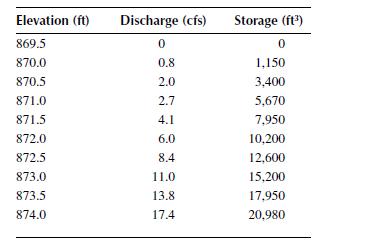
Storage versus outflow relation for a detention basin is given below. Calculate the storage–outflow function, 2S/Δt + O, versus O for each of the tabulated values, using Δt = 5 minutes. Plot a graph of the storage-outflow function versus O. Storage (10ft) Outflow (cfs) 75 32 81 87.5 100 110.2 6
Redo Problem 7.1 for the storage versus outflow discharge relation shown below: Storage (10m) 2 3 3.5 4 5 Outflow (m/s) 0.06 0.15 0.35 0.70 1.00
Consider a 0.5-acre detention basin with vertical walls. The inflow discharge increases linearly from zero to 60 cfs at 30 minutes and then decreases linearly to zero at 75 minutes.The outlet from the detention basin is a 24 in. RCP culvert, located at the bottom of the basin. The basin is 5 ft
Solve Problem 7.3 for the following conditions:Detention basin size = 2050 m2, 1.5 m deep Inflow peak = 1.75 m3/s Diameter of pipe = 60 cm Use a time interval of 10 minutes.
Using the TR-55 method, the pre- and postdevelopment 100-year peak rates of runoff for a 20-acre site are calculated at 25 and 50 cfs, respectively. Estimate the required detention storage to regulate the 100-year discharge from the site to 80% of the predevelopment peak rate of runoff. The soil
Solve Problem 7.5 for a 5 ha site and 100-year peak runoff discharge at 1 m3/s and 2 m3/s, respectively. The 100-year, 24-hour storm is 200 mm.
Using the rational method, the 100-year pre- and postdevelopment peak rates of runoff from a 50-acre residential development site are calculated at 20 and 50 cfs, respectively.Estimate the required storage to regulate the 100-year discharge from the site to 80% of the predevelopment peak rate of
In a 10 ha residential development, the pre- and postdevelopment peak rates of runoff are calculated at 1 m3/s and 2 m3/s, respectively. Estimate the required detention storage to attenuate the postdevelopment peak runoff to 80% of the predevelopment condition.Use the rational method and assume Tc
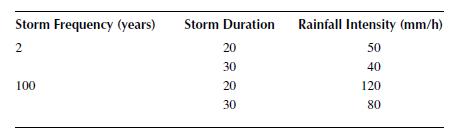
The postdevelopment conditions of an urban watershed are as follows:A = 20 ha Tc = 30 min C = 0.3 for lawn/landscaped C = 0.95 for impervious areas Impervious coverage = 25%Calculate the required detention storage volume to reduce the 2-year and 100-year postdevelopment discharges from the
Solve Problem 7.7 for a 50-acre watershed; use Figure 3.1b rainfall curves.
Repeat Problem 7.9 for a 50-acre watershed using the TR-55 method, assuming hydrologic group B, and 100% wood cover for existing conditions and 20% wood cover for the postdevelopment conditions. The 2- and 100-year SCS 24 storms are 3.3 and 8.0 in., respectively. The storm is type III.
In Problem 7.11, design a single outlet, using the following geometrics:a. Circular orificeb. Rectangular openingc. V notch weir The detention basin is 4.5 ft deep. Allow 6 in. ± freeboard.
A 75-acre development will consist of 35% pavement, 35% lawn, and 30% woods. Using the rational method, calculate the 100-year peak rate of runoff if the time of concentration is 30 minutes. The entire site runoff is drained to a detention basin. Using the IDF curves of Figure 3.1b in Chapter 3,
Redo Problem 7.13 using the SCS method. The site soil is hydrologic group C. The 100-year, 24-hour storm is 8.3 in. The storm is type III.
Solve Problem 7.13 under the following conditions:Area = 30 ha Tc = 60 minutes, predevelopment Tc = 30 minutes, postdevelopment Use IDF curves of Figure 3.1a.
Calculate the required detention storage in Problem 7.13 using the universal runoff model. The soil is silty sand and permeability is measured at 2.5 in./h. The runoff from all pavements is directly connected to the detention basin.
Calculate the required detention storage in Problem 7.15 using the universal runoff model and 50 mm/h permeability.
A 20 ha development site is wooded and has a permeability rate of 35 mm/h. The development creates 5 acres of pavement and turns another 5 acres into lawn, all hydraulically connected. The time of concentration is calculated at 30 minutes and 20 minutes for the pre- and postdevelopment conditions,
Calculate the required detention storage in Problem 7.18, if the pavements and pervious areas separately drain to the detention basin.
A detention basin is designed to attenuate the runoff from 5.16 acres comprising 4.65 acres of roadway/pavement, 0.28 acres of lawn, and 0.23 acre of brick pavers. The allowable discharges from the detention basin are calculated at 7.94, 10.90, and 15.88 cfs for the storms of 2-, 10-, and 100-year
Design a seepage pit to fully retain the runoff from the 150 m2 roof of a residential dwelling for rainfalls up to 50 mm. The pit is to be placed in a 50 cm thick stone envelope and 25 cm stone base.
A seepage pit is to be used to fully retain the runoff from a 1500 square foot roof of a residential dwelling during the 10-year, 60-minute storm. This storm has a 2 in./h intensity and amounts to 2 in. of rainfall. Calculate the required storage volume of the seepage pit.A 6.5 ft O.D., 6 ft I.D.,
In lieu of the seepage pit in Problem 7.22, 36 in. perforated HDPE pipes in stone trench are employed. Size this retention system and sketch its layout.
In Problem 7.21, StormTech MC-3500 chambers in stone trench are to be used in lieu of the seepage pit. Calculate the number of chambers required and define the footprint dimensions of the stone trench.
A 5000 m2 commercial building roof is drained into Terre Arch 26 structures. Calculate how many Terre Arch units are required to retain 30 mm of rainfall. The structures are to be placed on 150 mm thick stone base and their valleys also filled with stone. If the soil permeability is 50 mm/h, how
The construction of the Ambulance Corps in Hawthorne, Passaic County, New Jersey, affects 1.073 acres and increases the impervious coverage from 1400 square feet to 32,080 square feet. A rain basin in the form of lawn depression (see Figures 8.39 and 8.40) is designed to fully retain the entire
A 20 m2 rain garden receives runoff from a 150 m2 roof area. The rain garden includes a 15 cm deep depression, 30 cm thick top soil and 15 cm stone sublayer. Calculate the maximum rainfall depth that the rain garden can retain.
Solve Problem 8.2 for a 200 ft2 rain garden receiving runoff from a 1500 ft2 roof area.The garden consists of 6 in. depression, 1 ft thick top soil, and 6 in. stone base.
Design a rain garden to retain the runoff from a 1200 ft2 residential dwelling roof during a New Jersey water quality storm that is 1.25 in. of rainfall in 2 hours. The rain garden includes a 6 in. depression and 1 ft thick soil medium over a 6 in. layer of sand.Estimate porosity of the soil and
Solve Problem 8.4 for a 120 m2 roof area, 15 cm depression, 30 cm thick soil, 15 cm thick sand, and 30 mm rainfall.
A 1500 ft2 roof area drains to a 200 ft2 rain garden that includes 12 in. thick soil, 6 in.thick stone, and allowable ponding of 3 in. Evaluate if this rain garden satisfies the WQv requirements of New York State (refer to Chapter 5). The 90% rainfall event in the area is 0.9 in. State any
Solve Problem 8.6 for a 150 m2 roof area and 20 m2 rain garden. The thicknesses of soil and drainage layers are 30 cm and 15 cm, respectively. The 90% rainfall event is 23 mm and the allowable ponding is 7.5 cm.
Size a bioretention basin for a 1300 ft2 pavement and 2.0 in. of rainfall. The bioinfiltration basin includes 2.5 ft thick soil mix, 10 in. thick sand, 1.0 ft deep depression, and 3 in. thick mulch. Estimate the porosity of soil, sand, and mulch at 15%, 35%, and 40%, respectively. The basin abuts
Solve Problem 8.8 if the bioinfiltration basin is 10 ft away from the pavement. Assume that 35% of the runoff from the pavement is captured by lawn en route to the basin.
Redo Problem 8.8 for a 120 m2 pavement and 50 mm rainfall. The bioretention basin is 30 cm deep and the thicknesses of soil mix, sand base, and mulch are 75, 25, and 7.5 cm, respectively.
Solve Problem 8.10 if the bioretention basin is 3 m away from the pavement and 35%of pavement runoff is absorbed by the lawn between the bioretention basin and the depression.
A 25-acre single-family residential development comprises 1/3 acre lots and includes 35% impervious coverage. Calculate:a. The impervious coverage per dwelling and per capita, in square feetb. The annual runoff volume per dwelling and per capita Base your calculations on a household of four persons
A 25-acre multiresidential development includes 600 condominium units and is 50%paved. Calculate:a. The impervious coverage per condominium unit and per capita in square feetb. The annual runoff volume per capita Base your calculations on two persons per condo and 30 in. annual precipitation. State
A 10 ha residential development comprises 75 single-family homes and is 30% covered with impervious surfaces. Calculate:a. The average impervious coverage per dwelling and per capita in square metersb. The average annual runoff volume per dwelling and per capita Base your calculations on a
A multiresidential development includes 750 apartments on a 10 ha parcel of land that is 50% covered with pavements and roofs. Calculate:a. The average impervious surface per apartment and per capitab. The annual runoff volume per capita Base your calculations on two people per apartment and 750 mm
Calculate the volume of a standard trench excavation per lineal feet for a 24 in. RCP.The average cover over the pipe is 18 in.
Describe the seven characteristics of useful information
Describe the three functions of an effective information system (IS)
Describe the five guidelines for establishing an information system (IS)
Describe the basic functions of a computerized information system (CIS)
Describe the two basic data-processing modes
Discuss the various methods used for linking computer systems
Explain the purposes of decision support systems (DSSs)
Discuss the four challenges that must be met by managers of an information system
What privacy issues are raised here?
What safeguards do you want businesses with information about you to exercise?
What laws are you aware of that deal with protecting your privacy?
It is far easier to make a suggestion to your supervisor and colleagues via e-mail than it is to do so in a pressure-filled meeting room. Any time you have something that is difficult to say, e-mail can make it easier. Do you agree with these statements? Explain.
What are the business benefits of Web conferencing for meetings?
Outsourcing, moving inside activities to outside providers, is a tool that gives a company the ability to improve operations while cutting costs. How can outsourcing be cost-effective when you can no longer exercise direct control over the providers?
What makes information valuable to decision makers? What makes it useful?
How can an organization decide on the effectiveness of its information systems?
What basic functions must any CIS perform for its users?
What data-processing modes would you prescribe for each of the following? (a) handling airline reservations, (b) handling total sales by department for each day of operations, (c) measuring the quality of cookies coming off an assembly line.
How does a company decide whether an IS or IT function should be outsourced? Whether the IS or IT is operating effectively? Whether people are using them to their best advantage?
You are the chief information offi cer for a neighborhood bank that has just been absorbed into a larger bank. Each institution has different hardware and software. What must you do in order for your IS to properly network with the parent’s?
You have been asked to build and lead a committee to evaluate your company’s ISs and ITs. How would you go about selecting members for your committee? What issues should you deal with at your fi rst meeting?
How do information needs differ at the various levels of management? Why should all of management’s computers be networked to both insiders (intranet)and outsiders (Internet)?
Peter Drucker coined the term knowledge worker in his 1959 book, Landmarks of Tomorrow. Read“The Age of Social Transformation” (Atlantic Monthly, No vem ber 1994). What is a knowledge worker? How can you become a knowledge worker?http://www.providersedge.com/docs/leadership
In the Digital Age, a dominant role is played by information. In Wired magazine (March 1998), Peter Drucker described it this way: “Economic theory is still based on the scarcity axiom, which doesn’t apply to information. When I sell you a phone, I no longer have it. When I sell information to
What major advantages does VF Corporation have over its competition?
Will such a distribution system work as well for lesser-known brands made by smaller companies?Why or why not?
What data must be shared by retailers with VF to make the system work? How do you suppose the retailers gather these data?
What type of data might the Peapod IT department obtain about consumers who visit the Web site?
In what ways might Peapod managers use a decision-support system?
In what ways might Peapod use a CRM system to maintain its competitive advantage in the marketplace?
Do the scientists present data or information during the symposium?
If it is information, who transformed the data into information? Speculate about how such data became information.
What do you predict will be the next course of action for the Odones?
Describe the relationship between controlling and the other four functions of management
List and describe the four steps in the control process
Describe the nature and importance of feedforward, concurrent, and feedback controls
Describe the importance of a control system
Explain the characteristics of effective controls and the steps managers can take to make controls more effective
Describe the content of the three primary financial statements and how managers use them
Explain ratio analysis and four types of ratios used by managers
Describe the five types of financial responsibility centers and their relationships to budgeting
Describe the four approaches to creating budgets
Explain the two major types of budgets used in businesses
Describe the five major marketing control techniques used in businesses
Describe the six major human resource control techniques used in businesses
Enron stated its core values to be respect, integrity, communication, and excellence. Why do you think these values could not overcome individual and collective greed?
How long do you think you will want to work after you turn 50? Develop a vision of how you want to see yourself at work in your fifties, sixties, and seventies.
Showing 2700 - 2800
of 7324
First
21
22
23
24
25
26
27
28
29
30
31
32
33
34
35
Last
Step by Step Answers

 Get 50% OFF
Claim Now
Get 50% OFF
Claim Now