New Semester
Started
Get
50% OFF
Study Help!
--h --m --s
Claim Now
Question Answers
Textbooks
Find textbooks, questions and answers
Oops, something went wrong!
Change your search query and then try again
S
Books
FREE
Study Help
Expert Questions
Accounting
General Management
Mathematics
Finance
Organizational Behaviour
Law
Physics
Operating System
Management Leadership
Sociology
Programming
Marketing
Database
Computer Network
Economics
Textbooks Solutions
Accounting
Managerial Accounting
Management Leadership
Cost Accounting
Statistics
Business Law
Corporate Finance
Finance
Economics
Auditing
Tutors
Online Tutors
Find a Tutor
Hire a Tutor
Become a Tutor
AI Tutor
AI Study Planner
NEW
Sell Books
Search
Search
Sign In
Register
study help
business
understanding management
Urban Storm Water Management 2nd Edition Hormoz Pazwash - Solutions
Calculate the critical depth in Example 2.4 in this chapter using Table 2.2.
Water flows at a rate of 3.0 m3/s in a 3 m wide rectangular concrete channel at a depth of 0.5 m.a. Calculate the slope for n = 0.012.b. What slope would be required to produce the critical flow for the given discharge?Also, what is the critical depth?
Redo Problem 2.19 for a discharge of 100 ft3/s in a 10 ft wide rectangular channel, and at a depth of 1.5 ft.
Water discharges at a rate of 8 m3/s in a trapezoidal channel of bottom width of 2 m and side slopes of 2:1. Calculate the critical depth and the critical velocity for this channel.What will be the critical slope, if the channel is riprap lined (n = 0.035)?
Solve Problem 2.21 for a discharge of 280 cfs in a trapezoidal channel of 6 ft bottom width.
Calculate the normal depth of flow in a roadside trapezoidal shaped channel for a 1.5 m3/s design discharge. The channel is at 1% slope, lined with 100 mm stone riprap, and has a bottom width of side slopes of 1.2 m and 2:1, respectively. Estimate n = 0.04.
Solve Problem 2.23 for the following flow parameters:a. Q = 50 cfsb. b = 4 ftc. Riprap size = 4 in.
Solve Example 2.6 in this chapter for a discharge of 0.5 m3/s and 450 mm pipe.
Flow parameters in a junction similar to that shown in Figure 2.9 area. Qo = 0.8 m3/sb. Qℓ = 0.2 m3/sc. Di = 0.6 m; Do = 0.675 m; Dℓ = 0.3 md. θj = 30°Calculate the head loss in this junction.
Solve Problem 2.26 for the following case:a. Qo = 30 cfsb. Qℓ = 15 cfsc. Di = 24 in., Do = 30 in., Dℓ = 18 in.
Calculate the head loss in the drainage system of Example 2.9 for a discharge of 250 cfs.
Solve Problem 2.28 for a discharge of 7.5 m3/s.
An undisturbed rock sample has an oven-dry weight of 425.30 g. After saturation with kerosene its weight is 476.19 g. It is then immersed in kerosene and displaces 196.07 g of kerosene. What is the porosity of the sample?
A mildly sloped, undisturbed catchment area is covered with approximately 50% woods and 50% grass. For a 60-minute storm of 50 mm/h intensity, calculate:a. Interception using the Brooks et al. method. Estimate S = 4 mm and neglect evaporation during the stormb. Depression storage using Equation 3.3
Solve Problem 3.2, using: I = 2 in./h, S = 0.15 in., and Sd = 0.8 in.
Calculate infiltration volume for a sandy clay loam soil, having fo = 2.5 in./h, fc = K =1 in./h during a 2-hour storm of I = 1.6 in./h intensity. Use:a. Horton equation with α = 1 hour –1b. Horton equation and Table 3.6
Redo Problem 3.4 for the following parameters: fo = 62.5 mm/h, fc = 25 mm/h, and I =40 mm/h.
The infiltration rate in a small area was found to be 100 mm/h at the beginning of a 6-hour storm and it decreased to an equilibrium of 20 mm/h. A total of 250 mm of water was infiltrated during the storm period. Calculate the value of α in Horton’s equation.
Average rainfall intensities during each hour of a 4-hour storm over a 100 ha watershed were 30, 50, 25, and 15 mm/h, respectively. If the infiltration φ index for the storm was 20 mm/h, calculate the direct runoff from the watershed.
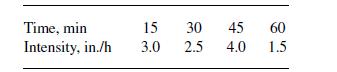
The rainfall intensities of a 60-minute storm falling on a 10-acre basin were as follows:a. Calculate the total rainfall depth in inches.b. Calculate the φ index if the net rainfall (overland flow) from the basin was measured to be 1.5 in.c. Calculate the volume of runoff from the basin. Time, min
Rain falls uniformly on a sandy loam soil at a rate of 30 mm/h for 2 hours. Using the Green-Ampt method, calculate:a. Time for the soil surface to become saturatedb. The amount of infiltration at the end of the storm period Assume initial moisture content at 0.25 and fp = 50 mm/h.
Solve Problem 3.9 for a 2-hour storm of 1 in./h intensity; fp = 2.0 in./h.
In Problem 3.9, rain falls at a rate of 15 mm/h during the first hour and 40 mm/h during the second hour. Calculate the time to surface saturation and the infiltration amount.
A falling head permeameter, similar to that shown in Figure 3.12b, is used to measure permeability of a soil sample. The head, H, is measured to drop from 400 to 150 mm in 90 seconds. Calculate the soil permeability. The permeameter dimensions are sample length, L = 120 mm; r = 10 mm; and R = 100
Calculate the soil permeability of Problem 3.12 for a head drop of 14 in. to 6 in. in 90 seconds. The permeater dimensions are L = 5 in.; r = 0.4 in.; and R = 4 in.
A 25-acre wooded area receives 2 inches of rain uniformly in 1 hour. If the time of concentration is 30 minutes, what is the peak flow rate at the watershed outlet? Base your calculations on the rational method.
Redo Problem 3.14 for 10 ha and 50 mm rainfall.
The rain falls uniformly for 1 hour at the rate of 2 in./h on a 100-acre watershed composed of: 25 acres, C = 0.3; 20 acres, C = 0.4; 40 acres, C = 0.6; and 15 acres, C = 0.90.Calculate the peak rate of runoff, assuming a time of concentration of 1 hour.What will be the peak discharge, if the time
Rain falls uniformly at a rate of 50 mm/h for 1 hour on a 40 ha watershed which comprises 10 ha having C = 0.3; 10 ha with C = 0.4; and 20 ha with C = 0.6. Calculate the peak rate of runoff assuming a time of concentration of 1 hour.If the time of concentration is 45 minutes, what will be the peak
A watershed contains two subareas with the following hydrologic characteristics:a. Subarea 1: A = 80 acres, C = 0.50, Tc = 30 minb. Subarea 2: A = 100 acres, C = 0.35, Tc = 40 min The 25-year rainfall intensities of the 30- and 40-minute duration storms are 3.6 and 3.0 in./h, respectively.
In Problem 3.18, subareas 1 and 2 are 32 and 40 ha, respectively. Calculate the 25-year peak runoff froma. Each subareab. The watershed The 25 year rainfall intensities of the 30- and 40-minute duration storms are 90 and 75 mm/h, respectively.
A 150-acre watershed includes two subareas: Subarea A, which includes 30% of the watershed, has a time of concentration of 20 min; subarea B has mild slope comprising 70% of the watershed with a time of concentration of 60 min. The abstraction can be taken as 1 in./h. Calculate the 25-year peak
Name the factors on which the soil curve number, CN, in the TR-55 method depends.
A drainage area has a composite soil curve number of 55. Based on the SCS method, how much rain must fall before any runoff occurs?
A natural watershed has the following characteristics:a. Woods in good condition, soil group B, covering 40% of the areab. Grass-brush in good condition, soil group C, covering 60%Calculate the runoff depth, in centimeters, for an 11.5 cm rainfall in 24 hours. Use the SCS type III storm
Calculate runoff depth in inches in Problem 3.23 for a 24 hour-5 inch rainfall.
Using the TR-55 method, calculate the time of concentration for a drainage area having the following characteristics:a. Sheet flow; dense grass, length L = 100 ft; slope S = 2.0%, 2 year-24 hour rainfall P2 = 3.5 in.b. Shallow concentrated flow; unpaved, length L = 250 ft, slope S = 1%c. Stream
Calculate the time of concentration of the drainage area in Problem 3.25 using the FHWA method. Base your calculation on rainfall intensity of 10-year storm frequency in Figure 3.1b.
The drainage area described in Problem 3.25 is composed of 40% wood, 30% grass, and 30% pavement. For this area, calculate the depths of runoff and the peak rates of flow for the 2-, 10-, and 100-year storms of 24-hour duration. The 24-hour storms in the area are P2 =3.5 in., P10 = 5.3 in., and
Use the rational method to calculate the peak rates of flow for the drainage area described in Problem 3.27 for the storms of 2-, 10-, and 100-year frequency. Use the New Jersey rainfall intensity–duration–frequency (IDF) curves of Figure 3.1b for this area. Base your calculations on the
A 10 ha watershed is composed of 60% woods, 20% lawn, and 20% pavement. The soil is uniformly hydrologic group B. Calculate the depth, volume, and peak runoff for a 24-hour, 150 mm type III storm. Assume a time of concentration of 45 minutes.
The drainage area of Problem 3.27 is composed of loamy sand soil and the pavements drain onto lawn and wooded areas. Calculate the volume and the peak runoff for the storms of 2-, 10-, and 100-year frequency and 45-minute duration based on the universal method. Use the IDF curves in Figure 3.1b.
Calculate the peak and volume of runoff in the previous problem if the pavements are not drained onto lawns and woodland.
A mildly sloped 10 ha watershed includes 4 ha of woodland, 3.5 ha of lawn, and 2.5 ha of pavement. The soil is sandy loam. Using the Universal Method, calculate the volume and peak runoff rate for a 45-minute storm of 75 mm/h intensity for the following cases:a. Pavements are hydraulically separate
A single-family home includes a 130 m2 dwelling, 80 m2 driveway and paved patio, 275 m2 lawn, and 150 m2 landscape. Initial abstraction and hydraulic conductivity of lawn and landscape are as follows:a. L = 10 mm, K = 50 mm/h—lawnb. L = 30 mm, K = 75 mm/h—landscape Calculate the lag time, the
Solve Problem 3.33 for a rainfall intensity of 40 mm/h.
Rain falls at a rate of 50 mm/h for 30 minutes and 40 mm/h for the next 30 minutes.Calculate the lag time, runoff volume, and peak runoff from the dwelling in Problem 3.33 for casesa, b, and c.
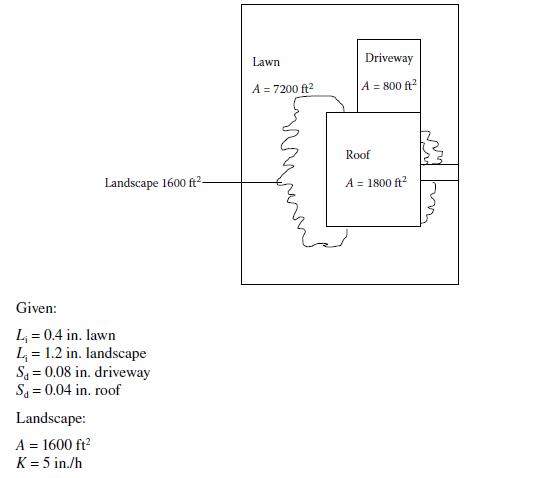
Calculate the peak and volume of runoff for the single-family home shown below during a 30-minute storm having 3.2 in./h intensity. Perform the calculations for the following cases:a. Direct discharge from pavementsb. Roof and driveway drain to lawn and landscape Lawn A = 7200 ft Driveway A = 800
Calculate the flow spread in a 2 m wide asphalt gutter for a flow of 0.08 m3/s. The gutter is at 2% longitudinal and 4% cross slopes, respectively.
Calculate the spread in a 6 ft wide asphalt gutter for a flow of 2.5 cfs. The gutter is at 1.5%longitudinal slope and 4% cross slope.
A 2 m wide smooth asphalt shoulder is at 4% cross slope and 0.5% longitudinal slope.Does the spread extend beyond the shoulder for a flow of 0.09 m3/s?
A 6 ft wide smooth asphalt shoulder is at 4% cross slope. For a flow of 2.5 cfs, does the spread extend beyond the shoulder if the longitudinal slope is 0.5%?
Calculate the flow spread on a 2 m wide shoulder at 4% cross slope for gutter flows of 0.03 m3/s, 0.06 m3/s, and 0.09 m3/s. The roadway and shoulder have an asphalt cover(n = 0.016). Perform calculations for a longitudinal slope of 3%.
Redo Problem 4.5 for a 6 ft wide shoulder and discharges of 1, 2, and 4 cfs.
In Problem 4.6, calculate the flow capture and efficiency of a “B” inlet using the NJDOT method.
Recalculate flow capture and efficiency in Problem 4.7 using the HEC-22 charts.
A grate inlet is to be placed at a roadway sag flush with a 15 cm curb to capture the gutter flow, calculated at 0.15 m3/s. Calculate the minimum required length of a 60 cm wide grate. For grate in sags assume that 50% of the grate opening and 25% of the grate perimeter are clogged by debris.
Calculate the required grate opening area in Problem 4.9 for a discharge of 6 cfs and 2 ft wide grate. The curb is 6 in. high. Consider weir flow through grate, in this case.
In Example 4.2 of this chapter, calculate the maximum spacing of the first set of inlets from the high point for a 75% efficiency.
A pond discharges through a 1.2 m × 1.2 m square box culvert at a rate of 2.5 m3/s. The culvert is very long, Manning’s n is 0.014, and S = 0.005. Calculate the elevation of water level in the pond at the inlet face of the culvert. The exit loss in the pond and the entrance loss can be
Redo Problem 4.12 if a 1200 mm circular culvert is used in lieu of the box culvert. Use n = 0.013.
Solve Problem 4.12 for a discharge of 85 cfs and 48 in. culvert.
Solve Problem 4.12 if the culvert is 300 ft long and the culvert outlet is submerged up to its crown. Account for inlet and exit losses in this case.
A 60 in. RCP culvert carries a stream under a roadway. The culvert is 100 ft long, at 2%slope, and its upstream invert lies 10 ft below the edge of road. Calculate the capacity of the culvert for the following conditions:a. The culvert outlet is unsubmerged.b. The outlet is submerged 2 ft above its
A box culvert is to carry a discharge of 10 m3/s. The culvert is 20 m long and has 0.4%slope. The depth of water at the upstream face of the culvert is not to rise more than 1 m above its crown. Select a suitable size culvert. The downstream face of the culvert is unsubmerged.
For a channel in alluvial silt, the Manning’s n value and the maximum permissible velocity are 0.02 and 2 ft/s, respectively. Calculate the corresponding permissible tractive force if the channel slope is 0.9%.
Calculate the discharge and the cross-sectional area of a channel excavated in a noncohesive soil having permissible shear stress of 5 Pa, angle of repose of 32°, and n =0.025. The channel slope is 0.4%.
Design a parabolic swale lined with Bermuda grass to carry a discharge of 35 cfs, at 2%slope. Base your design on retardance class D and the NJ Soil Erosion Standards.
Design the grass swale of Problem 4.20 for a discharge of 1 m3/s, using Figure 4.43 (n vs.VR relation).
Design a swale, lined with riprap stone of d50 = 15 cm, to carry a discharge of 1.5 m3/s.The channel has an average slope of 1.5%. Base your design on the permissible shear stress method and Equation 4.70 for n, and the following channel geometry:Trapezoidal channel of 3:1 side slope
Redo Problem 4.22 for d50 = 6 in. and 50 cfs discharge anda. Equation 4.70b. NRCS Equation 4.74
A trapezoidal grass-lined swale is to carry a discharge of 1.5 m3/s at 1.5% slope. The soil is clayey sand of PI = 20 and e = 0.5. The swale is 1.25 m wide at the bottom and has 3:1 side slope. For a mixed-grass lining in very good condition, 75 mm thick, design the swale using the HEC-15 (FHWA,
A trapezoidal channel of bottom width of 2 m and side slopes of 2:1 has a bend with a radius of 15 m. For a discharge of 8 m3/s, water depth at the inner wall of the bend is 1.0 m.Calculate water depth at the outer bank around this bend. Slope of this channel is mild.
Calculate the water depth at the outer bank of a trapezoidal channel of 2:1 side slope and 6 ft bottom width at a 50 ft radius bend. The channel discharge is 250 cfs and the depth of water at the inner bend is 3 ft.
Calculate the length of the channel past the bend in Problem 4.26, which requires protection.Base your calculations on a Manning’s n of 0.040.
The trapezoidal channel of Problem 4.25 is lined with d50 = 15 cm stone and is at 1.3%slope. Determine whether or not the stone is stable. Base your analysis on permissible shear stresses listed in Table 4.10.
Calculate the effective Manning’s n for the trapezoidal channel in Problem 4.24 if it is lined with concrete at the bottom and 75 mm high grass at the sides. Assume grass cover to be in good condition. Base your calculations for n = 0.016 for concrete.
In Problem 4.24, if the slope of the channel is 3%, will the grass be stable?
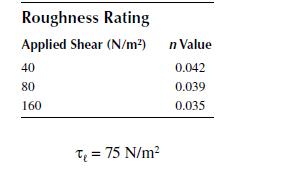
An RECP having the following listed roughness rating is used to control erosion in a trapezoidal earthen channel of 3:1 side slope:The bottom width and the channel slope are 0.9 m and 1.5%, respectively. The soil is clayey sand (SC) having PI = 16 and e = 0.5. Determine if the RECP lining is
Which agency passed the Clean Water Act (CWA) of 1972? What did the Act cover?
What are MS4s and what type of permit do they require?
What is a construction general permit (CGP)? When did the current CGP go into effect?
What does NPDES stand for? When did the NSPES phase II become effective and what does it require?
What does TSS mean? What is the required TSS removal in New Jersey? What is the requirement in your state?
What does EISA Section 438 cover?
What is the new trend in storm water quantity control?
What is defined as a major development in New Jersey?
Are major developments required to provide peak flow reductions in New Jersey? What are those reductions?
What is the water quality requirement in New Jersey? Are all development projects required to provide storm water treatment?
Calculate the volume of water quality storm for a 10-acre development in New Jersey.What is the volume for a 4.0 ha site? The impervious coverage is 30%. State any assumptions made.
Calculate the water quality runoff volume for a 10-acre development, having the following impervious/pervious coverages:a. 15% buildingb. 25% parkingc. 60% lawn/landscape How much of the runoff is subject to water quality treatment? Hint: Lawn and landscape generate little runoff during a water
The runoff from the building and parking area of Problem 5.12 is routed through an extended detention basin that provides 40% TSS removal. Is this adequate to address the state of New Jersey storm water management regulations? If not, what is the required TSS removal deficiency? What can be done to
Calculate the required groundwater recharge in Problem 5.12 using option 2 in the NJDEP regulation. The site soil is hydrologic group B and the 2-year, 24-hour storm is 3.4 in.
What is the water quantity sizing criteria in the state of Maryland? Calculate the required water quality volume for an 8-acre residential site in the eastern zone. The impervious coverage on the site is 2.4 acres.
Redo Problem 5.15 for a 2 ha site with 30% impervious coverage.
Calculate the water quality volume WQv of the residential project in Problem 5.15 for a site in the state of New York. The site is marked “site” on Figure 5.11.
Calculate the recharge volume for the residential site of Problem 5.15. The site soil is hydrologic group B.
Calculate the channel protection volume, Cpv, for the site of Problem 5.18. The site is located in Frederick County. Base your calculations on a time of concentration of 30 minutes for the predevelopment conditions and 15 minutes for post development.
Calculate overbank flood protection volume, Qp, for Problem 5.15. The site is situated in Frederick County.
Calculate the required ESD runoff depth and storage volume for Example 5.2 in this chapter in metric units. For simplicity, round the site area to 14 ha.
Showing 2600 - 2700
of 7324
First
20
21
22
23
24
25
26
27
28
29
30
31
32
33
34
Last
Step by Step Answers

 Get 50% OFF
Claim Now
Get 50% OFF
Claim Now