







Question: Repeat Example (15-7) except with a forced flow with a velocity of (1.05 mathrm{~cm} / mathrm{s}) past the sphere. Use Eq. (15-60b) to determine (mathrm{k}_{mathrm{c}}).
Repeat Example \(15-7\) except with a forced flow with a velocity of \(1.05 \mathrm{~cm} / \mathrm{s}\) past the sphere. Use Eq. (15-60b) to determine \(\mathrm{k}_{\mathrm{c}}\). The viscosity of air at \(1.0 \mathrm{~atm}\) and the effect of pressure on viscosity are available at http://www.engineeringtoolbox.com/.
a. Find the time required for the sphere to shrink from a diameter of \(0.6 \mathrm{~cm}\) to a diameter of \(0.2 \mathrm{~cm}\).
b. Compare answer from part a to the time required for the sphere to shrink from a diameter of \(0.6 \mathrm{~cm}\) to a diameter of \(0.2 \mathrm{~cm}\) if \(\mathrm{Sh}=2.0\).
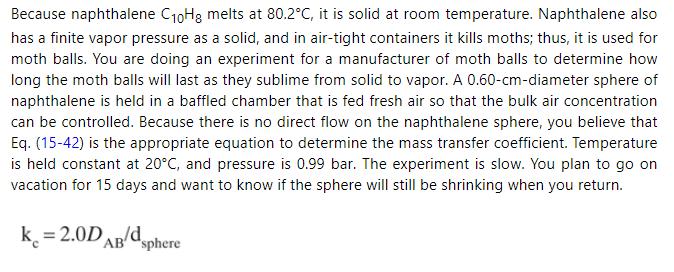
Example 15-7
Equation (15-60b)

Because naphthalene C10Hg melts at 80.2C, it is solid at room temperature. Naphthalene also has a finite vapor pressure as a solid, and in air-tight containers it kills moths; thus, it is used for moth balls. You are doing an experiment for a manufacturer of moth balls to determine how long the moth balls will last as they sublime from solid to vapor. A 0.60-cm-diameter sphere of naphthalene is held in a baffled chamber that is fed fresh air so that the bulk air concentration can be controlled. Because there is no direct flow on the naphthalene sphere, you believe that Eq. (15-42) is the appropriate equation to determine the mass transfer coefficient. Temperature is held constant at 20C, and pressure is 0.99 bar. The experiment is slow. You plan to go on vacation for 15 days and want to know if the sphere will still be shrinking when you return. k=2.0D AB/d AB sphere
Step by Step Solution
3.46 Rating (162 Votes )
There are 3 Steps involved in it

Get step-by-step solutions from verified subject matter experts
 Study Help