New Semester
Started
Get
50% OFF
Study Help!
--h --m --s
Claim Now
Question Answers
Textbooks
Find textbooks, questions and answers
Oops, something went wrong!
Change your search query and then try again
S
Books
FREE
Study Help
Expert Questions
Accounting
General Management
Mathematics
Finance
Organizational Behaviour
Law
Physics
Operating System
Management Leadership
Sociology
Programming
Marketing
Database
Computer Network
Economics
Textbooks Solutions
Accounting
Managerial Accounting
Management Leadership
Cost Accounting
Statistics
Business Law
Corporate Finance
Finance
Economics
Auditing
Tutors
Online Tutors
Find a Tutor
Hire a Tutor
Become a Tutor
AI Tutor
AI Study Planner
NEW
Sell Books
Search
Search
Sign In
Register
study help
computer science
cambridge igcse computer science coursebook
Chemistry For Cambridge O Level 3rd Edition Derek McMonagle - Solutions
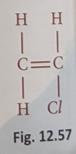
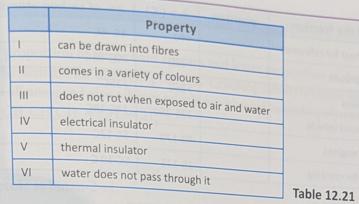
33. Fig. 12.57 represents a molecule of chloroethene.(a) Draw a diagram to show part of a molecule of poly(chloroethene) formed by three molecules of monomer.(b) Table 12.21 shows some properties of poly (chloroethene). Give three properties from Table 12.21 that make poly(chloroethene) suitable
32. (a) Describe the two main industrial processes for making ethanol, giving details of the starting materials, the conditions required and equations for the reactions that take place.(b) Explain which is the preferred method of making ethanol for use as a solvent.
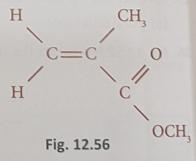
31. Perspex is a polymer formed from the monomer shown in Fig. 12.56.(a) State two functional groups present in this molecule.(b) What is the name of the process by which Perspex is formed from its monomer?(c) Draw the repeat unit of Perspex.(d) State two uses of Perspex. H H C=C CH =1 C 0 OCH Fig.
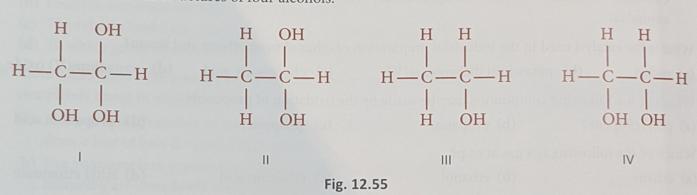
30. Fig. 12.55 shows the structures of four alcohols.Which pair of alcohols are isomers?(a) I and IV (b) II and III (c) III and 1 (d) IV and II HO HO H OH HO H HO HO H OH H-C-C-H H H H-C-C-H H H H-C-C-H H-O-O-H H OH Fig. 12.55 IV
29. What does the term 'non-biodegradable' mean when used to describe a plastic bottle?(a) It cannot be reshaped once it has been formed.(b) It cannot be recycled once it has been used.(c) It cannot be broken down by natural decay processes.(d) It cannot be used to store aqueous solutions.
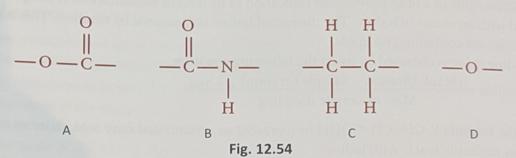
28. Which of the following is the linkage that joins amino acids in a protein molecule? -0-C- -C-N- A H B Fig. 12.54 H H | | -C-C- H H C -0- D
27. Which of the following is an example of a condensation polymer?(a) nylon(b) perspex(c) poly(ethene)(d) PTFE
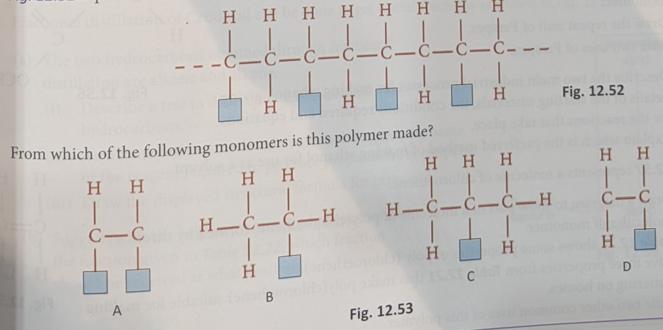
26. Fig. 12.52 represents the structure of a part of the additional polymer poly(phenylethene). HHHHHHHH H H H H Fig. 12.52 From which of the following monomers is this polymer made? H H C-C A H H H-C-C-H H B HHH H H C-C H H D C H----H H Fig. 12.53
25. An ester has the molecular formula CH,CH,COOCH, CH, The name of this ester is(a) ethyl ethanoate(b) ethyl propanoate(c) propyl ethanoate(d) propyl propanoate
24. Which of the following reacts with sodium carbonate solution to produce carbon dioxide gas?(a) propanoic acid(b) propanol(c) propene(d) propyl propanoate
23. Which of the following is a gas at r.t.p?(a) ethane(b) ethanol(c) ethanoic acid(d) ethyl ethanoate
22. Which of the following compounds may be made by the oxidation of propanol?(a) poly(propene)(b) propane(c) propene(d) propanoic acid
21. What is the catalyst used in the industrial preparation of ethanol from ethene and steam?(a) nickel(b) potassium dichromate(VI)(c) phosphoric acid(d) vanadium(V) oxide
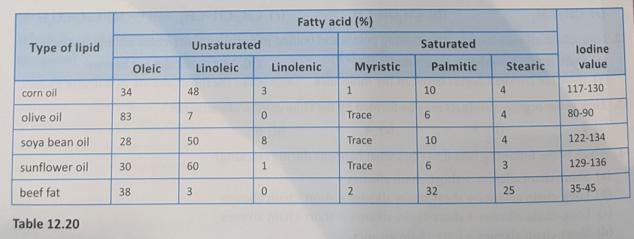
20. Animal and vegetable oils/fats are mixtures of alkyl alkanoates. These compounds are formed from saturated and unsaturated long-chain carboxylic (fatty) acids. Table 12.20 contains some information about the composition of different lipids (oils and fats).(a) Describe the structure of the
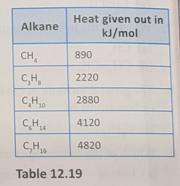
19. Table 12.19 shows the amount of heat released when some alkanes are completely burnt in oxygen.(a) Plot a graph of number of carbon atoms against heat given out and draw a line of best fit through the points.(b) Use your graph to predict the amount of heat released when the following are
18. Analysis of a hydrocarbon showed it to be 85.7% carbon, by mass(a) What was the percentage, by mass, of hydrogen?(b) Find the empirical formula of this compound.(c) The relative molecular mass of the hydrocarbon is 42. What is its molecular formula?(d) To which group of hydrocarbons does it
17. The alkynes are a third homologous series of hydrocarbons. Their names have the suffix "yne. Alkynes contain a carbon-carbon triple bond and have the general formula CH(a) Use the general formula to find the chemical formula of the alkyne that has four carbon atoms.(b) What is the name of the
16. Explain the meaning of the following:(a) homologous series(b) the prefix but(c) functional group(d) the suffix 'ene(e) structural isomers
15. Which of the following compounds would not decolourise bromine water?(a) CH-CH(b) CH, CH, CH-CH,(c) CH-CH=CH(d) CH, CH,
14. Which of the following best describes what happens during cracking?(a) Short-chain alkanes → short-chain alkenes(b) Long-chain alkanes → short-chain alkanes + short-chain alkenes(c) Long-chain alkenes → short-chain alkanes + short-chain alkenes(d) Short-chain alkenes → long-chain alkanes
13. How many organic products may be formed by the chlorination of methane?(a) 2(b) 3(c) 4(d) 6
12. Long-chain alkanes have higher melting points and boiling points than short-chain alkanes because:(a) there is more overlap between molecules.(b) the molecules are heavier.(c) there are covalent bonds between the molecules.(d) the molecules are of different shapes.
11. Which of the following compounds is an alkene?(a) CH-CH,(b) CHOH-CH,(c) CH-CH=CH,(d) CH-CO,H
10. What is the general formula for the homologous series of alkenes?(a) CH 20-2(b) CH(c) C 8 H 2n + 2(d) CH
9. Which of the following compounds has a structural isomer?(a) butane(b) ethane(c) methane(d) propane
8. The general formula of the homologous series of alkanes is carbon atoms is: C n H 2n + 2 ^ n The formula of the alkane that has eight(a) CH(b) CH 10(c) C,H,(d) CH
7. Which of the following compounds is not a hydrocarbon?(a) C*H_{4}(b) CH-CHOH-CH-CH,(c) C*H_{3}*CH = C*H_{2}(d) C*H_{2} = C*H_{2}
6. Which of the following compounds belong to the same homologous series?I. C*H_{3} - C*H_{3}II. C*H_{2} = C*H_{2}III. C*H_{3} - C*H_{2}*Cl IV. C*H_{3}*C*H_{2}*C*H_{2}*C*H_{3}(a) 1 and II(b) II and IV(c) III and IV(d) I and IV
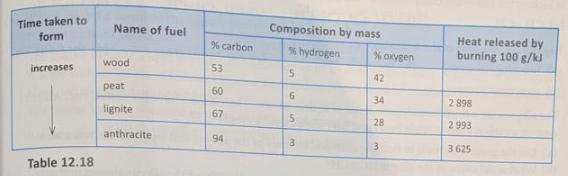
5. Information of some different types of fuel is given in Table 12.18.(a) (i) What pattern is there between the carbon content of a fuel and the heat released when it is burnt?(ii) Suggest a reason for this pattern.(b) On burning a fuel 1 g of carbon releases 34 000 J and 1 g of hydrogen releases
4. Here are five fractions obtained from petroleum.bitumen fuel oil petrol kerosene Which of these fractions is used:(a) for heating in the refinery(b) as a fuel for road vehicles(c) as aviation fuel(d) in road building(e) as a fuel for ocean-going ships?
3. Which fraction obtained from the distillation of petroleum provides petrol?(a) gas oil(b) kerosene(c) LPG refinery gases(d) naphtha
2. Naphtha and gas oil are two fractions obtained from the fractional distillation of petroleum. In which of the following ways does gas oil differ from naphtha?(a) It is paler in colour.(b) It is less viscous.(c) It is easier to ignite.(d) It burns with a smokier flame.
1. Which of the following fractions is obtained by the distillation of petroleum residue under reduced pressure?(a) bitumen(b) kerosene(c) naphtha(d) refinery gases
Draw the structural formula of pentanoic acid.
Explain the following statements:1. Beyond about 35 °C, the rate of fermentation cannot be increased by increasing the temperature of the fermenting mixture.2. Fermentation cannot produce a solution of ethanol above about 15% by volume.3. Distillation of a fermentation mixture does not yield
Write a balanced symbol equation including state symbols for the combustion of propanol.
2. Explain why butan-3-ol does not exist.
1. Draw structures for butan-1-ol and butan-2-ol.
2. Write an equation showing the possible products of cracking pentane, C₂H12.
1. Explain the importance of cracking in making the most efficient use of petroleum.
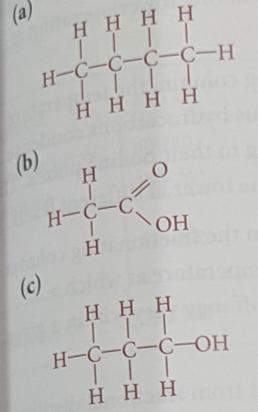
3. Give the name and structural formula of each of the following compounds. (a) HHHH TITT H-C-C-C-C-H HHHH (b) H H-C-C 0 HO H (c) HHH H-C-C-C-OH HHH
2. Draw the displayed formula of the following compounds.(a) butanoic acid(b) ethanol(c) propane
1. Draw the structural formulae of the following compounds.(a) ethane(b) propene(c) methanol
Give the name of each of the following by joining together the appropriate prefix and suffix.1. An alkene which contains three carbon atoms.2. An alkane which contains two carbon atoms.3. An alcohol which contains four carbon atoms.4. A carboxylic acid which contains two carbon atoms.5. An alkene
9. Sulphur dioxide, SO₂, and nitrogen dioxide, NO, are both atmospheric pollutants formed during the combustion of coal at a power station.(a) (i) State another source of sulfur dioxide as an atmospheric pollutant. [1](ii) State another source of nitrogen dioxide as an atmospheric pollutant.
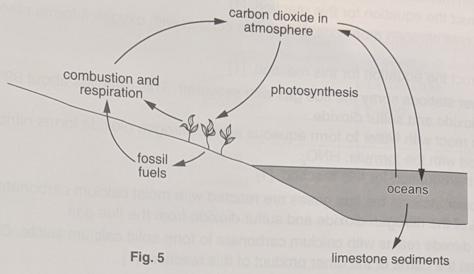
8. The diagram shows the carbon cycle.carbon dioxide in atmosphere(a) Many scientists think that the burning of hydrocarbons such as octane, C 8 H 18 deg contributes climate change.(1) Write an equation for the complete combustion of octane. [1](ii) Why do some scientists think that the burning of
7. Petrol (gasoline) is a mixture of hydrocarbons, one of which is octane, CH(a) In addition to carbon dioxide the exhaust emissions contain both nitric oxide, NO, and carbon monoxide, CO. Describe how a catalytic converter can help to reduce the amounts of nitric oxide and carbon monoxide in the
6. Sulfur dioxide is a gas which contributes to acid rain.(a) (i) State one source of sulfur dioxide in the atmosphere. [1](ii) Acid rain can cause lakes to become acidic. This may cause fish and plants in the water to die. Describe one other environmental problem caused by acid rain. [1]
5. The carbon cycle regulates the amount of carbon dioxide in the atmosphere.(a) Explain how the processes of photosynthesis and respiration help to regulate the amount of carbon dioxide in the atmosphere. [3]
4. Coal is largely carbon.(a) Coal contains a small amount of sulfur.(i) Explain how the burning of coal results in the formation of acid rain. [3](ii) State one effect of acid rain. [1](b) Oxides of nitrogen also contribute to acid rain. They can be formed naturally in the atmosphere from nitrogen
3. Many electricity generating power stations burn fossil fuels. The combustion of these fuels produces waste gases called flue gas.The flue gas contains nitrogen oxides, sulfur dioxide and carbon dioxide.Nitrogen oxides and sulfur dioxide contribute towards acid rain and must be removed from the
2. Fertilisers are used to promote plant growth and increase crop yield.Three fertilisers are potassium chloride, potassium nitrate and ammonium phosphate.(a) Ammonium phosphate is an ionic compound containing the phosphate ion, PO(1) Write the formula for ammonium phosphate. [1](ii) Calculate the
1. Many fertilisers contain phosphate ions and nitrate ions.(a) Explain why farmers put fertilisers on the soil. [1](b) Why should the chemicals in fertilisers be soluble in water? [1](c) Ammonium nitrate, NH,NO,, and ammonium sulfate, (NH)₂SO₄, are commonly used in fertilisers.(i) Calculate
23. The labels on three chemicals including pure water, aqueous dilute hydrochloric acid, and ethanol have fallen from their bottles. The chemist needs to use pure water for washing crystals in the lab. Anhydrous copper II sulfate or anhydrous cobalt II chloride can be used to find the presence of
22. Which of the following is a test for the presence of water?(a) turns blue litmus paper red(b) turns blue cobalt chloride paper pink(c) turns pink cobalt chloride paper blue(d) turns red litmus paper blue
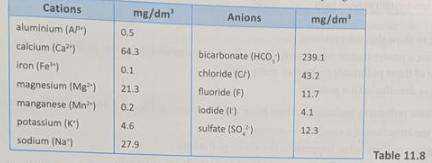
21. Table 11.8 shows details from the label on a bottle of natural spring water.(a) The symbol given for one of the ions is incorrect.(i) Name the ion.(ii) Give the correct symbol.(b) lons of which Group VII elements are present?(c) Suggest another anion, not in the table, you would expect to see
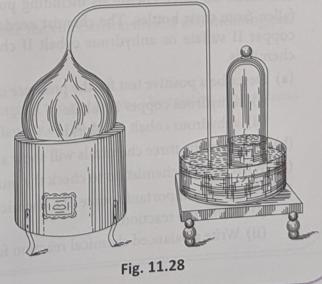
20. Fig. 11.28 shows the apparatus used by the scientist Antoine Lavoisier to investigate air. He placed some mercury in a long-necked retort flask on a charcoal furnace. The neck of the flask led into a bell jar sat in a trough of mercury.After heating the mercury in the flask for some days, he
19. Some apparatus used in an experiment to investigate the composition of air is shown in Fig. 11.27.The copper is heated and then air is passed from one syringe to the other until a constant volume is obtained.The apparatus is then left to cool.(a) What is the aim of this activity?(b) Which gas
18. Car exhaust gas contains pollutants including carbon monoxide, nitrogen oxides and unburnt hydrocarbons(a) Briefly describe the structure of a catalytic converter.(b) Draw a flow diagram to show what happens to the above pollutants.(c) In the catalytic converter, which pollutants are oxidised
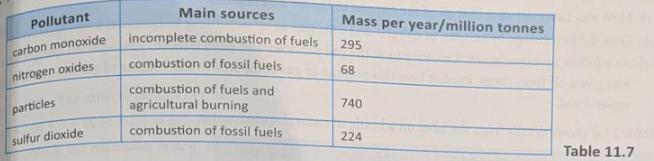
17. Table 11.7 gives information about the main sources of some atmospheric pollutants.(a) Draw a bar chart to show this information.(b) The waste gas from a power station which burns fossil fuels contains all four of the pollutants in the table. Which two of these pollutants make rain more
16. A sample of 35.0 cm³ of air is passed over an excess of hot copper powder until is attains a constant volume and then allowed to cool. The final volume of the gas was:(a) 7.3 cm³(b) 16.0 cm³(c) 20.9 cm³(d) 27.7 cm³
15. Which of the following greenhouse gases has the highest relative effect per molecule?(a) carbon dioxide(b) methane(c) CFCs(d) nitrous oxide
14. Flue gas desulfurisation reduced the emissions from power stations of(a) carbon particles(b) carbon dioxide(c) nitrogen oxides(d) sulfur dioxide
13. Which of the following processes reduces the concentration of carbon dioxide in the atmosphere?(a) combustion(b) decay(c) photosynthesis(d) respiration
12. Which of the following best describes the action of greenhouse gases in the atmosphere?(a) They absorb heat radiation from the Earth and then re-radiate the heat.(b) They reflect heat radiation from the Earth.(c) They heat up radiation from the Sun as it travels to the Earth.(d) They trap all
11. Which of the following pollutants is most likely to be released into water as a result of mining?(a) compounds of transition elements(c) nitrates(b) microorganisms that transmit diseases(d) untreated sewage
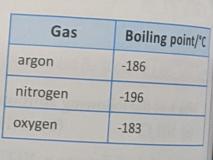
10. Table 11.6 shows the boiling points of argon, nitrogen and oxygen.If a sample of liquid air was warmed from -200 °C to 0 °C, in what order would the components become gases?(a) argon then oxygen then nitrogen(b) nitrogen then argon then oxygen(c) oxygen then argon then nitrogen(d) oxygen then
9. What is the purpose of putting chlorine into the water during water treatment?(a) to make people's teeth more resistant to decay(b) to precipitate out fine particles which make the water cloudy(c) to break down substances that give water an unpleasant smell(d) to kill harmful microorganisms
8. Which gas in air is needed for combustion?(a) nitrogen(b) oxygen(c) argon(d) carbon dioxide
7. A sample of 41.2 cm³ of dissolved air was obtained by boiling water. The air was passed over an excess of hot copper powder until it attained a constant volume and was then allowed to cool. The volume of the gas was 26.6 cm'. The percentage of oxygen, by volume, in dissolved air is yield of
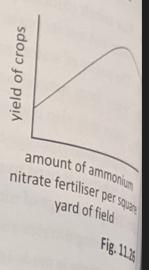
6. Fig. 11.26 shows how the yield of a crop changes with the amount of ammonium nitrate fertiliser added to the soil.(a) Describe the pattern shown by the graph.(b) Suggest a reason why the yield eventually starts to fall.(c) Discuss three reasons why farmers should not use excess fertiliser. yield
5. Ammonia is used to make fertilisers such as ammonium nitrate.(a) Write an equation for the preparation of ammonium nitrate from ammonia and nitric acid.(b) Calculate the volume of dry ammonia measured at r.t.P. needed to react exactly with 5 dm³ of nitric acid(c) Calculate the mass of ammonium
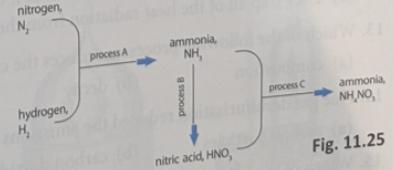
4. Fig. 11.25 shows different stages in the manufacture of the ammonium nitrate.(a) State the sources of the raw materials used to obtain nitrogen and hydrogen.(b) Name the catalyst used in process A.(c) What type of reaction occurs in process B?(d) What type of reaction occurs in process C?(e)
3. What is the percentage by mass of nitrogen in the fertiliser ammonium dihydrogen phosphate, NH H.PO? [Relative atomic masses: nitrogen = 14, hydrogen = 1, phosphorus = 31, oxygen = 16](a) 8%(b) 10%(c) 12%(d) 14%
2. Which of the following is NOT an advantage of chemical fertilisers over natural fertilisers?(a) take up less room to store(b) release nutrients quickly(c) easier to apply(d) cheaper to buy
1. Which of the following ammonium compounds is NOT used as a fertiliser?(a) NH CI(b) NH HPO(c) NHNO,(d) (NH) SO
In 1894, the Scottish chemist Sir William Ramsay noticed that dry nitrogen made by a chemical reaction has a density of 1.198 kg/m³, while nitrogen made by eliminating carbon dioxide and oxygen from dry air has a density of 1.204 kg/m³.1. Why was it important that the samples of nitrogen were
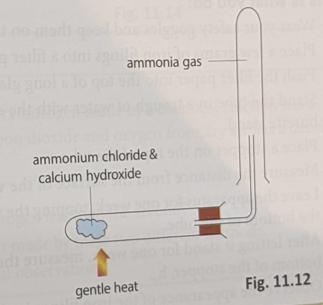
The following apparatus was used to make a sample of ammonia.1. Give an equation, including state symbols, for the reaction that takes place.2. Suggest why the ammonia gas cannot be collected:(a) over water(b) by downward delivery 3. Give details of a simple chemical test that could be used to
Find the percentage by mass of nitrogen in each of the following three compounds and decide which compound is the richest source of this element.1. potassium nitrate, KNO, 2. urea, CO(NH2), 3. ammonium sulfate, (NH)₂SO₄
What is the percentage by mass of nitrogen in ammonium nitrate, NH4NO3?
Conduct a survey of the sources of drinking water where you live and go to school. You should try and find out the answers to such questions as:1. Where does my drinking water come from?2. How is my drinking water treated to make sure it is safe?3. What eventually happens to waste water?
10. Electrolysis is used to produce many important chemicals such as chlorine, sodium hydroxide and aluminium. separate aluminium oxide from the impurities in the bauxite ore. The main impurity in the ore is iron(III) oxide, Aluminium(a) in the production of aluminium, sodium hydroxide is used to
Aluminium and iron are both metals.Iron rusts in the presence of oxygen and water. Rusting involves a series of reactions. Initially iron atoms lose electrons to form iron(II) ions. Fe(s) → Fe2+(aq) + 2e-At the same time oxygen, O₂, and water molecules react to form hydroxide ions. O2(g) +
Iron is extracted by reducing iron ore in a blast furnace. The raw materials used are iron ore, coke, air and limestone.(a) Name an ore of iron.(b) Explain, by reference to the chemical reactions involved, why limestone is used in the blast furnace.(c) Coke burns in oxygen to form carbon
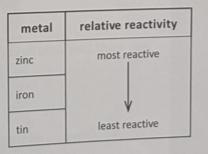
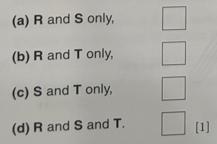
7. A student places each of three metals in tubes containing dilute hydrochloric acid. In which tubes is hydrogen produced? (a) R and S only, (b) R and T only, (c) S and T only, (d) R and S and T. [1]
6. A student is given some copper powder.(a) The student heats the copper in air to form copper(II) oxide. Give the formula and colour of copper(II) oxide.(b) The student adds dilute sulfuric acid to the copper(II) oxide. A reaction takes place. Construct the equation for the reaction.(c) Name the
5. Brass is an alloy of zinc and copper.(a) Describe, with the aid of a labelled diagram, the structure of a metal such as copper(b) Explain, in terms of their structures, why both zinc and copper are good conductors electricity.(c) A 1.2 g sample of powdered brass was analysed by reaction with
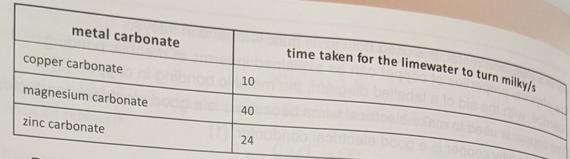
4. Magnesium is a reactive metal.(a) (i) Name the products formed when magnesium reacts with steam.(ii) Write the equation for the reaction of magnesium with ethanoic acid, CH3COOH.(b) The equation shows the reaction which occurs when magnesium carbonate is heated.MgCO3 → MgO + CO₂State the
3. (a) Choose from the following list of metals to answer the questions below. aluminium iron lead magnesium potassium silver vanadium Each metal can be used once, more than once or not at all. Which metal(i) reacts with cold water to form an alkaline solution,(ii) forms a protective oxide layer on
2. Copper is a transition metal. It is used both in its pure form and in alloys.(a) The physical properties of copper can be explained in terms of metallic bonding. Describe, with the aid of a labelled diagram, the metallic bonding in copper.(b) Pure copper is used to make electrical wires because
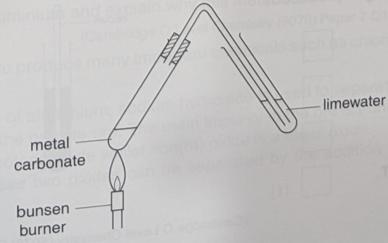
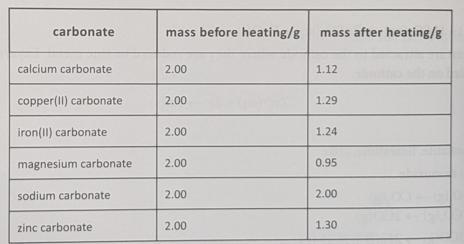
1. Many carbonates thermally decompose to form carbon dioxide and an oxide.Copper carbonate forms carbon dioxide and copper oxide.CUCO, CuO + CO₂Six 2.00 g samples of carbonates are heated strongly until there is no further change in mas The table shows the mass of solid remaining at the end of
3. For the given list of metals, answer the questions given below. A metal can be used once, more than once, or not at all. potassium, gold, magnesium, zinc, copper, iron, calcium, aluminium(a) (i) Which of the metals will react with oxygen to form an insoluble oxide?(ii) Write a balanced chemical
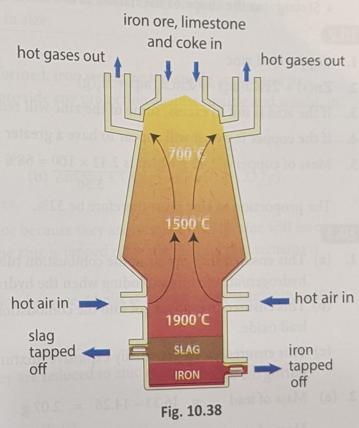
38. Fig. 10.38 shows the inside of a blast furnace.(a) Give the chemical formulae of the three solid raw materials used in the blast furnace.(b) Name the main reducing agent in the blast furnace and write chemical equations to show how it is formed from carbon.(c) The blast of hot air is about 600
(a) What is the charge on:(i) an aluminium ion(ii) an oxide ion?(b) Pure aluminium oxide has a melting point of 2072 °C. Aluminium is manufactured by the electrolysis of a solution of aluminium oxide in a molten mineral called cryolite at a temperature of 1052 °C.(i) Why is an electrolyte of
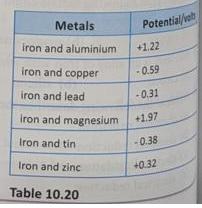
26. When iron and another metal are placed apart in an aqueous electrolyte, they form an electric cell and there is a voltage between them.Table 10.20 shows the potential of the cells formed by iron with other metals.(a) By referring to the reactivity series, comment on the pattern of cell
25. (a) What is a redox reaction?(b) Define reduction and oxidation in terms of the transfer of electrons.(c) The following equation represents the rusting of iron:4Fe(s) +30,(g) + 2H,O(1) → 2Fe,O,,H,O(s)Explain why rusting can be described as a redox reaction.(d) Write half-equations for the
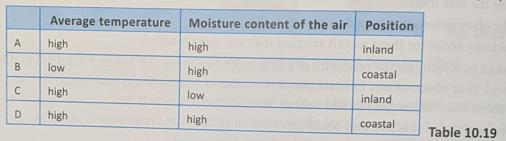
24. In which of the following conditions will a mild steel construction rust most rapidly? Average temperature Moisture content of the air Position A high high inland B low high coastal C high low inland D high high coastal Table 10.19
23. Which of the following is an alloy of aluminium used to build the bodies of aircraft?(a) alnico(b) bronze(c) duralumin(d) mild steel
22. Which of the following is pure aluminium oxide?(a) alumina(b) bauxite(c) cryolite(d) red mud
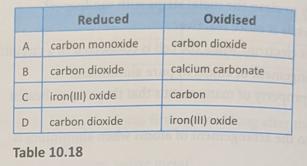
21. In Table 10.18, which option correctly shows a species which is reduced and a species which is in the blast furnace? Reduced Oxidised A carbon monoxide carbon dioxide B carbon dioxide calcium carbonate C iron(III) oxide carbon D carbon dioxide iron(III) oxide Table 10.18
Showing 300 - 400
of 1029
1
2
3
4
5
6
7
8
9
10
11
Step by Step Answers

 Get 50% OFF
Claim Now
Get 50% OFF
Claim Now