New Semester
Started
Get
50% OFF
Study Help!
--h --m --s
Claim Now
Question Answers
Textbooks
Find textbooks, questions and answers
Oops, something went wrong!
Change your search query and then try again
S
Books
FREE
Study Help
Expert Questions
Accounting
General Management
Mathematics
Finance
Organizational Behaviour
Law
Physics
Operating System
Management Leadership
Sociology
Programming
Marketing
Database
Computer Network
Economics
Textbooks Solutions
Accounting
Managerial Accounting
Management Leadership
Cost Accounting
Statistics
Business Law
Corporate Finance
Finance
Economics
Auditing
Tutors
Online Tutors
Find a Tutor
Hire a Tutor
Become a Tutor
AI Tutor
AI Study Planner
NEW
Sell Books
Search
Search
Sign In
Register
study help
computer science
cambridge igcse computer science coursebook
Chemistry For Cambridge O Level 3rd Edition Derek McMonagle - Solutions
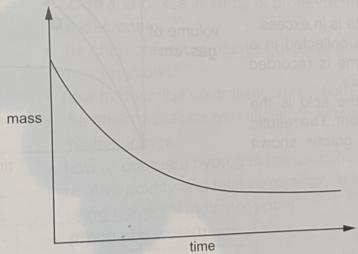
8. The diagram shows apparatus that can be used to investigate the rate of reaction between zinc and hydrochloric acid.(a) Write the equation, including state symbols, for the reaction between zinc and hydrochloric acid. [2](b) The graph shows the change in mass that occurs during the reaction
7. Hydrogen and iodine react together to form hydrogen iodide in a reversible redox reaction. The forward reaction is endothermic.H2(g) + 12(g) = 2HI(g) AH = +53 kJ mol-¹Hydrogen and hydrogen iodide are colourless gases whereas iodine gas is purple.(a) What is meant by the term redox reaction?(b)
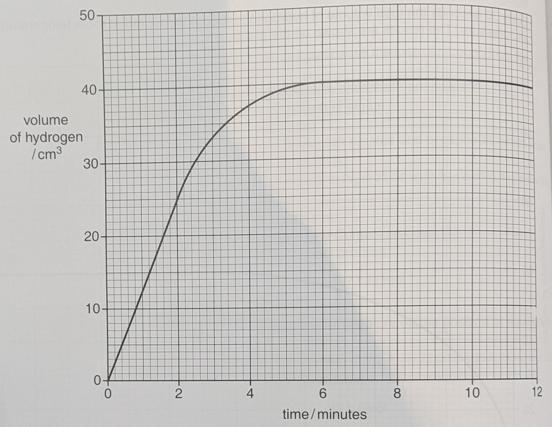
6. A student measured the volume of hydrogen produced over time when small pieces of reacted with excess sulfuric acid.The results are shown in the graph below.(a) Use the information from the graph to calculate the average speed of reaction in the first tw minutes. [1](b) Explain why the reaction
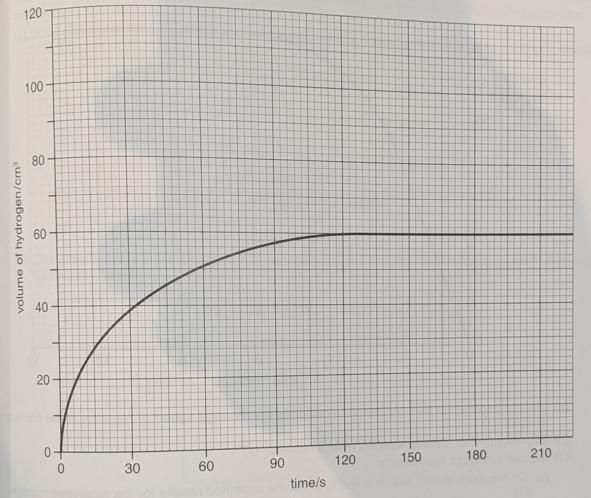
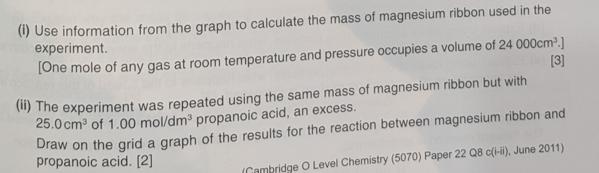
Propanoic acid, C₂H₂CO,H, and hydrochloric acid, HCl, both act as acids when dissolved in 5 water.(a) In an experiment magnesium ribbon is added to 25.0 cm³ of 1.00 mol/dm³ hydrochloric acid, an excess.Mg(s) + 2HCl(aq) → MgCl (aq) + H₂(g)Every 30 seconds the total volume of hydrogen
4. Barium oxide reacts with aluminium.3BaO+2A/3Ba + ALO, Explain how this equation shows that aluminium is a reducing agent.
3. Ammonia is made by the Haber process using an iron catalyst.N_{2} + 3H_{2} = 2N*H_{3} AH = -92 kJ/mol(a) On the same axes draw energy profile diagrams to show both the catalysed and the uncatalysed reaction, Label the diagram to show• the catalysed and uncatalysed reactions,• the reactants
2. Sulfur dioxide is a gas which contributes to acid rain.(a) Sulfuric acid is manufactured by the Contact process. Name the raw materials used in the first stage of the Contact process. [1](b) The equation shows the second stage of the Contact process. 2S*O_{2} + O_{2} = 2S*O_{2} AH-197 kJ/mol(1)
1. Ammonia is made by the Haber process.(a) (i) Write an equation for the formation of ammonia in the Haber process. [1] ((ii) State the essential conditions for the Haber process. [3](b) Ammonia is used to make fertilisers. Explain why farmers use fertilisers. [1](c) Many fertilisers are ammonium
18. Ammonia can be produced by the Haber process which is a reversible reaction.(a) What is meant by a reversible reaction?(b) The reaction is carried out at 400 and 200 atmospheric pressures. The equation for the reaction is sho below. AH=-92 KJ/mol.N₂ + 3H₁ = 2NH,(i) The reaction was
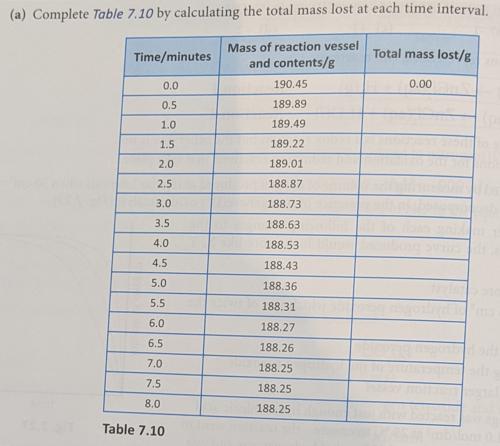
17. A sample of calcium carbonate was reacted with an excess of hydrochloric acid. The mass of the reaction vessel and contents was recorded every half minute for 8 minutes. The results are given in Table 7.10.(b) Plot a graph of total mass lost against time. Use your graph to answer the following
16. You are provided with magnesium carbonate, both as powder and lumps, and samples of cold and warm dilute hydrochloric acid of concentration 1 mol/dm². Design an activity to find which combination of magnesium carbonate and dilute hydrochloric acid reacts the fastest by observing the carbon
15. 0.14 g of iron filings was reacted with just enough hydrochloric acid of concentration 1.0 mol/dm² at 25 °C to ensure the reaction went to completion. The reaction produced 120 cm³ of hydrogen gas and was completed in 150 s.In terms of particles and collisions, explain how the results of the
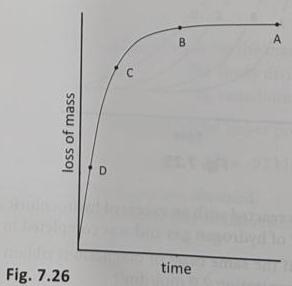
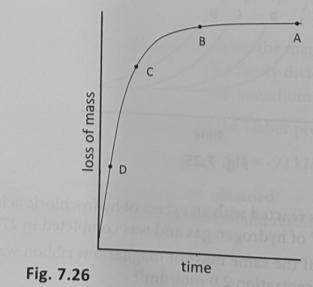
11. The following graph represents the loss of mass of a reaction mixture during a metal carbonate-acid reactioAt which point was the rate of reaction greatest? loss of mass D C time Fig. 7.26 B A
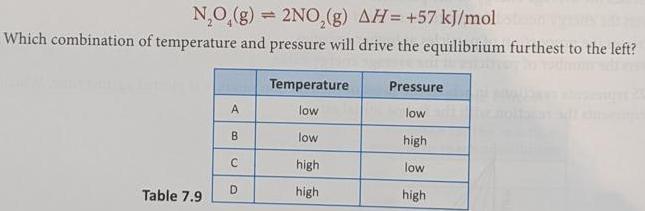
10. The following equation represents the equilibrium between dinitrogen tetroxide and nitrogen dioxide. = NO(g) 2NO2(g) AH= +57 kJ/mol Which combination of temperature and pressure will drive the equilibrium furthest to the left? Temperature Pressure A low low B low high C high low D Table 7.9
9. Which species acts as a reducing agent in the following equation?(a) C(s)(b) CuO(s)(c) Cu(s)(d) C*O_{2}(g) C(s) + 2CuO(s) Cu(s) + CO(g)
8. During the industrial production of nitric acid, ammonia is oxidised to nitrogen(II) oxide.Which of the following conditions favours the highest proportion of NO in the equilibrium mixture?(a) high pressure and high temperature (c) low pressure and high temperature (b) high pressure and low
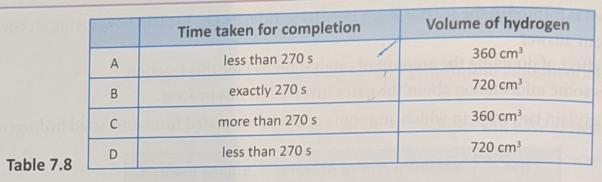
7. 0.36 g of magnesium ribbon was reacted with an excess of hydrochloric acid of concentration 1.0 mol/dm². The reaction produced 360 cm³ of hydrogen gas and was completed in 270 s. How would the results change if the same mass of magnesium ribbon was reacted with the same volume of hydrochloric
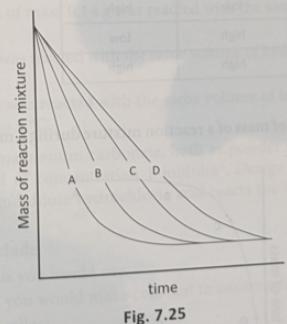
6. Fig. 7.25 represents reactions in which the mass of the reaction mixture is plotted against time. Which graph represents the reaction with the fastest initial rate? Mass of reaction mixture B time Fig. 7.25
5. When a catalyst is introduced into a mixture of reactant molecules it:(a) increases the average energy of the particles(b) lowers the energy needed for particles to react(c) increases the proportion of particles at higher energies(d) lowers the number of particles at the average energy value.
Nitrogen and oxygen react to form nitrogen(II) oxide according to the following equation. N₂(g) + O2(g) = 2NO(g) ∆H = +180 kJ/mol Which of the following changes in reaction conditions would increase the proportion of NO in the equilibrium mixture?(a) higher pressure(b) lower pressure(c) higher
3. Ammonia is manufactured from nitrogen and hydrogen in the Haber process.N 2 (g)+3H 2 (g) rightleftharpoons 2N*H_{3}(g)Delta*H = - 92kJ / m * ol(a) Name the raw materials from which the reactants are obtained.(b) State one condition, other than a low temperature, that would result in a higher
2. Which of the following catalysts is used in the Haber Process for the manufacture of ammonia?(a) finely divided iron(b) finely divided platinum(c) manganese(IV) oxide(d) vanadium(V) oxide
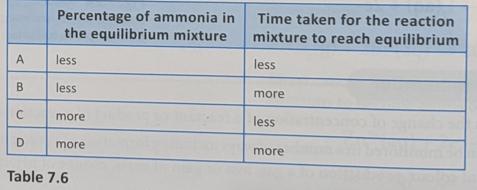
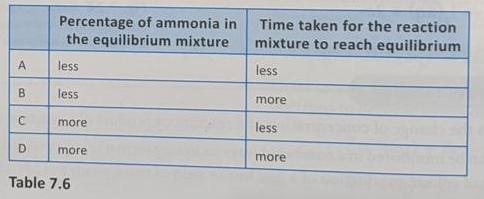
1. What would be the effect of lowering the reactor temperature in the Haber Process? Percentage of ammonia in the equilibrium mixture Time taken for the reaction mixture to reach equilibrium less A less B less C more D more Table 7.6 more less more
Explain each of the following observations about the Contact process.1. Aby-product of other industrial processes is used in this process.2. A catalyst is used in the reaction for making sulfur trioxide.3. Sulfur dioxide is oxidised into sulfur trioxide according to the following equation: (a) The
Explain each of the following observations about the Haber Process.1. A catalyst is used in this reaction.2. The catalyst is finely divided and not used in large lumps.3. The forward reaction is favoured by low temperatures.4. The forward reaction is favoured by high pressures.5. The mixture
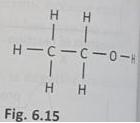
8. Ethanol is used as a fuel in some countries. It has the following structural formula.Ethanol burns completely in air according to the following equation:C₂H₂OH(I) +30,(g) → 2CO2(g) + 3H₂O(1)(a) Draw a table to show the bonds to be broken in the above reaction.(b) Draw a table to show the
7. Ethane burns in air according to the following equation:CH(g)+O(g) → 2CO2(g) + 3H2O(l)ΔΗ = -1560 kJ/mol What is the significance of 'AH' in the above equation?(a) It is the activation energy for the reaction.(b) It is the enthalpy change for the reaction,(c) It is the amount of heat energy
6. Which of the following is true about an exothermic reaction?(a) Exothermic reactions always involve oxygen.(b) Exothermic reaction is another name for combustion.(c) Exothermic reactions take in heat energy.(d) Exothermic reactions give out heat energy.
5. Which of the following could be described as a biofuel?(a) charcoal(b) coal(c) natural gas(d) petrol
4. What is the process by which carbon is removed from the air as carbon dioxide?(a) respiration(b) precipitation(c) photosynthesis(d) combustion
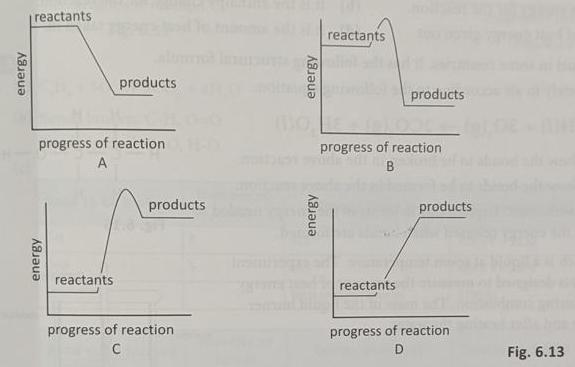
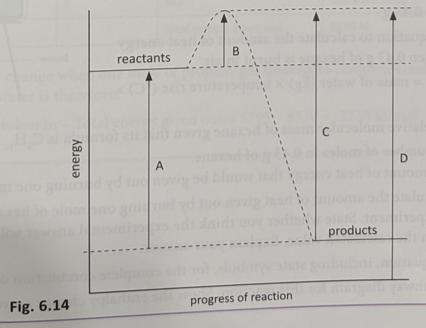
1. Which of the following fuels does not produce carbon dioxide when it burns?(a) petrol(b) natural gas(c) hydrogen(d) coal 2. Which of the following is an energy pathway for an exothermic reaction?3. Which of the following correctly indicates the activation energy for an exothermic reaction?
1. Propane has the chemical formula C3H8. In a good supply of air, it undergoes complete combustion to form carbon dioxide and water.(a) Write a chemical equation for the complete combustion of propane.(b) Make a list of the bonds which are broken and those which are formed when propane undergoes
Draw an energy pathway diagram for the reaction of methane and steam.
Draw an energy pathway diagram for the combustion of hydrogen.
6. Hydrogen-oxygen fuel cells are used to generate electricity. The overall reaction in a hydrogen-oxygen fuel cell is shown below.2H_{2}(g) + O_{2}(g) -> 2H_{2}*O(l)This reaction is exothermic.(a) Explain the meaning of the term exothermic. [1](b) Explain, in terms of the energy changes associated
16. (a) Explain the principle difference between a fuel cell and an electrochemical cell.(b) Explain what happens at the anode and the cathode of a hydrogen fuel cell.(c) Palladium is a very expensive metal. Palladium hydride is metallic palladium that contains a substantial quantity of hydrogen
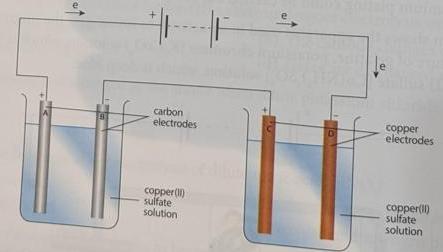
15. A student carried out an electrolysis of copper(II) sulfate solution using inert electrodes and active copp electrodes. The apparatus used is shown in Fig. 5.16. The electrodes are labelled A, B, C and D.(a) At which electrodes do the following processes take place?(i) reduction(ii)
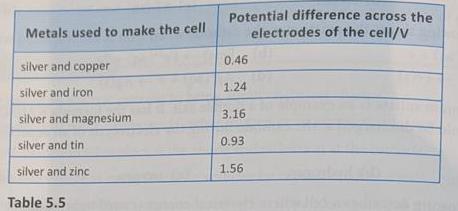
14. Table 5.5 shows the potential differences across the electrodes of electrochemical cells made using different combinations of metals.Metals used to make the cell(a) The greater the difference in reactivity of the metals the greater the potential difference between them. Which of the metals in
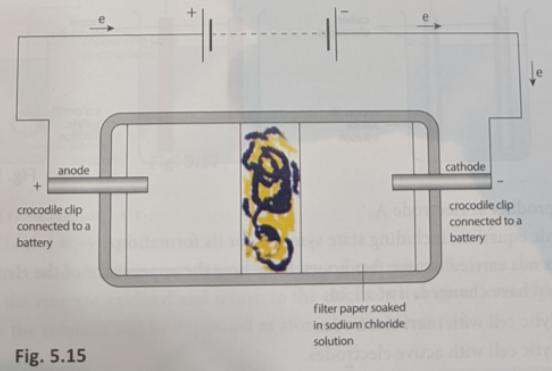
13. The following diagram shows the apparatus used in an activity to investigate the migration of ions. The gel is a mixture of gelatine, potassium chromate (K,CrO) solution, which is yellow, and tetraamminecopper(II) sulfate [Cu(NH) SO₄] solution, which is deep blue.(a) List the ions present in
12. Taps are made of brass but are often covered in chromium by electroplating.(a) Suggest two advantages of chromium plating.(b) What ions are present in chromium(III) sulfate, Cr, (SO₂),?(c) Explain how chromium plating could be carried out using aqueous chromium(III) sulfate.
11. (a) What ions are present in:(i) sodium chloride solution(ii) molten sodium chloride.(b) Write the half-equations for the reactions that occur when molten sodium chloride is decomposed by electrolysis.
10. In the Hall-Héroult cell, how many moles of oxygen gas are discharged for every mole of aluminium?(a) 0.67(b) 0.75(c) 1.50(d) 3.00
9. Which of the following describes a cell where electrical energy is used to bring about a chemical reaction?(a) electrolytic(b) electrode(c) electrolysis(d) electrolyte
8. Potassium aluminium sulfate is an example of a double salt. It has the formula KAl(SO),. Which of the following would be discharged at the cathode during the electrolysis of an aqueous solution of this compound?(a) aluminium(b) hydrogen(c) oxygen(d) potassium
7. Which of the following shows the reaction at the cathode when iron is electroplated with silver?(a) Ag(s) Ag(aq) + e(b) Fe(s)→ Fe(aq) + 2e(c) F * e ^ (2i) * (aq) + 2e -> Fe(s)(d) Ag(aq) + e → Ag(s)
6. An electrolysis of dilute sulfuric acid produced 58 cm³ of oxygen. What volume of hydrogen was produced?(a) 29 cm³(b) 58 cm³(c) 87 cm³(d) 116 cm³
5. Why is it NOT possible to obtain calcium metal and chlorine gas from the electrolysis of dilute calcium chloride solution?(a) Calcium chloride is insoluble in water.(b) Calcium chloride is a covalent compound.(c) Other ions prevent Ca² and Cl ions from reaching the electrodes.(d) Other ions
4. What would be the ratio of lithium atoms to bromine molecules formed by the electrolysis of molten lithium bromide, LiBr?(a) 1:1(b) 1:2(c) 2:1(d) 2:3
3. What would be the products of the electrolysis of dilute nitric acid, HNO,?(a) hydrogen and oxygen(b) nitrogen dioxide and hydrogen(c) nitrogen and hydrogen(d) oxygen and nitrogen dioxide
2. Which of the following is discharged at the anode when dilute potassium chloride solution undergoes electrolysis?(a) chlorine(b) hydrogen(c) oxygen(d) potassium
1. Which of the following happens when copper(II) sulfate undergoes electrolysis using inert electrodes?(a) The anode changes colour.(b) The cathode changes colour.(c) The electrolyte turns darker.(d) Gases are discharged at both electrodes.
A student wishes to electroplate a small copper ring with silver.1. Suggest why the salt used for the electrolyte solution should be readily soluble in water.2. What substance should be used for the anode?3. Draw a labelled diagram of the apparatus that could be used.4. Write a half-equation for
State the products at the anode and cathode when each of the following undergoes electrolysis, write half-equations for the reactions at each electrode and state whether the reaction is an oxidation or a reduction.1. molten sodium chloride using inert electrodes 2. sodium sulfate solution using
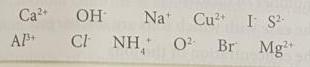
Sort the following into a group of anions and a group of cations. Ca2+ OH Na Cu I S2 AP+ C NH 02 Br Mg2+
15. A student is given a sample of an organic acid, G, and asked to• determine its relative molecular mass• suggest its formula.(a) A sample of the acid is placed in a previously weighed container and reweighed.mass of container + G = 8.55 g mass of container = 6.94 g Calculate the mass of G
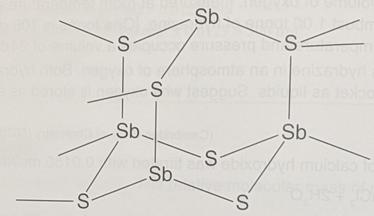
13. Part of the chain structure of antimony sulphide is shown below.Deduce the empirical formula of antimony sulphide. [1] Sb S S S -S- Sb. Sb. S S Sb.
12. (a) Analysis of 10.0 g of carboxylic acid X shows that it contains 2.67 g carbon, 0.220 g hydrog and 7.11 g oxygen.(i) Deduce the empirical formula of X. [3](ii) The relative molecular mass of X is 90. Deduce the molecular formula of X. [1]
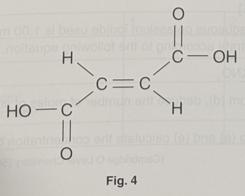
11. Fumaric acid is a colourless solid which can be extracted from plants.A solution of fumaric acid was titrated against aqueous sodium hydroxide.HOCCH=CHCOH + 2NaOH → NaO₂CCH=CHCO2Na + 2H2O 18.0 cm³ of 0.200 mol/dm³ sodium hydroxide were required to neutralise 60.0 cm³ of fumar
10. Methylamine is a gas. Calculate the volume occupied by 6.2 g of methylamine at room temperature and pressure. [2]
9. Solid zinc chloride absorbs ammonia to form tetrammine zinc chloride, Zn(NH), CI ZnCl +4NH, Zn(NH), CI Calculate the maximum yield, in grams, of tetrammine zinc chloride formed when 3.4 g of zinc chloride reacts with excess ammonia. [2]
8. An aqueous solution of calcium hydroxide was titrated with 0.0150 mol/dm³ hydrochloric acid. Ca(OH) + 2HCI→ CaCl₂ + 2H,O It required 6.00 cm³ of this aqueous hydrochloric acid to neutralise 20.0 cm³ of the calcium hydroxide solution. Calculate the concentration, in mol/dm³, of the
7. (a) Hydrazine, N₂H₂, is a liquid that has been used as a rocket fuel. It reacts with oxygen as shown in the equation. N_{2}*H_{4} + O_{2} -> N_{2} + 2H_{2}*O(i) Calculate the volume of oxygen, measured at room temperature and pressure, needed to completely combust 1.00 tonne of hydrazine.
6. Dilute hydrochloric acid reacts with aqueous silver nitrate to form a white precipitate. Write an ionic equation, with state symbols, for this reaction. [2]
5. Nitric oxide, NO, is an atmospheric pollutant formed inside car engines by the reaction between nitrogen and oxygen. N₂(g)+O₂(g) + 2NO(g) AH = + 66 kJ mol Calculate the mass of nitric oxide formed when 100g of nitrogen reacts completely with oxygen. [3]
4. Farmers that grow vegetable oil crops often use large quantities of ammonium nitrate fertiliser. NH,NO, Calculate the percentage by mass of nitrogen in ammonium nitrate. [2]
3. A student ignites a mixture of 15 cm³ of propane and 100 cm³ of oxygen. The oxygen is in excese All measurements of volume are taken at room temperature and pressure. C₂H₂(g)+50,(g) 3CO₂(g) + 4H₂O(I) Calculate the volume of carbon dioxide formed, [1] the volume of unreacted oxygen
2. (a) The concentration of sodium chlorate(I) in a solution can be found by reacting sodium chlorate(1) with excess acidified potassium iodide and then titrating the iodine liberated with aqueous sodium thiosulfate, Na,S,O,.1 + 2Na S₂O, 2Nal + Na₂SO A solution of sodium thiosulfate contains
1. Nickel carbonyl has the formula Ni(CO),. The relative molecular mass of nickel carbonyl is 171 Calculate the value of x. [1]
Lithium reacts with chlorine to form lithium chloride. Write a balanced symbol equation for this reaction.
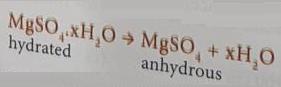
16. Hydrated magnesium sulfate has the chemical formula MgSO, XH₂O where x is a whole number. When this compound is heated strongly, anhydrous magnesium sulfate is formed.The following experiment was carried out to find the value of x.A sample of hydrated magnesium sulfate was heated in an
15. Propene is a compound of carbon and hydrogen. It has the chemical formula C₂H. It burns in oxygen to form carbon dioxide and water. 6(a) What is the empirical formula of propene?(b) How many moles of each of the following are formed from 1 mole of propene?(i) carbon dioxide(ii) water(c) Write
14. A sample of 3.25 g of zinc was heated in oxygen to form zinc oxide.(a) Write a chemical equation for this reaction.(b) What mass of oxygen was needed to react with the zinc?(c) What mass of zinc oxide was produced?
13. Butene (C.Hs) is a compound of carbon and hydrogen. It consists of 85.7% carbon and 14.3% hydroges and has a relative molecular mass of 56,(a) Find the empirical formula of butene.(b) Determine the molecular formula of this compound.(c) Which of the following compounds have the same empirical
12. Write chemical equations for the following reactions.(a) Magnesium reacts with chlorine to form magnesium chloride.(b) Hydrogen reacts with oxygen to form water.(c) Copper(II) carbonate decomposes on heating to form copper(II) oxide and carbon dioxide.(d) Nitrogen reacts with hydrogen to form
11. For each of the following equations:Rewrite the ions present in the reactants and the products.Delete the spectator ions.Write an ionic equation, including state symbols, for the reaction.(a) Pb(NO), (aq) + 2NaBr(aq) → PbBr, (s) + 2NaNO, (aq)(b) BaCl(aq) + K,SO (aq) → BaSO (s) + 2KCl(aq)(c)
10. What fraction of a mole is 240 cm³ of hydrogen gas, H_{2} ?(a) 1/100(b) 1/50(c) 150c * m ^ 1(c) 1/10(d) 200c * m ^ 3(d) 1/5
9. Hydrochloric acid has a concentration of 2mol / d * m ^ 3 What volume is needed to react with 10 g of calcium carbonate, CaCO,?(a) 50c * m ^ 3(b) 100c * m ^ 3
8. What is the mass, expressed in grams, of 0.2 mol of magnesium sulfate, MgSO?(a) 12 g(b) 24 g(c) 96 g(d) 94.2%(d) 0.5(d) 0.10(d) 120 g
7. How many moles of calcium oxide, CaO, have a mass of 2.8 g?(a) 0.025(b) 0.050(c) 0.075
6. How many moles of carbon dioxide have a volume of 120c * m ^ 3 measured at r.t.p.?(a) 0.0005 mol(b) 0.005 mol(c) 0.05 mol
5. In theory, a chemical reaction was supposed to produce 6.00 g of product but, in reality, only 4.92 g of product were obtained. What was the percentage yield from this reaction?(a) 49.2%(b) 60.0%(c) 82.0%
4. What mass of magnesium sulfate, MgSO, is present in 25c * m ^ 3 of solution of concentration 0.5mol / d * m ^ 32(a) 3.5 g(b) 2.5 g(c) 1.5 g(d) 0.5 g
3. What mass of sodium hydroxide, NaOH, is needed to make 200 cm³ of sodium hydroxide solution of concentration 2. mol / d * m ^ (1/2) ?(a) 12 g(b) 16 g(c) 20 g(d) 24 g
2. What is the mass of 1200c * m ^ 3 of chlorine, C*l_{2} measured at r.t.p.?(a) 1.75 g(b) 3.55 g(c) 5.00 g(d) 85.7%(d) 7.10 g
1. What is the percentage of carbon in ethene, C2H4?(a) 33.3%(b) 42.8%(c) 80.0%
2. A mass of 1.25 g of calcium carbonate was reacted with an excess of dilute hydrochloric acid. The volume of carbon dioxide produced was 225 cm³ measured at r.t.p. Calculate the percentage yield of carbon dioxide in this reaction.
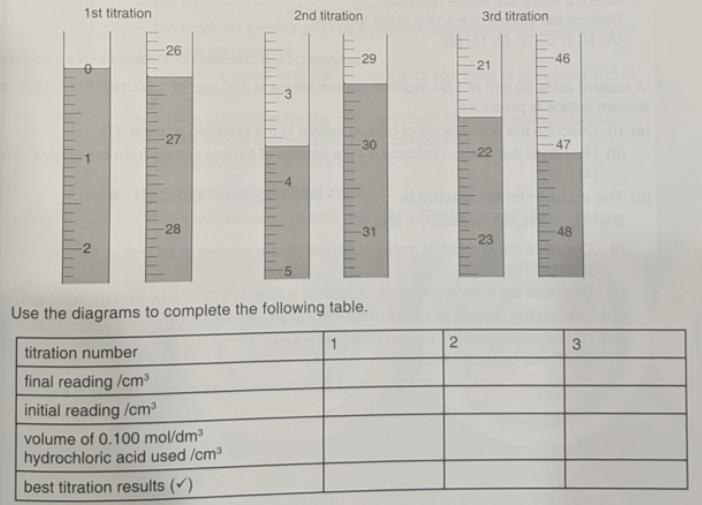
1. A mass of 1.85 g of magnesium was reacted with a small excess of dilute sulfuric acid. The resulting solution was reduced in volume and left to cool and crystallise. The mass of dry magnesium sulfate crystals obtained was 6.42 g. Calculate the percentage yield of magnesium sulfate in this
A mass of 3.31 g of lead(II) nitrate was dissolved in water. An excess of potassium iodide solution was added and the resulting precipitate of lead(II) iodide was filtered, washed with cold distilled water and dried. The mass of lead(II) iodide obtained was 3.89 g. Calculate the percentage yield
2. The formula of sodium sulfate decahydrate is Na SO.10H,O.(a) Write down the relative atomic masses of the elements present in sodium sulfate decahydrate.(b) Calculate the relative formula mass of sodium sulfate decahydrate.(c) Calculate the percentage by mass of each of the elements present in
1. The chemical formula of butanoic acid is CH(a) Write down the relative atomic masses of th elements present in butanoic acid.(b) Calculate the relative molecular mass of butanoic acid.(c) Calculate the percentage by mass of each of the elements present in butanoic acid.
Calculate the percentage by mass of carbon in ethanol, CHO Relative atomic masses:carbon = 12, hydrogen = 1, oxygen = 16]
1. Sodium burns in chlorine gas according to the following equation.A piece of sodium of mass 0.46 g was burnt in a gas cylinder containing 250 cm³ of chlorine gas at r.t.p.(a) Which reactant will limit the amount of product formed?(b) What mass of sodium chloride is formed in this reaction? Na(s)
A piece of magnesium foil of mass 1.20 g was burnt in a gas jar containing 500 cm³ of oxygen gas at r.t.p.(a) Which reactant will limit the amount of product formed?(b) What mass of magnesium oxide is formed in this reaction?
How much sulfuric acid of concentration 2.0 mol/dm³ is needed to react completely with 2.4 g of magnesium ribbon?
What mass of potassium nitrate is needed to make 50 cm³ of potassium nitrate solution of concentration 0.50 mol/dm³?
What mass of calcium carbonate is needed to exactly neutralise 150 cm³ of dilute hydrochloric acid of concentration 0.60 mol/dm³?
What mass of sodium chloride is dissolved in 15 cm³ of sodium chloride solution of concentration 2 mol/dm³?
What volume of oxygen is needed for the complete combustion of 100 cm³ of hydrogen and what volume of water vapour is formed, both measured at r.t.p.?
What volume of carbon dioxide is formed, measured at r.t.p., when 0.25 g of sodium carbonate reacts with an excess of dilute hydrochloric acid?
Methyl ethanoate is a chemical composed of atoms of carbon, hydrogen and oxygen. It has the following composition by mass: carbon = 48.65%, hydrogen = 8.11%, oxygen = 43.24%, and its relative molecular mass is 74. Find the molecular formula of this compound. [Relative atomic masses: C = 12 H = 1, O
Showing 500 - 600
of 1029
1
2
3
4
5
6
7
8
9
10
11
Step by Step Answers

 Get 50% OFF
Claim Now
Get 50% OFF
Claim Now