New Semester
Started
Get
50% OFF
Study Help!
--h --m --s
Claim Now
Question Answers
Textbooks
Find textbooks, questions and answers
Oops, something went wrong!
Change your search query and then try again
S
Books
FREE
Study Help
Expert Questions
Accounting
General Management
Mathematics
Finance
Organizational Behaviour
Law
Physics
Operating System
Management Leadership
Sociology
Programming
Marketing
Database
Computer Network
Economics
Textbooks Solutions
Accounting
Managerial Accounting
Management Leadership
Cost Accounting
Statistics
Business Law
Corporate Finance
Finance
Economics
Auditing
Tutors
Online Tutors
Find a Tutor
Hire a Tutor
Become a Tutor
AI Tutor
AI Study Planner
NEW
Sell Books
Search
Search
Sign In
Register
study help
computer science
cambridge igcse computer science coursebook
Chemistry For Cambridge O Level 3rd Edition Derek McMonagle - Solutions
20. Which of the following describes the process by which aluminium is obtained from alumina?(a) chemical oxidation(b) chemical reduction(c) electrical oxidation(d) electrical reduction
19. Mild steel is an alloy of iron with which element?(a) carbon(b) silicon(c) phosphorus(d) sulfur
18. Which of the following metals could form a sacrificial anode to protect the steel hull of a ship from rusting?(a) copper(b) magnesium(c) sodium(d) tin
17. With which of the following metals is iron coated to make galvanised iron?(a) aluminium(b) chromium(c) tin(d) zinc
16. What is the main reducing agent in the blast furnace?(a) carbon(b) carbon monoxide(c) carbon dioxide(d) calcium carbonate
10. Chromium is below zinc and above iron in the reactivity series. Which of the following in NOT likely to be true about chromium?(a) It reacts with dilute hydrochloric acid to give hydrogen gas.(b) It displaces zinc from aqueous zinc sulfate.(c) It can be obtained by heating chromium oxide with
9. Where is lithium likely to feature in the reactivity series?(a) above potassium(b) between potassium and sodium(c) below sodium but above magnesium(d) below magnesium
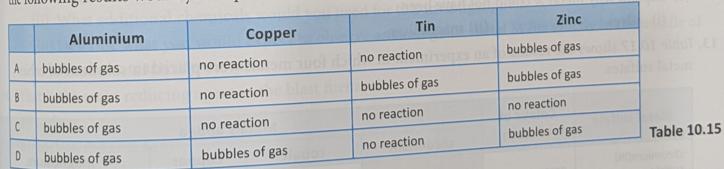
Samples of the metals aluminium, copper, tin and zinc were added to dilute hydrochloric acid. Which of the following results would you expect from their positions in the reactivity series? Aluminium A bubbles of gas B bubbles of gas no reaction C bubbles of gas no reaction Copper no reaction Tin
Which of the following alloys would be most suitable for making a pair of scissors?(a) brass(b) duralumin(c) soft solder(d) stainless steel
Which of the following metals cannot be obtained from its ore by heating with a chemical reducing agent?(a) copper(b) magnesium(c) silver(d) tin
Which of the following metals was unknown prior to the discovery of electricity?(a) calcium(b) copper(c) iron(d) tin
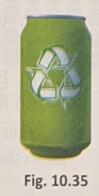
Prior to the invention of the Hall-Héroult process aluminium was obtained by displacing it from mohen anhydrous aluminium chloride. Which of the following metals could have been used to displace aluminium?(a) copper (b) iron (c) potassium (d) zinc Fig. 10.35
What does the sign in Fig. 10.35 on a drink indicate?(a) The drink should be chilled before opening.(b) The drink should be shared with a friend.(c) The can should be recycled.(d) The can is made of aluminium.
Metal X cannot be obtained from its ore simply by heating but it can be obtained by heating with carbon monoxide. Which of the following could be metal X?(a) aluminium(b) copper(c) iron(d) sodium
Which of the following reactions will take place?(a) Sn³ (aq) + Cu(s) → Sn(s) + Cu(aq)(c) Zn²(aq) + Pb(s) → Zn(s) + Pb2+(aq)(b) 2Al^ 3+ (aq) + 3Zn(s) 2Al(s)+3Zn^ 2+ (aq)(d) Fe²(aq) + Zn(s) → Fe(s) +
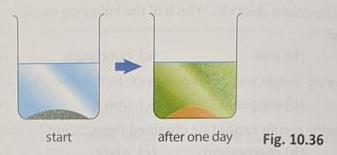
12. A sample of grey powder of metal X was stirred into a beaker of copper(II) sulfate solution. Fig. 10.36 shows the mixture at the start and one day later.(a) State two observations that indicate a chemical reaction has taken place.(b) Name the type of reaction.(c) Suggest the identity of X and
9. What evidence is there that a large amount of heat energy was produced?
8. Describe your observations during the reaction.?
4. Explain the role of limestone in the blast furnace process.
3. Give a chemical equation, including state symbols, for the formation of iron from its ore.
2. (a) What is the main reducing agent in the blast furnace?(b) Give a pair of chemical equations, including state symbols, to show how this reducing agent is formed from coke.
1. Name the three substances loaded into the top of the blast furnace.
4. Explain why lead cannot be used as a sacrificial anode to protect steel from rusting.
3. Name three metals suitable for use as sacrificial anodes to protect the steel hull of a ship from rusting.
2. Why is it necessary to replace sacrificial anodes attached to the legs of a steel drilling rig used to drill for oil out at sea at regular intervals?
1. Place the following metals in the order they appear in the reactivity series: lead, silver, tin, zinc.
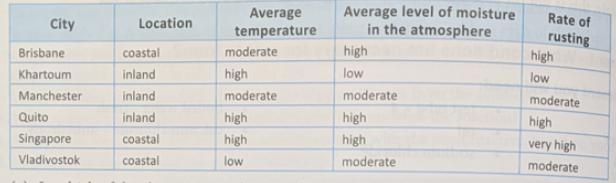
2. The rate at which iron rusts depends on the climate and the location. Table 10.12 gives information about the climate and location of different cities and the rate of rusting in them.(a) In which of the above cities is the rate of rusting slowest?(b) Suggest why the rate of rusting is generally
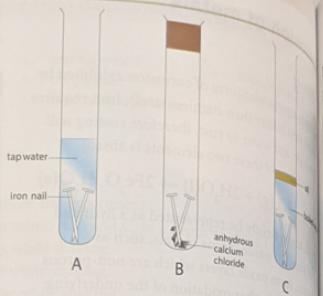
1. Fig. 10.14 shows an experiment to investigate the rusting of iron. After one week, it was noted that only the nails in test tube A had rusted.Explain why:(a) anhydrous calcium chloride was used in test tube B(b) freshly boiled water was used in test tube C(c) a layer of oil was added to test
15. Read the following passage about the noble gases and answer the questions that follow:It was traditionally thought that the noble gases could not form compounds because they had a full valence shell of electrons. They had no need to gain or lose additional electrons and therefore form
14. This question is about the elements in Group VII of the Periodic Table.(a) What is the traditional or common name for the elements in this group?(b) Describe how the elements form ions.(c) Draw a list to show the first four elements in the order they appear in the Periodic Table.(d) Passing
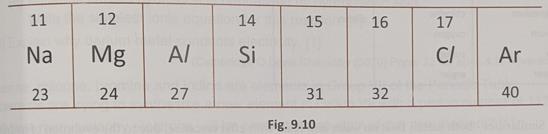
13. Fig. 9.10 shows the elements in Period 3 of the Periodic Table.(a) Copy Fig. 9.10 and add the missing information.(b) Explain as fully as you can the information given for each element using sodium as an example.(c) Which of these elements are:(i) non-metals (ii) metals (iii) semi-metals? 11 12
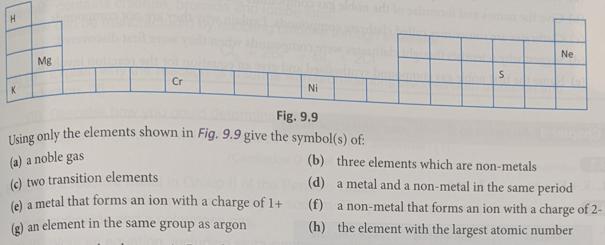
12. Fig. 9.9 shows part of the Periodic Table. H OP Ne Mg K S Cr Ni Fig. 9.9 Using only the elements shown in Fig. 9.9 give the symbol(s) of: (a) a noble gas (c) two transition elements (b) three elements which are non-metals (d) a metal and a non-metal in the same period (e) a metal that forms an
11. In 1864, the English chemist Newlands noticed that if the elements were arranged in order of increas relative atomic mass, then every eighth element had similar properties, rather like the eighth note octave of music. Fig. 9.8 shows part of the arrangement of elements proposed by Newlands in
10. The element with proton number 12 has similar chemical properties to the element with proton unde(a) 2(b) 11(c) 13(d) 20
9. Which of the following elements in Period 2 shows the least metallic character?(a) boron(b) fluorine(c) lithium(d) nitrogen
8. The elements lithium and oxygen are in Period 2. Which of the following is the same for both elements(a) the number of electrons surrounding the nucleus(b) the number of electron shells(c) the number of electrons in the outer shell(d) the number of electrons needed for a fill
7. An element forms an ion by accepting two electrons. To which group of the Periodic Table does it being(a) Group I(b) Group II(c) Group VI(d) Group VII
6. Which pair of elements from Group I and Group VII will react most violently?(a) potassium and chlorine(b) potassium and iodine(c) lithium and chlorine(d) lithium and iodine
5. An element X forms a coloured ion X²"(aq). From which group is the element X?(a) Group 1(b) Group II(c) Group VII(d) Transition elements
4. Why does argon come before potassium in the Periodic Table even though its relative atomic mais a(a) Argon atoms contain more neutrons.(b) Argon is a non-metal.(c) Argon atoms have one fewer proton.(d) Argon atoms have a complete octet
3. Atoms of element X have 12 electrons and atoms of element Y have 17 electrons. Which of the followings true of elements X and Y?(a) They are in the same period.(b) They are both metals.(c) They are both non-metals.(d) They are in the same group.
2. Which of the elements has a combination of metallic and non-metallic properties?(a) argon(b) boron(c) oxygen(d) sodium
1. An aqueous solution of which of the following compounds is colourless?(a) copper sulfate(b) iron sulfate(c) nickel sulfate(d) zinc sulfate
2. (a) Explain in terms of electronic configuration why the elements in Group I have similar chemical properties.(b) State the trend in reactivity down the group.
1. (a) Describe the reactions of lithium and sodium with water, giving one similarity and one difference.(b) Give an equation, including state symbols, for the reaction of sodium with water.
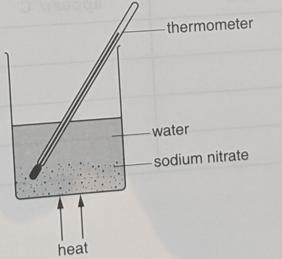
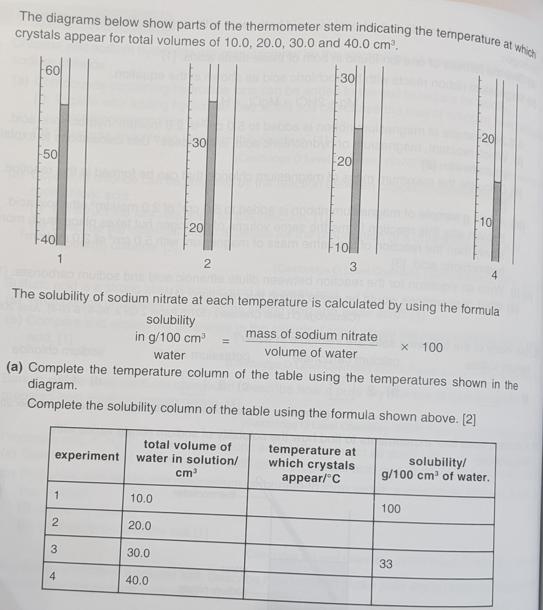
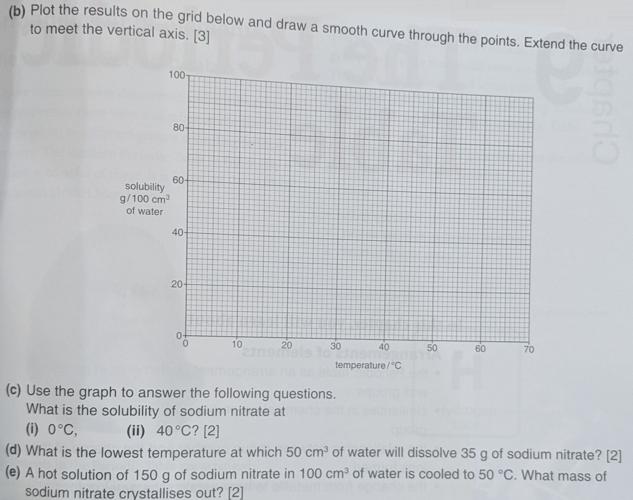
11. A student does four experiments to find how the solubility of sodium nitrate varies with temperature.10.0 g of sodium nitrate is put into a beaker and 10.0 cm³ of water is added.The beaker is heated and the contents stirred until all the solid dissolves.The beaker is allowed to cool slowly.
10. How many of the following salts are insoluble in water? barium sulfate a) 1 calcium carbonate b) 2 potassium nitrate c) 3 sodium chloride d) 4
3. Dilute ethanoic acid and dilute hydrochloric acid both react with magnesium ribbon to form hydrogen.(a) Give the formula of one ion found in both of these dilute acids.(b) Magnesium ribbon reacts with hydrochloric acid as shown in the equation.Mg + 2HCl → MgCl2 + H₂A 0.24 g sample of
8. Methylamine CH NH₂, is a base which has similar properties to ammonia. When methylamine dissolves in water, the following equilibrium is set up.CH3NH2 + H₂O CH₃NH + OH-Explain why methylamine behaves as a base in this reaction.
7. (a) Potassium nitrate is a soluble salt that can be prepared by reaction between an acid and an alkali.(i) Write an equation for the reaction of an acid with an alkali to prepare potassium chloride.(ii) Describe the essential experimental details of this preparation of solid potassium chloride
6. Magnesium chloride is a soluble salt. Describe how you can make pure dry crystals of magnesium chloride from magnesium carbonate.
5. Propanoic acid, C₂H₂CO₂H, and hydrochloric acid, HCI, both act as acids when dissolved in water(a) State the formula of an ion found in both dilute propanoic acid and in dilute hydrochloric acid(b) Propanoic acid reacts with magnesium carbonate to form water, a colourless gas and a salt
4. Barium sulfate is an insoluble compound. Describe how a pure dry sample of barium sulfate is prepared from aqueous barium nitrate.
3. Sulfuric acid is a strong acid. Ethanoic acid is a weak acid.(a) What do you understand by the terms strong acid and weak acid?(b) Compare and explain the difference in the electrical conductivity between a strong and a wes acid.
2. (a) Copper(II) chloride can be prepared by the reaction between copper(II) carbonate and hydrochloric acid.(i) Construct the ionic equation for this reaction.(ii) Describe the essential practical details for the preparation of a crystalline sample of copper(II) chloride.
1. Chlorine and sodium hydroxide are manufactured by the electrolysis of concentrated aqueous sodium chloride.(a) Compounds containing hydroxide ions can be added to the soil to reduce its acidity,(i) Explain why adding hydroxide ions to the soil can cause the loss of nitrogen from fertil
18. Soluble salts of transition metals can be prepared by using an insoluble solid and an acid. Describe how will prepare pure dry crystals of zinc sulfate starting from zinc carbonate.
17. Soluble salts of group I are prepared by titration method.(a) Name a salt that can be prepared by the titration method.(b) Write a balanced chemical equation for the preparation of the above salt.
16. The ionisation equation for the two acids is shown below.(a) H_{2}*S*O_{4} -> 2H ^ (S*O_{4} ^ 2)(b) CH t COOH= H ^ (- C) * H_{2}*COO(i) Identify which of the two acids is a weak acid and why?(ii) What is meant by strong acid?
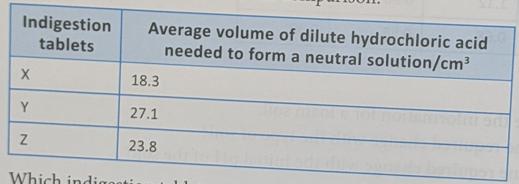
15. Excess acid in the stomach sometimes causes indigestion. Swallowing indigestion tablets neutralises The following experiments were carried out to compare three different indigestion tablets Tablets of each type were crushed to form powders.Exactly 1 g of each powder was weighed out.A solution
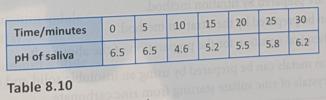
14. Bacteria in the mouth break down sugar residues that remain on the teeth after eating to form acids. Tooth decay starts when the pH of saliva drops below 5.5.Table 8.10 shows the pH of saliva in a person's mouth, measured every five minutes, before and after he ate a sweet.(a) Plot a graph of
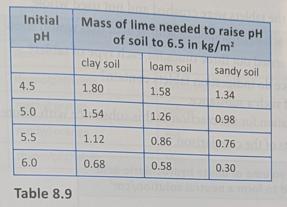
13. Lime in the form of powdered calcium carbonate is sometimes added to soil by farmers to raise the pH of soil. (a) What is measured on the pH scale?(b) What happens when a carbonate is added to an acid?(c) Table 8.9 shows how much lime has to be added to three types of soils at different
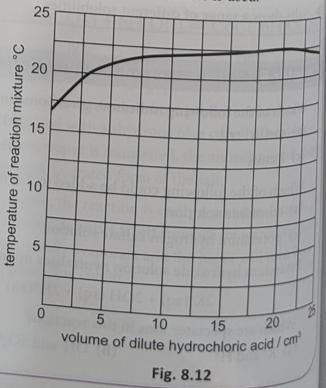
12. In an experiment, 25 cm³ of potassium hydroxide solution was placed in a polystyrene cup with a thermometer. Portions of 5 cm³ of dilute hydrochloric acid were added. In Fig. 8.12, a graph shows how the temperature of the mixture changed during the experiment.(a) What evidence is there that a
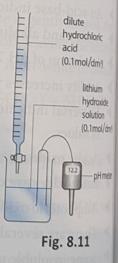
11. Fig. 8.11 shows the apparatus used to prepare lithium chloride.(a) What will be the reading on the pH meter when the mixture contains equal volumes of dilute hydrochloric acid and lithium hydroxide?(b) Suggest one advantage of using a pH meter instead of methyl orange indicator in this
10. Which of the following is an acid salt?(a) aluminium sulfate(b) ammonium nitrate(c) ethanedioic acid(d) sodium hydrogen sulfate
9. Which of the following compounds is not a salt?(a) calcium oxide(b) iron(II) sulfate(c) magnesium nitrate(d) sodium chloride dilute hydrochlon acid
8. The pH value of a sample of soil is 7.5. This means that the soil is:(a) weakly acidic(b) neutral(c) weakly alkaline(d) strongly alkaline
7. Which of these salts could be made by the reaction of a metal oxide with hydrochloric acid?(a) barium sulfate(b) iron(II) chloride(c) sodium hydrogen carbonate(d) zinc nitrate
6. Which of the following formula represents a double salt?(a) CuSO4.5H₂O(b) KCr(SO₂),(c) NaHCO(d) Zn(CI)OH
5. Metal X forms a soluble chloride, a soluble nitrate and an insoluble sulfate. Which of the following could metal X?(a) barium(b) copper(c) lead(d) sodium
4. In the human digestive system, the pH changes passing from the mouth, pH 6, to the stomach, pH 2, to the small intestine, pH 8. Which of the following best describes how the conditions change?(a) Weak alkali strong acid → weak alkali(b) Weak alkali strong alkali weak acid(c) Weak acid →
3. Potassium hydroxide solution neutralises dilute sulfuric acid according to the following equation:2K*(aq) + 2OH (aq) + 2H+(aq) + SO₄(aq) → 2K*(aq) + SO₄(aq) + 2H2O(1)Which are spectator ions in this reaction?(a) K* and H+(b) OH and SO 2-4(c) K* and SO2-4(d) H* and OH
2. Which of the following could be added to a solution to increase its pH value?(a) ammonia solution(b) dilute hydrochloric acid(c) potassium hydrogen sulfate solution(d) sodium chloride solution
1. Which of the following indicators gives some indication of the strength of an acidic or basic solution?(a) methyl red(b) thymolphthalein(c) litmus(d) universal indicator
Suggest solutions of suitable reactants to make the following insoluble salts. You might find the information of solubility in Table 8.8 helpful.Write an ionic equation for each reaction.1. barium sulfate 2. silver iodide 3. zinc sulfide
18. Write an ionic equation for this reaction.
17. Describe the appearance of the solid sodium chloride obtained.
16. Describe the colour change of the indicator.
15. What volume of dilute hydrochloric acid was used on each of the first two attempts?
14. When cold, pour off any remaining liquid and transfer the sodium chloride crystals onto a filter paper.
13. Leave the evaporating dish and contents to cool down.
12. Gently heat the solution until the volume of liquid has been reduced to about half of its starting amount.
11. Transfer the contents of the conical flask into an evaporating dish and place this on a tripod stand and ine gauze.
10. Repeat steps 3 to 8 without adding any indicator and using the same volume of dilute hydrochloric acid a your second attempt.
9. Repeat steps 3 to 8 taking extra care to stop adding acid immediately the indicator changes colour. On you first attempt you may have overshot the point where the indicator changes colour. This second attemptw give you a more accurate value for the volume of dilute hydrochloric acid needed.
8. Read the final volume of dilute hydrochloric acid in the burette.
7. Stop adding acid as soon as the colour of the indicator changes.
6. Place the conical flask under the burette and gently swirl the contents as you slowly add dilute hydrochlo acid.
5. Add two or three drops of screened methyl orange to the sodium hydroxide solution.
4. Using a pipette, place 10 cm³ of sodium hydroxide solution in a conical flask.
3. Read the initial volume of dilute hydrochloric acid in the burette.
2. Mount the burette vertically using a burette stand. Partially fill a burette with dilute hydrochloric acid. 35c * m ^ 3 will be sufficient for this activity. This means that the initial reading should be around 50 cm-15 15c * m ^ 3 A_{2}
6. A substance has a pH of 9. What kind of substance is it?
5. A substance turns the universal indicator yellow. What is the pH of this substance?
4. What type of substance turns universal indicator purple?
3. What advantage does universal indicator have over an acid-base indicator such as litmus?
2. What is the range of the pH scale?
1. What is measured on the pH scale?
Write an equation, including state symbols, for each of the following reactions. All of the salts produced are soluble in water.1. Calcium reacts with dilute hydrochloric acid to form calcium chloride and hydrogen gas.2. Solid iron(II) oxide reacts with dilute sulfuric acid to form iron(II) sulfate
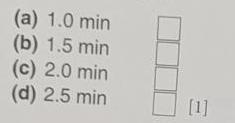
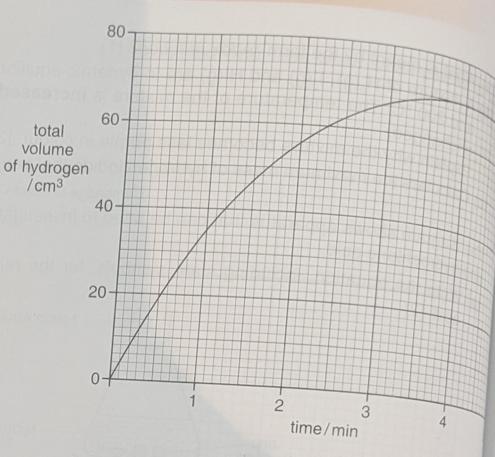
9. A student measures the speed of a reaction between a given mass of zinc and an excess of hydrochloric acid by recording the volume of hydrogen produced. The results are shown on the graph.How long does it take for half of the zinc to react? (a) 1.0 min (b) 1.5 min (c) 2.0 min (d) 2.5 min [1]
Showing 400 - 500
of 1029
1
2
3
4
5
6
7
8
9
10
11
Step by Step Answers

 Get 50% OFF
Claim Now
Get 50% OFF
Claim Now