New Semester
Started
Get
50% OFF
Study Help!
--h --m --s
Claim Now
Question Answers
Textbooks
Find textbooks, questions and answers
Oops, something went wrong!
Change your search query and then try again
S
Books
FREE
Study Help
Expert Questions
Accounting
General Management
Mathematics
Finance
Organizational Behaviour
Law
Physics
Operating System
Management Leadership
Sociology
Programming
Marketing
Database
Computer Network
Economics
Textbooks Solutions
Accounting
Managerial Accounting
Management Leadership
Cost Accounting
Statistics
Business Law
Corporate Finance
Finance
Economics
Auditing
Tutors
Online Tutors
Find a Tutor
Hire a Tutor
Become a Tutor
AI Tutor
AI Study Planner
NEW
Sell Books
Search
Search
Sign In
Register
study help
computer science
cambridge igcse computer science coursebook
Cambridge IGCSE Information And Communication Technology 3rd Edition David Watson, Graham Brown - Solutions
A sample of 0.28 g of lithium was burnt in oxygen to form 0.60 g of lithium oxide. Find the formula of lithium oxide.
A sample of copper was heated in a crucible to form black copper(II) oxide. The following data was collected.Mass of crucible = 35.75 g Mass of crucible + copper = 37.12 g Mass of crucible + copper(II) oxide = 37.47 g(a) Calculate the mass of copper used.(b) Calculate the mass of oxygen that
In a blast furnace, iron(III) oxide is reduced to iron according to the following equation:What mass of iron is obtained from each tonne (1000 kg) of iron(III) oxide? Fe,O,(s) + 3CO(g) 2Fe(1) + 3CO2(g)
For each of the following, state the particles present and the number of them.(a) 1 g of helium(b) 28 g of calcium oxide(c) 2.2 g of carbon dioxide(d) 0.64 g of methanol (CH, OH)
Calculate the number of moles of each of the following. Give each of your answers as a fraction and as a decimal.(a) 2.3 g of sodium atoms(b) 16 g of oxygen molecules(c) 16 g of calcium ions(d) 20 g of bromine molecules
Calculate the number of moles of each of the following substances.(a) 12 g of magnesium(b) 10 g of sodium hydroxide (NaOH)(c) 2 g of water (H₂O)(d) 16 g of iron(III) oxide (Fe₂O₂)
2. Give the relative formula masses of the following:(a) NaOH(b) KCl(c) CaCO, 3(d) CuSO
1. Give the relative molecular masses of the following:(a) F 2(b) NH, 3(c) 1,(d) H
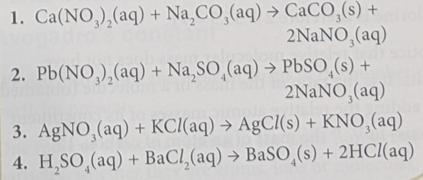
For each of the following equations:• Rewrite the equation showing the ions present in the reactants and the products.• Delete the spectator ions.• Write an ionic equation, including state symbols, for the reaction. 1. Ca(NO3)2(aq) + Na2CO3(aq) CaCO3(s) + 2NaNO,(aq) 2. Pb(NO),(aq) + NaSO(aq)
Write an equation, with state symbols, for each of the following chemical reactions.1. The combustion of solid sulfur in oxygen gas to form sulfur dioxide gas.2. The decomposition of solid magnesium carbonate to form solid magnesium oxide and carbon dioxide gas.3. Hot solid copper reacts with
What is the chemical formula of each of the following compounds?1. lithium hydroxide 2. sodium hydrogencarbonate 3. copper(II) carbonate 4. ammonium sulfate
What is the chemical formula of each of the following compounds?1. lithium sulfide 2. aluminium oxide 3. carbon tetrachloride (tetrachloromethan
2. Which elements are represented by the following symbols?(a) H(b) Mg(c) B(d) Ne(e) K(f) Fe
1. Give the symbols of the following elements.(a) carbon(b) oxygen(c) copper(d) lithium(e) chlorine(f) phosphorus
10. Magnesium reacts with chlorine to form magnesium chloride. Draw diagrams to show the electronic structures and charges of both ions present in magnesium chloride.
9. Ethane, C2H0, and ethene, C2Hd are both gaseous hydrocarbons. Draw a 'dot-and-cross' diagram for ethane. You only need to draw the outer electrons of the carbon atoms.
8. Chlorine forms some compounds that are covalent and others that are ionic.(a) Draw a 'dot-and-cross' diagram for carbon tetrachloride, CCI, You only need to draw the outer electrons of the carbon and chlorine atoms.(b) Calcium reacts with chlorine to form calcium chloride. Draw diagrams to show
7. Draw a dot-and-cross diagram for carbon dioxide showing the outer electrons only.
6. The electrical conductivity of a substance is related to its structure and bonding.(a) Graphite and diamond are both forms of solid carbon. Explain why graphite conducts electricity but diamond does not.(b) Explain why solid sodium chloride does not conduct electricity whereas aqueous sodium
5. (a) Acetylene has a triple covalent bond between its carbon atoms. Draw a 'dot-and-cross diagram for acetylene.You need only show the outer electrons.(b) Oxygen reacts with magnesium to form magnesium oxide.Draw diagrams to show the complete electronic structure and charges of both ions present
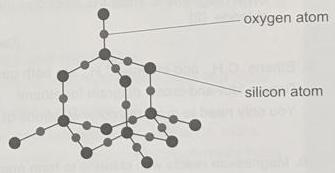
3. (a) Glass is made from sand.Pure sand has a giant molecular structure.(i) What is the formula for pure sand?(ii) Explain why sand has a very high melting point.(iii) Explain why sand does not conduct electricity. oxygen atom silicon atom
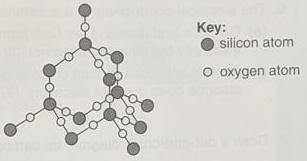
2. Glass contains silicon(IV) oxide and a number of metal oxides.(a) The structure of silicon(IV) oxide is shown below.(i) Describe two similarities in the structure of silicon(IV) oxide and diamond.(ii) Explain why silicon(IV) oxide has a high melting point.(iii) Explain why silicon (IV) oxide
16. Carbon is a member of group IV and forms covalent compounds.(a) Draw a dot and cross diagram to show the bonding of a compound that(i) is formed by single covalent bonds between carbon and hydrogen.(ii) is formed by double covalent bonds between carbon and oxygen.(iii) is formed by a triple
15. (a) (i) Give the atomic numbers and electronic configurations of potassium and bromine.(ii) Draw a dot-and-cross diagram to show the formation of potassium bromide (KBr) from its constituent atoms. Only the outer shell of electrons needs to be shown.(b) (i) Give the atomic number and electronic
14. (a) Draw a diagram to show the structure of a typical metal.(b) Explain why:(i) metals conduct electricity(ii) many metals are ductile(c) Explain why metals generally have high melting points.
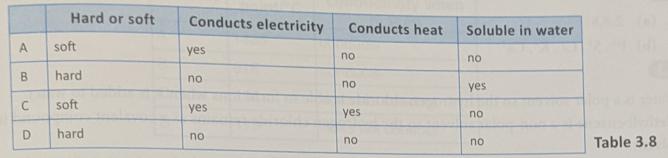
13. Table 3.8 contains information about four solid substances, A to D.Which of these substances could be?(a) copper(b) sodium chloride(c) iron(d) graphite A B Hard or soft soft hard Conducts electricity Conducts heat Soluble in water yes no no no yes C soft yes yes D hard no no Ou Table 3.8
12. (a) Give the electronic configurations for:(i) a magnesium atom(ii) a magnesium ion(iii) a bromine atom(iv) a bromide ion(b) Draw a dot-and-cross diagram for the formation of the ionic compound magnesium bromide. You only need to show the outermost layer of electrons around each particle.(c)
11. Answer the following questions.(a) Krypton has the proton number of 36. Use this information to give the electronic configuration of krypton.(b) Does krypton exist as an atom or a molecule?(c) Why does krypton form very few chemical compounds?(d) Write the formulae of the ions which are
10. Hydrogen chloride is a covalent compound and has the formula HCl. How many pairs of electrons are shared in the bonding between the two atoms?(a) 1(b) 2(c) 3(d) 4
9. Which of the following is an ionic compound?(a) copper(II) oxide(b) iodine(c) silicon (IV) oxide(d) water
8. Here are the electronic configurations of four elements. Which element needs 4 electrons to complete the outer shell?(a) 2,6(b) 2.8,2(c) 2,4(d) 2,8,8
7. Which of the following elements has a combining power of 2?(a) carbon(b) helium(c) sulfur(d) potassium
6. Silicon has a combining power of 4 and oxygen has a combining power of 2. Which of the following ist likely formula of the compound formed by these elements?(a) SiO(b) SiO(c) Si₂O,(d) SiO
5. A compound has the formula MgX. Which of the following elements could be X?(a) argon(b) bromine(c) oxygen(d) phosphorus
4. Which of the following is a physical property of all ionic compounds?(a) ductile(b) good conductor of electricity in the liquid(c) low melting point and boiling point(d) soluble in water
3. An element X, with electronic configuration 2,8,1, reacts with element Y, with electronic configuration 2,8,6, to form an ionic compound. The likely formula of the compound is(a) XY(b) XY(c) XY(d) X,Y,
2. Which solid is a giant covalent structure?(a) bromine(b) diamond(c) magnesium oxide(d) potassium iodide
1. An atom can form a negatively charged ion by(a) losing a proton(b) losing an electron(c) gaining a proton(d) gaining an electron
Ammonia is a covalent compound composed of hydrogen and nitrogen.1. Give the formula for ammonia.2. Draw a suitable structure to show the formation of bonds in ammonia.
Hydrogen gas exists as nolecules composed of t atoms, H.1. Draw a dot-and-cross diagram to show the bonding in a hydrogen molecule.2. Write a structure for the hydrogen molecule.
(a) Give the electronic configuration of argon.(b) Write the formulae of five ions which are isoelectronic with argon.
3. Write an equation for this reaction showing the ions formed.
2. Draw a dot-and-cross diagram to show the formation of the ionic compound lithium chloride.
1. Write the electronic configurations for:(a) a lithium atom(b) a lithium ion(c) a chlorine atom(d) a chloride ion
2. (a) Dry air contains about 1% of the argon-40 isotope, 4018Ar.(i) What do you understand by the term isotope?(ii) State the number of electrons and neutrons in this isotope of argon.
1. Bromine is a halogen. It has two naturally occurring isotopes.(a) Define the term isotopes.(b) One isotope of bromine has the symbol 8135Br.State the number of protons, neutrons and electrons in this isotope of bromine.
16. Uranium exists as three isotopes. 12U234 12U235 and 12U238(a) Write one similarity that all isotopes show.(b) Write one difference between all isotopes.(c) All isotopes of uranium similarly react with water and steam. Why do all isotopes of magnesium react in the same way?
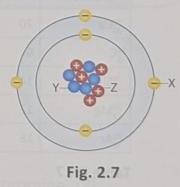
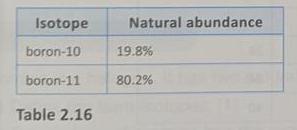
15. Fig. 2.7 represents an atom of the isotope boron-10.(a) Name particles X, Y and Z.(b) Using the same symbols, draw a similar diagram to show the structure of the isotope boron-11.(c) Explain why the isotopes will have the same chemical properties.(d) Table 2.16 gives the natural abundance of
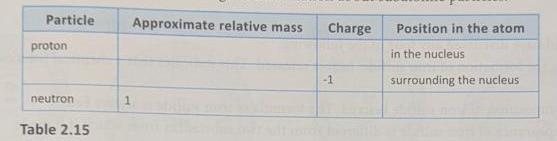
13. (a) Copy and complete Table 2.15 which gives information about subatomic particles.(b) The symbol Al represents the commonest isotope of aluminium. In one atom of this isotope there are how many:(i) protons(ii) neutrons?(c) Write symbols to represent the following isotopes.(i) sodium-23(ii)
12. This question is about six elements, A to F. The letters are not the atomic symbols of the isotopes. Nam each element from the information given, using Table 2.9 of the Periodic Table.(a) Element A has the nucleon number 12 and the electron configuration 2,4(b) Element B has the proton number
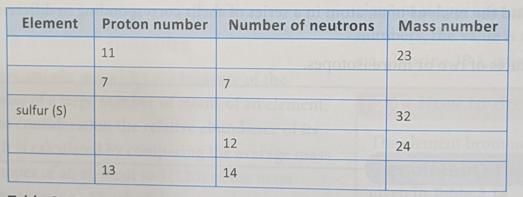
11. (a) Copy and complete Table 2.14. (You can use Table 2.9 to find the symbols of the elements.)(b) Represent each of the atoms of the elements in Table 2.14 as symbols showing their mass number atomic number. Element sulfur (S) Proton number Number of neutrons Mass number 11 7 7 12 13 14 23 32
10. In which of the following isotopes is the proton number exactly half the nucleon number?(a) argon-40(b) carbon-14(c) fluorine-19(d) oxygen-16
9. The accurate relative atomic mass of the element magnesium is 24.3. Which of the following can deduce about the element magnesium from this information only?(a) Magnesium is a metal.(b) Magnesium has the electronic configuration 2,8,2.(c) Magnesium must consist of at least two isotopes.(d)
8. The electron configuration of an element is such that its outer shell of electrons is a complete octet of the following could be the total number of electrons in an atom of this element?(a) 8(b) 10(c) 16(d) 20
7. Which of the following subatomic particles has a relative mass of 1?(a) neutrons only(b) neutrons and electrons(c) protons only(d) protons and neutrons
6. Which of the following is always true of an atom?(a) number of protons = Number of electrons(b) Number of electrons = number of nucleons(c) Number of neutrons = number of protons(d) Number of nucleons = number of electrons
5. What is the relative formula mass of potassium bromide, KBr?(a) 39(b) 41(c) 80(d) 119
4. The nucleus of an atom is composed of 4 protons and 5 neutrons. How many electrons surround the nucleus of this atom?(a) 1(b) 4(c) 5(d) 9
3. The nucleus of an atom of an element is surrounded by 14 electrons. What is the electron configuration of this element?(a) 8,6(b) 2,4,8(c) 2,8,4(d) 2,4,6,2
2. What is the relative molecular mass of methane, CH?(a) 16(b) 12(c) 8(d) 4
1. The proton of selenium is 34 and its nucleon number is 79. How many neutrons are in the nucleus of an atom of selenium?(a) 34(b) 45(c) 79(d) 113
2. Hydrogen has the proton number 1 and the atomic symbol H. There are three isotopes of the element containing 0, 1 and 2 neutrons respectively.(a) Draw a table to show the composition of these isotopes.(b) Show two ways in which these isotopes can be represented.
1. Draw diagrams to show the structures of atoms of the following isotopes. It is not necessary to show the structure of the nucleus but you should state the numbers of protons and neutrons in each isotope.(a) lithium-7(b) aluminium-27(c) oxygen-18(d) potassium-40
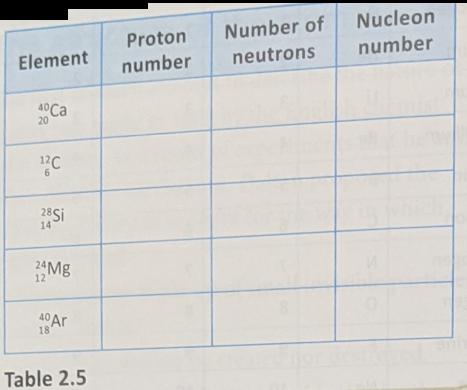
Copy and complete Table 2.5. Element Proton number Number of Nucleon neutrons number 40 Ca 20 12C 28Si 14 24Mg 12 40 Ar 18 18 Table 2.5
Represent atoms of the following elements as symbols showing their nucleon number and proton number.1. The nucleon number of lithium (Li) is 7 and its proton number is 3.2. The nucleus of an oxygen (O) atom consists of 8 protons and 8 neutrons.3. The nucleon number of helium (He) is 4 and it has 2
1. The proton number of beryllium is 4 and its nucleon number is 9. How many neutrons are present in the nucleus of an atom of beryllium?2. The nucleus of an atom of aluminium is composed of 13 protons and 14 neutrons. What is the proton number and nucleon number of aluminium?3. The nucleon number
Which two subatomic particles:(a) have approximately the same mass(b) carry a charge(c) form the nucleus of an atom?
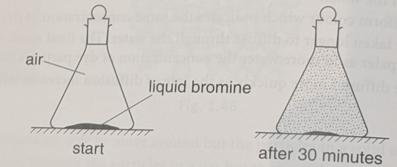
Bromine is a liquid at room temperature.(i) Draw a diagram to show the arrangement of the molecules in liquid bromine.Show a bromine molecule as O. [2](ii) A small amount of liquid bromine was placed in the bottom of a sealed flask. After thirty minutes the brown colour of the bromine had spread
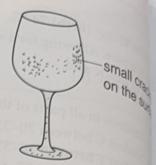
Old wine glasses often appear cloudy because they have many small cracks on their surface.The cracks are caused by differences in the rate of diffusion of sodium ions and hydrogen ions in the glass.(i) Explain the meaning of the term diffusion.(ii) Suggest why sodium and hydrogen ions do not
16. Which of the physical processes explains why a gas changes to liquid?(a) melting(b) boiling(c) condensation(d) freezing
15. Which of the following changes needs heating?(a) gas to liquid(b) solid to liquid(c) liquid to solid(d) gas to solid
Explain each of the following observations.(a) Steam at 100 °C damages skin more than water at 100 °C.(b) Pure water may not always boil at exactly 100 °C.(c) If a sealed tube of gas is heated it will eventually explode.(d) Wet clothing spread out on a clothes line dries more quickly than wet
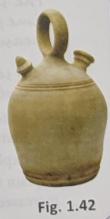
11. A botijos (Fig. 1.42) is a porous clay pot traditionally used in Spain to keep water cool. It has a spout through which it can be filled and water can be drunk.Explain how a botijos is able to keep water cool. Fig. 1.42
10. A gas is sealed in a container so its volume remains constant. Describe how the following will change, if at all, when the gas is heated.(a) the size of particles of gas(b) the motion of the gas particles(c) the frequency with which the gas particles will collide with the inside wall of the
9. On a heating curve, why does the graph become horizontal when a solid becomes a liquid?(a) The kinetic energy of the particles in the solid decreases.(b) The particles in the solid stop vibrating.(c) The energy supplied is absorbed by the container holding the solid.(d) The energy supplied is
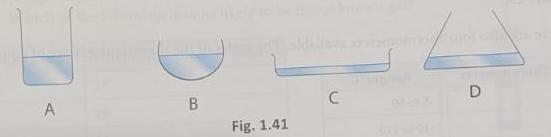
8. In an experiment, an equal volume of water was placed in four containers and they were left under the same conditions. From which container will the water evaporate quickest? A B Fig. 1.41 C D
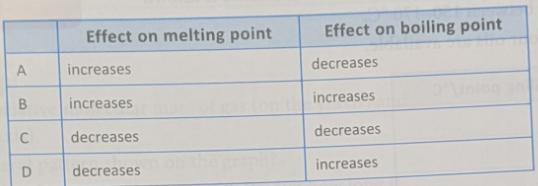
7. Which of the following is true about the usual effect of an impurity on the melting point and boiling point of a substance? Effect on melting point Effect on boiling point A increases decreases B increases increases C decreases decreases D decreases increases
6. Which of the following is a feature of solids but not liquids and gases?(a) easily squashed(b) fixed shape(c) particles move(d) take the shape of the container
5. The smell of perfume spreads around a room by(a) diffusion(b) dilution(c) evaporation(d) sublimation
4. Which of the following indicates that water is pure?(a) It boils at exactly 100 °C under standard atmospheric pressure.(b) It does not have any colour.(c) It evaporates without leaving a residue.(d) It turns blue cobalt chloride paper pink.
3. During which of the following changes does a gas become a liquid?(a) boiling(b) condensing(c) freezing(d) melting
In which change of state is there a large increase in volume?(a) solid to liquid(b) liquid to gas(c) liquid to solid(d) gas to liquid
1. Why do wet clothes on a washing line dry more quickly in a breeze than in still air?(a) The breeze raises the temperature of the wet clothes.(b) The breeze continuously removes water vapour from the air surrounding the clothes.(c) The breeze causes the wet clothes to hang at an angle to vertical
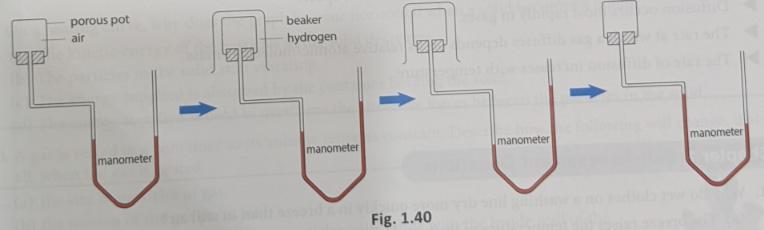
The following sequence of diagrams shows what happens when an inverted beaker containing hydrogen is placed over a porous pot containing air which is connected to a manometer containing coloured water.After a few minutes, the beaker of hydrogen is removed.Answer the following questions in terms of
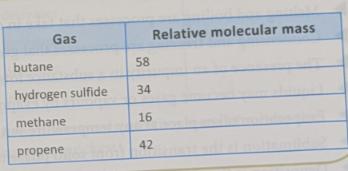
Table 1.3 gives the relative molecular masses of four gases.(a) Which of these gases diffuses quickest?(b) Which of these gases diffuses slowest? Gas Relative molecular mass butane 58 hydrogen sulfide 34 methane 16 propene 42
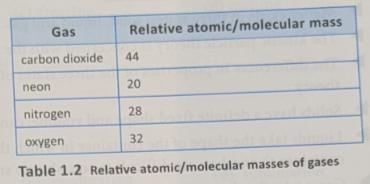
1. Table 1.2 gives the relative atomic/molecular masses of four gases.(a) Which gas diffuses quickest?(b) Which gas diffuses slowest? Gas Relative atomic/molecular mass carbon dioxide 44 neon 20 nitrogen 28 oxygen 32 Table 1.2 Relative atomic/molecular masses of gases
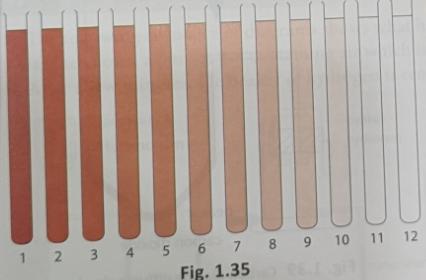
8. In an experiment, a sample of red ink was diluted a number of times. The procedure was as follows:• Half of the sample was discarded.• An equal volume of water was added.• The ink and water were shaken to ensure mixing.The colour of the test tube after each dilution up to 12 dilutions is
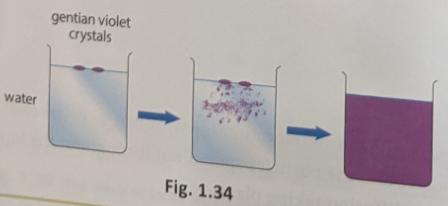
7. A student placed two small crystals of the dye gentian violet on the surface of cold water in a beaker.Fig. 1.34 shows what happened over the following hour.(a) By what process do particles spread water?(b) Describe what happened to the crystal the hour.(c) How can you tell that the dye
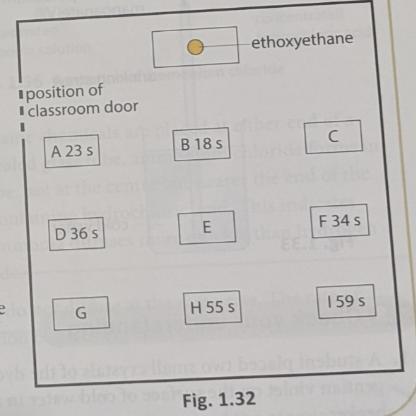
6. A teacher poured a small amount of a volatile liquid called ethoxyethane in an evaporating dish and placed it at the front of the class. She started a timer and asked nine students, labelled A to I on the diagram, to raise their hands as soon as they could smell the chemical. The time taken for
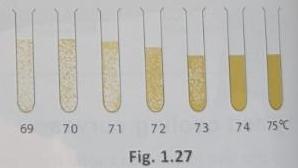
5. Fig. 1.27 shows the appearance of a capillary tube containing a sample of stearic acid at different temperatures around its melting point.1. What was the temperature when:(a) the stearic acid started to melt?(b) all of the stearic acid had become liquid?2. The melting point of stearic acid is
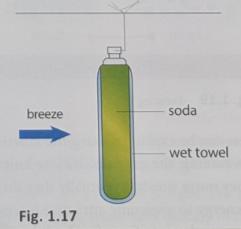
4. Fig. 1.17 shows a simple way of keeping soda cool on a warm day. A bottle of soda is wrapped in a wet towel and hung on a washing line in the breeze.Explain how it works. breeze = soda wet towel Fig. 1.17
3. Explain each of the following in terms of the arrangement and motion of particles.(a) Liquids take the shape of their container but solids do not.(b) Gases can be easily squashed but solids cannot.(c) When a small volume of water is boiled, it produces a large volume of steam.
3. Draw diagrams to show how particles are arranged in a:(a) solid(b) liquid(c) gas
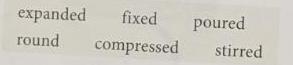
2. Copy and complete the following sentences using only words from the box.A solid has a _____ shape. A liquid can be ________ and takes the shape of its container. A gas spreads out to fill the available space and can be _______ into a smaller space. expanded fixed poured round compressed stirred
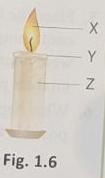
1. Fig. 1.6 shows a candle.What state is the candle wax at:(a) X (b) Y (c) Z? X Y Fig. 1.6 N
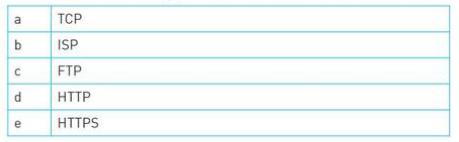
For each of these questions, choose the correct response from the five options given.a Which of the following provides a user with internet access? a TCP b ISP C FTP d HTTP e HTTPS
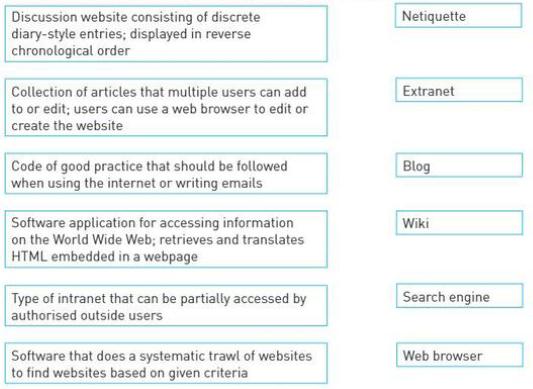
Six descriptions are shown on the left and six computer terms on the right. Draw lines to connect each description to its correct term. Discussion website consisting of discrete diary-style entries; displayed in reverse chronological order Collection of articles that multiple users can add to or
Eight statements are given below. Indicate whether the statement is a feature of an intranet or the internet by putting a tick (✔) in the appropriate box. Information on the network is specific to a particular company or organisation Requires a password and user ID to gain access to the network
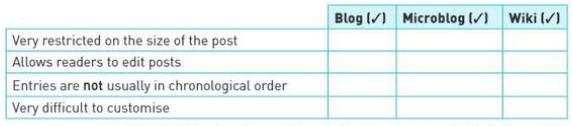
Tick which of these statements apply to a Blog, a Microblog or a Wiki. [4] Very restricted on the size of the post Allows readers to edit posts Entries are not usually in chronological order Very difficult to customise Blog () Microblog () Wiki ()
A company's employees can have access to the internet and the company intranet.Describe the differences between an intranet and the internet.
Showing 600 - 700
of 1029
1
2
3
4
5
6
7
8
9
10
11
Step by Step Answers

 Get 50% OFF
Claim Now
Get 50% OFF
Claim Now