New Semester
Started
Get
50% OFF
Study Help!
--h --m --s
Claim Now
Question Answers
Textbooks
Find textbooks, questions and answers
Oops, something went wrong!
Change your search query and then try again
S
Books
FREE
Study Help
Expert Questions
Accounting
General Management
Mathematics
Finance
Organizational Behaviour
Law
Physics
Operating System
Management Leadership
Sociology
Programming
Marketing
Database
Computer Network
Economics
Textbooks Solutions
Accounting
Managerial Accounting
Management Leadership
Cost Accounting
Statistics
Business Law
Corporate Finance
Finance
Economics
Auditing
Tutors
Online Tutors
Find a Tutor
Hire a Tutor
Become a Tutor
AI Tutor
AI Study Planner
NEW
Sell Books
Search
Search
Sign In
Register
study help
computer science
computer networking
Data Communications and Networking 5th edition Behrouz A. Forouzan - Solutions
Find the interface identifier if the physical address of the EUI is (F5-A9-23-AA-07-14-7A-23)16 using the format we defined for Ethernet addresses.
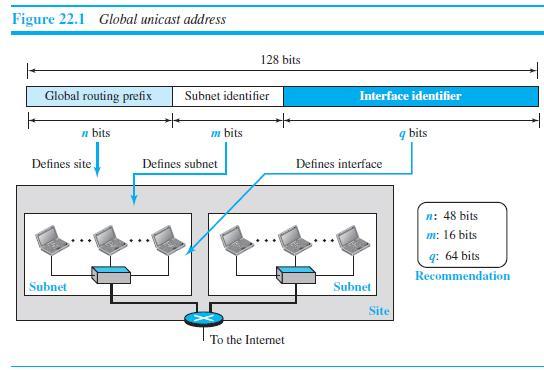
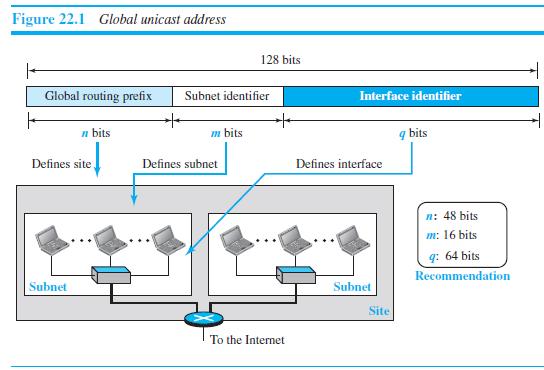
Find the size of the global unicast block from Table 22.1.Table 22.1 Figure 22.1 Global unicast address 128 bits Global routing prefix Subnet identifier Interface identifier n bits m bits q bits Defines site Defines subnet Defines interface n: 48 bits m: 16 bits q: 64 bits Recommendation Subnet
An organization is assigned the block 2000 : 1234 : 1423/48. What is the CIDR for the blocks in the first and second subnets in this organization?
If you are assigned an IPv6 address by your ISP for your personal computer at home, what should be the first (leftmost) three bits of this address?
What is the corresponding block or subblock associated with each of the following IPv6 addresses, based on Table 22.1:a. FE80 : : 12/10b. FD23 : : /7c. 32 : : /3 Figure 22.1 Global unicast address 128 bits Global routing prefix Subnet identifier Interface identifier n bits m bits q bits
What is the purpose of including the IP header and the first 8 bytes of datagram data in the error-reporting ICMP messages?
Show the original (unabbreviated) form of the following IPv6 addresses:a. : : 2b. 0 : 23 : : 0c. 0 : A : : 3
List three protocols in the IPv4 network layer that are combined into a single protocol in IPv6.
Decompress the following addresses and show the complete unabbreviated IPv6 address:a. ::2222b. 1111::c. B:A:CC::1234:A
Distinguish between compatible and mapped addresses and explain their applications.
Show abbreviations for the following addresses:a. 0000 : FFFF : FFFF : 0000 : 0000 : 0000 : 0000 : 0000b. 1234 : 2346 : 3456 : 0000 : 0000 : 0000 : 0000 : FFFFc. 0000 : 0001 : 0000 : 0000 : 0000 : FFFF : 1200 : 1000d. 0000 : 0000 : 0000 : 0000 : FFFF : FFFF : 24.123.12.6
Explain the use of the flow field in IPv6. What is the potential application of this field?
Explain the advantages of IPv6 when compared to IPv4.
Show the unabbreviated colon hex notation for the following IPv6 addresses:a. An address with 64 0s followed by 32 two-bit (01)s.b. An address with 64 0s followed by 32 two-bit (10)s.c. An address with 64 two-bit (01)s.d. An address with 32 four-bit (0111)s.
Compare and contrast the IPv4 header with the IPv6 header. Create a table to compare each field.
Router A sends a unicast RIP update packet to router B that says 134.23.0.0/16 is 7 hops away. Network B sends an update packet to router A that says 13.23.0.0/16 is 4 hops away. If these two routers are connected to the same network, which one is the designated parent router?
Explain why broadcasting the first or the first few messages is not important in PIM-DM, but it is important in PIM-SM?
Which version of PIM uses the first and the third steps of DVMRP? What are these two steps?
Explain why PIM is called Protocol Independent Multicast.
Explain why an MOSPF router can create the shortest path with the source as the root in one step, but DVMRP needs three steps to do so.
List three steps that a DVMRP router uses to create a source-based tree. Which phase is responsible for creating the part of the tree from the source to the current router? Which phase is responsible for creating a broadcast tree with the router as the root? Which phase is responsible for changing
Does RPM actually create a shortest path tree? Explain. What are the leaves of the tree?
Does RPB actually create a shortest path tree? Explain. What are the leaves of the tree?
Does RPF actually create a shortest path tree? Explain.
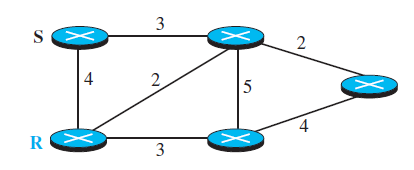
In the network of Figure 21.17, find the shortest path trees for router R if the network is using MOSPF with the source connected to the router marked as S. Assume that all routers have interest in the corresponding multicast group.Figure 21.17 2 R 3 3. 4.
We say that a router in DVMRP creates a shortest-path tree on demand. What is the meaning of this statement? What is the advantage of creating shortest path trees only on demand?
Assume that m is much less than n and that router R is connected to n networks in which only m of these networks are interested in receiving packets related to group G. How can router R manage to send a copy of the packet to only those networks interested in group G?
Assume we have 20 hosts in a small AS. There are only four groups in this AS. Find the number of spanning trees in each of the following approaches:a. Source-based treeb. Group-shared tree
It is obvious that we need to have spanning trees for both unicasting and multicasting. How many leaves of the tree are involved in a transmission in each case?a. A unicast transmissionb. A multicast transmission
A router using DVMRP receives a packet with source address 10.14.17.2 from interface 2. If the router forwards the packet, what are the contents of the entry related to this address in the unicast routing table?
A multicast router is connected to four networks. The interest of each network is shown below. What is the group list that should be advertised by the router?a. N1: {G1, G2, G3}b. N2: {G1, G3}c. N3: {G1, G4}d. N4: {G1, G3}
Why is there no need for the IGMP message to travel outside its own network?
Can a host have more than one multicast address? Explain.
Change the following IP multicast addresses to Ethernet multicast addresses. How many of them specify the same Ethernet address?a. 224.18.72.8b. 235.18.72.8c. 237.18.6.88d. 224.88.12.8
Define the group of each of the following multicast addresses (local network control block, internetwork control block, SSM block, Glop block, or administratively scoped block):a. 224.0.1.7b. 232.7.14.8c. 239.14.10.12
A multicast address for a group is 232.24.60.9. What is its 48-bit Ethernet address for a LAN using TCP/IP?
Define which of the following addresses are multicast addresses:a. 224.8.70.14b. 226.17.3.53c. 240.3.6.25
The AS number in an organization is 24101. Find the range of multicast addresses that the organization can use in the GLOP block.
When we send an e-mail to multiple recipients, are we are using multicasting or multiple unicasting? Give the reason for your answer.
Exactly describe why we cannot use the CIDR notation for the following blocks in Table 21.1:a. AD HOC block with the range 224.0.2.0 to 224.0.255.255.b. The first reserved block with the range 224.3.0.0 to 231.255.255.255.c. The second reserved block with the range 234.0.0.0 to 238.255.255.255.
Distinguish between multicasting and multiple unicasting.
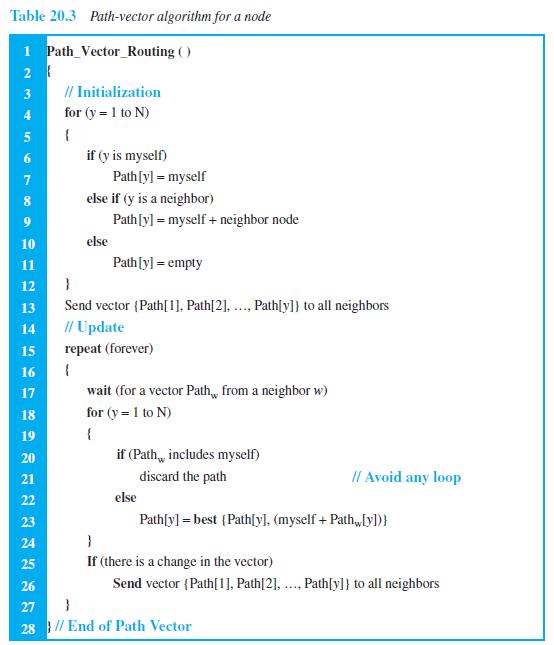
Write a program to simulate the path-vector algorithm (Table 20.3). Table 20.3 Path-vector algorithm for a node 1 Path_Vector_Routing ( ) 2 { // Initialization for (y = 1 to N) 3 { if (y is myself) Path[y] = myself else if (y is a neighbor) 9. Path[y] = myself + neighbor node 10 else 11
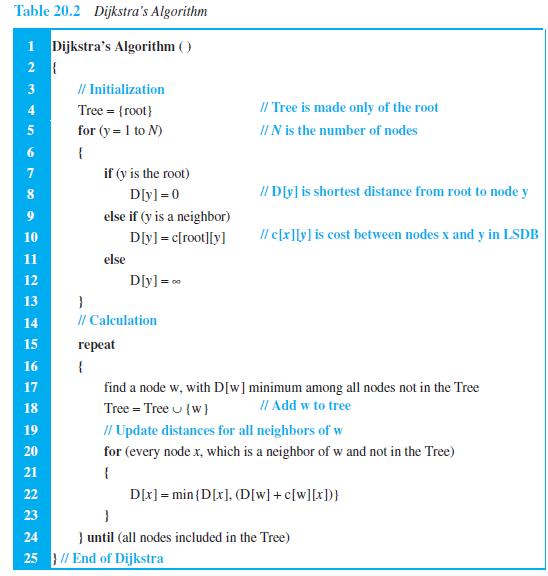
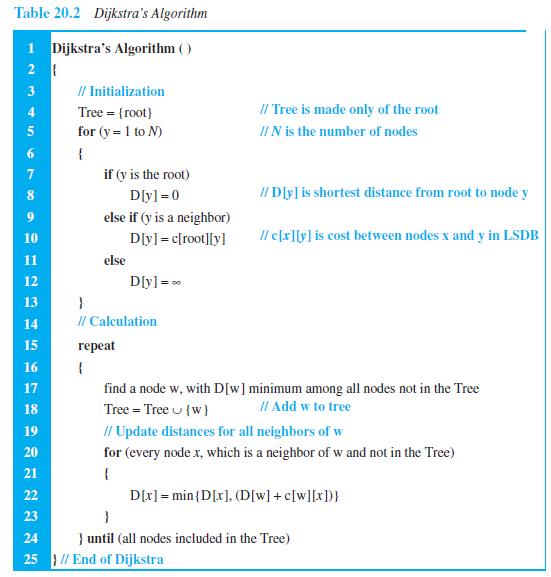
Write a program to simulate the link-state algorithm (Table 20.2). Dijkstra's Algorithm ( ) // Initialization Tree = {root} 3 I/ Tree is made only of the root 4. for (y = 1 to N) II N is the number of nodes { if (y is the root) 8. Dly] =0 // D[y] is shortest distance from root to node y else
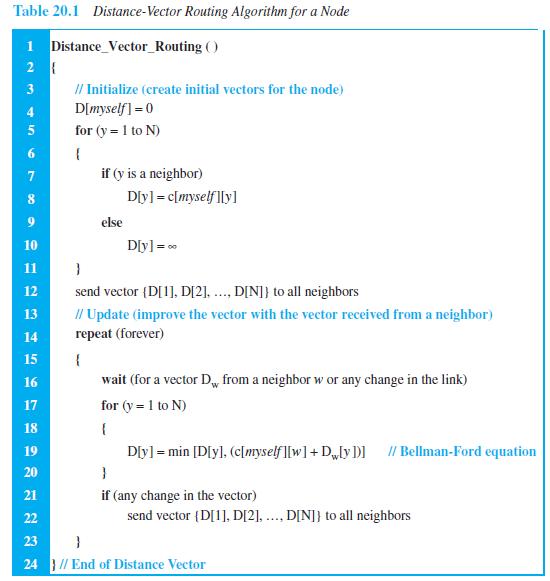
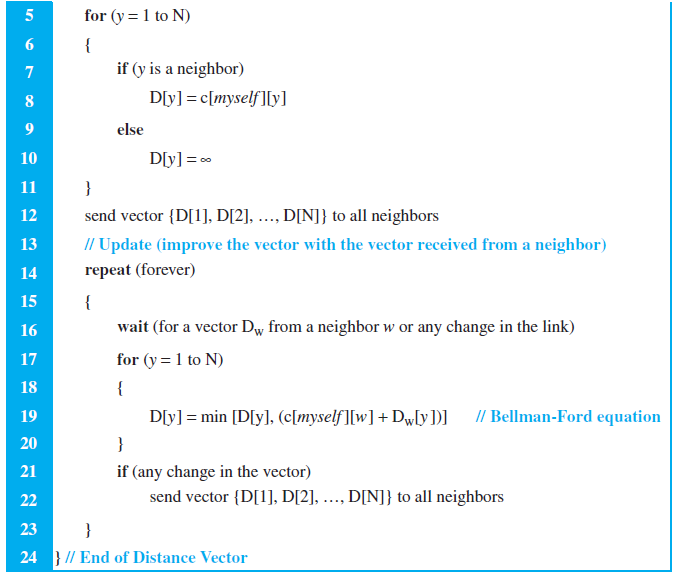
Write a program to simulate the distance-vector algorithm (Table 20.1). for (y = 1 to N) { if (y is a neighbor) D[y] = c[myself][y] else 10 D[y] = 0 11 } send vector {D[1], D[2], ..., D[N]} to all neighbors // Update (improve the vector with the vector received from a neighbor) repeat
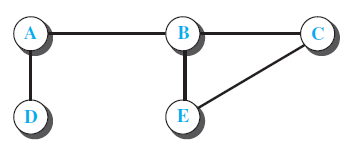
In a graph, if we know that the shortest path from node A to node G is (A → B → E → G), what is the shortest path from node G to node A?
Assume a router using RIP has 10 entries in its forwarding table at time t1. Six of these entries are still valid at time t2. Four of these entries have been expired 70, 90, 110, and 210 seconds before time t2. Find the number of periodic timers, expiration timers, and garbage collection timers
Assume the shortest path in a graph from node A to node H is A → B → H.Also assume that the shortest path from node H to node N is H → G → N.What is the shortest path from node A to node N?
When does an OSPF router send each of the following messages?a. Hellob. Data descriptionc. Link-state requestd. Link-state updatee. Link-state acknowledgment
Explain why a router using link-state routing needs to receive the whole LSDB before creating and using its forwarding table. In other words, why can’t the router create its forwarding table with a partially received LSDB?
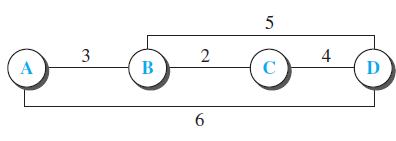
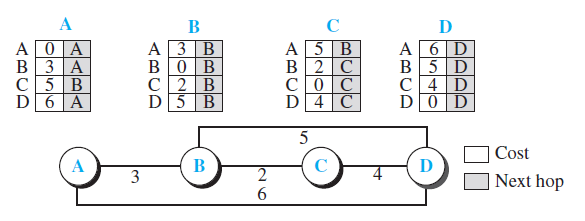
To understand how the distance vector algorithm in Table 20.1 works, let us apply it to a four-node internet as shown in Figure 20.32.Table 20.1Assume that all nodes are initialized first. Also assume that the algorithm is applied, one at a time, to each node respectively (A, B, C, D). Show that
Is the path-vector routing algorithm closer to the distance-vector routing algorithm or to the link-state routing algorithm? Explain.
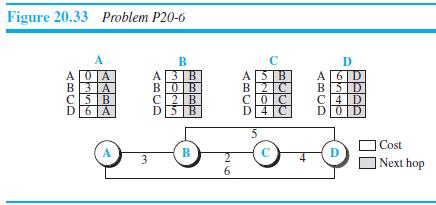
In distance-vector routing, good news (decrease in a link metric) will propagate fast. In other words, if a link distance decreases, all nodes quickly learn about it and update their vectors. In Figure 20.33, we assume that a four-node internet is stable, but suddenly the distance between nodes A
List three types of autonomous systems (ASs) described in the text, and make a comparison between them.
In distance-vector routing, bad news (increase in a link metric) will propagate slowly. In other words, if a link distance increases, sometimes it takes a long time for all nodes to know the bad news. In Figure 20.33 (see the previous problem), we assume that a four-node internet is stable, but
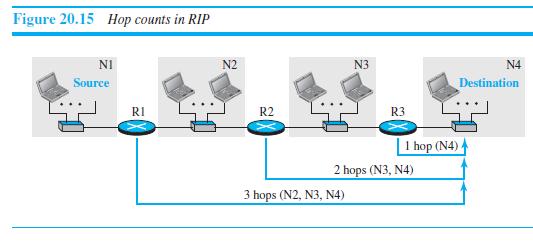
Explain the concept of hop count in RIP. Can you explain why no hop is counted between N1 and R1 in Figure 20.15? Figure 20.15 Hop counts in RIP NI N2 N3 N4 Source Destination RI R2 R3 1 hop (N4) 2 hops (N3, N4) 3 hops (N2, N3, N4)
In computer science, when we encounter an algorithm, we often need to ask about the complexity of that algorithm (how many computations we need to do). To find the complexity of the distance vector’s algorithm, find the number of operations a node needs to do when it receives a vector from a
Assume that we have an isolated AS running RIP. We can say that we have at least two different kinds of datagram traffic in this AS. The first kind carries the messages exchanged between hosts; the second carries messages belonging to RIP. What is the difference between the two kinds of traffic
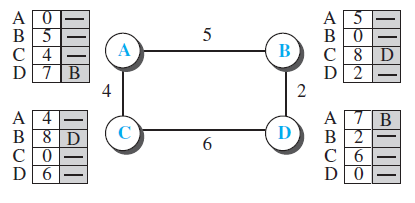
Assume that the network in Figure 20.34 uses distance-vector routing with the forwarding table as shown for each node.Figure 20.34If each node periodically announces their vectors to the neighbor using the poison-reverse strategy, what is the distance vector advertised in the appropriate period:a.
Router A sends two RIP messages to two immediate neighboring routers, B and C. Do the two datagrams carrying the messages have the same source IP addresses? Do the two datagrams have the same destination IP addresses?
Assume that the network in Figure 20.34 (previous problem) uses distancevector routing with the forwarding table as shown for each node. If each node periodically announces their vectors to the neighbor using the split-horizon strategy, what is the distance vector advertised in the appropriate
At any moment, a RIP message may arrive at a router that runs RIP as the routing protocol. Does it mean that the RIP process should be running all the time?
Assume that the network in Figure 20.34 (Problem P20-8) uses distance vector routing with the forwarding table as shown for each node. If node E is added to the network with a link of cost 1 to node D, can you find the new forwarding tables for each node without using the distance-vector
Why do you think RIP uses UDP instead of TCP?
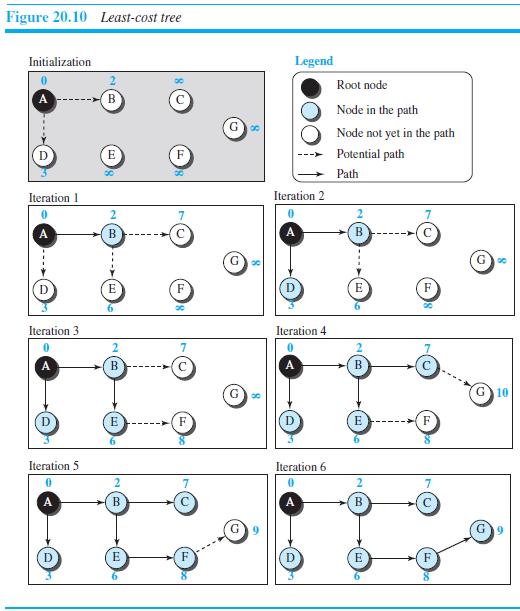
Create the forwarding table for node A in Figure 20.10. Figure 20.10 Least-cost tree Initialization Legend Root node A B Node in the path Node not yet in the path E F Potential path Path Iteration 1 Iteration 2 B E (F E F Iteration 3 Iteration 4 B A В G)10 E F 6. Iteration 5 Iteration 6 A. B B
We say that OSPF is a hierarchical intradomain protocol, but RIP is not. What is the reason behind this statement?
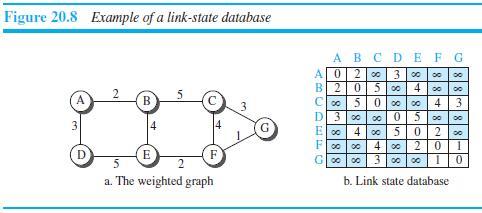
Create the shortest path tree and the forwarding table for node G in Figure 20.8. Figure 20.8 Example of a link-state database A B C DE F G A 0|2 00 B| 20|5 00 C00 D 3 0 3 00 4 00 B 4 3. 0 | 00 5 3 o0 0 4 00 4 00 3 2 |0 D F G00 00 00 a. The weighted graph b. Link state database len& 2.
In a very small AS using OSPF, is it more efficient to use only one single area (backbone) or several areas?
Why do you think we need only one RIP update message, but several OSPF update messages?
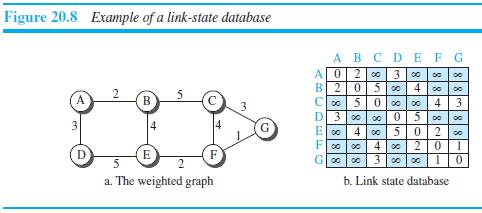
Create the shortest path tree and the forwarding table for node B in Figure 20.8. Figure 20.8 Example of a link-state database A B C DE F G A02 00 B| 20 5 00 3 00 4 00 A C00 D 3 0 3 4 3. o0 0 4 00 4 00 3. E 00 2 | 0 1 E F Go0 00 a. The weighted graph b. Link state database 2.
OSPF messages are exchanged between routers. Does this mean that we need to have OSPF processes run all the time to be able to receive an OSPF message when it arrives?
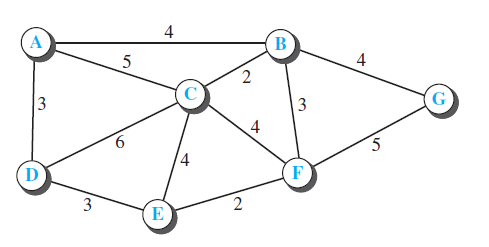
Use Dijkstra's algorithm (Table 20.2) to find the shortest path tree and the forwarding table for node A in the Figure 20.35.Table 20.2 4. 4. 3. 3.
OSPF messages and ICMP messages are directly encapsulated in an IP datagram. If we intercept an IP datagram, how can we tell whether the payload belongs to OSPF or ICMP?
In computer science, when we encounter an algorithm, we often need to ask about the complexity of that algorithm (how many computations we need to do). To find the complexity of Dijkstra’s algorithm, find the number of searches we have to do to find the shortest path for a single node when the
Explain what type of OSPF link state is advertised in each of the following cases:a. A router needs to advertise the existence of another router at the end of a point-to-point link.b. A router needs to advertise the existence of two stub networks and one transient network.c. A designated router
Assume that A, B, C, D, and E in Figure 20.36 are autonomous systems (ASs). Find the path vector for each AS using the algorithm in Table 20.3. Assume that the best path in this case is the path which passes through the shorter list of ASs. Also assume that the algorithm first initializes each AS
Can a router combine the advertisement of a link and a network in a single link-state update?
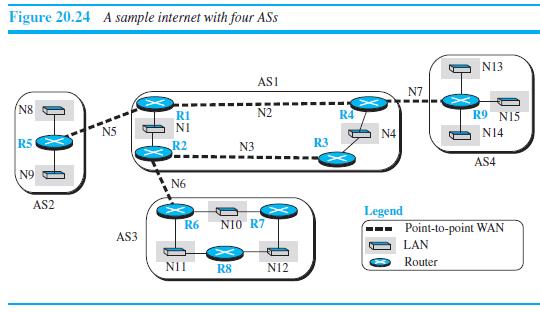
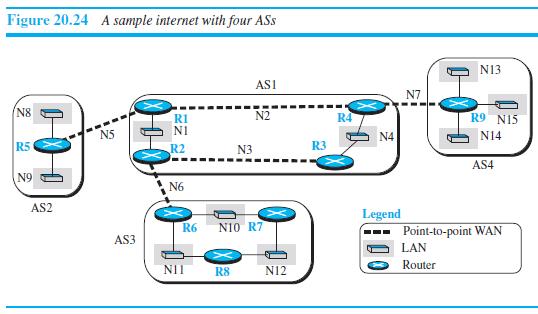
In Figure 20.24, assume that the intra-AS routing protocol used by AS1 is OSPF, but the one used by AS2 is RIP. Explain how R5 can find how to route a packet to N4. Figure 20.24 A sample internet with four ASs N13 ASI N7 N8 RI NI N2 R4 R9 NI5 N5 N4 N14 R5 R2 N3 R3 AS4 N9 N6 AS2 Legend
Explain why we can have different intradomain routing protocols in different ASs, but we need only one interdomain routing protocol in the whole Internet.
In Figure 20.24, assume that the intra-AS routing protocol used by AS4 and AS3 is RIP. Explain how R8 can find how to route a packet to N13. Figure 20.24 A sample internet with four ASs N13 ASI N7 N8 N2 R4 R9 N15 RI NI N5 N4 N14 R5 R2 N3 R3 AS4 N9 N6 AS2 Legend Point-to-point WAN R6 N10 R7 AS3 LAN
Can you explain why BGP uses the services of TCP instead of UDP?
Explain why policy routing can be implemented on an interdomain routing, but it cannot be implemented on a intradomain routing.
Explain when each of the following attributes can be used in BGP:a. LOCAL-PREFb. AS-PATHc. NEXT-HOP
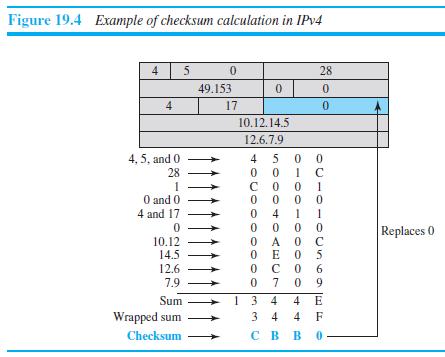
In Figure 19.4,a. Show how wrapped sum can be calculated from the sum using modular arithmetic.b. Show how checksum can be calculated from the wrapped sum using modular arithmetic. Figure 19.4 Example of checksum calculation in IPV4 4 28 49.153 4 17 10.12.14.5 12.6.7.9 4, 5, and 0 0 0 I C 4 28 1 C
Which protocol is the carrier of the agent advertisement and solicitation messages?
Create a foreign agent advertisement message using 1672 as the sequence number and a lifetime of 4 hours. Select your own values for the bits in the code field. Use at least three care-of addresses of your choice. Calculate and insert the value for the length field.
Discuss how the ICMPv4 router solicitation message can also be used for agent solicitation. Why are there no extra fields?
We have the information shown below. Show the contents of the IP datagram header sent from the remote host to the home agent.Mobile host home address: 130.45.6.7/16Mobile host care-of address: 14.56.8.9/8Remote host address: 200.4.7.14/24Home agent address: 130.45.10.20/16Foreign agent address:
Is registration required if the mobile host acts as a foreign agent? Explain your answer.
Create a home agent advertisement message using 1456 as the sequence number and a lifetime of 3 hours. Select your own values for the bits in the code field. Calculate and insert the value for the length field.
Explain why the registration request and reply are not directly encapsulated in an IP datagram. Why is there a need for the UDP user datagram?
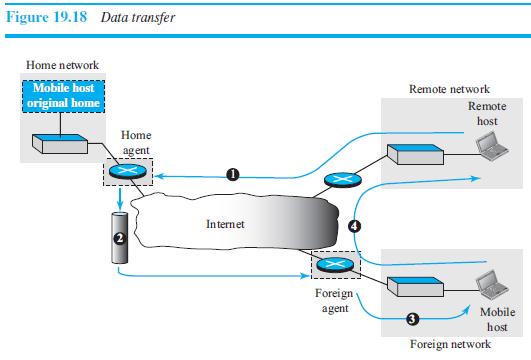
Redraw Figure 19.18 for the case where the mobile host acts as a foreign agent. Figure 19.18 Data transfer Home network Mobile host Remote network original home Remote host Home ag ent Internet Foreign agent Mobile host Foreign network
What are the source and destination IP addresses in a datagram that carries the ICMPv4 message reported by a router?
Briefly describe how we can defeat the following security attacks:a. Packet sniffingb. Packet modificationc. IP spoofing
Explain why the Internet does not create a report message to report the error in an IP datagram that carries an ICMPv4 message.
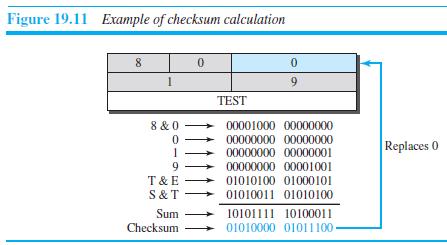
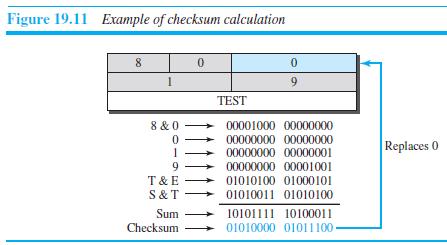
Redo the checksum in Figure 19.11 using decimal values and modular arithmetic. Figure 19.11 Example of checksum calculation 8 9 TEST 8 & 0 00001000 00000000 00000000 00000000 00000000 00000001 Replaces 0 9. 00000000 00001001 T & E 01010100 01000101 S& T 01010011 01010100 Sum 10101111 10100011
Assume a destination computer receives several packets from a source. How can it be sure that the fragments belonging to a datagram are not mixed with the fragments belonging to another datagram?
Redo the checksum in Figure 19.11 using hexadecimal values.Figure 19.11 Figure 19.11 Example of checksum calculation 8 9 TEST 8 & 0 00001000 00000000 00000000 00000000 00000000 00000001 Replaces 0 9. 00000000 00001001 T & E 01010100 01000101 S& T 01010011 01010100 Sum 10101111 10100011 Checksum
Can each of the following be the value of the offset field in a datagram? Explain your answer.a. 8b. 31c. 73d. 56
A packet has arrived in which the offset value is 300 and the payload size is 100 bytes. What are the number of the first byte and the last byte?
Which fields in the datagram is(are) responsible for gluing together all fragments belonging to an original datagram?
Showing 1000 - 1100
of 2050
First
4
5
6
7
8
9
10
11
12
13
14
15
16
17
18
Last
Step by Step Answers

 Get 50% OFF
Claim Now
Get 50% OFF
Claim Now


![Table 20.3 Path-vector algorithm for a node 1 Path_Vector_Routing ( ) 2 { // Initialization for (y = 1 to N) 3 { if (y is myself) Path[y] = myself else if (y is a neighbor) 9. Path[y] = myself + neighbor node 10 else 11 Path[y] = empty 12](https://dsd5zvtm8ll6.cloudfront.net/si.question.images/images/question_images/1607/4/8/9/3825fd057660847a1607489381626.jpg)
![Distance_Vector_Routing ( ) // Initialize (create initial vectors for the node) D[myself] = 0 4-](https://dsd5zvtm8ll6.cloudfront.net/si.question.images/images/question_images/1544/8/0/0/3205c13c8405b9ac1544782874654.jpg)
![B D C|0 D] 6 D|0 ABCD + bo ABCD ABCD](https://dsd5zvtm8ll6.cloudfront.net/si.question.images/images/question_images/1607/4/8/9/0625fd05626de53c1607489062886.jpg)
![B D C|0 D] 6 D|0 ABCD + bo ABCD ABCD](https://dsd5zvtm8ll6.cloudfront.net/si.question.images/images/question_images/1607/4/8/9/0505fd0561ace8721607489050235.jpg)