New Semester
Started
Get
50% OFF
Study Help!
--h --m --s
Claim Now
Question Answers
Textbooks
Find textbooks, questions and answers
Oops, something went wrong!
Change your search query and then try again
S
Books
FREE
Study Help
Expert Questions
Accounting
General Management
Mathematics
Finance
Organizational Behaviour
Law
Physics
Operating System
Management Leadership
Sociology
Programming
Marketing
Database
Computer Network
Economics
Textbooks Solutions
Accounting
Managerial Accounting
Management Leadership
Cost Accounting
Statistics
Business Law
Corporate Finance
Finance
Economics
Auditing
Tutors
Online Tutors
Find a Tutor
Hire a Tutor
Become a Tutor
AI Tutor
AI Study Planner
NEW
Sell Books
Search
Search
Sign In
Register
study help
computer science
systems analysis and design 12th
Free Space Optical Systems Engineering Design And Analysis 1st Edition Larry B. Stotts - Solutions
Equation (5.120) can be rewritten asUsing the above equation, show that the variance of the aberration function is given by 00 n =CR (p) + CR (p) cos me. nm n W(0, 0) = Coo + 2n=2 n=1m=1
Using the Zernike polynomial definition in Eq. (5.128), show that Z(p, 0) Z (0,0) p dp d0 = 8nn' 8mm (0,0) Z p do -
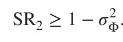
Equation (5.153b) states thatMaréchal postulated that a well-corrected imaging system translates into a SR of 0.8 or higher. Using this equation, what is the standard deviation of the wavefront error for that condition? SR 21-0
If \(k T \gg h v\), which will be true for radio and microwave frequencies, what is the mean number of photons in a single quantum state and how big is it?
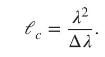
Show that a source with a narrow spectral width has a coherence length given by le = 22
Show that the coherent time \(\tau_{c}\) defined in Eq. (6.43) is related to the spectral width \(\Delta v\) given by Eq. (6.50) by the simple inversion formula \(\tau_{c}=\frac{1}{2 \Delta \omega}\). HINT: Use the Fourier transform relationships between \(S(\omega)\) and \(G(\tau)\) and Parseval's
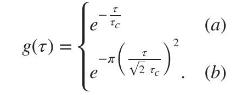
Valid that the coherence time calculated by Eq. (6.43) is accurate for the following complex degrees of temporal coherence:What is the drop-off rate for \(|g(\tau)|\) between 0 and \(\tau_{c}\) for each case? g(t) = e e 2 (a) () (b)
Assume an MCF equal toShow that the function \(J(\boldsymbol{r})\) satisfies the Helmholtz equation \(abla^{2} J+\) \(k_{0}^{2} J=0\), where \(k_{0}=\frac{\omega_{0}}{c}\). G(x1, x2;)=J(r-2)ximo.
What is the irradiance at the position of the third maximum for a single slit of width \(0.02 \mathrm{~mm}\) ?
If we have a single slit of \(0.2 \mathrm{~cm}\) wide, a screen of \(1 \mathrm{~m}\) distance, and the second maximum occurs at a position \(1 \mathrm{~cm}\) along the screen, what must be the wavelength of light incident on the screen?
Given the Koschmieder equation, calculate the atmospheric extinction coefficient for visibilities of \(5,10,15,23,50\), and \(100 \mathrm{~km}\). Plot the atmospheric loss for the range of \(0-200 \mathrm{~km}\). Assume the wavelength of interest is \(1.55 \mu \mathrm{m}\).
Assume a horizontal viewing geometry. If the visibility is \(35 \mathrm{~km}\), what is the Koschmieder extinction coefficient if we assume the wavelength of interest is \(0.55 \mu \mathrm{m}\) ? Given that extinction coefficient, what is the contrast of an object located \(12 \mathrm{~km}\) away?
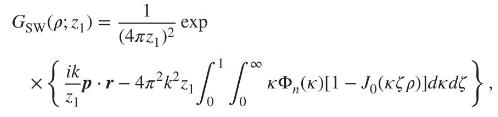
Givenassuming a von Karman spectrum, show that for small arguments, we have Gsw(P; z) = ik Z1 1 (4z) exp pr-4xkz 00 KP,(x)[1 - Jo(kp)]dkd
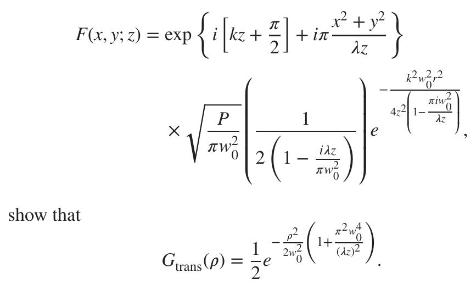
Given in F(x, y, z) = exp { i [k + ] + 1x 2 + y } kz 1 Az k2u2,2 P 2 1 - 1 iAz W 4221- e show that (0)=(1+55) Gtrans (p) =
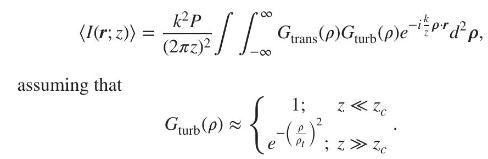
Calculate (I(r; z)) = kP (2z) DE LOS Gtrans (P)Gurb (p)e-prp, assuming that Gturb (p) { 1; 2 z
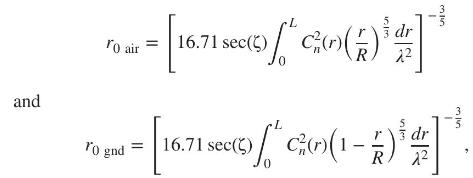
Assume that we have a horizontal \(10 \mathrm{~km}\) laser link at height \(h_{0}\) above the ground where the Fried parameters for the air and ground terminals are given byrespectively. Assume that the refractive index structure parameter at altitude isLet the wavelength equal \(1.55 \mu
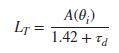
Graphically show that \(\sqrt{\cos \varphi_{\text {inc }}}\) approximates Eq. (7.163) for \(\varphi_{\text {inc }}\).Equation 7.63 LT A(0;) 1.42+d
Using Eq. (7.167), plot the multitime spread for asymmetry factors of \(g=0.8,0.9\), and 0.95 for the optical thickness range from 10 to 100. Assume that \(c=0.2286, b=0.16\), and \(a=0.0686\). Explain the results.Equation 7.167 A(@inc)=1.69-0.5513; +2.7173-6.9866 +7.14460-3.4249 +0.6155
Using Eq. (7.167), plot the multitime spread for single scatter albedos of \(\omega_{0}=0.5,0.65\), and 0.0 .8 for the optical thickness range from 10 to 100. Assume that \(g=0.875\). Explain the results.Equation 7.167 A(@inc)=1.69-0.5513; +2.7173-6.9866 +7.14460-3.4249 +0.6155
An abrupt silicon \(\left(n_{i}=10^{10} \mathrm{~cm}^{-3}ight) \mathrm{p}-\mathrm{n}\) junction consists of a p-type region containing \(10^{16} \mathrm{~cm}^{-3}\) acceptors and an n-type region containing \(5 \times 10^{10} \mathrm{~cm}^{-3}\) donors. Assume \(T=300 \mathrm{~K}\).(a) Calculate
An abrupt silicon \(\left(n_{i}=10^{10} \mathrm{~cm}^{-3}ight) \mathrm{p}-\mathrm{n}\) junction consists of a p-type region containing \(2 \times 10^{16} \mathrm{~cm}^{-3}\) acceptors and an \(\mathrm{n}\)-type region containing also \(10^{16} \mathrm{~cm}^{-3}\) acceptors in addition to \(10^{17}
Consider an abrupt p-n diode with \(N_{a}=10^{18} \mathrm{~cm}^{-3}\) and \(N_{a}=10^{16}\). Calculate the junction capacitance at zero bias. The diode area equals \(10^{-4} \mathrm{~cm}^{2}\).
An ideal photodiode is made of a material with a bandgap energy of \(2.35 \mathrm{eV}\). It operates at \(300 \mathrm{~K}\) and is illuminated by monochromatic light with wavelength of \(400 \mathrm{~nm}\). What is its maximum efficiency?Although each photon has an energy \(h v\) it will produce
What is the short-circuit current delivered by a \(10 \mathrm{~cm} \times 10 \mathrm{~cm}\) photodetector (with 100\% quantum efficiency) illuminated by monochromatic light of \(400 \mathrm{~nm}\) wavelength with a power density of \(1000 \mathrm{~W} / \mathrm{m}^{2}\).
Assume the photodiode of this problem as an ideal structure with \(100 \%\) quantum efficiency and area \(1 \mathrm{~cm}^{2}(=1 \mathrm{~cm} \times 1 \mathrm{~cm})\). In addition, assume it is illuminated by monochromatic light with a wavelength of \(780 \mathrm{~nm}\) and with a power density of
A photodiode is exposed to radiation of uniform spectral power density(covering the range from \(300-500 \mathrm{THz}\). Outside this range there is no radiation. The total power density is \(2000 \mathrm{~W} / \mathrm{m}^{2}\). Assume that the photodiode has \(100 \%\) quantum efficiency.(a) What
The power density of monochromatic laser light \((586 \mathrm{~nm})\) is to be monitored by a silicon photodiode with area equal to \(1 \mathrm{~mm}^{2}\) (= \(\left.1 \mathrm{~mm} \times 1 \mathrm{~mm}ight)\). The quantity observed is the short-circuit current generated by the silicon. Assume that
What is the theoretical efficiency of a photodetector with a \(2.5 \mathrm{eV}\) bandgap when exposed to \(100 \mathrm{~W} / \mathrm{m}^{2}\) solar radiation through with transmittance, 1; if 600 nm < < 1000 nm Yr 0; if 1000 nm
Consider a small silicon photodiode with a \(100 \mathrm{~cm}^{2}=10 \mathrm{~cm} \times 10 \mathrm{~cm}\) area. When \(2 \mathrm{~V}\) of reversed bias is applied, the reverse saturation current is \(30 \mathrm{nA}\). When the photodiode is short-circuited and exposed to blackbody radiation with a
Referring to Problem 8.11, consider an ideal photodiode with no internal resistance.(a) Under an illumination of \(1000 \mathrm{~W} / \mathrm{m}^{2}\), at \(300 \mathrm{~K}\), what is the maximum power the photodiode can deliver to a load. What is the efficiency? Do this by trial and error and be
Assume that we have an EDFA FSOC communications receiver whereunder high amplifier gain levels. For \(\lambda=1.55 \mu \mathrm{m}, B_{0}=75 \mathrm{GHz}\), \(B_{e}=7.5 \mathrm{GHz}, n_{p}=1.4, \eta=0.7\), and \(P_{s}=-30 \mathrm{dBmW}\), calculate SNR and OSNR? 2 2 shot + Othermal s-sp 2 2 +sp-sp
Assume that we have a horizontal \(10 \mathrm{~km}\) FSOC link at height \(h_{0}\) above the ground. If the refractive index structure function at altitude is \(C_{n}^{2}\left(h_{0}ight) \approx 3 \times 10^{-14} \mathrm{~m}^{-\frac{2}{3}}\), the wavelength of the FSOC laser is \(1.55 \mu
A photomultiplier (PMT) has a dark count noise level of 100 counts per seconds. Calculate the minimum optical power \((S N R=1)\) at \(500 \mathrm{~nm}\) that can be detected within a \(10 \mathrm{~s}\) integration time. Assume a quantum efficiency of 0.2 at \(500 \mathrm{~nm}\).
A \(\mathrm{p}-\mathrm{i}-\mathrm{n}\) photodiode has a responsivity of \(0.8 \mathrm{~A} / \mathrm{W}\) at \(1.55 \mu \mathrm{m}\). The effective resistance of the detector circuit is \(50 \Omega\). The photodiode dark current density is \(1 \mathrm{pA} / \sqrt{\mathrm{Hz}}\). Calculate the NEP of
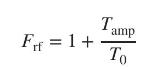
Referring to problem 8.16, what would the NEP be if the detector is now feeding an amplifier with a noise temperature of \(600 \mathrm{~K}\) ?The Noise Figure \(F_{\text {rf }}\) is related to its noise temperature \(T_{\text {amp }}\) :problem 8.16A photomultiplier (PMT) has a dark count noise
Prove the statement on page (5) that the average risk is minimized by choosing the hypothesis for which the conditional risk is the smaller.
Derive the conditions that the line of equal risk does not intersect the operating characteristic in the region \(0 \ll Q_{0} C11 < Co
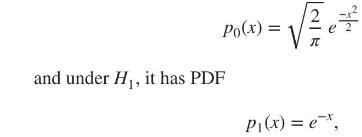
Find the Bayes test to choose between the hypotheses, \(H_{0}\) and \(H_{1}\), whose prior probabilities are \(\frac{5}{8}\) and \(\frac{3}{8}\), respectively, when under \(H_{0}\) the datum \(x\) had the PDF\(x\) always being positive. Let the relative costs of the two kinds of errors be equal.
The random variables \(x\) and \(y\) are Gaussian with mean value 0 and variance 1 . Their covariance may be 0 or some know positive value \(r>0\). Show that the best choice between these possibilities on the basis of measurement of \(x\) and \(y\) depends on where the point \((x, y)\) lies with
A sequence of \(N\) independent measurements is taken from a Poisson distribution \(\{x\}\) whose mean is \(m_{0}\) under \(H_{0}\), and \(m_{1}\) under \(H_{1}\). On what combination of the measurements should a Bayes test be based, and with what decision level should its outcome be compared, for
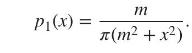
A random variable \(x\) is distributed according to the Cauchy distribution,The parameter \(m\) can take on either of two values, \(m_{0}\) or \(m_{1}\), where \(m_{0} P(x) = = m (m + x)
Under Hypotheses \(H_{0}\) and \(H_{1}\), a random variable has the following probability density functionsChoosing \(H_{0}\) when \(H_{1}\) is true costs twice as much as choosing \(H_{1}\) when \(H_{0}\) is true. Correct choices cost nothing. Find the minimax strategy for deciding between the two
A choice is made between Hypotheses \(H_{0}\) and \(H_{1}\) on the basis of a single measurement \(x\). Under Hypothesis \(H_{0}, x=n\); under Hypothesis \(H_{1}, x=s+n\). Here both \(s\) and \(n\) are positive random variables with the following PDFs:Calculate the PDFs under Hypotheses \(H_{0}\)
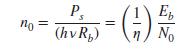
Derive Eqs. (9.105) and (9.106).Equation 9.105Equation 9.106 SNRDD-PIN rn Prec 2hvRb = (nrno)/2,
Using Eq. (9.108), calculate the value of \(Q\) for (a) \(10^{-9}\) and (b) \(10^{-12}\).Equation 9.108 rEb = m SNRQL No Ps (hv R) =
Determine the \(Q\) expression for preamplifier noise-limited receiver. Let \(i_{0}=0\).
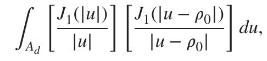
Show that if a circular aperture lens of diameter \(d\) is used when heterodyning with two match Airy patterns, the equivalent suppression factor for misaligned angles is proportional towhere \(ho_{0}\) is the offset distance. (u)] [(lu Pol) u - Pol |n| "/ du,
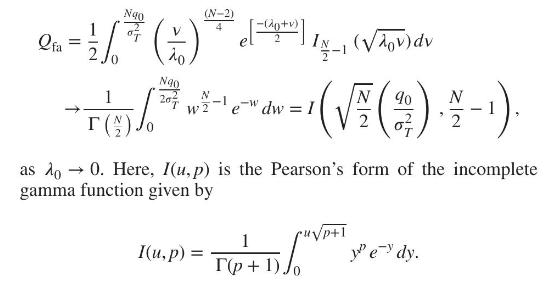
Show that Qfa N40 ** (N-2) -(d+v) IN-I (20v)dv Ngo 1 N 20 N 90 W2 ew dw=1 -1). as 20 - (). 0 0. Here, I(u,p) is the Pearson's form of the incomplete gamma function given by 1 I(u,p) = ye dy. (p+1).
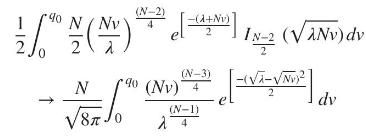
Show thatfor large even values of \(N\). 1 40 N (Nv N . (N-2) -(1+Nv) IN-2 (VANV) dv (N-3) 90 (Nv) 4 -VA-N dv (N-1) 24
Assume we have a \(5 \times 5\) pixel target with equal signal level at every pixel, and background clutter with equal estimated mean as well. Specifically, we set \(s_{n}=6\) and \(\widehat{\mu}_{b n}=2\) for all values of \(n\) comprising the target. What is the resulting contrast? If we set the
Let \(\Pi\) be the plane in \(R^{3}\) spanned by vectors \(\boldsymbol{x}_{1}=(1,2,2)\) and \(\boldsymbol{x}_{2}=\) \((-1,0,2)\).(i) Find an orthonormal basis for \(\Pi\).(ii) Extend it to an orthonormal basis for R3.Let \(\boldsymbol{x}_{3}=(0,0,1)\).
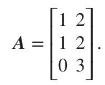
Find the QR factorization of 12 A=12 03
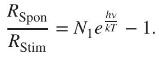
The ratio of the spontaneous to stimulated emission rates is given byWhat is the ratio at \(\lambda=600 \mathrm{~nm}\) for a tungsten lamp operating at \(2000 \mathrm{~K}\) ? Rspon hv = NT 1. Rstim
Assume that we have a lamp that has a radiance of \(95 \mathrm{~W} /\left(\mathrm{cm}^{2} \mathrm{sr}ight)\) at \(\lambda=546 \mathrm{~nm}\). What is the radiance of a \(1 \mathrm{~W}\) Argon laser at \(\lambda=\) \(546 \mathrm{~nm}\), assuming a diffraction-limited beam? Which is larger and by now
Consider a lower energy level situated \(200 \mathrm{~cm}^{-1}\) from the ground state. There are no other energy levels nearby. Determine the fraction of the population found in this level compared to the ground state population at a temperature of \(300 \mathrm{~K}\).The conversion from
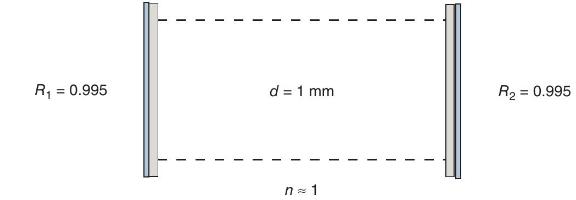
Find the FSR, \(Q\), and \(F\) of the cavity shown as follows.Assume that the wavelength of light equals \(1 \mu \mathrm{m}\). R = 0.995 d = 1 mm R2 = 0.995 n = 1
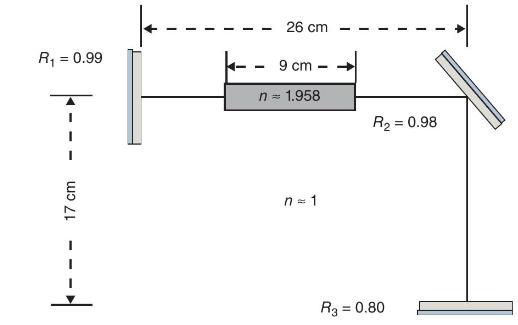
Find the FSR, \(Q\), and \(F\) of the cavity shown as follows.Assume that the wavelength of light equals \(1 \mu \mathrm{m}\) and \(\alpha=\) \(0.001 \mathrm{~cm}^{-1}\).If we have a cavity with a nonuniform index of refraction, then the resonance frequency of the cavity then is given byand a
The amplifying medium of a helium-neon laser has an amplification spectral band equal to \(\Delta v=1 \mathrm{GHz}\) at \(\lambda=632.8 \mathrm{~nm}\). For simplicity, the spectral profile is assumed to be rectangular. The linear cavity is \(30 \mathrm{~cm}\) long. Calculate the number of
Assume that we have a \(\mathrm{CO}_{2}\) laser that has a bandwidth of \(\Delta v=\) \(1 \mathrm{GHz}\) at \(=10.6 \mu \mathrm{m}\). For simplicity, the spectral profile is assumed to be rectangular. The length of the cavity is equal to \(1 \mathrm{~m}\). Calculate the number of longitudinal modes
Verify that for \(m=n=0\), with plane-parallel mirrors \(\left(c_{1}=c_{2}=ight.\) \(\infty\) ) in a cavity of length \(d\), the resonant longitudinal modes are given by Equation (10.114).
Calculate the gap in frequency between two longitudinal modes in a linear cavity with a length of \(300 \mathrm{~mm}\).
A helium-neon laser emitting at \(632.8 \mathrm{~nm}\) light makes a spot with a radius equal to \(100 \mathrm{~mm}\) at \(e^{-2}\) at a distance of \(500 \mathrm{~m}\) from the laser. What is the radius of the beam at the waist (considering the waist and the laser are in the same plane)?Assume a
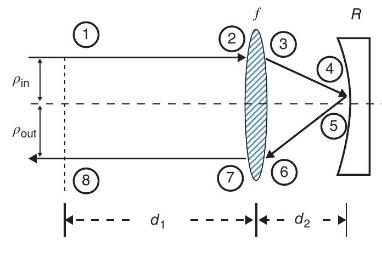
Find the output ray of the system shown as follows when the input ray is characterized by \(ho=0.1 \mathrm{~cm}\) and \(ho^{\prime}=-0.1 \mathrm{~cm}^{-2}\).assuming \(d_{1}=7 \mathrm{~cm}, d_{2}=5 \mathrm{~cm}, f=200 \mathrm{~cm}\), and \(R=400 \mathrm{~cm}\). Pin Pout 1 R 8 |---- d 5 7 6
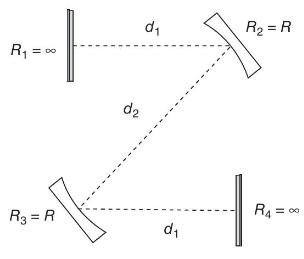
Determine the minimum radius of curvature of the two mirrors to ensure the following cavity is stable: R = = R3 = R d2 d R = R d =00 R4=
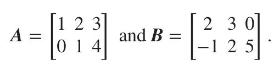
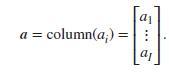
Let(a) what is \(\boldsymbol{A}+\boldsymbol{B}\) ?(b) What is \(\boldsymbol{A}-\boldsymbol{B}\) ? 23 A and B 0 1 14 23 2 30 -125
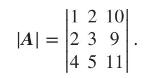
Compute the determinant 12 1 2 10 |A|=239 4 5 11
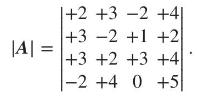
Compute the determinant |A| = 1+2 +32 +41 +3 -2 +1 +2 +3 +2 +3 +4 -2 +40 +5
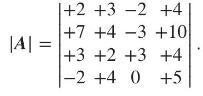
Compute the determinant |A|= 1+2 +32 +4 +7 +4-3 +10 +3 +2 +3 +4 -2 +40 +5
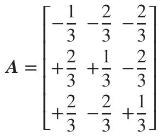
Show that the cofactor of each element ofis that element. A = + 1 -1321323 + + 1 + I 231323 WIN win 23 23 13
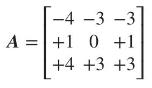
Show that the cofactor of an element of any row ofis the corresponding element of the same numbered column. -4-3-3 A = +10+1 +4 +3 +3
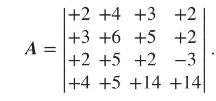
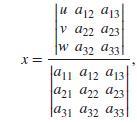
Find the inverse of A = 1+2 +4 +3 +2 +3 +6 +5 +2 +2 +5 +2 -3 +4 +5 +14 +14
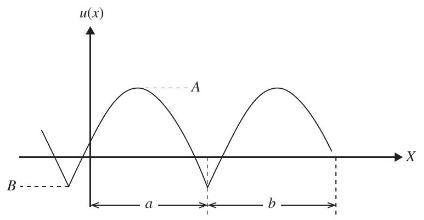
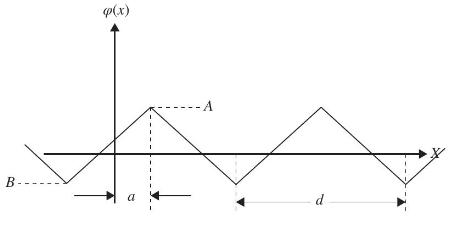
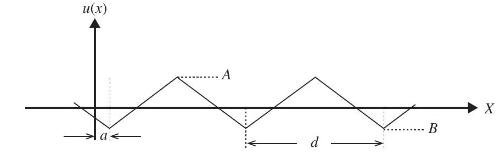
Calculate the Fourier series coefficients Cn for the following periodic function: B u(x) a A b X
Calculate the Fourier series coefficients Cn for the function u(x) plotted as follows, but do so exploiting some of the properties contained in Eqs. (1.4)-(1.24) to provide a solution derived from the coefficient calculation of a square wave. The slopes up and down are equally steep, and that \(B\)
Calculate the Fourier series coefficients Cn for the function u(x) plotted as follows, but do so exploiting some of the properties contained in Eqs. (1.4)-(1.24) to provide a solution derived from the coefficient calculation of a square wave. The slopes up and down are equally steep, and that \(B\)
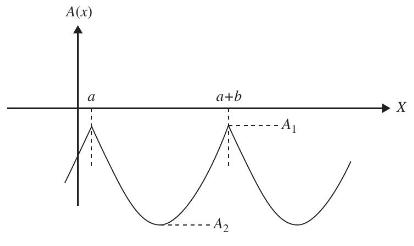
Calculate the Fourier series coefficients \(C_{n}\) for \(u(x)=A(x) e^{i \varphi(x)}\). \(\varphi(x)=\varphi_{0}+10 \pi \frac{x}{b}\). The curve shown in the following figure is like the lower portion of the cosine function. A(x) a a+b --A X -A
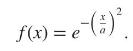
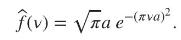
LetProve that its Fourier transform is f(x) = e()
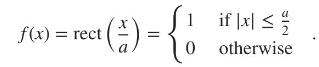
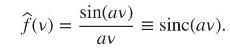
LetProve that its Fourier transform is 1 if |x| f(x) = rect 0 otherwise
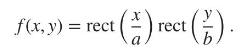
LetWhat is its two-dimensional Fourier transform? f(x, y) = rect (1) rect (f).
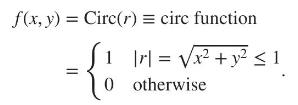
LetWhat is its two-dimensional Fourier transform? f(x, y) = Circ(r) = circ function ={ 1 |r|= x + y 1 0 otherwise
Assume a card selected out of an ordinary deck of 52 cards. Letand A = {the card is a spade}
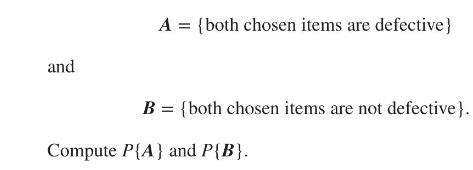
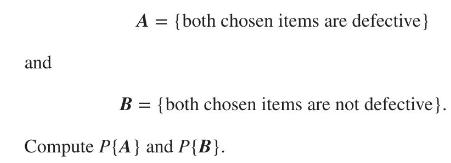
Let two items be chosen out of a lot of 12 items where 4 of them are defective. Assume and A = {both chosen items are defective} B = {both chosen items are not defective}. Compute P{A} and P{B}.
Given the problem laid out in Problem 1.19. Assume now thatWhat is the probability that event C occurs?Problem 1.19Let two items be chosen out of a lot of 12 items where 4 of them are defective. Assume C = {At least one chosen item is defective}.
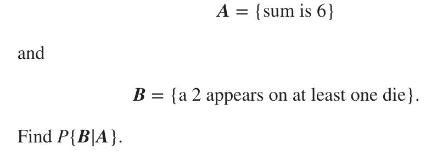
Let a pair of fair dice be tossed. If the sum is 6 , what is the probability that one of the dice is a 2 ? In other words, we have and A = {sum is 6} Find P{B|A}. B = {a 2 appears on at least one die).
In a certain college, \(25 \%\) of the students fail in mathematics, \(15 \%\) of the students fail in chemistry, and \(10 \%\) of the students fail both in mathematics and chemistry. A student is selected at random.(a) If the student failed in chemistry, what is the probability that the student
Let \(\boldsymbol{A}\) and \(\boldsymbol{B}\) be events with \(P\{\boldsymbol{A}\}=1 / 2, P\{\boldsymbol{B}\}=1 / 3\), and \(P\{\boldsymbol{A} \cap \boldsymbol{B}\}=\) \(1 / 4\). Find (a) \(P\{\boldsymbol{B} \mid \boldsymbol{A}\}\), (b) \(P\{\boldsymbol{A} \mid \boldsymbol{B}\}\), and (c)
A lot contains 12 items of which 4 are defective. Three items are drawn at random from that lot one after another. Find the probability that all three are nondefective.
A card player is dealt 5 cards one right after another from an ordinary deck of 52 cards. What is the probability that they are all spades?
Let \(\varphi(t)\) be the standard normal distribution (i.e., mean equals zero and variance equals to unity)? Find \(\varphi(t)\) for(a) \(t=1.63\),(b) \(t=-0.75\) and \(t=-2.08\).
A fair die is tossed seven times. Let us assume that success occurs if a 5 or 6 appear. Let \(n=7, p=P\{5,6\}=\frac{1}{3}\), and \(q=1-p=\frac{2}{3}\).(a) What is the probability that a 5 or a 6 occurs exactly three times (i.e., \(k=3\) )?(b) What is the probability that a 5 or a 6 occurs at least
A fair coin is tossed six times. Let us assume that success is a heads. Let \(n=6\) and \(p=q=\frac{1}{2}\).(a) What is the probability that exactly two heads occur (i.e., \(k=2\) )?(b) What is the probability of getting at least four heads (i.e., \(k=\) \(4,5\), and 6\()\) ?(c) What is the
For a Poisson distribution\[p(k, \lambda)=\frac{\lambda^{k}}{k !} e^{-\lambda}\]find(a) \(p(2,1)\),(b) \(p\left(3, \frac{1}{2}ight)\), and(c) \(p(2,7)\).
Suppose 300 misprints are randomly distributed throughout a book of 500 pages. Find the probability that a given page contains(a) exactly 2 misprints,(b) 2 or more misprints.
Suppose \(2 \%\) of the items made by a factory are defective. Find the probability that there are 3 defective items in a sample of 100 items.
Given\[X(\mathrm{~dB})=10 \log _{10} X\]derive an equation for \(X\) in terms of \(X(\mathrm{~dB})\).
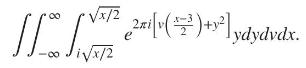
Solve the following integral: Integrals running from \(-\infty\) to \(+\infty\) integrate over the parameters \(v\) and \(x\), while the integral with finite limits integrates over the parameter \(y\). x/2 Jix/2 2iv()+ydydvdx.
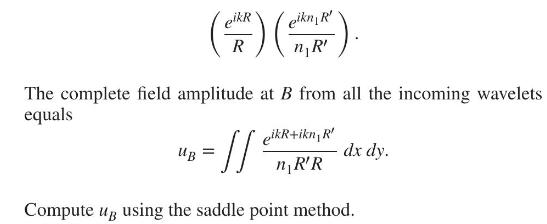
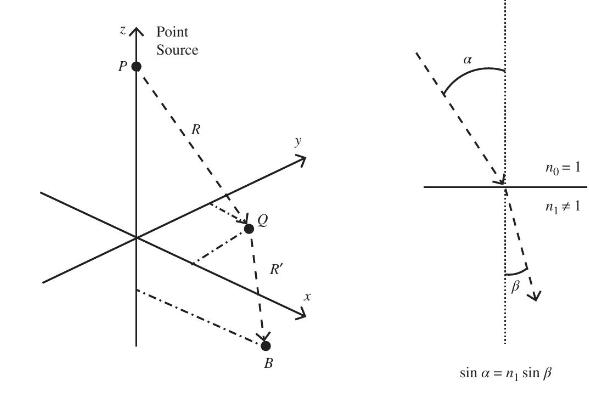
Let us assume that the refractive index of the medium above the \((x\), y) plane is 1 and that the refractive index of the medium below the \((x\), \(y\) ) plane is \(n_{1} eq 1\). Also, let us assume a point source at \((0,0, h)\) on the positive \(z\)-axis define the point \(Q\) to be an
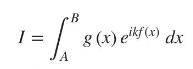
Computewith \(A=\frac{5}{2}, B=\frac{15}{2}, k=\frac{2 \pi}{5}, f(x)=x(x-5)^{2}\), and \(g(x)=\sin \left(\frac{\pi x}{30}ight)\). ] = A B 8(x) eikf(x) dx
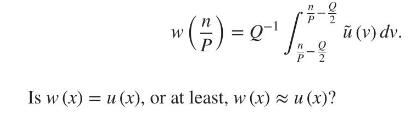
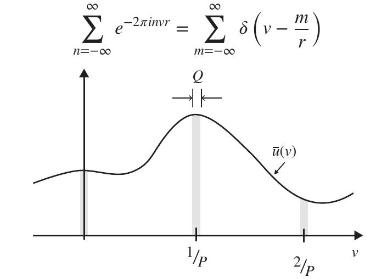
We assume \(u(x)=0\) in \(|x| \geq \frac{P}{2}\). Hence, \(\tilde{u}(v)\) can be sampled at \(v_{n}=\) \(\frac{n}{p}\), which is enough to know, \(\tilde{u}(v)\) and \(u(x)\) complex. Refer to the following figure. Unfortunately, we do not get \(\{\tilde{u}(v)\}\), but \(\{\tilde{w}(v)\}\), where
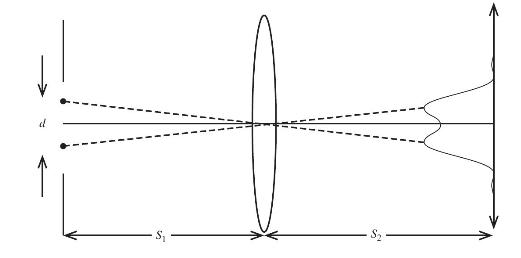
The Rayleigh Criterion for resolution states that two point sources are just resolved when the central maximum from one source falls on the first minimum of the diffraction pattern from the other source. Referring to the following figure, derive an equation for the separation between the peaks
Two stars are a distance \(1.5 \times 10^{8} \mathrm{~km}\) apart. At what distance can they be resolved by the unaided eye? Assume that the refractive index and the lens aperture of the eye are 1.34 and \(5 \mathrm{~mm}\), respectively. How much range improvement occurs if the eye now is aided by
Showing 2700 - 2800
of 4723
First
21
22
23
24
25
26
27
28
29
30
31
32
33
34
35
Last
Step by Step Answers

 Get 50% OFF
Claim Now
Get 50% OFF
Claim Now