New Semester
Started
Get
50% OFF
Study Help!
--h --m --s
Claim Now
Question Answers
Textbooks
Find textbooks, questions and answers
Oops, something went wrong!
Change your search query and then try again
S
Books
FREE
Study Help
Expert Questions
Accounting
General Management
Mathematics
Finance
Organizational Behaviour
Law
Physics
Operating System
Management Leadership
Sociology
Programming
Marketing
Database
Computer Network
Economics
Textbooks Solutions
Accounting
Managerial Accounting
Management Leadership
Cost Accounting
Statistics
Business Law
Corporate Finance
Finance
Economics
Auditing
Tutors
Online Tutors
Find a Tutor
Hire a Tutor
Become a Tutor
AI Tutor
AI Study Planner
NEW
Sell Books
Search
Search
Sign In
Register
study help
business
management accounting
Management Accounting 5th Canadian Edition Charles T Horngren, Gary L Sundem, William O Stratton, Howard D Teall, George Gekas - Solutions
Form groups of three to five persons each. Each member of the group should pick one of the following industry types:Manufacturing Insurance Health care Government Service Each person should explore the Internet for an example of an organization that has changed its cost management practices.
Explain the major attributes of cost allocation and the relationship among activities, costs, and cost drivers.
Use recommended guidelines to charge the variable and fixed costs of service departments to other organizational units.
Identify methods for allocating the central costs of an organization and use the direct, step-down, and reciprocal allocation methods to allocate service department costs to user departments.
Allocate costs to products or services and use the physical units, relative sales value, and net realizable value methods to allocate joint costs.
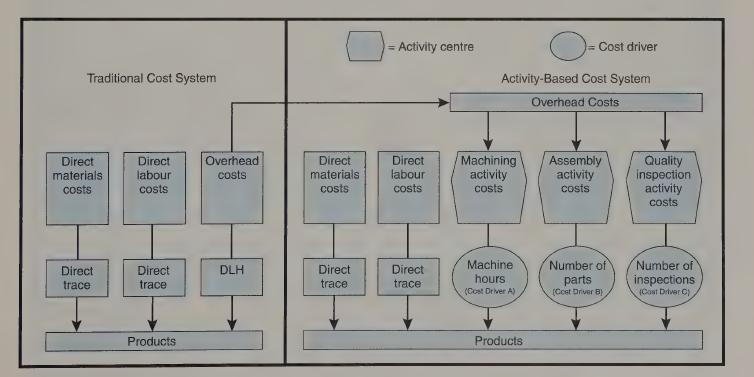
Use activity-based costing to allocate costs to products or services and identify the four steps involved in the design and implementation of activity-based costing systems.
Explain why activity-based management systems are being adopted.
Explain how just-in-time systems can reduce non-value-added activities.
“A cost pool is a group of costs that is physically traced to the appropriate cost object.” Do you agree? Explain.
Give three guides for the allocation of service department costs.
Why do many companies allocate fixed costs separately from variable costs?
Briefly describe the three popular methods for allocating servicedepartment costs.
Briefly explain each of the three conventional ways of allocating joint costs to products.
Refer to Exhibit 5-6. Suppose the appliance maker has two plants—the Salem plant and the Youngstown plant. The Youngstown plant produces only three appliances that are very similar in material and production requirements. The Salem plant produces a wide variety of appliances with diverse material
Choose any large organization with which you are familiar (e.g., a company you have worked for, the university at which you study, the bank you use). What insights do the various theories of organization outlined in this chapter give you into the way your chosen organization functions? To what
Compare and contrast the strategies chosen by the different chain stores that operate in your town. To what extent do you think that the way in which they operate (e.g., the way customers are treated, the range of merchandise offered, etc.) is affected by their overall strategy?
Do theories of management, developed to explain how business organizations operate, apply to other types of organization? How applicable are they to the management of(a) hospitals (also compare the UK with the USA)(b) universities(c) postal services and telecommunications(d) local government?
Compare and contrast military organizations with business organizations, paying particular attention to the different operating requirements and the different environments faced by each.
Outline the main tenets of the contingency theory of organizational structure and the contingency theory of management accounting. What are their similarities and differences?
In many service industries (such as hotels, restaurants, airlines and railways) time is a critical resource. For example, an unoccupied room or seat can never be resold. How do you think that this affects the organization and control of lower-level staff who deal directly with potential customers
Choose an organization that faces a very high level of uncertainty in relation to so me part of its activities (e.g., a manufacturer of fashion clothes). What alternative ways of coping with the uncertainty might it develop? How could it choose between alternative control strategies?
Explain what you understand by the terms' decentralization' and 'divisionalization', clearly indicating the difference between them. What are the major accounting problems that have to be over come in constructing a profit-based measure of performance for a division of a multidivisional company?
Outline the role played by accounting information in an overall system of management control. Explain how the contingency theory of management accounting can be used to provide guidelines for effective management control systems' design and operation.
What incentives would encourage you to work harder? Could you design areward system that would encourage you to devote more effort towards organizational goal attainment?
The relationship between work effort and actual attainment is conditioned by factors external to the control of either the individual or the organization. What is the effect of the state of affairs on the design of reward systems?
To what extent does Herzberg's two-factor approach to motivation accord with your own experience?
What effect do you think cultural factors, whether specific to the workplace, locality, ethnic graup or nationality, have on appropriate methods of motivation?
What implicit theories of motivation seem to be inherent in the way in which the educational institution you attended treated you as a student? What motivates you to contribute (or not contribute) in a tutorial dass? What changes could be made that would improve your level of motivation?
Use the expectancy theory of motivation to analyse the amount of effort you put into various aspects of your work. Suggest changes that would encourage you to work harder and check what effect such changes would have on your colleagues.
How can you ensure that the targets you, as a future manager, set your subordinates are sufficiently challenging to motivate high performance, yet not so difficult as to dis courage them from attempting to attain them?
Find out how a professional accounting firm organizes its auditing activities, and how it attempts to motivate and control its staff. What theories of organization and motivation do you think lie behind the way it operates?
Elegant Electronics compensates its salesmen according to the following scheme. A salesman's remuneration comprises three components:(a) a basic salary of f200 per month,(b) a sales commission amounting to 1% of gross sales, and(c) a bonus amounting to 5% of all gross sales made in excess of a
The management control systems framework has been criticized on the grounds that all managerial activity (e.g., planning, decision making, intelligence gathering) is seen as control activity. To what extent do you consider all managerial activities are essentially control based? What aspects of
It has been observed that managers make little use of many quantitative techniques that have been recommended to them. Why do you think this is? What, if anything, should be done about it?
Although the pattern of hectic activity observed by Mintzberg is generally agreed to be a true reflection of a typical senior manager's life, it has been argued that it is a sign of a poorly organized manager. A more competent manager should arrange his work activities in a better way. Do you
The lack of use of accounting information by managers clearly displays their ignorance and lack of confidence in this area. Most managers admit to a poor understanding of how to interpret financial information; what is needed is better training in the use and interpretation of accounting
Choose a small business with which you are familiar and outline the major features of an information system for it that is designed in accordance with Mintzberg's recommendations.
Classify some organizations you have dealt with in terms of their dominant culture. What effects did this culture have on the effectiveness of their operations?
The most influential controls in an organization are often the least obvious. For example, personnel selection and training can have an impact far more pervasive than that of any information system. Examine the range of controls operated by some organizations with which you are familiar (including
As a manager rises in the organizational hierarchy it is said that he knows less and less about more and more. To what extent do you think this statement is true, and what are the implications for management control?
Define management control, and justify why you consider your definition to be an improvement on others that have been advanced.
As a manager becomes more senior, it appears that he needs to rely more on formal information yet that his style of life encourages him to use it less. How would you explain this apparent paradox?
What insights into the role of information in management control do the different perspectives outlined in the chapter give? To what extent do you consider them to be complementary or competing?
If informal information systems are so pervasive, why do organizations need formal information and control systems?
What is the difference between the 'control' and 'strategy implementation' functions of management?
The feasibility constraints on the choice of controls should usually not be considered as absolute. Often each of the control types can be placed at a point on a continuum varying from 'totally sufficient' to 'totally useless'. What questions should managers ask to determine where on the continuum
It has been said that all controls are action controls, they simply vary in the degree of specificity of the desired actions. Do you agree or disagree with this statement?
It has been said that results controls should be used wherever they are feasible because, after all, the primary organizational purpose is to generate results. Do you agree or disagree with this statement?
This chapter describes maintenance of tight control over each entity's critical success factors as being important. Yet a criticism of some organizational control systems is that they are stifling because they are too tight. How can you reconcile these two statements?
How can managers identify their critical success factors? If it is considered necessary to maintain tight contral over the critical success factors, should control feasibility affect the identification of the factors? That is, should the factors be identified in terms that can be easily controlled?
Taking the LP formulation of the transfer pricing problem of the Jayfax Company as your starting point, analyse the effect of having an additional constraint that limits the total production of A2 to 600 units. What should the new transfer prices be, and how would the allocation of profits to each
Division A of Incorrigible Dysfunctionals Limited is the only source of supply for an intermediate product that is converted by Division B into its final saleable form. Most of A's costs are fixed. At an output of 1000 units per day its total costs amount to f550 per day and increase by f100 for
Microchip Manufacturers Ltd, have recently developed a microprocessor that will enable them to market a new computer chessplaying game. Development costs were in excess of f200 000, but the new product is thought to be significantly better than other currently available games. The game considered
The Argent Company, which makes and seIls a single product, is preparing a budget for the next three months. Because of possible seasonal fluctuations in sales, the company normally keeps finished stock at a level equal to 150% of the budgeted unit sales for the following month.The budgeted costs
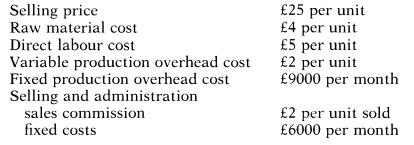
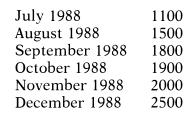
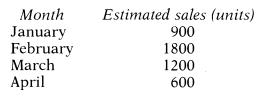
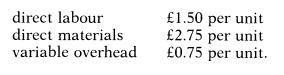
A small company producing a single product estimates that it will seIl the following amounts of its product in the next few months:It wishes to construct a profit budget for the first 3 months of the new year and has made the following estimates:(a) The product will seIl at an ex-factory price of
The Caradoc Company has two divisions. The Argent Division makes three products (Al, A2 and A3) which are transferred to the Belvoir Division. The Belvoir Division uses Argent's products as raw materials which it converts into two different final products (BI and B2). Production and cost
Accounting models are generally static and generate solutions that are assumed to be valid for an indefinite period of time. However, the world faced by the manager is continually changing.How do you think that this restricts the usefulness of accounting models, and how could they be made more
What are the· dangers inherent in using general-purpose accounting data for various different decisions? How might these be overcome?
How would you expect an accounting information system in a manufacturing company to differ from that found in a service industry?
'Financial planning is constrained more by the need to estimate parameters to be used in a model than by the form of the relationships between variables that have to be assumed'. Discuss.
Explain the different reasons why a manager might submit a budget estimate that is biased. What might a senior manager do in order to detect and correct such biased information?
It has been suggested that modern methods of statistical forecasting can almost totally eliminate the problem of budgetary bias. Do you agree?
Outline the contribution that the techniques of work measurement and standard costing can make to budgetary control. To what extent are control budgets suitable for planning purposes ?
'The conditions under which budgetary control is most effective are precisely those under which it is of least value'. Specify the conditions that you think make for effective budgetary control, and evaluate the above statement.
Ten managers, each operating identical factories, submit production budgets that are optimistic, such that each has a 25% chance of attainment. How likely is it that the total production budget for all ten factories will be achieved? Assume the probability distribution of a production budget
What kinds of management accounting information are most suitable for serving each of the three major functions of attention directing, problem solving and performance evaluation?
As Budget Accountant you have been asked to investigate a division of your company where the managers usually fail to attain their budget targets. By contrast, managers in other divisions are normally successful at meeting their budgets. What information would you try to discover and what actions
Give some examples of how a manager might achieve his budget by methods that are harmful to the organization. How would you guard against such practices occurring?
What are the structural causes of non-programmed decisions?Categorize the following as programmed or non-programmed decision takers, making your assumptions clear:(a) the local manager of a franchized fast-food restaurant.(b) the manager in charge of research and development in a large,
What is information asymmetry? What are the problems that it highlights in planning?
The pursuit of sub-goals is a defect of the unitary structure that the multidivisional structure overcomes. Discuss.
'Participation is a double-edged sword.' Clearly, explain and evaluate the significance of this statement will respect to planning in the decentralized, multidivisional structure.
In the context of planning, how consistent are the assumptions of the traditional AIS with the circumstances in which nonprogrammed decisions occur?What alterations, if any, would you recommend to the traditional AIS in a non-programmed situation?
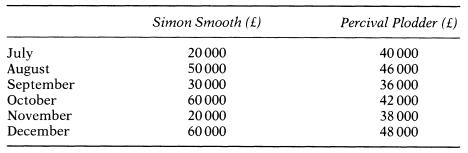
(a) Participation in budget-setting both improves subsequent performance and avoids the problems of biased and manipulated information. Do you agree?(b) Nine independent operating units have the following expections of output and its variability during the coming year:Unit managers each submit
The owner and managing director of Eaglet plc, a large, independent garage, is considering how to improve the company's management information system. The garage engages in 3 main activities: the sale of new cars under franchise, the sale of all makes of used cars and the repair and service of new,
Sennapods plc is contemplating an organizational restructuring.At present, the company is organized functionally, as follows:Sennapods plc has 3 main product ranges, health foods, medications for the National Health Service and agricultural fertilizers. In terms of profitability, each of these
The Grove Hotel has annual fixed costs applicable to rooms of $10 million for its 600-room hotel, average daily room rates of $105, and average variable costs of $25 for each room rented. It operates 365 days per year. The hotel is subject to an income tax rate of 40 percent.1. How many rooms must
Atlantic Jail requires a staff of at least one guard for every four prisoners. The jail will hold 48 prisoners. Atlantic has a beach that attracts numerous tourists and transients in the spring and summer. However, the region is rather sedate in the fall and winter. The fall/winter population of
Explain the decision process you followed in making an important decision in the past which has now taken effect (e.g., the choice of a course of study and the university to attend; the choice of your present job). Then explain the same process in relation to a decision you are currently faced with
Explain how totally utilitarian organizations can behave as if they were pursuing an agreed goal, giving some business examples.
A company is considering changing the price charged for one of its products. What information, both qualitative and quantitative, do you think it requires in order to evaluate whether or not this would be a desirable course of action? Having changed the price, what information does it require to
How does a system go 'out of control'? Analyse three systems with which you are familiar, including at least one social system (i.e., involving several people) and one business system, in terms of the control model developed in this chapter. Explicitly identify the predictive model used for control
'Doing things wrong is a necessary pre-condition for learning'. To what extent is this statement true? Analyse its implications for:(a) the design of a production control system(b) the design of a university course.
Design a set of controls that could be used to evaluate how weIl each of the following people were performing their jobs adequately:(a) a production worker on a car assembly line (b) a double-glazing salesman allocated a particular town as his territory (c) a research and development scientist in a
Design a system to control student learning on a degree course.Explicitly identify:(a) objectives, including possible conflicts(b) measures of performance to be used(c) the predictive model to be used(d) available control actions.Would you like to be controlled by the system you have designed?If
How would you set about discovering what the goals of a specific organization are?
Why is it usually easier for a group of people to agree upon a plan of action than it is for them to agree on objectives? Give some counter-examples, and relate your answer to Earl and Hopwood's (1981) analysis.
Analyse the goals and performance measures used in any group of which you are a member (e.g., a tutorial group; a sports club; or an organization which employs you). How well do the performance measures relate to the group goals, and what problems do any mis-matches engender?
The costs of the Systems Support (SS) department (and other service departments) of Northwest Wood Products have always been charged to the three business divisions (Forest Resources, Lumber Products, and Paper Products) based on the number of employees in each division. This measure is easy to
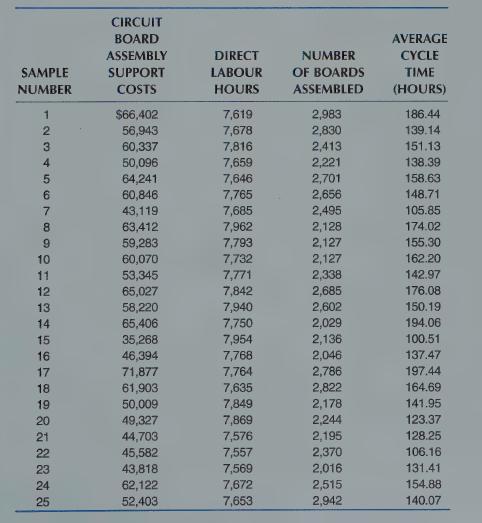
Hassan Gurdezi, the director of cost operations of Micro Devices Company, wishes to develop the most accurate cost function to explain and predict support costs in the company's printed circuit board assembly operation. Mr. Gurdezi has read about activity-based costing and is concerned that the
Read the previous case. If you worked through this case, use your measured cost functions. If you did not work the previous problem, assume the following measured cost functions:Required Y = $9,000/wk + $6 x (direct labour hours); R = 0.10 Y = $20,000/wk + $14 x (number of boards assembled); R =
Super Byte Company manufactures palm-sized portable computers. Because these very small computers compete with larger portable com- puters that have more functions and flexibility, understanding and using cost behaviour is critical to Super Byte's profitability. Super Byte's controller, Kelly
Berengar Ltd. is a small manufacturing company that pro- duces a variety of products using a number of different processes in different- sized job lots. For example, some products will be ordered in lots of ten or less, while others are produced in batches of up to 1,000 units.Berengar will modify
Name four cost objects.
“Amortization is an expense for financial statement purposes.” Do you agree? Explain.
What is the advantage of the contribution approach compared with the absorption approach?
Distinguish between manufacturing and merchandising.
“With variable costing, only direct material and direct labour are inventoried.”Do you agree? Why?
“An increasing number of companies should not be using variable costing in their corporate annual reports.” Do you agree? Explain.
Define and differentiate among the following terms: cost, cost object, cost accu- mulation, cost allocation, direct costs, indirect costs, product costs, and period costs.
Showing 3900 - 4000
of 5025
First
33
34
35
36
37
38
39
40
41
42
43
44
45
46
47
Last
Step by Step Answers

 Get 50% OFF
Claim Now
Get 50% OFF
Claim Now