New Semester
Started
Get
50% OFF
Study Help!
--h --m --s
Claim Now
Question Answers
Textbooks
Find textbooks, questions and answers
Oops, something went wrong!
Change your search query and then try again
S
Books
FREE
Study Help
Expert Questions
Accounting
General Management
Mathematics
Finance
Organizational Behaviour
Law
Physics
Operating System
Management Leadership
Sociology
Programming
Marketing
Database
Computer Network
Economics
Textbooks Solutions
Accounting
Managerial Accounting
Management Leadership
Cost Accounting
Statistics
Business Law
Corporate Finance
Finance
Economics
Auditing
Tutors
Online Tutors
Find a Tutor
Hire a Tutor
Become a Tutor
AI Tutor
AI Study Planner
NEW
Sell Books
Search
Search
Sign In
Register
study help
business
management accounting
Management Accounting Text Problems And Cases 6th Edition M Y Khan, P K Jain - Solutions
In what ways is variance analysis helpful to management?
Certain ratios are very important in connection with budgetary control and standard costing.What are these ratios? State the application of such ratios.
What are the two approaches to disposing off variances? Which will be preferred, when, and why? Take suitable examples to support your viewpoint.
Write short notes on:1. Tolerance limits 2. Significant and non-significant variances 3. Graphic and tabular presentation of variances 4. Disposal of variances.
From the following details, reconcile the budgeted sales with actual sales and standard profit with actual profit in terms of variances: Products Budgeted Actual Quantity Selling price Cost Quantity Selling price Cost (units) (units) Product A 4,000 24 14 4,500 22 15 Product B 6,000 18 12 3,000 20
PH Ltd. furnishes the following information relating to budgeted sales and actual sales for April.Calculate the following variances:(1) Sales quantity variance, (2) Sales mix variance, (3) Sales price variance, and (4) Total sales variance. Budgeted Actual sales A B Product Sales quantity (units)
From the following budgeted and actual figures, calculate and present the variances in respect of profit on sales and cost of sales. Budget: Sales, 2,000 units @ 15 each Cost of sales @ 12 each Profit Actual: Sales, 1,900 units @ 14 each Cost of sales @ 10 each Profit *30,000 24,000 6,000 26,000
From the following data for a particular period, compute sales and profit variances: Budgeted sales: Actual sales: X, 3,000 units @ Y, 2,000 units @ X, 4,000 units @ Y, 2,500 units @ 20 (standard cost 12) 10 (standard cost 6) 18 each 11 each
From the following information, calculate the various sales variances. Product Standard Actual Quantity Price Quantity Price Y |NXX 15,000 9,000 5.00 18,000 5.10 8.00 10,000 7.00 6,000 10.00 5,000 9.50
Fill in the following blanks. In some cases choices are provided.(i) Responsibility accounting focuses on ______________________.(ii) _______________is a sub-unit of an organisation under the control of a manager who is responsible for its activities.(iii) Responsibility centres are:
What is responsibility accounting? Discuss its significance in divisional performance measurement.
Define an expense centre. What is the suitability of the measure of performance in an expense centre?
What kind of performance is measured in profit centres? What are the criteria for evaluating that performance?
What is transfer prices? What are the different types of transfer prices? Under what circumstances is each type of transfer price appropriate and useful?
Define residual profit. Discuss its suitability as a performance measure.
“ROI is the best measure of overall performance.” Do you agree?
Briefly differentiate expense centres, profit centres and investment centres. Identify the basic characteristics of each.
Why is ROI classified as a composite performance measure? Explain its significance.
“Responsibility accounting consists in accumulation and reporting of costs by levels of responsibility within an organisation.” Offer your observations on the above statement.
“In addition to full cost accounting and differential accounting, a third type of accounting information is used in the management control process.” (Anthony and Reece). What is this third type of accounting information called? What are its functions and how is it useful to management?
“What management does, or at least what it attempts to do, is to control the action of the people who are responsible for incurring costs.” Comment.
“An important management function is that of assuring that activities of members of the organisation help to accomplish the organisation’s goals.”
“The management control process involves human beings, from those in the lowest responsibility centres of the organisational hierarchy up to and including each member of top management.” Discuss.
Explain why a decision centre should be treated as a profit centre rather than as a cost centre.
Explain briefly the elements of profits centre performance.
What problems exist with regard to firm-wide common costs when segments are treated and evaluated as profit centres? What are the alternative treatments available?
Why must profit centres be evaluated and/or ranked? What problems arise when undue emphasis is placed on the comparison of segment profit performance?
Explain why an incremental approach is most useful in making decisions that involve possible modifications to the operations of segments of the profit centres.
What are the potential merits of a dual (two-way) transfer pricing system? What are its limitations?
“Transfer prices must always be equal to externally determined market prices of comparative products or services.” Comment fully.
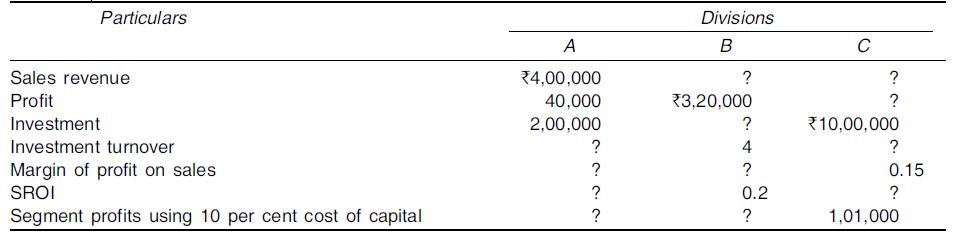
The ABC Ltd. has three divisions, A, B, and C. For the current year, the following data were reported:(a) Complete the table.(b) Rank the divisions in terms of their effective use of resources in capturing the market. Particulars Sales revenue Profit Investment Investment turnover Margin of profit
The home appliances division of Benjamin Industries Ltd. now shows a profit of 5 per cent on sales of ₹12 lakh. An investment of ₹4,00,000 is needed to finance these sales. The management of the firm in considering the following two alternative plans for improving operations submitted by two
Alfa Ltd. has two decentralised divisions, D1 and D2. D1 has always purchased certain units from D2 at `300 per unit. As D2 plans to raise the price to ₹400 per unit, D1 desires to purchase these units from outside suppliers for `300 per unit. The costs of D2 are as follows:If D1 buys from an
Hypothetical Ltd. has two divisions, A and B, which are operated as profit centres. Division A has been selling a part of its production to division B at ₹200 per unit. Annual output of division A is 10,000 units; sales are made as follows:Division B has found that it can negotiate a contract to
Avon Ltd. with two manufacturing divisions is organised on profit centre basis. Division A is the only source for the supply of a component that is used in division B in the manufacture of a product, KLIM. One such part is used in each unit of the product, KLIM. As the demand for the product is not
The installed capacity of XYZ Ltd. is 50,000 units per month. Sales normally permit operations at 80 per cent of this capacity. At normal capacity, indirect manufacturing overheads total ₹3,60,000.During the month of April of the current year, sales demand was above normal and 45,000 units were
Discuss the factors that have contributed to the emergence of balanced scorecard as a framework for performance measurement/reporting.
Define balanced scorecard. What are the three areas it specifically balances?
Describe the three broad elements of the balanced scorecard approach to measure corporate performance.
What are the four key perspectives in balanced scorecard as a measurement system?
Explain briefly the elements of balanced scorecard as a strategic management system.
Describe the features of a good balanced scorecard.
What are the pitfalls to avoid when implementing a balanced scorecard?
(a) Indicate whether the following statements are true or false.(i) Two mutually exclusive projects (A and B) have been evaluated. Project A has an NPV of ₹8 lakh and an IRR of 16 per cent; Project B has NPV of ₹7 lakh but has IRR or 18 per cent. Since Project B has higher IRR, it should be
Why is it important to evaluate capital budgeting projects on the basis of after-tax cash incremental flows? Why not use accounting data instead of cash flow?
What are the components of net cash outlay in the capital budgeting decision? At what time is such an outlay incurred in the case of conventional cash flows?
How should working capital and sunk costs be treated in analysing investment opportunities?Explain with suitable examples.
Explain clearly the concept of block of assets vis-a-vis depreciation in the context of replacement situations of capital budgeting.
Suppose a firm is considering replacing an old machine with a new one. The firm does not anticipate that any new revenues will be created by the replacement since demand for the product generation by both the machines is the same. However, in the CFAT work sheet used in evaluating the proposal, the
It is said that only cash costs are relevant for capital budgeting decision. However, depreciation which is a non-cash cost is a prominent part of cash flow analysis for such an investment decision.How do you explain this paradox?
What is pay back period? Also, discuss the utility of the pay back period in determining the internal rate of return.
What are the critical factors to be observed while making replacement investment decision?
What does the profitability index signify? What is the criterion for judging the worth of investments in the capital budgeting technique based on the profitability index?
Do the profitability index and the NPV criterion of evaluating investment proposals lead to the same acceptance-rejection and ranking decisions?
A large-sized chemical company is considering investing in a project that costs `5,00,000.The estimated salvage value is zero; tax rate is 35 per cent. The company uses straight line method of depreciation for tax purposes and the proposed project has cash flows before tax (CFBT) as
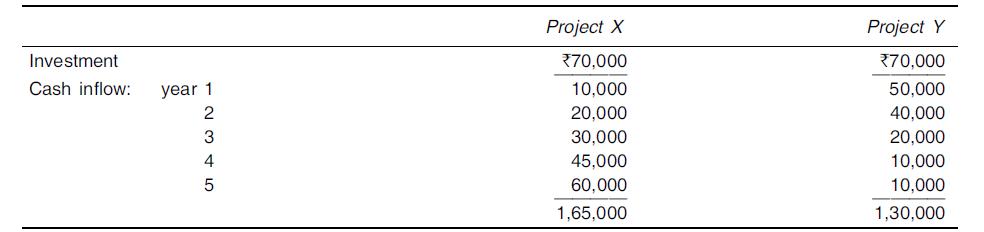
XYZ Ltd., whose cost of capital is 10 per cent, is considering two mutually exclusive projects, X and Y, the details of which are:Compute the NPV, profitability index and IRR for the two projects. Investment Cash inflow: year 1 12345 Project X 70,000 Project Y *70,000 10,000 50,000 20,000 40,000
A company wants to purchase a plant for its expanding operations. The desired plant is available at ₹3,00,000 in cash or ₹4,50,000 to be paid in 5 equal annual instalments due at the end of each year. Assuming the required rate of return of 15 per cent, which option should the company
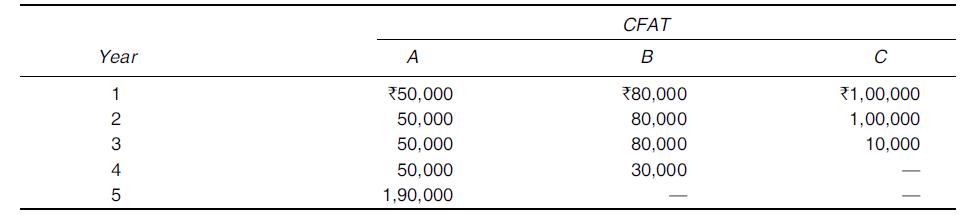
One of three projects of a company is doing poorly and is being considered for replacement.The projects are expected to require ₹2,00,000 each, have an estimated life of 5 years, 4 years, and 3 years respectively, and have no salvage value. The required rate of return is 10 percent. The
A company is planning to purchase a machine to meet the increased demand for its products in the market. The machine costs ₹50,000 and has no salvage value. The expected life of the machine is 5 years, and the company employs straight-line method of depreciation for tax purposes. The estimated
A textile company is considering two mutually exclusive investment proposals for its expansion programme. Proposal A requires an initial investment of ₹7,50,000 and yearly operating costs of₹50,000. Proposal B requires an initial investment of ₹5,00,000 and yearly operating costs of
Royal Industries Ltd. is considering the replacement of one of its moulding machines. The existing machine is in good operating condition but is smaller than required if the firm is to expand its operations. The machine is 5 years old, has a current salvage value of `30,000 and a remaining
During a week a worker produced 300 units, working for 48 hours. The hourly rate is ₹40. The estimated time to produce a unit is 10 minutes. Under incentive scheme, 20 per cent additional time is allowed. Calculate his gross earnings under Halsey and Rowan Plans.
A workman’s wages for a guaranteed 44 hours week is ₹75 per hour. The estimated time to produce one article is 30 minutes and under an incentive plan, the time allowed is increased by 20 per cent.During a week, a worker produced 100 articles. Calculate the wages under: (a) Time rate, (b) Rowan
An employee working under a bonus scheme saves 10 hours in a job for which the standard time is 60 hours. Calculate the rate per hour worked and wages payable to him if incentive bonus of 10 per cen on the hourly rate is payable when standard time (namely, 100 per cent efficiency) is achieved, and
A job can be executed either through workman A or B. A takes 32 hours to complete the job while B finishes it in 30 hours. The standard time to finish the job is 40 hours.The hourly wage rate is same for both the workers. In addition, workman A is entitled to receive bonus according to Halsey Plan
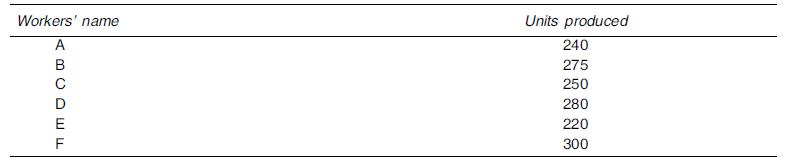
Supreme Industries Ltd recently adopted an incentive plan. Factory workers are paid at ₹3.75 per unit with a guaranteed minimum wages of ₹1,000 per week. Following is a report on employees’productivity for the week ending March, current year. All employees had worked the full 40-hour
In an engineering concern, the employees are paid incentive bonus in addition to their normal wages at hourly rates. Incentive bonus is calculated in proportion of time taken to time allowed, of the time saved. The following details are made available in respect of employees X, Y and Z for a
The time allowed for a job is 8 hours. The hourly rate is ₹8. Prepare a statement showing:(i) The bonus earned, (ii) The total earnings of labour, and (iii) Hourly earnings under the Halsey System with 50 per cent bonus for time saved, and Rowan System for each hour saved respectively.
The cost accountant of Y Ltd has computed labour turnover rates for the quarter ended March 31, current year as 10 per cent, 5 per cent, and 3 per cent respectively under Flux Method. Replacement Method and Separation Method. If the number of workers replaced during that quarter is 30, find out the
The Managing Director of AII Found Limited is very much perturbed to see that labour turnover is increasing every year. Before taking an appropriate action, he desires to know the profit forgone on account of labour turnover. You are required to calculate the profit forgone on account of labour
(a) Indicate whether the following statements are true or false.(i) Piece work system of wage payment is good for quality-conscious organizations producing aesthetic products or decorative items.(ii) Taylor piece rate system has differential piece rates.(iii) Merrick differential piece rate system
What are the costs included in total labour cost besides gross wages?
Explain timekeeping and book keeping and state the detailed records normally maintained under them.
What is idle time? How is it treated in costing of labour?
What is overtime premium? Discuss its treatment in cost accounting and suggest a procedure for its control.
What is labour turnover? How is it measured? What are its costs? How can they be reduced?
What are incentive plans? Describe the main types of incentives plans.
Explain and illustrate the differential price rate schemes type of incentive/bonus plans.
Write notes on the different types of premium bonus plans. Illustrate your answer with examples.
A skilled worker is allowed to take 9 hours to complete a job on daily wages and 6 hours on a scheme of payment by results. His daily rate is ₹75 per hour. The material cost is ₹400 and the overheads are recovered at 150 per cent of the total direct wages. Calculate the factory cost of the
Mr. A is working by employing 10 skilled workers. He is considering the introduction of some incentive scheme — either Halsey Scheme (with 50 per cent bonus) or Rowan Scheme — of wage payment for increasing the labour productivity to cope with the increased demand for the product. He feels that
From the following data provided to you, find out the labour turnover rate by applying(a) Flux method, (b) Replacement method, and (c) Separation method.Number of workers on the payroll: At the beginning of the month, 500; At the end of the month, 600.During the month, 5 workers left, 20 persons
Your organisation is experiencing a high labour turnover in recent years and management would like you to submit a report on the loss suffered by the Company due to such labour turnover.Following figures are available for your consideration:The direct man-hours include 9,000 man-hours spent on
(a) Indicate whether the following statements are ‘True’ or ‘False’.(i) Factory overheads are direct manufacturing costs.(ii) Indirect labour and indirect materials form part of factory overheads.(iii) Factory overheads are common costs and are shared among various cost centres.(iv)
What do you understand by fixed overheads? Why are they called ‘burdens’?
What two key factors determine the factory overhead application rate for a period? Why are these factors important?
What do you understand by the terms production department and service department? Explain the rationale for allocating the service department costs to production departments. Using your own figures, illustrate how the expenses are absorbed over the production department? Consider at least three
(a) Distinguish between cost allocation, cost apportionment and cost absorption, (b) Explain in brief various methods for apportionment of service department’s cost over production departments.
Describe how costs are allocated under the direct method, the step method, and the algebraic method.
What are the five bases commonly used to compute the factory overhead absorption rate and when is each one appropriate to use?
What is meant by absorbed overhead? Under what circumstances will a difference arise between absorbed and actual overheads? How would you dispose of the balance?
What is meant by under/overabsorption of factory overheads? How will you account for them in cost accounts? Does it bear any impact while submitting quotations?
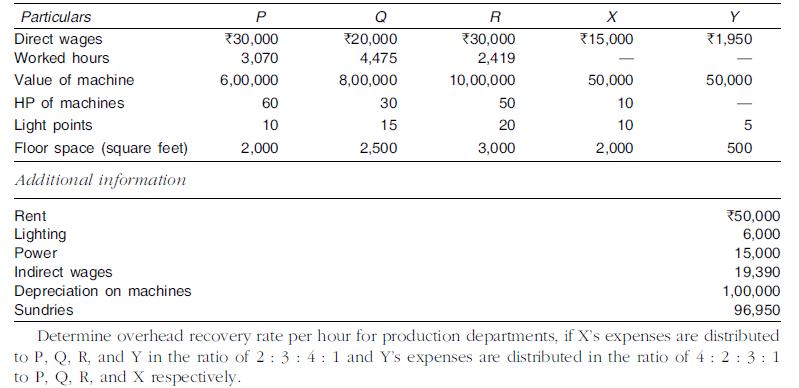
XYZ Ltd. has three production departments (P, Q, and R) and two service departments (X and Y). The following data relate to these departments: Particulars Direct wages Worked hours Value of machine HP of machines Light points Floor space (square feet) Additional information Rent Lighting Power
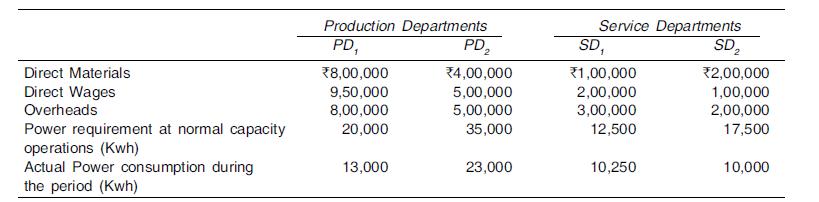
A company has two production departments and two service departments. The data relating to a period are as under:The power requirement of these departments are met by a power generation plant. The said plant incurred an expenditure, which is not included above, of ₹12,18,750 out of which a sum of
A manufacturing unit has added a new machine to its fleet of five existing machines. The total cost of purchase and installation of the machine is ₹7,50,000. The machine has an estimated life of 5 years and is expected to realise ₹30,000 as scrap at the end of its working-life.Other relevant
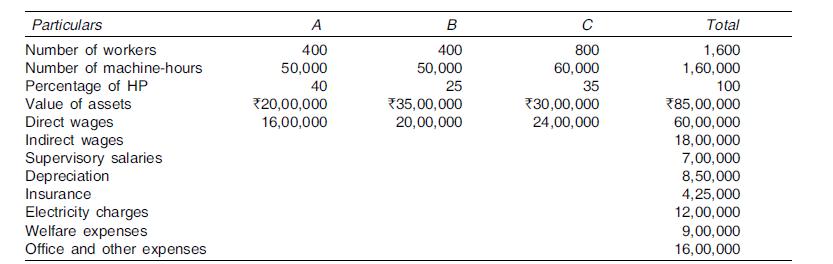
The following data pertains to the machine shop of an engineering company, relating to the current year. The machine shop has 3 cost centres A, B, and C, each having 3 distinct set of machines.Work out a composite machine-hour rate for each of the cost centres, showing the basis of apportionment of
From the following particulars calculate labour cost per hour:(a) Basic salary, ₹200 per working day(b) Dearness allowance per month, ₹5 per/ every point over 100 cost of living index (current cost of living index is 700 points)(c) Leave salary, 10 per cent of [ (a) + (b)](d) Employer’s
In the following multiple choice questions, select the correct answers.(i) A company undertakes job-works. Which one of the following is likely to be a variable cost?(a) the wages of workers paid on monthly basis, (b) the salary of the factory manager,(c) the wages of shop floor workers paid by
Fill in the following blanks.(i) The volume range over which cost relationships are valid is termed as .(ii) Future costs that differ under proposed alternatives are .(iii) Costs that are important to decision-makers, but are not recorded in financial accounting records are .(iv) Costs which
(a) Are all fixed costs sunk costs? Explain.(b) What are opportunity costs? Are opportunity costs relevant in decision-making? Give examples in support of your answer.
Showing 4300 - 4400
of 5025
First
37
38
39
40
41
42
43
44
45
46
47
48
49
50
51
Step by Step Answers

 Get 50% OFF
Claim Now
Get 50% OFF
Claim Now