New Semester
Started
Get
50% OFF
Study Help!
--h --m --s
Claim Now
Question Answers
Textbooks
Find textbooks, questions and answers
Oops, something went wrong!
Change your search query and then try again
S
Books
FREE
Study Help
Expert Questions
Accounting
General Management
Mathematics
Finance
Organizational Behaviour
Law
Physics
Operating System
Management Leadership
Sociology
Programming
Marketing
Database
Computer Network
Economics
Textbooks Solutions
Accounting
Managerial Accounting
Management Leadership
Cost Accounting
Statistics
Business Law
Corporate Finance
Finance
Economics
Auditing
Tutors
Online Tutors
Find a Tutor
Hire a Tutor
Become a Tutor
AI Tutor
AI Study Planner
NEW
Sell Books
Search
Search
Sign In
Register
study help
engineering
introduction to chemical engineering fluid mechanics
Introduction To Chemical Engineering Fluid Mechanics 1st Edition William M. Deen - Solutions
Show that for an incompressible Newtonian or generalized Newtonian fluid, the normal viscous stress vanishes at a solid surface. You may assume that the surface is stationary and that the no-slip condition holds. It is sufficient to consider planar, cylindrical, and spherical surfaces.
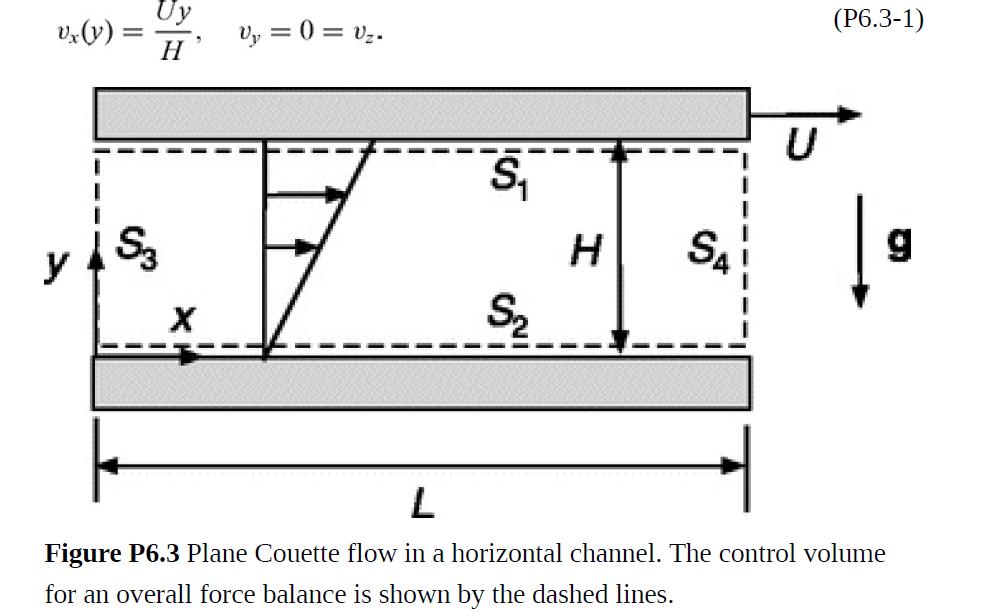
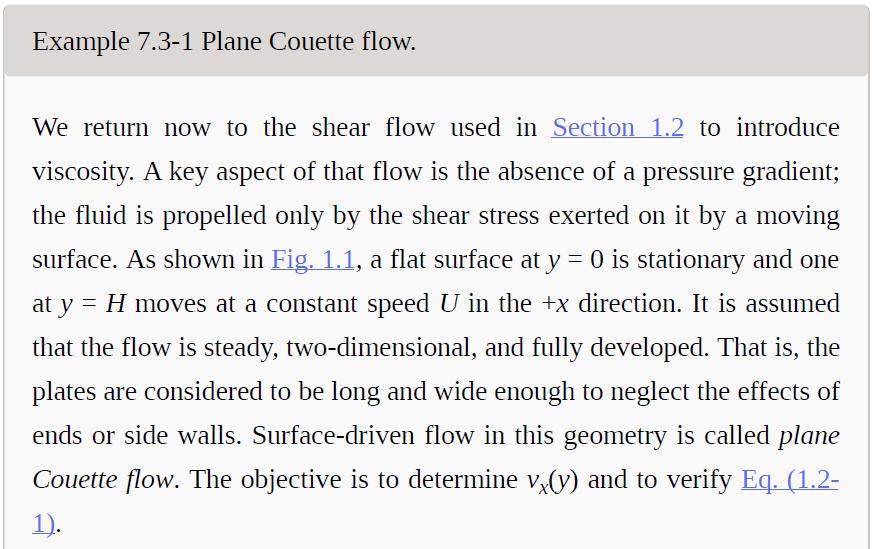
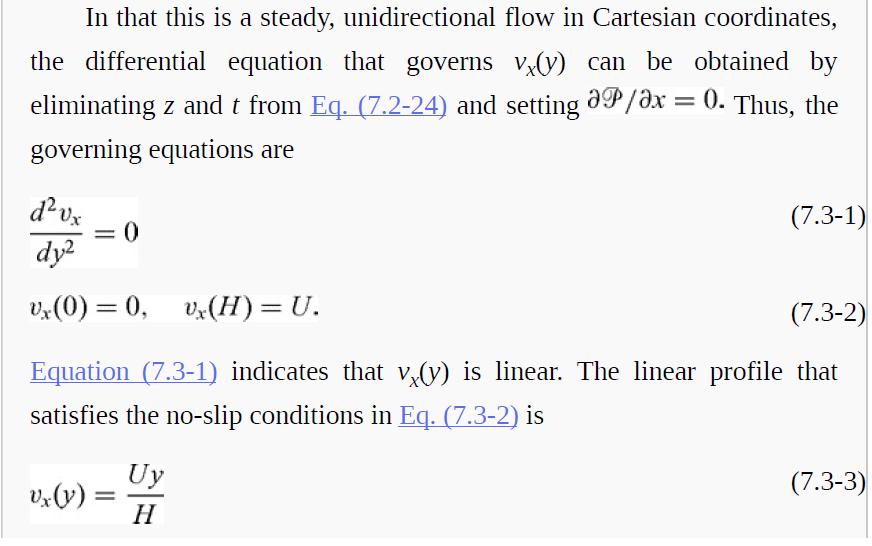
Figure P6.3 depicts flow in a horizontal parallel-plate channel in which vx = U at the upper wall, the lower wall is fixed, and P is independent of x. This is plane Couette flow, as introduced. The wall spacing is H, the length under consideration is L, and the width (not shown) is W. Assuming that
Suppose that at point P in a fluid the Cartesian stress tensor is(a) Evaluate the stress vector s at point P for a test surface that is perpendicular to the x axis. Find the stress exerted by the fluid on the +x side.(b) Repeat part (a) for a test surface perpendicular to the y axis, finding the
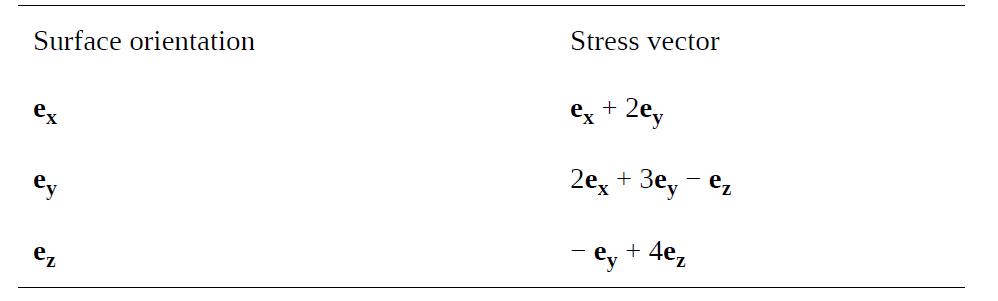
Suppose that the stress at point P in a fluid is determined by placing a small transducer there and measuring the force per unit area for different transducer orientations. The following time-independent results are obtained:(a) Determine the Cartesian components of the stress tensor, σij.(b)
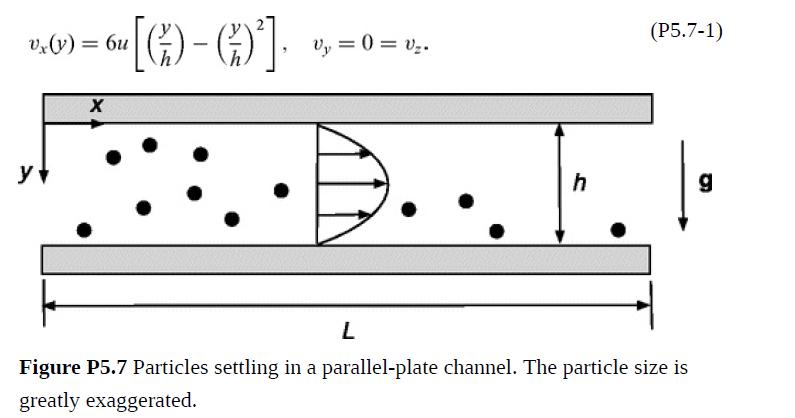
Suppose there is steady, laminar flow of a suspension of spherical particles through a parallel-plate channel, as in Fig. P5.7. The plate spacing is h, the channel length is L, the mean fluid velocity along the channel is u, and each particle has a constant downward velocity U. As can be shown
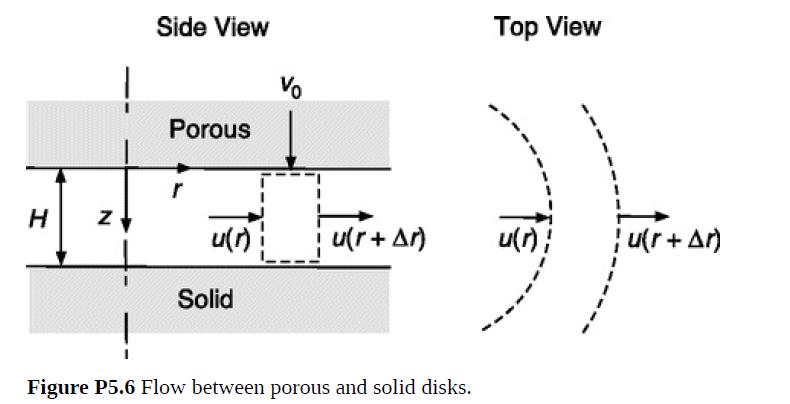
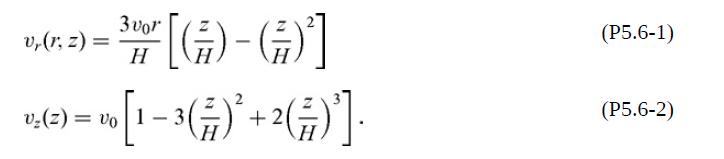
Suppose that two disks of indefinitely large radius are separated by a distance H, as in Fig. P5.6. One is porous and the other solid. Fluid is injected from the porous disk into the intervening space at a constant velocity v0, such that Re = v0H/ν ≪ 1. The radial velocity averaged over the
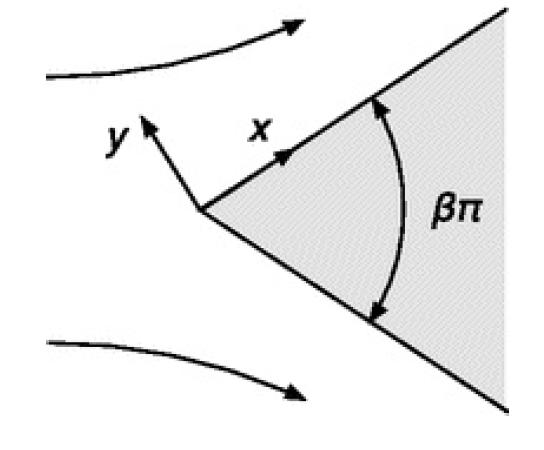
Consider two-dimensional flow near a solid wedge with angle βπ, as in Fig. P5.5. The flow along the top of this indefinitely long object can be described using the (x, y) coordinates shown. If the fluid has negligible viscosity, then for x ≥ 0 it is found thatwhere C is a constant and m = β/(2
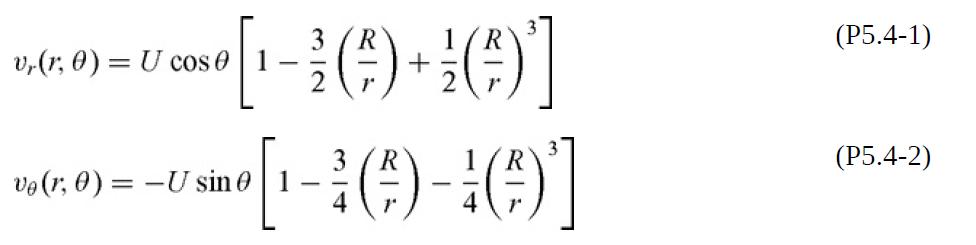
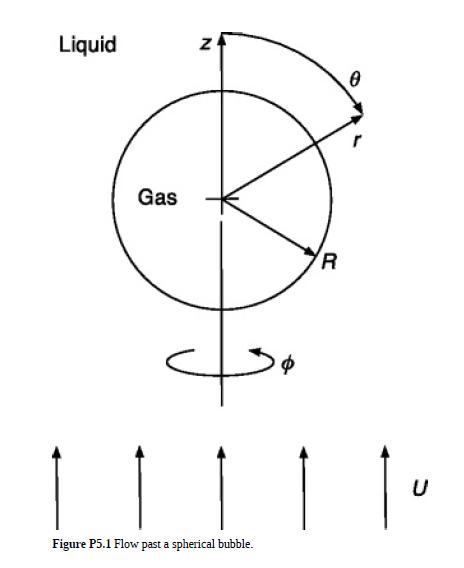
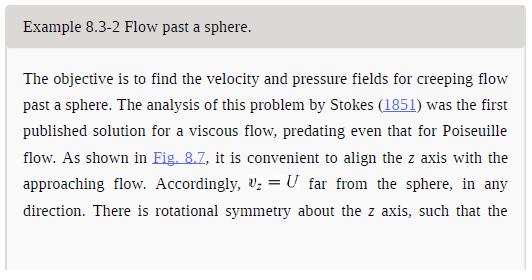
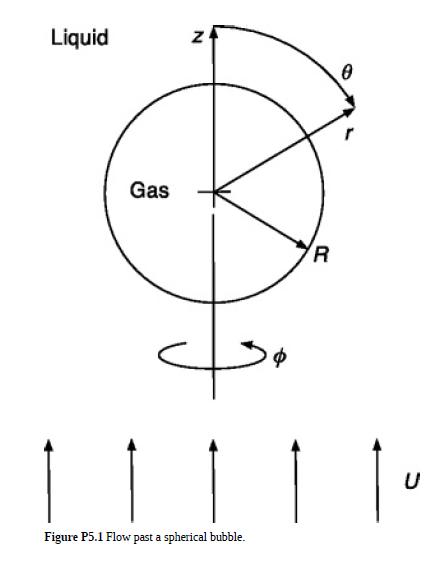
For flow past a solid sphere with coordinates as in Fig. P5.1 and with UR/ν → 0,as shown in Example 8.3-2. Show that this is not an irrotational flow. Where is the vorticity largest and where is it smallest? 3 R R U cos [1² () +¹()] [¹-0)-40)] R v,(r, 0) = U cos 1 ve (r; 0) U sin
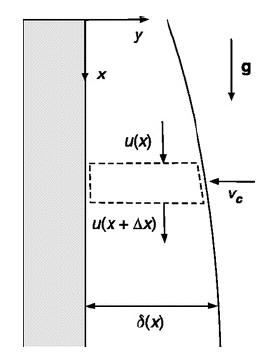
Suppose that a vapor condenses at a constant rate on a cold vertical wall, as shown in Fig. P5.3. As the liquid runs down the wall, the film thickness δ(x) and mean velocity u(x) both increase. Assume that the condensation begins at x = 0, such that u(0) = 0 = δ(0). The increase in volume flow
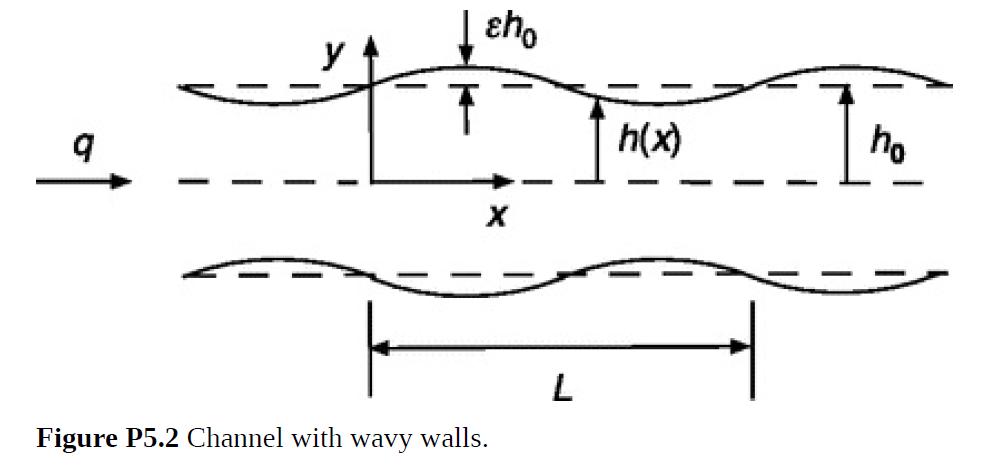
Consider steady flow in the two-dimensional channel in Fig. P5.2, in which the half-height varies asAssume that q = Q⁄W is known, where Q is the volume flow rate and W is the channel width.(a) Relate u(x), the mean velocity in the x direction, to q and h(x).(b) If the height variations are
Consider steady flow at velocity U relative to a spherical bubble of radius R, as in Fig. P5.1. The flow is axisymmetric (independent of ϕ and with vϕ = 0) and UR/ν → 0 in both fluids. The Hadamard–Rybczyński analysis predicts thatinside the bubble. Determine vr(r, θ) inside (0 ≤ r ≤
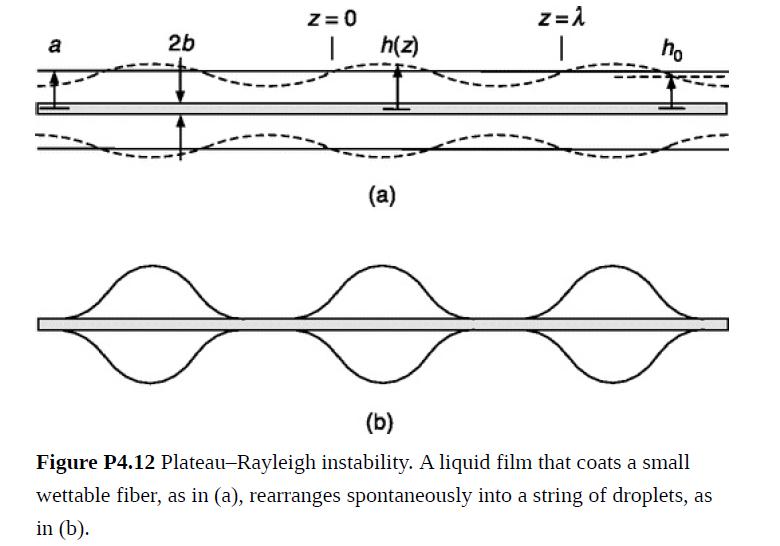
Surface tension stabilizes planar gas–liquid interfaces by smoothing ripples. It may be surprising, then, that at cylindrical interfaces it causes the liquid to break up. This is called the Plateau–Rayleigh instability. In Fig. P4.12(a) a wettable fiber of radius b is coated with a liquid film
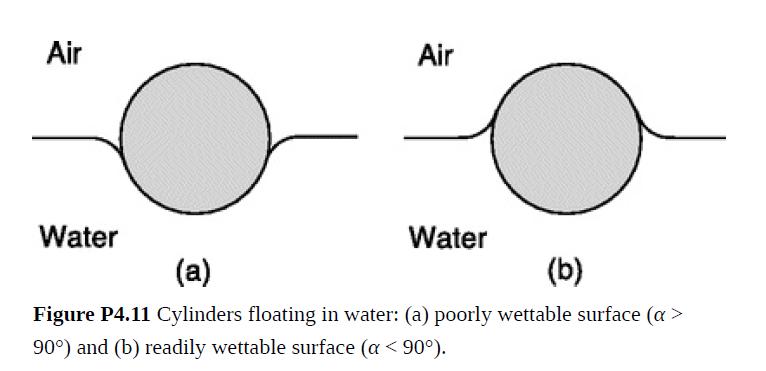
An object far denser than water can float if it is small enough and has the right surface properties. A result of surface tension, this is called capillary flotation. In what follows, suppose that each object is a cylinder of diameter D and length L, where L ≫ D.(a) In which of the two situations
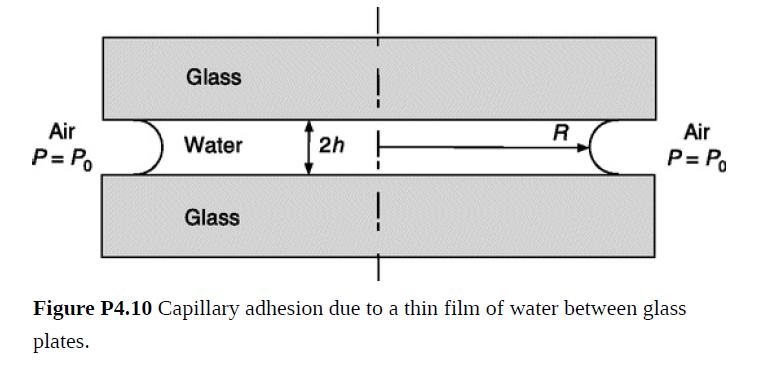
Suppose that a drop of water is placed between two glass plates, which are then pressed together to create a film of thickness 2h and radius R, as shown in Fig. P4.10. You may assume that the contact angle for water on the glass is nearly zero.(a) Derive a general expression for P within the water
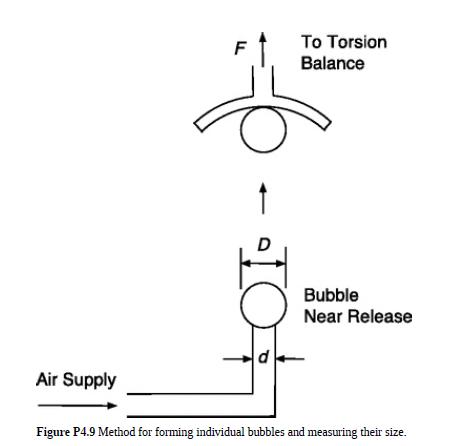
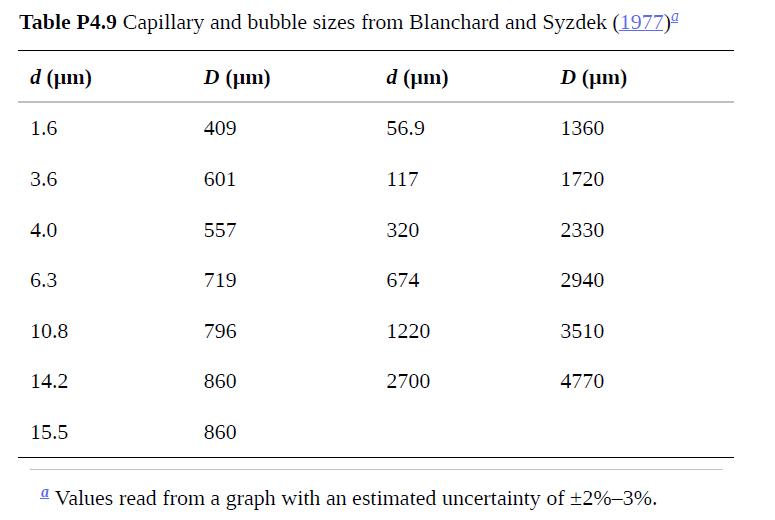
Blanchard and Syzdek (1977) formed individual air bubbles in water under nearstatic conditions using a method shown in Fig. P4.9. Air was pushed through an immersed glass capillary to form a slowly growing bubble at its tip. After reaching a critical size and being released, the bubble rose until
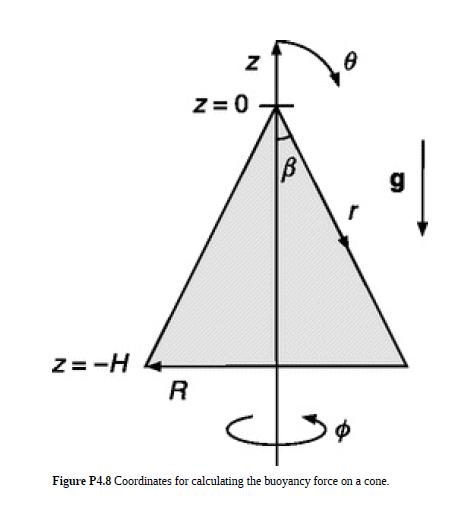
Verify Archimedes’ law for an upright cone of radius R and height H by direct calculation using Eq. (4.3-1). It is convenient to use a combination of Cartesian and spherical coordinates, as shown in Fig. P4.8, and to set P = 0 at z = 0. Note that the side of the cone corresponds to θ = π −
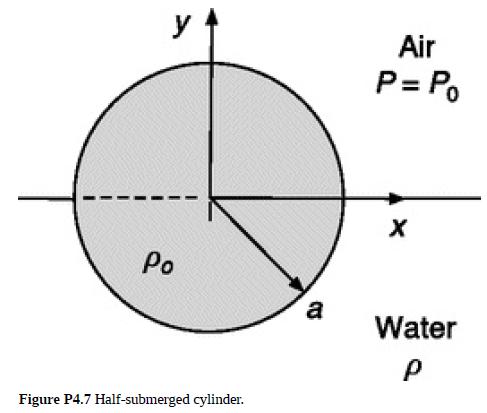
Suppose that a long cylinder of radius a is exactly half submerged in water, as shown in Fig. P4.7. The cylinder density is ρo, the water density is ρ, and the air density is negligible.(a) Verify Archimedes’ law for this case by directly calculating FPy using Eq. (4.3-1).(b) If the
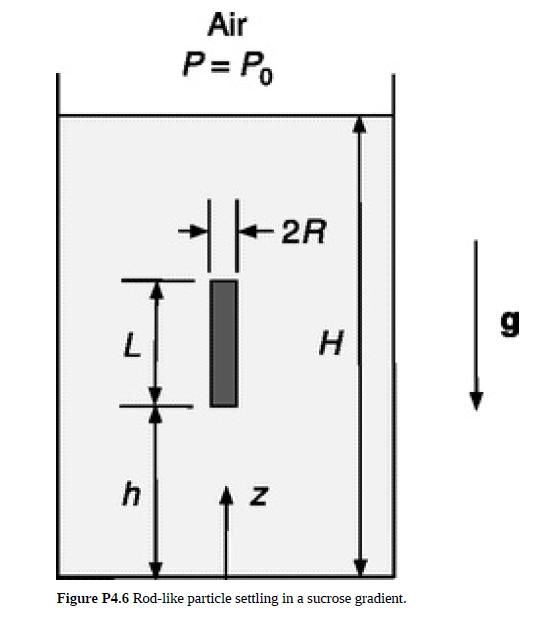
Centrifugation in liquids with spatially varying densities is used to purify cell components and viruses. This problem concerns simple gravitational settling in such a system. One way to vary the liquid density is with a gradient in sucrose concentration. Suppose that a rod-like virus or other
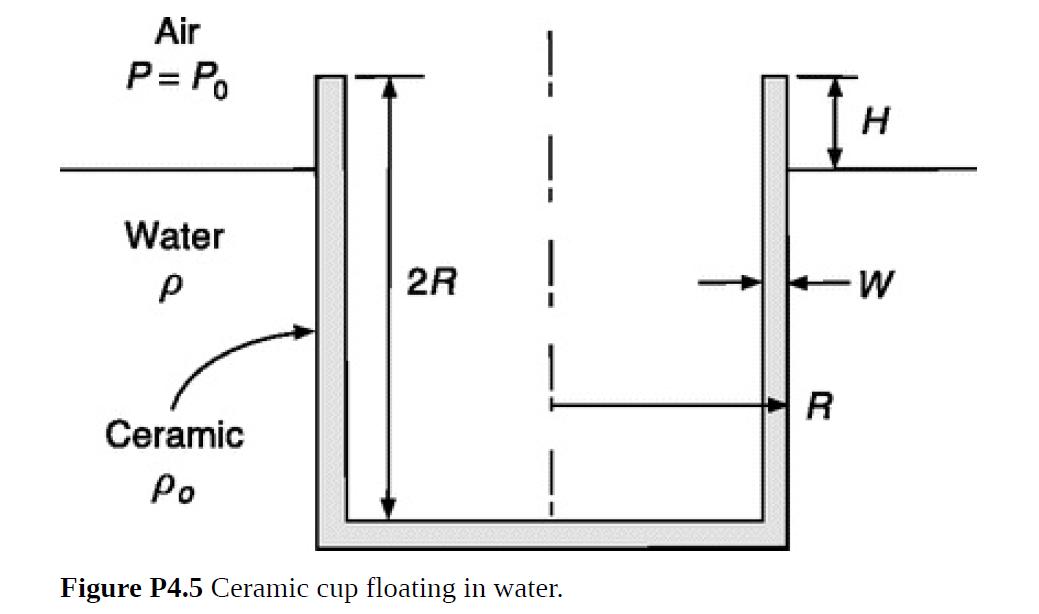
Suppose that a ceramic cup floats in water as in Fig. P4.5. The height of the cylindrical cup equals its diameter (2R) and its walls are thin (W ≪ R). Its rim rests at a height H above the water surface. The dimensions are large enough that surface tension is negligible.(a) Show how to calculate
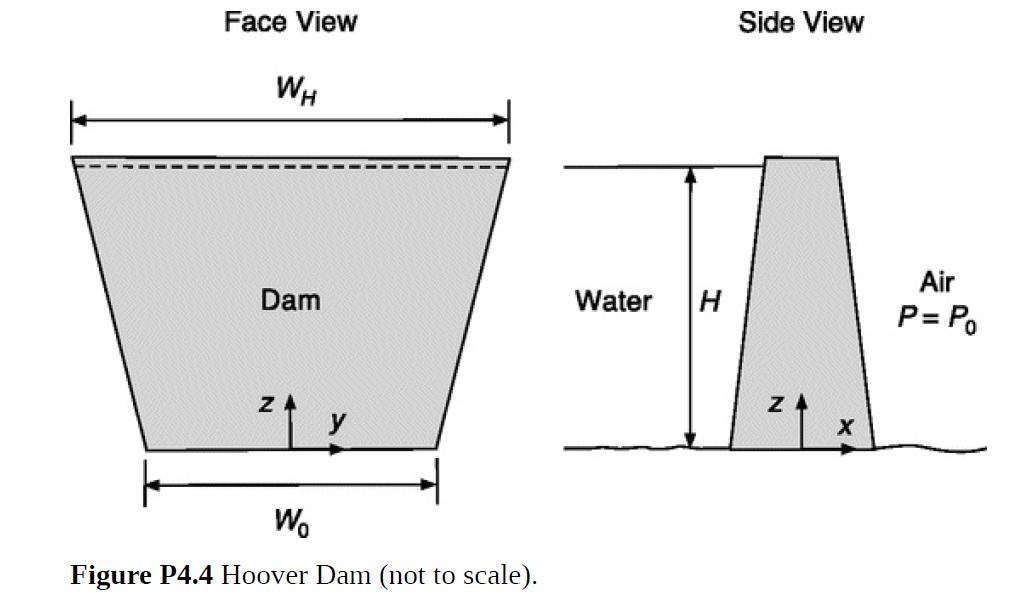
When viewed from downstream, Hoover Dam in the US is roughly trapezoidal (see www.usbr.gov/dataweb/dams/nv10122.htm), as in Fig. P4.4. The width at the top is WH = 1244 ft; the width at the bottom is about 2⁄3 of that, or W0 = 830 ft; and the height of the reservoir, assumed here to reach almost
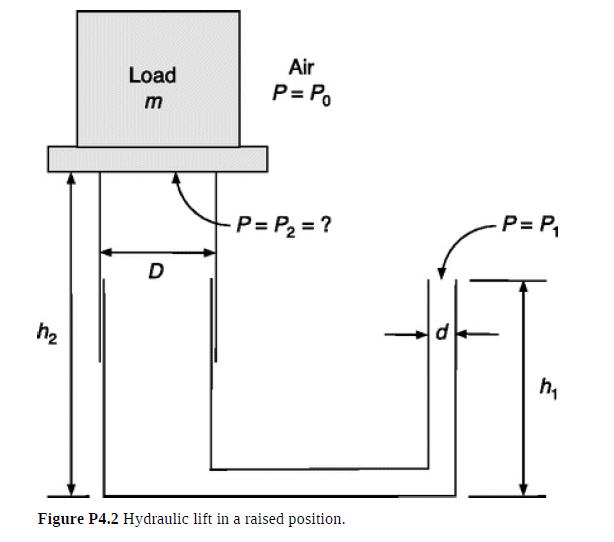
In a hydraulic lift an extendable chamber of diameter D is connected to a pipe of diameter d ≪ D, as shown in Fig. P4.2. Both are filled with an oil of density ρ. During lifting a pump delivers additional oil until the platform reaches its final height h2. The pump is then shut off and a
In force calculations it is usually assumed that the pressure in still air is constant.The objective is to examine the limitations of that assumption.(a) Derive an expression for P(z) in static air, with the z axis pointing upward and P(0) = P0. Use the ideal-gas law to find ρ(z), assuming that
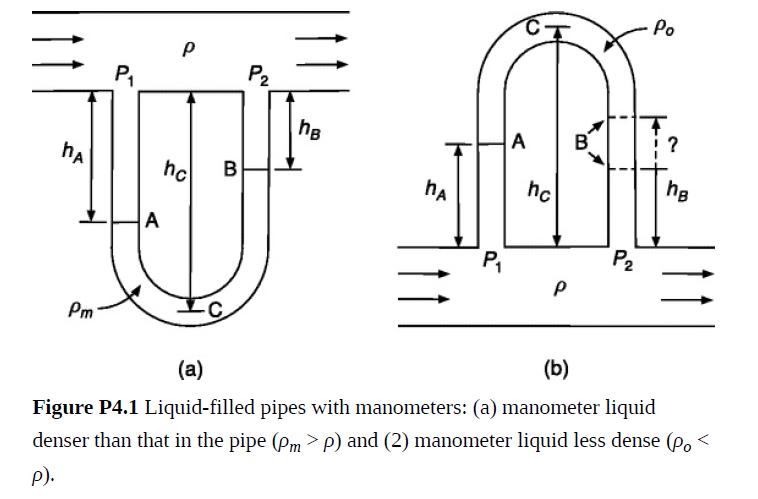
One way to monitor the flow rate in a pipe is to use a manometer to measure the pressure drop P1 – P2 between taps spaced a known distance apart. Two arrangements for liquid pipe flow are shown in Fig. P4.1. The U-tube is placed below the pipe if the manometer fluid is relatively dense and above
Show that, when Rep > 1000 and CD is governed by Eq. (3.2-5), the range of feasible velocities for fluidizing spheres of diameter d and density ρo isGiven that εf ≅ 0.41 under these conditions (Kunii and Levenspiel, 1977, p. 73), vf/vm = 0.11. That is, there is approximately a 10-fold range of
Suppose that a reactor used to pretreat a hot gas is a cylinder of diameter D = 20 cm and length L = 2 m that is filled with spherical catalyst particles of diameter d = 5 mm. The void fraction is ε = 0.35, the gas properties are ρ = 0.705 kg/m3 and μ = 2.71 × 10⁻⁵ Pa · s, and the
Suppose that it is desired to measure the Darcy permeability k of certain gels that consist of crosslinked polymers with water-filled interstices. These hydrogels are routinely fabricated as disks of diameter D = 5 mm, thickness h = 0.5 mm, and density ρo = 1030 kg/m3. Someone suggests that k be
Particles may aggregate in water as a result of their hydrophobicity or Van der Waals attractions. Such aggregates are called flocs and the process is termed flocculation. (Aerosols also can flocculate.) The objective is to explore how this affects gravitational settling. Suppose that an individual
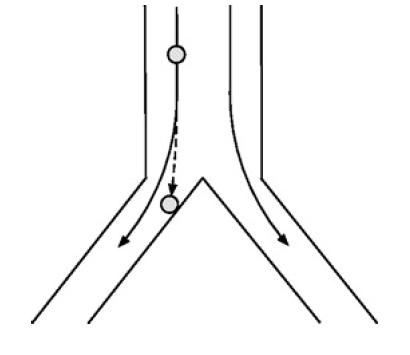
Two mechanisms for the deposition of inhaled particles in the airways are gravitational settling, discussed in Section 3.3, and inertial impaction, depicted in Fig. P3.7. If fluid paths suddenly curve, as when an airway bifurcates, relatively large particles tend to continue along straight lines
The objective is to predict how long it takes a small fluid sphere, initially at rest, to reach its terminal velocity. To derive the most general results for Re < 1, assume that the Hadamard–Rybczyński drag coefficient [Eq. (3.3-13)] is applicable. Results for solid spheres (or fluid spheres
Milk is an emulsion in which fat globules are dispersed within an aqueous solution that contains lactose, proteins, and minerals. Because the density of the fat is about 80 kg/m3 less than that of water, it tends to rise to the top and create a layer of cream. The mechanical breakup of the fat
World-class downhill ski racers reach speeds up to 150 km/h. The objective of this problem is to estimate the forces on a skier at that speed. For simplicity, the skier will be modeled as two cylinders (legs) attached to a sphere (the rest of the body, including the trunk, arms, and head). Some
Particles of plant pollen are often nearly spherical, with diameters ranging from about 10 to 100 μm and densities of about 1000 kg/m3. Suppose that a sudden gust of wind dislodges such particles and lifts them to a height of 5 m, followed by a steady breeze at 4 m/s.(a) Calculate the terminal
Racing shells are very narrow, causing the water drag to be predominantly frictional. A typical eight-rower (plus coxswain) shell has a length at the waterline of 16.9 m and a wetted area of 9.41 m2. A competitive speed for a men's eight in international competition is 6 m/s. You are asked to
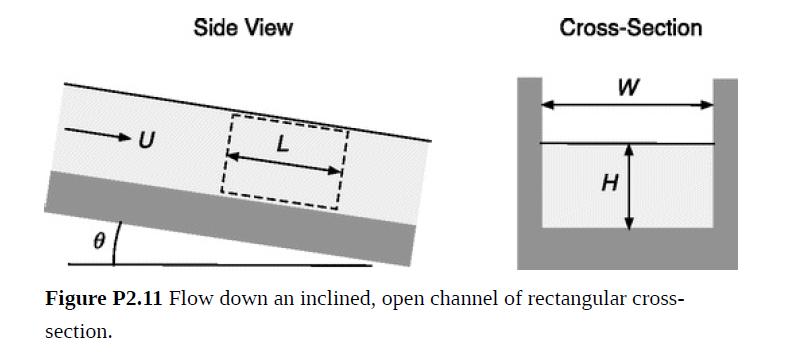
Consider steady water flow in the open, rectangular channel in Fig. P2.11, which might be part of an irrigation or drainage system. The flow is due to gravity. The channel has a width W, is filled to a level H, and its sides and bottom each have a roughness height k. It is inclined at an angle θ
To predict the ability of a chain-link fence to withstand high winds, an estimate is needed for the horizontal force that might be exerted on it. The 1.8 m-high fence is to be supported by steel posts 6.0 cm in diameter that are placed every 3.0 m. Between the posts will be steel wire 3.2 mm in
Figure P2.10 shows a blood vessel of radius R1 branching into “daughter” vessels of radii R2 and R3. The respective flow rates are Q1, Q2, and Q3. Anatomical studies of the mammalian circulation indicate that the radii in such a bifurcation tend to be related asindependently of the vessel
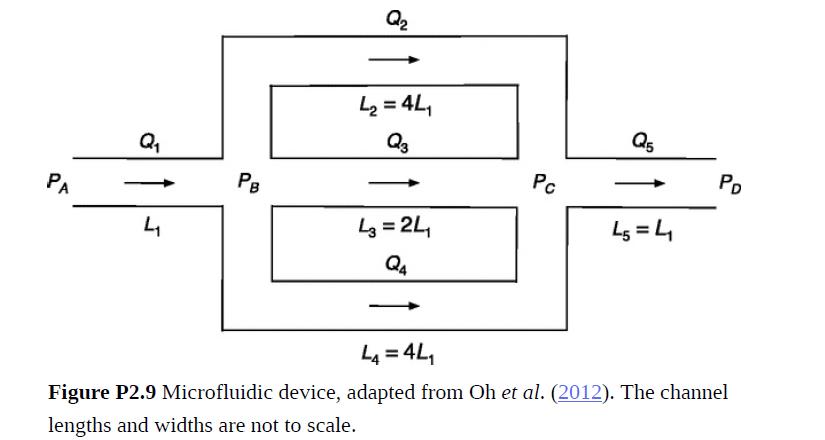
Figure P2.9 shows the layout of a microfluidic device with both series and parallel channels. The first segment has a length L1 = 1 mm and the relative lengths of the others are as indicated. Suppose that each channel has a square cross-section with side length 100 μm and that all flow is
At numerous places in chemical plants there is a need for a pipe of length L to carry a given fluid at a specified flow rate Q. An appropriate pipe diameter D must be chosen by the designer. Larger-diameter pipes are more expensive to buy and install but cheaper to operate. More precisely, the
As mentioned in Section 2.2 and reviewed in Virk (1975), polymeric additives can greatly reduce the resistance in turbulent pipe flow. That is manifested by a decrease in f at a given Re. At the small concentrations used (typically tens to hundreds of ppm by weight), μ is very close to that of the
Hydraulic fracturing, or “fracking,” is widely used to stimulate production from oil or gas deposits. A deep well is lined with steel pipe. A large volume of water is pumped into the well at a pressure sufficient to fracture the rock formation at the bottom. A slurry containing “proppants”
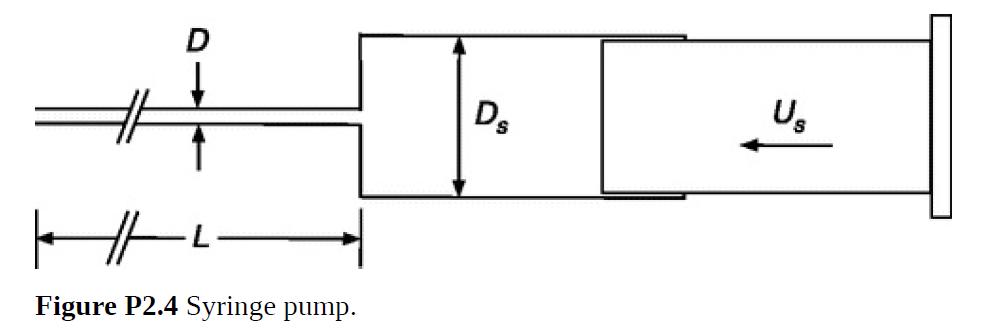
Suppose that a laboratory experiment requires that an aqueous solution be delivered to an open container at a constant flow rate of 100 μl/min for 30 min. A syringe pump is available, which has a motor and gear drive that will advance the plunger of any syringe at a set speed. As shown in Fig.
Suppose that the hot combustion products from a large furnace pass through horizontal steel pipes arranged in parallel, each 6.4 cm in diameter and 6.1 m in length. At the inlet temperature of 600 K, μ = 2.6 × 10⁻⁵ Pa · s and ρ = 0.63 kg/m3. The pressure drop is 63 Pa.If the temperature
A particular steam boiler must be filled with 7.57 m3 (2000 US gallons) of water before being used. It is connected to the water supply by copper tubing 15 m long that has a diameter of 2.60 cm. The fill point (tube outlet) is 3 m above the inlet and the supply pressure is such that | ΔP| = 4.0 ×
A food manufacturer is planning to bottle honey using gravity-driven flow from a tank. Fitting the equipment into the available space will require a pipe length of 4 m, with the inlet 2 m above the outlet. When the tank level is low, the pressure at the inlet will be close to atmospheric. The honey
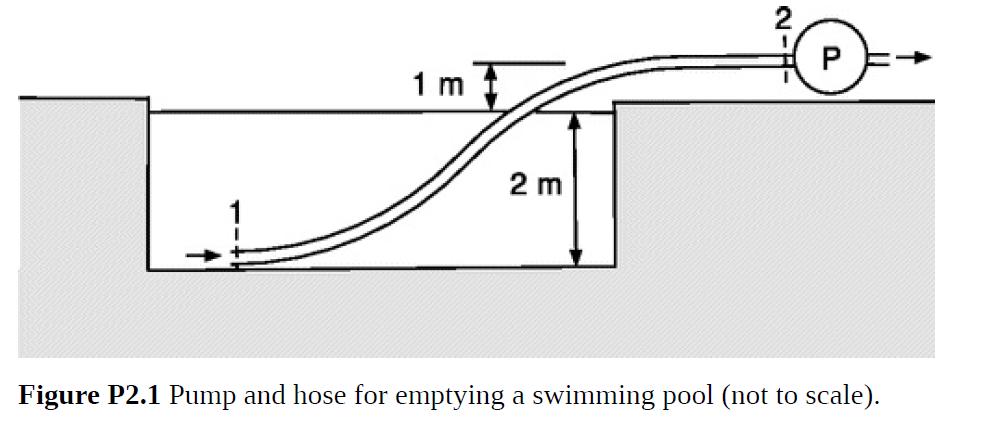
Bubbles tend to form wherever the pressure in a liquid falls below its vapor pressure (Pv), a phenomenon called cavitation. Shock waves created by the rapid collapse of such bubbles can be very damaging to equipment. A system where this might be a concern is shown in Fig. P2.1. To empty a swimming
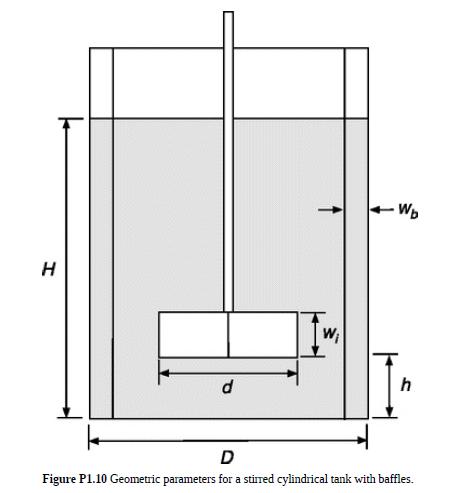
The effectiveness of mixing within a batch reactor or other stirred tank is determined mainly by the stirring power. The power Φ is the rate at which work is done on the liquid by the moving impeller. It is affected by the angular velocity ω and diameter d of the impeller, ρ, μ, and sometimes
This problem concerns the power Φ that an organism of length L must expend to swim underwater at a constant velocity U. In general, Φ will be affected by ρ and μ of water, in addition to L and U.(a) If N1 has Φ in the numerator and ρ in the denominator, what can you conclude from dimensional
Experiments with scale models are sometimes used to guide ship design. One quantity of interest is the drag force (FD) that opposes the ship's forward motion. It can be evaluated for a model by towing at a steady speed in a test tank and measuring the tension on the tow line. It is reasonable to
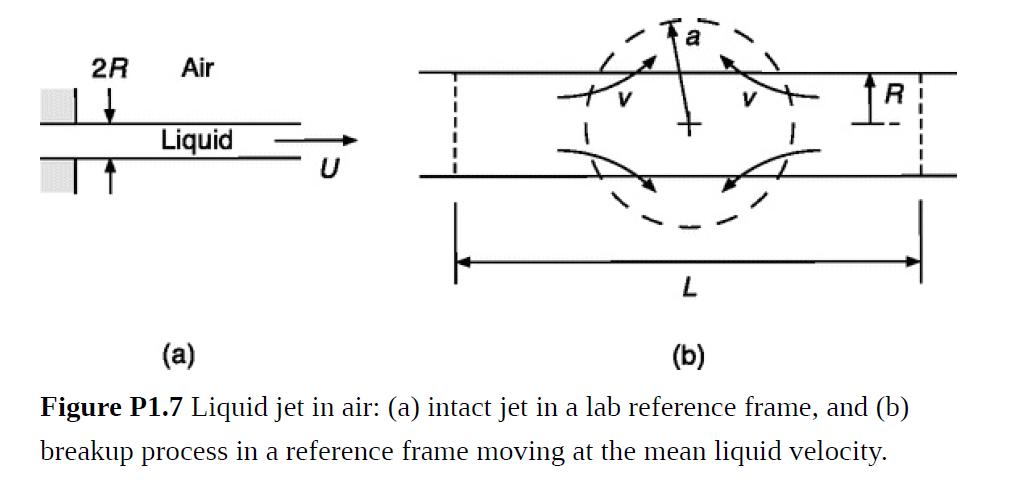
Circular jets of liquid are notoriously unstable. The breakup of one into drops may be observed by placing a finger under a thin stream of water from a faucet and noticing the rapid series of impacts at a certain distance from the nozzle. The objective is to explore why liquid cylinders break up
A valve manufacturer has received an inquiry from a company seeking large units for an oil pipeline. Certain types currently in production might be suitable, but they are much smaller than what is needed. Before investing in expensive prototypes, the manufacturer wants to know what the flow
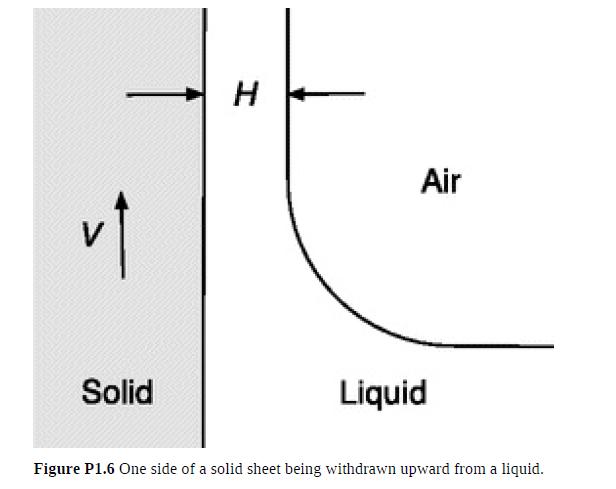
Various industrial processes require that a flat sheet be coated with a uniform liquid film. Dip coating is a procedure in which an immersed substrate is withdrawn through a liquid–gas interface. In the process in Fig. P1.6, in which a substrate is pulled upward at a constant velocity V, the
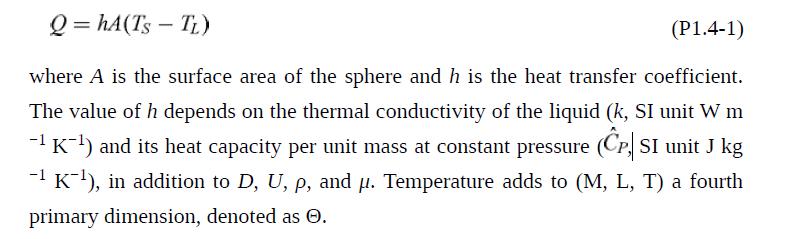
Suppose that a sphere of diameter D moves at a velocity U relative to a liquid, and that the sphere temperature TS exceeds the liquid temperature TL far from the sphere. The rate of heat transfer from sphere to liquid (energy per unit time) may be expressed as(a) It is customary to embed h in a
Liquid drops are generally nonspherical when formed (e.g., upon release from a pipette), and if they are in a certain size range their shape oscillates in time. It is desired to predict the period to of the oscillations.(a) Assuming that to depends only on the surface tension γ, the liquid density
A simple salad dressing can be prepared by adding one part vinegar to three parts vegetable oil and beating the mixture vigorously using a whisk. The result is an emulsion in which vinegar droplets are dispersed in the oil. The palatability of the dressing depends on the volume V of an average
A simple pendulum consists of a bob of mass m attached to a rigid rod, with R being the distance from the pivot to the bob center. The rod mass and bob diameter are each small (relative to m and R, respectively), the pivoting is frictionless, and the effects of the surrounding air are negligible.
It is desired to predict the time th that is needed for an object of mass m to travel downward a distance h, if gravity is the only force.(a) If the object is stationary before release, what could you conclude about th from dimensional analysis alone?(b) How is the dimensional analysis changed if
Showing 100 - 200
of 156
1
2
Step by Step Answers

 Get 50% OFF
Claim Now
Get 50% OFF
Claim Now