New Semester
Started
Get
50% OFF
Study Help!
--h --m --s
Claim Now
Question Answers
Textbooks
Find textbooks, questions and answers
Oops, something went wrong!
Change your search query and then try again
S
Books
FREE
Study Help
Expert Questions
Accounting
General Management
Mathematics
Finance
Organizational Behaviour
Law
Physics
Operating System
Management Leadership
Sociology
Programming
Marketing
Database
Computer Network
Economics
Textbooks Solutions
Accounting
Managerial Accounting
Management Leadership
Cost Accounting
Statistics
Business Law
Corporate Finance
Finance
Economics
Auditing
Tutors
Online Tutors
Find a Tutor
Hire a Tutor
Become a Tutor
AI Tutor
AI Study Planner
NEW
Sell Books
Search
Search
Sign In
Register
study help
engineering
introductory chemical engineering thermodynamics
Engineering And Chemical Thermodynamics 2nd Edition Milo D. Koretsky - Solutions
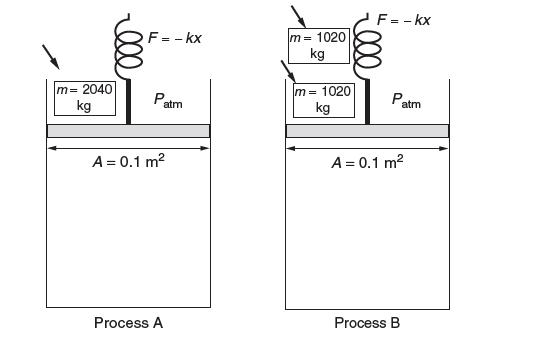
Consider the piston–cylinder assembly containing a pure gas shown below. The initial volume of the gas is 0.05 m3, the initial pressure is 1 bar, and the cross-sectional area of the piston is 0.1 m2. Initially the spring exerts no force on the very thin piston.(a) A block of mass m = 2040 kg is
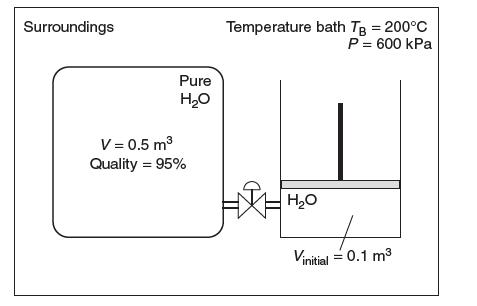
A rigid tank of volume 0.5 m3 is connected to a piston–cylinder assembly by a valve, as shown below. Both vessels contain pure water. They are immersed in a constant-temperature bath at 200ºC and 600 kPa. Consider the tank and the piston–cylinder assembly as the system and the
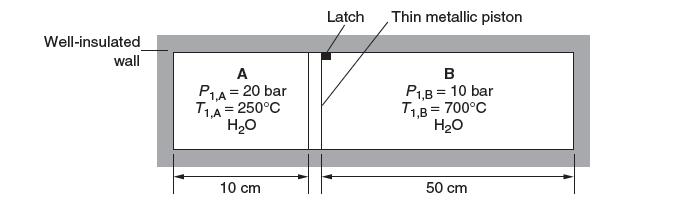
Consider the well-insulated, rigid container shown below. Two compartments, A and B, contain H2O and are separated by a thin metallic piston. Side A is 10 cm long. Side B is 50 cm long. The cross-sectional area is 0.1 m2. The left compartment is initially at 20 bar and 250ºC; the right compartment
When you open a can of soda (or beer), compressed CO2 expands irreversibly against the atmosphere as it bubbles up through the drink. Assume that the process is adiabatic and that the CO2 has an initial pressure of 3 bar. Take CO2 to be an ideal gas, with a constant heat capacity of cP = 37 [J/
Find the Pv work required to blow up a balloon to a diameter of 1 ft. Does the value you calculate account for all the work that is required? Explain.
You have a rigid container of volume 0.01 m3 that you wish to contain water at its critical point. To accomplish this task, you start with pure saturated water at 1 bar and heat it.(a) How much water do you need?(b) What is the quality of water that you need to begin this process?(c) How much
In an attempt to save money to compensate for a budget shortfall, it has been determined that the steam in ChE Hall will be shut down at 6:00 P.M. and turned back on at 6:00 A.M., much to the chagrin of a busy class of chemical engineers who have an outrageously long computer project due the
In an attempt to save money to compensate for a budget shortfall, it has been determined that the steam in ChE Hall will be shut down at 6:00 P.M. and turned back on at 6:00 A.M., much to the chagrin of a busy class of chemical engineers who have an outrageously long computer project due the
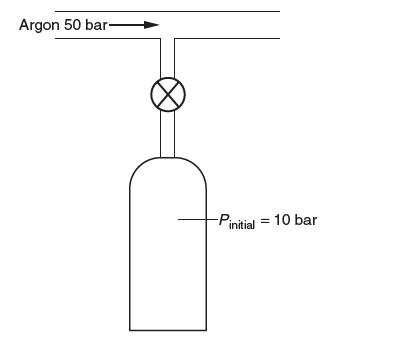
Consider fi lling a cylinder of compressed argon from a high-pressure supply line as shown below. Before fi lling, the cylinder contains 10 bar of argon at room temperature. The valve is then opened, exposing the tank to a 50 bar line at room temperature until the pressure of the cylinder reaches
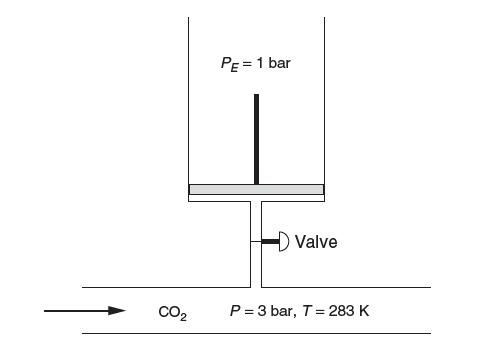
A well-insulated piston–cylinder assembly is connected to a CO2 supply line by a valve, as shown below. Initially there is no CO2 in the piston–cylinder assembly. The valve is then opened, and CO2 fl ows in. What is the temperature of the CO2 when the volume inside the piston– cylinder
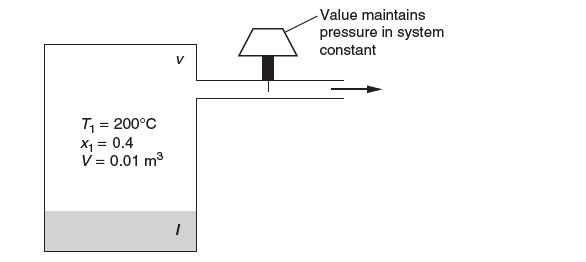
A rigid tank has a volume of 0.01 m3. It initially contains saturated water at a temperature of 200ºC and a quality of 0.4. The top of the tank contains a pressure-regulating valve that maintains the vapor at constant pressure. This system undergoes a process whereby it is heated until all the
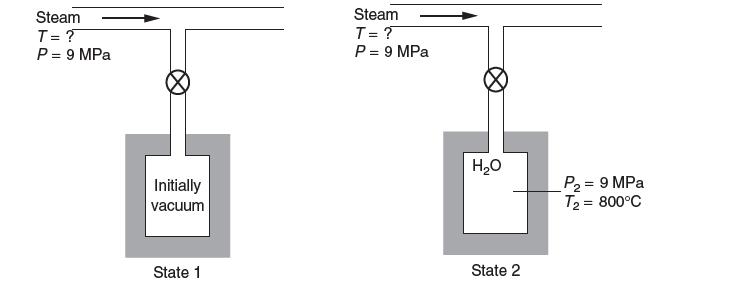
You wish to measure the temperature and pressure of steam fl owing in a pipe. To do this task, you connect a well-insulated tank of volume 0.4 m3 to this pipe through a valve. This tank initially is at vacuum. The valve is opened, and the tank fi lls with steam until the pressure is 9 MPa. At this
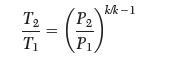
An ideal gas undergoes an adiabatic, reversible expansion process in a closed system:(a) If cp is constant, show that:(b) Determine the relationship between temperatures and pressures for an ideal gas if the heat capacity is given by: T2 T || P P. k/k-1
Methane vapor enters a valve at 3 bar and 25°C and leaves at 1 bar. If the methane undergoes a throttling process, what is the exit temperature, in °C? Under these conditions, you may assume methane is an ideal gas.
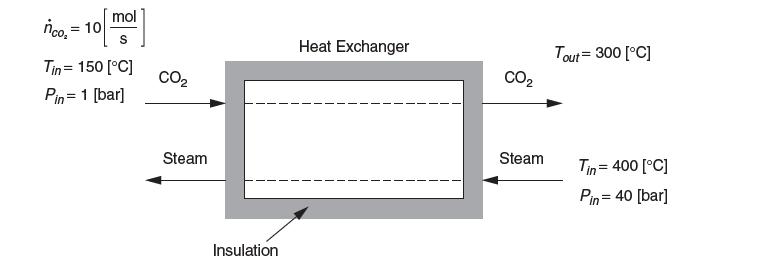
You wish to heat a stream of CO2 at pressure 1 bar, fl owing at 10 mol/s, from 150°C to 300°C in a countercurrent heat exchanger. To do this task, you have been asked to use a stream of highpressure steam available at 40 bar and 400°C, as shown in the following fi gure. You may assume the
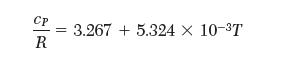
At steady-state, an ideal gas enters a compressor with a mass fl ow rate of 10.0 [mol/s]. The inlet pressure is 1.00 bar and the inlet temperature is 25.0°C. The gas exits at 25.0 bar and 65.0°C.The ideal gas heat capacity is given by:where T is in [K].(a) Assuming the compressor is adiabatic,
Answer the following questions:(a) Argon gas enters a heat exchanger at a volumetric flow rate of 4.0 [m3/min], a temperature of 100°C and a pressure of 2 bar. It leaves at 200°C and 1 bar. Compute the heat supplied, in W. You may assume ideal gas behavior.(b) Isobutane gas enters a heat
A stream of pure liquid benzene fl owing at a rate of 10 mol/s at 40°C and 10 bar enters a vessel where it is fl ashed. At steady-state, 6 mol/s of the benzene leaves as vapor, and the rest leaves as liquid. The fl ash vessel operates at a pressure of 5 bar; determine the rate of heat input
In a biological system, N2 is often bubbled through a fermentor to maintain anaerobic conditions.As the N2 bubbles through the fermentor, the gas strips water from the liquid. Consider an isothermal continuous fermentation process operated at 30°C, where 0.5 g/min of water are evaporated.(a) Does
An electric generator coupled to a waterfall produces an average electric power output of 5 kW. The power is used to charge a storage battery. Heat transfer from the battery occurs at a constant rate of 1 kW.(a) Determine the total amount of energy stored in the battery, (in [kJ]) in 10 hours of
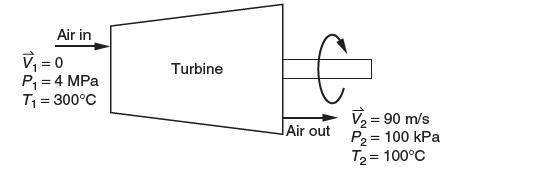
Air enters a well-insulated turbine operating at steady, state with negligible velocity at 4 MPa, 300ºC. The air expands to an exit pressure of 100 kPa. The exit velocity and temperature are 90 m/s and 100ºC, respectively. The diameter of the exit is 0.6 m. Determine the power developed by the
Ethylene (C2H4) at 100ºC passes through a heater and emerges at 200ºC. Compute the heat supplied into the unit per mole of ethylene that passes through. You may assume ideal gas behavior.
Propane at 350ºC and 600 cm3/mol is expanded in a turbine. The exhaust temperature is 308ºC, and the exhaust pressure is atmospheric. What is the work obtained? You may assume ideal gas behavior.
Consider 20 mol/s of CO fl owing through a heat exchanger at 100ºC and 0.5 bar.(a) At what rate must heat be added (in kW) to raise the stream to 500ºC?(b) Consider the same molar fl ow rate of n-hexane and the same rate of heat input calculated in part (a). Without doing any calculations,
Steam enters a well-insulated nozzle at 10 bar and 200ºC. It exits as saturated vapor at 100 kPa.The mass fl ow rate is 1 kg/s. What is the steady-state exit velocity? What is the outlet cross-sectional area?
Propane enters a nozzle at 5 bar and 200ºC. It exits at a velocity of 500 m/s. At steady-state, what is the exit temperature? Assume ideal gas conditions.
Consider a diffuser operating at steady-state with an outlet twice the area of the inlet. Air fl ows in with a velocity of 300 m/s, a pressure of 1 bar, and a temperature of 70ºC. The outlet is at 1.5 bar. What is the exit temperature? What is the exit velocity?
A stream of air is compressed in an adiabatic, steady-state fl ow process at 50 mol/s. The inlet is at 300 K and 1 bar. The outlet is at 10 bar. Estimate the minimum power that the compressor uses. You may assume air behaves as an ideal gas.
Sulfur dioxide (SO2) with a volumetric fl ow rate of 5000 cm3/s at 1 bar and 100ºC is mixed with a second SO2 stream fl owing at 2500 cm3/s at 2 bar and 20ºC. The process occurs at steadystate.You may assume ideal gas behavior. For SO2, take the heat capacity at constant pressure to be:(a) What
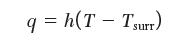
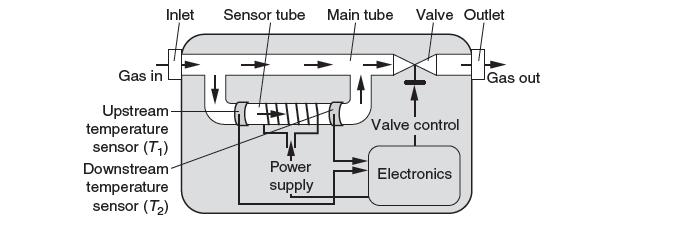
A mass fl ow controller (MFC) is used to accurately control the molar fl ow rate of gases into a system. A schematic of an MFC is shown below. It consists of a main tube and a sensor tube, to which a constant fraction of the fl owing gas is diverted. In the sensor tube, a constant amount of heat is
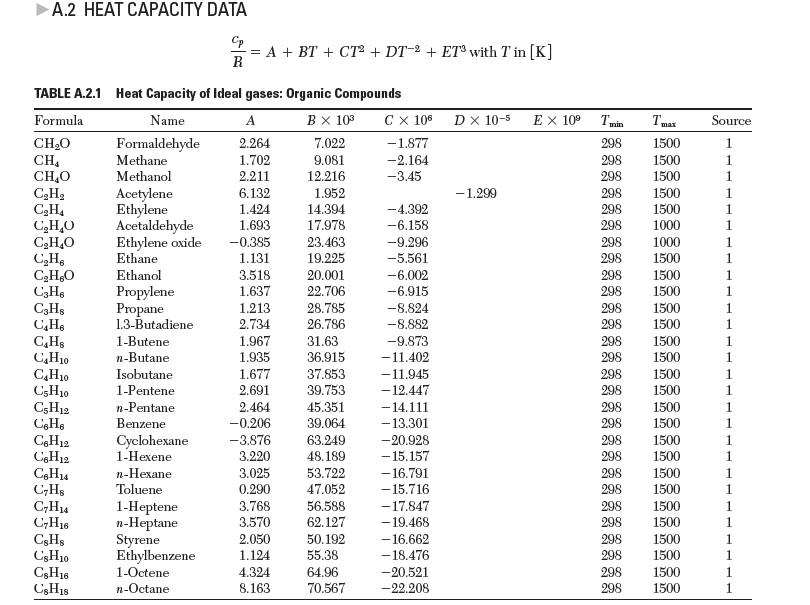
Using data from the steam tables, come up with an expression for the ideal gas heat capacity of H2O in the form:Compare your answer to the values in Appendix A.2. Co C = A + BT
Steam at 8 MPa and 500ºC fl ows through a throttling device, where it exits at 100 kPa. What is the exit temperature?
A monatomic, ideal gas expands reversibly from 500 kPa and 300 K to 100 kPa in a piston–cylinder assembly. Calculate the work done if this process is(a) isothermal;(b) adiabatic.
Compare the change in internal energy for the following two processes:(a) Water is heated from its freezing point to its boiling point at 1 atm.(b) Saturated liquid water is vaporized at 1 atm.Repeat for the change in enthalpy.
Calculate the values of the heat capacity of Ar, O2, and NH3 at 300 K. Account for their relative magnitudes in terms of the three modes (translational, rotational, and vibrational) in which molecules can exhibit kinetic energy.
Two kilograms of water, initially saturated liquid at 10 kPa, are heated to saturated vapor while the pressure is maintained constant. Determine the work and the heat transfer for the process, each in kJ.
A rigid vessel contains 5 kg of saturated liquid water and 0.5 kg of saturated vapor at 10 kPa.What amount of heat must be transferred to the system to evaporate all the liquid?
Consider the cooling of a glass of tap water by the addition of ice. The glass contains 400 ml of tap water at room temperature, to which 100 gm of ice is added. Assume the glass is adiabatic and that thermal equilibrium is obtained. The ice is originally at 210°C when removed from the freezer and
One mole of saturated liquid propane and 1 mole of saturated vapor are contained in a rigid container at 0ºC and 4.68 bar. How much heat must be supplied to evaporate all of the propane.At 0ºC,You may treat propane as an ideal gas. Ahvap 16.66 [kJ/mol]
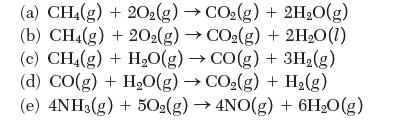
Calculate the enthalpy of reaction at 298 K for the following reactions: (a) CH4(g) + 20(g) CO(g) + 2HO(g) (b) CH4(g) + 2O2(g) CO(g) + 2HO(1) (c) CH4(g) + HO(g) CO(g) + 3H(g) (d) CO(g) + HO(g) CO(g) + H(g) (e) 4NH3(g) + 502(g) 4NO(g) + 6H0(g)
Calculate the adiabatic fl ame temperature of acetylene gas at a pressure of 1 bar under the following conditions. The reactants are initially at 298 K. Assume that the acetylene reacts completely to form CO2 and H2O:(a) It is combusted in a stoichiometric mixture of O2.(b) It is combusted in a
Calculate the adiabatic fl ame temperature of the following species in a stoichiometric mixture of air at a pressure of 1 bar. The reactants are initially at 298 K. Assume that they react completely to form CO2 and H2O. Compare the answers and comment.(a) propane(b) butane(c) pentane
In an experiment, methane is burned with the theoretically required amount of oxygen for complete combustion. Because of faulty operation of the adiabatic burner, the reaction does not proceed to completion. You may assume all of the methane that does react forms H2O and CO2. If the reactants are
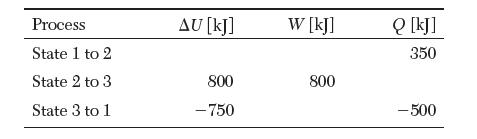
The following data are from a system that undergoes a thermodynamic cycle among three states. Fill in the missing values for ΔU, Q, and W. Is this a power cycle or a refrigeration cycle? Process State 1 to 2 State 2 to 3 State 3 to 1 AU [kj] 800 - 750 W [kj] 800 Q [kj] 350 - 500
One mole of air undergoes a Carnot cycle. The hot reservoir is at 800ºC and the cold reservoir is at 25ºC. The pressure ranges between 0.2 bar and 60 bar. Determine the net work produced and the effi ciency of the cycle.
One mole of air undergoes a Carnot refrigeration cycle. The hot reservoir is at 25ºC and the cold reservoir is at -15ºC. The pressure ranges between 0.2 bar and 1 bar. Determine the coeffi cient of performance.
Showing 700 - 800
of 746
1
2
3
4
5
6
7
8
Step by Step Answers

 Get 50% OFF
Claim Now
Get 50% OFF
Claim Now