New Semester
Started
Get
50% OFF
Study Help!
--h --m --s
Claim Now
Question Answers
Textbooks
Find textbooks, questions and answers
Oops, something went wrong!
Change your search query and then try again
S
Books
FREE
Study Help
Expert Questions
Accounting
General Management
Mathematics
Finance
Organizational Behaviour
Law
Physics
Operating System
Management Leadership
Sociology
Programming
Marketing
Database
Computer Network
Economics
Textbooks Solutions
Accounting
Managerial Accounting
Management Leadership
Cost Accounting
Statistics
Business Law
Corporate Finance
Finance
Economics
Auditing
Tutors
Online Tutors
Find a Tutor
Hire a Tutor
Become a Tutor
AI Tutor
AI Study Planner
NEW
Sell Books
Search
Search
Sign In
Register
study help
engineering
introductory chemical engineering thermodynamics
Engineering And Chemical Thermodynamics 2nd Edition Milo D. Koretsky - Solutions
A feed stream containing a mixture of 40% n-butane, 30% n-pentane, and 30% n-hexane fl ows into a fl ash unit. The fl ash temperature is 290 K and the fl ash pressure is 0.6 bar. What is the ratio of the exit vapor fl ow rate to the feed fl ow rate? What are the compositions of the exit streams?
Calculate the liquid and vapor compositions of butane(a) and n-hexane(b) at 0°C and 0.5 bar. You may assume the liquid forms an ideal solution.
Calculate the liquid and vapor compositions of n-pentane(a) and benzene(b) at 16°C and 0.333 bar. The excess Gibbs energy can be described by the two-suffi x Margules equation with A = 1816 [J/mol].
Calculate the liquid and vapor compositions of a binary mixture of isobutane (a) and hydrogen sulfi de (b) at 4.5°C and 8.77 bar. The excess Gibbs energy can be described by the three-suffi x Margules equation with these parameters:(a) Assume the vapor can be treated as an ideal
At 60°C, ethanol (1) and ethyl acetate (2) exhibit an azeotrope at a pressure of 0.64 bar and x1 = 0.4.(a) You wish to use the two-suffi x Margules equation as a model for gE. From these data, determine, as accurately as you can, the Margules parameter, A.(b) At 60°C, what is the composition of
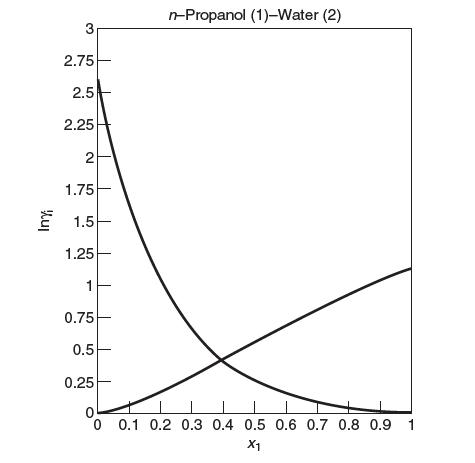
Consider a binary mixture of n-propanol and water in vapor–liquid equilibrium (VLE). Let n-propanol be designated species 1 and water, species 2. A plot of the activity coeffi cients for this system at 100°C follows. The Lewis/Randall reference state is chosen for both species. The mole
An equimolar liquid phase of benzene (1) and m-xylene (2) coexists with its vapor at 260°C.At this temperature, the saturation pressures are Using the van der Waals equation of state, calculate the equilibrium composition and pressure of vapor. You may assume that the liquid acts as an ideal
Consider a mixture of 1-propanol(a) and water(b) in vapor–liquid equilibrium at 25°C. For a liquid with mole fraction xa 5 0.2, answer the following questions. The three-suffi x Margules equation parameters are:
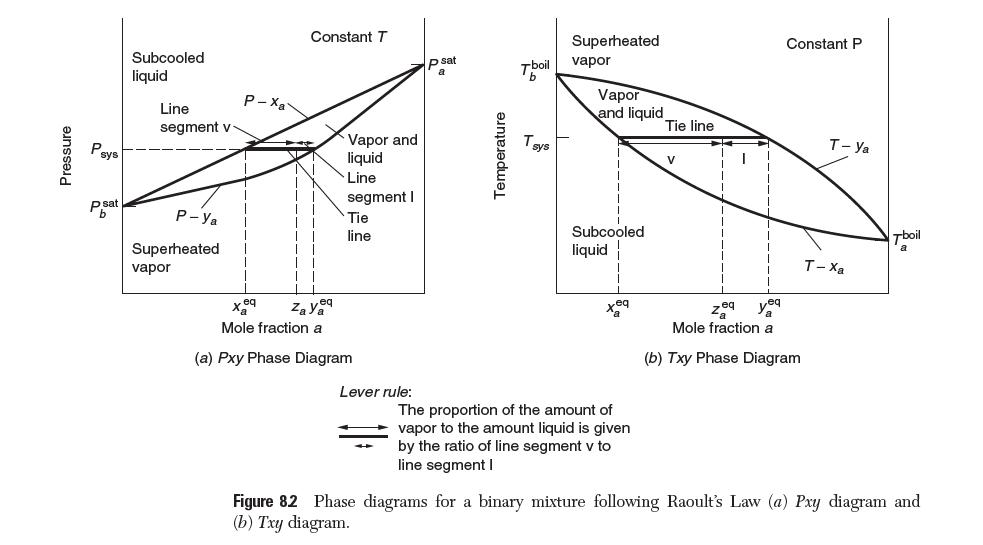
Example 8.6 illustrates how you solve a dew-point calculation for a binary mixture of a nonideal liquid and a nonideal gas with T known. This problem corresponds to quadrant I in Figure 8.2.Develop an analogous solution for the bubble point with the liquid-phase mole fractions and T known (quadrant
A binary mixture of water (1) and benzene (2) is in vapor–liquid equilibrium at a liquid mole fraction x1 = 0.6 and a pressure of 74.5 kPa. The liquid phase nonideality can be described by the two-suffi x Margules equation with A/ (RT) = 2.74. Determine the temperature and the vapor phase mole
Consider a mixture of 1-propanol(a) and water (b). At 25°C, the three-suffi x Margules equation parameters are:Does this binary mixture form an azeotrope at 25°C? If so, at what pressure does the azeotrope form? A = 4640 J mol and B-1700 J mol
At 20°C and 0.073 bar, a binary liquid mixture of cyclohexane (1) and toluene (2) is in vapor–liquid equilibrium. The liquid mole fraction of cyclohexane is measured to be x1 = 0.471. Assume that the liquid phase nonideality can be represented by the two-suffi x Margules equation. Answer the
Consider the system of ethanol (1)–benzene (2) at 25°C. This mixture exhibits an azeotrope at a mole fraction of x1 5 0.28 and a pressure of 122.3 torr. Determine values for the parameters in the van Laar equation. Estimate the liquid composition and pressure in equilibrium with a vapor of y1 5
Consider a mixture of species 1 and 2 in vapor–liquid equilibrium at 25°C and 90 bar. The following equation of state is available for the vapor phase:and y1 and y2 are the mole fractions of species 1 and 2, respectively. Species 2 is dilute in the liquid phase and may be described by Henry’s
A mixture of methanol(a) and ethyl acetate(b) exhibits an azeotrope at 55°C. Their saturation pressures are 68.8 and 46.5 kPa, respectively. The liquid-phase nonideality can be described by the two-suffi x Margules equation, with A = 2900 J/mol. What is the pressure and composition of the
Consider a mixture of benzene (1) and a proprietary organic molecule (2) that is in vapor–liquid equilibrium at 70°C. The proprietary molecule and benzene form a completely miscible liquid phase, but the proprietary molecule has a negligible vapor pressure. The activity coefficient at infinite
mixture of toluene (1) and polystyrene (2) is placed in an evacuated closed container (there is no air in the container). The container is then brought to 20.57 bar and 301°C where the liquid solution is in equilibrium with pure toluene vapor. Because polystyrene is large, you can assume no
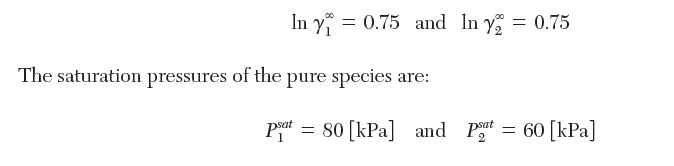
The following data are reported for a binary mixture of species 1 and 2 at 40°C. The activity coeffi cients at infi nite dilution are:Answer the following questions:(a) 4 moles of species 1 and 6 moles of species 2 are placed in a closed container and allowed to come to vapor–liquid equilibrium
A binary mixture of components a and b contains 1 mol a and 3 mol b in the liquid phase at 25°C and 0.50 bar. The excess Gibbs energy of the liquid mixture can be described by the van Laar equation with A = 4,010 [J/mol] and B = 2,501 [J/mol]. The saturation pressure of a is Psat a = 75
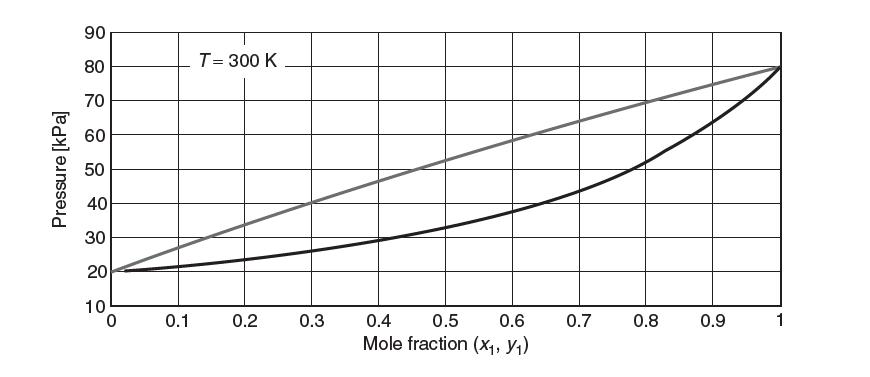
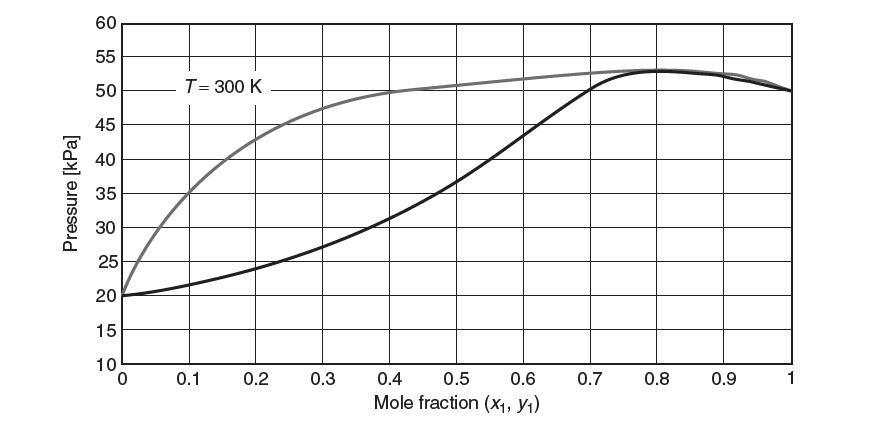
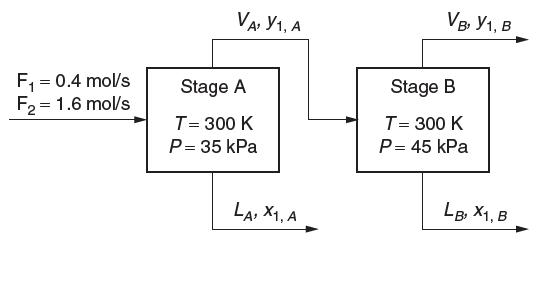
The following plot shows a Pxy phase diagram for a binary mixture of species 1 and 2 at 300 K.Answer the following:(a) A mixture of 2 mol of species 1 and 1 mol of species 2 exists at 20 kPa. Identify where it is on the plot in the preceding fi gure, and label it “A.” What phase or phases are
At 90°C, a binary-mixture of n-propanol(a) and water(b) follows the van Laar equation with A = 7,850 [J/mol] and B = 3,410 [J/mol].(a) Consider a liquid with 60 mole% n-propanol at 90°C in equilibrium with its vapor, calculate the fugacity of water in the liquid.(b) What is the partial
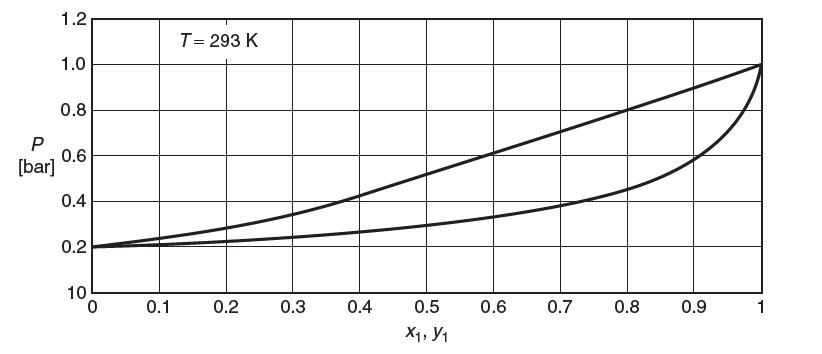
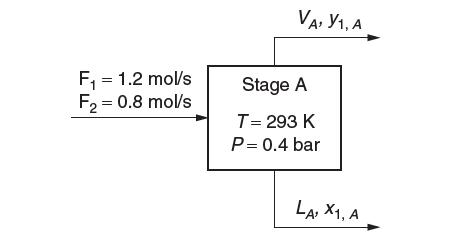
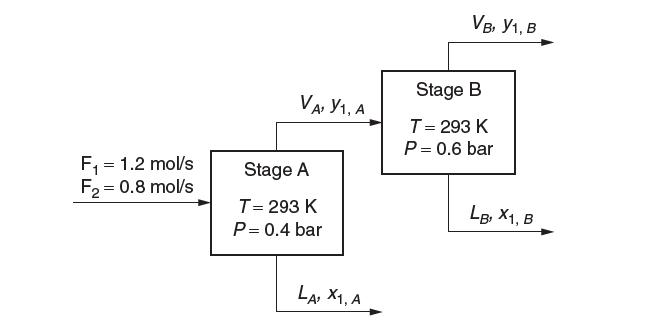
A vapor–liquid phase diagram for a binary mixture of species 1 and 2 at 293 K is shown in the following fi gure.Answer the following questions.(a) At 293 K, what is the value of P1sat?(b) Consider a mixture of 0.2 mol species 1 and 0.8 mol species 2 at 0.4 bar and 293 K.(i) What phase or
Consider a binary system of water vapor (1) in air (2) initially at room temperature and pressure (such as the air in this room). You desire to compress the gas to 100 bar and then cool it to 210 °C without any water condensing. Calculate the maximum mole fraction of water that can be in the air.
The Pxy phase diagram for a binary mixture of species “1” and “2” at 300 K is shown in the following fi gure.Answer the following questions:(a) On the g raph, identify the single-phase vapor region, the single-phase liquid region, and the two-phase region.(b) On the graph, identify the
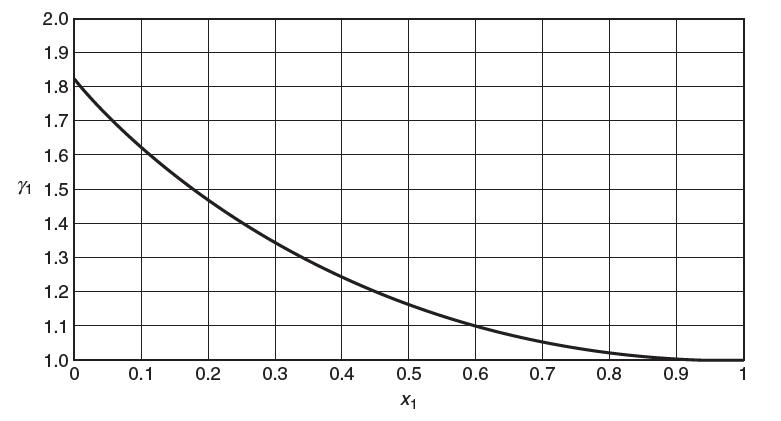
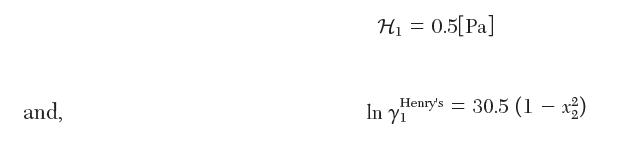
The Henry’s law constant and an expression for the activity coeffi cient have been found for the solute for a binary mixture of species 1 (solute)–2 (solvent) at 20°C. and, H = 0.5[Pa] Henry's= 30.5 (1-x) In y
What is the solubility of oxygen in methanol at 25°C and 1 bar? What is the solubility of oxygen in methanol at 25°C and 100 bar? Take Vo = 4.5 10-5 [m/mol].
A binary mixture of carbon dioxide and water exists in vapor–liquid equilibrium at 343.15 K and 1 bar. The solubility of CO2 in the liquid has been measured as xCO2 = 0.000255.What is the Henry’s law constant for CO2 at 343.15 K? State and justify any assumptions that you make.
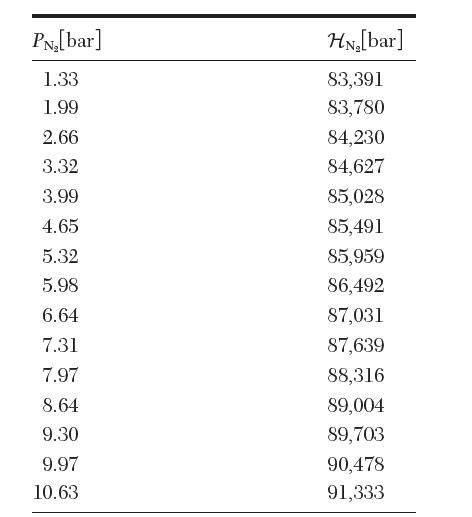
The following data are available for the Henry’s law constant of N2 in H2O at 19.4°C. From these data, estimate 00: 8 N*
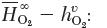
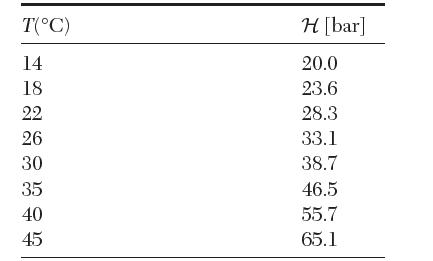
The following data are available for the Henry’s law constant of O2 in benzene. From these data, estimate Ho, - ho:
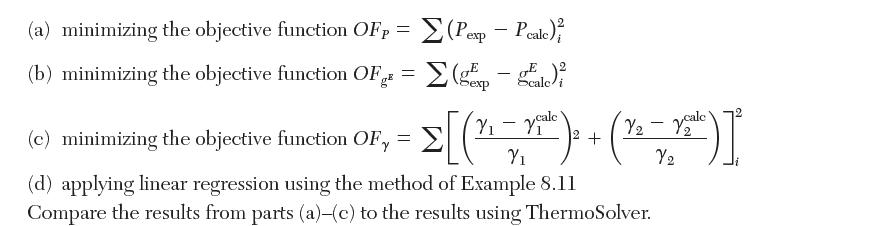
Develop a computer spreadsheet or write a program to verify that the objective functionin Example 8.9 gives the value A = 1399 [J/mol]. What value do you obtain for OFgE?Example 8.9 2 OF i i = (g GE Scale
Develop a computer spreadsheet or write a program to verify that the objective functionin Example 8.9 gives the value A = 1424 [J/mol]. What value do you obtain for OFγ? "HO = calc [((y yale) /7) + ((Y ,calc [z(h /
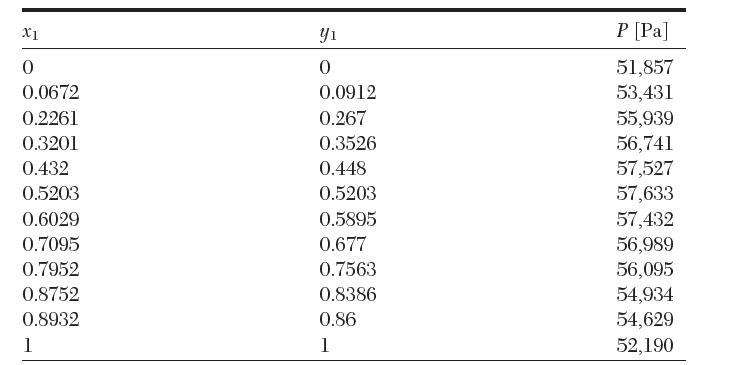
Liquid–vapor equilibrium data have been collected for a binary system of benzene (1)–cyclohexane (2) at 60°C. Mole fraction of liquid and vapor vs. total pressure are reported in the table below.From these data, determine the value of the two-suffi x Margules parameter, A. Compare your result
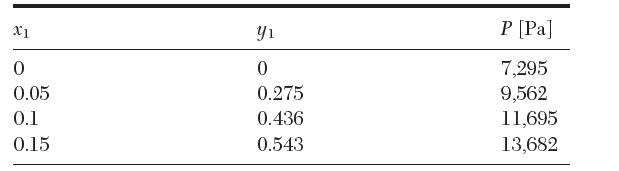
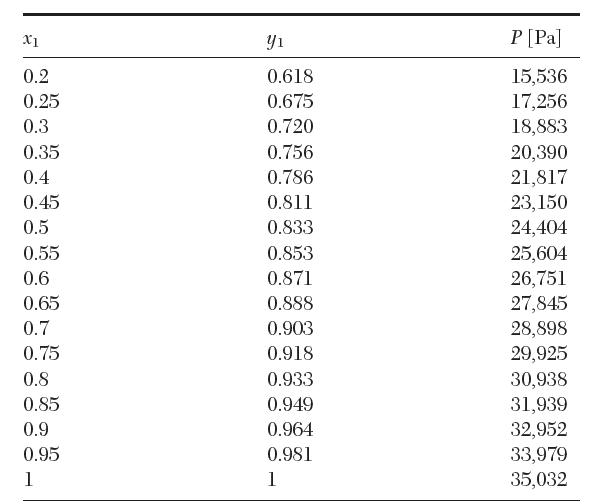
Liquid–vapor equilibrium data have been collected for a binary system of methanol (1)–water (2) at 40°C. Mole fraction of liquid vs. total pressure are reported in the table below. Develop a computer spreadsheet or write a program to fi nd the three-suffi x Margules parameters, A and B, that
Test the liquid–vapor equilibrium data for the binary system of methanol (1)–water (2) at 40°C presented in Problem 8.53 for thermodynamic consistency by using the area test.Problem 8.53Liquid–vapor equilibrium data have been collected for a binary system of methanol (1)–water (2) at
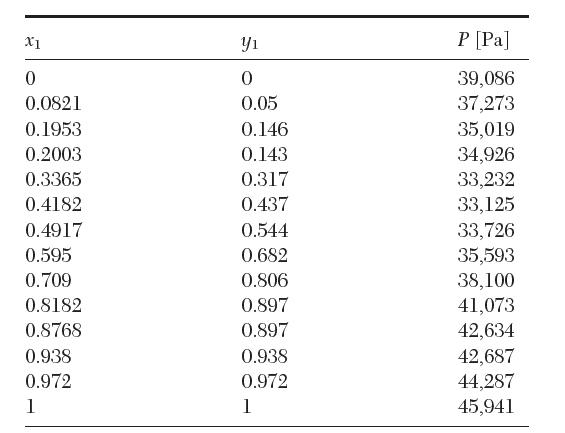
The following vapor–liquid equilibrium data have been reported for a binary mixture of acetone (1) in chloroform (2) at 35. 17°C. Test these data for thermodynamic consistency. X1 0 0.0821 0.1953 0.2003 0.3365 0.4182 0.4917 0.595 0.709 0.8182 0.8768 0.938 0.972 1 Y 0 0.05 0.146 0.143 0.317 0.437
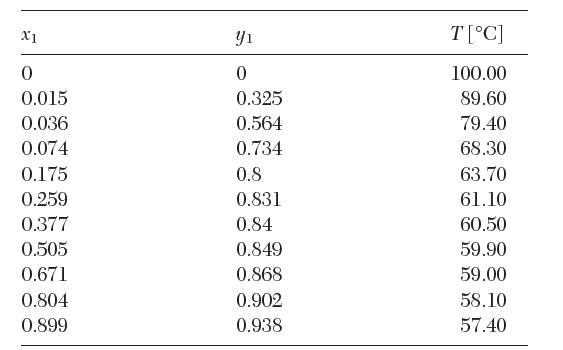
The following vapor–liquid equilibrium data have been reported for a binary mixture of acetone (1) in water (2) at 1 atm. Test these data for thermodynamic consistency. X1 0 0.015 0.036 0.074 0.175 0.259 0.377 0.505 0.671 0.804 0.899 Y 0 0.325 0.564 0.734 0.8 0.831 0.84 0.849 0.868 0.902 0.938
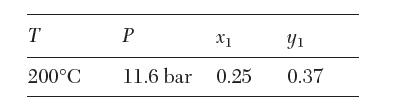
You wish to fi t the benzene (1)–isooctane (2) system to the following model for gE:The system temperature of interest is 200°C. After a literature search, the only vapor–liquid equilibrium data at this temperature that you can fi nd is:For the pure components, the Antoine constantswhere Psat
Using the Peng–Robinson equation of state, calculate the saturation pressure of pure n- pentane at 400 K using fugacity coeffi cients to calculate the fugacity for both vapor and liquid phases. Compare the results with the values of Pisat obtained by the Antoine equation and report the percent
Using the Peng–Robinson equation of state, calculate the saturation pressure of pure propane at 0°C using fugacity coeffi cients to calculate the fugacity for both vapor and liquid phases.Compare the results with the values of Pisat obtained by the Antoine equation and report the percent error.
Using the Peng–Robinson equation of state, calculate the saturation pressure of pure benzene at 400 K using fugacity coeffi cients to calculate the fugacity for both vapor and liquid phases. Compare the results with the values of Pisat obtained by the Antoine equation and report the percent error.
Using the equation of state method, determine the equilibrium composition in the vapor phase and the system pressure of a mixture of methane (1) and n-pentane (2) with a liquid mole fraction of x1 = 0.2 at 60°C. Use the van der Waals equation of state to determine fugacity for both vapor and
Repeat Problem 8.61 using the Peng–Robinson equation of state. Use a value for the binary interaction parameter of 0.026.Problem 8.61Using the equation of state method, determine the equilibrium composition in the vapor phase and the system pressure of a mixture of methane (1) and n-pentane (2)
Using the equation of state method, determine the equilibrium composition in the vapor phase and the system pressure of a mixture of carbon dioxide (1) and benzene (2) with a liquid mole fraction of x1 = 0.3 at 100°C. Use the van der Waals equation of state to determine fugacity for both vapor and
Repeat Problem 8.63 using the Peng–Robinson equation of state. Use a value for the binary interaction parameter of 0.077.Problem 8.63Using the equation of state method, determine the equilibrium composition in the vapor phase and the system pressure of a mixture of carbon dioxide (1) and benzene
Repeat Problem 8.67 using the Peng–Robinson equation of state. Use a value for the binary interaction parameter of:(a) 0(b) 0.077Problem 8.67Using the equation of state method, construct a Pxy diagram for a binary mixture of carbon dioxide (1) and benzene (2) at 25°C. Use the van der Waals
Using the equation of state method, construct a Pxy diagram for a binary mixture of carbon dioxide (1) and benzene (2) at 100°C. Use the van der Waals equation of state to determine fugacity for both vapor and liquid phases. To converge on the liquid mole fraction, it is helpful to start with an
Using the equation of state method, construct a Pxy diagram for a binary mixture of carbon dioxide (1) and benzene (2) at 25°C. Use the van der Waals equation of state to determine fugacity for both vapor and liquid phases. To converge on the liquid mole fraction, it is helpful to start with an
At a 300 K and 1 bar, a binary mixture of species a and b form two partially miscible liquid phases. The following activity coeffi cients at infi nite dilution are reported: Using the three-suffi x Margules equation, determine the composition of two liquid phases in equilibrium. y = 8 and y = 15.
Consider a binary liquid mixture of hexane (1) and acetone (2). At 15°C and 300 bar, this mixture forms two partially miscible liquid phases. Phase α has 20 total moles with x1α = 0.2, while phase b has 10 total moles with x1β = 0.8. The following data are available at 15°C:(a) Draw a
At 25°C and 1 bar, the following composition has been reported for a liquid–liquid mixture of CHCl3(a) and H2O(b) : xα α = 0.987 and xαβ = 0.0013. From these data predict the three-suffi x Margules parameters, A and B, for this binary mixture.
The Wilson equation requires positive values for binary parameters Lab and Lba. Verify that this activity coeffi cient model is incapable of describing the instability of partially miscible liquids.
Tetrahydrofuran(a) and water(b) separate into two liquid phases at 1 bar and 50°C. Determine the composition of each liquid phase. The following three-suffi x Margules parameters have been obtained for this binary system: A = 7395 [J/mol] and B = -1380 [J/mol]
Tetrahydrofuran(a) and water(b) separate into two liquid phases at 1 bar and 50°C. Determine the composition range over which the system is inherently unstable and will spontaneously separate into two phases. The following three-suffi x Margules parameters have been obtained for this binary
The mole fraction of isobutane in a liquid–liquid mixture of isobutane(a) in equilibrium with furfural(b) at 64°C and 10 bar has been measured to be:
A binary mixture of species a and b are in liquid–liquid equilibrium at 25°C. This mixture can be described by the two-suffi x Margules equation with A = 7,300 [J/mol]. Assume A does not change with temperature.(a) Determine the composition of each liquid phase.(b) Consider a mixture with an
A binary mixture of species a and b is in liquid–liquid–vapor equilibrium at 25°C. The liquid compositions are xαa = 0.92 and xβa = 0.08, and the saturation pressures of a and b are Psat a = 75 kPa and Psat b = 25 kPa. Determine the total pressure and the gas phase mole fraction.
A binary mixture of water(a) and 1-butanol(b) exhibits vapor–liquid–liquid equilibrium at 25°C. The activity coeffi cients at infi nite dilution are given by Determine the composition of the three phases and the system pressure at which VLLE occurs. At 25°C, the saturation pressure for
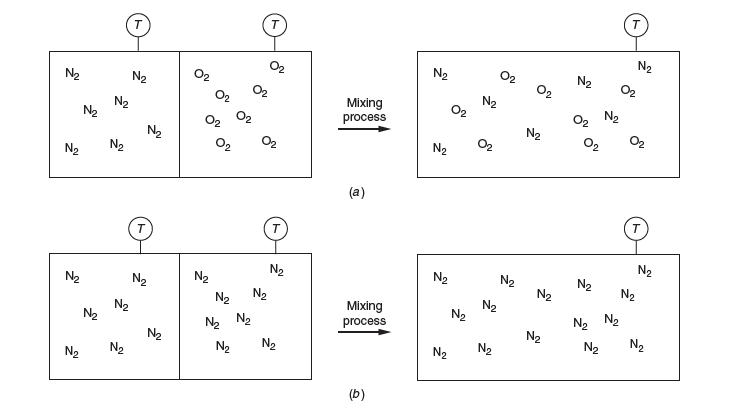
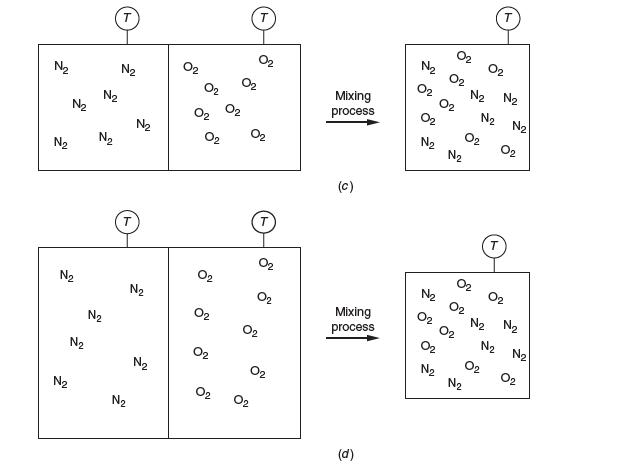
A set of mixing processes is shown in the following fi gures. The volumes are represented by the size of the boxes. For each process, determine whether Ds is greater than zero, less than zero, or equal to zero. Explain your answer. You may assume O2 and N2 behave as ideal gases.Refl ect on your
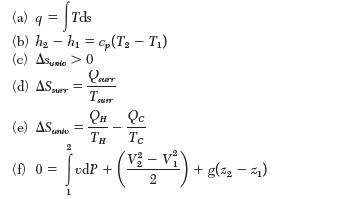
State the conditions under which the following equations apply. Be as specifi c as you can with the limitations. (a) q = [Tds (b) h h = cp(Ta - T) (c) Asumie > 0 (d) ASUT (e) Asunto 2 Courr 1 Tur QH Qc TH Tc (f) 0 = vdp + ( v = V). 2 + g(-)
Consider two ideal gases, A and B, that are initially separated. For each of the following processes, the gases are allowed to mix. Determine if the entropy change of the system is positive, negative, or zero. Explain.(a) The process occurs isothermally, at constant P.(b) The process occurs
Consider an ideal gas. For each of the following processes, determine if the entropy change of the system is positive, negative, zero, or you cannot tell. Explain.(a) Isothermal compression(b) Adiabatic compression(c) Isobaric heating(d) Isochoric heating
Consider the following processes and determine if the entropy change of the system is positive, negative, zero, or you cannot tell. Explain.(a) Liquid water is frozen to form ice.(b) 1 mol of oxygen and 2 mol of hydrogen react isothermally and completely to form 1 mol of water vapor.(c) 1 mol of
Consider an ideal gas that undergoes two alternative processes from state 1 to state 2. The path for the fi rst process (Path 1) is reversible, and the path of the second process (Path 2) is irreversible.Answer the following questions.(a) If we compare the entropy change of the system, we can
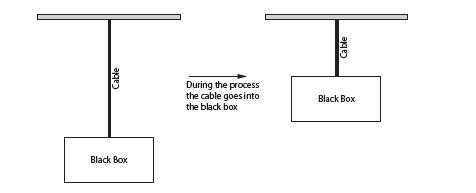
A black box is bolted to a beam with a cable as shown in the following fi gure. Consider the box as the system. During the process, the box raises in height as the cable goes into the box by an unknown mechanism. Assume that there is some friction associated with this process.(a) During the
In Problem 2.12, you explained why a thick rubber band heats when stretched. Offer an alternative explanation in the context of entropy. You may consider this process isentropic.Problem 2.12I thoroughly infl ated a bag of soccer balls last summer. However, when I brought them out to play this
Qualitatively sketch the Ts diagram corresponding to the real Rankine cycle given in Example 3.15.Example 3.15 EXAMPLE 3.15 Redo the analysis of the Rankine cycle of Example 3.14 but include isentropic efficiencies of 85% in the pump and turbine. Determine the net power and the overall efficiency
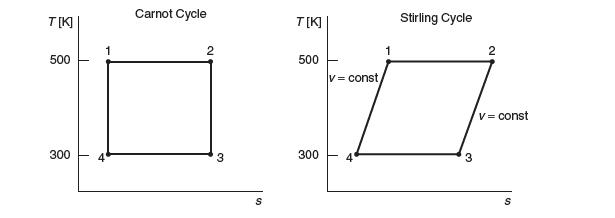
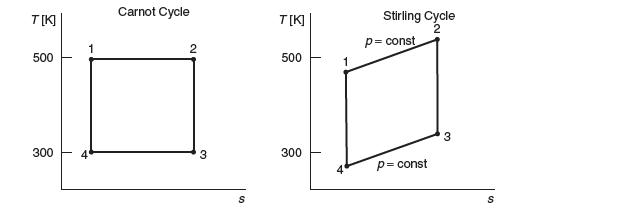
Ts diagrams for two reversible thermodynamic power cycles are shown in the following fi gure.Both cycles operate between a high temperature reservoir at 500 K and a low temperature reservoir at 300 K. The process on the left is the Carnot cycle described in Section 2.9. The process on the right is
Ts diagrams for two reversible thermodynamic power cycles are shown in the following fi gure.Both cycles operate between a high temperature reservoir at 500 K and a low temperature reservoir at 300 K. The process on the left is the Carnot cycle described in Section 2.9. The process on the right is
CdTe forms a II–VI compound semiconductor. This solid forms a well-ordered single crystal where Cd atoms and Te atoms sit in distinct sites adjacent to each other in a crystal lattice. Estimate the entropy of mixing from an initial state of 1 mole of pure solid Cd and 1 mole of pure solid Te to a
In the 1959 Rede Lecture, The Two Cultures, C. P. Snow asserts:A good many times I have been present at gatherings of people who, by the standards of traditional culture, are thought highly educated and who have with considerable gusto been expressing their incredulity at the illiteracy of
In his book The Trouble Waters, Henry Morris proclaims:The Law of Increasing Entropy is an impenetrable barrier which no evolutionary mechanism yet suggested has ever been able to overcome. Evolution and entropy are opposing and mutually exclusive concepts. If the entropy principle is really a
“Four of a kind” is one of the best hands you can have in poker. Can you relate this statement to the concept of entropy? Would you say this hand has a high value of s?
The concept of entropy was developed in the nineteenth century, in order to study the efficiency of the steam engine, largely through the work of Sadi Carnot, Rudolph Clausius, and Lord Kelvin. However, it has had major implications well beyond the realm of engineering, including impacting the
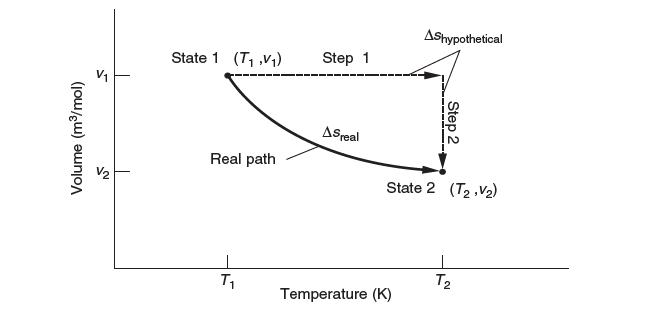
Develop a general expression for Δssys for an ideal gas that goes from (v1, T1) to (v2, T2) based on the path below. S Volume (m/mol) NT State 1 (T.V) Real path T Step 1 ASreal AShypothetical Temperature (K) Step 2 State 2 (T, V) T
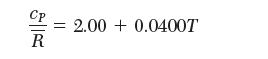
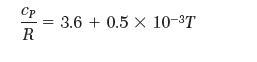
Develop a general expression for Dssys for an ideal gas that goes from (P1, T1) to (P2, T2) where heat capacity is given by: Cp = A + BT + CT2
A rigid vessel contains 10 kg of steam. The steam is initially at 10 bar and 300°C. After a period of time, the pressure in the vessel is reduced to 1 bar due to heat transfer with the surroundings. The surroundings are at a constant temperature of 20°C. Determine the change in entropy of the
A 10-kg block of copper is initially at 100°C. It is thrown in a very large lake that is at 280 K.What is the entropy change of the copper? What is the entropy change of the universe?
Calculate the change in entropy for the system for each of the following cases. Explain the sign that you obtain by a physical argument.(a) A gas undergoes a reversible, adiabatic expansion from an initial state at 500 K, 1 MPa, and 8.314 L to a fi nal volume of 16.628 L.(b) One mole of methane
Calculate the change in entropy of the universe for the process described in Problem 2.28.Repeat for Problem 2.29.Problem 2.28 Consider a piston–cylinder assembly that contains 1 mole of ideal gas, A. The system is well insulated. Its initial volume is 10 L and initial pressure, 2 bar. The gas
Determine the change in entropy of an ideal gas with constant heat capacity, cP = (7/2)R, between the following states: (a) P = 1 bar, T = 300 K; P = 0.5 bar, T = 500 K (b) v = 0.05 m/mol, T = 300 K; v = 0.025 m/mol, T (c) P = 1 bar, T = 300 K; = 0.025 m/mol, T = 500 K T2 = 500 K
Compare the change in entropy(a) when water is heated from its freezing point to its boiling point at 1 atm and(b) when saturated liquid water is vaporized at 1 atm.
You have just cooled a glass of tap water at 20°C by adding ice, at 210°C. The glass originally contains 400 mL of tap water, to which 100 g of ice is added. Assume that the glass is adiabatic.Calculate the change in entropy of the universe after thermal equilibrium has been obtained. For ice,
Consider a piston–cylinder assembly that initially contains 0.5 kg of steam at 400°C and 100 bar. For the isothermal expansion of the steam in this system to a fi nal pressure of 1 bar, determine the following:(a) What is the maximum possible work (in [kJ]) that can be obtained during this
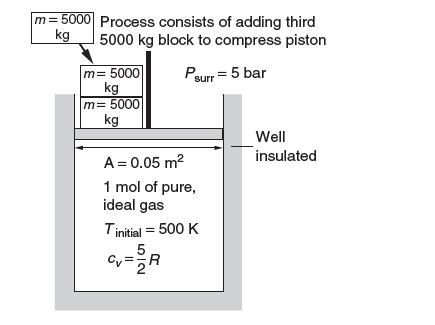
Consider the piston–cylinder assembly shown at the top of page. It is well insulated and initially contains two 5000-kg blocks at rest on the 0.05-m2 piston. The initial temperature is 500 K.The ambient pressure is 5 bar. One mol of an ideal gas is contained in the cylinder. This gas is
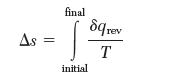
Problem 3.27 consists of an irreversible process in which an ideal gas with constant heat capacity was compressed in a piston–cylinder assembly. As part of this problem, you were asked to calculate Dssys for this process. Entropy change is defi ned for a reversible process as:Since entropy is a
Consider a well-insulated piston–cylinder assembly. O2, initially at 250 K and 1 bar, undergoes a reversible compression to 12.06 bar. You may assume oxygen is an ideal gas. Answer the following questions:(a) What is the entropy change for this process?(b) What is the fi nal temperature of the
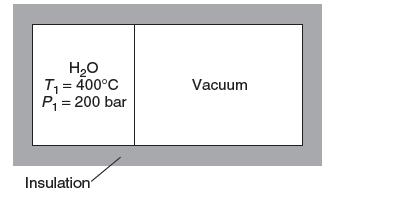
The insulated vessel shown below has two compartments separated by a membrane. On one side is 1 kg of steam at 400°C and 200 bar. The other side is evacuated. The membrane ruptures, fi lling the entire volume. The fi nal pressure is 100 bar. Determine the entropy change for this process. HO T =
A partition divides a rigid, well-insulated 1-m3 tank into two equal parts. The left side contains an ideal gas [cP = (5/2)R] at 10 bar and 300 K. The right side contains nothing; it is a vacuum.A small hole forms in the partition, gas slowly leaks out from the left side, and eventually the
An insulated tank is divided by a thin partition.(a) On the left is 0.79 mole of N2 at 1 bar and 298 K; on the right is 0.21 mole of O2 at 1 bar and 298 K. The partition ruptures. What is ΔSuniv for the process?(b) On the left is 0.79 mole of N2 at 2 bar and 298 K; on the right is 0.21 mole of
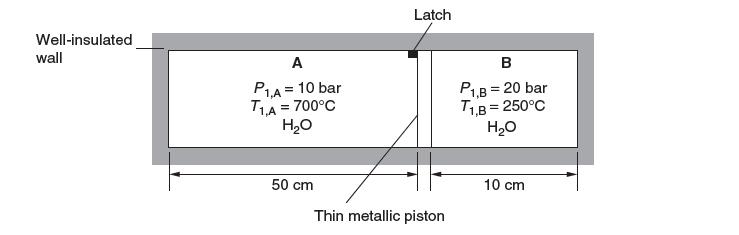
Consider the well-insulated, rigid container shown in the following fi gure. Two compartments, A and B, contain H2O and are separated by a thin metallic piston. Side A is 50 cm long. Side B is 10 cm long. The cross-sectional area is 0.1 m2.The left compartment is initially at 10 bar and 700°C; the
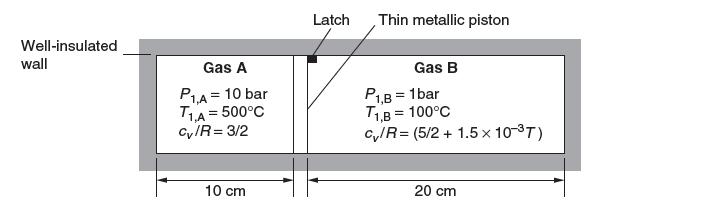
Consider the well-insulated container shown below. Two gases, gas A and gas B, are separated by a metallic piston. The piston is initially held in place by a latch 10 cm from the left of the container.Gas A, which is located in the left compartment, is initially at 10 bar and 500°C. The heat
Steam at 8 MPa and 500°C fl ows through a throttling device, where it exits at 100 kPa.Determine the entropy change for this process.
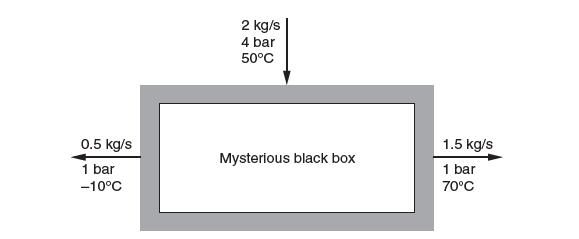
A fast-talking salesperson comes to your doorstep and says she is down on her luck and is willing to sell you the patent rights to her most glorious invention. She brings out a mysterious black box and says it can take an inlet stream of ideal gas at 2 kg/s and 4 bar and cool part of it (0.5 kg/s)
Steam enters a nozzle at 4 MPa and 640°C with a velocity of 20 m/s. This process may be considered reversible and adiabatic. The nozzle exit pressure is 0.1 MPa.(a) Draw a sketch of this process. Include all known information.(b) What is the entropy change of the steam?(c) What is the exit
Propane at 350°C and 600 cm3/mol is expanded in a turbine. The exhaust pressure is atmospheric.What is the lowest possible exhaust temperature? How much work is obtained? You may assume ideal gas behavior and that heat transfer to the surroundings is negligible.
What is the minimum amount of work required to separate an inlet stream of air fl owing at 20°C and 1 bar into exit streams of pure O2 and pure N2 at 20°C and 1 bar?
An adiabatic turbine is designed to take stream of steam fl owing at 10 kg/s from an inlet at 10 bar and 500°C to an outlet at 1 bar. It is reported that at steady-state, this turbine can deliver 7,619 kW of power. Is this possible? Explain.
An ideal gas at a fl ow rate of 10.0 m3/min enters a compressor at 25°C and 1 bar. It leaves at 1 MPa. During this process, heat is dissipated to the surroundings at a rate of 2100 W. You may take the surroundings to be at a constant temperature of 25°C. The heat capacity of the ideal gas is
Consider a Carnot (reversible) power cycle operating between a hot reservoir of 727°C and a cold reservoir of 27°C. If 700 W of power are generated, calculate the total entropy change of the universe, the entropy change of the hot reservoir, and the entropy change of the cold reservoir.
An ideal gas enters an adiabatic turbine with a molar fl ow rate of 10 [mol/s]. The inlet pressure is 100 bar, and the inlet temperature is 500°C. The gas exits at 1 bar. The ideal gas heat capacity is given by:where T is in [K].(a) At steady state, calculate the maximum power (in kW) generated
Showing 400 - 500
of 746
1
2
3
4
5
6
7
8
Step by Step Answers

 Get 50% OFF
Claim Now
Get 50% OFF
Claim Now