New Semester
Started
Get
50% OFF
Study Help!
--h --m --s
Claim Now
Question Answers
Textbooks
Find textbooks, questions and answers
Oops, something went wrong!
Change your search query and then try again
S
Books
FREE
Study Help
Expert Questions
Accounting
General Management
Mathematics
Finance
Organizational Behaviour
Law
Physics
Operating System
Management Leadership
Sociology
Programming
Marketing
Database
Computer Network
Economics
Textbooks Solutions
Accounting
Managerial Accounting
Management Leadership
Cost Accounting
Statistics
Business Law
Corporate Finance
Finance
Economics
Auditing
Tutors
Online Tutors
Find a Tutor
Hire a Tutor
Become a Tutor
AI Tutor
AI Study Planner
NEW
Sell Books
Search
Search
Sign In
Register
study help
engineering
introductory chemical engineering thermodynamics
Engineering And Chemical Thermodynamics 2nd Edition Milo D. Koretsky - Solutions
Consider the liquefaction of N2 by Joule–Thomson throttling. If the inlet to the expansion valve is at T1 = -122°C and P1 = 100 bar and the outlet is at 1 bar, determine the percentage of N2 that is liquefi ed.
A pot of boiling water is open to the atmosphere when, at time 0, the pot is sealed by a tight lid so no gas can escape. With continued heating, the water continues to boil. As best you can, estimate how the temperature changes with time and plot it on the following graph. You may assume that the
The boiling point for species A at 1 bar is reported to be 250 K, and you desire to know the boiling point at 10 bar. Knowing the enthalpy of vaporization, you apply the Clausius-Clapeyron equation and calculate the temperature to be 300 K. However, at that pressure, you also know that species A is
The boiling point for species A at 1 bar is reported to be 250 K, and you desire to know the saturation pressure at 300 K. Knowing the enthalpy of vaporization, you apply the Clausius-Clapeyron equation and calculate the pressure to be 10 bar. However, at that pressure, you also know that species A
A well-insulated tank with a valve at the top contains saturated water at 5 MPa. The quality of the water is 0.1.(a) What is the ratio of the liquid volume to the vapor volume?(b) The valve is opened, and the vapor is allowed to escape to atmosphere while the water continues to boil. Plot how you
Your coworker has scribbled down the saturation pressures for a pure species from the solid (sublimation) and liquid (evaporation) as follows:and,However, in his haste, he forgot to note which equation was for sublimation and which was for evaporation. Please help your coworker by determining the
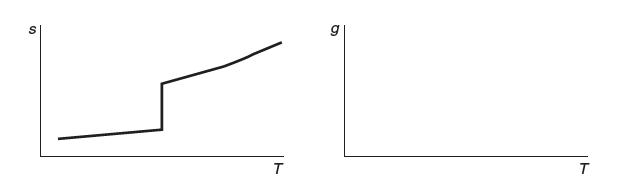
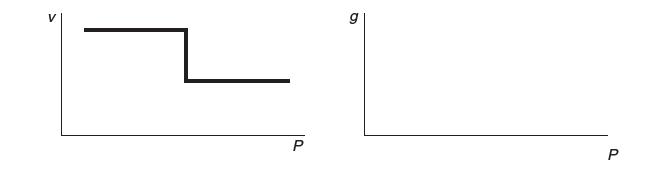
(a) A pure fl uid shows the following s vs. T behavior. Draw schematically how the chemical potential would change with temperature.(b) A pure substance shows the following v vs. P behavior at constant temperature. Draw schematically how the molar Gibbs energy would change with pressure. Explain
At room temperature, iron exists in the ferrite phase (α-Fe). At 912°C, it goes through a phase transformation to the austenite phase (γ-Fe). Which phase of iron has stronger bonds?Explain.
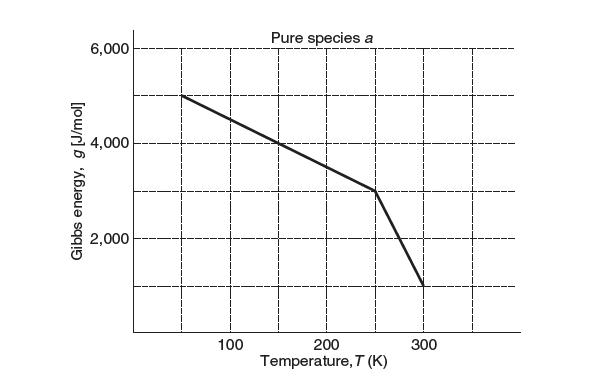
Consider the crystallization of species a. The molar Gibbs energy of pure species a vs. temperature at a pressure of 1 bar is shown below. Take the molar volume of species a in the liquid phase to be 20% larger than its molar volume as a solid.Answer the following questions:(a) Identify the
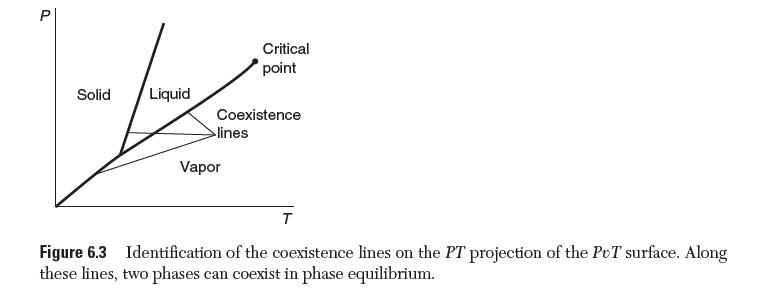
The slope of the coexistence line between the solid and liquid phases shown in Figure 6.3 is positive. Most pure species behave this way. However, species that expand on freezing (like liquid water to ice) exhibit a negative slope. Using the thermodynamic principles presented in this chapter, show
For two species, A and B, with a positive enthalpy change of mixing:(a) Are the like interactions or the unlike interactions stronger? Explain.(b) If pure species A and B are mixed adiabatically, will the temperature (increase, stay the same, decrease, or cannot tell)? Explain.(c) If pure
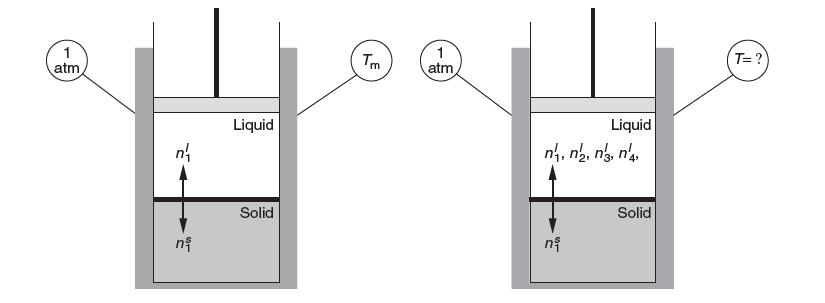
The following diagram shows the normal melting point of pure solid 1 to be Tm. Consider now that the same pure solid 1 is in a liquid mixture with four species 1, 2, 3, and 4 as shown on the right. How does the temperature at which 1 will be in equilibrium with liquid, T, compare to the case on the
The normal boiling point of puThe normal melting point of pure solid 1 is Tm. Consider now that the same pure solid 1 is melting into a liquid that initially contains pure 2. How does the temperature at which 1 will melt into the liquid, T, compare to Tm? You may assume that the enthalpy of mixing
The normal melting point of pure solid 1 is Tm. Consider now that the same pure solid 1 is melting into a liquid that initially contains pure 2. How does the temperature at which 1 will melt into the liquid, T, compare to Tm? You may assume that the enthalpy of mixing of liquid 1 and 2 is zero.
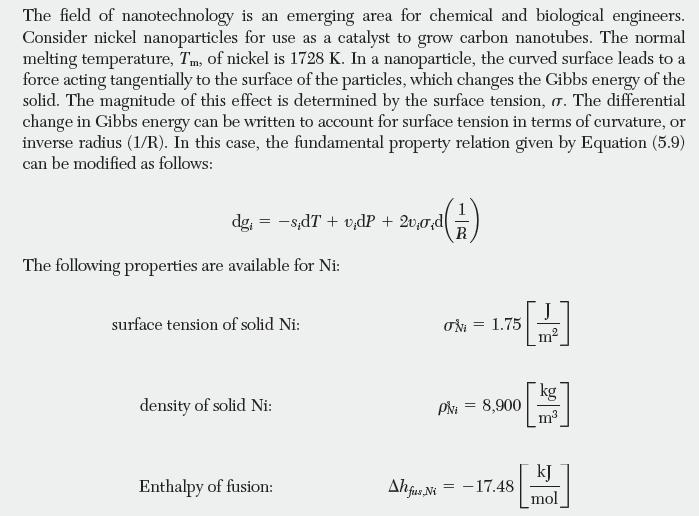
In Example 6.5, we found Ni nanopartibles of 2 nm radius would melt at 587 K, assuming the system contained pure Ni liquid. Consider now 2 nm Ni nanoparticles in equilibrium with a liquid mixture. How would the actual melting temperatature compare to the value using the assumptions in Example 6.5?
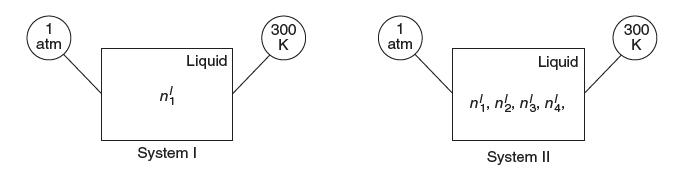
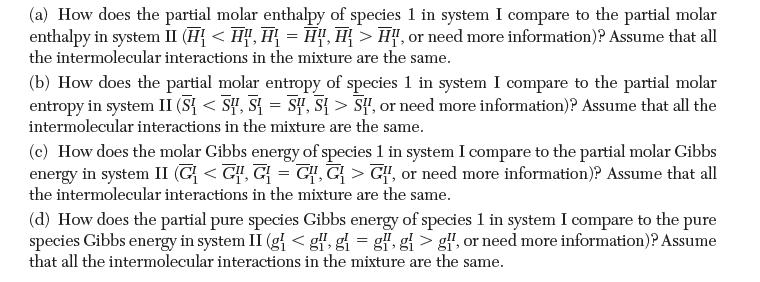
In this problem you will compare properties of species 1 as a pure liquid at 1 atm and 300 K (System I) to species 1 in a mixture with species 2, 3, and 4 at the same pressure and temperature (System II), as shown in the following fi gure. Select the correct answer in each case, and explain your
For a given binary system, the partial molar volume of species 1 is constant. What can you say about species 2? Explain.
(a) Use the Clausius–Clapeyron equation and data for water at 100°C to develop an expression for the vapor pressure of water as a function of temperature.(b) Plot the expression you came up with on a PT diagram for temperatures from 0.01°C to 100°C.(c) Include data from the steam tables on
What pressure is needed to isothermally compress ice initially at 25°C and 1 bar so that it changes phase?
One mole of a pure species exists in liquid–vapor equilibrium in a rigid container of volume V = 1 L, a temperature of 300 K, and a pressure of 1 bar. The enthalpy of vaporization and the second virial coeffi cient in the pressure expansion are:Assume the enthalpy of vaporization does not change
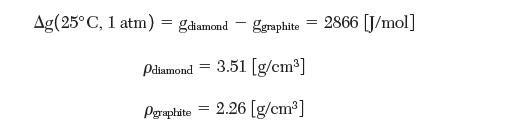
Tired of studying thermo, you come up with the idea of becoming rich by manufacturing diamond from graphite. To do this process at 25°C requires increasing the pressure until graphite and diamond are in equilibrium. The following data are available at 25°C:Estimate the pressure at which these two
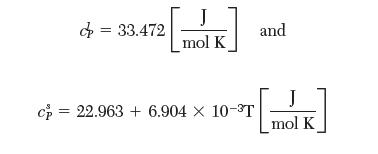
You wish to know the melting temperature of aluminum at 100 bar. You fi nd that at atmospheric pressure, Al melts at 933.45 K and the enthalpy of fusion is:Heat capacity data are given by:Take the density of solid aluminum to be 2700 3kg/m3 4 and liquid to be 2300 [kg/m3 ]. At what temperature does
The vapor pressure of silver (between 1234 K and 2485 K) is given by the following expression:with P in torr and T in K. Estimate the enthalpy of vaporization at 1500 K. State the assumptions that you make. In P= 14,260 T 0.458 In T + 12.23
At a temperature of 60.6°C, benzene exerts a saturation pressure of 400 torr. At 80.1°C, its saturation pressure is 760 torr. Using only these data, estimate the enthalpy of vaporization of benzene. Compare it to the reported value of Δhvap = 35 [kJ/mol].
Pure ethanol boils at a temperature of 63.5°C at a pressure of 400 torr. It also boils at 78.4°C and 760 torr. Using only these data, estimate the saturation pressure for ethanol at 100°C.
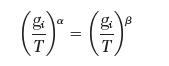
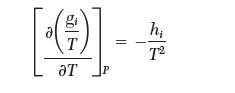
An alternative criteria for chemical equilibrium between two phases of pure species i can be written:Apply the thermodynamic web to show that the partial derivative of this function with respect to temperature at constant pressure is given by: D 50/
At 922 K, the enthalpy of liquid Mg is 26.780 [kJ/mol] and the entropy is 73.888 [J/(mol K)].Determine the Gibbs energy of liquid Mg at 1300 K. The heat capacity of the liquid is constant over this temperature range and has a value of 32.635 [J /(mol K)].
Solid sulfur undergoes a phase transition between the monoclinic (m) and orthorhombic (o) phases at a temperature of 368.3 K and pressure of 1 bar. Calculate the difference in Gibbs energy between monoclinic sulfur and orthorhombic sulfur at 298 K and a pressure of 1 bar. Which phase is more stable
At 900 K, solid Sr has values of enthalpy and entropy of 20.285 [kJ/(mol)] and 91.222 [J/(mol K)], respectively. At 1500 K, liquid Sr has values of enthalpy and entropy of 49.179 [kJ/mol]and 116.64 [J/(mol K)], respectively. The heat capacity for the solid and liquid phases is given
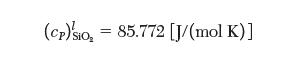
At 1100 K, solid SiO2 has values of enthalpy and entropy of 2856.84 3kJ/mol4 and 124.51 [J/(mol K)], respectively. At 2500 K, liquid SiO2 has values of enthalpy and entropy of 2738.44 [kJ/mol] and 191.94 [J/(mol K)], respectively. The heat capacities for the solid and liquid phases are given
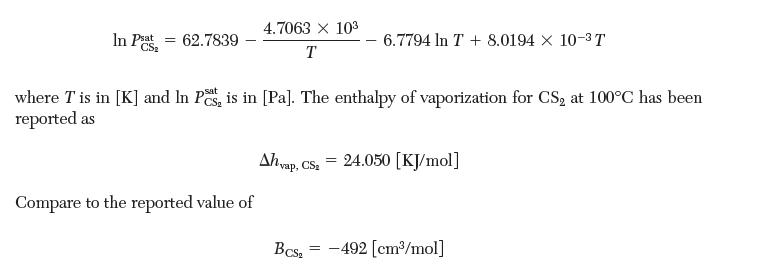
Determine the second virial coeffi cient, B, for CS2 at 100°C from the following data. The saturation pressure of carbon disulfi de (CS2) has been fi t to the following equation: In Pat CS = 62.7839 4.7063 x 10 T Compare to the reported value of 6.7794 In T+ 8.0194 x 10- T where I' is in [K] and
Calculate the Gibbs energy of the liquid and vapor phases of water for the following conditions:(a) Saturated water at 100°C(b) 100°C and 50 kPa Are these results consistent with Equation (6.3) and your intepretation of Gibbs energy? 0 (dG)T,P (6.3)
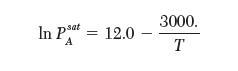
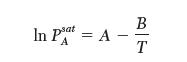
The saturation pressure of pure solid species A is given by:where PAsat is in [bar] and T is in [K]. You wish express the vapor pressure of the liquid in the form:You know the enthalpy of fusion is 210.94 kJ/mol. As best you can, determine the constants A and B. For this problem, you can assume
At 1 bar, silver melts at 1233.95 K. The density of the liquid and solid are:You may assume these values are constant in this problem. The entropy at the normal melting point is:The molecular weight of silver is 107.9 [g/mol].(a) Calculate the Gibbs energy of fusion for silver at 5,000 bar and
You need to fi nd the triple point of pure species A and are unable to fi nd its value in any reference books. You can fi nd the following data for A. It sublimes at 200 K and 0.1 bar, and it boils at 250 K and 1 bar.(a) Calculate the temperature and pressure at the triple point. You may assume
You need to fi nd the enthalpy of sublimation of solid A at 300 K. The following equilibrium vapor pressure measurements have been made on pure A: (1) at 250 K, the pressure is 0.258 bar and (2) at 350 K, the pressure is 2.00 bar. The following heat capacity data are known:(a) Calculate the
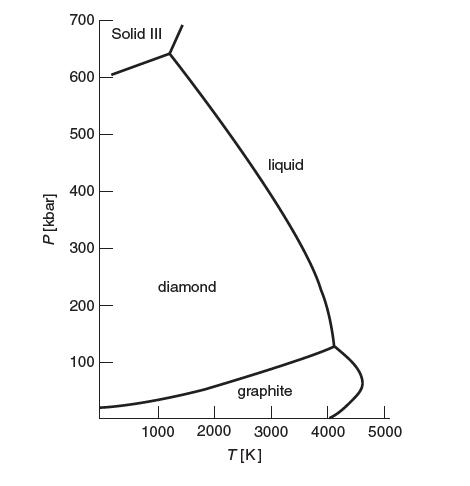
A TP diagram of carbon is presented in the following fi gure. The following data are available at 25°C.Answer the following questions:(a) Identify the region where diamond is the thermodynamically stable phase of carbon. In this region, what can you say about the Gibbs energy of diamond relative
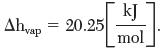
Consider the use of CF2Cl2 as a dispersing agent for aerosol spray cans. Estimate the pressure a can has to withhold at 40°C. Its enthalpy of vaporization at its normal boiling point (244 K) is State your assumptions. Ahvap 20.25 kJ mol
At 1 atm titanium melts at 1941 K and boils at 3560 K. Its triple point pressure is 5.3 Pa.Using only these data, estimate the enthalpy of vaporization of titanium. You will need to think about a reasonable assumption to solve this problem.
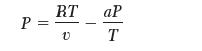
You wish to determine the enthalpy of vaporizaton of species A. You are able to fi nd the following data: Species A has a normal boiling point of 207.3 K, and at 20.0 atm, it boils at 301.5 K.The following equation of state is reported:with a = 25 K. As best as you can, estimate Δhvap. State any
In Example 6.2, we developed an expression for gd - gn vs. T for the protein lysozyme (l)between its native phase, n, and its denatured phase, d, where unfolding occurs. Develop the same expression from the following different approaches:(a) Use the property relation given by Equation
Consider an ideal gas mixture at 83.14 kPa and 500 K. It contains 2 moles of species A and 3 moles of species B. Calculate the following:VA, VB, vA, vB, VA, VB, V, v, ΔVmix, Δvmix.
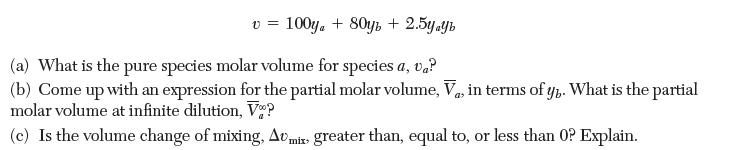
For a given binary system at constant T and P, the molar volume (in cm3 /mol) is given by v = 100y + 80y + 2.5yayb (a) What is the pure species molar volume for species a, va? (b) Come up with an expression for the partial molar volume, Va, in terms of y. What is the partial molar volume at
Consider a mixture of species 1, 2, and 3. The following equation of state is available for the vapor phase:where,and y1, y2, and y3 are the mole fractions of species 1, 2 and 3, respectively. Consider a vapor mixture with 1 mole of species 1, 2 moles of species 2, and 2 moles of species 3 at a
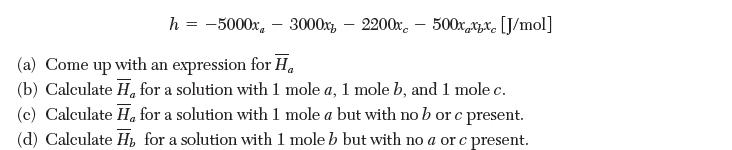
The molar enthalpy of a ternary mixture of species a, b, and c can be described by the following expression: h = -5000x - 3000x2200x500xxx [J/mol] (a) Come up with an expression for H (b) Calculate H for a solution with 1 mole a, 1 mole b, and 1 mole c. (c) Calculate H, for a solution with 1 mole a
Plot the partial molar volumes of CO2 and C3H8 in a binary mixture at 100°C and 20 bar as a function of mole fraction CO2 using the van der Waals equation of state.
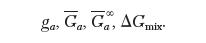
The Gibbs energy of a binary mixture of species a and species b at 300 K and 10 bar is given by the following expression:(a) For a system containing 1 mole of species a and 4 moles of species b, fi nd the following:(b) If the pure species are mixed together adiabatically, do you think the
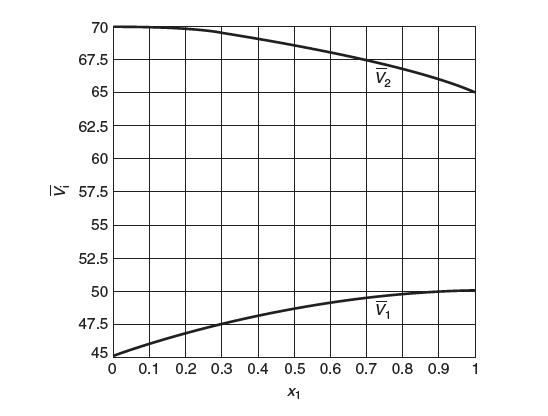
Consider a binary mixture of species 1 and species 2. A plot of the partial molar volumes in [cm3/mol] of species 1 and 2, V1 and V2, vs. mole fraction of species 1 is shown below. For a mixture of 1 mole of species 1 and 4 moles of species 2, determine the following quantities for this mixture:
Enthalpies of mixing for binary mixtures of cadmium (Cd) and tin (Sn) have been fi t to the following equation at 500°C:where, XCd and XSn are the cadmium and tin mole fractions, respectively. Consider a mixture of 3 moles Cd and 2 moles Sn.(a) Show that: Ahmix 13,000XcdXsn [J/mol] =
The Gibbs energy of a binary mixture is given by the following expression:where R is the ideal gas constant and T is in [K]. For a mixture at 298 K with the following mole fractions of a, calculate Ga - ga.(a) xa = 1(b) xa = 0.4(c) xa = 0 (a in infinite dilution) Agmix = RT[xa In xa + xz ln xz] +
The molar enthalpy of a binary liquid mixture of species 1 and 2 is given by:where T is the temperature in [K](a) What is the enthalpy of mixing, ΔHmix in [J], of a mixture with 2 mol of 1 and 3 mol of 2 at 20°C?(b) Consider the adiabatic mixing of a stream of pure 1 fl owing at 2 mol/s with a
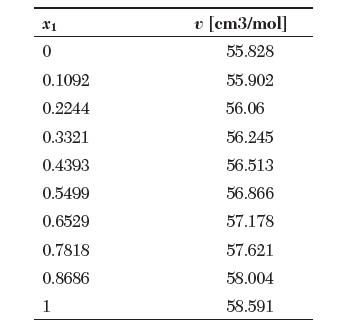
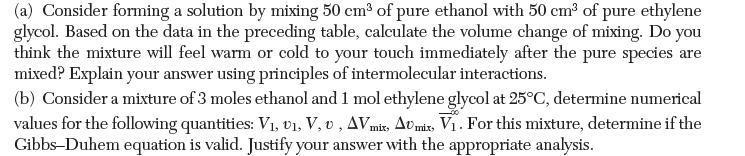
The molar volume, in [cm3/mol], of a binary mixture of ethanol (1) and ethylene glycol (2)at 25°C is given in the following table.Using the graphical method, determine the partial molar volume of ethanol at 25°C for the following mole fractions of species 1:(a) x1 = 0.8(b) x1 = 0.4(c) x1 = 0
The volume change of mixing, in [cm3/mol], for binary liquid mixture of sulfuric acid (1) and water (2) at 25°C is given by the following expression: _Uma = -13.1x12 - 2.25x3x2 mix
The molar enthalpy of a binary liquid mixture of species 1 and 2 is given by:where T is the temperature in [K]. This expression is valid in the temperature range from 280 K to 360 K. Please answer the following questions:(a) You wish to dilute and cool a process stream containing 50 mol% species 1
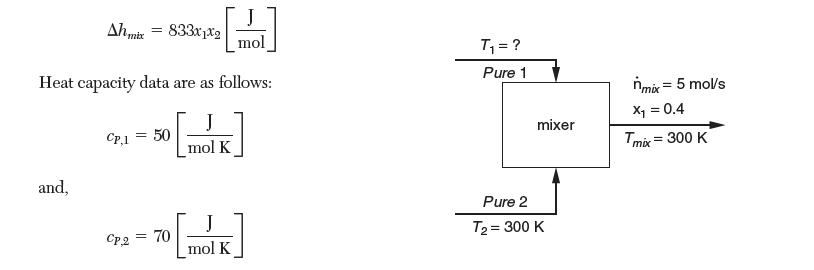
You are running a manufacturing process where a mole fraction of 0.40 species 1 in a binary mixture of 1 and 2 is required at a fl ow rate of 5 mol/s and a temperature of 300 K. This is achieved by mixing pure streams of 1 and 2. The stream of pure 2 fl ows into the mixer at a temperature of 300 K.
The partial molar Gibbs energy of species 1 in a binary liquid mixture of species 1 and 2 is given by: G-500 + 2,500 In x + 833x J mol
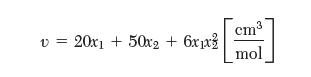
The following expression describes the molar volume of a binary liquid mixture of species 1 and 2:Consider a mixture that contains 2 mol of species 1 and 4 mol of species 2. Answer the following questions:(a) What are the values of V1 and v1?(b) Develop an expression for the partial molar
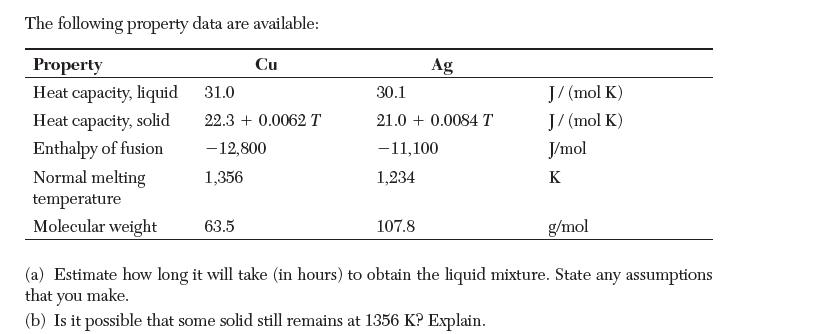
You are designing a process that requires a molten liquid solution of copper (Cu) and silver (Ag). You start with a charge of 1,000 kg of pure Cu and 2,000 kg of pure Ag at 298 K and 1 atm.You place the materials in a well-insulated, open container and heat them to 1356 K so that they form a liquid
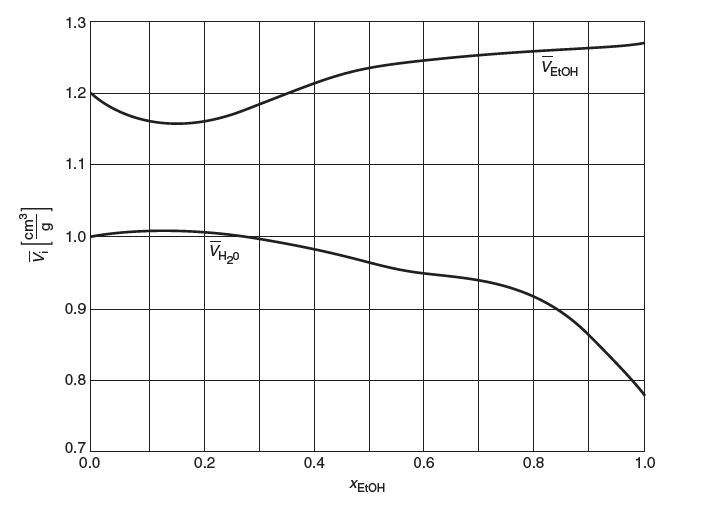
Consider a binary mixture of ethanol, EtOH (CH3CH2OH) and water (H2O) . A plot of the partial molar volumes of EtOH and H2O versus mole fraction EtOH (xEtOH) is provided in the following fi gure. Note that the units of partial molar volume are on a per mass basis so that both plots fi t on the same
A group of students came across an unsuspected supply of laboratory alcohol containing 96 weight % ethanol (EtOH) and 4 weight % water (H2O) . As an experiment, they wanted to see if they could make exactly 2.00 L of vodka having a composition of 56 weight % ethanol. Determine the volume of lab
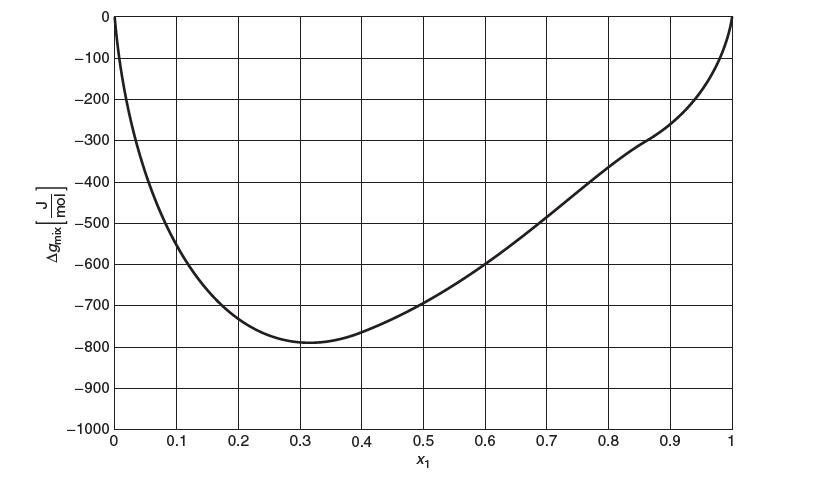
The Gibbs energy of mixing, Δgmix in [J/mol], of a binary liquid mixture of water (1) and 1-propanol (2) vs. mole fraction water (x1)is shown below. These data are at a temperature at 40°C. A9mix mol! 0 -100 -200 -300 -400 -500 -600 -700 -800 -900 -1000 0 0.1 0.2 0.3 0.4 0.5 X1 0.6 0.7 0.8 0.9
A binary mixture of species a and b behaves as an ideal gas at 300 K and 1 bar. Calculate the partial molar Gibbs energy of species a, Ga, and the total solution Gibbs energy, g, at the following compositions. The pure species Gibbs energy for species a is 225 kJ/mol and for species b is 240
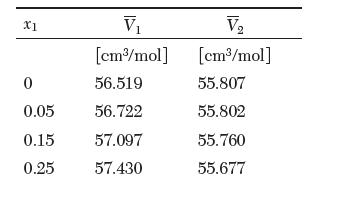
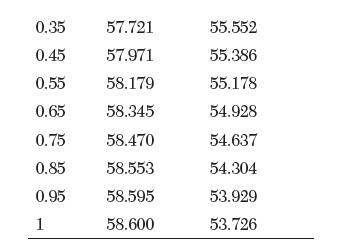
The partial molar volumes of a binary mixture of ethanol (1) and ethylene glycol (2) at 25°C are reported in the following table. Answer the following questions: V [cm3/mol] 0 56.519 0.05 56.722 0.15 57.097 0.25 57.430 X1 V [cm/mol] 55.807 55.802 55.760 55.677
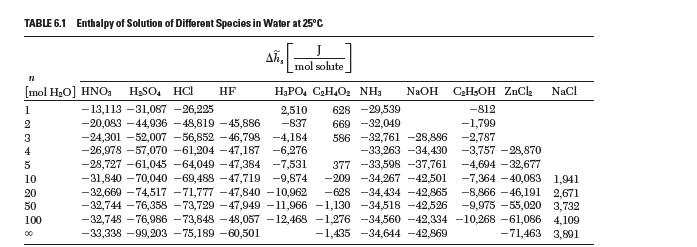
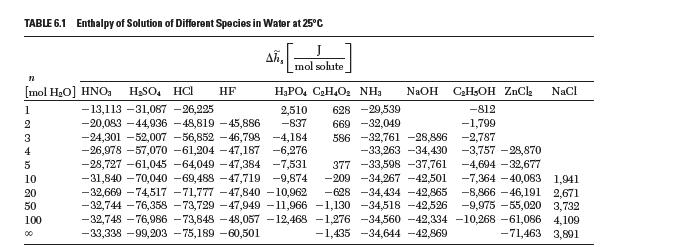
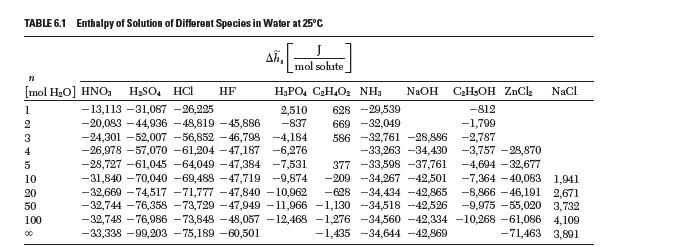
Enthalpies of solution, are reported in Table 6.1 for 1 mole of HCl diluted in n moles of H2O at 25°C:(a) Consider a mixture of 8 moles H2O and 2 moles HCl. As best you can from these data, estimate(b) For a mixture of 80 moles H2O and 2 moles HCl, estimate ,
Aqueous HCl can be manufactured by gas-phase reaction of H2 and Cl2 to form HCl(g), followed by absorption of HCl(g) with water. Consider a steady-state process at 25°C where HCl(g)and pure water are fed to form aqueous acid with 30% HCl by weight. What is the amount of cooling that must be
How does the enthalpy of mixing data for H2SO4 given by Equation (6.24) compare to the enthalpy of solution data from Table 6.1? Is the agreement reasonable? What are the reasons they may be different? Ahmbx = -74.40XHSO, XHO(1 - 0.561xHSO.) [kJ/mol] (6.24)
Calculate the enthalpy of mixing for HCl from the enthalpy of solution data reported in Table 6.1. TABLE 6.1 Enthalpy of Solution of Different Species in Water at 25C Ah, J mol solute n NaOH CH5OH ZnCl NaCl HPO4 CH4O NH 2,510 628 -29,539 -812 669 -32,049 -1,799 -2,787 586 -32,761 -28,886 -33,263
What is the heat requirement to dilute an inlet aqueous stream of 50% NaOH, by weight, to a fi nal concentration of 10%?
Develop an equation for a ternary mixture analogous to Equation (6.30). Then generalize to a mixture with m components.
The partial molar volume of benzene (1) in cyclohexane (2) at 30°C is given by the following expression:Find an expression for the partial molar volume of cyclohexane. The density of cyclohexane at 30°C is 0.768 [g/cm3 ]. V = 92.6 - 5.28x + 2.64x7 [cm/mol]
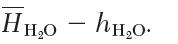
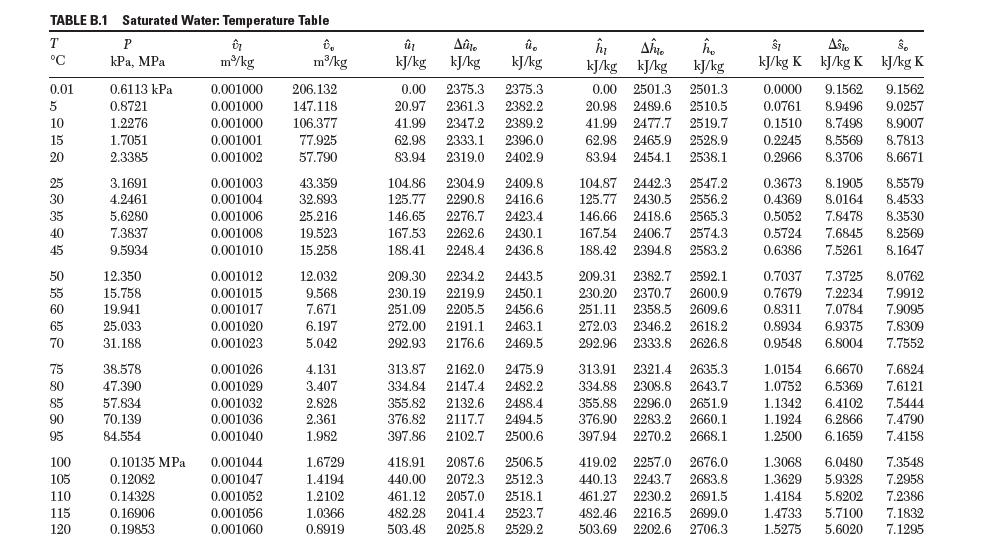
Using data from Table 6.1, fi nd the partial molar enthalpy of water in a mixture of ethanol (1) and water (2) at 25°C with x1 = 0.33. Use the same reference state as used in the steam tables.Steam tables TABLE 6.1 Enthalpy of Solution of Different Species in Water at 25C Ah, J mol solute n NaOH
Consider the isothermal mixing of 20% solute 1 by weight and 80% water, 2, at 25°C. What is the heat transferred for the following mixtures? (a) pure HSO4 (1) and HO (2) (b) 18 M HSO4 (1) and HO (2). (the density of 18 M HSO4 is reported as 1.84 g/cm) (c) solid NaOH (1) and HO (2) (d) NH3 gas (1)
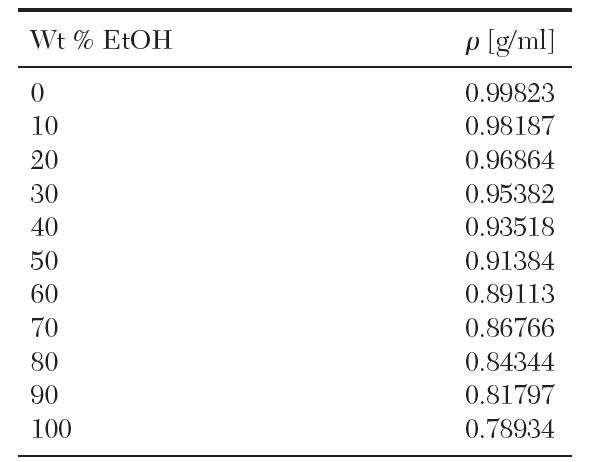
The following data are available for a binary mixture of ethanol and water at 20°C:(a) Make a plot of the partial molar volumes of ethanol and water vs. mole fraction ethanol.(b) What is Δvmix for an equimolar solution? Wt % EtOH 0 10 20 30 40 50 60 70 80 90 100 p[g/ml] 0.99823 0.98187 0.96864
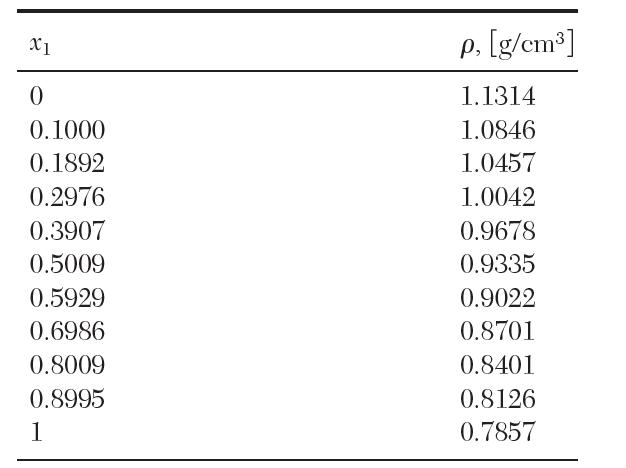
The following data have been reported for the density, r, vs. mole fraction ethanol of binary mixtures of ethanol (1) and formamide (2) at 25°C and 1 bar. X1 0 0.1000 0.1892 0.2976 0.3907 0.5009 0.5929 0.6986 0.8009 0.8995 1 p, [g/cm] 1.1314 1.0846 1.0457 1.0042 0.9678 0.9335 0.9022 0.8701 0.8401
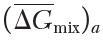
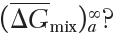
Consider a binary mixture of ideal gases, a and b, at temperature T and pressure P. Come up with an expression forin terms of T, P, and ya. What is the value of (AGmix) a
Consider a system in which liquid water is in phase equilibrium with wet air at 25°C and 1 bar. What is the partial molar Gibbs energy of the water in the vapor phase? You may assume the liquid is pure water and the vapor behaves as an ideal gas.
We have seen that the Gibbs energy determines whether a process can occur spontaneously. This concept can be applied to understand aspects of biological systems. Use the Gibbs energy to show why the proteins that control complex living organisms are not stable at high ambient temperatures.
We can use the principles of phase equilibrium to learn about the stability of proteins in biological systems. In this example, we consider the phase equilibrium of the protein lysozyme (l) between its native phase, n, and its denatured phase, d, where unfolding occurs.The following thermochemical
Trimethyl gallium, Ga(CH3 ) 3, can be used as a feed gas to grow fi lms of GaAs. Estimate the enthalpy of vaporization of Ga(CH3) 3 from the data of saturation pressure vs. temperature given in Table E6.3.
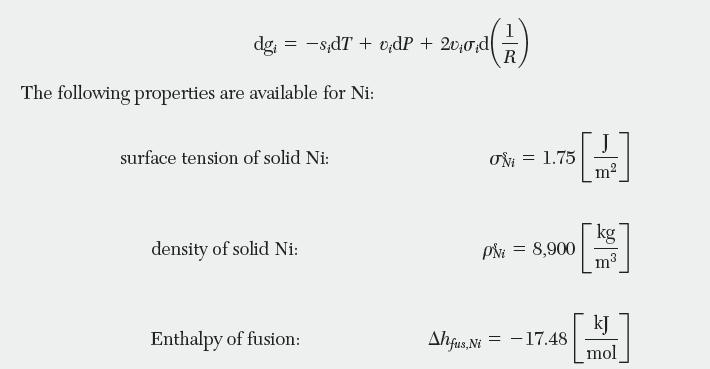
The fi eld of nanotechnology is an emerging area for chemical and biological engineers. Consider nickel nanoparticles for use as a catalyst to grow carbon nanotubes. The normal melting temperature, Tm, of nickel is 1728 K. In a nanoparticle, the curved surface leads to a force acting tangentially
Mathematically verify that integration of Equation (6.16) leads to Equations (6.18) or (6.17) (a) starting with the expression for dK; (b) based on applying Euler’s theorem to Equation (6.13). dk = Ekdni (6.16)
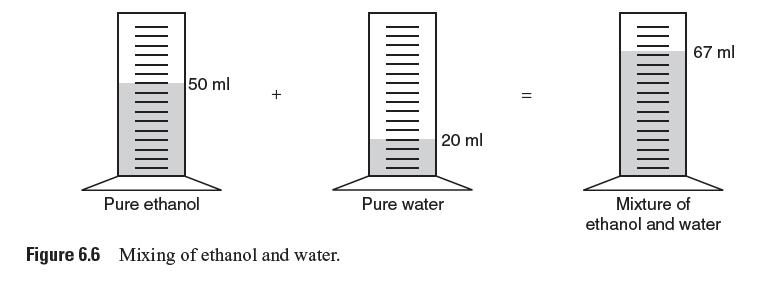
Label the volumes depicted in Figure 6.6 according to the different types of thermodynamic properties depicted in this section. 50 ml Pure ethanol + Figure 6.6 Mixing of ethanol and water. 20 ml Pure water || 67 ml Mixture of ethanol and water
An experiment is performed to measure the enthalpy of mixing of chloroform, CHCl3, and acetone, C3H6O. In this experiment, pure species inlet streams of different compositions are mixed together in an insulated mixer at steady-state. This mixing process is exothermic, and the heat that is removed
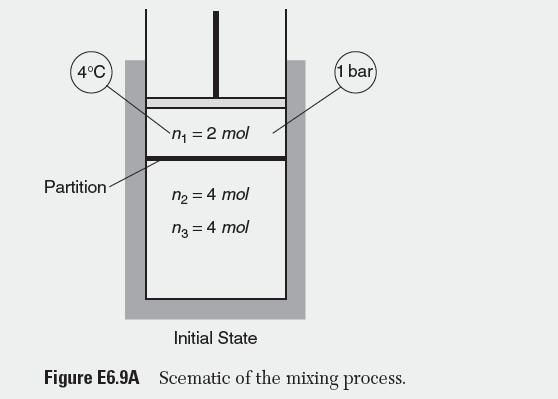
An insulated piston–cylinder assembly contains two compartments divided by a partition. As shown in Figure E6.9A, the top compartment initially contains 2 moles of pure liquid 1, whereas the bottom contains a mixture of 4 moles of liquid 2 and 4 moles of liquid 3. The temperature is initially
Table 6.1 presents data for the enthalpy of solution, for nitric acid in water at 18°C. Find the corresponding values for the enthalpy of mixing vs. mole fraction of solute. Ahs, S
Develop an expression for the entropy change of mixing for a binary ideal gas mixture.
Consider a binary mixture of 10 mole% chloroform (1) in acetone (2) at 333 K and 10 bar. The second virial coeffi cients for this system are reported to be B11 = 2910, B22 = -1330, and B12 = 22005 cm3/mol. Determine v1, V1, and Δvmix.
Develop expressions for the partial molar enthalpies of sulfuric acid and water in a binary mixture at 21°C. The pure species enthalpies are 1.596 [kJ/mol] and 1.591 [kJ/mol], respectively, and the enthalpy of mixing is given by Equation (6.24). Calculate their values for an equimolar mixture of
Verify that the expressions developed in Example 6.12 for the partial molar enthalpies of sulfuric acid and water in a binary mixture at 21°C satisfy the Gibbs–Duhem equation.
Develop an expression for the partial molar enthalpy of sulfuric acid in water at 21°C using Equation (6.30). dk K=kx2 drz (6.30)
Graphically determine values for the partial molar enthalpies of sulfuric acid and water in an equimolar mixture at 21°C by plotting Equation (E6.13A). h = 1.596XHSO, +1.591xHO - 74.40xHSOHO (1 - 0.561xHSO.) [kJ/mol] (E6.13A)
Consider a system at temperature T and pressure P with m species present in π phases. How many measurable properties need to be determined (e.g., T, P, and xi) to constrain the state of the entire system?
Consider a bottle of water that you have just opened in the room in which you are sitting. How does the fugacity of water in the liquid in the bottle compare to the fugacity of water in the vapor (i.e., in the air in the room)? You may assume that the liquid in the bottle is at room
A gas mixture of species 1 and 2 at 300 K and 30 bar perfectly obeys the Lewis fugacity rule. What is the enthalpy of mixing? Choose one of the following answers, and explain your reasoning. (Δhmix , 0 if attractive interactions dominate at 300 K and 30 bar/Δ hmix . 0 if attractive interactions
In which of the following mixtures do you expect species 1 to be better represented by the Lewis fugacity rule? Explain.Mixture A: n-pentane (1) and n-hexane (2)or, Mixture B: water (1) and n-hexane (2)
Explain why the mixing rules for the van der Waals constants a and b have different forms.
It is 10 a.m. and already getting hot. You are wondering why you agreed to do fi eld work for the summer in Houston. On the radio, the weatherperson declares, “It will be another scorcher today with the temperature approaching 95 (°F) and a (relative) humidity of 90%.” Maybe it is the heat,
Henry’s law is often a convenient reference state for the dilute components in the liquid phase in equilibria calculations.(a) Consider a solution of acetone (1) in water (2) vs. a solution of methane (1) in water (2). Which solution has the larger Henry’s law constant, Hi?
Consider a binary liquid mixture of species a and b. The activity coeffi cients for this mixture are adequately described by the two-suffi x Margules equation.(a) If Δhmix = 0, what can you say about the two-suffi x Margules parameter, A?(b) If Δvmix = 0, what can you say about the two-suffi x
The development of fugacity is stated to be inductive. Explain what you think is meant by that.
Showing 200 - 300
of 746
1
2
3
4
5
6
7
8
Step by Step Answers

 Get 50% OFF
Claim Now
Get 50% OFF
Claim Now