New Semester
Started
Get
50% OFF
Study Help!
--h --m --s
Claim Now
Question Answers
Textbooks
Find textbooks, questions and answers
Oops, something went wrong!
Change your search query and then try again
S
Books
FREE
Study Help
Expert Questions
Accounting
General Management
Mathematics
Finance
Organizational Behaviour
Law
Physics
Operating System
Management Leadership
Sociology
Programming
Marketing
Database
Computer Network
Economics
Textbooks Solutions
Accounting
Managerial Accounting
Management Leadership
Cost Accounting
Statistics
Business Law
Corporate Finance
Finance
Economics
Auditing
Tutors
Online Tutors
Find a Tutor
Hire a Tutor
Become a Tutor
AI Tutor
AI Study Planner
NEW
Sell Books
Search
Search
Sign In
Register
study help
engineering
introductory chemical engineering thermodynamics
Engineering And Chemical Thermodynamics 2nd Edition Milo D. Koretsky - Solutions
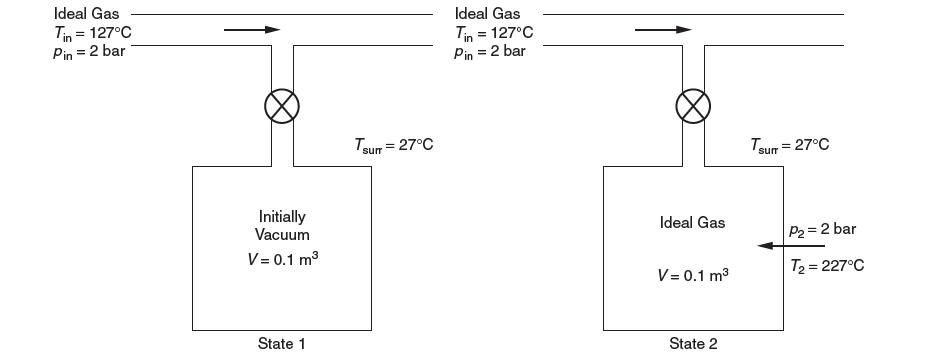
A rigid tank of volume 0.1 m3 is fi lled from a supply line at 127°C and 2 bar, as drawn in the following fi gure. It is initially at vacuum. The valve is opened, and the tank fi lls until the pressures equilibrate. The valve is then shut. During this process, 6,000 [J] of heat transfers to the
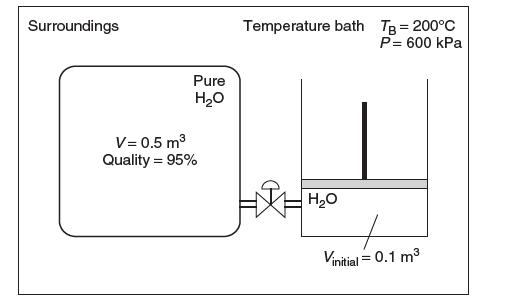
A rigid tank of volume 0.5 m3 is connected to a piston–cylinder assembly by a valve as shown below. Both vessels contain pure water. They are immersed in a constant-temperature bath at 200°C and 600 kPa. Consider the tank and the piston–cylinder assembly as the system and the
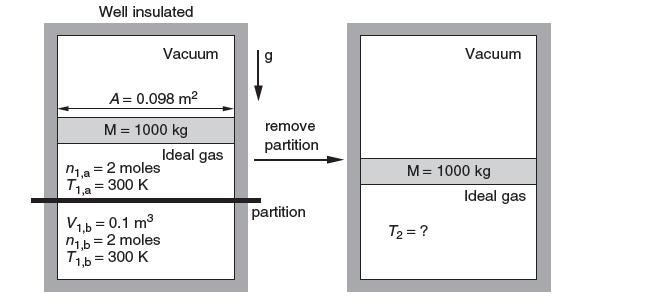
A rigid, well-insulated container is initially divided into three compartments. The top compartment contains a vacuum. It is separated from the middle compartment A by a frictionless mass of 1000 kg and area 0.098 m2. Compartment A contains 2 moles of ideal gas at 300 K and is separated from
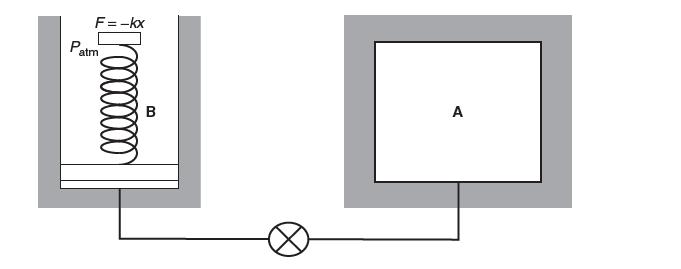
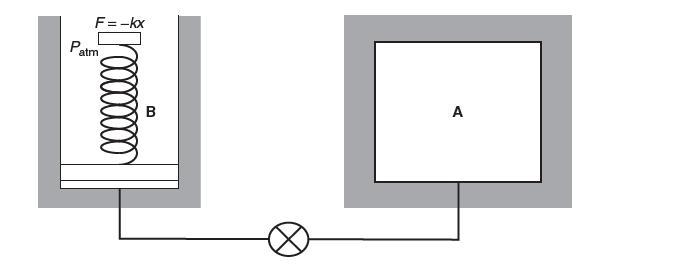
Consider the system shown below. Tank A has a volume of 0.3 m3 and initially contains an ideal diatomic gas at 700 kPa, 40°C. Cylinder B has a piston resting on the bottom, at which point the spring exerts no force on the piston. The piston–cylinder has a cross-sectional area of 0.065 m2, the
A steam turbine in a small electric power plant is designed to accept 4500 kg/hr of steam at 60 bar and 500°C and exhaust the steam at 10 bar. Heat transfers to the surroundings 1Tsurr 5 300K2 at a rate of 69.86 kW. Answer the following questions:(a) Calculate the maximum powerthat the turbine
Air fl owing at 1 m3/s enters an adiabatic compressor at 20°C and 1 bar. It exits at 200°C. The isentropic effi ciency of the compressor is 80%. Calculate the exit pressure and the power required.
Steam enters a turbine at 10 MPa and 500°C and leaves at 100 kPa. The isentropic effi ciency of the turbine is 85%. Calculate the exit temperature and the work generated per kg of steam fl owing through.
Nitrogen gas at 27°C fl ows into a well-insulated device operating at steady-state. There is no shaft work. The device has two exit streams. Two-thirds of the nitrogen, by mass, exits at 127°C and 1 bar. The remainder exits at an unknown temperature and 1 bar. Find the exit temperature of the
Consider a well-insulated piston–cylinder assembly containing 5 kg of water vapor, initially at 540°C and 60 bar, that undergoes a reversible expansion to 20 bar. The surroundings are at 1 bar and 25°C. Answer the following questions:(a) What is the entropy change (Δsuniv, Δssurr, and
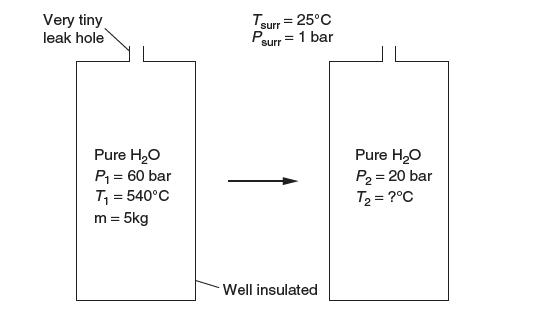
Consider a well-insulated, rigid tank containing 5 kg of water vapor in the same initial state as in Problem 3.52 (540°C, 60 bar). Again, the surroundings are at 1 bar and 25°C, as shown below.A tiny leak develops, and water slowly escapes until the pressure reaches 20 bar.Do you expect the fi
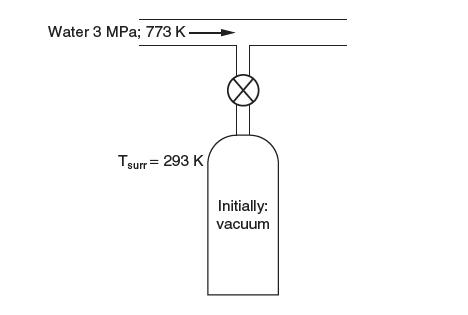
Consider fi lling a “type A” gas cylinder with water from a high-pressure supply line as shown on next page. Before fi lling, the cylinder is empty (vacuum). The valve is then opened, exposing the tank to a 3-MPa line at 773 K until the pressure of the cylinder reaches 3 MPa. The valve is then
A rigid tank has a volume of 0.01 m3. It initially contains saturated water at a temperature of 200°C and a quality of 0.4. The top of the tank contains a pressure-regulating valve that maintains the vapor at constant pressure. This system undergoes a process whereby it is heated until all the
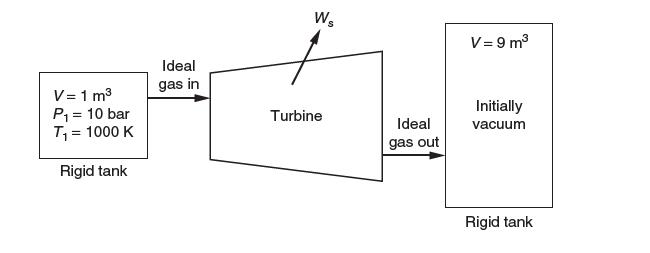
Consider the system sketched below in which a turbine is placed between two rigid tanks. Tank 1 initially contains an ideal gas at 10 bar and 1000 K. Its volume is 1 m3. Tank 2 is 9 m3 and is initially at vacuum. The heat transfer with the surroundings is negligible. Determine the maximum work (in
A hot reservoir is available at 500°C and a cold reservoir at 25°C. Calculate the maximum possible effi ciency of a power cycle that operates between these two reservoirs.
An ideal Rankine cycle operates with the following design: 100 kg/s of steam enters the turbine at 30 bar and 500°C and is condensed at 0.1 bar. Determine the power produced and the effi ciency of the cycle.
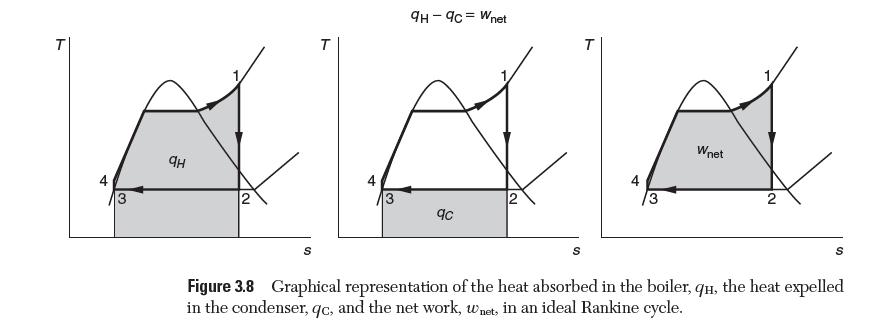
Come up with four ways in which you can make the power cycle of Problem 3.58 more efficient. Illustrate how your ideas achieve increased effi ciency using sketches like that in Figure 3.8.Problem 3.58An ideal Rankine cycle operates with the following design: 100 kg/s of steam enters the turbine at
An ideal Rankine cycle produces 100 MW of power. If steam enters the turbine at 100 bar and 500°C and is condensed at 1 bar, determine the mass fl ow rate of steam. Recalculate the mass fl ow rate assuming that the isentropic effi ciency of the turbine and the compressor are 80%.
Consider a refrigeration system based on an ideal vapor-compression cycle using R-134a as the refrigerant. It operates between 0.7 MPa and 0.12 MPa with a fl ow rate of 0.5 mol/s. Calculate the following:(a) the rate of heat removal from the refrigerated unit(b) the power input needed to the
If the throttling valve in Problem 3.62 is replaced by an isentropic turbine, what is the COP? Is this modifi cation practical? Explain.Problem 3.62Consider a refrigeration system based on an ideal vapor-compression cycle using R-134a as the refrigerant. It operates between 0.7 MPa and 0.12 MPa
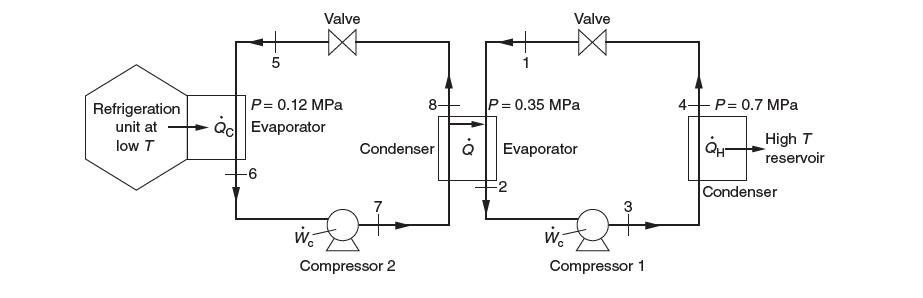
A two-stage cascade refrigeration system is shown below. The refrigerant is R134a. It consists of two ideal vapor-compression cycles with heat exchange between the condenser of the lowertemperature cycle and the evaporator of the higher-temperature cycle. The hotter cycle operates between 0.7 MPa
Design a vapor-compression refrigeration system to cool a system to 25°C with the capability for up to 20 kW of cooling. You have a reservoir at 20°C to reject heat to. Refrigerants and their properties can he found at http://webbook.nist.gov/chemistry/fluid/.
Modify the vapor-compression refrigeration system presented in Section 3.9 to apply to a refrigerator for home use. This system needs to provide cooling to two units: the freezer at 215°C and the main compartment at 5°C. Take the refrigeration capacity, QC, of each compartment to be equal. You
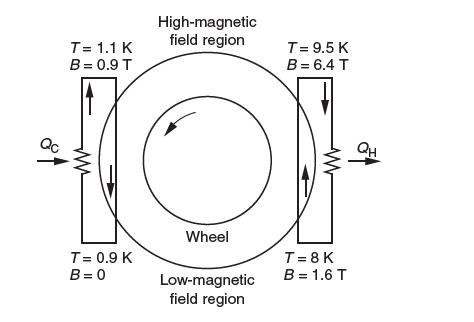
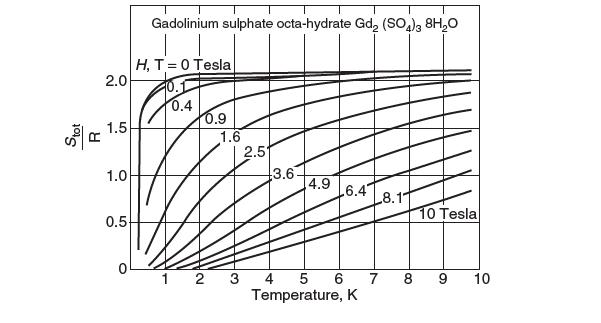
Consider an ideal, reversible magnetic refrigeration cycle shown in the fi gure on next page.A paramagnetic working material in the form of the rim of a wheel is rotated between a hightemperature reservoir and a low-temperature reservoir. In the high-temperature reservoir, the working material
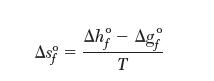
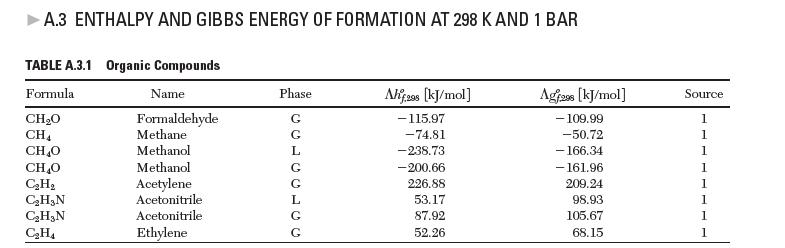
Consider the oxidation of cuprous oxide to form cupric oxide by the following reaction:Calculate Δsrxn. This task can be done in the same type of path described in Section 2.6 for Δhrxn.You can calculate the values of entropies of formation from the data in Appendix A.3 by applying the following
Determine the exergy of the following states. Take the environment to be at 25°C and 1 bar.(a) Argon at 500 K and 2 bar(b) Propane at 500 K and 2 bar(c) Water at 500 K and 2 bar
Determine the exergy of a system of pure water containing 1 kg ice and 10 g water vapor at 220°C. Take the environment to be at 10°C and 1 bar.
1 kg of copper at 600°C and 1 bar is immersed in 20 kg of water at 20°C and 1 bar in a well-insulated container. Consider the system to be both the copper and the water. Calculate the change in internal energy, energy and exergy of the system for the process. Take the environment to be 25°C and
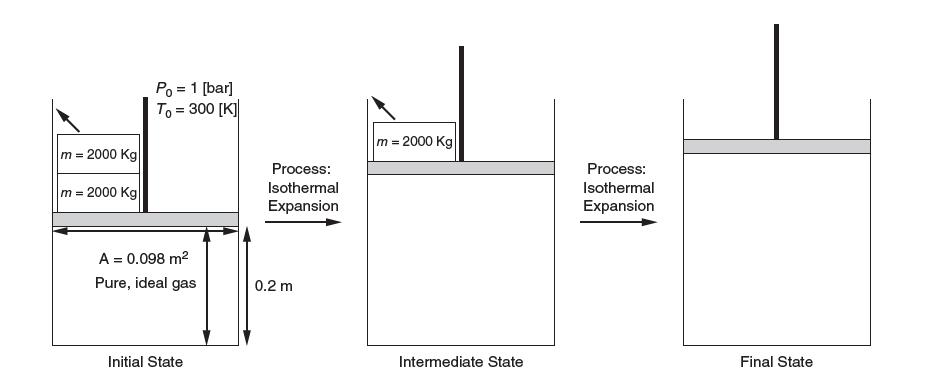
An ideal gas is contained in a piston–cylinder assembly. The pressure of the gas is initially balanced by two 2000 kg blocks plus the atmospheric pressure of 1 [bar]. The piston has a crosssectional area of 0.098 3m2 4 and is initially 0.2 [m] from the base of the cylinder. The gas is allowed to
Steam enters a turbine with a mass fl ow rate of 5 [kg/s]. The inlet pressure is 60 bar, and the inlet temperature is 500°C. The outlet contains saturated steam at 1 bar. The surroundings are at 20°C. At steady state,(a) Calculate the power generated by the turbine.(b) Calculate the isentropic
1 mol of steam is initially at 10 bar and 200°C. The surroundings are at 20°C and 1 bar.(a) Calculate the exergy of the system.(b) Calculate the change in exergy for a process where the steam is heated at constant pressure until the volume doubles.(c) Calculate the change in exergy for a
Ethylene (C2H4) at 100°C and 1 bar passes through a heater and emerges at 200°C. Calculate the change in exthalpy per mole of ethylene that passes through. You may assume ideal gas behavior. The environment is at 20°C.
Consider a tank containing 100 kg of water initially at 70°C. Due to heat transfer, the temperature of water in the tank drops to 50°C. The surroundings are at 10°C. Calculate the lost work.
An open feedwater heater is used to take inlet stream of water vapor at 5 bar and 200°C and have it leave as saturated liquid at 5 bar. This is accomplished by mixing it with an appropriate amount of a second inlet stream at 5 bar and 20°C. Calculate the lost work.
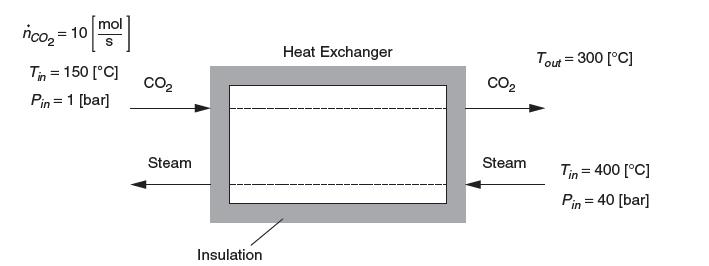
You wish to heat a stream of CO2 at pressure 1 bar, fl owing at 10 mol/s, from 150°C to 300°C in a countercurrent heat exchanger. To do this task, you are using a stream of high-pressure steam available at 40 bar and 400°C, as shown in the following fi gure. The steam exits the heat exchanger as
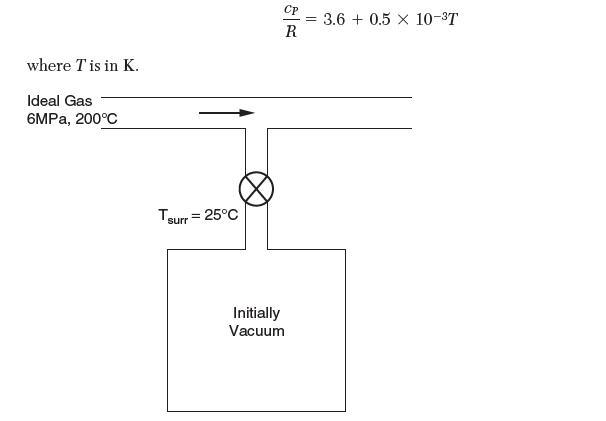
An ideal gas at 6 MPa and 200°C is fl owing in a pipe, as shown in the following fi gure. Connected to this pipe through a valve is a tank of volume 0.4 m3. This tank initially is at vacuum. The valve is opened, and the tank fi lls with the ideal gas until the pressure is 6 MPa, and then the valve
Steam at 6 MPa and 400°C is fl owing in a pipe. Connected to this pipe through a valve is a tank of volume 0.4 m3. This tank initially is at vacuum. The valve is opened, and the tank fi lls with the steam until the pressure is 6 MPa, and then the valve is closed. Heat transfer occurs from the tank
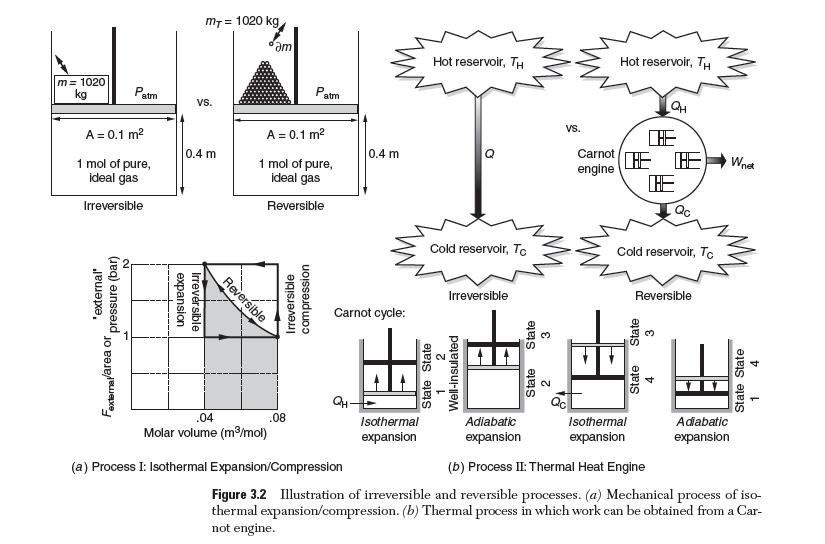
In Section 2.3, we learned about reversible and irreversible processes in the context of a piston–cylinder assembly undergoing isothermal expansion and compression processes. Four of these processes are summarized in Figure 3.2:(i) Irreversible expansion, process A (ii) Irreversible
An insulated tank (V = 1.6628 L) is divided into two equal parts by a thin partition. On the left is an ideal gas at 100 kPa and 500 K; on the right is a vacuum. The partition ruptures with a loud bang.(a) What is the fi nal temperature in the tank?(b) What is Δsuniv for the process?
Consider an isolated system containing two blocks of copper with equal mass. One block is initially at 0ºC while the other is at 100ºC. They are brought into contact with each other and allowed to thermally equilibrate. What is the entropy change for the system during this process?Take the heat
Calculate the change in entropy when 1 mole of saturated ethanol vapor condenses at its normal boiling point.
Steam enters a nozzle at 300 kPa and 700ºC with a velocity of 20 m/s. The nozzle exit pressure is 200 kPa. Assuming this process is reversible and adiabatic determine(a) the exit temperature and(b) the exit velocity.
In Example 2.21, we analyzed an open feedwater heater. Superheated water vapor at a pressure of 200 bar, a temperature of 500ºC, and a fl ow rate of 10 kg/s was brought to a saturated vapor state at 100 bar by mixing this stream with a stream of liquid water at 20ºC and 100 bar.The fl ow rate for
A piston–cylinder device initially contains 0.50 m3 of an ideal gas at 150 kPa and 20ºC. The gas is subjected to a constant external pressure of 400 kPa and compressed in an isothermal process. Assume the surroundings are at 20ºC. Take cP = 25R and assume the ideal gas model
Calculate the entropy change when 1 mole of air is heated and expanded from 25ºC and 1 bar to 100ºC and 0.5 bar.
One mole of pure N2 and 1 mole of pure O2 are contained in separate compartments of a rigid container at 1 bar and 298 K. The gases are then allowed to mix. Calculate the entropy change of the mixing process.
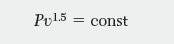
In Section 2.7, we came up with the following expression for a reversible, adiabatic process on an ideal gas with constant heat capacity, based on fi rst-law analysis:Come up with the same equation based on second-law analysis, starting from Equation (3.23). pyk = const
Consider a cylinder containing 4 moles of compressed argon at 10 bar and 298 K. The cylinder is housed in a big lab maintained at 1 bar and 298 K. The valve develops a leak and Ar escapes to the atmosphere until the pressure and temperature equilibrate. After a suffi cient amount of time, the argon
An ideal gas enters a turbine with a fl ow rate of 250 mol/s at a pressure of 125 bar and a specifi c volume of 500 cm3/mol. The gas exits at 8 bar. The process operates at steady-state. Assume the process is reversible and polytropic with:Find the power generated by the turbine. Puls = const
In an actual expansion through the turbine of Example 3.12, 22.1 [MW] of power is obtained. What is the isentropic effi ciency, hturbine, for the process? The isentropic effi ciency is given by: nturbine = (W) real (W) rev
Steam enters the turbine in a power plant at 600ºC and 10 MPa and is condensed at a pressure of 100 kPa. Assume the plant can be treated as an ideal Rankine cycle. Determine the power produced per kg of steam and the effi ciency of the cycle. How does the effi ciency compare to a Carnot cycle
Redo the analysis of the Rankine cycle of Example 3.14 but include isentropic effi ciencies of 85% in the pump and turbine. Determine the net power and the overall effi ciency of the power cycle.
It is desired to produce 10 kW of refrigeration from a vapor-compression refrigeration cycle. The working fl uid is refrigerant 134a. The cycle operates between 120 kPa and 900 kPa. Assuming an ideal cycle, determine the COP and the mass fl ow rate of refrigerant needed. Properties of refrigerant
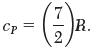
Consider a piston-cylinder assembly containing an ideal gas, initially at 20.0 bar and 1000 K. The initial volume is 1.6 L. The system undergoes a reversible process in which it is expands to 1 bar. Take the environment to be at 1 bar and 20°C. Take cp = (7/2)R. The pressure volume relationship
A shell and tube heat exchanger is designed to warm air from the environment by condensing steam that is passed through the tubes on the other side. The maximum air fl ow is 30 kg/min, and the air is inlet at the temperature and pressure of the environment, 285 K and 1 bar, respectively.The steam
Magnetic refrigeration cycles can be used to achieve supercold temperatures. They typically operate between a “hot” reservoir at liquid helium temperature (4.4 K) and a cold reservoir at very low temperature (as low as 0.0065 K). One confi guration consists of a paramagnetic working material,
Consider BClH2. In each of the following cases, when do you expect the compressibility factor to be closer to one. Explain.(a) At 300 K, 10 bar or at 300 K, 20 bar(b) At 300 K, 20 bar or 1000 K, 20 bar(c) Consider a mixture of BClH2 and H2 at 300 K, 10 bar. Qualitatively plot the compressibility
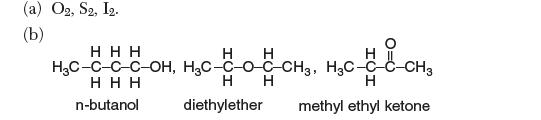
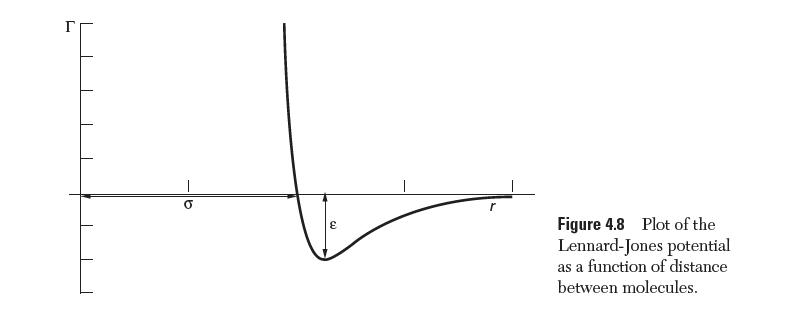
The Lennard-Jones potential function is often used to describe the molecular potential energy between two species. Rank each of the following sets of species, from largest to smallest, in terms of Lennard-Jones parameters s and e. If there is no noticeable difference, write that they are roughly
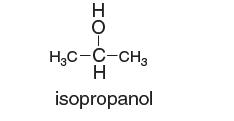
Using your knowledge of intermolecular forces, explain the following observation:(a) At 300°C and 30 bar, the internal energy of water is less than at 300°C and 20 bar.(b) At 300 K and 30 bar, the compressibility factor of isopropanol (H3CCOHCH3) is less than that of n-pentane (C5H12), but at
Consider comparing 1 mole of NH3 at 10 bar and 500 K behaving as a real gas (i.e., considering its intermolecular interactions) vs. 1 mole of NH3 at 10 bar and 500 K behaving as an ideal gas (i.e., hypothetically “turning off” the intermolecular interactions). Answer the following questions
Consider comparing 1 mole of NH3 at 10 bar and 500 K vs. 1 mole of Ne at 10 bar and 500 K.Answer the following questions using molecular arguments. Explain your choice with diagrams and descriptions of the interactions involved.(a) In which case is the compressibility factor, z, higher?(b) In
The normal boiling points of some halide silanes are reported below. Explain the order in terms of intermolecular forces. Species Boiling point [C] SiCIF 3 - 70.0 SiBrF3 - 41.7 SiCl3F 12.2 SiBr3 F 83.8 SilCl3 114
Three isomers of C3H6O2 have the following normal boiling points: propanoic acid (CH3CH2COOH), 141°C; methyl acetate (CH3COOCH3), 58°C; and ethyl formate (HCOOCH2CH3), 53°C. Using your understanding of intermolecular interactions, explain why (i) propanoic acid boils at a much higher
Normal boiling points are shown for sets of species in the following tables. Explain the order based on your understanding of intermolecular interactions:(a) Alkyl halides(b) Alkanes Species Boiling Point (C) CHCH3 -88 CHCHC1 12 CHCHBr 38 CHCHI 71
If the diatomic gas of Problem 3.47 were nonideal at the pressures in the problem and attractive forces dominate, qualitatively describe how the fi nal temperature in tank A would change from the answer you obtained in that problem.Problem 3.47Consider the system shown below. Tank A has a volume of
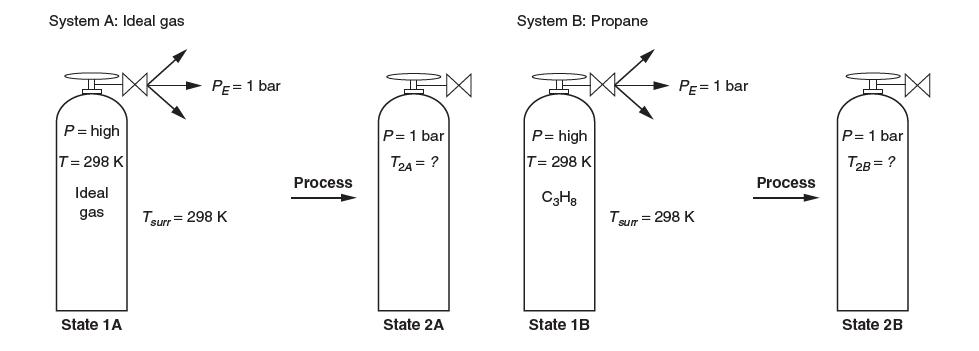
Consider a high-pressure tank at room temperature. It undergoes a process where a valve is opened and the gas escapes until the pressure reaches 1 bar.(a) The process is undertaken with an ideal gas, as shown as system A. Will the fi nal temperature T2A be greater than, equal to, or less than 298
The second virial coeffi cient for argon is reported versus temperature in the following table.Explain the trend with temperature in terms of dominant intermolecular interactions. What can you say about what is happening around 410 K? T[K] 100 200 300 B [cm/mol] -183.5 -47.4 -15.5 400 -1 500 7 600
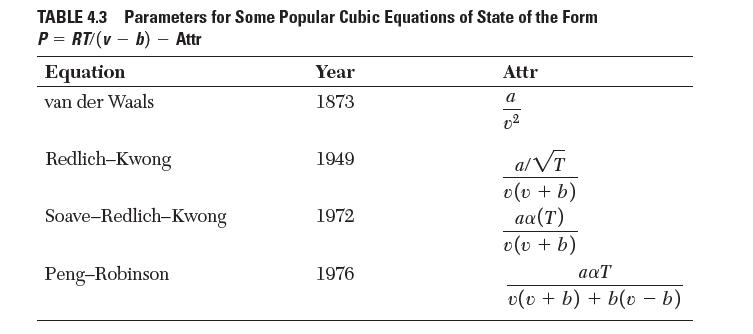
Table 4.3 compares the van der Waals (1873), Redlich–Kwong (1949), and Peng–Robinson (1976) equations of state in similar forms. Based on intermolecular interactions, qualitatively analyze how the progression of equations may have given more accurate results. TABLE 4.3 Parameters for Some
At very high temperatures, a gas can be ionized and remain in thermodynamic equilibrium.Consider the case of gas containing only ions, A1. Your supervisor requests that you come up with a simple (one-parameter) equation of state for this gas. Your assistant leaves you a memo that she has fi t the
Consider a mixture of O2 (a) and C3H8 (b): (a) Write expressions for the attractive interactions Taa, Ibb, and Iab as a function of distance between the molecules, r. (b) How does I'ab compare to VTT bb? (c) Write a general expression for the average attractive intermolecular interaction in a
While returning to your dorm late last night with a hot cup of coffee, the heat overcomes you and, much to your chagrin, you drop the paper cup, spilling its entire contents. As you had just spent your laundry money, this is somewhat upsetting, especially since you still have a good deal of thermo
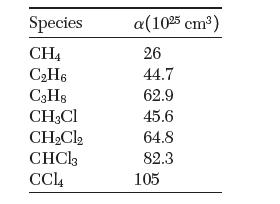
The London force is directly related to the polarizabilities of the corresponding molecules.Consider the following table of molecular polarizability, a:From these data, come up with a model to account for the contribution of each atom to the polarizability of a molecule. Predict the polarizability
Consider 2 neighboring Ar atoms in a system of pure Ar at 25 bar and 300 K:(a) What is the average distance between them (in Å)?(b) Calculate the potential energy due to gravity (between the two atoms).(c) Calculate the potential energy due to London interactions.(d) Compare the values
As discussed in the text, the repulsive term in the Lennard-Jones potential should have an exponential dependence rather than r-12. Graphically compare the features of the Lennard-Jones potential to one that has the same attractive term but whose repulsive term is given by:C1 and C2 are constants
Calculate the bond strength in [eV] of a sodium ion in a crystal of NaCl. For the salt lattice: (a) Consider only the six nearest-neighbor Cl- ions. The Cl- ions are at a distance r = 2.76 . from the Nation. (b) In addition to the six nearest-neighbor Cl- ions, include the twelve
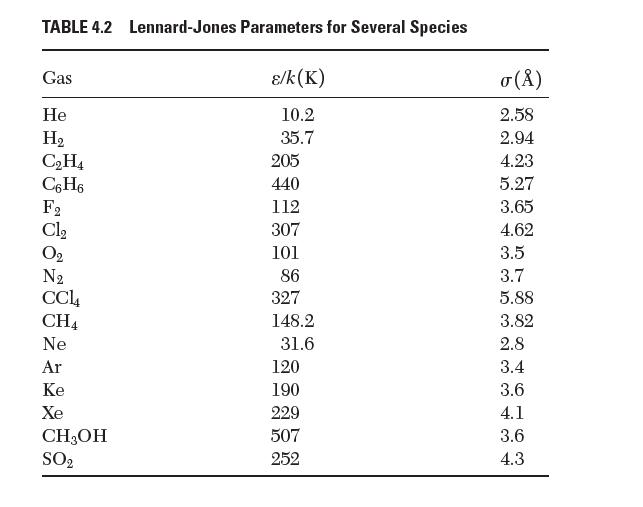
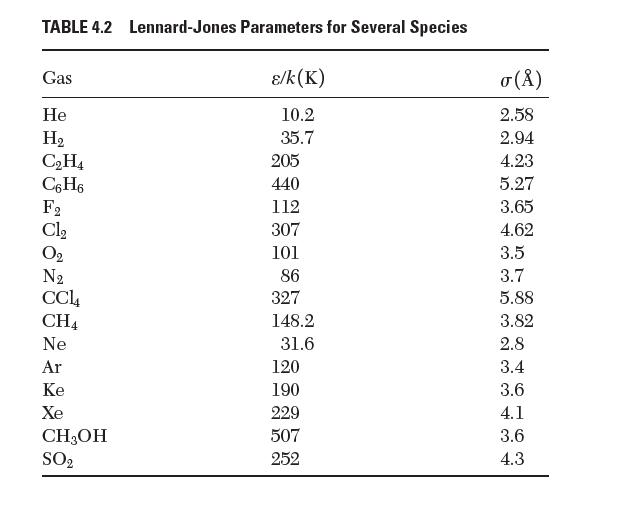
Using data from Table 4.2, estimate the equilibrium bond length that would exist in a molecule of Xe2. TABLE 4.2 Lennard-Jones Parameters for Several Species /k(K) 10.2 35.7 Gas He H CH4 C6H6 288 28 Cl CH4 Ne Ar Ke Xe CH3OH SO 205 440 112 307 101 86 327 148.2 31.6 120 190 229 507 252 () 2.58 2.94
Calculate the van der Waals parameter b for CH4, C6H6, and CH3OH. Based on these values, estimate the molecular diameter of each species. Compare the values obtained with those in Table 4.2. TABLE 4.2 Lennard-Jones Parameters for Several Species /k(K) 10.2 35.7 Gas He H CH4 C6H6 288 28 Cl CH4 Ne Ar
Calculate the van der Waals parameter a for CH4, C6H6, and CH3OH. Based on these values, estimate the value of C6 for each species. Compare the values obtained with that calculated by Equation (4.8). 3 ;j Lilj 26 I+Ij CGS units a (4.8)
Consider a cylinder fi tted with a piston that contains 2 mol of H2O in a container at 1000 K.Calculate how much work is required to isothermally and reversibly compress this gas from 10 L to 1 L, in each of the following cases:(a) Use the ideal gas model for water.(b) Use the Redlich–Kwong
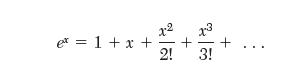
Determine the second and third virial coeffi cients using the van der Waals equation of state.Begin by writing the van der Waals equation in compressibility factor form and performing a power-series expansion. The following mathematical relation is useful: 1 1- x = 1+ x +x + x +
Determine the second and third virial coeffi cients using Redlich–Kwong equation of state. 1 1- x = 1 + x +x + 3 +
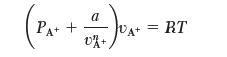
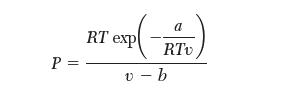
The Dieterici equation of state is given by:(a) Find an expression for the parameters a and b in terms of the critical properties Tc and Pc.(b) Find the compressibility factor at the critical point, zc, for a Dieterici gas.(c) Rewrite the Dieterici equation in virial form for molar volume. What
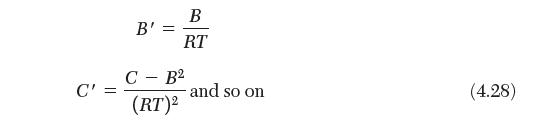
Verify Equations (4.28) by rewriting the expansion of the virial equation in pressure [Equation (4.27)] in terms of the virial expansion in the reciprocal of molar volume [Equation (4.26)]. Pu RT 1 + B V C 02 D (4.26)
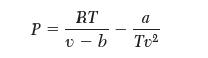
Consider the Berthelot equation of state given below. Show how to calculate the constants a and b using only critical point data. P = RT v-b a Tv
Find the reduced form of the Berthelot equation of state. See Problem 4.29.Problem 4.29Consider the Berthelot equation of state given below. Show how to calculate the constants a and b using only critical point data. P = RT v-b a Tv
Calculate the saturation pressure of n-pentane at 90°C by applying the “equal area” rule to(a) the Redlich–Kwong equation;(b) the Peng–Robinson equation. Compare these results to the measured value of 5.7 bar.
At -30°C, the saturation pressure of ethane is 10.6 bar. Calculate the densities of the liquid and vapor phases using the Peng–Robinson equation. Compare to the reported values for the liquid and vapor densities of 0.468 and 0.0193 g/cm3.
Welcome to Beaver Gas Co.! Your fi rst task is to calculate the annual gross sales of our superpure-grade nitrogen and oxygen gases.(a) The total gross sales of N2 is 30,000 units. Take the volume of the cylinder to be 43 L, the pressure to be 12,400 kPa, and the cost to be $6.1/kg. Compare your
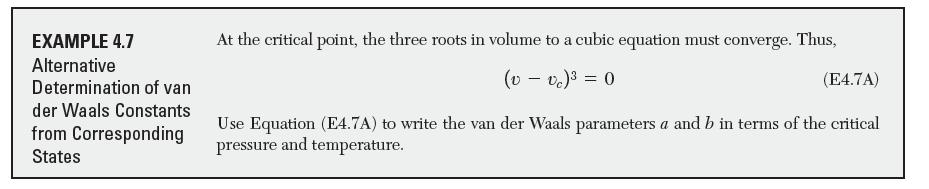
For the Redlich–Kwong equation, develop expressions for the parameters a and b, the equation reduced form, and the value of the compressibility factor at the critical point as a function of the critical pressure and the critical pressure using an approach similar to Example 4.7. EXAMPLE 4.7
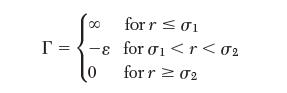
The square-well potential function is given by:Answer the following questions:(a) Sketch a plot of square-well potential energy versus distance.(b) Using this potential function, develop an expression for the second virial coeffi cient.(c) For CH4, the parameters are reported to be σ1 = 2.856,
In this problem we seek to develop an expression for the van der Waals constants a and b in terms of molecular parameters using the Sutherland model for potential energy.(a) Show that writing the van der Waals model in virial form gives an expression for the second virial coeffi cient as: B = b -
Determine expressions for the thermal expansion coeffi cient, β, and the isothermal compressibility, k, for an ideal gas.
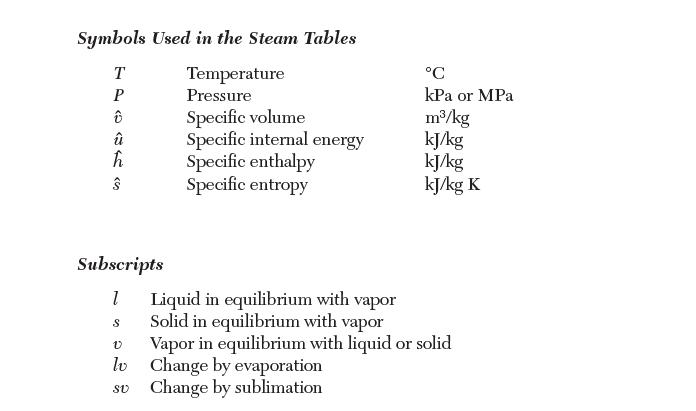
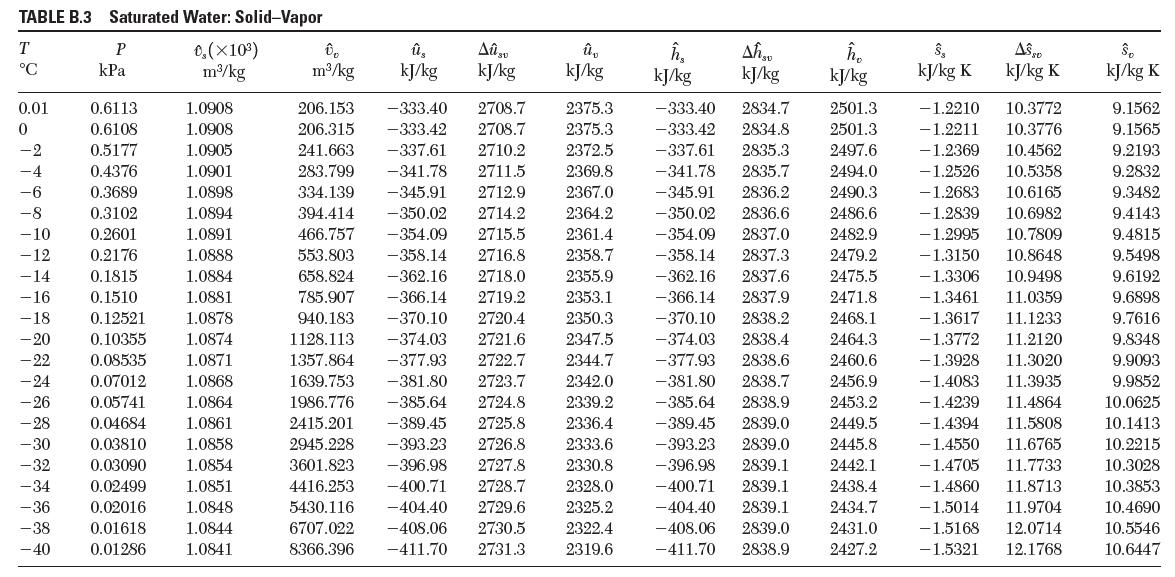
Using the steam tables, estimate the values for the thermal expansion coeffi cient, β,and the isothermal compressibility, k, of liquid water at 20°C and 100°C. Symbols Used in the Steam Tables T P Subscripts 1 S V lv su Temperature Pressure Specific volume Specific internal energy Specific
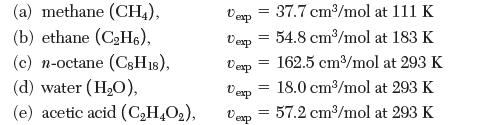
Use the Rackett equation to calculate the liquid-phase molar volume of each of the following species at the same temperature as the measured values reported. Which species had the greatest absolute percent error? The least? Can the trend be explained by molecular concepts?Rackett equation (a)
Calculate the following:(a) the volume occupied by 20 kg of ethane at 70°C and 30 bar(b) the pressure needed to fi ll a 0.1 m3-vessel at room temperature to store 40 kg of ethane
Calculate the volume occupied by 50 kg of propane at 35 bar and 50°C, using the following:(a) the ideal gas model(b) The Redlich–Kwong equation of state(c) The Peng–Robinson equation of state(d) The compressibility charts(e) The textbook software, ThermoSolver
For a lecture-demonstration experiment, it is desired to construct a sealed glass vial containing a pure substance that can be made to pass through the critical point by heating the vial in a person’s hand. Thus, at room temperature the vial should contain a liquid and its vapor.(a) From the
Compare the compressibility factor of methane at Tr = 1.1 and Pr = 1.2 using the Peng–Robinson equation of state and the compressibility charts. Repeat the calculations for methanol.
Using the generalized compressibility charts, calculate the molar volume of ammonia at 92°C and 306.5 bar. What phase is ammonia in? GENERALIZED COMPRESSIBILITY CHARTS The principle of corresponding states invokes a unique generalized relation between the compressibility factor and reduced
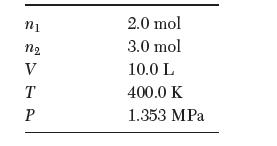
Use the Redlich–Kwong equation to calculate the size of vessel you would need to contain 30 kg of acetylene mixed with 50 kg of n-butane at 30 bar and 450 K. The binary interaction coeffi cient is given by k12 = 0.092. Redlich-Kwong 1949 a/VT v(v + b)
You wish to use the Redlich–Kwong equation of state to describe a mixture of carbon dioxide (1) and toluene (2). To be as accurate as possible with the mixing rules, you want to include the binary interaction parameter, k12. In the literature, you fi nd reference to an experiment with the
Showing 500 - 600
of 746
1
2
3
4
5
6
7
8
Step by Step Answers

 Get 50% OFF
Claim Now
Get 50% OFF
Claim Now