New Semester
Started
Get
50% OFF
Study Help!
--h --m --s
Claim Now
Question Answers
Textbooks
Find textbooks, questions and answers
Oops, something went wrong!
Change your search query and then try again
S
Books
FREE
Study Help
Expert Questions
Accounting
General Management
Mathematics
Finance
Organizational Behaviour
Law
Physics
Operating System
Management Leadership
Sociology
Programming
Marketing
Database
Computer Network
Economics
Textbooks Solutions
Accounting
Managerial Accounting
Management Leadership
Cost Accounting
Statistics
Business Law
Corporate Finance
Finance
Economics
Auditing
Tutors
Online Tutors
Find a Tutor
Hire a Tutor
Become a Tutor
AI Tutor
AI Study Planner
NEW
Sell Books
Search
Search
Sign In
Register
study help
engineering
machine elements in mechanical design
Theory Of Machines Kinematics And Dynamics 3rd Edition Sadhu Singh - Solutions
What is set point and dead time?
Derive the expression representing the output response of a first order system with input as given below:(a) Free response(b) Step input(c) Ramp input
Transfer function is the operational relationship between output and(a) input(b) error(c) response(d) command
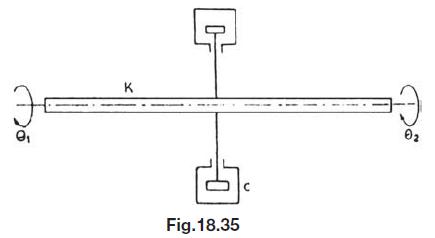
Given Fig. 18.35 shown a flexible shaft of negligible mass of torsional stiffness \(K\) coupled to a viscous damper having a coefficient of viscous damping \(c\). If at any instant the left and right ends of this shaft have angular displacement \(\theta_{1}\) and \(\theta_{2}\) respectively, then
Define output response.
Derive the expression representing the output response of a second order system with input as given below:(a) Zero input(b) Step input(c) Ramp input
Differentiate between stable and unstable system.
Consider the following statement in respect of introduction of feedback in a control system:1. It enhances its gain.2. It attenuates the unwanted noise.3. It helps in improving the accuracy of the systemWhich of these statements are correct?(a) 2 and 3(b) 1,2 and 3(c) 1 and 3(d) 1 and 2
With neat block diagram, explain open-loop and closed-loop control systems.
What is overshoot?
State and explain open-loop and closed-loop transfer function.
Explain response time, settling time and delay time.
Which of the following is a closed-loop control system?(a) Traffic control on the roads by lights where the timing mechanism is present irrespective of the intensity of traffic(b) Switching off the street lights of a tower at a predetermined time by a time-switch irrespective of the fact that the
The open-loop transfer function of a unity feedback control system is given by:\[ G(s)=\frac{K}{s(1+\tau s)} \](a) By what factor the gain be multiplied so that damping ratio is increased from 0.2 to 0.8 ?(b) By what factor the constant \(\tau\) should be multiplied so that the damping ratio is
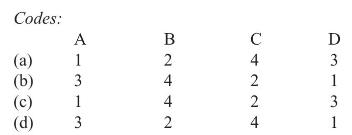
Match List-I with List-II and select the correct answer using the codes given below the Lists:List-I (Property)A. ResonanceB. On-off controlC. Natural frequencyD. Feedback signalList-II (System)1. Closed-loop control system2. Free vibrations3. Excessively large amplitude4. Mechanical brake Codes: A
A unit step input is applied to a second-order measurement system with effective mass of \(40 \mathrm{~g}\) and spring constant \(2 \mathrm{kN} / \mathrm{m}\). Find the damping constant for \(40 \%\) overshoot and the corresponding period of oscillation.
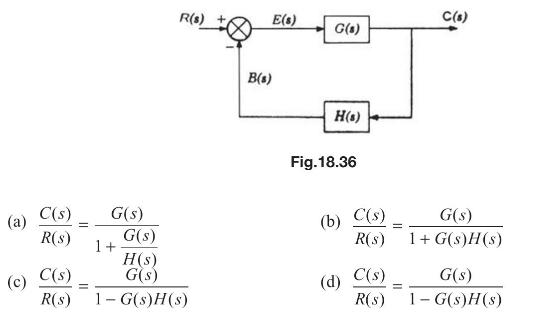
A physical system is translated into functional block diagram of the type shown in the Fig.18.36. The command input \(r(t)\) and controlled output \(c(t)\) of this system are given by C(s) R(s) E(s) G(s) B(s) H(s) Fig.18.36 C(s) (a) G(s) R(s) G(s) 1+ (b) C(s) R(s) H(s) (c) C(s) G(s) = R(s) 1-
Define command.
A second order measurement system has effective mass of \(25 \mathrm{~g}\), spring constant \(2500 \mathrm{~N} / \mathrm{m}\) and damping factor 0.6. Determine the rise time and settling time for a \(\pm 2.5 \%\) tolerance band.
In which one of the following types of control system is the output of the control element proportional to the time rate of change of the input?(a) Proportional(b) Integral(c) Proportional and derivative(d) Derivative
A second order measurement system has an effective mass of \(60 \mathrm{~g}\) and the spring constant \(2.25 \mathrm{kN} / \mathrm{m}\). Calculate the steady state error and the time lag for damping factor 0.48 when a unit ramp input is applied.
What are the effects of feed back control.
Traffic control on the roads by lights where the timing mechanism operates irrespective of the intensity of traffic is an example of(a) Closed loop control(b) Under-damped control(c) Open loop control(d) Over-damped control
In a second-order measurement system with a damping ratio of 0.65 , the natural frequency is \(30 \mathrm{~Hz}\). Calculate the dynamic error and the time lag at frequency input of \(10 \mathrm{~Hz}\).
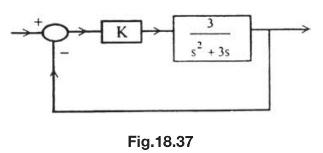
What is the value of \(K\) for which the relative damping of the closed loop system shown above is equal to 0.5 ?(a) 2(b) 3(c) 4(d) 5 3 K $ +35 Fig.18.37
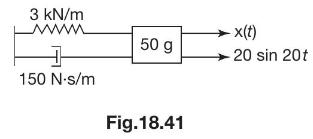
Determine the steady state response of the second - order system shown in Fig.18.41. By using transfer function method. 3 kN/m www -x(t) 50 g 20 sin 20t 150 N-s/m Fig.18.41
Differentiate between first-order and second-order systems.
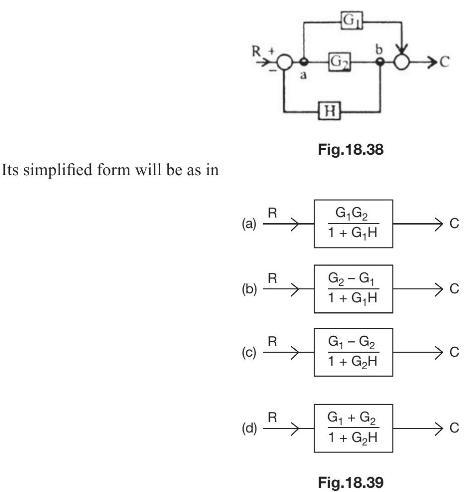
The block diagram of an automatic control system is shown in the following Fig.18.38. Its simplified form will be as in G H Fig.18.38 (a) R GG2 1 + GH G-G1 1 + GH G - G 1+ GH R G + G (d) 1 + GH Fig.18.39 > C
Define frequency response of a system.
Given that \(G=\) forward path gain and \(H=\) feed back path gain, if \(G\) and \(H\) are functions of frequency, then the feedback would affect gain \(G\) of a non-feedback system by a value to(a) \(1+\mathrm{GH}\)(b) \(1-\mathrm{GH}\)(c) \(\mathrm{GH}\)(d) \(1 / \mathrm{GH}\)
Write the transfer function of first and second order systems.
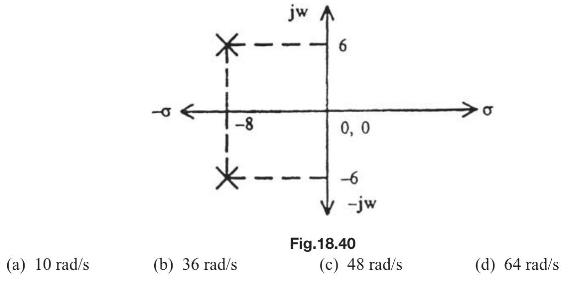
The Fig. 18.40 given below shows the locations of the roots of the characteristic function of a second order, linear, closedloop control system. What is the natural frequency of the system? jw 6 0, 0 -6 -jw Fig.18.40 (a) 10 rad/s (b) 36 rad/s (c) 48 rad/s (d) 64 rad/s
The fly balls of spring loaded governor of Hartnell type running at 600 rpm have a radius of rotation of 80 mm with sleeve in mid-position and ball arms vertical. The ball arms and sleeve arms are of equal length. The maximum sleeve movement is 20 mm with ±5% variation in speed. The mass of sleeve
The height of Watt's governor is proportional to(a) speed (N)(b) \(\mathrm{N}^{2}\)(c) \(1 / \mathrm{N}\)(d) \(1 / \mathrm{N}^{2}\).
What is the main function of a governor? How does it differ from that of a flywheel?
A Porter governor has all the four arms of 250 mm length each. All the upper arms and the sleeve arms are pivoted on the axis of rotation. The mass of each governor ball is 0.9 kg. The mass on the sleeve is 15 kg. Find the speed of rotation when the balls rotate at a radius of 160 mm.
The lengths of upper and lower arms of a Porter governor are 220 mm and 260 mm respectively.All the arms are pivoted on the axis of rotation. The central load is 125 N and weight of each ball is 15 N. The friction of sleeve together with the resistance of the operating gear is equivalent to a force
In a Hartnell governor, if the stiffness of spring is increased, the governor will(a) become more sensitive(b) become less sensitive(c) remain unaffected(d) start hunting.
What are the various types of governors?
A Porter governor has all four arms 200 mm long. The upper arms are attached on the axis of rotation and the lower arms are attached to the sleeve at a distance of 25 mm from the axis. The mass of each ball is 5 kg and the mass of sleeve is 40 kg. The extreme radii of rotation are 150 mm and 200
The function of a governor is to(a) reduce the speed fluctuations during a cycle(b) maintain the prime mover speed within prescribed limits(c) not to influence the speed of the prime mover(d) not to control the variation in load on the prime mover.
How does centrifugal governor differ from an inertia governor?
A loaded Porter governor has four arms each 240 mm long, two revolving masses each weighing 25 N and a central dead weight of 200 N. All the arms are attached to respective sleeves at radial distances of 40 mm from the axis of rotation. The masses revolve at a radius of 150 mm at minimum speed and
The following governor is spring loaded(a) Watt governor(b) Porter governor(c) Proell governor(d) Hartnell governor.
What is the effect of friction on the functioning of a Porter governor?
In a Proell governor, the mass of each ball is 5 kg and central load on sleeve is 50 kg. The length of each upper and lower arms is 250 mm. The minimum and maximum radii are 120 mm and 180 mm respectively. The distances of point of suspension of upper and lower links from governor axis are 20 mm
The gravity controlled governor is(a) Hartnell governor(b) Pickering governor(c) Hartung governor(d) Proell governor.
Why an auxiliary spring is used along with main springs in a Wilson-Hartnell governor?
The arms of a Proell governor are 250 mm long. The upper arms are pivoted on the axis of rotation, while the lower arms are pivoted at a radius of 35 mm. Mass of each ball is 5 kg and is fixed to the extension 100 mm long of the lower arms. The central sleeve load is 100 N. At minimum radius of 160
The height of a Watt's governor is(a) \(\omega^{2} / g\)(b) \(g / \omega^{2}\)(c) \(g \omega^{2}\)(d) \(2 g \omega^{2}\)
Which type of governor is used in a gramophone?
The Proell governor as compared to Porter governor, at same speed(a) is more sensitive(b) requires smaller size(c) has less lift(d) all of the above.
Explain the meaning of sensitiveness, hunting and stability of a governor?
In a Hartnell type governor, the two masses are 5 kg each and the load on the sleeve is 45 kg.With the mass arms vertical, the path radius is 80 mm and the equilibrium speed, neglecting friction, is 450 rpm. Determine(a) the corresponding compressive force in the spring, and(b) the friction force
The sensitivity of a governor due to frictional resistance at the sleeve(a) increases(b) decreases(c) remains same(d) depends on speed.
What is the condition of isochronism in case of a Hartnell governor?
In Hartnell governor, the lengths of ball and sleeve arms of a bell crank lever are 120 mm and 100 mm respectively. The distance of the fulcrum of the bell crank lever from the governor axis is 150 mm. Each governor ball has a mass of 4 kg. The governor runs at a mean speed of 300 rpm with the ball
The spring loaded governors as compared to gravity controlled governors(a) can operate at higher speeds(b) are more compact and smaller in size(c) are capable of being fixed at any inclination(d) all of the above.
Define effort and power of a governor.
In a Wilson-Hartnell spring loaded governor, the two balls are of 5 kg each, which are connected by two springs. The speed of the governor is 600 rpm in its mean position. The radius of the governor ball is 150 mm. The tension in each spring is 1200 N. Find the tension in the other spring and its
If the ball masses of a governor occupy a definite specified position for each speed, it is said to be(a) stable(b) hunting(c) isochronous(d) sensitive.
What is the controlling force of a governor? How does the controlling force curve help in establishing the stability or instability of a governor?
In a spring-controlled governor, the curve of controlling force is a straight line. When balls of 8 kg mass each are 400 mm apart, the controlling force is 1 kN and when 200 mm apart is 560 N.At what speed will the governor run when the balls are 250 mm apart? What initial tension on the spring
If the ball masses of a governor have same equilibrium speed for all the radii of rotation, it is said to be(a) stable(b) hunting(c) isochronous(d) sensitive.
The controlling force F in N and radius of rotation r in cm for a spring loaded governor are related by the expression: F = 3r - 8. The mass of each ball is 5 kg and extreme radii of rotation of the balls are 100 mm and 175 mm, respectively. Find the maximum and minimum speeds. If the friction of
Isochronous governor is(a) more sensitive(b) less stable(c) less sensitive(d) less stable.
The controlling force curve of a spring controlled governor is a straight line. The weight of each governor ball is 40 N and the extreme radii of rotation are 120 and 200 mm. The values of the controlling force at the above radii are respectively 200 N and 400 N. The friction of the mechanism is
Governor effort is defined as the force applied for(a) \(1 \%\) change in speed(b) \(2 \%\) change in speed(c) \(5 \%\) change in speed(d) the total range of speed.
The following data refer to a Hartnell governor:Length of ball arm of bell crank lever = 150 mm; length of sleeve arm = 100 mm;Mass of ball = 5 kg; spring stiffness = 250 N/mm.At minimum speed of 300 rpm the radius of rotation of ball is 80 mm. Neglecting gravity effect, determine(a) the speed
Governor which is hunting is(a) more sensitive(b) less sensitive(c) more stable(d) less stable.
Governor power is defined as the product of governor effort and(a) sleeve lift(b) reciprocal of sleeve lift(c) difference of radii of rotation for maximum and minimum speeds(d) square of sleeve lift.
Define piston effort and crank effort.
The flywheel influences the(a) variation of load demand on prime mover(b) mean speed of the prime mover(c) cyclic variation in speed of the prime mover(d) mean torque developed by the prime mover.
A horizontal steam engine running at \(250 \mathrm{rpm}\) has a bore of \(210 \mathrm{~mm}\) and a stroke of \(350 \mathrm{~mm}\). The piston rod is \(20 \mathrm{~mm}\) in diameter and connecting rod length is \(1050 \mathrm{~mm}\). The mass of the reciprocating parts is \(6 \mathrm{~kg}\) and
What do you mean by dynamically equivalent system?
If mean speed of the prime mover is increased then the coefficient of fluctuation of speed will(a) increase(b) decrease(c) remains same(d) unpredictable.
A single cylinder vertical engine has a bore of \(250 \mathrm{~mm}\) and a stroke of \(500 \mathrm{~mm}\). The connecting rod is \(1000 \mathrm{~mm}\) long. The mass of the reciprocating parts is \(150 \mathrm{~kg}\). The gas pressure is \(0.75 \mathrm{MPa}\) during expansion stroke when the crank
How do you account for the inertia of the connecting rod?
The maximum fluctuation of energy of flywheel is directly proportional to(a) coefficient of fluctuation of speed(b) square of angular speed of flywheel(c) moment of inertia of flywheel(d) all of the above.
In a reciprocating engine, the length of stroke is \(250 \mathrm{~mm}\) and connecting rod is \(500 \mathrm{~mm}\) long between centres. Determine:(a) the angular position of the crank,(b) velocity and acceleration of the piston, and(c) angular velocity of the connecting rod if the engine speed is
What is a turning moment diagram? What are its advantages?
The acceleration of piston of a reciprocating engine is:(a) \(\omega^{2} r\left[\sin \theta+\frac{\cos 2 \theta}{n}\right]\)(b) \(\omega^{2} r\left[\cos \theta+\frac{\cos 2 \theta}{n}\right]\)(c) \(\omega^{2} r\left[\sin \theta+\frac{\sin 2 \theta}{n}\right]\)(d) \(\omega^{2} r\left[\cos
The following data refer to a horizontal reciprocating engine:Mass of reciprocating parts \(=125 \mathrm{~kg}\), crank length \(=100 \mathrm{~mm}\), length of connecting rod between centres \(=500 \mathrm{~mm}\), engine speed \(=600 \mathrm{rpm}\), mass of connecting rod \(=100 \mathrm{~kg}\),
Define coefficient of fluctuation of energy and coefficient fluctuation of speed.
Crank pin effort in a reciprocating engine is:(a) \(\frac{F \sin (\theta+\phi)}{\cos \phi}\)(b) \(\frac{F \sin (\theta+\phi)}{\sin \phi}\)(c) \(\frac{F \cos (\theta+\phi)}{\cos \phi}\)(d) \(\frac{F \cos (\theta+\phi)}{\sin \phi}\)where \(F=\) piston effort
The following data refer to a connecting rod of a reciprocating engine:Mass \(=60 \mathrm{~kg}\); Distance between bearing centres \(=900 \mathrm{~mm}\); Diameter of small end bearing \(=80\) \(\mathrm{mm}\); Diameter of big end bearing \(=120 \mathrm{~mm}\); Time of oscillation when the connecting
What is the main function of a flywheel?
Crank effort in a reciprocating engine is(a) \(F_{r}\left[\sin \theta+\frac{\sin 2 \theta}{2 n}\right]\)(b) \(F_{r}\left[\cos \theta+\frac{\cos 2 \theta}{2 n}\right]\)(c) \(F_{r}\left[\sin \theta+\frac{\cos 2 \theta}{2 n}\right]\)(d) \(F_{r}\left[\cos \theta+\frac{\sin 2 \theta}{2 n}\right]\)
A connecting rod of length \(400 \mathrm{~mm}\) between centres has a mass of \(4.5 \mathrm{~kg}\). The centre of gravity is \(260 \mathrm{~mm}\) from the small end and its radius of gyration about an axis through the centre of gravity perpendicular to the plane of rotation is \(125 \mathrm{~mm}\).
Write the relationship between coefficient of fluctuation of speed, maximum fluctuation of energy and kinetic energy of flywheel.
Coefficient of fluctuation of speed is given by:(a) \(\frac{\omega_{\max }+\omega_{\min }}{\omega_{m}}\)(b) \(\frac{\omega_{\max }-\omega_{\min }}{\omega_{m}}\)(c) \(\frac{\omega_{\max }-\omega_{\min }}{2 \omega_{m}}\)(d) \(\frac{\omega_{\max }-\omega_{m}}{\omega_{m}}\)
The connecting rod of a vertical reciprocating engine is \(2 \mathrm{~m}\) long between centres and its mass is \(250 \mathrm{~kg}\). The mass centre is \(750 \mathrm{~mm}\) from the big end bearing. When suspended as a pendulum from the gudgeon pin axis, it makes 10 complete oscillations in 25
Write the procedure for determining the turning moment diagram.
Fluctuation of energy of a flywheel is(a) \(C E\)(b) \(2 C_{s} E\)(c) \(\frac{1}{2} C_{s} E\)(d) \(4 C_{s} E\)
A single cylinder vertical engine has a bore of \(300 \mathrm{~mm}\), a stroke of \(350 \mathrm{~mm}\) and a connecting rod of length \(700 \mathrm{~mm}\). The weight of the reciprocating parts is \(125 \mathrm{~kg}\). When the piston is at quarter-stroke from TDC and is moving downwards, the net
What is a compound pendulum?
The turning moment curve for one revolution of a multicylinder engine above and below the line of mean resisting torque are given by:\(-0.32,+4.06,-3.71,+3.29,-3.16,+3.32,-3.74,+3.71\), and \(-3.45 \mathrm{sq} . \mathrm{cm}\).The vertical and horizontal scales are: \(1 \mathrm{~cm}=60000
A constant torque \(3 \mathrm{~kW}\) motor drives a punching machine. The mass of the moving parts including the flywheel is \(130 \mathrm{~kg}\) at \(750 \mathrm{~mm}\) radius. One punching operation absorbs \(1 \mathrm{~kg}\) of energy and takes \(1 \mathrm{~s}\). Speed of the flywheel is \(240
State the conditions of static equilibrium.
The forces generally considered in the design of mechanisms are:(a) applied forces(b) inertia forces(c) frictional forces(d) all of them.
Showing 500 - 600
of 1879
1
2
3
4
5
6
7
8
9
10
11
12
13
14
15
Last
Step by Step Answers

 Get 50% OFF
Claim Now
Get 50% OFF
Claim Now