New Semester
Started
Get
50% OFF
Study Help!
--h --m --s
Claim Now
Question Answers
Textbooks
Find textbooks, questions and answers
Oops, something went wrong!
Change your search query and then try again
S
Books
FREE
Study Help
Expert Questions
Accounting
General Management
Mathematics
Finance
Organizational Behaviour
Law
Physics
Operating System
Management Leadership
Sociology
Programming
Marketing
Database
Computer Network
Economics
Textbooks Solutions
Accounting
Managerial Accounting
Management Leadership
Cost Accounting
Statistics
Business Law
Corporate Finance
Finance
Economics
Auditing
Tutors
Online Tutors
Find a Tutor
Hire a Tutor
Become a Tutor
AI Tutor
AI Study Planner
NEW
Sell Books
Search
Search
Sign In
Register
study help
engineering
machine elements in mechanical design
Theory Of Machines Kinematics And Dynamics 3rd Edition Sadhu Singh - Solutions
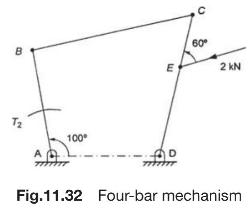
A four-bar mechanism shown in Fig. 11.32 is subjected to a force of \(2 \angle 60^{\circ} \mathrm{kN}\) of link \(\mathrm{CD}\). The dimensions of the various links are:\(A B=A D=300 \mathrm{~mm}, B C=450 \mathrm{~mm}, C D=400 \mathrm{~mm}, C E=150 \mathrm{~mm}\).Calculate the required value of
State the principle of superposition.
A pair of action and reaction forces acting on a body are called(a) applied forces(b) inertia forces(c) frictional forces(d) constraint forces.
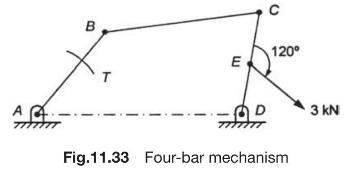
A four-bar mechanism shown in Fig. 11.33 is subjected to a force as shown. The dimensions of the various links are:\(A B=C D=200 \mathrm{~mm}, B C=300 \mathrm{~mm}, A D=400 \mathrm{~mm}, C E=100 \mathrm{~mm}\).Calculate the input torque to link \(A B\) for the static equilibrium of the mechanism. B
State the D’Alembert’s principle.
For the static equilibrium of planar mechanisms(a) \(\Sigma F_{x}=0\)b) \(\Sigma F_{y}=0\)(c) \(\Sigma M_{O}=0\)(d) all of the above.
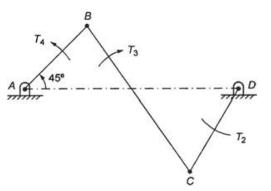
A four-bar mechanism shown in Fig. 11.34 is subjected to torques \(T_{3}=50 \mathrm{Nm}\) and \(T_{4}=60 \mathrm{Nm}\). The dimensions of the various links are:\(A B=C D=400 \mathrm{~mm}, B C=800 \mathrm{~mm}, A D=1000 \mathrm{~mm}\)Calculate the input torque to link \(C D\) for the static
What is equivalent offset inertia force?
If the resultant of forces acting on a body does not pass through the centre of mass, then the inertia force and inertia couple is replaced by(a) Equivalent inertia force(b) equivalent inertia couple(b) Equivalent offset inertia force(c) equivalent offset inertia couple
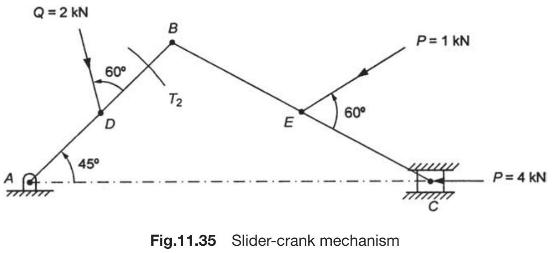
A slider crank mechanism is loaded as shown in Fig. \(11.35 . A B=400 \mathrm{~mm}, B C=600 \mathrm{~mm}, A D=200\) \(\mathrm{mm}, C E=300 \mathrm{~mm}\). Calculate the input torque for the static equilibrium of the mechanism. A A Q=2 kN B 45 60 T 0 60 E Fig.11.35 Slider-crank mechanism P=1 kN P=4
What is inertia force?
The lengths of crank and connecting rod of a slider crank mechanism are \(40 \mathrm{~mm}\) and \(100 \mathrm{~mm}\), respectively. It is subjected to piston force of \(2000 \mathrm{~N}\). Determine the required input torque on the crank for the static equilibrium.
Which do you mean by a static force?
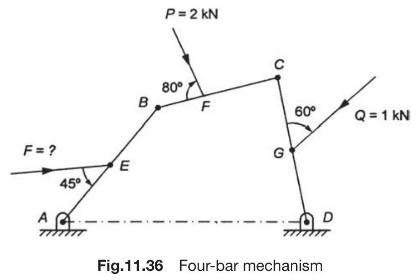
A four-bar mechanism is loaded as shown in Fig.11.36. \(A B=C D=300 \mathrm{~mm}\).\(B C=250 \mathrm{~mm}, A E=C G=150 \mathrm{~mm}, B F=100 \mathrm{~mm}, A D=500 \mathrm{~mm}\)Determine the magnitude of force \(F\). F= ? 45 A E P=2kN 80 B F 60 Q = 1 kN G Fig.11.36 Four-bar mechanism D
What is an applied force?
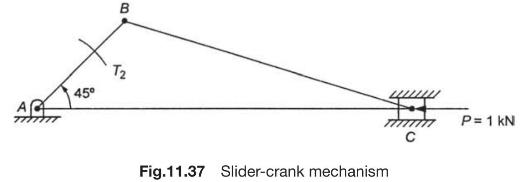
A slider-crank mechanism shown in Fig. 11.37 is subjected to piston load of \(1 \mathrm{kN}, A B=250 \mathrm{~mm}\), \(B C=600 \mathrm{~mm}\). Determine the input torque to link \(A B\) for the static equilibrium of the mechanism. B T 45 Fig.11.37 Slider-crank mechanism P = 1 kN
State the conditions for the equilibrium of a body under the following system of loading.(a) Two forces,(b) three forces, and(c) two forces and a torque.
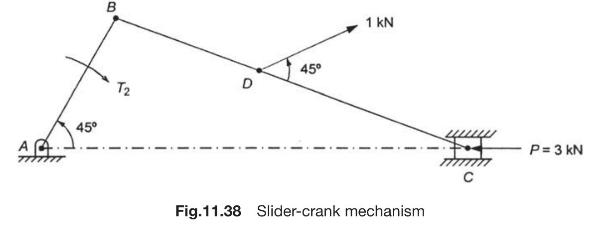
A slider-crank mechanism shown in Fig. 11.38 is subjected to piston load of \(3 \mathrm{kN}\) and a force \(1 \angle 45^{\circ} \mathrm{kN}\) or link \(\mathrm{BC}\).\(A B=300 \mathrm{~mm}, B C=750 \mathrm{~mm}, B D=300 \mathrm{~mm}\).Determine the input torque to link \(A B\) for the static
A shaft carries four rotating masses A, B, C and D in this order along its axis. The mass A may be assumed concentrated at a radius of 120 mm, B at 150 mm, C at 130 mm, and D at 180 mm.The masses at A, C and D are 10, 15 and 12 kg, respectively. The planes of rotation of A and B are 150 mm apart
In case of reciprocating engines the ratio of primary to secondary forces is(a) \(\cos \theta / \cos 2 \theta\)(b) \(\cos \theta /(\mathrm{n} \cos 2 \theta)\)(c) \(n \cos \theta / \cos 2 \theta\)(d) \(\cos ^{2} \theta / \cos 2 \theta\)
What is the necessity of balancing high speed machinery?
A shaft rotating at 1000 rpm carries two unbalances of magnitudes 0.2 kg m and 0.1 kg m in planes A and B respectively. The planes A and B are 0.5 m apart and the directions of the unbalances are at 90°. A third unbalances has to be attached to the shaft at a location C so that the shaft is
Partial balancing in locomotives results in(a) hammer blow(b) variation in tractive effort(c) swaying couple(d) all of the above
What do you mean by static and dynamic balance of machinery
The cranks and connecting rods of a 4-cylinder in-line engine running at 1800 rpm are 50 mm and 200 mm long respectively. The cylinders are spaced 150 mm apart. If the cylinders are numbered 1 to 4 in sequence from one end, the cranks appear at intervals of 90° in an end view in the order
In reciprocating engines, primary forces are(a) completely balanced(b) partially balanced(c) can not be balanced(d) balanced by secondary forces.
What do you mean by primary and secondary unbalance in reciprocating engines?
A four-crank engine has the two outer cranks set at 120° to each other, and their reciprocating masses are each 400 kg. The distance between the planes of rotation of adjacent cranks are 0.5, 0.8 and 0.6 m. If the engine is to be in complete primary balance, determine the reciprocating mass and
In case of locomotives, the effect of hammer blow is counteracted by(a) flanges of the tyres of the wheels(b) balancing weights(c) inside section of the rails(d) dead weight of the engine.
What is partial balancing of reciprocating engines?
A rotating shaft carries four unbalanced masses 20, 15, 18 and 10 kg at radii 50, 60, 70 and 65 mm, respectively. The 2nd, 3rd and 4th masses revolve in planes 80, 150 and 300 mm respectively measured from the plane of the first mass and are angularly located at 60°, 130° and 270° respectively
Hammer blow in locomotives results in(a) pulsating torque(b) tendency to lift wheels from rails.(c) uneven speed(d) variable horizontal force.
Define hammer blow, tractive effort and swaying couple.
A single cylinder reciprocating engine has a reciprocating mass of 50 kg. The crank rotates at 80 rpm and the stroke is 300 mm. Mass of revolving parts at 150 mm radius is 40 kg. If 2/3rd of the reciprocating parts and whole of the revolving parts are to be balanced, determine(a) the balance mass
Swaying couple results due to(a) primary disturbing force(b) secondary disturbing force(c) partial balancing(d) hammer blow.
What are direct and reverse cranks in radial engines?
The reciprocating mass per cylinder in a V-twin engine is 1.5 kg. The stroke is 100 mm for each cylinder. If the engine runs at 1800 rpm, determine the maximum and minimum values of the primary forces and the corresponding crank position.
Inertia force acts(a) perpendicular to the accelerating force(b) along the direction of the accelerating force(c) opposite to the direction of the accelerating force(d) in any direction with respect to accelerating force.
What is a coupled locomotive?
The cranks of a two-cylinder uncoupled inside cylinder locomotive are at right angles and are 300 mm long. The distance between the centre lines of the cylinders is 650 mm. The wheel centre lines are 1.6 m apart. The reciprocating mass per cylinder is 300 kg. The driving wheel diameter is 1.8 m. If
If the balance mass is to be placed in a plane parallel to the plane of the unbalance mass then the minimum number of balance masses required are(a) one(b) two(c) three(d) four.
Differentiate between primary and secondary cranks.
The pistons of a 60° twin V-engine have strokes of 120 mm. The connecting rods driving a common crank have a length of 200 mm. The mass of the reciprocating parts per cylinder is 1 kg and the speed of the crankshaft is 2500 rpm. Determine the magnitude of primary and secondary forces.
The frequency of secondary force as compared to that of primary force is(a) half(b) twice(c) four times(d) sixteen times.
For an inside cylinder locomotive with two cranks at right angles, the reciprocating parts are 300 kg per cylinder. The distance between the cylinder centre lines is 0.6 m and between the plane of rotation of wheels 1.5 m. Each crank is 0.3m long and the driving wheels are 1.8 m diameter. Revolving
If the ratio of the length of connecting rod to crank radius increases, then(a) primary force increases(b) primary force decreases(c) secondary force increases(d) secondary force decreases.
The resultant unbalanced force is minimum in reciprocating engines when the part of the reciprocating mass balanced by rotating masses are(a) \(1 / 3\)(b) \(1 / 2\)(c) \(2 / 3\)(d) \(3 / 4\)
In partial balancing of locomotives, the maximum variation of tractive effort is(a) \((2 / 3) M r \omega^{2}\)(b) \((\sqrt{2} / 3) M r \omega^{2}\)(c) \((3 / \sqrt{2}) M r \omega^{2}\)(d) \((3 / 2) M r \omega^{2}\)
Static force balancing involves balancing of(a) forces(b) couples(c) forces as well as couples(d) masses
If a system is dynamically balanced, then it is statically(a) balanced(b) unbalanced(c) partially balanced
Define gyroscope and a gyroscopic couple.
When a ship travels in sea, which of the following effects is more dangerous(a) steering(b) pitching(c) rolling(d) all of the above.
A uniform disc of diameter \(250 \mathrm{~mm}\) and weighing \(4.5 \mathrm{~N}\) is mounted at one end of an arm of length \(0.5 \mathrm{~m}\). The other end of the arm is free to rotate in a universal bearing. If the disc rotates about the arm with a speed of \(240 \mathrm{rpm} \mathrm{cw}\),
Define spin and precession.
The gyroscopic acceleration of a disc rotating at speed \(w\) and uniform acceleration is(a) \(\mathrm{d} \omega / \mathrm{d} t\)(b) \(\omega \mathrm{d} \theta / \mathrm{d} t\)(c) \(r \omega^{2}\)(d) \(r \mathrm{~d} \omega / \mathrm{d} t\)
An aeroplane makes a complete half circle of \(60 \mathrm{~m}\) radius towards the left when flying at \(180 \mathrm{~km} / \mathrm{h}\). The rotary engine and the propeller of the plane have a mass of \(35 \mathrm{~kg}\) with radius of gyration of \(0.25 \mathrm{~m}\). The engine runs at \(2400
What are gyroscopic planes?
The gyroscopic couple acting on a disc of moment of inertia \(I\), rotating with speed \(w\) and speed of precession \(w_{\mathrm{p}}\), is given by(a) \(I \omega^{2} \omega_{p}\)(b) \(I \omega \omega_{p}^{2}\)(c) \(I \omega \omega_{p}\)(d) \(I \omega^{2} \omega_{p}^{2}\)
A motor cycle and its rider together have a mass of \(180 \mathrm{~kg}\) and their combined centre of gravity is \(0.6 \mathrm{~m}\) above the ground level when the motor cycle is upright. Each road wheel is of \(0.60 \mathrm{~m}\) diameter and has a moment of inertia \(0.16 \mathrm{~kg} \cdot
How gyroscopic couple affect the motion of an aeroplane while taking a turn.
The total reaction of ground on wheels of a vehicle due to gyroscopic couple and centrifugal force while negotiating curve is(a) increased on inner wheels and decreased on outer wheels(b) decreased on inner wheels and increased on outer wheels(c) decreased on all the wheels(d) increased on all the
A racing car weighs \(20 \mathrm{kN}\). It has a wheel base of \(2 \mathrm{~m}\), track width \(1 \mathrm{~m}\) and height of C.G. 0.3 above the ground level and lies mid-way between the front and rear axles. The engine flywheel rotates at \(3000 \mathrm{rpm} \mathrm{cw}\) when viewed from the
Explain the effect of gyroscopic couple on a naval ship.
The axes of spin, precession and gyroscopic couple are contained in(a) one plane(b) two planes perpendicular to each other(c) two parallel planes(d) three planes perpendicular to one another.
One of the driving axles of a locomotive with its two wheels has a moment of inertia of \(350 \mathrm{~kg} \cdot \mathrm{m}^{2}\). The wheels are of \(1.85 \mathrm{~m}\) diameter. The distance between the planes of the wheels is \(1.5 \mathrm{~m}\). When travelling at \(100 \mathrm{~km} /
How a four-wheeled vehicle is affected by gyroscopic couple?
The gyroscopic couple is introduced in a ship whose spin axis is parallel to starboard, when it is(a) rolling(b) pitching(c) pitching or rolling(d) neither pitching nor rolling.
A ship is pitching through a total angle of \(15^{\circ}\), the oscillation may be taken as simple harmonic and the complete time period us \(30 \mathrm{~s}\). The turbine rotor mass is \(500 \mathrm{~kg}\), its radius of gyration is 0.4 \(\mathrm{m}\) and it is rotating at \(2400 \mathrm{rpm}\).
Why a two-wheeler rider leans towards the inside while negotiating a turn?
The effect of gyroscopic torque on the naval ship when it is rolling and the rotor is spinning about the longitudinal axis is(a) to raise the bow and lower the stern(b) to lower the bow and raise the stern(c) to turn the ship to one side(d) no effect.
The propeller of an aircraft weighs \(500 \mathrm{~N}\) and has radius of gyration of \(0.8 \mathrm{~m}\). The propeller shaft rotates at \(2000 \mathrm{rpm}, \mathrm{cw}\), as viewed from tail end. The plane turns left, making a U-turn of \(120 \mathrm{~m}\) radius, at a speed of \(350
Discuss the gyroscopic effect in a grinding mill.
If the propeller of an aeroplane rotates clockwise when viewed from the rear and the aeroplane takes a right turn, the gyroscopic effect will(a) tend to raise the tail and depress the nose(b) tend to raise the nose and depress the tail(c) tilt the aeroplane about spin axis(d) have no effect.
A disc with radius of gyration \(50 \mathrm{~mm}\) and mass of \(3 \mathrm{~kg}\) is mounted centrally on a horizontal axle of \(90 \mathrm{~mm}\) length between the bearings. It spins about the axle at \(750 \mathrm{rpm} \mathrm{ccw}\) when viewed from the right hand side bearing. The axle
A two wheeler of \(350 \mathrm{~mm}\) wheel radius is negotiating a turn of radius \(80 \mathrm{~m}\) at a speed of \(100 \mathrm{~km} / \mathrm{h}\). The combines mass of vehicle with its rider is \(250 \mathrm{~kg}\). The C.G. of rider is 0.6 \(\mathrm{m}\) above the ground level. The mass moment
The turbine rotor of a ship has a mass of 2 tonnes and rotates at \(1800 \mathrm{rpm}\) clockwise when viewed from the left. The radius of gyration of the rotor is \(0.3 \mathrm{~m}\) determine the gyroscopic couple and its effect when(a) the ship turns at a radius of \(250 \mathrm{~m}\) with speed
Explain what you understand by gyroscopic stabilization. Illustrate with the help of a sketch how this is carried out in ships. Obtain a relation between the gyroscopic torque and the couple applied by the waves for complete stabilization if the waves be sinusoidal.
For a single cylinder engine determine the bearing forces caused by the gyroscopic action of the flywheel \(\left(I=0.32 \mathrm{~kg} \cdot \mathrm{m}^{2}\right)\) as the engine traverses a \(305 \mathrm{~m}\) radius curve at \(96.6 \mathrm{~km} / \mathrm{h}\) in a turn to the right. The engine
Explain the following:(a) Gyroscopic stabilization of sea vessels(b) Effect of gyroscopic couple on the stability of an automobile negotiating a curve(c) What are the principle of a gyroscope? Discuss the factors that effect the stability of an automobile while negotiating a curve.(d) How is the
The surface of the gear tooth below the pitch surface is called(a) addendum portion(b) dendendum portion(c) flank(d) face.
The rolling moment on a ship at a given instant is \(12 \times 10^{6} \mathrm{Nm}\) clockwise when viewed from the rear. The rotor of the stabilizing gyroscope is of \(12 \times 10^{4} \mathrm{~kg}\) mass and spins at \(1200 \mathrm{rpm}\) clockwise when viewed from above. If the radius of the
Name the gears for connecting parallel shafts.
A pair of \(20^{\circ}\) full involute spur gears having 40 and 60 teeth of module \(4 \mathrm{~mm}\) are in mesh. The smaller gear rotates at \(1440 \mathrm{rpm}\). Find(a) sliding velocity at engagement and disengagement of the pair of teeth, and(b) contact ratio.
Calculate the minimum number of teeth on a pinion to avoid interference to have a speed ratio of 2.5:1. The pressure angle is \(20^{\circ}\) and addendum of one module of gear may be used.
The path of contact in involute gears is(a) a straight line(b) involute path(c) curved path(d) circle.
What are the gears used for intersecting shafts?
A pinion of involute profile has 25 teeth and \(150 \mathrm{~mm}\) pitch circle diameter. It drives a rack. The addendum of both pinion and rack is \(6.25 \mathrm{~mm}\). Calculate the least pressure angle to avoid interference.
For two meshing gears, their(a) number of teeth must be same(b) addendum must be same(c) dedendum must be same(d) module must be same.
Which gears are used for non-parallel and non-intersecting shafts?
The following data refer to two meshing involute gears of \(20^{\circ}\) pressure angle: Number of teeth on pinion \(=20\), speed ratio \(=2\), speed of pinion \(=250 \mathrm{rpm}\), module \(=12 \mathrm{~mm}\)The addendum of each wheel is such that the path of approach and path of recess on each
The size of a gear is usually specified by(a) circular pitch(b) module(c) pitch circle diameter(d) base diameter.
Define pressure angle of a gear.
Two spur gear wheels of \(80 \mathrm{~mm}\) and \(120 \mathrm{~mm}\) pitch diameters have involute teeth of standard addenda of \(3 \mathrm{~mm}\) and \(20^{\circ}\) pressure angle. The module is \(1 \mathrm{~mm}\). Determine(a) the length of path of contact,(b) contact ratio, and(c) angle turned
The type of gears used to connect two parallel coplanar shafts are(a) spur gears(b) bevel gears(c) spiral gears(d) worm gears.
What is the relationship between circular pitch and diameter pitch of a spur gear?
A pair of involute profile spur gears is to give a speed ratio of 3. The arc of approach is not to be less than the circular pitch. The pressure angle is \(20^{\circ}\) and pinion is the driver. The module is \(4 \mathrm{~mm}\). Calculate(a) minimum number of teeth on gear, and(b) addendum of gear
The type of gears used to connect two intersecting coplanar shafts are(a) spur gears(b) straight bevel gears(c) helical gears(d) spiral gears.
A pinion having 30 teeth drives a gear of 80 teeth. The profile of gears is involute with \(20^{\circ}\) pressure angle, \(12 \mathrm{~mm}\) module, and \(10 \mathrm{~mm}\) addendum. Find(a) the length of path of contact,(b) arc of contact, and(c) contact ratio,
The type of gears used to connect two non-parallel and non-intersecting shafts are(a) spur gears(b) bevel gears(c) worm gears(d) spiral gears.
What is conjugate action in gears?
Showing 600 - 700
of 1879
1
2
3
4
5
6
7
8
9
10
11
12
13
14
15
Last
Step by Step Answers

 Get 50% OFF
Claim Now
Get 50% OFF
Claim Now